
人教版高中英语选修8教学设计:Unit 3 Inventors and inventions
Unit 3 Inventors and inventions I 单元教学目标II 目标语言III. 教材分析与教材重组1. 教材分析本单元以Inventors and inventions为话题,旨在通过单元教学,使学生能了解发明和发现的区别,了解发明创造的过程和获得专利的条件,学习发明家的成功事例;能灵活运用基础句型描述中外古代和现代发明,谈论不同发明的优缺点及其现实意义;根据不同问题及条件设计、改进发明并阐述自己的观点;能写出一封有创新的求职申请,阐述自己的特长和优势,能对别人的发明、创造或观点提出意见或建议;并能运用所学知识利用现实生活中有限材料进行发明创造。
1.1 Warming Up 提供了三幅不同发明或发现的图片,让学生运用已有的知识和经验,区分发明和发现的不同含义;并能与同伴合作描述现代发明在现实生活中的作用。
1.2 Pre-Reading要求学生将课本所列关于进行科学研究或发明创造所必须经历的几个阶段(步骤或过程)进行正确的排序。
了解每一项发明在得到社会承认前都必须经历一个过程。
1.3 READING是一篇记叙性的文章。
作者在文中详细介绍了从发现问题(snake trouble)、分析问题(products that might help)到解决问题(remove the snakes)的全过程,并介绍了专利申请方面的一些知识。
1.4 Comprehending第一个训练题要求学生根据课文内容回答问题;第二个训练要求学生运用科学步骤设计一项发明解决课本所提供的三个问题,并与同学交流观点。
第三个训练题要求学生通过进行角色表演活动,学会对某一发明做出评价并确定其能束获得专利。
1.5 Learning about Language 分两部分。
第一部分要求学生利用填空、改写句子的方式复习所学词汇及表达法。
第二部分重点练习过去分词作定语的用法。
1.6 Using Language分成四部分。
第一部分Reading要求学生阅读一篇介绍发明家Alexander Graham Bell的文章并回答有关问题,了解电话发明者贝尔的发明及其成功的原因。
第二部分Listening and Speaking是一段关于Zhou Rui对一家发明公司的工程师进行电话采访的听力材料。
要求学生掌握电话交谈常用表达;并在此基础上进行角色扮演活动,即求职者与公司考核人员之间的电话交谈。
第三部分Writing要求学生写一封求职信,列举自己的优势、特长和工作经历向这家发明公司提出求职申请。
2. 教材重组2.1 从话题内容上及训练目标分析,Warming Up 与Speaking和Workbook中的TALKING相一致,可将这三部分整合在一起,设计成一节任务型“口语课”。
2.2 将Listening and speaking 和Workbook中的LISTENING, LISTENING TASK 整合在一起,设计成一节"听力课"。
2.3 可将Pre-reading, Reading和Comprehending三个活动整合在一起上一节“阅读课(一)”。
2.4 可将Learning about language 与Workbook中的USING WORDS AND语EXPRESSIONS,USING STRUCTURES 整合在一起上一节“语法课”。
2.5 可将Using Language 中Reading 和Workbook中READING TASK整合起来,上一节“阅读课(二)”。
2.6 将Using Language中的writing和Workbook中的WRITING TASK整合成一节“写作课”。
3. 课型设计与课时分配1st period Speaking2nd period Listening3rd period Reading (I)4th period Grammar5th period Reading (II)6th period WritingⅣ. 分课时教案SpeakingTeaching goals 教学目标1. Target language目标语言:重点词汇和短语discovery, application, evaluate, presentation, alternative, messenger, get together, make a case for, add up2. Ability goals能力目标Enable the students to talk about information and different.3. Learning ability goals 学能目标Help the students learn how to talk about inventions and discoveries.Teaching important & difficult points教学重难点How to talk about inventions and discoveries.Teaching methods教学方法Discussion.Teaching aids教具准备A computer and a projector.Teaching procedures & ways教学过程与方法Step I Warming upTalk about inventions and discoveries.T: The importance of inventions to social progress can never be changed. Ench invention carries the world a step forward and provides stimulation for later ones. Whit inventions turning up all the time, our world is always taking on a new look. But do you know what an invention is?S1: The creation of something newS2: A creation (a new device or process) resulting from study and experimentation.S3: The creation of new things.…Ask the students to talk about the pictures wi th the teacher’s help, and then discuss the first two questions.T: And what is a discovery? What’s the difference between a discovery and an invention? Now look at the pictures on page 1. Work in pairs and talk about the three different things, telling them apart and giving reasons.Show the following.1. Which o these pictures show inventions? Does any of them show discoveries?2. Work out two rules that will help you decide what is a discovery and what is an invention?S1: I think the first two are inve ntions, i. e. the amphibious car and Stevenson’s “Rocket” while the last picture about the DNA is a kind of discovery. Because the first two products were quite new to people at that time and no one had ever seen or designed such kind of vehicles before though some others had made similar cars or machines which had less functions and advantages as these two. I think the picture about the DNA is a kind of scientific discovery inbiology because such cells and their structure do exist in living creatures and they have been found out by a certain scientist and are made known to the public nowadays. So I think a discovery is something existing before but unknown while an invention is something unknown and not existing before.S2: I think the first two pictures show us great human inventions about the transportation because they were invented by people for certain purposes and they had special advantages and could satisfy people’s needs in some ways. On the other hand the third picture showing the formation of DNA is a kind of discovery because these special cells exist and function in the body of life all the time no matter who discovers it or when and where it is discovered. In my opinion a discovery is something found out or brought to view now but it was unknown before while an invention is something created or designed by people, which is completely new not only now but in the past.T: Well, from these pictures we can see that there lies differences between a discovery and an invention. There are certain rules or questions you should pay attention to while distinguishing them. Did it exist in the past? Is it created or developed by people? An invention is something that is created by a human being, such as the lightning rod. To the contrary, a discovery merely makes known something that already existed in nature, such as the discovery on the New Continent by Columbia. OK. Let’s go on with some other questions of this part. You may talk with your partner first before we have a check five minutes later.Show the following.What modern inventions do you know? Describe them to your partner and how useful they are in life today.S1: Adidas 1 is the thinking shoes with a built-in microprocessor that decides how soft or firm the wearer needs the support. It has been chosen by Popular Science magazine as the best recreation invention of 2004. It is very comfortable to wear it all day without worrying about your toes being hurt and you can adjust the height and stiffness according to your demands whenever you want and wherever you go. Thus it is a very practical choice for both the young and the old when having exciting sports outdoors or resting at home during holidays. S2: Camera phones have opened up a new way to communicate. Because many of them look like regular cell phones, you can snap pictures as discreetly as any spy and, with the push of a fewbuttons, pop them into an e-mail or upload them to the Web in less than a minute. No wires or to the Web in less than a minute. No wires or computer hookups necessary. To be sure, most camera phones end up taking pictures of friends family, babies and pets. But they have also been used to snap pictures of VIPs at private parties, copy recipes from cookbooks at bookstores and even document crimes in progress. But with an estimated 80 million camera phones sold in 2003, 6 million in the U. S. alone− the cat may already be out of the camera bag. Like it or not, these camera phones have been very popular and widely used by people even today.S3: A kind of robot heart called AbioCor was invented in 2001. On July 2, 2001, the 59-year-old grandfather and retired librarian Robert Tools became the first human to get one. It’s been long since the operation, and Tools’ new heart is still beating. He can walk a city block without stopping and he’s even making plans for the future. Though not everybody needs a new heart, hundreds of thousands eventually may. Nor will an artificial heart rid the world of sickness or poverty or terror. But sometimes it really helps.T: V ery good! I am glad to see that all of you have known so many modern inventions both at home an d abroad and you have thought a lot about them. It’s certain that modern discoveries and inventions do have great effects in people’s life and can always represent the advanced science and technology, so you should to distinguish them and make good use of them.Step II TalkingT: Suppose you are working for a mobile company. It is your job to suggest new ways of developing a mobile. In pairs discuss some new applications of a mobile. Make a list of the ones you like and that seem the most useful. Choose one you both like and think will be popular with other people. Now work in groups of four to discuss the question.S1: I suggest the new applications of mobile should be: portable entertainment players, cameras, membership and loyalty cards, guidebooks, maps, tickets, watches, and devices for accessing everything from news to corporate databases. Among them, we like the applications of devices for accessing everything from news to corporate databases. We both think they are useful and will soon be popular with others in the near future because the ability will enable a whole class of workers to rely less on their memory and more on their company’s and even world’sknowledge maintenance, sales construction, transportation, taxicab drivers, and many other workers spend a great deal of time from offices. Thus, when they need information, they must either have it in their heads or stop what they are doing and make a pone call.S2: I think the new mobiles can be developed better with 4G to listen to the radio, watch TV, play games, do shopping, chat on the QQ,, surf the internet, control the electrical equipment at home in the distance, give off harmless rays and be used as computers with special operating systems which can do business, have fun and work as intelligent P4 computers. Among them, we like the new application of surfing the internet and doing shopping and we both think they are useful and will soon be popular among youngsters because it is very convenient for people to find various useful information whenever and wherever possible. As there are different kinds of goods to choose from online and it’s very funny and exciting to make choices and buy what we need at a reasonable price without going out and bargain with sellers in the markets.…T: Very good. Now get together with another pair to discuss whether your suggestion is a good one.Make a case for your idea. Let the other pair evaluate it. Then swap so that you evaluate their idea. Decide which idea you like better and prepare to explain it. Then present it to the class.S1: I think the first classmate’s expectation that the mobile phones can do so much, maybe more than they can offer. The mobile phones usually have limited size and capacity. So I think it will take time before the mobiles are designed to meet his needs.S2: I think it’s practical and meaningful for the second classmate to develop the mobiles in that way. Though it has been used in some ways but we can do better because every day we have much information to look for and different types of things to do and the smart mobile can make it more convenient for us to achieve our goals in life.…T: Now, I’d like you to discuss in groups and try to tell the other about your ideas and the others who act as the leaders of the company may ask some questions for him or her to answer. Then I’d like some of you to report your group work.Five minutes later.(L=Leader of the company)S: I think the new mobiles can be developed better with 4G to watch TV and do shopping on theinternet.L1: Well, have you thought about the cost of this kind of new mobile which has a large capacity and such functions.S: Yes. I’ll make a good survey of the international electronic markets in advance and try to reduce the cost as much as possible.L2: Are you sure of the security measures of using these mobiles, especially when they are used to shop on the internet.S: Sure. I’ll keep the new mobiles designed so in order that they will give warning messages whenever there is misleading information or dishonesty in selling and buying things on the internet.L3: I think it would be difficult for the new mobile of limited size to be used to watch live broadcast and pick out all sorts of goods on the internet. Have you taken these into consideration?S: Yes. Now, I come to realize that I have to design the mobiles with larger screens, which can make it more convenient and comfortable for the users. Thank you!T: Very good! I can see all of you have done a good job in the presentation. Next I want you to evaluate the ideas using the following criteria. First, do you know about the words, Such as originality and quality argument?S: Yes, originality just means the quality of being new and interesting and quality argument just means different opinions about the quality of the product.T: Quite right! Now let’s look at the criteria and go on with the next step.Show the followingAfter each group has taken part, add up the scores and award the contract to the winner!T: Next, I’d like to divide you into four teams and the leader of the company will write down the scores according to the criteria while helping everyone present the ideas. At last the winner will be awarded in class.Step III SPEAKING TASK (若时间不足,可改为作业)T: Leonardo da Vinci was not only a painter, but a true inventor. Now look at the picture in 1 on page 68. I’d like you to work in pairs and discuss what this invention of Leonardo da Vinci was. Several alternative explanations are provided, but only one is correct. Be prepared to give your ideas to the class with your reasons.S: I think it’s a kind of water slide because we can clearly see the long slide way connecting the water tower, equipment on the roof of the building and the base on the ground. If there is a lack of water down on the ground, the working machine will be used so carry water from the tower above to the ground along the slide way. Just so, this specially fixed machine can also carry water up to store in the tower if the water on the ground is more than needed. This kind of invention is really useful especially in some dry or mountainous areas.T: Good! You are very creative in thinking about the use of the machine in different cases and from this we can see Leonard da Vinci i s really a great inventor. He contributed to people’s everyday life besides painting wonderful pictures. Well, let’s go on with Activity 2. Please look at the pictures and read the instructions below, discuss in groups and finish the exercises. Sample answers:人教版高中英语选修8Step IV ProjectT: “Creativity is the soul of a nation and an inexhaustible source of a country’s prosperity.”Chinese former President Jiang Zemin said in the speech delivered on November 24 to the scientific and technological community in the Science City of Novosibirsk. As a young generation, every one of us should be creative and inventive in order to contribute more to make our country richer and more beautiful. Now, please look at the project exercise on page69. I’d like you first read the introductions and then discuss in pairs about the pictures andsolutions to the problems. Finally I’d like someone to present your work.One possible solution:S: In this kind of situation, I will have to use the sticks and ropes to make a fishing rod with the nails made in shape of hooks. I will cut the pumpkin or the nuts on the trees into halves so as to make a water container. And as for the shelter I’d use the piece of cloth combined with sticks, ropes and nails. I will have to need a magnifying glass found on the island to focus the heat on the leaves and wood so that there will be much smoke rising from the fire caused by the strong light and heat from the sun. If I’m not lucky enough to be saved by someone, I would have to use the ropes cut by the knife to link the pieces of wood together so as to make a raft as means of escape.T: Good! You all have good imaginations and you have known much about how to design and make effective inventions especially in emergency. I am very proud of you and I’m sure you will do more research about the inventions after class until you make them perfect.Step V HomeworkAsk the students to do the following.1. Search for more information about mobiles on the Internet.2. Prepare for the listening part on page 26.11。
人教版高中英语选修8教案Unit Three Inventors and Inventions

人教版高中英语选修8教案Unit Three Inventions and inventors Topic: Inventions; patent applications; great inventorsV ocabulary: patent专利证书; courtyard院子, 庭院; walnut胡桃; distinguish显示差别, 使….有所不同; distinguishing卓越的, 杰出的, 著名的; merciful宽大的, 仁慈的; product, powder, perfume香水, 香味; stainless不生锈的, 没有污点的; cube, cubic立方的; abrupt意外的, 突然的; abruptly突然地, 唐突地; convenient; caution谨慎, expectation预期, 期待; passive被动的, 消极的; merry, merrily快乐的, 愉快的; seize; criterion评判标准, 尺度; valid有效的, 确凿的; file提交文件, 文件夹; ripe; string; glue; freezing, greengrocer蔬菜水果商; identification证明; directory商行名录, 号码薄, 指导, 指挥; dial; rainfall; innocent; lantern 灯笼; bear; jam; forehead; dynamic充满活力的, 精力充沛的; dot打点; 小圆点; tap水龙头; wire; straw; current水流或气流, 现在的, 当前的; helicopter, triangle三角形, 三角形物体; stable稳固的, 稳定的, 安定的; associate联系, 联合, 结合; practical; refrigerator; court; extension扩展, 延伸; version译文, 译本; competence能力, 胜任, 本领; jeep; personal; call up给…打电话, 使…想起, now and then, set about开始, 着手; beaten track踩出痕迹, 常规, 惯例; set out to do开始做…; hang on不挂断, 稍等, 紧握住; patent application专利申请; version版本, 译本; out of order; get through; ring back回复电话; ring off挂断电话;Function: Making telephone callsWhich extension….., please?Can I speak to….., please?Hold the line, please. Hang on, please.Just a moment, please.I’m sorry, but this phone is out of order.I can’t get through.Sorry. He / She isn’t here now.Can I ring her / him back later?I must ring off now because…..Grammar: Revise the Past Participle as the Attribute, Predicative and Object ComplementI carried in my hand a small net used for catching fish.She seemed embarrassed by the question.Mary wants her paintings displayed in the gallery.Important sentence patterns:…., but there only seemed to be powders designed to kill snakes.Only after you have had that recognition can you say that you are truly an inventor.Every time you do you will be certain to find something that you have never seen before.Inventing is a scientific and creative activity because it uses the same procedures as scientific experiments, which is generally thought to make, design or produce something new for the first time. But in fact inventing goes through much the same stages as you do with a scientific experiment. So to be a good inventor you need to be imaginative as well as disciplined in your approach. One of the important aims of this unit is to identify (确认) and set out the steps that should be followed by any inventor. Another is to make clear the difference between a discovery and an invention. The third is to introduce students to the role of the patent office in deciding what an invention is and what is not.Period One Warming Up, Pre-reading, Reading and Comprehending Knowledge and skills:1) To know the meanings of the following new words and phrases: patent专利证书; courtyard院子, 庭院; walnut胡桃; distinguish显示差别, 使….有所不同; merciful宽大的, 仁慈的; product, powder, perfume 香水, 香味; stainless不生锈的, 没有污点的; cube, cubic立方的; abrupt 意外的, 突然的; abruptly突然地, 唐突地; passive被动的, 消极的; merry, merrily快乐的, 愉快的; seize; criterion评判标准, 尺度; valid有效的, 确凿的; file文件, 文件夹; call up给…打电话, 使…想起, now and then, set about开始, 着手;2) To learn about some inventions, make clear the difference between a discovery and an invention and introduce students to the role of the patent office in deciding what an invention is and what is not.3) To develop students’ reading ability by skimming and scanning the passage.4) To develop students’speaking ability by talking about inventions and inventors.Emotion, attitude and value:1) To stimulate students to love science.2) To develop students to talk about inventions.Teaching important and difficult points:1) To enable students to learn about inventions and inventors and to develop their reading ability.2) To enable students to talk about inventions.Step 1 Warming up1. Warming up by looking and talking about some pictures.2. Some New Four Great Inventions in ChinaChina’s new “Four Great Inventions”: hybrid [haibrid] rice (杂交稻), Chinese character laser printing (汉字激光照排), Synthetic [sinθetik] bovine [bəʊvaɪn] insulin [ɪnsəlɪn] (人工合成结晶胰岛素), and Artemether compound tablets (复方蒿甲醚片)Step 2 Pre-readingAsk students if they know the stages every inventor must go through before they can have their invention approved. Encourage them to talk about it and look at the list on Page 19 to work out a suitable order.( ) Applying for patent( ) Finding a problem( ) Doing research( ) Testing the solution( ) Thinking of a creative solution( ) Deciding on the inventionStep 3 Reading and comprehending1. Fast-reading: skim the passage so as to get the key words and general idea of each paragraph and answer the question: What’s the main idea of the text?_________________________________________________________ ____________________________________________________.2. Read the passage carefully, divide it into 4 parts and write down the main ideas of each part.Part 1 (Para 1): ____________________________________________.Part 2 (Para 2-3): __________________________________________.Part 3 (Para 4-6): _________________________________________.Part 4 (Para 7-8): __________________________________________.3. 根据课文内容填空.Problem There were some snakes in the yard1_____ to trap snakes Attempts Approaches ResultsThe first attempt In the morning, Iplaced the frozenbowl 2_____ and theice-cubes on top ofthe bowl. Finally Icovered the wholething with 3_____.Failure: the snakeswere less 4_____and theydisappeared into ahole.The secondattemptI repeated the firstmethod in theevening as thetemperature wasstarting to cool.Failure: the snakeswere very sleepy,but once picked up,they tried to 5_____me.The third attempt I repeated thesecond 6__ but witha net for catchingfish.Success: I collectedthe 7_____ snakesand released themthe next day.8____ for a patent Things that canget a patentJob of patentexaminersPublishing time9_____A scientific ideaor mathematicalmodelliterature or artA game or abusinessA computerprogrammeA new animal orplant varietyWhether the claim is10____ should beexamined by manyexaminers.Eighteen monthsfrom the date youapply4. Ask students to scan for detailed information and choose the best answers.1) What does the text mainly talk about?A. How to apply for patent.B. The best procedure for trapping snakes.C. The solution to preventing snakes from biting people.D. How to become a true inventor.2) Which of the following can best describe the writer?A. Absent-minded and careless.B. Worried and hot-tempered.C. Greedy and cruel.D. Determined and patient3) The purpose of the text is ______.A. to show us how to trap the snakes but not to kill themB. to tell people how to apply for a patent of the writer’s new ideaC. to introduce the writer’s new idea of trapping the snakes and her application for a patentD. to tell the readers how to get a new idea and make it a patent4) The biggest advantage of the writer’s new idea is that ______.A. it makes the snakes move slowlyB. it makes the snakes hardly bite usC. it is easier for us to kill the snakes without hurting ourselvesD. it is easier for us to catch the snakes without killing them5) How did the writer catch the snakes?A. Use something the snakes were interested in to attract them into a trapB. Take their habitat to another placeC. Place the snakes at a low temperature for them to sleep and then catch themD. All the above6) What instruments were used for catching the snakes?A. A bowl, ice-cubes and male perfumeB. A bowl, a bucket and female perfumeC. A small net, ice-cubes, a bucket and a bowlD. A small net, a bucket, powders and a bowl7) How did the snakes react in the first attempt?A. They escaped immediatelyB. They bit the writerC. They were very sleepyD. They had no reaction8) In which order did the writer carry out the process of cooling the snakes?a. Took the bowl from the ice-cream makerb. Placed the frozen bowl over the snakes’ habitatc. Prepared some ice-cubes to keep the bowl coold. Covered the bowl with a bucket and left everything overnighte. Froze the bowlA.a-e-b-c-dB. e-c-b-d-aC. e-a-c-d-bD. a-e-c-b-d9) Which statement is true according to the text?A. The snakes were so sleepy in the second attempt that they couldn’t bite the writer at allB. Your product must be different from everybody else’s if you want to receive a patentC. The writer decided to send her invention to the patent office the moment she succeeded in catching the snakesD. If an application for your product proves to be valid, you can get a patent.10) According to the last paragraph, the criteria for a patent include the following items except ______.A. your product needs to be something smart that helps to make people’s life easier and betterB. your invention proves to be a copy from other’s productC. a new way to make dirty water cleanD. the product you make needs to be really different from everybody else’s11) According to the text, which subject do you think can be given a patent?A. A new star discovered by a scientistB. A new novel written by Yao MingC. A new way to make dirty water cleanD. A new kind of grass found in a mountain which can be used as a medicine12) Where does this passage probably come from?A. A science magazineB. A workC. A tourist handbookD. A novel(Suggested answers: CDCDC CACBB CA)4 True or false( ) I bought an ice-cream maker made of aluminum [əlu:mənəm] (铝).( ) The snakes are too big for me to handle.( ) The snakes are poisonous.( ) The snakes are finally sent to the zoo.( ) People who produced a new type of plant have the qualification to get a patent( ) A patent will be published 18 months from the date you applyStep 4 Language study1. call up给….打电话, 使….回忆起, 征召入伍; 打电话的表达方式: ring sb up, call sb. up, telephone sb. phone sb. give sb. a phone call, give sb. a ring;call on访问, 探望某人; call on sb to do sth号召某人做某事; call at sp拜访某地; call for需要, 提倡, 邀约; call off取消交易或比赛; call back回电话, 召回; call in sth / sb请来, 下令收回; call out大声喊叫;----Can I do the job?----I’m afraid not, because it _____ skill and patience.A. calls onB. calls outC. calls upD. calls for2. distinguish A from B = tell A from B把A与B加以区分; distinguish sb / sth by凭借….区分某物或某人;Dogs can distinguish a greater range of sounds than humans.The child cannot distinguish between right and wrong!Elephants are distinguished by their long trunks.They have distinguished themselves as dedicated social workers.他们作为全心全意的社会工作者而著称.3. merciful宽大的, 仁慈的; mercifully幸运的, 幸亏; show mercy to sb = show mercy to sb对某人仁慈; show no mercy to sb对某人无情; without mercy无情; have mercy on / upon对….有怜悯之心, 对…..仁慈;They asked him to be merciful to the prisoners.They were lost at sea at the mercy of wind and weather.他们在海上迷失, 任由大风和天气摆布.It’s a mercy the accident happened so near the hospital.幸亏事故发生在离医院很近的地方.Mrs Smith, as the general manager of our company, distinguishes herself by (因……而出名) her coolness and bravery.4. product产品, 制品;Petrol is the most important product of many Middle East countries.The company sells plastic products.5. there be句型: be可以被be going to, be likely to be, happen to be, seem to be, live, stand, exist, remain 等代替, 表示“存在, 有”There must be something wrong here.There happened to be nobody in the room.There exist different opinions on this question.There lives a family of five in the village.6. seem好像, 似乎; 相似结构: seem like + n. / V-ing看起来像……, 其后接动词不定式的一般式(to do), 进行式(to be doing), 或完成式(to have done); It seemed / seems that / as if…..似乎….;Tom seems (to be) a very clever boy.It seems like years since I last saw you.They seem to know what they’re doing.The children seemed to be eating something in the room.= It seemed that the children were eating something in the room.It would seem that there is no way out of our difficulty.我们似乎无法摆脱困境.It seemed as if the good man were trying to teach us all he knew at this last lesson. 这位好心人似乎要在最后这一课堂上把他的全部知识传授给我们.Do you know the girl in red?She seems to _____ me at last month’s party. But I’m not sure.A. introduce toB. be introducing toC. be introduced toD. have been introduced to7.decide to do sth. = make up one’s mind to do sth.决心, 决定做某事;As soon as they decided on the plan, they took action.He decided to take my advice.They have decided not to go abroad for their holiday.8. approach接近, 逼近, 通道, 入口; the approach to….方法或途径; at the approach of随着….的临近; make approach to sb想法接近某人;The approach of the game is making him nervous.All the approaches to the airport were blocked by the police.At the approach of the evening the herdsman (牧人) comes to feed his cattle.As the Spring Festival is approaching, the traffic in is heavier day by day.His method presents (提出) a new approach to foreign language.There is no means of getting there.At the meeting they discussed three different _____ to the study of mathematics.A. approachesB. meansC. methodsD. ways9. 表示地点, 方向, 范围的介词短语位于句首, 构成倒装.On her left sat her husband.Beyond the river lives an old fisherman.Among the guests was standing Mary.10. 如果连词引导的状语从句的主语与主句的主语一致或从句的主语为it, 且包含be动词, 就可以把从剧中的主语以及be动词省略. 常用来引导省略的状语从句的连词有: when, while, if, unless, once, although, even if, as if, where等.If (it is) necessary, I will give you the answer.You must be careful when (you are) crossing the street._____ with the size of the whole earth, the biggest ocean does not seem big at all.pareB. When comparingC. ComparingD. When compared11. abrupt突然的, 意外的; 言语不流畅的, 不连贯的; 行为唐突的, 粗鲁的;The train came to an abrupt end. 火车突然停住了.The composition is made up of short abrupt sentences.这篇作文由短小而不连贯的句子写成.The young man has an abrupt manner. 那个年轻人举止粗鲁.12. convenient便利的, 方便的, 就近的; be convenient for sp到某地很方便; it’s convenient for sb tos do sth对某人来说做某事很方便; for convenience为了方便; at one’s convenience在某人方便的时候, 在适宜的地点; for the convenience of ab为了方便某人;Our house is convenient for the children’s school.我们的房子到孩子的学校很近.Will it be convenient for you to start work next week?Come and have a meal with me whenever _______.A. you are convenientB. you will be convenientC. it is convenient to youD. it will be convenient to you13. go according to plan按照计划进行;14. expectation期望的前景, 事物(总是用复数); in expectation of预料, 期望; beyond one’s expectation出乎某人的意料; against (one’s) expectation与某人的预期相反; have high / low expectation怀有很高的期望/期望不高;The children waited patiently in expectation of / expecting the magician.Ha has little expectation of passing the exam.Our team has every expectation of winning.I usually enjoy his film, but the latest one didn’t come up to my expectations. 我向来喜欢看他的电影, 但最近的一部电影并不像我所期望的那样好.I thought I could get the patent, but ____ expectation, I didn’t.A. inB. againstC. outD. beyond15. 以only开头的句子, 如果only修饰的是句子的状语, 则句子的主句要部分倒装.Only then did we realize that we were wrong.Only in this way can you finish the work on time.Only when the war was over in 1945 was he able to (他才能够) return to his hometown. (able)16. 否定副词not , merely, never, seldom, hardly, little, few, nowhere, scarcely, rarely, neither, nor或者是表示否定意义的短语, 如: under no circumstances, on no account, in no way, at no point, at no time, by no means (表示“决不”)等放在句首时, 句子应该使用部分倒装.Yesterday I went shopping, so did my best friend.He didn’t want to apologize for his mistake, neither / nor did his assistant.She doesn’t play the piano, but she likes singing. So it is with my sister.Hardly had he arrived (他一到达) when he received an important letter from his former classmate. (hardly)17. seize抓住, 摄取, 攻占,夺取;He seized a fish when he was swimming in the river.The campaign to seize the city was a failure.The party seized the political power later.If you don’t pay your debt, your property will be seized.如果你不还债, 你的财产将会被扣押.18. set about sth. / doing sth开始做….., 着手做……; set off使….爆炸; set sb off doing sth使某人笑, 哭或者说等; set out to do出发, 打算, 着手, 开始; set up树立榜样, 设立, 创立; set out for = leave for动身去某地; set aside留下, 不顾; set down放下, 记下; set free释放, 使….获得自由;When George set aside his sister’s wishes she was very upset.The day they set out was cold and windy and looked as if it would rain.She set down all her working experience in her resume (简历).She set about answering letters as soon as she arrived at the office.19. bear忍受, 忍耐, 负担, 其后可以接名词, 动名词, 不定式, 或从句. bear to do sth表示一次性动作; bear doing sth表示习惯性动作;She bore the pain with great courage. 她非常勇敢地忍受了痛苦.I can’t bear reading under the sun.I doubt if that chair will bear your weight.I can’t bear him to speak ill of others.The blouse didn’t stand washing.Jane can’t bear ______, so remember to be on time whenever you make an appointment with her.A. to keep waitingB. to keep to waitC. being kept waitingD. being kept to wait多项选择:1) Varieties of programmes in the TV station ______ many different types of interest and taste among the public.A. cater to (迎合, 投合)B. appeal toC. apply toD. adjust to2) An item that is produced and sold by a particular company, often under _____, copyright, or trademark protection.A. certificateB. agreementC. licenseD. patent3) The new couple call each other _____, even when there’s not much to say.A. now and thenB. in no timeC. more or lessD. by and by4) ----Hello, this Tom speaking.----Hi, Tom, please stay at home. I’ll _____ you at five and we’ll go shopping.A. call atB. call forC. call outD. look for5) Many personal managers say it is getting harder and harder to ______ honest applicants from the growing number of dishonest ones.A. dissolveB. disguiseC. discountD. distinguish6) One can tell the success of reform in agriculture by taking a look at the market, which thrives with a great variety of farm ______.A. productsB. productionC. outputD. produce7) Within months, the whole budget that had been ____ for the year had been used up.A. set aboutB. set outC. set asideD. set up8) If it is quite _____ to you, please come to my house at 5 tomorrow afternoon.A. convenientB. fairC. easyD. comfortable9) Even though he was guilty, the _____ judge didn’t send him to prison.A. mercifulB. incredible (难以置信的)C. politeD. tolerant (宽容的)10) _____ acceptance of the teacher’s wisdom is easy to most boys and girls, but that’s not what education should be like.A. Compassionate (慈悲的)B. ActiveC. InformalD. Passive (消极的)11) After studying in a medical college for five years, Jane ____ her job as a doctor in the countryside.A. set outB. took overC. took upD. set up12) His scores in the exam didn’t come up to his parents’ ____ that he would win first place.A. recognitionB. criterionC. expectationD. application13) The government has _____ the parents to work with teachers in the education of their children.A. asked forB. called forC. looked forD. paid for14) While the income of people who are able to ____ the opportunityhas soared, the salary of ordinary workers has hardly increased.A. haveB. seizeC. ownD. give15) According to the local newspaper, the big earthquake has _____ more than 10,000 people homeless.A. remainedB. keptC. broughtD. left16) We should know that we can only reach the top if we are ready to _____ and learn from failure.A. deal withB. depend onC. carry onD. go with17) Franklin’s ability to learn from observations and experience ______ greatly to his success in public life.A. owedB. contributedC. attachedD. related18) As the temperature dropped _____, the campers were shivering (颤抖) all over with cold, so they turned to the club for help.A. graduallyB. punctually (准时的)C. approximatelyD. abruptly (突然)19) Although the risk is small, use _____ when on any unfamiliar network.A. warningB. cautionC. adviceD. counsel (商议, 忠告)20) The accused man proved that he was ______ by the fact that he was abroad when the murder was committed.A. considerable (可观的)B. innocentC. considerate (考虑周到的)D. unconscious21) When we plan our vacation, mother often offers _____ suggestions, which helps us a lot.A. carefulB. practicalC. effectiveD. acceptable22) Anyone who _____ his career and makes a great contribution to our country deserves special respect and admiration.A. dives himself intoB. devotes himself toC. divesD. devotes to23) People’s expectation about the future may have more influence on their sense of well-being than their ______ state does.A. primitiveB. modernC. current (当前的)D. original24) Having lived in the town for many years, Mr. Smith no longer felt ______ among the local people.A. out of controlB. out of orderC. out of place (格格不入的)D. out of date25) There were a lot of people standing at the door and the small girlcouldn’t get ______.A. betweenB. throughC. acrossD. beyond26) It’s not easy to learn English well, but if you _____, you’ll succeed in the end.A. hang upB. hang out (闲逛)C. hang on (坚持, 不放弃)D. hang over (笼罩)27) As is known, water has the character of taking in and giving off a great deal of heat with small changes in temperature, so it can create a _____ environment.A. abstractB. sensitiveC. peacefulD. stable28) To save from buying a pair of new trousers, the lady had her son’s trousers _____.A. spreadB. expendedC. extendedD. reached29) Until 1300 the Arab civilization was _____ and its learning because became widespread.A. distinct (清晰的, 明显的)B. dynamic (充满活力的, 精力充沛的)C. effectiveD. famous30) I was about to _____ the phone when it was ______.A. reply, rung offB. receive, rung upC. answer, rung offD. answer, rung up31) All the characteristics that distinguish birds _____ other animals can be traced to prehistoric times.A. toB. betweenC. forD. from32) He was left out when they _____ to choose a new manager, which came as a complete surprise to him.A. set outB. set aboutC. set offD. set up33) ----Could I speak to Mr. Smith, please?----______. I’ll go and ask him to answer the call.A.Sorry, he isn’t here nowB. Please hang offC. Please hold onD. Sorry. I’m afraid you have the wrong number34) They have a beer together ______, talking about their separate life, but not often.A. by and byB. now and thenC. all the timeD. more or less35) We have to _____ his bad temper because he is a bit annoyed thesedays.A. admitB. appreciateC. bearD. accept36) _____ you exercise every day ____ be able to stay healthy.A. Only if, you willB. If only, you willC. Only if, will youD. If only, will you37) My brother ____ from Wuhan last night, saying he would offer me a job.A. called on meB. called me upC. called me offD. called me in38) ---Can you ____ the different musical instruments playing now?---Of course. I can even play all of them.A. recognizeB. speakC. judgeD. distinguish39) For all these days I have been working for others. I’m hoping I’ll ____ my own business someday.A. turn upB. fix upC. set upD. make up40) The cheque is not ____ if it were not signed by the finance director.A. availableB. rightC. trueD. valid (Suggested answers: ADABD DCAAD CCBBD ABDBB BBCCB CDCBC DACBC CBDCD)Step 5 Listening, reading aloud and underliningAsk students to read the passage aloud to the tape and let them pay attention to the pronunciation of each word and the pause within each sentence. Tell them to pick out all the useful expressions or collocations from the passage while reading and copy them down in their notebook after class as homework.Step 6 structure analyzing1.The text structure: The aim of this passage is two-fold. It is to describe an invention so that students can identify (识别) its stages. But it is also to show that inventions are not necessarily important enough to make a lot of money. It mainly introduces the problem of the snakes that needed to be solved. It is the writer’s new idea of trapping the snakes and her application for a patent. It includes the discovery of the problem of the snakes, the research on the approaches to solving the problem, the attempts to catch the snakes and the requirements of getting a patent.2. Do the exercises on Page 23 in learning about language.Step 7 HomeworkLean the useful new words and expressions by heart.Try to find more pictures of inventions and talk about them.Reflection after teaching:Period Two Reading and WritingThe reading passage describes why and how Bell came to produce his most famous invention: the telephone, while the second part on Page 27 is Writing task , writing a letter to James Dyson to apply a job.Knowledge and skills:1) To enable the students to know something about Bell.2) To get students to learn the following useful new words and expressions: bear, dive into, tap, associate, out of order, get through.3) To help students learn how to write a letter of application.Emotion, attitude and value:1) To stimulate the students’ love to science.2) To develop their ability of invention.Teaching important and difficult points:1) The understanding of the reading passage.2) The following new words and expressions: bear, dive into, tap, associate, out of order, get through.3) Some important key sentences.4) Teaching students how to write a letter of application.Step 1 Revision1. Check the answers to the grammar exercises on Page 24 and explain the difficult ones.2. Some pictures about Bell and his inventions.Step 2 Lead inBegin with a question: Suppose you have made an invention, please tell us your experience, just to give them a specific imagination to think and talk about some great inventions.Step 3 ReadingRead the passage quickly and do the following exercises:1. 语篇理解:1) The text mainly tells us some information about ______.A. Bell and his telephoneB. Bell and his telegraphC. Bell and his helicopter designsD. Bell and his inventions2) Bell invented ______ by chance according to the text.A. more codeB. telegraphC. telephoneD. tetrahedron [tetrəhedrən] (四面体)3) Which statement is TRUE according to the text?A. Bell made a contribution for the deafB. Bell invented the telephone for the deafC. Bell thought that you should not think too muchD. Bell invented many flying machines while searching for a kite to carry a man into the air4) According to the text, Bell got such great achievements thanks to _____.A. a straw joined to a deaf man’s earB. the exploring around problemsC. a moving electrical currentD. his excellent assistant Watson(Suggested answers: DCAB)2. Find the main idea of each paragraph.。
新课标人教版高中英语选修8第3单元教学设计
Unit 3 Inventors and inventions教学设计I 单元教学目标II 目口号言III. 教材分析与教材重组1. 教材分析本单元以Inventors and inventions为话题,旨在通过单元教学,使学生能了解发明和发觉的区别,了解发明制造的进程和取得专利的条件,学习发明家的成功事例;能灵活运用基础句型描述中外古代和现代发明,谈论不同发明的优缺点及其现实意义;依照不同问题及条件设计、改良发明并论述自己的观点;能写出一封有创新的求职申请,论述自己的特长和优势,能对他人的发明、制造或观点提出意见或建议;并能运用所学知识利用现实生活中有限材料进行发明制造。
1.1 Warming Up 提供了三幅不同发明或发觉的图片,让学生运用已有的知识和体会,区分发明和发觉的不同含义;并能与同伴合作描述现代发明在现实生活中的作用。
1.2 Pre-Reading要求学生将课本所列关于进行科学研究或发明创造所必须经历的几个阶段(步骤或过程)进行正确的排序。
了解每一项发明在得到社会承认前都必须经历一个过程。
1.3 READING是一篇记叙性的文章。
作者在文中详细介绍了从发现问题(snake trouble)、分析问题(products that might help)到解决问题(remove the snakes)的全过程,并介绍了专利申请方面的一些知识。
1.4 Comprehending第一个训练题要求学生根据课文内容回答问题;第二个训练要求学生运用科学步骤设计一项发明解决课本所提供的三个问题,并与同学交流观点。
第三个训练题要求学生通过进行角色表演活动,学会对某一发明做出评价并确定其能束获得专利。
1.5 Learning about Language 分两部分。
第一部分要求学生利用填空、改写句子的方式复习所学词汇及表达法。
第二部分重点练习过去分词作定语的用法。
1.6 Using Language分成四部份。
高中英语人教版选修8教案-Unit_3_Inventors_and_inventions_教学设计_教案_1
教学准备1. 教学目标Learning aims:1:Knowing the structure of the application letter and useful sentences, and having the ability of writing one in limited time.(能写出申请信的篇章结构和常用句型,并在限定时间内完成申请信的写作)2:Bing capable of self-evaluating and partner-evaluating.(能对书面表达进行自评和互评)2. 教学重点/难点Learning aims:1:Knowing the structure of the application letter and useful sentences, and having the ability of writing one in limited time.(能写出申请信的篇章结构和常用句型,并在限定时间内完成申请信的写作)2:Bing capable of self-evaluating and partner-evaluating.(能对书面表达进行自评和互评)3. 教学用具4. 标签教学过程A Letter of ApplicationDear Happy Camp Team,Your Happy Camp (快乐大本营) programm interests us very much, so I am writing in the hope that we can have the opportunity to hold our own in our school.We are confident to hold such an event succesfully. The reasons come as follows:First of all, our students are very creative and talented, who have many excellent ideas to spread. What is more , we have enoughadvanced equipment and plenty of fund which can meet the demands of the event. In addition , we have already organized a clubconsisting of 20 passion members, and they have rich experience in running such an activity.We would appreciate it if you could consider my application.If thereis any question , please don’t hesitate to contact me. I am looking forward to your early reply.Sincerely yours,Chen wangUseful sentences and structures:apply v申请(n. applicant)position职位 qualified合格的 vacancy空缺 recommend推荐candidate候选人 interview面试contact联系,接触advertise广告 qualification资格secretary秘书 student’s union学生会consider consideration考虑 favorable 有利的 reply 回复,答复I am extremely pleased to see …I am confident that I am suitable for …I am writing this letter to recommend myself as …There is no doubt that + 主语 + 谓语The reasons are listed as follows.The reson why … is that …An advantage of … is that …If you need to know any more about me , please contact me at …I shall be much honored if you will offer me the opportunity to …Thanks for considering my application and I am looking forward toyour earlist reply.Task 2: Finish the the composition in 15 minutes.(2010年•天津卷)假设你是晨光中学的高中生李华。
新人教版高中英语选修8 unit 3《inventors and inventions》教学设计(精品).doc
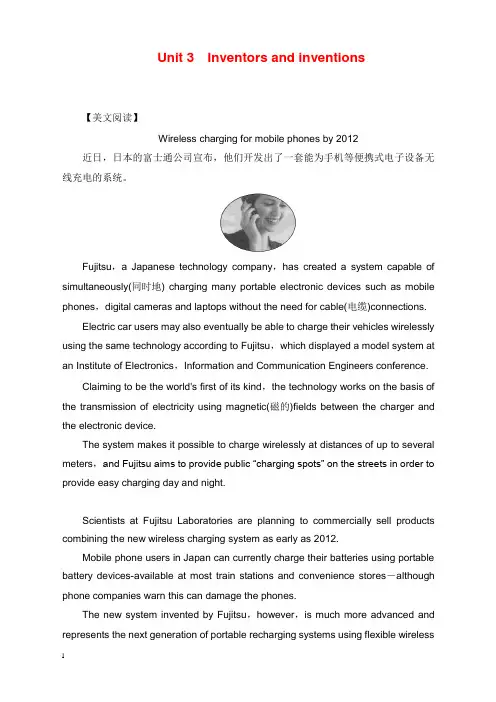
Unit 3Inventors and inventions【美文阅读】Wireless charging for mobile phones by 2012近日,日本的富士通公司宣布,他们开发出了一套能为手机等便携式电子设备无线充电的系统。
Fujitsu,a Japanese technology company,has created a system capable of simultaneously(同时地) charging many portable electronic devices such as mobile phones,digital cameras and laptops without the need for cable(电缆)connections.Electric car users may also eventually be able to charge their vehicles wirelessly using the same technology according to Fujitsu,which displayed a model system at an Institute of Electronics,Information and Communication Engineers conference.Claiming to be the world's first of its kind,the technology works on the basis of the transmission of electricity using magnetic(磁的)fields between the charger and the electronic device.The system makes it possible to charge wirelessly at distances of up to several meters,and Fujitsu aims to provide public “charging spots” on the streets in order to provide easy charging day and night.Scientists at Fujitsu Laboratories are planning to commercially sell products combining the new wireless charging system as early as 2012.Mobile phone users in Japan can currently charge their batteries using portable battery devices-available at most train stations and convenience stores-although phone companies warn this can damage the phones.The new system invented by Fujitsu,however,is much more advanced and represents the next generation of portable recharging systems using flexible wirelesstechnology.The company added,“We are also l ooking at applying the results of this work to fields other than portable electronics,including power transmission between circuit boards(电路板) or computer chips,and providing mobile charging systems for electric cars.”【诱思导学】1.How does the wireless charging technology work?____________________________________________________________________________________________【答案】It works on the basis of the transmission of electricity using magnetic fields between the charger and the electronic device.2.When can consumers probably buy products using the new wireless charging system?______________________________________________【答案】As early as 2012.Period ⅠPreviewing(教师用书独具)●教学目标本课时主要是通过学生对学案所给出的内容的学习,了解本课文中所出现的词汇,初步了解课文以及相关的背景知识,为下一堂课对课文的全面理解起到一个铺垫作用。
Unit 3 《Inventors and Inventions》教案-Listening , speaking and Writing(新人教版选修8)

Unit 3 Inventors and InventionsListening , speaking and Writing---教案Teaching Goals:1.To develop Ss’ speaking and writing ability.2.To enable Ss to use the expression to make a phone.3. To enable Ss to write a letter applying for a position.Teaching Procedures:Step 1. Listening and speaking (2) (Using Language)1. Do some preparations for Writing. Teacher may say, “Do you remember the expressions related to making telephone?”2. Do more preparations for Writing. Teacher may say, “ Do you remember the expressions related to answering teleph one?”3. Get Ss to form groups of three to practise speaking. One is a receptionist, another an engineer, and the third a student.situation: A student wants to apply for a job in James Dyson`s company. So he rings up one of engineers to ask what kind of person he needs and the engineer answers the questions honestly Step 2. Writing (Using Language)1. Ask Ss to discuss the following question in groups of four.Suppose you are going to apply for a job in a company, what skills will you tell the interviewer to qualify you?2. Get Ss to write to James Dyson and begin the letter with the address and the date.The beginning and the ending of the letter:3. Get Ss to know what they should pay attention to.(1)Use the list of skills to make new paragraphs in your letter.(2) For each skill set down any experience you have had, which shows that you are a suitable person. You may be creative in this part of the letter.(3) Finish the letter by mentioning again the skills that you have.(4) End the letter.4. Get Ss to write the letter and exchange their articles and correct the mistakes. They are expected to assess the writing. First , students are supposed to give a general mark with their general impression of the writing. Then they are expected to assess the writing in the three aspects, content language, and organization. Ss have to correct the mistakes or point out the mistakes by underlining the words, phrase or sentences with"_____".Students are also expected to underline the beautiful words, phrases or sentences with “_______”. After the assessment, the groups will discuss how to correct the mistakes.5. The writings with the high levels will be shown on the projector so that the whole class can appreciate them.Step 3. Homework1.Ask Ss to sum up what has been learned in this unit.Ask Ss to preview the next unit.。
人教版高二英语选修8-Unit-3-Inventors-and-inventions--全单元教案

Unit 3 Inventors and inventionsThe First Period Warming up一.Aims:1. Teaching aims 教学目标:Help the students learn how to talk about inventions and discoveries.重点词汇和短语discovery, application, evaluate, presentation, alternative, messenger, get together, make a case for, add up2. Ability aims能力目标Enable the students to talk about information and different.二.ContentsStep I Ask the students to talk about the pictures with the teacher’s help, and then discuss the first two questions.what is a discovery?What’s the difference between a discovery and an invention?Step II Work in pairs and talk about the three different things, telling them apart and giving reasons.1. Which these pictures show inventions? Does any of them show discoveries?2. Work out two rules that will help you decide what is a discovery and what is aninvention?Step III Go on with some other questions of this part.What modern inventions do you know? Describe them to your partner and how useful they are in life today.Step IV Work in groups of four to discuss the question: Suppose you are working for a mobile company. It is your job to suggest new ways of developing a mobile. In pairs discuss some new applications of a mobile. Make a list of the ones you like and that seem the most useful.Choose one you both like and think will be popular with other people.The Second Period Reading一.Aims:1. Teaching aims 教学目标How s to describe the problem of the snakes and what has been done by the writer to solve the problem.重点词汇和短语Patent, distinguish, product, power, perfume, cube, abrupt, abruptly, convenient, expectation, monitor, passive, criterion, valid, application, file, rod, call up, now and then, set about, in case 2. Ability aims能力目标Enable the students to describe the problem of the snakes and what has been done by the writer to solve the problem. Make them realize it takes steps to catch the snakes and it’s not easy to get a patent.二.Contents:Step I Ask the Ss to guess about the content of the passage from the title.Then ask the Ss to judge the right order of stages of inventions.Step II Get the Ss to comprehend the passage carefully and accurately, and then divide the textinto several parts and work out the main idea for each paragraph.PartⅠ (Para.1) the discovery of the problem of snakesPartⅡ (Para.2-3) the research on the approaches to solve the problemPartⅢ (Para.4-6) the attempts to catch the snakesPartⅣ (Para.7-8) the requirements of getting a patent.Step III Ask Ss to go over the whole text again and analyze the text in details.Discuss the following questions:1.What are the writing techniques of this text?2.What’s the main idea of the text?3.What should we learn from this text?4.What’ the writing purpose of the writer?Step IV Comprehending: Finish the exercise1, 2, 3.The Third Period Language Points一.Aims:Talk about inventors and inventionsLearn about the stages used in scientific research二.Contents:Step I words and phrase1. Do you know the stages every inventor must go through before they can have their invention approved?go through(1)经历(2)通过,成功,成交(3)审阅,检查(4)翻找,查看(5)穿过,通过Most families went through a lot in the war.2. I was researching into the habits of snakes so I could trap them in the easiest way.do research on /into /in... 从事, 进行, 做研究They are carrying out a research into the causes of cancer.They are doing research into electricity.3. when I called up my mother in the countryside on the phone.call up 打电话,使......回忆起I’ll call you up tonight (call sb. /ring sb. up )The old photo calls up memories of my childhood. (recall sth.)4. Snakes come near the house now and then.now and then 有时, 偶尔I see them now and then, but not often.5. Here was a chance for me to distinguish myself by inventing something that would catch snakes but not harm them.distinguish oneself 显扬自己, 使自己扬名6. But there only seemed to be powders designed to kill snakes.powder: n. 粉,粉末;药粉;火药grain sth. into powder 把磨成粉7. I set about researching the habits of snakes so I could tap them in the easiest way.set about 开始, 着手The sooner we set about it , the sooner we’ll finish.8. This was in the expectation that the snakes would bite again.expectation: n. 预料,期待Against all expectation, she won first prize.9. abruptly adv.A man with an abrupt manner is not welcome here.10. convenientCome and see me whenever it is convenient to you.If it is quite convenient to you, I’ll visit you next Tuesday.11.If it passes that test, your application for a patent will be published 18 months from the date you apply.application: n. 应用,运用;申请,请求;努力,专注The invention had no practical application.12. bear (bore, borne) 忍受; 带有, 具有I couldn’t bear to listen any longer, so I left the room.bear doing 表示习惯性动作bear to do sth. 表示一次具体动作This letter bears french stamp.13. mess: n.杂乱,脏东西v.无所事事, 混日子,胡闹There is a lot of mess to clear up.14. but monitored carefully, the snakes proved to be no trouble and all went according to plan. monitor: vt.监听,收听:监视15. I collected the passive snakes and the next day we released them all back into the wild.passive: adj. 被动的,消极的;不抵抗的;不活跃的He played a passive role in the marriage.Step II sentences1. The first thing I tried to do was to see if there were products that might help me, but there only seemed to be powders designed to kill snakes. P202. Between the outside and inside walls of the bowl there is some jelly, which freezes hard when cooled. P203. The criteria are so strict that it is difficult for new ideas to be accepted unless they are truly novel. P21The Forth period Learning about language and Using language一.Aims1. Teaching aims 教学目标Help the Ss learn how the famous inventor Alexander Graham Bell invented telephones重点词汇和短语forehead, dot, tap, wire, straw, current, importance, helicopter, triangle, stable, practical, beaten track, dive into, set out (to do), in truth重点句子He found th at by pressing his lips against …He designed a machine that …Although he will always be known for …, he was …He realized that by understanding how …2. Ability aims能力目标Enable the Ss to learn about the famous inventor Alexander Graham Bell and his inventions. 二.ContentsStep I Check the homework. Get the Ss to finish the exercises on page 23-24.Step II Ask the Ss to discuss the following questions:1.What do you know about the inventor?2.How useful is his invention to human society?Step III Let the Ss read the four questions first to get general idea of what should be paid attention to and then play the tape for Ss to follow. When they finish, let them exchange notes with their partners and find the supporting sentences. Then check the answer with the whole class.Step IV Give the Ss the reading task:Do you know about the world famous painting “Mona Lisa”?Do you know who painted the great picture?Do you think Leoanrdo da Vinci is really a good painter? What else do you know he is famous for?Step V Ask the Ss to do exercise 1 and exercise 2Then ask the Ss to do Exercise 3, that is, having a discussion。
人教版高中英语选修8《unit3 inventors and inventions》教学设计
教学设计Unit 3 Inventors and inventionsReadingTeaching aimsKnowledge aims: to master the new words and expressions of the topic.Ability aim: To help develop the right reading skills and learn to use them.Emotional aim: To help establish the right attitudes towards inventions.And to inspire students to love science and their creation.Difficult points and key points:1.Learn to master the difference of a discovery between an invention.2.Learn to know the six stages every inventor must go through.3.Learn to master the way of catching snakes without hurting them.4.Learn to used the past participle as the attributive.Teaching methods :Reading, writing, presenting watching, performing,working in pairs or in groups,Teaching procedures:Part I: Lead-in (5’)Enjoy a short piece of videoTalk about discoveries and an inventions.Show the six stages every inventor must go through and put them in a suitable order.The suitable order:Stage1: Finding a problemStage2: Doing researchStage3: Thinking of a creative solutionStage4: Testing the solutionStage5 : Deciding on the inventionStage6: Applying for a patentPart II: Reading(25’in all)Step I:Fast reading(5’)Task1:Skim the text and match the stages with the paras.Stage I: Finding a problem (1)Stage 2: Doing research (2)Stage 3: Thinking of a creative solution (3)Stage 4: Testing the solution (4-6)Stage 5: Deciding on the invention (7)Stage 6: Applying for a patent (8)Task2:Skim the text again and find the main idea about the text.The main idea is :The text mainly tells us about the problem of the snakes and presents the procedures of catching them and applying for a patentStep II: Careful reading (20’in all)Reading the text more carefully according to the stages.Task1:Stage1(1) Finding a problem.(2’)What was the problem?Some snakes were in their courtyard and the author must get rid of them but not hurt them.Task2:Stage2(2) Doing research.(2’)The first thing the author did was to see if…The she set about …Task3:Stage3(3) Thinking of a creative solution.(3’)Fill in the blanks according to this part.After researching ,the author decided on three possible ____________: Firstly, __________ their habitat;Secondly , attracting them into a______;Thirdly , _______ them so that they would become sleepy and could be easilycaught. The author chose the ____ one.(Answers: approaches removing trap cooling last)Task4:Stage4(4-6) Testing the solution.(9’)Work in groups of four or six to summarize the way of catching the snakes.Present a student’s work.Present the suitable answer and give students some time to get familiar with them first.Firstly , place the frozen bowl over the snakes’ habitat and ice-cubes on top of the bowl to keep it cool. Secondly , cover the whole thing with a large bucket.Then play a games. First the teacher performs and the students watch then exchange. Task5:Stage5(7) Deciding on the solution(2’)Read the text and choose the right answer.Which of the following will not get a patent?A. a mathematical modelB. a novel awarded the Nobel Prize for literatureC. a computer gameD. all the aboveTask6:Stage6(8) Applying for a patent.(2’)Read the text and choose the right answer.How long will you wait for your patent application to be published ?A. For one and a half yearsB. For about 500 daysC. For 80 monthsD. For two yearsThe related information: If it passes all the tests , your application for a patent will be published 18 months from the date you applyPart III: Testing(6’)Task1:Fill in the blanks according to the whole text.When I called up my mother , she told me ____ some snakes appeared in our courtyard. Mum asked me to remove them away without______ them.After ______ , I decided on three possible ________(approach) ,but I chose to use the last one. After two ______(success)attempts , I _______ my design .I repeated the second procedure __ my third attempt ,but used a small net_____(catch) the passive animals. And all went ___ planned.At last, pressed by my friends and relations, I have filled in the form and filed my patent application ____the Patent Office.Ask one students to come to the blackboard to do this exercise(The answers: that researching approaches unsuccessful improved at to catch as with) Task2:First check the answers and give students a few minutes to read through them Then ask some to try to retell.Part IV: Discussion (5’)1).Do you want to be an inventor?2).Find words as many as possible to describe an inventor.(Suggested answers: brave determined devoted intelligent persistent patient hard-working honest etc.)Part V:Summary(3’)What have we learned from the text?1).The difference between discovery and an invention2).The six stages an inventor must go through.3).How to catch snakes without hurting themPart VI : Homework(1’)请你给专利局用英语写一封约100词左右的信内容包括:1.写信的目的--想为自己的小发明申请专利2.简要描述自己的小发明3.询问申请专利的程序4.提出自己的希望Thank You!。
新人教版高中英语选修8 unit 3《inventors and inventions》优秀教案(重点资料).doc
Unit 3 Inventors and inventions【美文阅读】Wireless charging for mobile phones by 2012近日,日本的富士通公司宣布,他们开发出了一套能为手机等便携式电子设备无线充电的系统。
Fujitsu,a Japanese technology company,has created a system capable of simultaneously(同时地) charging many portable electronic devices such as mobile phones,digital cameras and laptops without the need for cable(电缆)connections.Electric car users may also eventually be able to charge their vehicles wirelessly using the same technology according to Fujitsu,which displayed a model system at an Institute of Electronics,Information and Communication Engineers conference.Claiming to be the world's first of its kind,the technology works on the basis of the transmission of electricity using magnetic(磁的)fields between the charger and the electronic device.The system makes it possible to charge wirelessly at distances of up to several meters,and Fujitsu aims to provide public “charging spots”on the streets in order to provide easy charging day and night.Scientists at Fujitsu Laboratories are planning to commercially sell products combining the new wireless charging system as early as 2012.Mobile phone users in Japan can currently charge their batteries using portable battery devicesavailable at most train stations and convenience stores-although phone companieswarn this can damage the phones.The new system invented by Fujitsu,however,is much more advanced and represents the next generation of portable recharging systems using flexible wireless technology.The company added,“We are also looking at applying the results of this work to fields other than portable electronics,including power transmission between circuit boards(电路板) or computer chips,and providing mobile charging systems for electric cars.”【诱思导学】1.How does the wireless charging technology work?____________________________________________________________________________________________【答案】It works on the basis of the transmission of electricity using magnetic fields between the charger and the electronic device.2.When can consumers probably buy products using the new wireless charging system?______________________________________________【答案】As early as 2012.Period ⅠPreviewing(教师用书独具)●教学目标本课时主要是通过学生对学案所给出的内容的学习,了解本课文中所出现的词汇,初步了解课文以及相关的背景知识,为下一堂课对课文的全面理解起到一个铺垫作用。
高中英语 Unit 3 Inventors and inventions教案 新人教版选修8
Unit 3 Inventors and inventions【美文阅读】Wireless charging for mobile phones by 2012近日,日本的富士通公司宣布,他们开发出了一套能为手机等便携式电子设备无线充电的系统。
Fujitsu,a Japanese technology company,has created a system capable of simultaneously(同时地) charging many portable electronic devices such as mobile phones,digital cameras and laptops without the need for cable(电缆)connections.Electric car users may also eventually be able to charge their vehicles wirelessly using the same technology according to Fujitsu,which displayed a model system at an Institute of Electronics,Information and Communication Engineers conference.Claiming to be the world's first of its kind,the technology works on the basis of the transmission of electricity using magnetic(磁的)fields between the charger and the electronic device.The system makes it possible to charge wirelessly at distances of up to several meters,and Fujitsu aims to provide public “charging spots” on the streets in order to provide easy charging day and night.Scientists at Fujitsu Laboratories are planning to commercially sell products combining the new wireless charging system as early as 2012.Mobile phone users in Japan can currently charge their batteries using portable battery devicesavailable at most train stations and convenience stores-although phone companies warn this can damage the phones.The new system invented by Fujitsu,however,is much more advanced and represents the next generation of portable recharging systems using flexible wireless technology.The company added,“We are also looking at applying the results of this work to fields other than portable electronics,including power transmission between circuit boards(电路板) or computer chips,and providing mobile charging systems forelectric cars.”【诱思导学】1.How does the wireless charging technology work?____________________________________________________________________________________________【答案】It works on the basis of the transmission of electricity using magnetic fields between the charger and the electronic device.2.When can consumers probably buy products using the new wireless charging system?______________________________________________【答案】As early as 2012.Period ⅠPreviewing(教师用书独具)●教学目标本课时主要是通过学生对学案所给出的内容的学习,了解本课文中所出现的词汇,初步了解课文以及相关的背景知识,为下一堂课对课文的全面理解起到一个铺垫作用。
人教版英语选修8 Unit3 全单元教案
Unit 3 Inventors and inventionsThe First Period ReadingTeaching goals教学目标1. Target language目标语言a. 重点词汇和短语patent, distinguish, product, power, perfume, cube, abrupt, abruptly, convenient, expectation, monitor, passive, criterion, valid, application, file, rod, call up, now and then, set about, in case 2. Ability goalsEnable the students to describe the problem of the snakes and what has been done by the writer to solve the problem.3. Learning ability goalsHelp the students to learn how to retell the story and how to meet the requirements of getting a patent.4. Emotional goalsMake the students try to be good at discovering some useful things and realize that it’s not easy to get a patent.Teaching important points 教学重点To get the main idea of the whole passage and each parts.Teaching difficult points 教学难点Learn how to meet the requirements of getting a patent.Teaching methods 教学方法Reading and Task-based activities.Teaching procedures & ways教学过程与方式Step Ⅰ warming upDeal with the part of warming up and ask the students to find out the definitions of discovery and an invention, and their differences.An invention is something that is created by a human being, such as the lightning rod. To the contrary, a discovery merely makes known something that already existed in nature, such as the discovery on the New Continent by Columbia.Step Ⅱ Pre-readingAsk the students to discuss in groups and work out a suitable order for the list of how people get their invention approved.1. Finding a problem2. Doing research3. Thinking of a creative solution4. Testing the solution5. Deciding on the invention6. Applying for a patentStep Ⅲ While-readingTask 1: Get the students to comprehend the passage carefully and accurately to find out the main idea of the passage, and then divide the text into several parts and work out the main idea for each paragraph.Main idea: The text is mainly about the author’s experience in helping her mother get rid of the snakes and applying for the patent for her invention.Part I (Para.1): the discovery of the problem of the snakesPart II (Paras.2-3): the research on the approaches to solve the problemPart III (Paras.4-6): the attempts to catch the snakesPart IV (Paras.7-8): the requirements of getting a patentTask 2: go through the whole text again and finish Exercise 1 on page 21.Step Ⅳ Post-readingAsk the students to think of 2 questions.1. What should we learn from this text?2. What’s the writing purpose of the writer?1. We can learn from the text the way of doing scientific researches and how to apply for a patent. We can also learn that it takes an inventor great determination and persistence to achieve his or her ambition in life.2. The writer wants to inform us of the scientific methods to solve present problems so that we students can not only broaden the horizons but become more skilled in discovering and considering carefully the problems in daily life. We are also encouraged by the writer to be creative and hardworking as well as thinking independently.Step Ⅴ Homework1. Go over the whole passage, and try to retell it.2. 能力提升,Jinbang.The second Period Language pointsTeaching goals教学目标1. Target language目标语言a. 重点词汇和短语patent, distinguish, product, power, perfume, cube, abrupt, abruptly, convenient, expectation, monitor, passive, criterion, valid, application, file, rod, call up, now and then, set about, in caseb. 重点句子1. The first thing I did was to …, but there only seemed to …2. Between the outside and the inside walls of the bowl there is some jelly, which freezes when cooled.3. The criteria are so strict that it is difficult to get new ideas accepted unless they are truly novel.4. Nor will you receive a patent until a search has been made to find out that your product really is different fr om everybody else’s.2. Ability goalsEnable the students to master the usage of the new words and expressions and some key sentence structures, and use them in the writing.3. Learning ability goalsTeaching important points 教学重点How to use the language pointsTeaching difficult points 教学难点Try to comprehend some complicated sentence structuresTeaching methods 教学方法Reading, explaining and practicing.Teaching procedures & ways教学过程与方式Step Ⅰ revisionCheck their homework, and try to retell the passage briefly.Step Ⅱ language points1. Pre-reading go through(1)经历(2)通过,成功,成交(3)审阅,检查(4)翻找,查看(5)穿过,通过Most families went through a lot in the war.2. do research on /into /in... 从事, 进行, 做研究They are carrying out a research into thecauses of cancer. They are doing research into electricity.P 1. call up 打电话,使......回忆起I’ll call you up tonight (call sb. /ring sb. up )号召call on 需要call for…取消call off 使产生call forth结束一天的工作call it a day 收回call back拜访某人pay a call on sb./ visit sb./ drop in on sb./ pay a visit to sb.now and then 有时, 偶尔I see them now and then, but not often.distinguish 1. distinguish oneself 使…出名显扬自己, 使自己扬名2. distinguish A and B区分A 和B3. d istinguish/ tell right from wrong辨别是非4. distinguish/ tell good from evil 分清善恶5. distinguished/respected guests 尊敬的来宾P 2. powder: n. 粉,粉末;药粉;火药grain sth. into powder 把磨成粉set about 开始, 着手The sooner we set about it , th e sooner we’ll finish.P 3. prepare with, sleepy, stainless steelP 4. abruptly adv. A man with an abrupt manner is not welcome here.convenient Come and see me whenever it is convenient to you.Inconvenience inconvenient convenienceP5 cautionP6. expectation 1. 出乎意料out of expectation 2. 在意料之中in expectation3. 盼望得到…in expectation of…4. 不负…所望live up to one’s expectationpassive: adj. 被动的,消极的;不抵抗的;不活跃的He played a passive role in the marriage. P 7. 1. seize the chance/ opportunity 抓住机遇P 8. application: n. 应用,运用;申请,请求;努力,专注The invention had no practical application.Step Ⅴ Homework1. learning about language2. English weekly P3 part 1, part 2The third Period using languageTeaching goals教学目标1.Target language 目标语言a. 重点词汇和短语forehead, dot, tap, wire, straw, current, importance, helicopter, triangle, stable, practical, beaten track, dive into, set out (to do), in truthb. 重点句子He found that by pressing his lips against...He designed a machine that...Although he will always be known for..., he was...He realized that by understanding how...2. Ability goals能力目标Enable the students to learn about the famous inventor Alexander Graham Bell and his inventions.3. Learning ability goals学能目标Help the students learn how the famous inventor Alexander Graham Bell invented telephones. Teaching important points 教学重点How the famous inventor Alexander Graham Bell invented telephones.Teaching difficult points教学难点Help the students learn what the key is to become a successful inventor.Teaching methods 教学方法Listening, fast reading and practicing.Teaching procedures & ways 教学过程与方式Step Ⅰ RevisionCheck their homeworkStep Ⅱ Pre-readingAsk the students to look at the title and the picture of the great inventor on page 25, and answer the following questions in groups.1. What do you know about the inventor?2. How useful is his invention to human society? Why?Step Ⅲ Listening & ReadingFirstly, let the students read the four questions in the EX 1 on page 26 to get a general idea of what should be paid attention to and then play the tape for students to follow and give the answers to the questions. Then check the answers with the whole class.Step Ⅳ Language pointsTo underline some key words and phrases for the students and help them master some complicated sentences.Bear, associate, reproduce, stable, practical, dive into, a flash of inspiration, set out to do sth, hang out, out of order, get throughHe found that by pressing his lips against...He designed a machine that...Although he will always be known for..., he was...He realized that by understanding how...Step Ⅴ Post-readingDo some EXS in “English Weekly” 34, P3, Part 1, and check their answersStep ⅥHomework1. Jinbang from page 23 to 242. Preview the part of grammar in the workbook.The Fourth Period GrammarTeaching goals 教学目标1. Ability goals能力目标Enable the students to use the past participle as the attribute,predicative and object complement.2 Learning ability goals学能目标Help the students learn how to use the past participle as the attribute,predicative and object complement.Teaching important & difficult points教学重难点How to use the past participle as the attribute,predicative and object complement.Teaching methods 教学方法Individual work and practice.Teaching procedures & ways教学过程与方式Step Ⅰ RevisionCheck their homeworkStep Ⅱ Grammar focus过去分词作定语、表语和宾语补足语基础过关:过去分词(表示和被动的动作) 是有形容词.副词的作用,在句中可以用作定语,表语,宾语补足语和状语一.过去分词作定语过去分词做定语,表示分词的动作与所修饰的名词之间存在被动关系,单一的确过去分词做定语一般放在被修饰的名词之前,过去分词短语作定语放在被修饰的名词之后,过去分词及过去分词短语作定语均可以转换为一个定语从句The broken window (=The window which was broken) will be replaced soon.破损的窗户很快就会被换掉.The books bought yesterday (=which were bought yesterday) are of high quality.昨天买的书确实很不错(1)表示情绪的过去分词作定语:--She threw me a quick, frightened glance.他迅速而惊恐地看了我一眼--His face wore a puzzled expression.他脸上有一种困惑的表情举一反三amaze,embarrass,interest,excite,disappoint,encourage,move,surprise,astonish,delight,frighten,ins pire,please,puzzle,terrify,shock,satisfy,worry,confuse, amuse, tire等。