
牛津译林版八年级英语上册Unit 4 Do it yourselfwelcome课件
tools decorate instructions stand for had better instead of
Hobo has some work to do today.
Listen and answer
1. What does Hobo get?
He gets a new house.
tips:(things):kites, paper planes, paper ships, lucky stars …
(tools):bamboo, wood, rulers, scissors, glue …
Group work: how to do DIY?
sandwich
fruit salad
Another DIY story
Listen to Millie and Suzy’s conversation and answer the question.
What’s Suzy going to do today? She is going to make some paper roses today.
New words and expressions
exactly repair decorate stand for had better (not) do sth. instead of (doing) sth.
确切的,精确的 修补 装饰 代表,象征 最好(不要)做某事 代替做某事/某物
Fill in the blanks with the words in the box.
你最好上学不要迟到。 You had better not be late for school.
Exercises
1. You'd better ______ early, so you can
catch the early bus.
A. to get up
B. not to get up
C. not get to
蓝色象征着忧郁。 Blue stands for sadness.
UFO代表什么? What does UFO stand for ?
Language points
3. You make , repair or decorate things instead of paying someone to do it.
instead of (doing) sth. 而不是,代替
我想要一杯茶而不是果汁。 I want a cup of tea instead of juice.
明天我去钓鱼而不去打棒球。 I’ll go fishing instead of playing baseball tomorrow.
Make up a similar dialogue
Last week, I made a paper rose for
my mother by myself __i_n_s_te_a_d__o_f__ buying it in the flower shop. Because
rose __s_ta_n_d_s__fo_r__ love. My brother told me that I
__h_a_d_b_e_t_t_e_r__read the _i_n_s_tr_u_c_t_io_n__s_ and get some ___t_o_o_ls___ to help me. Finally, I used a red rope to
_d_ec_o_r_a_t_e__ the paper rose.
1.Bring us fun.
e brain and hands at the same time.
3.Help us save money.
• Remember the new words and language points. • Search for more information about DIY
A: What's DIY exactly? B: It stands for...When you do DIY, you make/ repair/
decorate ... instead of … A: What are you going to do then? B: I'm going to ... A: What do you need for that? B: I need ... A: Do you like DIY? B: ...
Group work
How to make _fr_u_it_s_a_la_d_
Tools/materials(材料): __F_r_u_it_, s_a_la_d__cr_e_a_m_a_n_d_a__k_ni_fe_._________
Steps: 1) C__ho_o_s_e_y_o_u_r _fa_v_o_ri_te__fr_u_it_. ______________ 2) _W_a_s_h_t_h_e_fr_u_it_.______________________ 3) _C_u_t_l_ar_g_e_r_fr_u_it_i_n_to_s_m_a_l_l _p_ie_c_es_a_n_d__m_ix_t_h_e_m together. 4) _A_d_d_s_o_m_e_s_a_la_d__cr_e_a_m_.________________
Feelห้องสมุดไป่ตู้ngs Enjoy making something about DIY __n_e_w___. That’s __fu_n____.
Read together
Millie: What’s DIY exactly, Suzy? Suzy : It stands for “do-it-yourself”. When you do
/ri´pεə/ vt.修补
decorate the wall
/ˊdekəreit/ vt.装饰
a pair of scissors two brushes
brush
/brʌʃ/
glue
/glu:/
tape
/teip/
scissors
/′sizəz/
rope
/rəup/
Do you know what these tools are used for?
Group work
How to make a _s_a_n_dw__ic_h_
Tools/materials(材料): Br_e_a_d,_m__ea_t_, _ve_g_e_ta_b_le_s_,_to_m_a_t_o_s_a_uc_e_a_n_d__a_s_po_o_n.
Steps: 1) _P_ic_k_a__p_ie_c_e_o_f _br_e_a_d_. _________________ 2) _U_s_e_a_s_p_o_o_n_to__p_u_t s_o_m_e__to_m_a_to__sa_u_c_e_o_n_i_t.__ 3) _P_u_t_s_om__e_m_e_a_t_a_n_d_v_eg_e_t_ab_l_e_s _o_n_it_. _______ 4) _P_u_t_a_n_o_th_e_r_p_ie_c_e_o_f _b_re_a_d_o_n_t_h_e_to_p__of_i_t.___
Listen and complete.
stands for “_d_o_-_it_-_y_o_ur_s_e_lf_”
DIY
We can make,__re_p_a_ir__ or
decorate things ourselves.
Things for Some paper,__gl_u_e___ and paper roses a pair of _s_c_is_s_or_s_.
D. get up
2. You'd better ______ there. It's
dangerous.
A. not go
B. not to go
C. not go to
D. not to
Language points
2. It stands for “do-it-yourself”.
stand for 代表,象征
on the Internet.
亲爱的读者:
春去燕归来,新桃换旧符。在那桃花盛开的地方,在 1、三人行,必有我师。20.7.57.5.202014:4714:47:52Jul-2014:47
2、书是人类进步的阶梯。二〇二〇年七月五日2020年7月5日星期日
这醉人芬芳的季节,愿你生活像春天一样阳光,心情像桃 3、会当凌绝顶,一览众山小。14:477.5.202014:477.5.202014:4714:47:527.5.202014:477.5.2020 4、纸上得来终觉浅,绝知此事要躬行。7.5.20207.5.202014:4714:4714:47:5214:47:52
2. Will Eddie help Hobo?
No, he won’t.
Read together
Act it out
Retell the story
Hobo gets a new _h_o_u_se__. It is a __D_I_Y__ house. And Eddie tells Hobo to read the clear __in_s_tr_u_c_t_io_n_s__ first. He also tells Hobo to get some _t_o_o_ls__ to build the house. But Eddie can’t help Hobo to start because it says, “_D__o_i_t _y_o_u_rs_e_lf__”.
牛津译林版八年级英语上册Unit4Doityourself精美教案
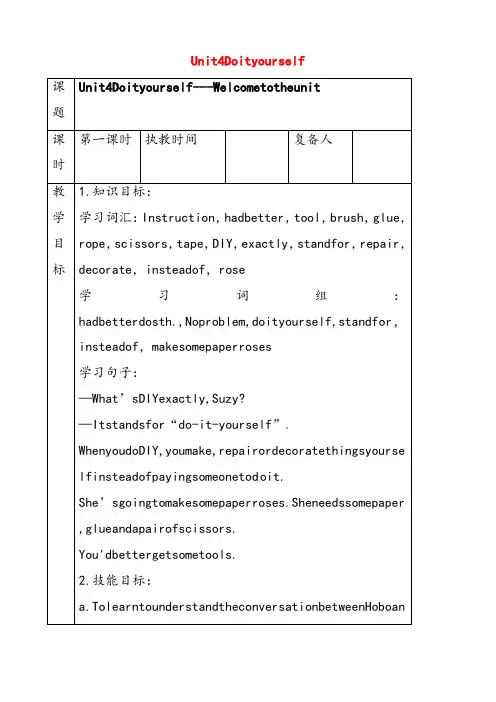
Unit4Doityourself课题Unit4Doityourself---Welcometotheunit课时第一课时执教时间复备人教学目标1.知识目标:学习词汇:Instruction,hadbetter,tool,brush,glue,rope,scissors,tape,DIY,exactly,standfor,repair,decorate,insteadof,rose学习词组:hadbetterdosth.,Noproblem,doityourself,standfor,insteadof,makesomepaperroses学习句子:—What’sDIYexactly,Suzy?—Itstandsfor“do-it-yourself”.WhenyoudoDIY,youmake,repairordecoratethingsyourse lfinsteadofpayingsomeonetodoit.She’sgoingtomakesomepaperroses.Sheneedssomepaper ,glueandapairofscissors.You'dbettergetsometools.2.技能目标:a.TolearntounderstandtheconversationbetweenHoboan任务二:Presentation Showsomepicturestotalkabouthowtodoity ourself.T:EddieandHobowanttodosomethingbythem selves.Ask:Howcanwedoityourself? DIYasweater:如果你觉得自己的sweater 太过单调,可以试着在上面画一幅画。
过程Step3:课堂导学与互动任务一:Freetalk1.DoyoulikeDIY?2.HaveyouevertriedDIY?Whatisit?3.DoyouwanttotakeacourseinDIY?任务二:ListenandfinishPartB1onPage45. Matchthewordsontheleftwiththemeaning sontheright.任务三:FinishPartB2onPage45.Suzy’scousinAndrewiscrazyaboutDIY,b utheisnotverygoodatit.Liste ntoSuzy’sarticleandmatchthejobshedidwiththep roblemshecaused.任务四:ReadandfinishPartB3onPage46. 任务五:WatchandfinishPartB4onPage46. Step4:总结提升Workinseveralgroups. Makeupsentenceswithyourpartnersw iththephrasesabove.Speakthemouttous.Let’sseewhichgroupisthemost active.学法指导查阅资料与练习相结合。
牛津译林版英语八上Unit4《Doityourself》(Reading1)说课稿

牛津译林版英语八上Unit 4《Do it yourself》(Reading1)说课稿一. 教材分析《牛津译林版英语八上Unit 4 Do it yourself》(Reading 1)的主要内容是关于一位名叫Mike的学生自己动手做家具的故事。
通过这个故事,学生可以学习到关于家具制作和房子的词汇,以及如何用英语描述一个房间的布局。
这篇文章题材新颖,贴近学生生活,能够激发学生的学习兴趣,同时培养学生独立思考和解决问题的能力。
二. 学情分析八年级的学生已经具备了一定的英语基础,能够理解和运用一些基本的词汇和语法知识。
然而,他们在阅读理解、词汇量和语言运用方面还存在一定的困难。
因此,在教学过程中,我将会关注学生的个体差异,尽量让每个学生都能参与到课堂活动中来,提高他们的英语水平。
三. 说教学目标1.知识目标:学生能够掌握文章中出现的关键词汇,如furniture, DIY,furniture store等;能够理解并运用文章中的句型,如“How much is it?”, “CanI help you?”等。
2.能力目标:学生能够独立完成阅读理解,把握文章的主旨大意;能够运用所学知识,描述一个房间的布局。
3.情感目标:通过学习这篇文章,学生能够培养自己动手解决问题的意识,提高自主学习能力。
四. 说教学重难点1.重点:学生能够理解文章的内容,掌握关键词汇和句型。
2.难点:学生能够运用所学知识,描述一个房间的布局,并能够流利地进行口语表达。
五. 说教学方法与手段1.任务型教学法:通过设定各种任务,让学生在完成任务的过程中,自然地学习和运用所学知识。
2.情境教学法:通过模拟家具店和房间布局的情境,让学生在真实的环境中进行语言实践。
3.小组合作学习:通过小组讨论和合作,培养学生独立思考和解决问题的能力。
六. 说教学过程1.导入:通过展示一些家具的图片,引导学生谈论自己喜欢的家具,激发学生的学习兴趣。
2.阅读理解:学生独立阅读文章,回答相关问题,检查学生的理解程度。
牛津译林版英语八年级上册《Unit 4 Do it yourself Integrated skil
牛津译林版英语八年级上册《Unit 4 Do it yourself Integrated skills》说课稿1一. 教材分析《Unit 4 Do it yourself Integrated skills》是人教版牛津译林英语八年级上册的一篇课文。
本节课的主要内容是关于一个叫Mike的男孩在周末自己动手做早餐的故事。
通过这个故事,学生可以学习到日常生活中的英语表达,提高听说读写的能力,特别是自我表达能力。
教材以任务型教学法为主线,注重培养学生的实际运用语言的能力。
二. 学情分析八年级的学生已经具备了一定的英语基础,对于日常生活中的简单英语表达已经有所了解。
但是,学生在听说读写方面的能力参差不齐,部分学生对于英语表达还是存在一定的困难。
此外,学生的学习兴趣和学习动机是影响教学效果的重要因素,因此,在教学过程中,需要注重激发学生的学习兴趣,提高他们的学习积极性。
三. 说教学目标1.知识目标:学生能够掌握课文中的关键词汇和句型,能够用英语简单描述日常生活中的事情。
2.能力目标:学生能够听懂、说对、读懂、写对课文内容,提高自我表达能力。
3.情感目标:学生能够培养独立思考的能力,培养自主学习的习惯,提高学习英语的兴趣。
四. 说教学重难点1.重点:学生能够掌握课文中的关键词汇和句型,能够用英语简单描述日常生活中的事情。
2.难点:学生能够正确运用课文中的关键词汇和句型,流利地进行自我表达。
五. 说教学方法与手段1.教学方法:采用任务型教学法,通过设置各种任务,让学生在完成任务的过程中,自然地学习和运用英语。
2.教学手段:利用多媒体教学设备,展示课文图片,播放课文音频,帮助学生更好地理解和记忆课文内容。
六. 说教学过程1.导入:通过提问方式,引导学生回顾日常生活中的一些简单英语表达,为新课的学习做好铺垫。
2.展示:展示课文图片,让学生根据图片预测课文内容。
3.听读:播放课文音频,学生跟读,模仿语音语调。
4.讲解:讲解课文中的关键词汇和句型,让学生充分理解并能够运用。
牛津译林初中八年级上册英语Unit 4 Do it yourself Welcome to the

brush
glue
tape rope
scissors
Whatisitbydescribing. Weuseittopaint(粉刷) thewalls. Wecan'tcutpapereasilywithoutit. Wecanuseittostick(粘) paper. It'softeninthebottle. Wealwaysuseittostickpaperonthewall.
3. getsometools拿一些工具 4. Noproblem. 没问题。
1. 读一下清晰的说明 2. 去拿一些工具 3. 最好/最好不要做
4. 没问题。 5. 制作一些纸玫瑰 6. 一把剪刀
readclearinstructions getsometools hadbetterdo /hadbetternotdo Noproblem. makesomepaperroses apairofscissors
1. Hereareclearinstructions. 1) instruction名词,“说明, 指示” 复数形
式。其动词形是instruct。
e.g. Youneedtoreadinstructions beforeyouusethisphone.
2) clear形容词,“清楚的,明白的,清晰 的”,也可以直接作为动词,“使…… 清楚,明白,清晰”,其副词形式 clearly。
Welcometotheunit
Lookatthepictures.
DIY
Doityourself!
paperroses
Whatdoweneedtomaketh em?
scissors
tools
译林版牛津英语八年级上册Unit-4-Do-it-yourself教案
译林版⽜津英语⼋年级上册Unit-4-Do-it-yourself教案译林版⽜津英语⼋年级上册Unit 4 Do it yourself教案第⼀课时Comic strip & welcome to the unitTeaching aimsKnowledge aims: At the end of the lesson, the students should learn something about DIY and some vocabulary about its tools and making process.Ability aims: At the end of the lesson, the students can describe a DIY activity with some new words.Emotion aims: At the end of the lesson, the students may show great interest in DIY. Important and difficult points1.To describe some tools and how to use them correctly.2.Some difficult language points such as, instead& instead of, you‘d better (not) do Teaching methodAudio-visual method, direct method and revealing methodTeaching aidMultimedia CoursewareTeaching proceduresStep one- Leading in1.To talk about DIY with students to arise their interest. If possible, you may asksomeone to give some details in Chinese.2.Show them some pictures and introduce DIY in English.Step two- Presentation1.Show them some tools and introduce the words.2.Finish the exercise in the text book and check answers.3.Show a new house of Hobo and encourage them to answer the questions afterlistening.4.Study and finish the dialogue. Read or recite them in class.5.Ask the students to have a discussion about the dialogue and retell it./doc/0c0c2485b8d528ea81c758f5f61fb7360b4c2b18.html nguage points.7.Listen to a dialogue again and answer the three questions.8.Let the students read and give some explanations.9.Make a similar dialogue and act it out.Step three- ConclusionDo some C-E translation to check their understanding.Step four- Homework1.Review what have learnt in class.2.Show one of your works of DIY in your group and try to introduce it to your classmatein English next period.教后感:Most of the students understand the passages well, and most of them can read and write the new words and useful expressions correctly.第⼆课时Reading 1Teaching aims: Learn new words and phrases in Reading.Get the students understand the passage.Key ponits: instead, not only... but also...fill...with... keep on doingTeaching aids: multi-media blackboardTeaching procedures:Step 1 Lead-in1.Look and guess.(1)Suzy‘s cousin Andrew likes DIY a lot. He‘s crazy about DIY.(write down crazy about on the blackboard)Show the picture of Andrew and ask the students to look at the picture. What happened to Andrew?Try to encourage the students to answer:He tried t hit the nail with a hammer, but he hit a pipe and filled t he room with water. It‘s terrible.(write down pipe fill with on the blackboard)((2)look at the picture again, and discuss:Do you think Suzy‘s cousin is good at DIY?S: No, he isn‘t. He caused a lot of problems when he did things himself.Finish part B2 and Match the jobs he did with the problems he caused.2.Finish part B1.(1)Here are some new words and their meanings. Can you match them?(2)Check the answers.Read together.3.Look and guess.(1)Suzy‘s cousin Andrew likes DIY a lot. He‘s crazy about DIY.(write down crazy about on the blackboard)Show the picture of Andrew and ask the students to look at the picture. What happened to Andrew?Try to encourage the students to answer:He tried t hit the nail with a hammer, but he hit a pipe and filled t he room with water. It‘sterrible.(write down pipe fill with on the blackboard)((2)look at the picture again, and discuss:Do you think Suzy‘s cousin is good at DIY?S: No, he isn‘t. He caused a lot of problems when he did things himself.Finish part B2 and Match the jobs he did with the problems he caused.4.Finish part B1.(3)Here are some new words and their meanings. Can you match them?(4)Check the answers.Step2 Pre-reading.6.Listen to the tape and do true or false questions.Millie wants to retell Suzy‘s story about DIY. Listen to Suzy‘s article carefully and read the sentences in part B3 on page 46. Write a T if the sentence is true or an F if it is false and correct it at the same time.7.Check the answers and read.Read the sentences and correct those with wrong information.Let‘s read the corrected sentences together.While-reading.1.Read the articleRead the article as quickly as possible and make some notes about it.2.Read after the tape.Let‘s repeat the article after the tape sen tence by sentence. Pay attention to your pronunciation and intonation.I‘ll show you some key words and phrases in each paragraph.Paragraph1: be crazy about repair decorate look terribleParagraph2: a brighter light make a mistake power cut put up a picture hit a pipe fill with Paragraph3: living room boring paint blue ceiling floor catParagraph4: a shelf above spend five hours not stay much higherParagraph5:buy advise make him angry attend lessons know much moreClose your books, please. Use these key words and useful phrases to retell the article.Step 3PracticeCan you retell Suzy‘s story about her cousin in your own words?1.I‘ll show you a form to help you.Discuss with your partners.Step 4Activity2.Show time,Write them downHomework:1. Read the text correctly and fluently.2. Do the exercises.3. Retell the passage.板书设计:My cousin and DIY1. Words: Crazy terrible once mistake fill advise course already instead attend2. Phrases: Be crazy about put in a brighter light make a mistake put up a pictureAttend lessons fill…with… not only… but also… take a course in.教后感:Most of the students understand the passages well, and most of them can read and write the new words and useful expressions correctly.第三课时Reading 2Teaching aimsKnowledge aims:1. To understand the structure of each passage.2. To recite the passage.Ability aims:1. To understand the structure of each passage.2. To recite the passage.Important and difficult points1. To use the sentences in the passage to talk or write about DIY.2. To focus on the language points.Teaching proceduresStep 1 Presentation1.Ask questions and review Reading.We have learnt about Suzy‘s cousin Andrew. Tell me something about him.He is crazy about DIY. There are lots of funny DIY stories about him. What funny stories did you learn about?2.Discuss and try to retell the stories with the following important words:Paragraph2: put in a brighter light; put up a pictureParegraph3: paint the living room blueParagraph4: put up a shelf/doc/0c0c2485b8d528ea81c758f5f61fb7360b4c2b18.html pare sentences and learn language points.4.Encourage students to ask some questions. Teacher helps them tosolve difficult language points.5.Let the students make sentences with these important language points.E.g. DIY can not only help us save money, but also make us more creative.Step 2 Practice/doc/0c0c2485b8d528ea81c758f5f61fb7360b4c2b18.html plete B4Open your books and turn to page 46, please. Suzy is telling Kitty about her cousin‘s DIY. Help her complete the conversation.4.Check answers.Let‘s read Suzy and Kitty‘s conversation. Girls will play the role of Suzy and boys will play the role of Kitty. Then change roles.3. Let‘s read the conversation together.4. Please make dialogues about DIY with your own words. Here are some questions that can help you complete the dialogues:(1) what do you like to do?(2)what do you often help your parents do?(3)do you think it‘s good to help with the housework?(4)Are you good at DIY?(5) what do you think is the best thing about DIY? Why?(6)Do you have any problems with DIY?(7)who can you ask for DIY advice?8.Work in pairs to practice the dialogue.9.Show time.Things learnt through practice are more effective than the ones learnt from books. Try to do some DIY work and you can learn what you never expected.Step3 consolidationPlease complete these sentences.(1)It was_____________________(⼀个很⼤的错误)to leave my umbrella at home.(2)The meeting room__________________(充满了)thick smoke an hour ago.(3)Please put the book_________________(架⼦上)。
牛津译林版英语八年级上册《Unit 4 Do it yourself Integrated skil
牛津译林版英语八年级上册《Unit 4 Do it yourself Integrated skills》教学设计1一. 教材分析《Unit 4 Do it yourself Integrated skills》是人教版牛津译林英语八年级上册的一单元,主题是关于自己动手做的活动。
本单元通过学习如何制作一款简易的烤鸡饭,让学生掌握一般过去时的被动语态和一般现在时的被动语态,以及相关的词汇和短语。
教材包括听力、阅读、写作、口语表达等多种类型的学习材料,旨在培养学生的综合语言运用能力。
二. 学情分析八年级的学生已经掌握了一般过去时和一般现在时,但对于被动语态的运用还不够熟练。
因此,在教学过程中,需要引导学生通过实例去感知、理解和运用被动语态。
此外,学生对于烹饪类的词汇和表达可能比较陌生,需要教师在教学过程中进行适当的引导和拓展。
三. 教学目标1.知识目标:–能听懂、会说、会读本单元的生词和短语。
–能运用一般过去时的被动语态和一般现在时的被动语态进行表达。
–能理解并运用与烹饪相关的词汇和表达。
2.能力目标:–能用英语描述制作过程,进行简单的烹饪交流。
–能通过合作完成一个简单的烹饪活动。
3.情感目标:–培养学生的合作意识,提高学生对自己动手做的活动的兴趣。
四. 教学重难点1.教学重点:–一般过去时的被动语态和一般现在时的被动语态的运用。
–与烹饪相关的词汇和表达的掌握。
2.教学难点:–一般过去时的被动语态和一般现在时的被动语态在实际语境中的运用。
–烹饪类词汇和表达的理解和运用。
五. 教学方法1.任务型教学法:通过设置各种烹饪相关的任务,让学生在完成任务的过程中学习并运用英语。
2.情境教学法:创设烹饪情境,让学生在真实的环境中学习英语。
3.交际法:鼓励学生进行烹饪相关的交流,提高学生的口语表达能力。
六. 教学准备1.教师准备:–制作课件和教学材料。
–准备烹饪工具和食材。
2.学生准备:–预习本单元的生词和短语。
牛津译林版八年级上册Unit4Doityourself(市一等奖)
②Teacher: Please open your bookson P43. Look at the young man in this picture. He loves DIY a lot./He has lots of tools.
练习阅读复述对话
记忆had better用法
思考建房子需要哪些工具
领读单词,讲解意思
完成相应练习
练习听力回答教师问题,
朗读对话,模仿例文,编一个新对话
当场制作DIY
完成相应练习
记录重点单词短语用法
理解DIY
引出听力部分
练习听力
加强听力,口语训练
掌握had better用法
导入P43页A部分
学会新单词
The teacher shows a DIY work
Teacher asks: When you do DIY work, you do things yourself. Can you do any DIY work?What can you do?Now let’s know about what happened between Hobo and Eddie.
过程与方法目标:Learn tothe meaning of DIY by talk and definition, and how to DIY.
情感态度与价值观目标:Know about the word“DIY”, and love DIY.
牛津译林版英语八上Unit 4《Do it yourself》(Welcome)说课稿
牛津译林版英语八上Unit 4《Do it yourself》(Welcome)说课稿一. 教材分析《牛津译林版英语八上Unit 4 Do it yourself》是一篇以生活为主题的英语文章。
通过介绍一位年轻人自己动手做家具的故事,引导学生学会如何在生活中解决问题,培养他们的创新精神和实践能力。
文章语言生动,贴近生活,富有教育意义。
本节课主要通过学习课文,让学生掌握一些日常生活中的常用词汇和表达方式,提高他们的英语听说读写能力。
二. 学情分析八年级的学生已经具备了一定的英语基础,能够听懂并运用一些基本的日常用语。
但他们在阅读理解方面还存在一定的困难,特别是对于一些长句子和复杂句型的理解。
此外,学生在口语表达方面也存在一定的问题,需要加强训练。
针对这些情况,教师在教学过程中应注重培养学生的阅读理解和口语表达能力,提高他们的英语综合运用能力。
三. 说教学目标1.知识目标:让学生掌握课文中的关键词汇和表达方式,能够正确运用一般现在时进行描述。
2.能力目标:提高学生的阅读理解和口语表达能力,培养他们的创新精神和实践能力。
3.情感目标:引导学生树立自信,相信自己能够通过努力解决问题,培养他们热爱生活的态度。
四. 说教学重难点1.重点:课文的理解和词汇的掌握。
2.难点:一般现在时的运用和口语表达。
五. 说教学方法与手段1.交际式教学法:通过小组讨论、角色扮演等方式,让学生在实际语境中运用英语,提高他们的口语表达能力。
2.情境教学法:创设生活情境,让学生在实践中学会解决问题,培养他们的创新精神和实践能力。
3.信息技术辅助教学:利用多媒体课件和网络资源,丰富教学内容,提高学生的学习兴趣。
六. 说教学过程1.导入:通过展示一些家具图片,引导学生谈论自己喜欢的家具,激发学生的学习兴趣。
2.阅读理解:让学生阅读课文,回答相关问题,理解课文内容。
3.词汇学习:讲解并练习课文中的关键词汇和表达方式。
4.口语练习:分组进行角色扮演,让学生运用所学词汇和表达方式进行口语交流。
牛津译林版英语八上Unit-4《Do-it-yourself》(Welcome)ppt课件
scissors paper
glue brush
tape
rope
About DIY: Some tools for DIY
brush
glue
tape rope
issors
Millie and Suzy are talking about DIY. Listen to their conversation and answer the questions.
3.The garden is full of _ro__s_e_s___。(玫瑰花)
4.She seems quite c_le__a_r__ about how to
use a computer.
5.The chair is so old, I can’t re_p_a_i_r it . 6.We need twop_a_i_r_s (pair) of scissors. 7.Let’s look at the sign ‘’Do it_y_o_u__rs__e_lf
Discussion
Do you like DIY? What do you like to make? What tools do you need?
Question
1.What’s Hobo going to do ? He’s going to build his new house. 2. What should Hobo do first? He should read the instructions first. 3.What does Hobo probably need? He probably needs some tools.
牛津译林版八年级英语上册 Unit4 Do it yourself! 知识点总结(WORD版无答案)
Unit4Key points1.instruction 指示,说明可数名词:instructions使用前务必阅读说明。
Always before you start.2.had better +动词原形had better (not) do sth. 最好(不)做某事用于表示对别人的劝告,建议或表示一种愿望You had better (read) the book.3.No problem! 没问题!可用于以下情景:回答感谢,意为“不用谢;别客气”Thank you very much.—No problem.回答道歉,意为“没关系;没什么”I‘m sorry to keep you waiting too long.-No problem.表示有能力做某事,意为“没问题;不在话下”。
Can you finish the work in an hour?--No problem.Could you post the letter for me ?---No problem.4.Exactly adv. 确切地,精确地adj.请确切地告诉玛丽住在哪里。
where Mary lives.I remember what Audrey Hepburn looked like in her first film.(exact)5.stand for 代表;象征The dove peace.6.decorate sth. with …用……装饰……7.春节时,我们通常用剪纸来装饰我们的墙和窗户。
We usually our walls and windows paper cutting at Spring Festival.8.instead of 与instead辨析她没有学习,而是上网了。
,she surfed the Internet.天太热了,不能去散步,我们打算改为去购物。
It’s too hot to walk. , we will go shopping.你如果没有奶油了,用牛奶代替好了。