
英语人教版八年级下册unit3 Section A 3a-3c教学设计
Section A 3a-3c教学设计
Preparing for class(候课)
Ask students to sit well and check the words with each other.
Studying Aims(学习目标)
1.Be able to use reading strategies to finish off the reading tasks.(能运用阅读策略完成阅读任务)
2.Be able to use important phrase to make up sentences.(能运用本课时重点短语造句)Studying procedures (学习过程)
Step 1: Daily greetings and leading into a new lesson.(导入新课)
Today we’ll learn Unit 3 Could you please clean your room? Section A 3a-3c.(今天,我们将学习第三单元,Section A 3a-3c)
Step 2: Show “Studying aims”(出示目标)(1')
Step 3: Guide One(自学指导一)(6')
1.Read and understand the words and phrases by looking at the pictures and pronunciation. (根据音标拼读单词和短语,根据图片理解汉意,2分钟后比比看,谁读得最好)(3')
2.抽读、正音、领读、齐读。
(3')
Step 4: Guide Two(自学指导二)(14')
1. Read the story and answer the question in 3a .(阅读3a故事,回答文中的问题)(4')
阅读策略:快速浏览全文,寻找与问题相关的信息,注意正确的人称、时态和语序
2. Read the sentences below. Underline the sentences from the reading that mean the same thing.(阅读3b的句子,在文中意思相同的句子下划线)(5')
阅读策略:先理解题意,然后在文中寻找与题中陈述相关的内容
3.Decide whether the underlined words in the sentences are verbs or nouns. Then write another sentence using the underlined word in the other form.(判断这些句子中的划线单词是动词还是名词。
然后用划线单词的另一词性造句)(5')
Step 5: Guide Three(自学指导三)(12')
1. Read 3a silently and find out difficult points. Solve the difficulties by each other. Help them if necessary.(让学生参照课本84页的注释3,自己找出不会的词汇、语言结构或文章内容理解有困难的句子,然后小组讨论,最后全班解决,教师可给予适当的解析和帮助。
)(6')
学习策略:根据上下文猜测词义
2. Listen and repeat. (听录音,跟读磁带,齐读,注意语音语调) (6')
Step 6: Exercises in class (当堂训练) (15')
1. Please recite and dictate the following words.(背诵并默写下列单词)(4')
(1)扔___________(2)也不___________(3)衬衫___________
2. Translate the following phrases and sentences.(翻译下列短语)(9')
(1)一直___________ (2) 一......就......___________
(3)对某人生气___________ (4)解决问题_________________
(5)放学/下班回家___________ (6)扔下_______________
(7)我一坐下________ (8)过来___________
(9)遛狗__________ (10)生气地回答_________________
(11)帮助做家务___________ (12)整天工作_______________
(13)整晚干家务____________ (14)就像......一样......________________
(15)大声反驳___________ (16)走开_________________
(17)我也不___________ (18)吃惊地_____________(19)第二天________
3. Translate the following sentences.(翻译下列句子)(2')
(1)我一坐在电视机前,妈妈就走了过来。
_____________________________________________________________________
(2)我就和你一样累。
_______________________________________________________________________
(3)有一周时间,她没做任何家务,我也没做。
_______________________________________________________________________
(4)最后我终于明白我们需要分担家务以便有一个干净舒适的家。
_______________________________________________________________________
Blackboard design(板书设计)
Unit3 Could you please clean your room?(Section A 3a-3c)
Time:Last month.
Place: At home.
Characters: My mother and I.
Cause: Mom asked me to take the dog for a walk, but I refused angrily.
Procedures: For one week, Mother did not do any housework and neither did I. Finally I couldn’t find a clean dish or a clean shirt.
Result: I decide to share the housework with Mom to have a clean and comfortable home.。
人教版八年级下册英语Unit3SectionA3a—3c优秀教学案例

3.组织同伴评价,让学生互相评价和反馈,培养他们的评价能力和批判性思维。
4.教师要根据学生的学习情况和反馈,及时调整教学策略和教学内容,以满足学生的学习需求和提高教学效果。
四、教学内容与过程
(一)导入新课
2.学生能够在学习过程中,保持积极的态度和乐观的心态,面对挑战和困难,培养坚持不懈的精神。
3.学生能够尊重他人的观点和意见,学会与他人合作和分享,培养团队精神和合作意识。
4.学生能够通过学习英语,拓宽自己的视野和文化认知,培养跨文化交流的能力和意识。
三、教学策略
(一)情景创设Βιβλιοθήκη 1.通过讲述一个真实的故事,引入过去进行时态的学习,激发学生对过去进行时态的兴趣和好奇心。
五、案例亮点
1.情境创设:通过讲述一个真实的故事和以动物园为场景的设计,使得学生能够身临其境地学习过去进行时态,增强了学生的学习兴趣和动机,提高了教学效果。
2.问题导向:通过提问和讨论的方式,引导学生主动探索和发现过去进行时态的构成和用法,培养了学生的自主学习能力和问题解决能力。
3.小组合作:通过小组活动和讨论,学生能够在互动交流中实践和巩固过去进行时态的运用,提高了口语表达能力和团队协作能力,培养了跨文化交流的能力和意识。
在教学评价方面,我采用了形成性评价和终结性评价相结合的方式,关注学生在学习过程中的表现和进步,及时给予反馈和鼓励,帮助他们建立自信,激发学习兴趣。
二、教学目标
(一)知识与技能
1.学生能够理解过去进行时态的概念,掌握动词的过去式形式以及表示过去某个时刻正在进行的句子结构。
2.学生能够正确运用过去进行时态描述过去正在进行的动作,并能与他人进行交流和互动。
Unit3SectionA(3a-3c)教案-人教版八年级下册英语
Unit 3 Could you please clean your room?Section A 3a—3c 读写课教学设计一、教材分析本课是新目标八年级下册第三单元Section A 的阅读部分,它的任务不仅仅是训练和提高阅读技能,也涵盖了实际交际、词汇和知识点等内容,同时它还承载着培养正确的情感态度、价值观等深层意义,培养学生分担家务的责任感。
教学内容贴近学生生活,学生有一定的学习兴趣。
二、学情分析本节课的授课对象为八年级的37名学生,大部分学生平时接触英语阅读材料的机会较少,学生通常是为了做题而阅读,所以调动学生阅读的积极性,使其在阅读过程中主动思考是本节课的重点。
本节课的话题来自学生的生活经历,学生在人教版英语七年级下册Unit 4 Don’t eat in class. Section B 中已经学习了许多表示家务劳动的动词短语:do the dishes, help his mom make breakfast, clean his room等,为学生们的口语表达和书面表达提供了语言基础。
三、教学目标1. 知识与技能:细读文章,学习相关的短语及表达,理解文章的含义,能复述课文内容。
(1) 短语:throw down, the minute / as soon as, come over, all the time, in surprise等。
(2) 句子:a. The minute I sat down in front of the TV, my mom came over.b. I’m just as tired as you are!c. For one week, she did not do any housework and neither did I.2. 过程与方法:熟练运用各种阅读技巧,如:推测、略读、寻读、细读、思维导图等方法,掌握全文内容。
3. 情感态度及价值观:要爱自己的父母,学会分担家务。
Unit 3 Section A (3a -3c)教案人教版英语八年级下册
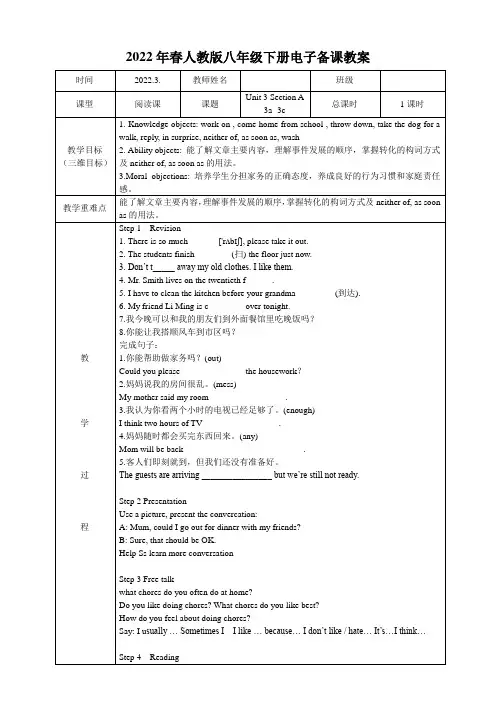
Step 2 Presentation
Use a picture, present the convercation:
A: Mum, could I go out for dinner with my friends?
Read the story and choose the best answer.
( )1. Who wanted a walk?
A.Nancy’s room B. The dog C. Nancy’s dad D. Nancy
( )2. Nancy came home from ________.
B: Sure, that should be OK.
Help Ss learn more conversation
Step 3Free talk
what chores do you often do at home?
Do you like doing chores? What chores do you like best?
D.Because she got back home late.
( )5. How did they solve the problem?
A.Nancy’s mother said sorry to Nancy.
B.Nancy said sorry to her mother and now she understood she should share the housework.
3.我认为你看两个小时的电视已经足够了。(enough)
Unit3SectionA(3a-3c)教学设计人教版八年级英语下册
Unit 3 Could you please clean your room? Section A (3a3c)一、教学目标:1. 能读懂短文并会做相关练习;2. 能够理解文中词语并进行写的训练;二、教学重难点:教学重点1. 能够理解文中词语并进行写的训练;2. 能够学会对提出有礼貌的请求和征求允许的句型以及如何礼貌应答进行总结。
教学难点对提出有礼貌的请求和征求允许的句型以及如何礼貌应答进行总结。
三、教学方法:四、教学过程:(一)课前五分钟:(二)“立体式”复习(预习)检测:预习3a4c,完成下列翻译练习:1.扔下_______________2.带某人去散步_______________3.整曰/夜_____________4.做家务_______________5.闲逛____________6.把某物传给某人___________________7.把某物借给某人____________ 8.讨厌做某事_______________9.做杂务_______________ 10.帮助某人干某事_______________(三)情景设置、导入课题,认定目标:Step 1 WarmingupSing the song and dance to the musicStep 2 Reading3a Read the passage and answer the following questions.1. Did Nancy do any housework that day?2. Why was Nancy’s mom angry with Nancy?3. Did they solve the problem? How?4. Match the main idea with each ParagraphPara(12) How to solve the problemPara(37) When and where the story happened.Para(810) What happened between Nancy and her mom.3b. Read the story again and read the sentences below.Underline the sentences from the reading that mean the same thing.1. Neither of us did any housework for a week.2. My mom came over as soon as I sat down in front of the TV.3. You’re tired, but I’m tired, too.3c. Decide whether the underlined words in the sentences are verbs or nouns. Then write another sentence using the underlined word in the other form.Step 3 Practice1.Make up dialogues using the sentences in Grammar Focus with your partner.A: Could you please take the dog for a walk?B: OK, but I want to watch one show first.2.After reading Listen carefully and fill in the blanks.If we are having a camping trip, what should we do before the trip?Last month, when Nancy came home from school she __________ her bag and went to the living room. Her mom came over _________ she sat down in front of the TV. Her mother wanted her to _______________________ first, but she wanted to watch one show first. Her mother was angry with her but said _________. For one week, _______ of them did any housework. Finally, Nancy could not find __________ or __________.She knew she was wrong. To solve the problem, she did chores around the house. She thinks it's important for us to __________________.4a Write R for requests and P for permission. Then match each one with the correct response. Step4 Discussion(四)达标测试Chores were not popular at my house. My children didn't like to do chores. They always saw me do chores, but they hardly ever helped me do them. A year ago, I made a game called “The Endless Chore Game”. It is really great. Here's how the game works. I make a card with forty squares(方框),and I write a different chore on each square. These chores can be easy and interesting like making dessert. Then my family rolls the dice(骰子) to decide what chores we have to do. The card also has a few squares with funny things, like watching TV and singing. If you are lucky, you can watch TV when the others are doing the chores. My son likes the game very much. He goes to the kitchen happily every morning to do the game. It is really a good way to make my children do chores. You can have a try if you have the same problem as me.1. The writer's famil y began to do the game()ago.A. one yearB. one monthC. two yearsD. two months2. What do you need to do “The Endless Chore Game”?A. cardB. A dice.C. A card and a dice.D. A card and forty dice.3. When does the writer's family do the game?A. In the morning.B. In the afternoon.C. In the evening.D. We don't know.4. We can learn from the passage that()A. the writer only has one childB. everyone in the writer's family likes playing the gameC. the writer wrote this passage to parentsD. everyone in the writer's family has to do the chores every day5. The writer made this game to( )A. do fewer choresB. tell us an interesting gameC. make her children happyD. make her children do chores五、课后反思:为了使本节课达到良好的教学效果,实现预期的教学目标,我在备课的过程中作了充分的准备工作。
初中英语八年级下册unit3第2课时(A 3a-3c)
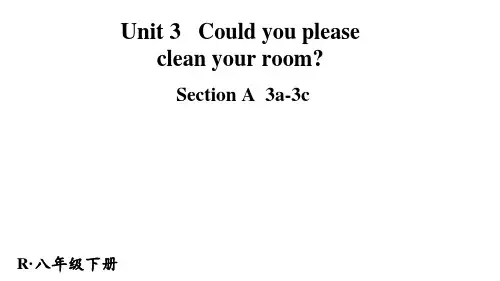
2. Did they solve the problem? How?
Yes, they did. What Nancy’s mother did made Nancy understand they needed to share the housework to have a clean and comfortable home.
1. Why was Nancy’s mom angry with her? Because Nancy wanted to watch TV first before taking the dog out for a walk. Nancy watched TV all the time and never helped out around the house.
1. After Nancy came home, she didn’t take the dog for a walk.
2. Nancy anlwevaeyrshdeolepsstohuethaoruosuenwdotrhke. house. 3. Nancy and her mother didn’t do any housework
Could you please …?
Could you please …cle?an the room?
fold the clothes
sweep the floor
tidy up toys
take out the rubbish
A: Could you please do the dishes? B: _Y_e_s_,_s_u_r_e_. __________________
Result The next day, Nancy __c_le_a_n_e_d__ the house.
人教版八年级下册英语Unit3SectionA3a—3c教学设计
2.小组内用英文进行讨论,每位成员介绍自己的兴趣爱好,并运用所学形容词和句型进行描述。
3.各小组向全班展示讨论成果,其他小组进行评价和反馈。
(四)课堂练习(500字)
1.教师设计听力练习,让学生听懂并获取关于兴趣爱好的一段对话,提高听力水平。
(3)口语表达的流畅性:学生能够在实际交流中,克服紧张情绪,运用所学知识进行流畅表达。
(二)教学设想
1.采用任务型教学法,设计丰富多样的教学活动,激发学生的学习兴趣,引导学生主动参与课堂。
2.创设真实语境,让学生在实际场景中进行听力训练,提高听力技巧。
3.结合小组合作学习,鼓励学生相互交流、讨论,培养口语表达能力,同时加强生生之间的互动。
2.学习3a部分的句型,如“Do you like...?”, “I don't like.பைடு நூலகம்.”和“I find...interesting/funny...”,让学生模仿、朗读,并进行角色扮演练习。
3.通过听力练习,让学生听懂并准确获取关于他人兴趣爱好的信息,提高听力技巧。
(三)学生小组讨论(500字)
三、教学重难点和教学设想
(一)教学重难点
1.重点:
(1)词汇:学生能够熟练掌握表示喜好和厌恶的形容词,如interesting, boring, exciting, funny等。
(2)句型:学生能够运用一般现在时描述自己的兴趣爱好,如“I like reading books.”,并掌握相关疑问句型“Do you like...?”。
2.学生在听力方面,对于日常生活中的兴趣爱好话题,能够听懂并获取相关信息,但面对稍复杂的语境,部分学生仍存在一定的困难。
人教版英语八年级下册Unit3SectoinA(3a3c)教学设计
4.口语表达:创设真实的语言环境,让学生运用所学知识进行口语表达。教师可以组织角色扮演、小组讨论等活动,引导学生在实际情境中运用一般现在时和频率副词。
5.语法讲解:结合课本内容,用生动的例子和形象的比喻,讲解一般现在时的用法和频率副词的位置。通过对比、练习等方法,让学生掌握语法知识。
3.观看一段关于运动或业余爱好的英文视频,总结视频中的主要内容和关键信息。
作业要求:以书面形式提交观后感,不少于100词,涉及视频中出现的运动项目、活动场景以及个人感受。
4.结合课本3a和3c的内容,完成课后练习题,巩固一般现在时的用法和频率副词的位置。
作业要求:认真完成练习题,对于错误的地方进行修改和反思,确保掌握相关知识。
二、学情分析
八年级下册的学生已经具备了一定的英语基础,他们已经熟悉并掌握了一些基本的语法结构和词汇,能够进行简单的英语对话和阅读。在此基础上,他们对运动和业余爱好这一话题有着较高的兴趣和热情,这为本节课的教学提供了良好的基础。然而,学生在实际运用英语进行表达时,仍存在一些困难,如一般现在时的正确使用、频率副词的位置把握等。此外,学生的听说能力发展不均衡,部分学生口语表达较为流利,而部分学生则在听力理解上存在一定难度。因此,在教学过程中,教师应充分考虑到这些学情特点,采取分层教学、个别辅导等方法,帮助每个学生克服困难,提高英语综合运用能力。同时,注重激发学生的学习兴趣,营造轻松愉快的课堂氛围,让他们在愉悦的情感中学习英语,提升学习效果。
人教版英语八年级下册Unit3SectoinA(3a3c)教学设计
一、教学目标
(一)知识与技能
Unit3SectionA3a-3c教案人教版八年级英语下册
环节一:Prelistening1教师活动1T introduces the background of this class. Peter’s classmate Nancy is talking with his brother Tony about doing chores. What may happen during their talk? 学生活动 1Ss read the background of the lesson活动意图说明:通过设置背景,让本节课生动鲜活地和学生的生活实际联系到一起,激发学习兴趣。
环节二:listening 1教师活动2Step 2T asks Ss to listen and answer the following questions.1.What does his sister want Tony to do?2.What does Tony want to do first?3.Where do you think their mother is? 学生活动 2Ss look at the picture and guess the possible relationship between the two children .Ss then listen to the conversation and answer the following questions.活动意图说明:通过插图激发学生关注听力内容,通过回答问题串帮助学生理清Nancy对于做家务的看法,为后文的讨论埋下伏笔。
环节三:listening 2教师活动3Step 3T asks Ss to listen again. Fill in the blanks. After that, try to retell it and guess what will happen next. 学生活动 3Ss listen and fill in the blanks and then guess what will happen next.活动意图说明通过排序引导学生复述文本,熟悉对话,同时通过合理预测引出阅读文章内容。
人教版八年级英语下册Unit3SectionA(3a3c)说课稿
(1)能够正确拼读和运用本节课所学的词汇;
(2)掌握情态动词could的用法,能够运用句型Could you please...?提出请求和建议;
(3)能够听懂、会说、会读课文3a,理解课文3b的内容。
2.过程与方法目标:
(1)通过参与课堂活动,提高学生的英语听说能力;
(2)通过小组合作,培养学生合作解决问题的能力;
3.角色扮演:让学生模拟真实场景进行角色扮演,练习使用本节课的句型和词汇。
4.课堂游戏:设计一些简单的游戏,如快速问答、竞赛等,让学生在游戏中学习和练习。
这些互动方式旨在为学生提供多种参与课堂的机会,促进他们之间的交流和合作,从而提高他们的语言运用能力和社交技能。
四、教学过程设计
(一)导入新课
新课导入是激发学生兴趣和吸引注意力的关键环节。我将采用以下方式导入新课:
(二)学习障碍
学生在学习本节课之前,已经掌握了一定的英语基础,如基本的词汇和简单的语法结构。然而,在学习本节课时,他们可能面临以下学习障碍:首先,对于情态动词could的用法可能不够熟悉,容易与can混淆;其次,对于如何在真实情境中提出礼貌的请求和建议可能缺乏实践经验;再者,部分学生可能因为词汇量有限,对于课文内容的理解存在困难;最后,一些学生可能因为害羞或缺乏自信,不愿意在课堂上积极参与口语练习。
主要知识点如下:
1.词汇:clean, room, please, could, you, your等;
2.句型:Could you please...? Sure./Of course./Certainly.等;
3.语法:情态动词could的用法;
4.交际功能:学会礼貌地提出请求和建议。
(二)教学目标
人教版英语八年级下册Unit3SectionA教学设计
三、教学重难点和教学设想
(一)教学重难点
1.重点:本章节的重点在于让学生掌握一般过去时的构成及用法,学会用一般过去时描述过去发生的事情;同时,熟练运用本单元的生词和短语进行交流。
6.创新评价,全面反馈:采用多元化的评价方式,如小组互评、自我评价、教师评价等,全面了解学生的学习情况,及时给予反馈。关注学生在学习过程中的进步,激发他们的潜能,提高英语素养。
四、教学内容与过程
(一)导入新课
1.教师展示一张冒险主题的图片,引导学生猜测图片中的故事情节,激发学生的好奇心和兴趣。
2.邀请学生分享自己的冒险经历或听说过的冒险故事,让学生在真实语境中使用英语进行交流,为新课的学习做好铺垫。
3.通过提问方式,引导学生回顾已学过的时态知识,为新课中一般过去时的学习打下基础。
(二)讲授新知
1.教师呈现新课文中的一般过去时的句子,引导学生观察、分析句子结构,总结一般过去时的构成及用法。
2.通过实例讲解,让学生了解并掌握一般过去时的肯定句、否定句、疑问句及其回答形式。
3.教师带领学生学习本节课的生词和短语,通过图片、例句等形式帮助学生理解和记忆。
5.提高写作能力,能够仿照课文,运用一般过去时编写小故事。
(二)过程与方法
在教学过程中,教师将采用以下方法引导学生学习:
1.利用图片、视频等直观教具,激发学生的学习兴趣,引导学生主动参与课堂活动。
2.采用任务型教学法,设计丰富多样的课堂活动,如小组讨论、角色扮演、情景对话等,让学生在实际语境中运用所学知识。
4.巩固拓展,提高能力:通过设计丰富的课堂活动和课后作业,巩固学生对一般过去时的掌握,并在此基础上拓展学生的阅读和写作能力。例如,让学生编写小故事、进行课文复述等,提高他们的语言运用能力。