
牛津英语6A知识点归纳
牛津英语6A知识点归纳Unit11.Nosmoking禁止吸烟2.Nolittering禁止扔杂物3.Noparking禁止停车4.Nocycling禁止骑自行车5.Noeatinganddrinking禁止吃喝6.keepoffthegrass不接近草坪7.Bequiet保持安静8.Donottouch不要摸9.climbtrees爬树10.ridebikes骑自行车11.takephotos拍照片12.gotothepark去公园13.gohome回家14.haveanicecream吃一个冰激凌15.havedinner吃饭16.watchTV看电视17.readone’sbooks读书18.playcomputergames玩电脑游戏19.gotobed睡觉20.alotof\alot大量的;许多21.publicsigns公共标志22.onthewall在墙上23.stayawayfrom…远离……24.walkonthegrass在草地上走25.thebird’scage鸟笼26.makenoise发出噪音27.takeawalk散步28.aten-yuannote一张十元的钞票29.lookaround四周看30.pickup捡起euptosb.走进某人Unit21.anewstudentinBen’sclass本班上的一位新学生2.gohometogether一起回家3.afterschool放学以后4.talkabout谈论有关……esoon快到了6.thethirdofMarch三月三日7.onthetwenty-secondofJuly在七月二十二日8.onthe18thofOctober在十月十八日9.yourbirthday你的生日10.Let’swaitandsee让我们等一下看看11.blowoutthecandles吹灭蜡烛12.asabirthdaypresent作为生日礼物13.birthdaycake生日蛋糕etomybirthdayparty来参加我的生日聚会15.haveabirthdayparty举办生日聚会16.aVCDofJapanesecartoons一张日本卡通光盘17.openthedoor开门18.makeabirthdaycard做一张生日贺卡19.takeoff脱下20.blowout吹灭21.apieceofpaper一张纸22.folditinhalf把它对折Unit31.SportsDay运动日2.allthestudents所有的学生3.beexcited非常激动4.veryexciting非常令人兴奋5.lookfor寻找6.arunningrace一场赛跑7.letmesee让我看看8.amomentago/justnow刚才9.ontheground在地上10.pickthemupforme帮我把它们捡起来11.infrontof在……前面12.nextto紧靠……旁边13.apairofglasses一副眼镜(单数)14.arolloffilm一卷胶卷(单数)15.threediaries三本日记16.apairofearphones一副耳机(单数)17.listentomusic听音乐18.yesterdayevening昨天晚上19.underthetable在桌子下面20.trytoremember试图记住21.intheredbox在红色盒子里22.closeyoureyes闭上你的眼睛23.playagame玩游戏24.withyourclassmates和你的同学们25.overthere在那边26.inmyschoolbag在我的书包里Unit51.NationalDay(国庆日)2.theNationalDayholiday(国庆假期)stweek/lastyear上个星期/去年4.aftertheholiday(假期后)5.gotoschoolearly(很早上学)/early--late6.intheschoolplayground(在学校操场上)7.beforeclass(上课前)/before--after8.watchafilmwithmyparents(和我的父母一起去看电影)/watched9.afunnycartoon(一部有趣的卡通片)/funny(形容词)10.visitafarmwithmyfamily(和我的家人一起参观农场)/visited11.onthefarm(在农场里)12.watertrees(浇树)/watered13.pullupcarrots(拔胡萝卜)/pulledupkcows(挤牛奶)/milked15.Thatwasfun!(那是件有趣的事!)/fun(名词)16.collecteggs(收集鸡蛋)/collected17.fruittrees(果树)18.pickalotoforanges(摘许多橘子)/picked19.tastethem(品尝它们)/tasted20.Wonderful!(太好了!)21.gotothefarm(去农场)/went22.attheweekends(在周末)23.watchcartoons(看动画片)/watched24.visitthezoo(参观动物园)/visited25.listentomusic(听音乐)/listened26.playfootball(踢足球)/played27.playvolleyball(打排球)/played28.cleanthehouse(打扫房子)/cleaned29.visitLiuTao’sgrandparents(拜访刘涛的祖父母)/visited30.campingtrip(野营旅行)31.atacamp(在一个营地上)32.walkinthemountains(登山)/walked33.cookalotoffood(做许多食物)/cooked34.playalotofgames(玩许多游戏)/played35.gocamping(去野营)/went36.plantflowers(种花)/planted37.haveagoodtime(玩得很高兴)/had Unit61.getveryexcited变得非常兴奋eafter在……之后到来3.NewYear'sDay元旦4.onNewYear'sDay在元旦5.atChristmas在圣诞节6.gotoparties去参加聚会7.haveabiglunch吃一顿丰盛的午餐8.atSpringFestival在春节9.WhatdopeopleusuallydoatSpringFestival?人们通常在春节干什么?10.visittheirrelativesandfriends拜访他们的亲戚和朋友11.eatlotsofdeliciousfood吃许多美味的食物stSpringFestival上个春节13.ofcourse当然14.myfavouriteholiday我最喜爱的节日15.inOctober在十月16.dressupincostumes用戏服装扮stHalloween去年万圣节18.Mid-AutumnFestival中秋节19.eatmooncakes吃月饼20.playwithlanterns玩灯笼21.watchthemoo赏月n22.thebeautifulmoon漂亮的月亮23.ondifferentholidays在不同的节日styear去年25.atEaster在复活节26.from…to从……到………27.listentohim听他讲28.inthegrass在草丛中29.apopularholid一个流行的节日ay30.inChina在中国31.inJanuaryorFebruary在一月或二月32.eatricedumplings吃粽子33.liketoplaywithlanterns喜欢玩灯笼34.eatchocolateeggs吃巧克力蛋35.makepumpkinlanterns制作南瓜灯笼36.givepresentstoyourfriends把礼物给你的朋友37.gotoBeijing去北京38.thisafternoon今天下午39.playwithballoons玩气球40.watchcartoons看卡通片41.singanddance唱歌跳舞42.hisconversationwithhisteacher他和他老师的谈话43.meetHelenintheplayground在操场上遇见海伦44.readabookaboutthefarm读关于农场的书45.visitafarmwithmyparents和我的父母亲一起参观农场46.thesameholiday相同的假日47.playwithfriends和朋友玩48.watchthedragonboatraces观看龙舟比赛Unit71.onthe25thofDece在12月25日mbe2.istmasDay圣诞日3.onChristmasDay在圣诞日4.im'sfamily吉姆一家人J5.inhisgrandparent'shouse在他爷爷奶奶的房子里6.Christmastrees圣诞树7.thepresentsundertheChristmastree在圣诞树下的礼物8.somany这么多9.fromgrandmother来自祖母10.openitforme为我打开它11.likedrinkingtea喜欢喝茶12.befrom来自13.Christmaspresents圣诞礼物14.atJim'shouse在吉姆家15.drawandwriteinthediary在日记上画和写16.gotothesupermarket去超市17.sitatthebackofthebus坐在公共汽车的后面18.getoff下车19.theseatinfrontofme在我前面的座位20.thewomanbesidehim在他旁边的妇女21.walktothedriver走向驾驶员22.afterlunch午餐后23.Youarewelcome.不用谢24.nexttotheblackboard紧靠黑板25.getmanypresentsonChristmasDay在圣诞节得到很多礼物26.attheback在……后部27.writehisdiary写他的日记28.undertheseat在座位下面29.openthepresents打开礼物。
牛津英语6a知识点梳理

牛津教材6A知识点大盘点(上)Prepositions:◆ at1) 用于表示位置或地点She works at the hospital.I am at home all the morning.2) 用于表示时间I usually get up at 7 o’clock.What are you going to do at the weekend?3) 意为“面向;朝着;对着”What are you looking at?She shouted at me, but I couldn’t hear that.4) 固定结构be good / poor at 擅长于 / 不善于at night 在晚上at noon 在正午at work 在工作◆ on1) 意为“在……上”(有接触面)Leave the glasses on the table.He was sitting on the grass.2) 表示在某地或某位置I live on the other side of the road.3) 表示方向The girl on the right / left is my sister.On my way to school, I bought a pen.4) 与表示具体日期的词语连用We’ll have a party on the evening of May 1st.They have a puter class on Monday.5)表示穿着、带着Put on your new coat / shoes / hat.I’ve got no money on me.6) 意为“有关;关于”a talk / an article on history 关于历史方面的一次讲座 / 一篇文章7)固定结构on foot 步行on the phone 在听xxbe on 上演on holiday 在度假get on 上车◆ in1) 表示在某范围内She lives in a small village in France.There is a book in the box.2) 表示在某段时间内It happened in the past.My birthday is in August.3) 表示在某段时间后She will visit there in three weeks.I’ll e back in ten minutes.4) 固定结构be in = be at home 在家in spring / summer / autumn / winter 在春天 / 夏天 / 秋天 / 冬天in time 及时in hospital (生病)住院◆ above 在……上方(没有接触面)The people in the flat above mine made a lot of noise.◆ below 在……下方(没有接触面)Please do not write below this line.The temperature fell below freezing during the night.Adverbs:◆副词的分类1) 频度副词: always, often, usually, sometimes, seldom, hardly, never2) 地点副词: here, there, everywhere, anywhere, inside, outside3) 程度副词: much, little, very, rather, so, too, still, quite, enough, almost, slightly4) 疑问副词: how, when, where, why5) 表示先后顺序的副词:first / next / then / after that / finally; firstly / secondly / next / then / after that / finally◆副词的位置1) 多数副词都可以放在动词的后面;但如果动词带有宾语,副词就需放在宾语后面。
《牛津小学英语》6A Unit 6 Holidays

牛津小学英语 6A Unit 6 Holidays单元概述《牛津小学英语》6A Unit 6 Holidays 是英语教材牛津小学英语6A中的一个单元,主要介绍了一些关于假期的知识和话题,如假期的活动、送给朋友的礼物等。
该单元以培养学生的英语听说读写能力为目标,通过课文、活动和练习等多种教学手段,引导学生掌握与假期相关的词汇、句型和语法知识。
学习目标在完成本单元的学习后,学生应该能够:1.了解并能够描述假期的活动和计划;2.掌握并能够正确使用与假期相关的词汇和短语;3.通过听力训练,提高对英语语音、语调和语速的理解能力;4.阅读并理解与假期相关的简短英语文章;5.运用所学知识,进行书面和口头表达。
课文内容Section A本节课主要讲述了学生们在假期里的活动和计划,以及他们打算给朋友们送什么礼物。
课文中的主要词汇和句型有:•Words:–holiday (假期)–swim (游泳)–play (玩)–shop (购物)–visit (访问)–letter (信)–card (卡片)–present (礼物)–send (发送)•Sentences:–What are you going to do? (你打算做什么?)–I’m going to swim. (我打算去游泳。
)–What present are you going to give? (你打算给什么礼物?)–I’m going to send a card. (我打算寄一张卡片。
)Section B本节课继续探讨了学生们的假期活动和计划,并引入了更多的假期词汇和句型。
课文中的主要词汇和句型有:•Words:–have (拥有)–take (带上)–bring (带来)–do (做)–make (制作)–go (去)–see (看)–family (家人)–friends (朋友)•Sentences:–What are you going to do this weekend? (你周末打算干什么?)–I’m going to visit my grandparents. (我打算去看望我的祖父母。
牛津6A学习知识点情况总结
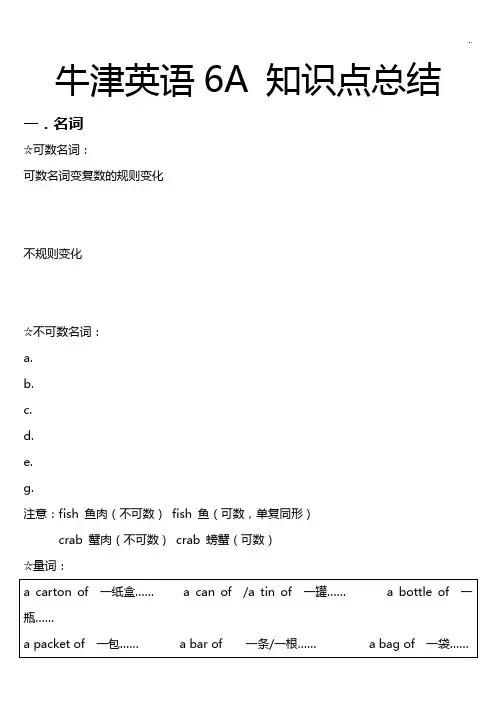
牛津英语6A 知识点总结一.名词☆可数名词:可数名词变复数的规则变化不规则变化☆不可数名词:a.b.c.d.e.g.注意:fish 鱼肉(不可数)fish 鱼(可数,单复同形)crab 蟹肉(不可数)crab 螃蟹(可数)☆量词:☆只能接_____________________:a few 几个few 几乎没有many 许多too many 太多☆只能接______________________:a little 一点little 几乎没有much 许多too much 太多too little 太少☆既可以____________________________________:some 许多any 许多plenty of = a lot of=lots of 大量的enough 足够的☆分类:1.___________________________: chicken steak sauages meat2.___________________________: fish crab prawns squid3.___________________________: ice-cream fish balls4.___________________________: milk eggs5.___________________________: chocolate crisps sweets6.___________________________: cakes biscuits bread small cakes7.___________________________: 7-up fruit juice coffee lemonade Coke8.___________________________: carrots onions tomotoes cabbages lettucespotatoes9.___________________________: peaches pineapples oranges pears bananas apples10.___________________________: rice noodles二.冠词☆不定冠词:带有a/an 的词组:a lot of 许多,大量a few 几个a little 一点have a rest 休息have a break 休息have a good time 过得愉快half an hour 半小时☆定冠词:the +形容词的最高级the tallestthe +序数词the second带有the 的词组:play +the +乐器演奏某种乐器in the morning/afternonn/evening 在早上/下午/晚上the same 相同的at the weekend 在周末all the rest 剩下的全部lay the table 摆好餐具on the left 在左边on the left of 在……右边on the right 在右边on the right of 在……左边go to the cinema 去看电影the USA 美国☆零冠词1.月份,星期,季节前2.三餐前3.play+球类4.by +交通工具5. 零冠词的词组:go to school 去上学at school 在学校at home 在家at noon 在中午at night 在下午on weekends 在周末best of all 所有当中最好的go skating 去溜冰go shopping 去购物三.数词☆基数词:表示数量☆序数词:表示顺序在第十层on the tenth floor☆百,千,百万百:hundreds of 数以百计的one hundred 一百two hundred 二百千:thousands of 数以千计的one thousand 一千two thousand 两千百万:millions of 数以百万的one million 一百万two million 两百万☆单位millimetre/er 毫米缩写:_______centimetre/er 厘米缩写:_______metre/er 米缩写:_______ kilogramme 千克缩写:_______ second 秒minute 分hour 小时四.代词☆人称代词:☆指示代词:五.形容词☆形容词的比较级和最高级变化:a). +er +estb). 以e结尾+r +stc). 重度闭音节结尾的,双写+er +estd). 辅音+y结尾的,y改成i+er i+este). 多音节词:more +多音节词most+多音节词特殊变化: good/well------______________------_________________much/many-----_______________-----________________bad------_____________________-----_________________☆句型结构:A 比B 更……A +be+比较级+than +BA最……A +be+the +最高级☆同义句转换:1.Danny is lighter than Peter.2.I am 150 cm. My brother is 180 cm.☆形容词的排序:限数描大形,新色国材名一张灰色的大圆桌_________________________________________________________六.副词☆频度副词:注意:位置:用于__________________时态☆方式副词:用来修饰动词或者动词词组在形容词后面加ly, 以辅+y 结尾,把y变i,再加ly1.loud---____________________2.quiet----_____________________3.slow---_____________________4.quick---_____________________5.happy---____________________七.介词☆表示时间的介词☆in+年,月,季节在一月份in Januaryon+具体的某一天(包括某一天的早上,下午或晚上)在周日on Sunday morning 在周日的晚上on Sunday evening at+时刻在一点十五at a quarter past five☆表示位置的介词1.live in (大地点) Ben and Kitty live in a housing estate.live on +楼层They live on the ninth floor.live at +具体的地点He lives at Flat 18B.2.arrive at(小地点)I'll arrive at Wanda Cinema at nine o'clock.arrive in(大地点)My father will arrive in Beijing tomorrow.3.on+岛屿on Hongkong Island4.in front of in the front of5.next to beside near6.There is a bird_______ the tree.There is an apple________ the tree.☆常用的介词短语1.what about=how about ……怎么样2.Write about 写关于……3.talk about 谈论4. tell sb. about sth. 告诉某人关于某事B. After系列1.look after 照顾2.After school 放学后3.run after 追赶C. For 系列1.be good for 对……有益2.be bad for 对……有害3.look for 寻找4.wait for 等待……5.cook food for people 给人们做饭6shop for food 去买食物7.get ready for…为…做准备8.It's time for +名词到……时间了D. From 系列come from=be from 来自于……E. Like 系列1look like 看起来像……2just like 就像……3.What's the weather like today? 今天天气怎么样?1play with sb. 和某人一起玩play with sth. 玩某物2.share sth with sb. 和某人分享某物3.be crowded with 挤满了…4make…with 用…来做G. Up 系列1.make up 化妆2.dress up 打扮3.grow up 生长H. To 系列1.sell things to people 卖东西给人们2. bring food to people 把东西带给人们3.bring sth to sb.4give sth to sb.5.show sth to sb6.want to do sth.7.need to do sth.8.one’s jurney to 某人去…的旅行9.a visit to…一次去、、、的旅行10fly to…= go to…by aeroplane 乘坐飞机去….I. of 系列1start of visit 参观开始2 end of visit 参观结束3.different kinds of food 不同种类的食物4.a list of foof 食品消费清单5. east of ……的东部6.the first day of Chinese New YearJ. On 系列1.go on a river trip 水上之旅2.go on a picnic 去野餐3.put on 穿上4.get on 上车5.stick…on…把、、、粘到、、、上6.on the pavement 在人行横道上7.on the zebra crossing 在斑马线上8on weekends 在周末9on one's way to 在某人去……的路上10on foot 步行11on the right 在右边☆介词短语后置介词短语后置,起到形容词的作用,来修饰前面的名词The children on page3 of this book are healthy.在书上第三页的孩子们很健康。
牛津英语6A重点词汇和句型汇总重点讲义资料
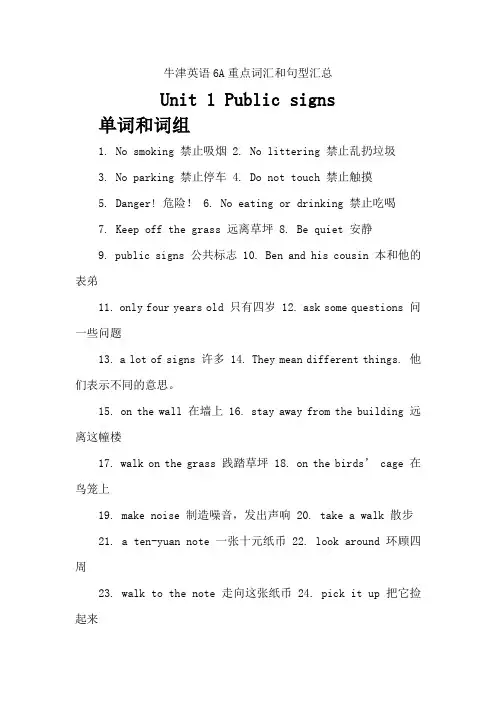
牛津英语6A重点词汇和句型汇总Unit 1 Public signs单词和词组1. No smoking 禁止吸烟2. No littering 禁止乱扔垃圾3. No parking 禁止停车4. Do not touch 禁止触摸5. Danger! 危险!6. No eating or drinking 禁止吃喝7. Keep off the grass 远离草坪 8. Be quiet 安静9. public signs 公共标志 10. Ben and his cousin 本和他的表弟11. only four years old 只有四岁 12. ask some questions 问一些问题13. a lot of signs 许多 14. They mean different things. 他们表示不同的意思。
15. on the wall 在墙上 16. stay away from the building 远离这幢楼17. walk on the grass 践踏草坪18. on the birds’ cage在鸟笼上19. make noise 制造噪音,发出声响 20. take a walk 散步21. a ten-yuan note 一张十元纸币 22. look around 环顾四周23. walk to the note 走向这张纸币 24. pick it up 把它捡起来25. a park keeper 公园管理员 26. come up to him 向他走来27. point to 指向…… 28. give me ten yuan 给我十元钱29. climb trees 爬树 30. take photos 拍照31. go to the park 去公园 32. have an ice cream 吃个冰激凌33. read books 读书 34. play computer games 玩电脑游戏句型1. What does this sign mean? 这个标志是什么意思?It means you shouldn’t litter. 它是指你不应该乱扔垃圾。
牛津小学英语6A第二单元知识点整理及要求(二)
牛津小学英语6A第二单元知识点整理及要求(二)
三、初步理解掌握本课语法知识。
1.在一月: in january (在某月要用介词in)
在7月12号: on the twelfth of july(在某日要用介词on)
2.几月几日表达法:6月1号:the first of june (the 1st of june)(june 8)
3.星期几询问法:what day is it today? it’s monday.
(monday tuesday wednesday thursday friday saturday sunday)
日期询问: what date is it today? it’s the third of august.
4.i’d like=i would like= i want………我要。
(东西)
i’d like to = i would like to = i want to…….我要……(做某事)do you want…?= would you like …?
i’d like some flowers. →
do you want to….?= would you like to…?
5.when 什么时候 == what time
what time do you go to school?
==== when do you go to school?
when can we watch it? 我们什么时候能看?
6.what would you like as a birthday present? i’d like ………
牛津小学英语6a第二单元知识点整理及要求(二) 来自。
上海牛津英语6A期末复习(精华版)
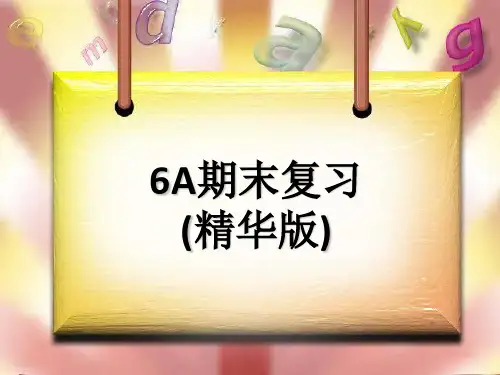
一般不用冠词的情况 1.What do you have for breakfast? (一日三餐
前) 2. We play football after school every
day. (球类运动前)
固定词组:by train/motorcycle, on foot, at night, at noon, watch TV, go to school, walk to school, be late for school, at weekends, start work, finish work, in class等。
6A期末复习 (精华版)
不定冠词(a/an)的用法
1.I would like to be a policeman. (职业前加“a” 或“an”) 2.There is a beautiful garden behind the house. (翻译成中文, 有“一”的意思) 3. 习惯用语:have a good/great time, half an hour, tell a lie, make a (shopping) list, have a picnic, have a barbecue, have a healthy diet, have an unhealthy diet, That’s a good idea. 等
(比较: day---days boy---boys) 2.可数名词的复数不规则变化 A.以o结尾 e.g. potato—potatoes tomato--tomatoes
(比较: radio---radios photo---photos piano---pianos kilo---kilos zoo---zoos kangaroo---kangaroos)
牛津英语6AUnit2知识点
Teaching PlanModule 1 Unit 2 I have a good friendEpisode 2 (page 10)Note some language points in this text.●sb’s 某人的Li Ming’s motherKitty’s schoolbagher/his/their teacher/trip/visit●visit n./v.visitor n. 访问者●the USA = the United States of America●for the first time 第一次I’m visiting my aunt for the first time.●about 关于●where she has been 从句,了解意思即可●现在完成时:have/has + p.p. (学生对动词过去式和过去分词的变换掌握尚不够透彻,虚多加练习)I’ve finished my homework.●just, already, yet adv.I’ve just finished my homework.I’ve already finished my homework.I haven’t finished my homework yet.●What about 表建议What about a trip to Garden City?What about going for a picnic?What about visiting Miss Lin?what about + doing sth. = why not do sth.默写:1. 从不2. 几乎3. 互相4. 友好的5. 有帮助的6. lie (两种词性及其意思)7. 调皮的8. together9. Mary总是和我分享她的食物。
10. 与他人谈话;Kitty从不在课上和他人说话。
Episode 3 (page 10)Language points●look after = take care ofPlease look after my house during my absence.Lingling is looking after her grandmother in hospital because she is ill.= Lingling is taking care of her grandmother in hospital because she is ill.●environment●pollute v. 污染pollution n. 污染air pollution, water pollution, land pollution●keep v. 保持keep quietKeep the door open/closed.I keep all her letters. 我保存着她所有的信。
上海牛津英语6A期末复习(精华版)
one…, the other… 一个…另一个(前提两个人或物)
(4) Some students like cartoons, others like science fiction. some…, others… 一些…, 另一些…
1.可数名词( Countable Noun)的复数规则变化:
When do we use adjectives ?
在系动词后作表语
angry 1. He became very ________(angrily). 2. Chillies taste ___________ (spice). spicy
When do we use adjectives ? 形容词作宾语补足语
How
We use ‘How … questions’ to ask for numbers or amounts.
How … How many meaning Question Answer
多少 How many people There are seven. are there? (可数) How much sugar 多少 do we need every Only a little. How much (不可数) day?
可数名词
5. Hurry up! We have only ______ ( a little, a few, little, few) time ! There are ____ (a little, a few, little, few) spicy sausages in the fridge. Let’s go and buy some.
Whword
What Which
meaning
牛津英语6AUnit2知识点梳理
六年级第一学期牛津英语知识点梳理Module 1 Unit 2 I have a good friend 知识点梳理:(打* 的知识点仅供参考)I 词组:1.talk to her: 和她谈话2.not…at all:一点也不,根本不3.go out at night:晚上出去4.like to be together:喜欢在一起5.walk to school:步行上学6.help each other:互相帮助7.help other people:帮助别人8.work hard:学习努力9.get angry:生气10.share her food with me:和我分享她的食物11.tell lies:撒谎12.live in the USA:住在美国13.for the first time:第一次14.on Saturday:在周六15.Friends of the Earth:地球之友16.look after the environment:保护环境17.pollute the environment:污染环境18.help keep the environment clean:帮助保持环境整洁19.pick up rubbish:捡起垃圾20.put rubbish into rubbish bins:把垃圾扔到垃圾箱里21.tell people not to leave rubbish:告诉人们不要丢垃圾II. 词性转换:1.friend n. 朋友friendly adj. 友好的* friendship n.友谊2.help n./v.帮助helpful adj.有帮助的* helpless adj.无帮助的3.one的序数词first4.pollute v. 污染pollution n.污染5.discuss v. 讨论*discussion n. 讨论e n.用法,用处v.使用useful adj.有用的* reuse v. 再利用III. 语言点/句型1. I always talk to her.和某人谈话:talk to sb.谈论某事:talk about sth.和某人谈论某事:talk to sb. about sth.*和某人交谈:talk with sb.e.g. Now my teacher is talking to Alice.Let’s talk about our plan for the trip.We can talk to our parents about the problem.*My uncle is very funny. I like to talk with him.2.But she does n’t talk at all.not…at all: 一点也不Not at all: 不用谢,没关系e.g. 1) It isn’t clean at all.2)—Thank you very much. —Not at all.3. She likes to play.They like to be together.喜欢做某事:like to do sth.= like doing sth.e.g. He doesn’t like smoking.= He doesn’t like to smoke.4.She can’t read or write.肯定句中连接并列成分的and 变为否定句, 要改成ore.g. She can sing and dance.否定句:She can’t sing or dance.5.They walk to school together.步行上学:walk to school = go to school on foote.g. Ben walks to school every day.= Ben goes to school on foot every day.6.She always shares her food with me.和某人分享某物:share sth. with sb.e.g. Kitty shares a room with her sister.I like to share the good time with my good friends.7.They help each other.互相帮助:help each other相爱:love each other互相学习:learn from each othere.g. My father and mother love each other.We should help each other and learn from each other.8. She always works hard.努力工作:work hard= be hardworkinge.g. My teacher always works hard. =My teacher is always hardworking.9.She never tells lies.撒谎:tell a lie = tell liese.g. Tom isn’t honest. He usually tells lies.=He usually tells a lie.10.Kitty’s cousin lives in the USA.居住在某地:live in sp.美国:the USA=Americae.g. She lives in Rose Garden Estate.11.Kitty and Alice are asking Winne about where she has been in Garden City.向某人询问某事:ask sb. about sth.e.g. Don’t ask me about my salary.12.I’m going there on Saturday.在星期几和具体日期前要用介词one.g. Let’s go to have a barbecue on Sunday.13.Kitty: Have you been to Ocean Park yet, Winne?Winne:No, I haven’t been to Ocean Park yet. Alice:Have you been to Garden City Zoo yet? Winne: Yes, I’ve just been to Garden City Zoo.Kitty: Have you been to North City Park yet? Winne:Yes, I’ve already been there.have/has been to sp. 去过某地1).经常和already(已经),just(刚),yet(还)连用already:“已经”,用于肯定句中(have/has之后)just: “刚”,用于肯定句(have/has之后)yet:“尚,还”,用于否定句和一般疑问句句末2).否定式:haven’t /hasn’t been to sp.一般疑问式:直接将have/ has 提到句首回答:Yes, …have/has.No, …haven’t/hasn’t.3).当sp.是here, there 或home时,to 要省略e.g. I have already been to Beijing.I haven’t been to Beijing yet.Have you been to Beijing yet?No, I haven’t been there.14.What about Water World?What about…? 经常用于表示征求建议,表示“…怎么样?”“…呢?”用法:n. n.what about+ Ving = How about + Vinge.g. What about a trip to City Park?=How about a trip to City Park?What about going to City Park?=How about going to City Park?15.Friends of the Earth look after the environment.照顾,照看:look after=take care of好好照顾某人:look after sb. well = take good care of sb.16.Friends of the Earth help keep the environment clean.帮助某人做某事:help sb. (to) do sth.= help sb. with sth.e.g.He helps me (to) learn English.=He helps me with my English.17.They put rubbish into rubbish bins and tell people not to leave rubbish.告诉某人做某事:tell sb. to do sth.告诉某人不要做某事:tell sb. not to do sth.e.g.The teacher tells us not to tell lies.The teacher tells us to listen carefully in class.18.What do you promise todo? What do you promise not to do?I promise to keep our school clean.I promise not to leave rubbish.承诺做某事:promise to do sth.承诺不要做某事:promise not to do sth.e.g. My father promises not to smoke.We promise to obey the rules.19.Discuss it with your classmates.和某人讨论某事:discuss sth.with sb.e.g. I always discuss the maths problems with my classmates.。
新版译林牛津6AU2知识点和考点
新版译林牛津6AU2知识点和考点1.语法知识点:-一般现在时和一般过去时的用法和变化规则-疑问句和否定句的结构和变化规则-一般将来时的构成和用法- 情态动词的用法,如can, must, should等-比较级和最高级的形式和用法2.词汇知识点:-常见动词的过去式和过去分词形式-常见名词的复数形式- 常用连词和连接词,如and, but, because等-常见形容词和副词的比较级和最高级形式-常见的日常用语和短语3.阅读理解:-根据上下文推断词义和句子意义-理解文章的主题和大意-根据问题选择正确的答案-理解对话和文章中的细节信息4.听力技巧:-听懂并理解对话和文章的大意-倾听并记录关键信息和细节-根据听到的内容选择正确的答案-辨认不同音调、语气和语速的说话者-掌握一些常见的听力策略和技巧5.口语表达:-使用正确的句型和词汇进行口语表达-学会用简单的句子描述事物、表达意见和情感-学会询问问题和进行交流-掌握一些常见的口语交际用语和口头表达方式6.写作技巧:-使用正确的语法和词汇进行书面表达-学会写简单的句子和段落描述事物和经历-学会写简单的信件和日记-学会根据指导写作要求进行写作-逐渐提高写作的准确性和连贯性7.文化背景:-介绍一些英语国家的文化和风俗-学习一些英语国家的地理和历史知识-了解一些与英语语言和文化相关的名人和事件-通过阅读理解等学习材料了解不同文化之间的差异和相似之处以上只是可能的知识点和考点总结,实际教材可能还有其他内容。
学生在学习时,应该根据教材的具体要求和教师的指导进行有针对性的学习和复习。