
剑桥(join in)版2019-2020年五年级英语下册 Revision 1 教案(全)
Revision 1 Contents:Part1&2&pair workObjectives:知识与技能:熟练运用句型交流手机功能的相关信息Teachingmains:熟练运用句型交流手机功能的相关信息Teachingdifficult:熟练运用句型交流手机功能的相关信息Aids:Blackboard ,chalk, tape, PPT,pictures课前预习:预习part1的短语,看看手机又哪些功能教学过程(Teac hing steps) :Step1 warm up:展示图片,复习手机功能的词组Step2 presentation:1.打开书26页,阅读短语,大致了解听力内容,并教授新词组watch the weather report2.老师播放听力,学生自主勾出所听到的内容3.老师通过句型What can you do with a mobile phone?与学生来共同核对答案4.同桌两人一组练习对话What can you do with a mobilephone? I can…5.学生仔细阅读part2的对话,并回答问题Who has got a 3Gmobile phone? What does Mike do with his mobile phone?What does Rose do with her mobile phone? 师生共同核对答案6.老师播放录音,学生跟读对话7.四人一组分角色朗读对话,老师巡视并给与指导Step3 practice:1.老师随意展示图片,学生说出对应的手机功能2.学生两人一组运用句型交流手机功能3.老师点2-3学生展示对话Step4 homework:熟练练习对话交流手机功能教师活动:学生活动:板书设计Who has got a 3G mobile phone?What does Mike do with his mobile phone?What does Rose do with her mobile phone?What can you do with a mobile phone?I can…Revision 1Contents:Part4&pair workObjectives:知识与技能:1.根据录音,听懂有关Television的内容2.能独立完成part4及pair work的提问,并熟练运用句型交流电视的相关内容Teaching mains:根据录音,听懂有关Television的内容能独立完成part4及pair work的提问,并熟练运用句型交流电视的相关内容Teachingdifficult:能独立完成part4及pair work的提问,并熟练运用句型交流电视的相关内容Aids:Blackboard ,chalk, tape, PPT,pictures课前预习:阅读pair work的问题,试着独立完成教学过程(Teac hing steps) :Step1 warm up:老师展示图片,学生说电视节目,比比谁说得又快又准Step2 presentation:1.师生自由对话What programmes do you like? Whatprogrammes does your father/mother like? What programmesdo you often watch? What programmes does your father/motheroften watch?2.打开课本28页,学生读句子,独立完成连线3.老师播放录音,学生核对答案3.再次播放录音,学生跟读句子4.两人一组问答part4的句子6.学生两人一组,问答pair work中的问句,老师巡视并给与指导Step3 practice:1.学生两人一组互相问答part4及pair work的问句,请2-3组学生展示对话2.请读得好的学生领读part4Step4 homework:反复操练有关电视的对话教师活动:学生活动:板书设计What programmes do you like?What programmes does your father/mother like?What programmes do you often watch?What programmes does your father/mother often watch?Revision 1Contents:Part3&pair workObjectives:知识与技能:3.根据录音,听懂有关北极动物的内容4.能独立完成part3及pair work的提问,熟练运用句型交流自己喜欢的北极动物。
Teaching mains:根据录音,听懂有关北极动物的内容能独立完成part3及pair work的提问,熟练运用句型交流自己喜欢的北极动物Teaching difficult:能独立完成part3及pair work的提问,熟练运用句型交流自己喜欢的北极动物Aids:Blackboard ,chalk, tape, PPT,pictures 课前预习:观察图片和单词,尝试拼读单词教学过程(Teac hing steps) :Step1 warm up:老师展示图片,学生说单词,比比谁说得又快又准Step2 presentation:1.师生自由对话What arctic animals do you like? Why do youlike it?2.呈现图片,学习新单词the arctic fox, the snowy owl.3.老师说单词,学生指图片4.老师指图片,学生说单词4.两人一组,一个指图片,一个说单词,复习巩固动物单词。
5.演示对话内容Step3 practice:1.学生两人一组互相问答pair work的问句,请2-3组学生展示对话Step4 homework:反复操练有关对话教师活动:学生活动:板书设计the arctic fox, the snowy owl第4课时Revision 1 Contents:Part5&pair work,part 6Objectives:知识与技能:能够根据句子内容填入单词。
能掌握动词的单数第三人称变化。
Teaching mains:能够根据句子内容填入单词。
能掌握动词的单数第三人称变化。
Teaching difficult:能够根据句子内容填入单词。
能掌握动词的单数第三人称变化。
Aids:Blackboard ,chalk, tape, PPT,pictures 课前预习:观察图片和单词,尝试拼读单词教学过程(Teac hing steps) :Step1 warm up:学生自读单词,边读边理解单词含义。
Step2 presentation:1.引导学生对比单词cold和cool, hot和warm2.创设情境,帮助学生理解单词hungry 和thirsty,clever。
3学生自读句子,完成填空。
4.一起核对答案。
Step3 practice:1.自读Part6句子,按要求换成规定单词,替换句子。
Step4 师生共同核对答案教师活动:学生活动:板书设计第5课时Revision 1 Contents:Part7,part 8Objectives:知识与技能:能够根据录音内容选择正确的图片。
能自读对话,理解不同对话的含义。
Teaching mains:能够根据录音内容选择正确的图片。
能自读对话,理解不同对话的含义。
Teaching difficult:能够根据录音内容选择正确的图片。
能自读对话,理解不同对话的含义。
Aids:Blackboard ,chalk, tape, PPT,pictures 课前预习:观察图片和单词,尝试拼读单词教学过程(Teac hing steps) :Step1 warm up:学生观察图片,预测对应图片可能出现的单词。
Step2 presentation:1.播放录音,学生听录音,标序号。
2.慢放录音,老师重复录音内容,引导学生怎样抓关键词选择答案。
3一起核对答案。
Step3 practice:1.自读Part8对话和句子,理解对话内容。
2.老师讲解对话,引导学生理解不同对话发生的情景。
教师活动:学生活动:板书设计第6课时Revision 1 Contents:Part9Objectives:知识与技能:自读短文,理解短文内容Teachingmains:自读短文,理解短文内容Teachingdifficult:自读短文,理解短文内容Aids:Blackboard ,chalk, tape, PPT,pictures课前预习:观察图片和单词,尝试拼读单词教学过程(Teac hing steps) :Step1 warm up:教师播放录音,学生边听录音边看短文。
Step2 presentation:1.引导学生复述对话内容,加强对对话的理解。
2.呈现短文填空的内容,让学生阅读短文,完成填空。
3一起核对答案。
Step3 practice:利用所学的句子和单词,说说你是否愿意生活在农场。
教师活动:学生活动:板书设计。
剑桥(joinin)版2019-2020年五年级英语下册Unit6(6)教案

剑桥(joinin)版2019-2020年五年级英语下册Unit6(6)教案Unit 6 Adventures (Part 6)Teaching Aims:1.Knowledge objects: Be able to listen, read the story.2.Ability objects: Be able to listen, read and act out the story.3.Moral objects: A hero needs bravery and clever.帮助学生了解如何机智的处理面临的问题。
Teaching Key Points:1.Key vocabulary: hero, bank robbers, pancakes2.Target language: Read the story affectionately.Teaching Procedures:Step I Lead-inActivity 1: P PT shows the first people: “杨利伟”.T: This is Yang Liwei. He is the first people to fly to the space in China. He is a “hero”.The teacher teaches the word “hero”, then stick it on the board.Activity 2: PPT shows the second people: “成龙”.T:Who is he? Ss: Cheng Long. T: Yes. He is a famous film actor in China. He plays many excellent action movies. He is a ...?Ss: Hero.Activity 3: PPT shows the third people: “姚明”.T:This is Yao Ming. He is good at playing basketball. Everyone knows him. He is a ...?Ss: Hero.Brief sum-up: There are many heroes in their fields. Today, we’ll know another hero. Step II Pre-readingActivity 1: T: Please listen to a story. Think about: How manypeople in the story? Who are they?T and the pupils listen to the story.S: There are 5 people. They are Joe , Sarah, bank robbers, Sheriff.Activity 2: T: Who is the hero? Listen again and watch.The pupils listen again and watch the screen.S1: Joe is a hero. T: Maybe.S2: Sarah is a hero. T: Maybe.Step III While-readingPicture①②:T: Please open your books and read picture1 and 2, think about:Is Joe afraid of bank robbers?PPT deal with the word “ bank robbers”. The pupils read it 3 times.T: Please find out the answer and underline the key sentences.Ss: No. Joe isn’t afraid of ban k robbers.T: How can you know that?S: “I’ll catch them. I’m not afraid.”The teacher teaches them read affectionately.T: Joe is very brave. (stick the word) So he is proud.The teacher retell this part: Sheriff meets bank robbers. Joe helps Sheriff. Pic ture③-⑧:Activity1: Look and read follow the tape. And think about:(PPT) 1, Does Joe find the bank robbers?2, Does he catch them?The pupils answer the questions..T: At last, what happened? Ss: Bank robbers catch Joe.T: How can bank robbers catch Joe?S1: Can I sing a last song, please?(PPT) Choose the right answer:A, Bank robbers want to sing.B, Bank robbers want to run away and catch Joe.B is right. Read the sentence together.Activity2: Read the story picture3-8 in each groups.Practice in groups.1-2 groups have a show.Picture⑨-?:(PPT) Who helps Joe?Listen to the story. S1: Sarah helps Joe.(PPT) Sarah helps Joe with the pancakes.The teacher teaches the new word “pancakes”.The pupils re ad the sentence “Sarah helps Joe with the pancakes.”T: Open your books and read by yourselves. And think about: 1, Does Sarah afraid of robbers ?2, Does she catch them?Ss answer the questions.Do role-play in class.Picture?-?:Watch the screen and read together.T: Do you think who is the hero at last?The teacher sticks the word “ clever”.Step IV Post-readingActivity1: Read the whole story together.Activity2: Retell the story.Activity3: Compare Sarah and Joe in form.Activity4: Read the poemLife is full of adventures.Let’s overcome ourselves.If we are brave and clever.We will be a hero in our life!Step V Homework1, Read the story.2, Act out the story with your friend. 3, Retell the story.Blackboard Design:Unit 6 Adventures (6)A story---The herohelps helpsSheriff Joe Sarah catch finds meets catchesbank robbers。
2020春五年级英语下册 Revision 1教案 剑桥版

反复操练有关对话
教师活动:
学生活动:
板书设计
the arctic fox, thesnowy owl
第4课时
Revision 1
Contents:
Part5&pairwork,part 6
Objectives:
知识与技能:
能够根据句子内容填入单词。
能掌握动词的单数第三人称变化。
教
学
过
程
(Teaching steps):
Step1 warm up:
学生自读单词,边读边理解单词含义。
Step2 presentation:
1。引导学生对比单词cold和cool, hot和warm
2。创设情境,帮助学生理解单词hungry 和thirsty, clever。
3学生自读句子,完成填空.
2。呈现图片,学习新单词the arctic fox, the snowy owl.
3.老师说单词,学生指图片
4.老师指图片,学生说单词
4。两人一组,一个指图片,一个说单词,复习巩固动物单词。
5.演示对话内容
Step3 practice:
1。学生两人一组互相问答pairwork的问句,请2—3组学生展示对话
老师展示图片,学生说电视节目,比比谁说得又快又准
Step2 presentation:
1.师生自由对话What programmes do you like? What programmes does your father/mother like? What programmes do you often watch? What programmes does your father/mother often watch?
外研剑桥版五年级英语下册教案Revision 1教案3
Revision 1 教学设计一、教学内容7、8、9二、教学目标能听懂,读懂Life in the Arctic 这个话题的相关内容;能运用相关句型交流有关北极动物的简单信息;能读懂有关农场生活的对话并能运用相关句型交流信息;三、教学重点使学生学会认读表示打电话用语,描述北极生活和动物的单词四、教学难点学生能通过听音获取正确的信息;能指认关于电话、北极、电视的单词五、教学过程(一)看视频播放一段关于谈论北极生活的对话视频,引起学生对天气英语表达的兴趣(二)复习老师和学生间谈论中国各城市的天气(三)模拟对话学生再听一次谈论中国各城市的天气对话视频;学生模仿对话,与同学一对一对话谈论天气(四)新课教授师引导学生在听前观察图片,从而预测听力内容老师让学生看图片1并提问:What can you see? What’s it ?(TV)What’s on TV? Do you like sports programmes?学生图片2并思考:What’s it?(A birthday cake.)学生讨论图片3:What’s it?(Big Ben)Where is it?(It’s in London.)学生讨论图片4:What’s the boy doing? (He is playing football.) Maybe he plays football well. He is good at playing football.老师播放录音,学生听录音标序号师生共同核对答案,师生共同核对答案老师播放录音,学生边听边思考:③ Where are they for holiday? ② Does Joe like it there?③ Why does Joe think it is boring there? ④ How about Dick?老师再次播放录音,学生跟读学生小组活动,讨论:Do you want to live on a farm? Why?老师巡视并加以指导老师挑选2-3组展示,并及时给予评价(七)总结回顾今天学习的知识回顾今天学习涉及的重点单词六、课后作业写一篇关于自己假期的小文章。
(2020年春)剑桥版五年级下册英语教案Revision 1
Revision 1教学设计(第1课时)【教学内容】1,2,3,4【教学目标】(一)知识与技能1.能听懂,读懂A phone call , Life in the Arctic , Television这三个话题的相关内容;2.能运用相关句型交流有关手机功能,北极动物的简单信息;3.能读懂有关北极生活的对话并能运用相关句型交流信息;4.能正确运用形容词。
(二)过程与方法1.以小组合作与情景教学为主,运用游戏帮助学生理解与运用所学知识;2.指导学生通过听音获取正确的信息,掌握一定的听音技巧。
(三)情感、态度与价值观使学生学会接打电话常用语,使能了解并表达北极动物的信息,使学生熟悉电视节目名称单词,并能理性对待看电视。
【教学重点】使学生学会认读表示打电话用语,描述北极生活和关于电视节目的单词。
【教学难点】学生能通过听音获取正确的信息;能指认关于电话、北极、电视的单词:phone,ask,call,before,get,ill,work,wrong,polar bear,arctic hare,arctic fox,snowy owl,seal,lemming,snow,mobile,igloo,always,hunt,early,grandma,grandpa,lake,snow,interesting,star,want能与伙伴们表演故事。
【教学准备】接打电话的图片、写有表示电话英文单词的卡片、教材相配套的录音带和课件。
关于北极的图片、写有表示北极动物的卡片、教材相配套的录音带和课件。
【教学过程】Step 1 Let’s watch a video!播放一段关于打电话的简单对话的视频,引起学生对打电话用语的兴趣。
Step 2 Revision学习打电话用语,复习上一单元学习的单词。
Step 3 Listen and point1.学生再看一次打电话的对话视频。
2.让学生模仿对话,与同学一对一模拟打电话。
剑桥(join in)版2019-2020年五年级英语下册 Unit 4 同步练习(4)
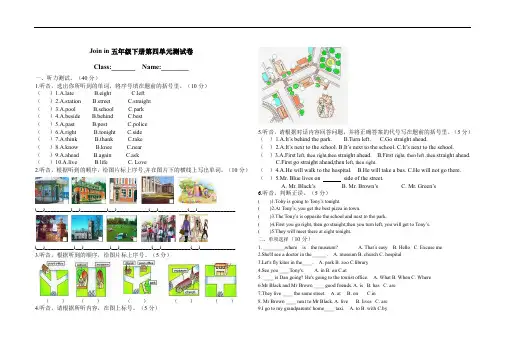
7.They live ____ the same street. A. at B. on C.in
8. Mr Brown ____ next to Mr Black. A. live B. lives C. are
9.I go to my grandparents' home____ taxi. A. to B. with C.by
Jack: That's easy. Go out from our school. Go straight about five minutes. You can get to a crossing (十 字 路 口 ). Turn right there and go straight ahead for ten minutes. You can see it. It's next to the post office. Tom:Thank you. Jack :That's OK. Bye. 1.Tom will go to the____________. 2.The book is about____________. 3.Tom should(应该)turn ________________at the crossing. 4.The bookstore is ________________the post office. 5.It will take Tom _________________ minutes to get to Xinhua Bookstore. B:根据短文内容在房间号下面写上对应的旅客名字。 This is a hotel, Mr. A, B, C, D, E live here. Mr. A lives in 101. Mr. B lives next to Mr. C. Mr. D lives in Mr. A's floor(层). But he is not next to Mr. A. Mr. E lives on Mr. C's left. Where do they live? Can you write their names in the rooms ?
剑桥(joinin)版2019-2020年五年级英语下册Unit5(4a,4b)教案

剑桥(joinin)版2019-2020年五年级英语下册Unit5(4a,4b)教案Unit 5 On the Beach教学设计(第3课时)【教学内容】Part 4a, Part 4b【教学目标】(一)知识与技能1.能听懂、理解故事内容和发展脉络;2.能在老师的指导下和图片的提示下听懂、读懂小故事,并完成相关任务;3.能了解掌握新的短语或表达,如go snorkeling, get my mask and flippers等。
(二)过程与方法1.以小组合作与情景教学为主,运用游戏帮助学生理解与运用所学知识;2.指导学生通过听音获取正确的信息,掌握一定的听音技巧。
(三)情感、态度与价值观培养学生爱心,提高海洋动物保护意识,且丰富学生对海洋生物及环境的认识。
【教学重点】使学生学会认读和理解一些新的短语及表达如Let’s go snorkeling.I’ll get my mask and flippers. I think it’s blood. The seal is hunt. How is our seal? On the rock.等;理解海豹的小故事内容。
【教学难点】学生能通过听录音获取正确的信息;了解小故事的基本发展脉络和时间顺序;一些新的表达的掌握和理解。
【教学准备】写有表示英文单词的卡片、教材相配套的录音带【教学过程】Step 1 Warming up给学生们呈现一些海滩风景和海洋生物的图片,介绍一些海滩海洋的背景知识。
Step 2 Revision复习上个课时中学到的关于天气的表达。
Step 3 Listen, think and read1.老师播放录音,学生通过回答问题What’s the story about? 初步感知故事内容。
2.学生打开课本,小组分角色朗读图片1-3,通过回答问题What do they see?How is the seal? 了解故事起因。
3.学生听图片4-9的录音,回答问题:What happens? How is the seal? 了解故事的发展,并适时学习get closer,it’s blood 等。
2019-2020剑桥(join in)版英语五年级下册课件Unit 2 Life in the Arctic(4)
And he runs up the hill.
When he comes to the top. He comes to a stop. He looks around,
And what’s not there? The hare, the hare, the arctic hare.
What’s over there?
want to / he wants to catch a hare jumps in the water swims across the lake walks through the snow runs up the hill comes to looks around
What ’s over there? What’s over there?
A bear, a bear, a big, big bear, a big, bh a hare.
He jumps in the water. He swims across the lake.
the arctic
The polar bear
Listen and say the chant.
What ’s over there? What’s over there? A bear, a bear, a big, big bear, a big, big polar bear. What’s he doing over there? What’s he doing over there? The bear, the bear, the big, big bear, the big, big polar bear. He wants to catch a hare. He wants to catch a hare. The bear, the bear, the big, big bear, the big, big polar bear. He jumps in the water. He swims across the lake. He walks through the snow. And he runs up the hill. When he comes to the top. He comes to a stop. He looks around, And what’s not there? The hare, the hare, the arctic hare.
剑桥(join in)版2019-2020年五年级英语下册 Unit 3 同步练习(4)
Unit 3 Television一.选择正确的单词填在横线上完成短文My favorite programmes 1.__________ (is,are) nature programmes and cartoons. I always watch TV 2._______ (in,on) Saturday and Sunday. The cartoons 3.__________ (begin,begins) at half past six, 4.________ (it,they) end at seven. The nature programme 5._________ (begin,begins) 20 minutes later. 6.________ (It, They) 7.________ (begin,begins) at twenty past seven.二.根据电视节目单,将正确答案的序号写在括号内人与自然05:45-6:20 猫和老鼠06:30-7:00体育世界07:40-8:15 真爱至上08:20-9:50未来世界09:55-10:25()1. The cartoon begins at _______.A half past sixB seven o’clockC five to ten( ) 2. The science fiction film begins after ________.A the sports programmeB the nature programmeC the romantic film ( ) 3.The nature programme ends at________.A quarter to sixB twenty past sixC twenty to seven( ) 4. The romantic film lasts(持续)for _______.A an hourB one and half hoursC half an hour三.连词成句1.short is TV for television_______________________________________.2.like Fred Does nature programmes____________________________________________?3.cartoons Children usually watch Sunday on______________________________________________________.ter 15 minutes The sports programme begins_____________________________________________________.四.阅读理解,将正确答案的序号写在括号中I am Lisa. I am in the Wuhan Primary School. I am in Class Six,Grade Five.I like watching TV very much. I like weekend best because I can watch TV for a long time. My favorite TV programme is Camp of happiness(快乐大本营).I think it is very interesting.I love Xie Na and He Jiong best. The programme begins at ten past eight every Saturday. ( ) 1. Lisa likes weekend because____________A she can have classB she can watch TV for a long timeC she can dance ( )2.Her favorite programme is_________A Man and NatureB Camp of happinessC Kungfu Panda ( )3.The programme begins at_________A 8:50B 7:10C 8:10( )4.She thinks that Camp of happiness is very________A interestingB boringC stupid。
剑桥(join in)版2019-2020年五年级英语下册 小学英语课堂教学反思
小学英语课堂教学反思教学反思对于教师来说是一种有益的思维活动和再学习活动。
教学反思是教师成长的必要条件和有效途径;教学反思位教师的成长提供了可能和内在动力;教学反思有助于教师提升教学经验,并将其升华为实践智慧。
那么,如何通过教师的教学反思促进教师的专业成长,在成长过程中该如何进行反思呢?1、思想和认识上要做好准备;2、不断积累具体经验;3、认真分析和讨论问题所在;4、积极验证,这样才能使教学反思活动更加顺畅地延续和循环。
一、反思教学经验回顾从教三十多年,我对课堂教学这门综合性的复杂艺术感触最深的一条是:既要教书育人,又要培养学生全面发展。
知识当然重要,知识就是力量;但还有比知识本身更重要的,那就是教会学生认识自我,学会学习,学会求知。
课堂教学有三个层次:一是知道教什么,传授书本知识。
二是知道怎样去教,运用一定的教学方法和技巧进行课堂授课。
三是知道为什么这样去教,做到每一个教学活动的设计都要符合什么样的理念和原则,有很强的目的性,培养了学生什么的能力,是学生获得了什么样的体验和经历。
我的课堂教学也经历了这样三个层次。
经常反思让我觉得每天都在成长,每天都在进步,每天都会有新的发现,新的启发。
我的课堂教学主要在以下几个方面得到了较大的提高:一是不断更新教育教学理念,与时俱进,追求真理。
这不等于传统的教育方法与理念不好,相反,我更是认真实践传统外语教学中一些秀做法。
而对于较为流行的一些做法更要认真探索,用好其中的核心理念,向他人虚心学习。
还要有自己独到的见解,学会分析判断,不保守,也不要盲从。
二是切实树立课堂是学生的课堂的观念。
从理念到教学行为上努力实现“自主、互助、高效”学习型课堂。
三是大量阅读,促进教师专业成长。
教书者,更要大量读书。
从教育理论方面的专着,到英语教育期刊;从高等教育专业书籍,到教育语专业书籍、期刊、报纸;从各类人文学书籍,到各类大小教育报刊等等都要广泛涉猎。
四是英语教学要培养学生用英语思维的能力。
剑桥(join in)版2019-2020年五年级英语下册 Unit 6(3) 教案
课题:Adventures Part 3知识与技能目标:The pupils can master the sentence pattern: I’m afraid of…方法与过程目标:The pupils can make sentences with the sentence pattern.情感态度与价值观目标:The pupils can develop their imagination to make sentences as many as possible.教学重难点:1.The pupils can apply the sentence pattern and use the phrase in Part 1.2.The pupils can develop their imagination to make sentences.教学准备:Pictures, posters教学过程Step1. Warm upThe teacher can play CD, give the pupils several kinds of sounds and voices , such as thunder, big dogs, horror films…Then introduce: I’m afraid of…Using the TPR technique.Step2. Presentation1. The teacher gives the pupils another example sentences and introduce: I’m not afraid of…Eg: I’m not afraid of c old (dark).2. Talk about your afraid and not afraid in group.If the pupils can’t express in English, they can write down to ask for help, or they can pick it up in dictionary by themselves.3. Ask several groups to give some examples so as to open othe r’s mind.4. Open the books, look at the pictures in Part 1, and discuss in groups again.5. Correct the sentences after all the pupils have had a turn to speak, the teacher just make a record on the board. Then correct them to expand the pupils’ vocabular y. Step 3. ConsolidationThe teacher takes out some pictures and gives two kinds of facial expressions: afraid and not afraid. Then ask the pupils to apply the sentence pattern: A. I’m afraid of… B. I’m not afraid of…The pupils can use following words: cold, big dogs, the dark, English, talking in English, thunder, horror films, listening to English.重点强调be afraid of 后面加名词.Step 4. HomeworkThe teacher asks if they like coming through adventures, such as climbing up the mountain, living in the jungle, bungee, and asks how many adventures do they know, what are they?。