
人教版九年级全一册Unit2知识点及练习
1.感叹句结构感叹句是表示喜怒哀乐等强烈感情的句子。
一般说来,感叹句是由what 或how 开头的,其余与陈述句结构相同, 句末用感叹句,朗读时用降调。
由what引导的感叹句what修饰名词或名词短语,有以下两种形式:1. What+a(an)+(形容词)+单数可数名词+主语+谓语!如:What an apple this is!What a fine day it is!2. What+(形容词)+可数名词复数或不可数名词+主语+谓语!What kind women they are!What nice music it is!由How引导的感叹句how用来修饰形容词、副词或动词。
其结构是:How+形容词(副词)+主语+谓语!How hard the worker are working!How clever the girl is!How quickly the boy is writing!2.直接引语和间接引语引述别人的原话叫直接引语,用自己的话转述别人的话叫间接引语。
一这两种引语都是宾语从句,但直接引语放在引号内,不用连词连接;间接引语不用引号,通常用连接词与主句连接.典型例句:1. She said ,” I like English very much. “ (直接引语)(她说:“我非常喜欢英语”。
)典型例句:2. She said she liked English very much. (间接引语)(她说她非常喜欢英语。
)直接引语变间接引语(一)人称变化人称变化可以遵循如下顺口溜“一随主,二随宾,第三人称不更新”。
“一随主”是指在直接引语变间接引语时,如果从句中的主语是第一人称或被第一人称所修饰。
从句中的人称要按照主句中主语的人称变化Eg:She said. “My brother wants to go with me.”→She said her brother wanted to go with her.“二随宾”是指直接引语变间接引语时,若从句中的主语及宾语是第二人称,或被第二人“你”所修饰,从句中的人称要跟引号外的主句的宾语一致。
如果引号外的主句没有宾语,也可以用第一人称Eg:He said to Kate,"How is your sister now?"→He asked Kate how her sister was then.“第三人称不更新”是指直接引语变间接引语时,如果从句中的主语及宾语是第三人称或被第三人称所修饰从句中的人称一般不需要变化Eg:Mr. Smith said,“Jack is a good worker.”→Mr. Smith said Jack was a good worker.3.直接引语变为间接引语(二)---时态变化直接引语在改为间接引语时,时态需要做相应的调整。
其基本法则和我们刚刚学过的宾语从句的时态变化一致,也就是说从句时态要和主句时态一致。
如果从句是过去时,主句要向后退一格时态,变成一种过去时。
1. She said. “I have lost a pen.” →She said she had lost a pen.2. She said. “We hope so.” →She said they hoped so.3. She said,“He will go to see his friend。
”→She said he would go to see his friend. (一般将来→ 过去将来)但要注意在以下几种情况下。
在直接引语变为间接引语时,时态一般不变化。
①直接引语是客观真理。
Eg:“The earth moves around the sun and the moon moves around the earth”, the teacher told me.→ The teacher told me the earth moves around the sun and the moon moves around the earth 。
②直接引语是过去进行时,时态不变。
Eg :Jack said, “John, where were you going when I met you in the street?”→Jack asked John where he was going when he met him in the street.③直接引语中有具体的过去某年、某月、某日作状语,变为间接引语时,时态不变。
Eg : Xiao Wang said ,“I was born on April 20, 1980.”there that day.4.直接引语变间接引语(三)句型变化句型:①直接引语如果是陈述句,间接引语应改为由that 引导的宾语从句。
Eg :She said, “Our bus will arrive in five minutes.”→She said that their bus would arrive in five minutes.②直接引语如果是反意疑问句,选择疑问句或一般疑问句,间接引语应改为由whether 或if 引导的宾语从句Eg :He said, “Can you swim, John?” →He asked John if he could swim.“You have finished the homework, haven‘t you?” my mother asked.→ My mother asked me whether I had finished the homework.“Do you go to school by bus or by bike?”→ He asked me if I went to school by bus or by bike. ③直接引语如果是特殊问句,间接引语应该改为由疑问代词或疑问副词引导的宾a cup of tea.⑤直接引语如果是以“Let‘s”开头的祈使句,变为间接引语时,通常用“suggest +动名词(或从句)。
”Eg :He said, “ Let’s go to the film.” → He suggested going to the film.→ He suggested that they should go to see the film.5.宾语从句在复合句中担当宾语的从句叫宾语从句,宾语从句可作谓语动词的宾语,也可做介词的宾语。
eg, He said he was good at drawing. (动词宾语)He asks him how long Mike has been down . (动词宾语)Miss Zhang is angry at what you said. (介词宾语)宾语从句是一种名词性从句,在句中作及物动词的宾语,或介词的宾语,或形容词的宾语。
根据引导宾语从句的不同连词,宾语从句可分为三类。
1. 由that引导的宾语从句。
that只有语法作用,没有实在的意义,在口语和非正式文体中可以省略。
例如:He said (that) he wanted to stay at home. She doesn’t know (that) she is seriously il l.I am sure (that) he will succeed.2. 由连接代词who, whom, whose, what, which和连接副词when, where, why, how 引导的宾语从句。
这些连接代词和连接副词在宾语从句中充当某个成分。
例如:Do you know who (whom) they are waiting foe?He asked whose handwriting was the best. Can you tell me where the No.3 bus stop is?I don’t know why the train is late.3. 由if或whether引导的宾语从句。
if和whether在句中的意思是“是否”。
例如:I want to know if (whether) he lives there. He asked me whether (if) I could help him. (二)宾语从句的语序宾语从句的语序应为陈述句的语序。
例如:I hear (that) physics isn’t easy.I think (that) you will like this school soon. Can you tell me how I can get to zoo? Please tell me when we’ll have the meeting.(三)宾语从句的时态1. 如果主句的时态是一般现在时,宾语从句该用什麽时态就用什麽时态。
如:I don’t think (that) you are right.Please tell us where he is.Can you tell me how I can get to the railway station?2. 如果主句的时态是一般过去时,宾语从句只能用相应的过去时态(一般过去时,过去进行时,过去将来时,过去完成时)。
例如:He asked what time it was.He told me that he was preparing for the sports meet.He asked if you had written to Peter.He said that he would go back to the U.S. soon.3. 如果宾语从句所陈述的是客观真理,其时态常用一般现在时。
例如:Our teacher said that January is the first month of the year.Scientists have proved that the earth turns around the sun.6.宾语从句的转化1.当主句谓语动词是hope,wish,decide,forget,plan,agree等,且主句主语与从句主语相同时,从句可简化为不定式结构。
如:She agreed that she could help me with my maths.→She agreed to help me with my maths.2.当主句的谓语动词是know, learn, forget, remember, decide等后面带特殊疑问句转化的宾语时,主从句的主语也须一致这时从句可以简化成“疑问词+不定式结构”。
人教版英语九年级全一册unit2笔记
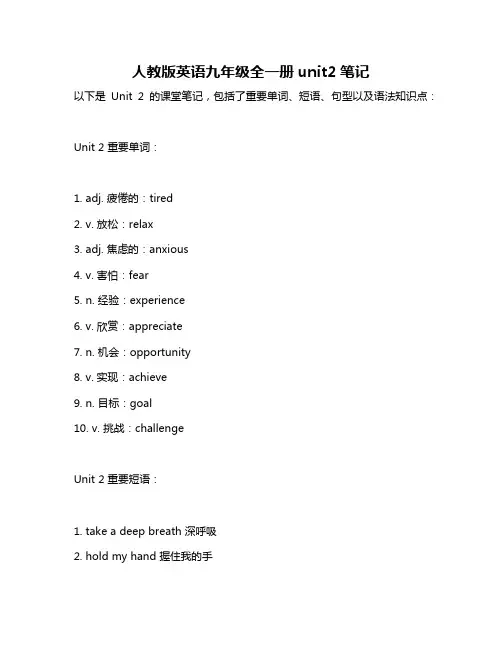
人教版英语九年级全一册unit2笔记以下是Unit 2的课堂笔记,包括了重要单词、短语、句型以及语法知识点:Unit 2 重要单词:1. adj. 疲倦的:tired2. v. 放松:relax3. adj. 焦虑的:anxious4. v. 害怕:fear5. n. 经验:experience6. v. 欣赏:appreciate7. n. 机会:opportunity8. v. 实现:achieve9. n. 目标:goal10. v. 挑战:challengeUnit 2 重要短语:1. take a deep breath 深呼吸2. hold my hand 握住我的手3. calm down 冷静下来4. get butterflies in my stomach 心头鹿撞5. worry about 为...担心6. be nervous about 对...感到紧张7. be anxious about 对...感到焦虑8. be scared of 对...感到害怕9. look forward to 盼望,期待10. in the future 在未来Unit 2 重要句型:1. I feel tired these days. (现在时态,描述当前状态)2. I was really nervous before the big speech. (过去时态,描述过去发生的动作)3. I will challenge myself to do things I didn't think I could do before. (将来时态,描述将来的动作)4. It's important to learn how to deal with stress. (形式主语,强调某事的重要性)5. I look forward to hearing from you. (固定句型,表示期待)6. I have a goal to achieve. (动词不定式作后置定语,表示目标)7. It's a waste of time doing sth. (动名词作主语,表示某事是浪费时间)8. I'm sorry to hear that you're feeling down. (固定句型,表示同情或安慰)9. The best way to relax is through exercise. (动词不定式作后置定语,表示放松的最好方式)10. I will try my best to get the job. (动词不定式作目的状语,表示努力) Unit 2 语法知识点:1. 现在完成时态(Present Perfect Tense):用于描述过去发生的动作对现在的影响或结果。
初中英语 Unit 2 重点单词,短语和句子归纳 人教版九年级全一册
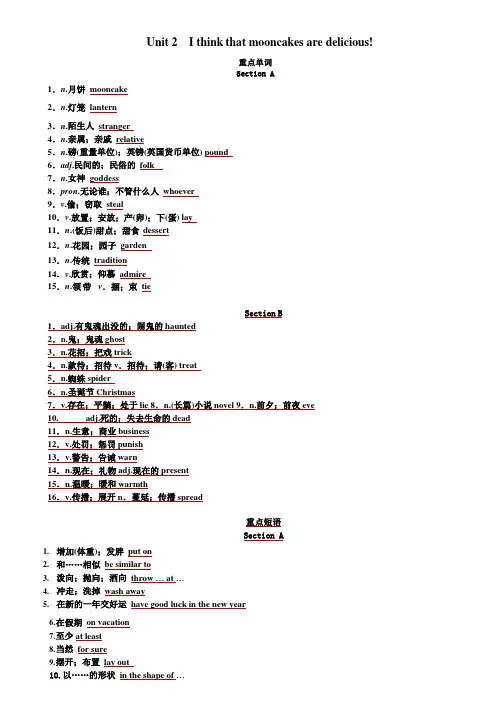
Unit 2 I think that mooncakes are delicious!重点单词Section A1.n.月饼mooncake2.n.灯笼lantern3.n.陌生人stranger4.n.亲属;亲戚relative5.n.磅(重量单位);英镑(英国货币单位) pound6.adj.民间的;民俗的folk7.n.女神goddess8.pron.无论谁;不管什么人whoever9.v.偷;窃取steal10.v.放置;安放;产(卵);下(蛋) lay11.n.(饭后)甜点;甜食dessert12.n.花园;园子garden13.n.传统tradition14.v.欣赏;仰慕admire15.n.领带v.捆;束tieSection B1.adj.有鬼魂出没的;闹鬼的 haunted2.n.鬼;鬼魂 ghost3.n.花招;把戏 trick4.n.款待;招待 v.招待;请(客) treat5.n.蜘蛛 spider6.n.圣诞节 Christmas7.v.存在;平躺;处于 lie 8.n.(长篇)小说 novel 9.n.前夕;前夜 eve10. adj.死的;失去生命的 dead11.n.生意;商业 business12.v.处罚;惩罚 punish13.v.警告;告诫 warn14.n.现在;礼物 adj.现在的 present15.n.温暖;暖和 warmth16.v.传播;展开 n.蔓延;传播 spread重点短语Section A1.增加(体重);发胖put on2.和……相似be similar to3.泼向;抛向;洒向throw … at …4.冲走;洗掉wash away5.在新的一年交好运have good luck in the new year6.在假期on vacation7.至少at least8.当然for sure9.摆开;布置lay out10.以……的形状in the shape of …11.在中秋节的晚上on the Mid-Autumn night12.射下shoot down13.赏月admire the moon14.与……分享……share … with …15.计划做某事plan to do sth16.拒绝做某事refuse to do sth.17.给某人某物give sb. sth.= give sth. to sb.18.结果as a result19.带某人出去吃午餐take sb. out for lunch20.(在某物上)花钱spend money (on sth.)Section B1.不招待就捣乱 trick or treat2.捉弄某人 play a trick on sb.3.款待某人 give sb. a treat4.装扮成……dress up (as)5. 使某人或某物做某事 make sb./sth. do sth.6. 关掉 turn off7. 听起来像 sound like8. 最终成为;最后处于end up9. 关心;在意 care about10. 醒来 wake up11. 在危难中 in danger12. 对待每一个人都充满善意和温暖 treat everyone with kindness and warmth13. 挣钱 make money14. 提醒某人做某事 warn sb. to do sth.15.期待某人做某事 expect sb.to do sth.16.带某人(回)去某地 take sb. (back) to sp.17.使某人回想起某事 remind sb. of sth.18. 过去常常做某事 used to do sth19. 许诺(某人)做某事 promise (sb.) to do sth20. 因(做)某事而惩罚某人 punish sb. for (doing) sth21. 分发;散发 give out =hand out22. 到处传播……spread … around23. 新生命的象征 a symbol of new life24. 孕育生命 give birth to life重点句型Section A1.多么美好的一天啊!What a great day!2.无论谁喝了此药便能长生不老,后羿打算和嫦娥一起服用。
Unit1--2知识点归类讲练 九年级英语人教版全一册(教师版)
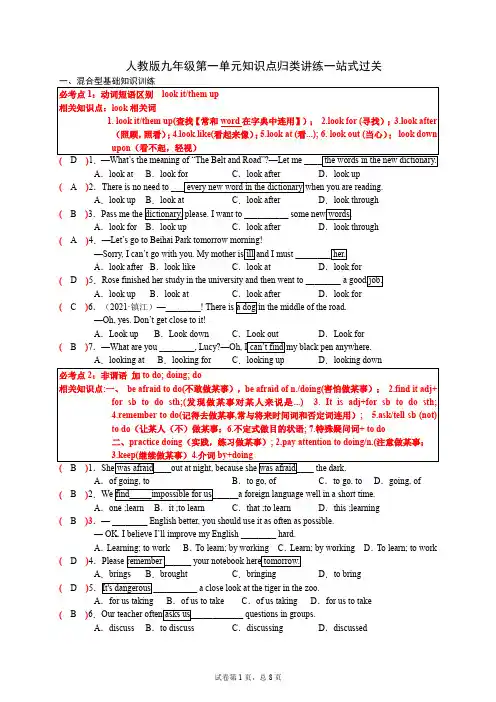
人教版九年级第一单元知识点归类讲练一站式过关A.look at B.look for C.look after D.look up( A)2.A.look up B.look at C.look after D.look through( B)3.A.look for B.look up C.look after D.look through( A)4.—Let’s go to Beihai Park tomorrow morning!A.look after B.look like C.look at D.look for( D)5.A.look up B.look at C.look after D.look for( C)6.(2021·镇江)—Oh, yes. Don’t get close to it!A.Look up B.Look down C.Look out D.Look for( B)7.A.of going, to B.to go, of C.to go, to D.going, of( B)2.A.one ;learn B.it ;to learn C.that ;to learn D.this ;learning( B)3.— ________ English better, you should use it as often as possible.— OK. I believe I’ll improve my English ________ hard.A.Learning; to work B.To learn; by working C.Learn; by working D.To learn; to work( D)4.A.brings B.brought C.bringing D.to bring( D)5A.for us taking B.of us to take C.of us taking D.for us to take( B)6.A.discuss B.to discuss C.discussing D.discussed( A)7.-It's important for us to know ____ all the subjects.-Yeah, group work is my favorite.A.how to study B.when to study C.which to study D.what to study( C)8.— Jane’s spoken English is pretty good.A.spoke B.to speak C.speaking( B)9.A.to listen B.to listening C.listened D.listen( C )26.﹣Hello,Lucy,please give me some____on how to improve my English!﹣You'd better keep___more English books.A.advices;read B.advice;read C.advice;reading D.advices;reading1.2.3.4.My teacher told me many good methods to review (review) my lessons.56789.1.他的汉语不好,理解他的话有点儿难。
人教版九年级英语全一册知识点Unit2知识点总结
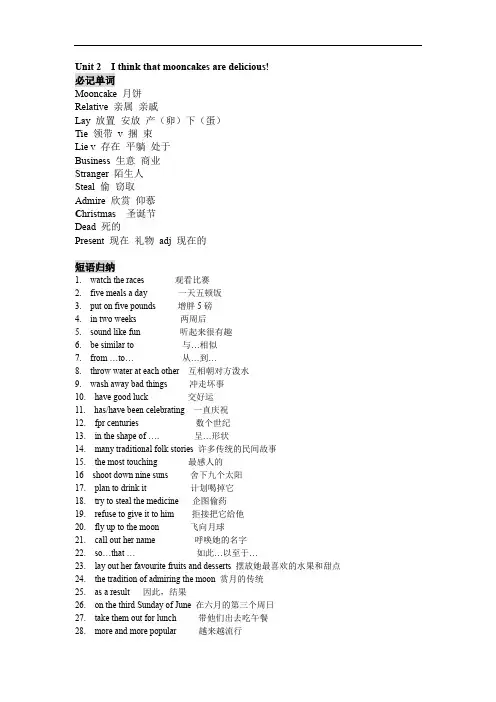
Unit 2 I think that mooncakes are delicious!必记单词Mooncake 月饼Relative 亲属亲戚Lay 放置安放产(卵)下(蛋)Tie 领带v 捆束Lie v 存在平躺处于Business 生意商业Stranger 陌生人Steal 偷窃取Admire 欣赏仰慕C hristmas 圣诞节Dead 死的Present 现在礼物adj 现在的短语归纳1. watch the races 观看比赛2. five meals a day 一天五顿饭3. put on five pounds 增胖5磅4. in two weeks 两周后5. sound like fun 听起来很有趣6. be similar to 与…相似7. from …to… 从…到…8. throw water at each other 互相朝对方泼水9. wash away bad things 冲走坏事10. have good luck 交好运11. has/have been celebrating 一直庆祝12. fpr centuries 数个世纪13. in the shape of …. 呈…形状14. many traditional folk stories 许多传统的民间故事15. the most touching 最感人的16 shoot down nine suns 舍下九个太阳17. plan to drink it 计划喝掉它18. try to steal the medicine 企图偷药19. refuse to give it to him 拒接把它给他20. fly up to the moon 飞向月球21. call out her name 呼唤她的名字22. so…that … 如此…以至于…23. lay out her favourite fruits and desserts 摆放她最喜欢的水果和甜点24. the tradition of admiring the moon 赏月的传统25. as a result 因此,结果26. on the third Sunday of June 在六月的第三个周日27. take them out for lunch 带他们出去吃午餐28. more and more popular 越来越流行29. help sb. do/to do /with sth. 帮助某人做某事30. dress up as ghosts 装扮成鬼31. play a trick on sb. 捉弄某人32. give sb a treat 款待某人33. treat sb.nicely 对待某人友好34. treat sb.with kindness and warmth 用善心和热情对待…35. on October 31st 在10月31 日36. think of 想起37. the true meaning of Christmas 圣诞节的真正意义38. the importance of sharing 分享的重要性39. a novel written by LuXun 一篇鲁迅写的小说40. think about himself 考虑自己41. care about 在乎,关心42. warn sb. (not) to do 告诫某人(不)去做某事。
人教版英语九年级全一册Unit2单元分层练习设计含答案
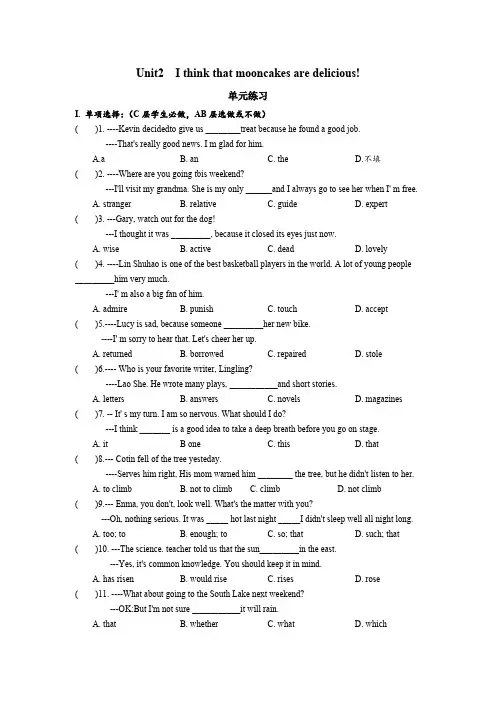
Unit2 I think that mooncakes are delicious!单元练习I. 单项选择:(C层学生必做,AB层选做或不做)( )1. ----Kevin decidedto give us ________treat because he found a good job.----That's really good news. I m glad for him.A.aB. anC. theD.不填( )2. ----Where are you going tbis weekend?---I'll visit my grandma. She is my only ______and I always go to see her when I' m free.A. strangerB. relativeC. guideD. expert( )3. ---Gary, watch out for the dog!---I thought it was _________, because it closed its eyes just now.A. wiseB. activeC. deadD. lovely( )4. ----Lin Shuhao is one of the best basketball players in the world. A lot of young people _________him very much.---I' m also a big fan of him.A. admireB. punishC. touchD. accept( )5.----Lucy is sad, because someone _________her new bike.----I' m sorry to hear that. Let's cheer her up.A. returnedB. borrowedC. repairedD. stole( )6.---- Who is your favorite writer, Lingling?----Lao She. He wrote many plays, ___________and short stories.A. lettersB. answersC. novelsD. magazines ( )7. -- It' s my turn. I am so nervous. What should I do?---I think _______ is a good idea to take a deep breath before you go on stage.A. it B one C. this D. that( )8.--- Cotin fell of the tree yesteday.----Serves him right, His mom warned him ________ the tree, but he didn't listen to her.A. to climbB. not to climbC. climbD. not climb( )9.--- Enma, you don't, look well. What's the matter with you?---Oh, nothing serious. It was _____ hot last night _____I didn't sleep well all night long.A. too; toB. enough; toC. so; thatD. such; that ( )10. ---The science. teacher told us that the sun_________in the east.---Yes, it's common knowledge. You should keep it in mind.A. has risenB. would riseC. risesD. rose( )11. ----What about going to the South Lake next weekend?---OK:But I'm not sure ___________it will rain.A. thatB. whetherC. whatD. which( )12.--- __________will the breakfast be ready?----In two minutes.A. How farB. How longC. How soonD. How often( )13. ---___________role she played in the movie!---Yeah, that’s why she has a lot of fans.A. How interestingB. How an interestingC. What interestingD. What an interesting ( )14. ---We' re going to have a party for mothers on Mother' s Day.---____________. May I join you?A. Sounds like funB. No problemC. Have a good tripD. Help yourself( )15. ---______________? I saw Sllyy in London.- ----Really? I thought she was in New York.A. How comeB. Why notC.So whatD. Guess whatII. 完形填空。
人教版九年级英语unit2知识点
人教版九年级英语unit2知识点English:Unit 2 of the 9th-grade English textbook from People's Education Press covers various language points and skills. The unit typically focuses on themes like "My Day" or "Daily Routines," introducing vocabulary related to activities, time, and daily routines. Grammar points often include present simple tense for habitual actions, adverbs of frequency, time expressions, and prepositions of time. Additionally, students may learn about the use of conjunctions to express reasons, such as "because" and "so," to link ideas in sentences. Reading passages within this unit usually revolve around descriptions of daily activities or routines, offering practice in comprehension and extracting key information. Writing tasks may involve describing one's daily routine, using appropriate vocabulary and grammar structures learned throughout the unit. Overall, Unit 2 aims to enhance students' ability to talk about their daily lives, understand written descriptions, and express themselves effectively in both spoken and written forms.Translated content:人教版九年级英语教材第二单元涵盖了各种语言要点和技能。
人教版九年级英语全一册《Unit 2 Section B》作业同步练习题及参考答案
Unit 2 I think that mooncakes are delicious!Section B(1a-1d)一、根据句意及汉语提示完成单词1.The kid is afraid of (蜘蛛).2.My grandmother often told me some (鬼)stories when I was a child.3.Tom will (款待)us to lunch.4.If you watch carefully,you’ll see how the (把戏) is done.5.It is said that there is a (闹鬼的)house in that village.二、将下列短语与相应的图片匹配1.dress up2.haunted house3.trick or treat4.Halloween pumpkin三、单项选择★1.John dressed up a cartoon character at the dancing party.A.withB.ofC.asD.for2.We took the kids to the zoo as a special .A.cakeB.treatC.relativeD.dessert3.—?—I think it is really fun to put things like ghosts around the door.A.What does she think of the festivalB.Do you like the festivalC.What have you learned about the festivalD.What do you like most about the festival4.—What did you do on April Fool’s Day?—I played a trick my brother.A.onB.toC.withD.at★四、完形填空March 15th is a special day for almost everyone in the UK.At school,kids get to wear their own1 instead of uniforms.In offices,people do lots of silly things,like crazy dances.In the streets,some people 2 to sell cakes.And,strangest of all,everybody is wearing a red nose.This day is called Red Nose Day.It is a huge 3 event in the UK every other year.On this day,many people,from the famous to 4 people,wear a red plastic nose and do something funny to 5 money.All the money they raise goes to help the poorest people in the UK and Africa.6 Africa?The story goes back to 1985.There was a big TV show on the BBC which had many7 on it.It hoped to make the public laugh so that they would donate money.With the money they made,they would help people in Africa.The 8 Red Nose Day happened in 1988.Since then,Red Nose Day has raised over $600 million and helped 9 50 million lives in the UK and Africa.It has become one of the 10 charity events on the UK calendar.1.A.shoes B.hats C.trousers D.clothes2.A.put on B.dress up C.get down D.take off3.A.charity B.sport C.art D.music4.A.popular B.great C.ordinary D.important5.A.collect B.spend C.raise D.share6.A.When B.Why C.Which D.How7.A.librarians B.assistantsC.engineersedians8.A.first B.second C.third st9.A.make B.choose C.change D.celebrate10.A.smallest B.biggestC.easiestD.happiest答案与解析一、1.spiders 2.ghost 3.treat 4.trick 5.haunted二、1.A 2.C 3.B 4.D三、1.C 2.B 3.D 4.A四、1.D 2.B 3.A 4.C 5.C 6.B 7.D 8.A 9.C 10.BSection B(2a-2e)一、根据句意及首字母提示完成单词1.Charles Dickens wrote lots of famous n in his life.2.The teachers often w us to finish our homework on time.3.It’s sunny.People are enjoying the w of the sun in front of the houses.4.It’s none of your b .Please leave me alone.5.People usually have a party on C Eve. 二、用方框内所给单词的适当形式填空present punish lie dead spread mean1.The old man on a very cold night.2.Do you know the Chinese of the new word?3.Don’t do that again,or you will be by our teacher.4.At present,he has got more than ten .5.Look!There is an old lady on the road.6.Word quickly that she was leaving.三、单项选择★1.There are some dangerous fishes in this river,and I’ve warned the kids here.A.not to swimB.to not swimC.swim not toD.to swim not2.Now I realized the of eating a healthy diet.A.spiritB.meanC.importanceD.kindness★3.If you continue to steal,you’ll in prison.e upB.take upC.end upD.go up4.Don’t be so mean.You should learn to others more than yourself.A.take careB.care aboutC.warn aboutD.worry about5.(2018·辽宁沈阳中考)He look at the stars every night, but now he does not.A.had bettered toC.ought toD.had to6.(2017·吉林长春中考) Chinese culture,many college students go to foreign countries every year.A.SpreadingB.To spreadC.SpreadsD.Spread★四、阅读填句In UK schools,there is an old tradition of putting older students in charge of (负责) younger students outside of the classroom.This is called the prefect system (级长制度).1. At Hogwarts,prefects can walk the dorm(宿舍) halls to make sure that no one is out at night.The prefect system in the UK is as old as school itself.2. They hit younger students with sticks and often treated them as personal slaves(奴隶).Prefects had to make sure that younger students behaved in the dorms,but they could carry out the rules in any way they pleased.3. Even today,many parents remember how badly the prefects treated schools don’t have prefects,either.4. In China,there are class monitors.5. And monitors can’t punish other students.It is an honor to be a monitor,and students take their jobs very seriously.Whether it’s as a prefect,a monitor or a class president,schools around the world give young students good chances to become leaders.A.Teachers choose monitors for their leadership,good behavior and high grades.B.If you read Harry Potter, you have heard of prefects(监督生).C.They like to choose a class president over a prefect.D.In the past,prefects at boarding schools were known for being very cruel(残忍的).E.Because of prefects’bad behavior,most UK schools have decided to end the prefect system.答案与解析一、1.novels 2.warn 3.warmth 4.business 5.Christmas二、1.died 2.meaning 3.punished 4.presents 5.lying 6.spread三、1.A 2.C 3.C 4.B 5.B 6.B四、1.B 2.D 3.E 4.C 5.ASection B(3a)-Self Check一、用方框内所给单词或短语的适当形式填空spread ...around relative lie not only ...but also ... give out1.Miss Chen on the bed to have a rest as soon as she got home from work.2.I saw a young lady handbills(传单) in the street.3. is he very clever, hardworking.4.I was told not to the secret .5.Do you often visit your friends or on weekends?★二、补全对话Michael:It seems that the whole world has gone Christmas mad!Billy:1.Michael:Everywhere I look I see Christmas decorations and everywhere I go I hear Christmas carols!Billy:Well,2.Michael:What about Christmas cards?3.Billy:4. I bought cards in July,arranged my address book in September,wrote the cards in November and posted them two weeks ago.Michael:What about your Christmas shopping?5.Billy:I did all of that in July during the sales,so I could save a fortune.Michael:I have so much to learn!A.Have you sent yours yet?B.Why do you say that?C.You know that I am always well organized.D.I bet you have not finished that yet!E.decorations and carols are two important aspects of Christmas.★三、短文填空Laba Porridge(腊八粥) is known to every Chinese.It marks a special day,Laba Festival,which comes 1. the 8th day of the 12th lunar(农历的) month.People eat Laba Porridge on that day.The porridge is also 2. “Eight Treasures Porridge”,because it usually has at least eight things.Rice,beans,dried fruits and peanuts are very 3. in the porridge.On the night before the festival,mothers are busy 4. their porridge.They cookit over a slow fire from midnight to the next morning.When kids wake up in the morning,they smell the aroma(香味) and rush to the kitchen to have a feast.5. custom on Laba Festival is to prepare Laba vinegar(醋) for dumplings on Spring Festival Eve.People peel garlic(蒜) and put it into a jar(罐子) filled with vinegar.6. the days go by,the garlic turns green and gains a special flavor.Some people also like to pickle(腌) meat on Laba baFestival was a time for the ancient Chinese to pray for the harvest(丰收) and good 7.in the coming year.After Laba Festival,many people 8. to prepare for the Chinese New Year.答案与解析一、y 2.giving out 3.Not only;but also 4.spread;around 5.relatives二、1.B 2.E 3.A 4.C 5.D三、1.on 2.called/named 3.popular 4.making/preparing 5.Another 6.As 7.luck8.start/begin。
人教版九年级unit2知识点总结
人教版九年级unit2知识点总结Unit 2 Knowledge Points Summary (人教版九年级)Unit 2 of the ninth grade textbook focuses on the theme "How often do you exercise?" This unit covers a wide range of topics related to health, daily routines, and frequency adverbs. In this article, we will summarize the main knowledge points discussed in this unit.1. Vocabulary Expansion:In this unit, students are introduced to various vocabulary related to exercise, health, and daily routines. Some of the key words include "exercise, regularly, rarely, occasionally, diet, junk food, nutritious, advantage, disadvantage, benefit, sedentary lifestyle," and more. It is important for students to memorize and understand these words in order to effectively communicate about these topics.2. Frequency Adverbs:Unit 2 heavily emphasizes the use of frequency adverbs to express how often activities are done. Common frequency adverbs include "always, usually, often, sometimes, rarely, and never." These adverbs are used to modify verbs and can be placed before the main verb orafter the verb "be." For example, "I always exercise in the morning" or "She is often late for class."3. Comparative and Superlative Adjectives:In this unit, students learn to use comparative and superlative adjectives to compare the frequency of activities. Comparative adjectives are used to compare two things, while superlative adjectives are used to compare three or more things. For example, "I exercise more often than my friend" or "He exercises the most frequently in our class."4. Present Simple Tense:The present simple tense is widely used in Unit 2 to talk about routines and habits. It is used to express actions that are repeated regularly, general truths, and permanent situations. For example, "She exercises every day" or "Water boils at 100 degrees Celsius." It is important for students to understand the usage and formation of present simple tense sentences.5. Grammar Structures:Apart from present simple tense, this unit also introduces students to other grammar structures such as the use of "how often" and "why."For example, "How often do you exercise?" or "Why do you eat junk food?" These structures allow students to ask and answer questions about frequency and reasons behind certain habits.6. Reading and Listening Comprehension:Throughout Unit 2, students are exposed to various reading and listening exercises that test their understanding of the topics covered. These exercises help students internalize the vocabulary and grammar structures while improving their overall comprehension skills.7. Cultivating Healthy Habits:A significant part of this unit focuses on the importance of exercise and a healthy lifestyle. Through discussions and activities, students are encouraged to reflect on their own habits and make positive changes. This unit promotes the idea that regular exercise and a balanced diet are crucial for maintaining good health.In conclusion, Unit 2 of the ninth-grade textbook covers an array of knowledge points related to health, exercise, and frequency adverbs. By mastering the vocabulary, grammar structures, and concepts discussed in this unit, students can effectively express their routines, compare habits, and engage in conversations about health and exercise.Implementing the knowledge gained from this unit can pave the way for a healthier lifestyle.。
Unit2+Grammar 人教版英语九年级全册+
8. ——I hear we’ll have a new English teacher soon. Do you
陈述语序
What your name is.
Can you sing? Is she happy?
You can sing. She is happy.
Will you help me ?
You will help me .
Does she have a basketball? She has a basketball.
从句三要素
01. 引导词 02. 语序 03. 时态
三要素
引导词 (连接词)
什么都不缺 that
是否的含义 if / whether
特殊疑问词 what / where / when / who…
语序
陈述句的语序
时态
(1)主现从不限 (2)主过从必过 (3)真理永为现
01. 引导词
找出下列宾语从句的引导词
1.She asked_________________. A. what they would choose B. which would they choose C. what will they choose
2.——I’d like to know_________. ——Maybe in the forest. A. where we will go shopping B. whether we will go shopping C. where will we go shopping
人教版英语九年级全一册unit2知识点
人教版英语九年级全一册unit2知识点Unit 2 of the 9th grade English textbook published by the People's Education Press covers a variety of language topics and skills. This article aims to explore and discuss some of the key points and concepts in this unit.One of the main focuses of Unit 2 is vocabulary expansion. Learning new words and phrases is crucial to improving language proficiency. The unit introduces students to a range of vocabulary related to different topics such as school life, hobbies, and emotions. By incorporating various activities and exercises, students can practice using these words in context and learn how to apply them in their daily conversations.Grammar is also an essential part of Unit 2. The unit presents grammar points like the present continuous tense, possessive pronouns, and comparative forms of adjectives. These grammar structures allow students to express actions happening at the moment or in the near future, indicate possession, and make comparisons between two or more objects. Understanding and applying these grammar rules enable students to create more accurate and meaningful sentences.In addition to vocabulary and grammar, Unit 2 includes listening and speaking activities to enhance students' communication skills. The listening materials provided in the unit expose students to different accents and speech patterns, helping them improve their listening comprehension. Through listening exercises, students can practice identifying key information, understanding main ideas, and inferring meaning from context.The speaking activities in Unit 2 encourage students to engage in conversations and express their opinions. Role-plays, discussions, and presentations are designed to promote interaction and collaboration among students. These activities provide opportunities for students to use the target language in a meaningful and authentic way, enhancing their fluency and confidence in spoken English.Furthermore, Unit 2 introduces reading materials that cater to students' interests and expand their reading comprehension skills. The texts cover a variety of genres, including narratives, dialogues, and informational articles. By engaging with these texts, students can strengthen their reading strategies such as skimming for general information, scanning for specific details, and making inferences. They also learn how to analyze and interpret texts, enhancing their critical thinking skills.Unit 2 also delves into writing skills, allowing students to practice different types of writing tasks. This includes descriptive writing, writing about daily routines, and writing dialogues. Through these activities, students learn how to organize their ideas, structure their writing, and use appropriate vocabulary and grammar. Writing is essential for communication and self-expression, and the writing tasks in Unit 2 help students develop these skills.Overall, Unit 2 of the 9th grade English textbook provides a comprehensive coverage of various language skills and components. From vocabulary expansion to grammar rules, listening comprehension to speaking practice, reading strategies to writing tasks, the unit equips students with the necessary tools to become proficient English language users. By engaging in diverse activities and exercises, students can improve their linguistic abilities and build a solid foundation for further language learning.。