
八年级英语人教版下册第九单元Unit9 Section A2
the Hangzhou National Tea Museum (Linlin)
2. What do you think is the most interesting thing about each museum? American Computer Museum-the special computer can play chess even better than humans. the International Museum of Toilets-many different kinds of toilets
2. What can we learn at the International Museum of Toilets?
We can learn the history and development of toilets.
3. Why is the Hangzhou National Tea Museum a nice place to enjoy tea? Because it’s a relaxing and peaceful place near a lake.
Name the kinds of museums that
you know.
science museum film museum
historer museum
art museum
nature museum space museum
What’s the full name of each museum?
2)He had a _____look at it. 他匆匆地扫了一眼 quick quick breakfast and hurried to work. 3)She ate a _____ 她匆匆吃了早餐就赶去上班. 4)He made _______ rapid progress in English. 他在英语方面取得了很快的进步
a nice/good/quiet place to do sth.: “一个做某事的好/安静的地方 这个公园是一个 放松的好地方。 The park is a nice place to relax.
揭示预习案
1. the most interesting thing_____________ 最有趣的事情 a very unusual 2.一个非常不同寻常的博物馆 _____________ museum 3. have been to___________ 曾经去过 4. such a rapid way______________ 如此快的方式 in the future 5 be able to 能够 _________6.在将来_________ social group8.考虑______ think about 7.社会团体__________ as…as… 9. 和……一样 ____________ 10.湖边near ______ a lake a nice place to enjoy tea 11.一个品茶的好地方 ____________
3b. Read the passage again and answer the following questions.
1. What does Ken say about the American Computer Museum?
It’s unbelievable that technology has progressed in such a rapid way.
encourage:encourage sb. to do sth. “鼓励某人做某事”
Amy: I’ve recently been to a very unusual museum in India, the International Museum of Toilets. I just couldn’t believe my eyes when I saw so many different kinds of toilets there. The museum teaches people about the history and development of toilets. It also encourages governments and social groups to think about ways to improve toilets in the future.
encouragement 拓展:encourage的名词为____________ 练习:我的老师总是鼓励我要大声朗读英语 Our teacher always encourages me to __________________________________ read English loudly.
4.-I’ve never been to a water park. -Me neither.此对话中,me neither意为 我也没有 ____________
想想,我们还可以怎么来表达我也没有呢? have _____. I Neither ____
练习:She has never been there. I have never been there, either. (改为同义句) Me neither She has never been there. _____ 5. invent v 发明→inventor n 发明家 → invention n 发明 invented Edison , a great _____________, _______ inventor ___over 1’000__________ inventions all his life. (invent)
Linlin: Last year I went to the Hangzhou National Tea Museum. It’s a relaxing and peaceful place near a lake. The tea art performances show how to make a perfect cup of tea with beautiful tea sets. Watching the tea preparation is just as enjoyable as drinking the tea itself. I’ve finally realized why my grandpa loves drinking tea and collecting tea sets.
这三个单词的基本意思都是“快的,迅速的”, 1.fast表示的是物体的运动速度很快,比如汽车开的 快,人走的快,时间过的快,都可以用fast来形容。 2.rapid表示的是物体或者说是事情变化得快,比如价 格涨的快,社会变革快,学习进步快等。 3.quick用来表示动作很快,一下就结束了,比如快 速的看一眼,快速阅读等,有时还含有匆忙之意。 fast as she could. 她有好快就跑好快 1)She ran as _____
Language points
2.It’s unbelievable that technology has progressed in such a rapid way! 动 词。此外 【解析1】此句中progress 为_____ 名 词,构成短语make ,还可作_____ progress(in)…意为(在某方面)取得进步 练习:在英语学习方面,她取得了很快的/很 大的/一点点的进步。 She made a rapid/a big/ a small progress in ______________________ English.
II. 阅读训练
Last year I went ______ to the Hangzhou National relaxing and________ peaceful Tea Museum. It is a _______ __ place near a lake. The tea art performanc show how to make a _________cup perfect es ______ of tea sets. Watching _____ the tea preparation is just as enjoyable ____ as drinking the tea ______. itself I h ave finally ____________ realized why my grandp a loves drinking tea and _______________ t collecting ea sets.
【解析2】unbelievable 难以置信的;不真 实的(反)believe 【记】believe +able = believable 可信的 un + believable =unbelievable 难以置 信的 That story is unbelievable. 3. It also encourages governments and social groups to think about ways to improve toilets in the future. encourage sb. to do sth. 意为 _________________ 鼓励某人去做某事
the American Computer Museum
the International Museum of Toilets
Hangzhou National Tea Museum
Scanning
1. Which three museums do the students talk about? the American Computer Museum (Ken) the International Museum of Toilets (Amy)
初中英语人教版八年级下册Unit9 sectionB 2a-2e
Unit 9 Have you ever been to a museum?Section B (2a-2e)Teaching Aims1. Knowledge and Ability Objects(1) Key vocabulary:Singapore, population, southeast Asia, western food, Indian food, Night Safari…(2) Target language:Have you ever tried/seen/ been…?(3) To train students’ listening, speaking reading abilities and skills..2.Moral aims:(1) To raise students’ interest of learning English.(2) To make students get to know cultures of other countries.Teaching Key Points1. Key vocabulary in this period.2. Target language in this period.Teaching Difficulties1. Improve students’ listening.2. Improve students’ reading skills.Teaching methods(1) The activity teaching methods.(2)The cooperative learning method,(3)The institutional teaching methods.Teaching Aids1. A computer for multimedia use.2. A tape recorder.Teaching Steps:Step 1 Free talk1.Talk about what should we learn before our journey.Step 2 Pre-readingT shows pictures about Singapore. Let Ss guess what country is it?What do you know or want to know about Singapore?Step 3 While reading1.Fast readingRead the article and answer the question:How many reasons can you find for visiting Singapore?1)Wonderful and safe place to take a holiday.2)Can speak Putonghua3)Good place to speak English.4)Able to find a lot of food from China.5)Place to try new food.6)The night Safari.7)Temperature is almost the same all year round.8)Not too far from China.2.Careful reading(1)Read again and Fill in the blank.a) Singapore’s geographical positio n A small island (1) ____________b) Language(s) people speak in Singapore (2) ______________________c) Food we can find in Singapore Chinese food, (3) __________ and Japanese food.d) Name of the night zoo in Singapore(4) ___________e) Temperature in Singapore It is (5) ______________ all year round.Keys: 1. in Southeast Asia 2. Putonghua and English 3. Indian food, western food 4. Night Safari 5. almost the same(2)Read and work on 2c. The statements below are false. Use information from the article to correct them.1)Most people in Singapore only speak English.2)It is not easy to get many different kinds of good food in Singapore.3)It’s better to see lions and tigers during the daytime because they willpr obably be awake.4)It’s best to visit Singapore in the autumn.Keys: 1. both English and Chinese 2. very easy 3. at night 4. whenever you like(3)Read and find something important and difficult:(4)Discuss and try to use the useful expressions.on the one hand …on the other hand…/have problems (in) doingchoose to do sth./whenever=no matter when/three quarters thousands ofStep 4 After reading1.watch a video about Singapore.2.Share with the students according to the chart below.3.Make some notes about Singapore. Write down anything that you remember. Step5.HomeworkSearch information about other countries and share with your friends.。
Unit9SectionA(2d3c)课件人教版英语八年级下册

Anna: It's really interesting, isn't it It’s a great twoasypend a
Saturday afternoon反. 义疑问句
Jill: Yes, I love all the old movie cameras there.leIarned about
My sister has been to Dalian twice. 我姐姐去过大连两次。 Have you ever been to the West Lake? 你曾经去过西湖吗?
have/has gone to
表示“去某地了” (去了还没回 — Where is Jim?吉姆在哪里? 来),暗含说话时该人不在现场。 — He has gone to England.他
现在完成时的标志词还有:
just(刚刚),before(以前;之前),so far(到目前为止)也可 以用于现在完成时,谈论刚刚发生的动作或者过去的经历。
Have you helped others before?你以前帮助过别人吗? I have just helped a little kid. 我刚刚帮助了一个小孩。
I’ve never been to a water park. Me neither.
二、have/has been to 与 have/has gone to 的区别
have/has been to
表示“曾经去过某地”(去了已 经回来了)。后可接次数,如 once, twice, three times 等,表 示“去过某地几次”,也可和 just,never,ever等连用。
is famous for his inventions.
八年级-人教版-英语-下册-Unit 9 Section A (Grammar Focus-4c)
Section A (Grammar Focus-4c)
a couple of German theme ride province
两个;一对;几个 adj. / n. 德国的;德语的;德国人的 / 德语;德国人 n. 主题 n. 供乘骑的游乐设施;短途旅程 n. 省份
4a Put the correct forms of the verbs in the blanks.
1.A: Do you want _to__co_m__e_(come) to the space museum? B: No, I’ve already __b_e_e_n__(be) there three times.
4b Fill in the blanks with the correct forms of the verbs in brackets.
Most of us __h_av_e__s_e_en__(see) Mickey Mouse, Donald Duck and other famous Disney characters in cartoons before. But have you ever _b_e_e_n__ (be) to Disneyland? Disneyland __i_s_ (be) an amusement park with a special theme—Disney characters and movies. There _a_r_e_ (be) many exciting rides, lovely restaurants and fantastic gift shops there. You can also _s_e_e_ (see) the Disney characters walking around the park. And have you ever _h_e_a_r_d_ (hear) of a Disney Cruise? This _i_s_ (be) a boat ride with a Disney theme. You can __ta_k_e__ (take) a ride on the boat for several days and eat and sleep on it. On the boat, you can _s_h_o_p_ (shop) and have Disney parties before you _a_r_r_iv_e_ (arrive) at the Disney island.
英语人教版八年级下册unit9
1d What places have you been to?
Ask your partner. Have you visited …? Have you been to …? Have you seen …? Have you tried …?
Zi Wei Cave
The Ziwei Cave
8. We planned to go out, but ended up watching ____________ (watch) TV at home.
Summary Have you visited …? Have you been to …? Have you seen …? Have you tried …?
5. Tina often ___________ (study) with her studies classmates after class.
6. I _____________________(visit) the space will / am going to visit museum tomorrow. 7. Let’s _______ sing (sing) a song for our teacher.
Australia: Sydney
France: Paris
Russia: Moscow
The United States: New York
1.I have _________(be) been to the zoo for three
times.
argued 2. Have you ever __________(argue) with your best friend? 3. Harvey _________(go) to the aquarium four went times last year. seen 4. I have never ________(see) this kind of animal before.
初中英语人教版八年级下册unit9 sectionA
Unit 9 Have you ever been to a museum ?Period 1 Section A 1a-1cTeaching AimsKey vocabulary: amusement; neitherTarget language:Lets' go somewhere different today.Have you ever been to…? Yes, I have./ No, I haven’t.How about/what about…?How are we going to get there?We can take the subway/…Ability AimsSs can talk about the past experiences with been, ever, never and language chunks.To train students’ listening and speaking skills.Moral AimsImprove the cooperative spirit of the Ss and let the Ss be proud of the interests of the world. Teaching key Points1. Key vocabulary in this period.2. Target language in this period.Teaching Difficult PointsLearn to talk about the past experiences by using “Have you ever been to....?”.Teaching ProceduresStep1 Warming-up1.Greet as usual.2.Review the Past Perfect Tense.Step2 Presentation1. Checking the words .2. Study the new language in group. Get students to work in groups to practice theconversation: “Have you ever been to…”“Yes, I have”/ Not, I haven’t.Step 2 Work on 1a .1. T: OK. Now open your books on Page 65. In Part 1a, 6 places are given. Please read thenames of these places. (Teacher writes the names on the blackboard.) Which of these places would you like to visit? Rank them from 1 to 5.2. Talk about the pictureStep 3 Listening 1b1. Look at the picture and answer.Know the names of the five museums.2. Listen again and answer:When did Sarah visit the National Science Museum?A. TodayB. YesterdayC. Last year2. When did Claudia visit the nature museum?Last year B. Last summer C. Last school trip3. What may the relationship be between the two speakers?A. FriendsB. Teacher and studentC. Mother and kid .Listen and repeat.3. Listen and check.4.Follow the tape.Step 4 Pair work.1. Example :A: Let’s go somewhere different today.B: OK. Where do you want to go?A: Have you ever been to the spacemuseum?B: No, 1 haven’t. How about you?A: A: Me neither. / Neither have I.2. Students work.Step 5板书设计Unit 9 Have you ever been to a museum?Section A (1a-1c)Has been to/has gone toMe neither.Neither have I.Have you ever been to a museum?Yes,I have.No,I have not.Step6 Homework.plete the exercises.2.Preview the next period.。
初中英语人教版八年级下册Unit 9
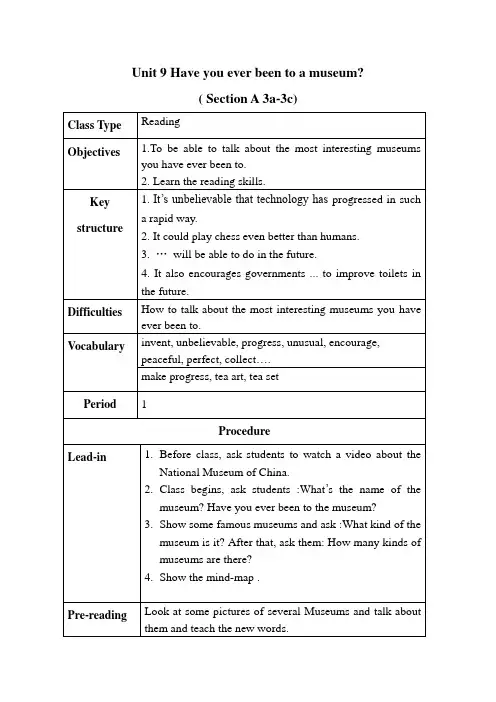
invent, unbelievable, progress, unusual, encourage,
peaceful, perfect, collect….
makeprogress, tea art, tea set
Period
1
Procedure
Lead-in
1.Before class, ask students to watch a video about the National Museum of China.
1.Read the magazine articlequicklyand find
out what kinds of museums it talks about.
2.Show a mind-map and check theanswers.
Step 2
Task 2:True or False
Read the article again andjunglethe followingstatementstrue or false.
2.Class begins, ask students :What’s the name of the museum? Have you ever been to the museum?
3.Show some famous museums and ask :What kind of the museum is it? After that, ask them: How many kinds of museums are there?
invent发明;创造peaceful和平的;安宁的
unbelievable难以置信的tea art茶艺
人教版初中英语八年级第九单元词汇
人教版初中英语八年级第九单元词汇以下是人民教育出版社出版的初中英语八年级第九单元的词汇表:Unit 9 Section Ahost family 寄宿家庭unforgettable 难忘的exchange student 交换生stay with sb 与某人待在一起practice doing sth 练习做某事improve one’s English 提高某人的英语水平go to the movies 看电影on weekends 在周末at night 在晚上invite sb to sp 邀请某人去某地be friendly to sb 对某人友好feel like 感觉像write sb a letter 给某人写信speak English fluently 流利地说英语make a lot of mistakes 犯很多错误guess the meaning of new words 猜测新词的意思choose a topic 选择一个主题look up new words in a dictionary 在字典中查找新词read the textbook 阅读教科书do some research 做研究a little bit 稍微,有几分,有几分be afraid to do sth 害怕做某事be sure to do sth 一定要做某事be able to 能够做某事have to do sth 不得不做某事need to do sth 需要做某事had better do sth 最好做某事feel comfortable doing sth 感觉舒服做某事seem to do sth 似乎做某事start doing sth 开始做某事stop doing sth 停止做某事enjoy oneself doing sth 玩得开心做某事be interested in 对……感兴趣be excited about 对……感到兴奋be happy about 对……感到高兴be proud of 对……感到自豪be/get used to sth/doing sth 习惯于做某事be terrified of sth/doing sth 害怕做某事be tired of sth/doing sth 对某事/做某事感到厌倦look forward to doing sth 盼望做某事how often 多长时间一次,每隔多久时间一次,频率副词。
英语人教版八年级下册unit9 Section A1a-2c
3.Ask the students to listen to the conversations one by one and finish three tasks .
4.Let Ss listen and repeat the second conversation.
3. Students will be able to tell the differences between the Present Perfect Tense and the Simple Past Tense.
Moral objects:
Students will be motivated to love the nature and love life.
Step 7
Summary& Homework
1.Lead students to recall what they have learned in this period.
2.Give students some exercises to do after class.
1.Recall what they learned and ask questions if they have.
Unit 9 Have you ever been to an amusement park?
By Pan Qi
Analysis
of
teaching material
This period is aiming at talking about past experiences using the Present Perfect Tense. The first period serves as an introduction and a leading-in part. The material in talking are mostly from the recent life and is familiar to them, so they will be interested in it. A series of questions and plenty of pictures are used to attract students’ attention. And listening pair work and group work are also used in this period.
八年级英语人教版下册第九单元unit9 Section A PPT
Sarah
√
√ √
Pair work
Ask and answer questions about the places in 1b. (1c)
A: Let’s go somewhere different today. B: OK. Where do you want to go? A: Have you ever been to the space
Unit 9
Have you ever been to a museum?
Hale Waihona Puke Section A Period One
预习检测
•Have you _e_v_e_r__b_e_e_n___ to an
_a_m_u__s_e_m_e_n__t _p_a_r_k____ ?
你曾去过游乐场吗?
•I __w_e__n_t___ there last year. 我去年去
(1) 英语中表示后者与前者情形相同“也 不……”时,常用neither引起的倒装句 Neither+助动词/系动词be/情态动词+主 语。如:
I’m not tall. Neither is she. = She’s not tall, either. 我个子不高, 她个子也不高。
(2) 如果表示后者与前者情形相同, “也……”,常用so引起的倒装句,so+ 助动词/系动词be/情态动词+主语。 如:
Pair work
Anna: So, what did you do on the weekend?
Jill: I camped in the mountains with some friends. We put up a tent and cooked outside.
英语人教版八年级下册Unit 9 SectionA Grammar focus
八年级 下册 Unit 9 Have you ever been to museum Section A 3 Grammar Focus-4c
辛集市旧城镇第一中学 姚茶闪
Play a game
Have a match: Who can make a paper model plane most quickly?
Reading
Second reading: . Fill in the blanks.
4b
Fill in the blanks with the correct forms of the verbs in brackets.
Most of us have ____________ (see) Mickey Mouse, seen
ห้องสมุดไป่ตู้
Summary this lesson
Thank you very much! Bye !
There _____ are (be) many exciting rides,
lovely restaurants and fantastic gift shops there. You can also _____ see (see) the Disney characters walking around the park. And have you ever _______ heard (hear) of a Disney Cruise? This ______ (be) a is boat ride with a Disney theme. You can ______ take (take) a ride on the boat for several days and eat and sleep on it.