
牛津小学英语(译林版)五年级上册U6教案
Unit6 My e-friend
课时
5—1
日期
教学目标
1.理解,掌握对话内容,用正确的语音语调朗读对话,初步表演对话。
2.正确运用日常交际用语How old is he/she?Do/Does?? Yes/No, ? do/don’t/does/doesn’t.What subjects does he like?He likes...
小组合作交流,通过对话的形式将上节课布置的有关朋友的作业拿出来展示交流。并对交流内容,提出问题,将课文中的重点进一步巩固强化。Step 4. Consolation (补充习题Page 1)
1、Listen and judge 2、Look,listen and circle.
Homework: Copy the words and dialogues.
S1: How old is your mother ?
S3:The Great Wall is in China.
S4:Big Ben is in the UK.
S5:There are many maples in Canada.
4.Learn the new words about countries.
Step 3. Think and say
1.T:(Show a picture)Look , this is my friend Peter.
5)He likes Maths and PE. (True)
6)He likes swimming and playing football. (True)
学生自主完成判断从而复习巩固Story time的课文内容。
Step 2: Learn the words
1.Boys and girls ,Peter lives in UK.Let’s look at some pictures.教师可以呈现两组图片,一组是本课文中的五个国家类单词,一张的这些国家的标准性建筑图片。
S3: Yes , she is.
S2: Is she fat?
S3:No, she isn’t.
S2: Does she have big eyes?
S3: Yes, she does.
S2: Is she good at PE?
S3: No, she isn’t.
S2: Does she like singing?
S2: I like English.
S1: Do you have Maths and PE at school?
S2: Yes, I do.
问答活动中,注意一般疑问句的用法,要去学生体会助动词do和does以及它们的否定形式。
3.拓展训练。安排学生就家人的年龄、业余爱好和职业等用第三人称的一般疑问句进行问答活动。
Who is the boy?He is Wang Bing.
What’s his name? He is Peter.
Is he Liu Tao’ friend? No, he is Wang Bing’s friend. Where does he live? He lives in the UK.
1. T: Good morning, class. In the last class, we have learned the
story.
What is the name of the story? My e-friend.
课开始直接入题,复习上节课所学过的课文。
2.Let’s play a game (True or false)
How old is he ? He is 11 years old.
5. Watch the story.
整体呈现语篇,听力理解,把握大意和相关信息
Step3. Consolidation
1.Read the story one by one after the tape/cartoon .
2.Read the story in groups.
What does your friend like doing ?
S1:.......
S2:....... .
(承接上一活动的歌谣,设置一些问题,要求学生小组进行问答活动,引入本单元话题。)
2.Show picture 1 on P58.
T: Who is the boy?
What’s his name?
S1:I’m 11 years old. I’m tall. I’m thin. My hair is short. I like swimming.
2. Ask and answer.
Ask some questions about the introduction.
S2: Is she tall?
How old is he ?
Where does he live?
What does he like doing?
What subjects does he like?
What does he do after school?
根据文本内容,做相关练习,加深对课文的理解。
Step6. Homework
教
后
记
(第篇)
课题
Unit6 My e-friend
课时
5—3
日期
教学目标
1.能听懂、会说、会读句型:Do/Does?? Yes/No, ? do/don’t/does/doesn’t. What subjects do you/they like?I/They like... What subjects does he/she like?He/She likes...
S1:How old is he ?
S:2:What does he like doing?
S3:What does he do after school?
S4: What subjects does he like?
.........
3.Look at “Think and say”.
Introduce one of your friend in groups and ask some questions about it.
Ss:Read the text together.
Read in groups of four.(together, or role reading, choose the way they prefer)
齐读、小组朗读课文。
通过跟读、自读,培养学生的语音、语调、语气。
3.T:Think and write( P 60), think and write.
Judge the sentences according to the story
1)Peter is 12 years old. (False , 11)
2) Peter lives in UK. (True )
3) He can speak Chinese. (True)
4) He has Chinese lessons at school. (False , after school)
3.能正确的听、说、读单词和词组:send to, ...years old, Australia, Canada,US, wait a minute.
教学重点
1.能正确理解对话内容,朗读对话,初步表演对话
教学难点
会说会读单词:send to, ...years old, Australia, Canada,US, wait a minute.
1..Listen, read and try to retell the text.
2.做一张自己好朋友的信息卡。
教
后
记
(第篇)
课题
Unit6 My e-friend
课时
5—2
日期
教学目标
1、复习上节课所学的课文。
2、能够听懂、会说、会读句型:Do/Does?? Yes/No, ? do/don’t/does/doesn’t. What subjects do you/they like?I/They like... What subjects does he/she like?He/She likes...
S2: Yes.
S1: Does he like swimming?
S3: Yes, he does.
S1: DoΒιβλιοθήκη s he swimming well?
S4: No, he doesn’t.
S1:It’s Gou Mingle.
Ss: You’re right.
可多叫几名同学来参加猜同学游戏,为下面的Grammar教学做好铺垫。
并理解句型的意思。
3、学习单词:live, study, sit, by
教学重点
1、学习单词:live, study, sit, by
2、能简单介绍自己的朋友相关信息。
教学难点
语音语调正确的朗读对话,复述故事。
教学准备
头饰、录音机
预习要求
教学过程
二次修改、旁注
教学过程
Step 1: Revision
2.认读句子,读出Grammar表格中的句子。
Read the sentences in the blanks in pairs. One asks and the other answers.
S1: Do you have an e-friend?
S2: No, I don’t.
S1: What subjects do you like?
通过欢乐的歌曲渲染学习氛围。感受新知,引出话题。
牛津译林版五上U6第1课时(Story time)教案

五年级上册第六单元第1课时教案Teaching contents 教学内容Story timeTeaching aims and learning objectives 教学目标1. 能听懂、会读、会说e-friend, send, email, to, live, UK, …years old, study2. 能听懂、会读、会说日常用语Wait a minute. Does he/she have…? Yes, he/she does.Does he/she like…?No, he/she doesn’t.3. 能正确地理解并朗读对话内容,在教师的引导和帮助下尝试复述课文内容。
4. 能初步运用本课所学的词汇和日常用语谈论自己的朋友。
Focus of the lesson and predicted area of difficulty 教学重点和难点教学重点:能正确地理解并朗读对话内容,在教师的引导和帮助下复述课文内容。
教学难点:能初步用句型Does he/she have/like…? Yes, he/she does.来询问他人朋友。
Teaching procedures 教学过程Step 1 Brain stormingT: Say the same kind of words. The more the better.【设计意图:由游戏导入,在活跃气氛的同时唤醒学生的旧知。
】Step 2 Self-introduction1. An information cardT: This is me. Do you want to know me? You can ask me some questions.Name ---- What’s your name? ---- JollyAge ---- How old are you? ---- 33 years old (教….years old)Subjects ---- What subjects do you like? ---- EnglishHobbies ---- What do you like doing? ---- making friends2. Let’s guessT: I have a kind of special friend. We can’t see each other. We usually send emails to each other.Can you guess? (教send, send to, email )S: E-friend. (教e-friend )(引出课题Unit 6 My e-friend)【设计意图:简单介绍自己,激发学生的提问兴趣,复习已学问句,引出下个环节。
小学英语译林牛津版五年级上册五上U6教案

小学英语译林牛津版五年级上册小学英语译林牛津版五年级上册执教日期月日总第课时板书设计Unit 6 My e-friend教学反思执教日期月日总第课时课题Unit 6 My e-friend 第( 5 ) 课时教学目标1. 能熟练运用本单元句型,询问别人网友的信息和介绍自己的网友。
2.通过活动和练习,检测学生对句型Do/Does…? What subjects do you/they like?What subjects does he/she like?等句型的掌握情况。
教学重点对本单元的字词句进行复习,以便学生熟练掌握并实际运用。
教学难点能正确并熟练地运用本课词句简单介绍动物。
教学资源 1. 教师准备:PPT,打印的练习,板书,听力资料。
2. 学生准备:复习,熟读,会复述,会合作表演。
教学过程教学内容及引思设计学生活动集体备课后的调整Step1.Warm up1.Describe your e-friends.1. Ask some questions about his/here- friends.Step2. Collecting starsRules: Finish the following exercises.If you do it all right, you can collect 3stars(★★★). If you mistake one,you can get 2 stars(★★), and therest of you will only get 1 star(★).Come on, boys and girls. Try yourS1:I have an e-friend.。
牛津译林苏教版五年级英语上册Unit6 My e-friend详案(参赛教案)
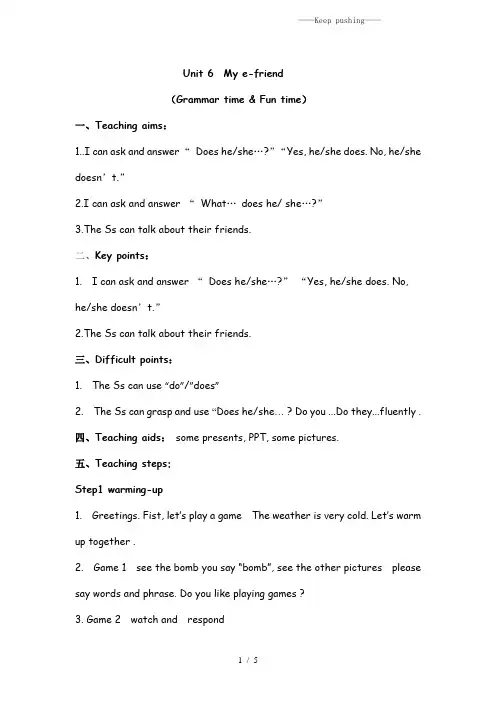
Unit 6 My e-friend(Grammar time & Fun time)一、Teaching aims:1..I can ask and answer “Does he/she…?”“Yes, he/she does. No, he/she doesn’t.”2.I can ask and answer “What…does he/ she…?”3.The Ss can talk about their friends.二、Key points:1. I can ask and answer “Does he/she…?”“Yes, he/she does. No, he/she doesn’t.”2.The Ss can talk about their friends.三、Difficult points:1. The Ss can use “do”/”does”2. The Ss can grasp and use “Does he/she… ? Do you ...Do they...fluently .四、Teaching aids:some presents, PPT, some pictures.五、Teaching steps:Step1 warming-up1. Greetings. Fist, let’s play a game The weather is very cold. Let’s warm up together .2. Game 1 see the bomb you say “bomb”, see the other pictures please say words and phrase. Do you like playing games ?3. Game 2 watch and respondhobbies/subjects...Hobbies: 1.you mean you like sports. Good habit. I don’t like sports, So ,i am fat . 2. You like swimming ,Do you like Sun Yang ? He can swim very well , He is famous in China . 3. You like drawing . You can draw well ,You are good at drawing . 4. You like playing computer games. Do you like playing computer games? Don’t play too much .Subjects: 1.you mean you like sports.You are good at .... 2. Do you like English ? Your English is in the classroom .Be careful! 3. Do you like dancing ? 4. You a Chinese ,you should love Chinese. English is very interesting .Step 2: Learn the sentences What subjects do /does ...like ?1.What subjects does he ...like ?He likes…2.Make a new sentences Who can ask your classmates like this ?3.出示图片,教授句型What subjects does he like ? He likes…4.Boys and girls pk5.Peter ---can you remember something about Peter ?Peter ---What does he do after school ?How old is he ? Where does he live ?He studies Chinese after school . 教授studies -study5.Here are some questions,. Read and find教授单词live--lives5.What can you find?There is the third person in questions ,for example ,He/she ,we use does. There is no third person in questions , for example ,you/they ,we use do. Give you thirty seconds ,Read the learning tips,try to understand and remember6. Check outDo you have an e-friend ? I have some e-friendsStep 3: Learn the sentences Does he/she…? “↗.Yes, he does./ No, he doesn’t. ↘1.Guess: What do they like ? Does he like ...? Does he have a ...? Do theyhave ..? 升调Dancing /swimming/watch film/play football/ e--friend /Chinese lessons Does she/he play well ?2.黑板出示句型操练3.Work in pairs try to ask and answer 男生,女生互换角色,一起读4.Do you have a friend ? Of course you do . Let’s play a game about yourfriend .Step 4: Make friends1.The teacher make a model .2.Work in pairs. Play the game “Who is your friend?”3.Let’s have a show4. I am a new today . I want to make friends with you . So ,I made some information cards . Introduce your friends.4. Make a model5. Introduce6. Some of you are my friends now . Let’s make more friends .朴载相Psy likes singing dancing 江南styObama lives in the White House likes playing basketballYao Ming likes playing basketball likes MathsLi Na likes playing tennis likes shoppingZhou Jielun Jay likes singing likes playing basketballZhao Benshan likes playing golf likes playing footballSun Yang likes swimming listening to musicDo you want to make e-friends with these superstar ?7. Introduce the superstars .Step5 Check the goals.Check the goalsStep6 HomeworkA guessing gameStep 1: Make an information card of your friend.第一步:制作一张关于你网友的信息卡。
译林版五年级上册教案Unit6 My e-friends

译林版五年级上册教案Unit6 My e-friends 关键信息1、教案主题:译林版五年级上册 Unit6 My efriends2、教学目标:知识目标:学生能够掌握与“efriends”相关的词汇和句型。
技能目标:提高学生的听、说、读、写能力。
情感目标:培养学生对交友的正确认知和跨文化交流意识。
3、教学方法:情景教学法、互动教学法、任务驱动法等。
4、教学资源:教材、多媒体课件、教具等。
5、教学评价:课堂表现、作业完成情况、测验等。
11 教学背景本教案旨在教授译林版五年级上册 Unit6 My efriends 这一单元,帮助学生了解电子朋友这一概念,学习相关的英语表达,培养他们的语言运用能力和跨文化交际意识。
111 学情分析五年级学生已经具备一定的英语基础,对英语学习有较高的兴趣和积极性。
但在词汇量、语法运用和口语表达方面仍需进一步提高。
112 教材分析本单元围绕“efriends”这一主题展开,通过对话、短文等形式呈现了相关的词汇和句型,内容贴近学生生活,具有较强的实用性和趣味性。
12 教学目标细化121 知识目标学生能够熟练掌握单词:efriend, country, send, email, live, study 等。
能够正确运用句型:Do you have an efriend? Yes, I do / No, I don't Where does he/she live? He/She lives in What subjects does he/she like?He/She likes122 技能目标能够听懂关于“efriends”的对话和短文,获取关键信息。
能够用所学句型进行简单的交流,介绍自己或他人的电子朋友。
能够正确书写与“efriends”相关的句子和短文。
123 情感目标培养学生乐于结交朋友、尊重不同文化的意识。
激发学生对英语学习的兴趣,增强学习自信心。
13 教学方法与策略131 情景教学法创设真实的情景,让学生在情景中感受和运用语言。
牛津译林版-英语-五年级上册-Unit 6 My e-friend.教案

T: He can write an email. Look.(过渡到下一张ppt,让学生说出write an email并呈现,然后教学email.电子邮件)
T:What can we do then?引出send对照friend让学生尝试着读出来)
复备:
教学反思:
T:(动画收到一封邮件,来自我的网友Mercy)
How are you ? I jion in an English Club. I have a new friend. His name is Tom. He is 11 years old.He likes Music and PE. He is good at singing and playing football. Do you have a new friend too? Please write to me soon.
3.能正确的理解并朗读课文,在教师的引导和帮助下尝试复述课文内容。
4.能初步运用本课所学的词汇和句型对自己的朋友或者网友进行综合全面的介绍。
教学重点:
能正确理解并朗读课文,在教师的帮助下尝试复述课文。
教学难点:
能初步运用本课所学的词汇和句型对自己的朋友或者网友进行综合全面的介绍。
教学准备:PPT
教学设计:
Step 2 : Presentation
1.Watch and answer
T: Boys and girls, do you want to know what are they talking about?
let's watch and answer: They are talking about ( Peter)(Wang Bing’s e-friend)
牛津译林版-英语-五年级上册-Unit 6 My e-friend.教学设计

Unit 6 My e-friend.教学设计Teaching contentCheckout time and ticking timeTeaching aims1. 知识与技能1. I can ask and answer “does he\she…”and “what…does he\she ..? ”2. I can talk about my e-friends.3. I can write an email to my e-friend.2.过程与方法学生在交流的过程中锻炼口语表达能力和小组合作能力。
3.情感态度价值观学生能感悟友情的可贵,珍惜朋友间的友谊。
Teaching difficulities1.Students can learn how to write an email.2.The ability of information gathering.Teaching aidsInformation cardsTeaching procedures一.Greetings good morning boys and girls二.Learning aimsT:introduce a new friend .complete each aim , get one clue of him.1. I can ask and answer “does he\she…”and “what…does he\she ..? ”2. I can talk about my e-friends.3. I can write an email to my e-friend.三.Presentation(一)magic eyes and brain storm1.can you read?summarythese are macroscopic features. Cuntries . ages. Subjects .hobbies jobs. 2. Can you ask ?Today I’m your new teacher. Do you have any questions about me? Try to ask me3. can you talk about?T : This is me. I have a friend. He is a boy. Can you ask ?(以男女生比赛形式让学生 操练第三人称的询问方式)Do you have any friends? Make a chart and ask and answer with your partners.完成书上的信息图,并和搭档一起问一问答一答。
牛津译林版-英语-五年级上册-Unit6Mye-friend教学设计
牛津译林版-英语-五年级上册-Unit6Mye-friend教学设计Unit 6 My e-friend 教案教学设计Teaching aims:1. Knowledge aims:a. 学生能听、说、读表示国家名词, 如:UK, US, Australia, Canada, China等。
b. 学生能用句型Who’ s your e-friend? How old is he? Can he speak Chinese?2. Ability aims:通过本节课的学习, 学生能综合运用已学单词和句型介绍自己及他人的外貌、性格及兴趣爱好, 并对外貌进行比较。
3. Emotion aims通过本节课的学习, 学生懂得珍惜友谊, 关爱他人。
Emphasis and difficult points:1. 复习巩固四个单元的单词和相应的句型。
2. 更够用所学的句型描述自己及他人的兴趣爱好。
Teaching aids:PPT, exercise paper, tape recorderTeaching steps:1.Warm-up(1) Ss enjoy and sing “Friends”.(2) Listen to the song Where are you from?2. Presentation(1) T (shows pictures of different countries’ flags): Look, this is the flag ofAustralia. And this is a flag of Canada…(2) T: Do you have an e-friend?S: Yes, I do.T: Where does he/she live in?S: He/ She lives in….T: How old is he/ she?S: He/ She is … years old.… …(3) Read the dialogues on Page 58 for 3 minutes.(4) Each two students in a group to practice the dialogues.(5) Choose five groups to act their dialogues at the stage.3. Make sentencesLet students make sentences by using the types: Where does he live? How old is he? What does he like doing? What subjects does he like?Homework:1.Say with your partner: Describe your e-friend.2.Read the dialogue between Liu Tao and Wang Bing for 2 times.。
小学英语译林牛津版五年级上册五上U6教案.docx
T:What does your father like doing?
T:What subjects do you study at school?
T:Can you speak English?
T:How old are you?
3.通 察文本插 ,培养学生 文本信息和提 的能力。
4.到交朋友是一件好事,但要学会保 自己。
教学资源
PPT, some pictures.
教
学
过
程
教学内容及引思设计
学 生 活 动
集体备课后的调整
Step1 Free talk
T:Hello, boy. I like running.What do you like doing?
e-friend
Can he/she
⋯?
send
Does
he/she have/like
⋯?
wait a
minute
⋯years
old
What
subjects does
he
like?
月日总第课时
2
Do one thing at a time, and do well.
课题Unit 6My e-friend
Ss trytoanswer the
teacher's questions.
Ss: Liu Tao and Wang
Bing.
S1: Liu Tao can play
football.
He has a football.
He likes playing
牛津译林版英语五年级上册 Unit6 Story time(教案)
牛津译林版英语五年级上册 Unit6 Story time(教案)课程目标•学习并掌握故事中的生词和短语。
•听懂、理解并复述故事内容。
•学会运用一般过去式谈论过去的事情。
教学重点•生词和短语的掌握和运用。
•听力理解和口语表达能力的提升。
教学准备•课件和教材。
•多媒体设备。
•学生的教材和练习册。
教学过程步骤一:导入1.通过播放课件中的图片,引起学生对故事的兴趣。
2.回顾上一节课所学的单词和短语,与本节课的内容进行关联。
步骤二:故事听力1.播放故事录音,让学生先听故事。
2.在第一遍听完后,鼓励学生表达他们对故事的理解和感受。
3.第二遍播放故事录音,让学生更加深入地理解故事的情节和内容。
步骤三:故事复述1.让学生以小组为单位,互相交流并复述故事的情节。
2.鼓励学生使用故事中的关键词和短语来复述。
步骤四:语法讲解1.引导学生回顾故事中使用的一般过去式。
2.解释一般过去式的构成和用法,并进行示范。
3.给学生提供相关的练习,让他们巩固一般过去式的用法。
步骤五:交流活动1.将学生分成小组,让他们用一般过去式进行对话。
2.设计几个情景,让学生在小组内互相演练对话。
3.鼓励学生在对话中灵活运用所学的生词和短语。
步骤六:练习与总结1.分发练习册上相关的练习,让学生巩固所学的知识。
2.鼓励学生互相检查并纠正错误。
3.总结本节课所学的知识和重点,对学生的表现给予肯定和鼓励。
课堂延伸•在下一节课中,可以引导学生编写自己的小故事,运用一般过去式来表达。
课后作业•完成教材中相关的练习题。
•复述故事的情节并用一般过去式叙述。
•阅读与本课故事主题相关的英语文章或故事。
教学反思本节课通过故事的方式,帮助学生学习并理解一般过去式的用法。
通过听故事、复述、对话和练习,学生的听力和口语表达能力得到了提升。
然而,教学内容的设置还可以更加丰富多样,可以加入更多的互动和实际运用的机会,提高学生的学习兴趣和参与度。
同时,也需要关注学生的学习进度和理解程度,及时给予帮助和反馈。
【最新】牛津译林苏教版五年级英语上册Unit6 My e-friend-5-5优质教学设计
课题Unit 6 My e- friend 课型New课时5~5授课日期教学目标1.了解中国和英语国家信封的书写方式。
2.能正确并熟练地运用本课词句简单介绍朋友或是家人。
3.通过练习,检测学生对句型掌握情况,使学生能正确运用。
教学重、难点1.能正确并熟练地运用本课词句简单介绍朋友或是家人。
2.能正确运用句型。
教学准备挂图,卡片,录音机预习要求预习Culture time, Checkout time 教学过程(师生活动内容、方式)旁注Step1 Free talk & revision1. T: Good morning, everyone! Ss: Good morning, Miss t.2.Make dialogue:S1:Do you have an e-mail friend? S2: Yes, I do.S1:Does he have Chinese lessons? S2: Yes , he does.S1:What subjects does he like? S2: He likes Maths and PE.Step2 Preview & feed backDescribe your friends.Step3 Presentation1. Write and say.Look at P67, complete the chart and then talk about it.Ss:------2. Describe your friends.S1:Linda is my e-mail friend. She lives in Canada. She is 11years old. She‟s good at English. She likes swimming.----3.Ask and answer: (Ask some questions about “ friends”P66)S1:Who‟s your friend?S2: --- is my friend.S3: How old is he/she ? S2: He‟s/She‟s ----.S4: What subjects does he/she like ? S2: He/She likes ---S5:What does he/she like doing after school?S2: He/she likes ---教学过程(师生活动内容、方式)旁注4.Write your friend in groups.--- is my e-mail friend. He/She lives in ---. He/She is --- years old. He‟/She‟s good at ---. He/She likes .----5. Talk about the friends in groups.6. Listen and tick.P66.7.Check the answer. S2:.........Culture time1. Look at the two pictures. What …s the difference between them? Ss: ------2.T : We write Chinese addresses like this (the left picture). We write English addresses like this (the right picture).4.Write address in Chinese and in English in groups.Step4 ConsolidationExercise (补充习题 )Step5 Homework1. Write a friend or a family member.2. Review Unit6板书设计:Unit6 My e-friendWe write Chinese addresses like this.We write English addresses like this.XX is my e-friend. He/She live s …. He‟s/She‟s … years old. He/She likes …. He/She can ….。