
英文摘要页示例
西南交通大学研究生学位论文撰写规范(新版)

西南交通大学研究生学位论文撰写规范研究生学位论文是研究生科学研究工作的全面总结,是描述其研究成果、代表其研究水平的重要学术文献资料,是申请和授予相应学位的基本依据。
学位论文撰写是研究生培养过程的基本训练之一,必须按照确定的规范认真执行。
指导教师应加强指导,严格把关。
论文撰写应符合国家及各专业部门制定的有关标准,符合汉语语法规范。
硕士和博士学位论文,除在字数、理论研究的深度及创新性成果等方面的要求不同外,对其撰写规范的要求基本一致。
1内容要求1.1 题目题目以简明的词语恰当、准确地反映论文最重要的特定内容,一般不超过25字。
题目通常由名词性短语构成,应尽量避免使用不常用缩略词、首字母缩写字、字符、代号和公式等。
如题目内容层次很多,难以简化时,可采用题目与副题目相结合的方法,其中副题目起补充、阐明题目的作用。
题目和副题目在整篇学位论文中的不同地方出现时,应保持一致。
1.2 西南交通大学学位论文版权使用授权书作者仔细核实授权书后签名,格式见附录3。
1.3声明博士学位论文:西南交通大学博士学位论文创新性声明,实例如附录4所示,作者需简明扼要提出博士学位论文的主要创新点,将创新性声明补充完整并签名。
硕士学位论文:西南交通大学硕士学位论文主要工作(贡献)声明,实例如附录5所示,作者需简明扼要提出本人在硕士学位论文中所完成的主要工作或贡献并签名。
1.4 摘要与关键词1.4.1 摘要摘要是论文内容的简要陈述,是一篇具有独立性和完整性的短文,摘要应具有独立性和自含性,即不阅读论文的全文,就能获得必要的信息。
摘要的内容应包含与论文等同量的主要信息,供读者确定有无必要阅读全文,也可供二次文献采用。
摘要一般应说明研究工作目的、方法、结果和结论等,重点是结果和结论。
1.4.2 关键词关键词是供检索用的主题词条,应采用能覆盖论文主要内容的通用技术词条(参照相应的技术术语标准)。
关键词一般列3~8个,用显著的字符号另起一行,排在摘要的下方。
论文及英文翻译格式

六、毕业设计(论文)的撰写1、内容与要求毕业设计(论文)的内容一般依次由以下部分组成:封面、任务书、中文摘要、英文摘要、目录、(符号说明)、前言、正文、结论、参考文献、致谢、(附录)、外文资料译文、外文原文。
毕业设计(论文)应采用汉语(外语专业用外语)撰写。
要求内容层次分明、文理通顺、数据可靠、文字简练、说明透彻、立论正确、推理严谨。
2、毕业设计(论文)的格式及规范毕业设计(论文)的格式、图纸绘制、实验数据、各种标准的运用和引用都要符合各学科、各专业国家标准的规定。
毕业设计(论文)一律使用计算机编辑,用A4规格纸输出,页面设置上、下页边距2.54厘米,左、右页边距2.5厘米,装订线1厘米,文档网格设为小四号宋体,指定行网格和字符网格,每行33个字符,每页31行,栏数为1。
外文资料译文页面设置、格式规范及字体同正文要求一样,装订时外文资料译文在前,外文原文在后。
除封面、任务书、外文资料译文、外文原文外,毕业设计(论文)其余部分均设置页眉,页眉为“河南科技大学毕业设计(论文)”五号宋体居中。
毕业设计(论文)正文页码用“1、2、3……”小五号宋体居中设置,封面、任务书、外文原文及外文资料译文不设页码,目录及中、英文摘要的页码用“Ⅰ、Ⅱ、Ⅲ……”小五号宋体居中设置。
各部分的具体要求如下:(1) 封面:由学校统一印制;封面填写课题名称,作者姓名,指导教师姓名,院系专业等内容;题目不得超过36个汉字。
学院统一填写全称:材料科学与工程学院;专业填写全称,专业方向统一规范,如材料成型及控制工程(铸造)。
(2) 毕业设计任务书(3) 中英文摘要①毕业设计(论文)中文题目为三号黑体字,可以分成1或2行居中打印。
②题目下空一行居中打印“摘要”二字(三号黑体),字间空一格。
③“摘要”二字下空一行打印摘要内容(小四号宋体)。
每段开头空二格。
④中文摘要内容下空一行打印“关键词”三字(小四号黑体),其后为关键词(小四号宋体)。
附录1封面示例

附录1:封面示例学校代码: 11342 学号:分类号:密级:公开(小4号宋体,行距1.5倍,空2行)湖南工程学院(二号宋体加粗)硕士学位论文(二号宋体加粗)(空4行)学位论文题目(二号黑体)工程领域动力工程(三号宋体)研究方向风电机组机械设计与制造作者姓名XXX指导教师XXXX 职称企业导师XXXX 职称2019年6月(三号宋体)附录2:扉页示例(中文)(空3行,行距1.5倍)学位论文题目(二号黑体)工程领域(三号宋体)研究方向作者姓名指导教师企业导师(空6行)湖南工程学院(三号宋体)答辩日期:2019年6月附录3:扉页示例(英文)(空3行,行距1.5倍)(此处为论文题目的外文译文、全部大写、Times New Roman 2 号字)(以下各项字体为Times New Roman 4 号字体)SpecialityCandidate Xiaoxiao WangSupervisor Dashan Zhang ProfessorYiyun Wei EngineerHunan Institute of EngineeringJune, 2019(空2行,行距1.5倍)湖南工程学院学位论文版权使用授权书本学位论文作者完全了解学校有关保留、使用学位论文的规定,同意学校保留并向国家有关部门或机构送交论文的复印件和电子版,允许论文被查阅和借阅。
本人授权湖南工程学院可以将本论文的全部或部分内容编入有关数据库进行检索,可以采用影印、缩印或扫描等复印手段保存和汇编本学位论文。
本学位论文属于1.保密□,在年解密后适用本授权书;2.不保密□,使用本授权书。
(请在以上方框内打“√”)学位论文作者签名:指导老师签名:日期:年月日日期:年月日(空2行,行距1.5倍)湖南工程学院学位论文独创性(贡献)声明本人郑重声明:所呈交的学位论文,是在导师指导下独立进行研究工作所得的成果。
除文中已经注明引用的内容外,本论文不包含任何其他个人或集体已经发表或撰写过的研究成果。
学士学位论文格式要求
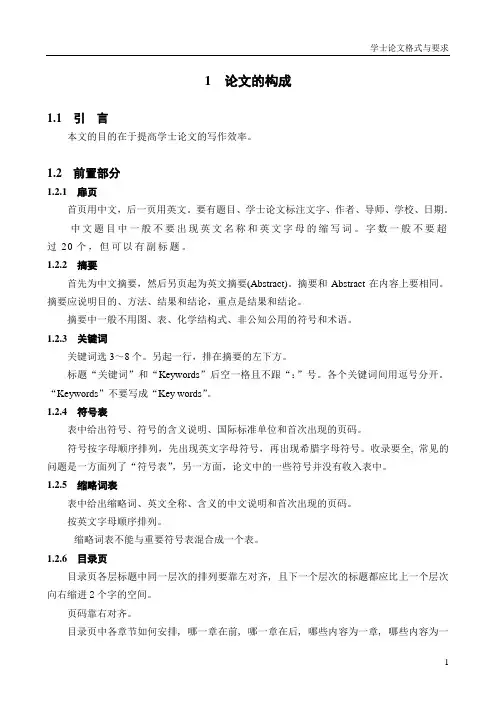
1 论文的构成1.1 引言本文的目的在于提高学士论文的写作效率。
1.2 前置部分1.2.1 扉页首页用中文,后一页用英文。
要有题目、学士论文标注文字、作者、导师、学校、日期。
中文题目中一般不要出现英文名称和英文字母的缩写词。
字数一般不要超过20个,但可以有副标题。
1.2.2摘要首先为中文摘要,然后另页起为英文摘要(Abstract)。
摘要和Abstract在内容上要相同。
摘要应说明目的、方法、结果和结论,重点是结果和结论。
摘要中一般不用图、表、化学结构式、非公知公用的符号和术语。
1.2.3关键词关键词选3~8个。
另起一行,排在摘要的左下方。
标题“关键词”和“Keywords”后空一格且不跟“:”号。
各个关键词间用逗号分开。
“Keywords”不要写成“Key words”。
1.2.4 符号表表中给出符号、符号的含义说明、国际标准单位和首次出现的页码。
符号按字母顺序排列,先出现英文字母符号,再出现希腊字母符号。
收录要全, 常见的问题是一方面列了“符号表”,另一方面,论文中的一些符号并没有收入表中。
1.2.5 缩略词表表中给出缩略词、英文全称、含义的中文说明和首次出现的页码。
按英文字母顺序排列。
缩略词表不能与重要符号表混合成一个表。
1.2.6 目录页目录页各层标题中同一层次的排列要靠左对齐, 且下一个层次的标题都应比上一个层次向右缩进2个字的空间。
页码靠右对齐。
目录页中各章节如何安排, 哪一章在前, 哪一章在后, 哪些内容为一章, 哪些内容为一节, 都必须在写作前与导师商量好, 然后再撰写。
否则一旦导师要求重新编排章节, 这以前的写作时间和精力就被浪费了。
1.3 主体部分1.3.1 一般要求全文要用阿拉伯数字连续编页码。
页码应标注在每页的右下角。
封面、封二、封三和封底不编页码。
将目录页等前置部分(见第1.2节)单独编排页码,用罗马大写数字Ⅰ,Ⅱ,Ⅲ,Ⅳ,Ⅴ,Ⅵ,Ⅶ,Ⅷ,Ⅸ,Ⅹ,Ⅺ,Ⅻ等。
图、表、公式、化学反应式等,用阿拉伯数字分别分章依序、连续编排序号。
5.英文摘要的写法

Example 3 范例3 -指示性摘要
一般现在时、一般过去时、现在完成时及其被动语 态
This section highlights early electronics milestones that have made significant contributions to aerospace and defense. Today everyone thinks digital, whereas more than 50% of electronic advances since technology founding 50 years ago were in the analog or continuous domain. It is too easy to forget that before the 1970s and 1980s analog systems had been the norm.
thesis, review, conference proceeding or any in-depth
analysis of a particular subject or discipline, and is often
used to help the reader quickly ascertain the paper‘s
purpose.
abstract 摘要 discipline 学科 ascertain 确定,弄清
article 期刊论文 thesis (学位)论文 review 评论
conference proceeding
会议论文集
摘要是对研究性论文、学位论文、学术评论、会议论文或任 何特定领域和学科分析研究的一种简略的概述,并经常被用 来使读者能够快速了解文章的意图。
研究生毕业论文排版、装订格式要求
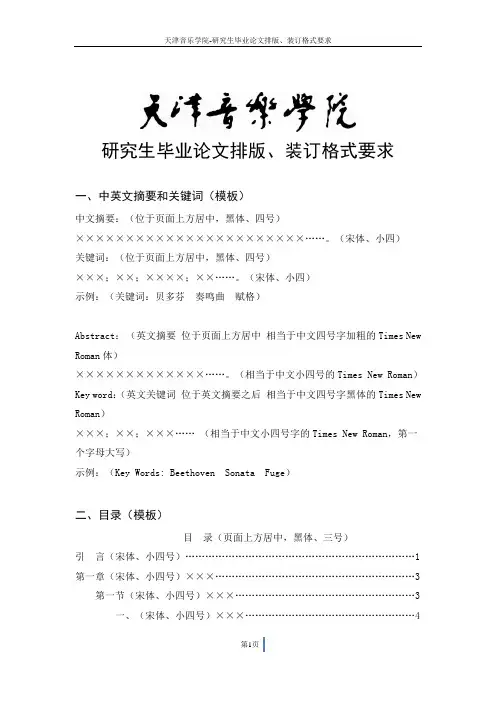
研究生毕业论文排版、装订格式要求一、中英文摘要和关键词(模板)中文摘要:(位于页面上方居中,黑体、四号)×××××××××××××××××××××××……。
(宋体、小四)关键词:(位于页面上方居中,黑体、四号)×××;××;××××;××……。
(宋体、小四)示例:(关键词:贝多芬奏鸣曲赋格)Abstract:(英文摘要位于页面上方居中相当于中文四号字加粗的Times New Roman体)×××××××××××××……。
(相当于中文小四号的Times New Roman)Key word:(英文关键词位于英文摘要之后相当于中文四号字黑体的Times New Roman)×××;××;×××……(相当于中文小四号字的Times New Roman,第一个字母大写)示例:(Key Words: Beethoven Sonata Fuge)二、目录(模板)目录(页面上方居中,黑体、三号)引言(宋体、小四号) (1)第一章(宋体、小四号)××× (3)第一节(宋体、小四号)××× (3)一、(宋体、小四号)××× (4)1. (宋体、小四号)××× (6)二、(宋体、小四号)××× (9)第二章(宋体、小四号)××× (12)第三章(宋体、小四号)××× (18)结论(宋体、小四号) (34)参考文献(宋体、小四号) (36)附录(宋体、小四号) (38)后记(宋体、小四号) (40)论文目录,一般只列到第四级,即“1.2.3.”即可。
史学学位论文参考文献及注释规范(
东北师范大学研究生学位论文规范1. 引言1.1 为了规范我校研究生学位论文的格式,提高论文撰写水平,便于信息系统的收集、存储、处理、加工、检索、利用、交流和传播,特制定本规范;1.2 本规范适用于申请东北师范大学硕士学位、博士学位的学位论文的撰写要求与格式;1.3 本规范参照《中华人民共和国标准科学技术报告、学位论文和学术论文的编写格式》和《中华人民共和国标准文后参考文献著录规则》制定。
2. 学位论文的基本要求2.1 硕士学位论文的基本要求:要求对所研究的课题有新见解或新成果,在理论上或实践上对我国现代化建设或本门学科发展具有一定的意义,并能表明作者在本门学科上掌握了坚实的基础理论和系统的专门知识,具有从事科学研究工作或独立担负专门技术工作的能力。
学位论文应在导师指导下,由硕士研究生本人独立完成。
2.2 博士学位论文的基本要求:要求对所研究的课题在科学上或专门技术上做出创造性成果,并在理论上或实践上对我国现代化建设或本门学科发展具有较重要的意义,表明作者在本门学科上掌握了坚实宽广的基础理论和系统深入的专门知识,具有独立从事科学研究工作的能力。
学位论文应在导师指导下,由博士研究生本人独立完成。
2.3 语言种类:学位论文一般用中文撰写,特殊专业可用英文或其它文字撰写,但论文题目、摘要等必须有中文译注。
2.4 字数要求:理科硕士学位论文字数一般不少于一万,理科博士学位论文字数一般不少于二万;文科硕士学位论文字数不少于二万,文科博士学位论文字数不少于五万。
3. 学位论文书写格式3.1 学位论文的形式结构:博士、硕士学位论文一般应包括以下几部分(按学位论文中先后顺序排列)封面独创性声明、版权使用授权书学前置部分中英文摘要位目录论文引言形正文式主体部分结语结参考文献构附录附录部分后记(包括致谢)在学期间学术成果情况(适用于博士学位论文)3.2 论文封面及首页3.2.1 封面及首页由我校图书馆统一制作,首页内容与格式与封面相同,格式见附件1;3.2.2 学校代码:我校代码为10200;3.2.3 研究生学号:填写研究生证号;无学生证的,填写姓名拼音大写和授予学位年份,例如:王立国2005年被授予学位,则填写WANGLIGUO2005;3.2.4 分类号:按《中国图书资料分类法》一书填写(可到图书馆查询);3.2.5 密级:根据实际情况和导师意见在“无、内部、秘密、机密、绝密”中选择其一填写;有保密要求不宜公开的论文由学生本人提出申请,经导师和学位评定分委员会同意后,提交研究生院学位办公室备案。
中英文论文写作(摘要)
1 基本特性 2 时态 3 语态 4 语法修辞 5 一个典型示例 6 化学常用句式
2 时态
以一般现在时为主, 也使用一般过去时和 现在完成时 从理论上讲: 说法一: 一般现在时
通过科 学实验取得的 研究结果、结 论,揭示自然 界的客观规律 一般过去时
Objective 动词不定式开头 To investigate … To study … To explore … To examine … To determine … To report … To review … 使用第一人称时,用凡指的we, the author, the authors ,不用I。 如: In this paper we conclude …
Result: The contents of the components of midecamyc A1 and leucomycin A6 was 30%~ 50% and 10%~20% respectively, the contents of the rest components w lower, different manufactures produces have differ components. Conclution: To revise the specificati meleumycin for quality control.
指示性文摘(indicative abstract)
This type of abstract is designed to ind the subject of a paper, making it easy fo potential readers to decide whether to r the paper.
英文合同摘要模板
英文合同摘要模板This Contract Summary ("Summary") is provided for informational purposes only and is not intended to replace or substitute the terms of the underlying contract. This Summary is intended to provide a high-level overview of the key provisions of the contract for ease of reference.1. Parties: This contract is entered into by and between [Party A], a company organized and existent under the laws of [jurisdiction], with its principal place of business at [address], and [Party B], a company organized and existent under the laws of [jurisdiction], with its principal place of business at [address].2. Purpose: The purpose of this contract is to establish the terms and conditions for the supply of [goods/services] by [Party B] to [Party A].3. Term: The term of this contract shall be for a period of [term], commencing on [start date] and ending on [end date], unless earlier terminated in accordance with the provisions of this contract.4. Scope of Work: [Party B] shall provide [detailed description of goods/services to be provided], in accordance with the specifications set forth in Exhibit A attached hereto.5. Delivery: [Party B] shall deliver the [goods/services] to [Party A] in accordance with the delivery schedule set forth in Exhibit A. [Party A] shall have the right to inspect the [goods/services] upon delivery and reject any non-conforming or defective[goods/services].6. Payment: [Party A] shall pay [Party B] the sum of [amount] for the [goods/services] provided under this contract, in accordance with the payment terms set forth in Exhibit B.7. Warranties: [Party B] represents and warrants that the [goods/services] provided under this contract shall be free from defects in materials and workmanship and shall conform to the specifications set forth in Exhibit A. [Party B] further warrants that it has the right and authority to enter into this contract and to provide the [goods/services] as contemplated herein.8. Indemnification: [Party B] agrees to indemnify and hold harmless [Party A] from and against any and all claims, liabilities, damages, losses, and expenses arising out of or in connection with [Party B]'s breach of any provision of this contract.9. Termination: Either party may terminate this contract upon written notice to the other party in the event of a material breach of any provision of this contract by the other party.In the event of termination, any amounts owed by either party shall become immediately due and payable.10. Governing Law: This contract shall be governed by and construed in accordance with the laws of [jurisdiction].This Summary is provided for informational purposes only and does not constitute legal advice. Parties to the underlying contract should review the full terms and conditions of the contract before taking any action based on the provisions of this Summary.。
关于计算机的英文文献写作范文摘要
关于计算机的英文文献写作范文摘要全文共10篇示例,供读者参考篇1Title: All About ComputersHey guys! Have you ever wondered how computers work and why they are so important in our daily lives? In this article, we will dive into the fascinating world of computers and learn all about their history, functions, and impact on society.First off, let's talk about the history of computers. Did you know that the first computer was invented in the early 20th century? It was a huge machine that took up an entire room! But over the years, computers have become smaller, faster, and more powerful. Nowadays, we have laptops, tablets, and smartphones that can fit in the palm of our hands.So, what do computers actually do? Well, they can process information, store data, and perform calculations at incredible speeds. This allows us to do all sorts of cool things like play video games, surf the internet, and communicate with people all over the world.But computers aren't just for fun and games – they also play a crucial role in many industries like healthcare, education, and business. For example, doctors use computers to analyze medical images and diagnose diseases, while teachers use them to create interactive lessons for their students.In conclusion, computers are an essential part of our modern world and they have revolutionized the way we live, work, and play. So the next time you turn on your computer, remember how amazing this technology is and how lucky we are to have it in our lives. Let's give a big shoutout to all the brilliant minds who have made computers possible!篇2Once upon a time, there was a magical invention called a computer. It can do all kinds of cool things like playing games, watching videos, and even helping with homework!Computers are made up of many parts, like the screen, keyboard, and mouse. They also have something called a CPU, which is like the brain of the computer. It helps the computer think and do all the things we want it to do.One important thing about computers is that they can store lots of information. This is called memory. Without memory, thecomputer wouldn't be able to remember all the things we tell it to do.Another cool thing about computers is that they can connect to the internet. The internet is like a giant web that connects all the computers in the world. We can use it to find information, talk to our friends, or even play games with people from other countries!In conclusion, computers are amazing inventions that help us in so many ways. From helping with homework to connecting us with people around the world, computers have made our lives easier and more fun. Let's all give a big round of applause to the wonderful world of computers!篇3Title: Let's Learn About ComputersHey guys! Have you ever wondered how computers work? Well, I'm here to tell you all about it! Computers are super cool machines that can do all sorts of things, like play games, surf the internet, and even help with homework. But how do they actually work?First off, computers have a bunch of different parts that all work together to make them run. There's the CPU, which is like the brain of the computer, the motherboard, which holds all the other parts in place, and the hard drive, which stores all your files and pictures. And let's not forget about the keyboard and mouse, which help you control the computer.But how does all this stuff actually work? Well, when you type something on the keyboard or click the mouse, it sends a signal to the CPU. The CPU then processes that signal and sends it to the motherboard, which tells the other parts of the computer what to do. It's like having a bunch of little helpers inside the computer, all working together to make sure everything runs smoothly.And did you know that computers can do math really fast? That's because they use something called binary code, which is just a bunch of ones and zeros. By combining these numbers in different ways, computers can do all sorts of calculations in the blink of an eye.So next time you're playing a game or doing homework on the computer, remember all the cool stuff that's going on behind the scenes. Computers may seem like magic, but with a little bitof knowledge, you can understand how they work and maybe even become a computer whiz yourself!篇4Computer is a super cool thing in our life! It can help us do so many things, like playing games, watching movies, and even doing homework! In this article, we are going to talk about the history of computers, how they work, and some fun facts about them.First of all, do you know when the first computer was invented? It was actually a long time ago, in the 1940s! Back then, computers were huge machines that took up whole rooms. But now, we have laptops and smartphones that are much smaller and faster.So, how does a computer work? Well, it has a brain called a central processing unit (CPU) that does all the thinking and calculations. It also has memory to store information and input devices like keyboards and mice to help us give commands.There are also different types of computers, like desktops, laptops, tablets, and smartphones. Each of them has its own features and uses. For example, desktops are great for work and gaming, while laptops are good for when we are on the go.Did you know that the first computer bug was actually a real bug? Back in the 1940s, a moth got stuck in a computer and caused it to malfunction. That's why we now call any glitch in a computer system a "bug"!In conclusion, computers are amazing inventions that have changed the way we live and work. They are constantly evolving and becoming more powerful. So next time you use a computer, remember how far technology has come and how much more it can do in the future!篇5Computer is a super cool machine that can do a lot of fun and useful stuff! It has a super fast brain called a processor, and it can store a lot of information in its memory. We can use computers to play games, watch videos, do homework, and even talk to our friends online.There are different parts of a computer, like the monitor, keyboard, mouse, and CPU. The monitor is like a TV screen where we can see what the computer is doing. The keyboard helps us type words and numbers, while the mouse lets us click on things on the screen. The CPU is where all the magic happens – it's like the computer's brain!Computers can also connect to the internet, which is like a super big library with all the information in the world. We can use the internet to search for things, watch videos, play games, and even talk to people from far away. It's really cool how computers can help us learn and have fun at the same time.In conclusion, computers are amazing machines that can do so many things to help us in our daily lives. From playing games to doing homework to connecting with friends online, computers have become an essential part of our lives. We should all be grateful for the technology that allows us to use computers and make our lives easier and more enjoyable. Thank you, computers, for being so awesome!篇6Today I want to talk about something super cool and exciting - computers! Computers are amazing machines that can do so many things to help us in our daily lives. In this article, we will explore the history of computers, how they work, and some of the amazing things they can do.Computers have come a long way since they were first invented. Did you know that the first computer was as big as a room and could only do simple calculations? Now we havecomputers that can fit in the palm of our hands and can do things like play games, send emails, and even help us with our homework.But how do computers actually work? Well, computers are made up of many different parts, like the motherboard, CPU, and hard drive. These parts all work together to process information and carry out tasks. When you type on the keyboard or click the mouse, the computer sends this information to the CPU, which then processes it and sends it back to the screen so you can see the result.Computers can do so many amazing things, like help scientists discover new things, help doctors save lives, and even help us connect with people all over the world. They are truly incredible machines that have changed the way we live our lives.In conclusion, computers are an essential part of our lives and have revolutionized the way we do things. From simple calculations to complex tasks, computers have come a long way and will continue to shape our future. So next time you use a computer, remember how amazing and powerful it is!篇7Title: Computers: The Magical MachinesHey guys! Let's talk about computers today! Computers are like magic machines that can do all sorts of cool things. They can help us play games, do homework, watch videos, and even chat with our friends. Isn't that super awesome?First of all, let's talk about what a computer actually is. A computer is a machine that can be programmed to carry out sequences of arithmetic or logical operations automatically. It has a bunch of parts like a keyboard, a monitor, a mouse, and a CPU (Central Processing Unit). All these parts work together to make the computer run smoothly.Next, let's chat about how computers work. When we type something on the keyboard or click the mouse, the computer sends all that information to the CPU. The CPU then processes that information and sends it to the monitor, so we can see what we're doing on the screen. It's like a big dance party inside the computer!Now, let's talk about the different types of computers. There are personal computers (PCs) that we use at home or school, laptops that we can take with us anywhere, and even super powerful computers called supercomputers that can do really complex tasks really fast. It's amazing how many different kinds of computers there are!In conclusion, computers are truly magical machines that have changed the way we live and work. They help us do so many things and make our lives easier in so many ways. So next time you're using a computer, remember how incredible it is and how lucky we are to have such amazing technology at our fingertips. Yay for computers!篇8Computers are super cool things that can do a lot of awesome stuff! They can help us play games, do homework, and even talk to our friends online. But do you know how computers work and who invented them? Let me tell you all about it!The first computers were really big and took up a whole room! They were invented a long time ago by some super smart people who wanted to help with really hard math problems. Over time, computers got smaller and faster, and now we have laptops and smartphones that we can carry around with us.Computers are made up of a bunch of parts like the CPU, motherboard, RAM, and hard drive. They all work together to help the computer run smoothly and do all the things we need it to do. When we type on the keyboard or move the mouse, the computer uses these parts to figure out what we want it to do.We can also use programs and apps on the computer to do different things like make art, write stories, or even code our own games! It's so much fun to explore all the things computers can do and learn how to use them in new and exciting ways.So next time you turn on your computer or tablet, remember all the amazing things it can do and how lucky we are to have such cool technology to help us learn and puters are awesome, and I can't wait to see what new things they can do in the future!篇9Title: Let's Talk About Computers!Hey guys! Today I want to talk to you all about computers. Computers are super cool machines that can do so many things, like play games, watch videos, and even help us do our homework. They have different parts like the monitor, keyboard, mouse, and CPU. The CPU is like the brain of the computer, it helps it run smoothly and do all the things we ask it to.Computers also have something called software, which is like all the programs and apps we use on it. We can use software to write documents, edit photos, or even make music. There are so many cool things we can do with computers!But do you know how computers actually work? Well, inside the CPU there are tiny electronic parts called transistors. These transistors help the computer process information quickly and efficiently. Computers also use something called binary code, which is a series of 0s and 1s that the computer understands. It's like a secret language that only computers can understand!So next time you use a computer, remember all the cool things it can do and how it works behind the scenes. Computers are amazing machines that help us in so many ways. Let's keep exploring and learning about them together!篇10Hello everyone, today I want to talk about computers! Computers are super cool machines that can help us do all kinds of things like play games, do homework, and even talk to our friends far away. In this article, I will share some fun facts and information about computers.First of all, did you know that the first computer was as big as a room? Isn't that crazy? Nowadays, our computers can fit in our pockets or even on our wrists like a watch. Computers have become smaller and faster over the years, thanks to amazing technology.Computers have different parts that work together to make them run. There is the central processing unit (CPU) that acts as the brain of the computer, the hard drive where we store all our files and games, and the monitor where we can see everything. It's like a big puzzle that needs all the pieces to work properly.We can use computers for so many things. We can do research for school projects, watch videos on YouTube, or even make our own art using cool programs. The possibilities are endless with a computer by our side.But we also need to be careful when using computers. We should always ask our parents for permission before going online and never share personal information with strangers. It's important to stay safe and responsible when using technology.In conclusion, computers are amazing machines that have changed the way we live and learn. They help us in so many ways and make our lives easier. So next time you use a computer, remember to appreciate all the hard work and technology that goes into making it run smoothly. Thank you for reading and happy computing!。