
财务管理chapter 10
IRR Solution (Interpolate)
.05 X
.10
.15
$41,444
$36,841
$1,444 $4,603
IRR $40,000
X .05
=
$1,444 $4,603
13-15
IRR Solution (Interpolate)
.05 X
.10
.15
$41,444
NPV = $8,850 + $9,396 + $10,395 + $6,130 + $3,801 - $40,000
= - $1,428
13-22
NPV Acceptance Criterion
The management of Basket Wonders has determined that the required rate is 13% for projects of this type.
PBP Acceptance Criterion
The management of Basket Wonders has set a maximum PBP of 3.5 years for projects of this type.
Should this project be accepted?
IRR Strengths and Weaknesses
Strengths:
Weaknesses:
Accounts for TVM Considers all cash flows Less subjectivity
Assumes all cash flows reinvested at the IRR Difficulties with project rankings and Multiple IRRs
13-4
Independent Project
For
this project, assume that it is independent of any other potential projects that Basket Wonders may undertake. Independent -- A project whose acceptance (or rejection) does not prevent the acceptance of other projects under consideration.
Strengths:
Weaknesses:
Cash flows assumed to be reinvested at the hurdle rate. Considers all cash flows.
13-12
IRR Solution (Try 10%)
$40,000 = $10,000(PVIF10%,1) + $12,000(PVIF10%,2) + $15,000(PVIF10%,3) + $10,000(PVIF10%,4) + $ 7,000(PVIF10%,5) $40,000 = $10,000(.909) + $12,000(.826) + $15,000(.751) + $10,000(.683) + $ 7,000(.621) $40,000 = $9,090 + $9,912 + $11,265 + $6,830 + $4,347 = $41,444 [Rate is too low!!]
13-13
IRR Solution (Try 15%)
$40,000 = $10,000(PVIF15%,1) + $12,000(PVIF15%,2) + $15,000(PVIF15%,3) + $10,000(PVIF15%,4) + $ 7,000(PVIF15%,5) $40,000 = $10,000(.870) + $12,000(.756) + $15,000(.658) + $10,000(.572) + $ 7,000(.497) $40,000 = $8,700 + $9,072 + $9,870 + $5,720 + $3,479 = $36,841 [Rate is too high!!]
13-20
+
CF2 (1+k)2
CFn - ICO +...+ n (1+k)
NPV Solution
Basket Wonders has determined that the appropriate discount rate (k) for this project is 13%. NPV = $10,000 +$12,000 +$15,000 + (1.13)1 (1.13)2 (1.13)3
CF1 CF2 + ICO = (1+IRR)1 (1+IRR)2
13-11
+...+
CFn (1+IRR)n
IRR Solution
$10,000 $12,000 $40,000 = + + (1+IRR)1 (1+IRR)2 $15,000 $10,000 $7,000 + + (1+IRR)3 (1+IRR)4 (1+IRR)5 Find the interest rate (IRR) that causes the discounted cash flows to equal $40,000.
13-10
Internal Rate of Return (IRR)
IRR is the discount rate that equates the present value of the future net cash flows from an investment project with the project’s initial cash outflow.
Chapter 10
Capital Budgeting Techniques
13-1
Capital Budgeting Techniques
Project Evaluation and Selection
Potential Difficulties Capital Rationing Project Monitoring
13-5
Payback Period (PBP)
0
-40 K
1
10 K
2
12 K
3
15 KLeabharlann 410 K5
7K
PBP is the period of time required for the cumulative expected cash flows from an investment project to equal the initial cash outflow.
Should this project be accepted?
No! The NPV is negative. This means that the project is reducing shareholder wealth. [Reject as NPV < 0 ]
13-23
NPV Strengths and Weaknesses
Should this project be accepted?
No! The firm will receive 11.57% for each dollar invested in this project at a cost of 13%. [ IRR < Hurdle Rate ]
13-18
Proposed Project Data
Julie Miller is evaluating a new project for her firm, Basket Wonders (BW). She has determined that the after-tax cash flows for the project will be $10,000; $12,000; $15,000; $10,000; and $7,000, respectively, for each of the Years 1 through 5. The initial cash outlay will be $40,000.
$36,841
$1,444 $4,603
IRR $40,000
X .05
=
$1,444 $4,603
13-16
IRR Solution (Interpolate)
.05 X
.10
.15
$41,444
$36,841
$1,444 $4,603
IRR $40,000
X = ($1,444)(0.05) $4,603
13-6
Payback Solution (#1)
0
-40 K (-b)
1
10 K 10 K
2
12 K 22 K
3 (a)
15 K 37 K(c)
4
10 K (d) 47 K
5
7K 54 K
Cumulative Inflows
PBP
=a+(b-c)/d = 3 + (40 - 37) / 10 = 3 + (3) / 10 = 3.3 Years
Intermediate Accounting (10)
Retained Earnings (2014 original) $5,200,000 Less: correction for 2014 inventory 45,000 Retained Earnings (2014 restated) $5,155,000 Note: 2013 inventory error is self-corrected as it was discovered after the books for 2014 were closed
Overstated
Copyright © John Wiley & Sons Canada, Ltd.
9
Example
Given for the year 2014: COGS = $1.4 million Retained Earnings (R/E) = $5.2 million December 31st inventory errors both discovered after 2014 books were closed: 2013: inventory overstated by $110,000 2014: inventory overstated by $45,000 Calculate correct 2014 COGS and R/E at Dec. 31, 2014
Copyright © John Wiley & Sons Canada, Ltd. 10
Example
COGS (as originally stated in 2014) $1,400,000 Add: December 31, 2014 overstatement error 45,000 1,445,000 Less: December 31, 2013 overstatement error 110,000 Corrected 2014 COGS $1,335,000
国际财务管理课后习题答案chapter 10
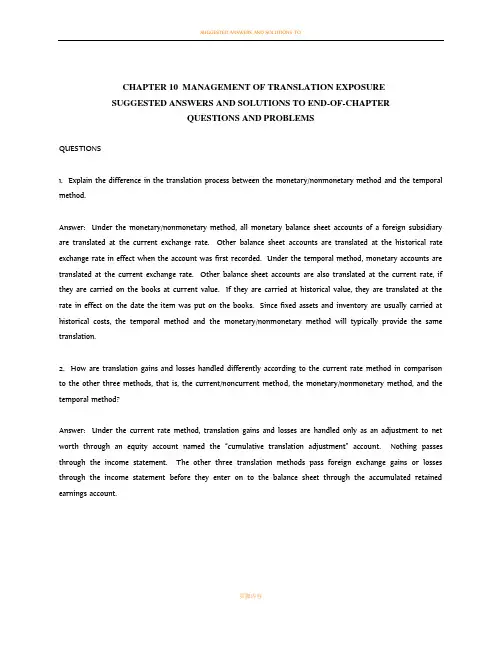
CHAPTER 10 MANAGEMENT OF TRANSLATION EXPOSURESUGGESTED ANSWERS AND SOLUTIONS TO END-OF-CHAPTERQUESTIONS AND PROBLEMSQUESTIONS1. Explain the difference in the translation process between the monetary/nonmonetary method and the temporal method.Answer: Under the monetary/nonmonetary method, all monetary balance sheet accounts of a foreign subsidiary are translated at the current exchange rate. Other balance sheet accounts are translated at the historical rate exchange rate in effect when the account was first recorded. Under the temporal method, monetary accounts are translated at the current exchange rate. Other balance sheet accounts are also translated at the current rate, if they are carried on the books at current value. If they are carried at historical value, they are translated at the rate in effect on the date the item was put on the books. Since fixed assets and inventory are usually carried at historical costs, the temporal method and the monetary/nonmonetary method will typically provide the same translation.2. How are translation gains and losses handled differently according to the current rate method in comparison to the other three methods, that is, the current/noncurrent method, the monetary/nonmonetary method, and the temporal method?Answer: Under the current rate method, translation gains and losses are handled only as an adjustment to net worth through an equity account named the “cumulative translation adjustment” accoun t. Nothing passes through the income statement. The other three translation methods pass foreign exchange gains or losses through the income statement before they enter on to the balance sheet through the accumulated retained earnings account.3. Ident ify some instances under FASB 52 when a foreign entity’s functional currency would be the same as the parent firm’s currency.Answer: Three examples under FASB 52, where the foreign entity’s functional currency will be the same as the parent firm’s currency, are: i) the foreign entity’s cash flows directly affect the parent’s cash flows and are readily available for remittance to the parent firm; ii) the sales prices for the foreign entity’s products are responsive on a short-term basis to exchange rate changes, where sales prices are determined through worldwide competition; and, iii) the sales market is primarily located in the parent’s country or sales contracts are denominated in the parent’s currency.4. Describe the remeasurement and translation process under FASB 52 of a wholly owned affiliate that keeps its books in the local currency of the country in which it operates, which is different than its functional currency.Answer: For a foreign entity that keeps its books in its local currency, which is different from its functional currency, the translation process according to FASB 52 is to: first, remeasure the financial reports from the local currency into the functional currency using the temporal method of translation, and second, translate from the functional currency into the reporting currency using the current rate method of translation.5. It is, generally, not possible to completely eliminate both translation exposure and transaction exposure. In some cases, the elimination of one exposure will also eliminate the other. But in other cases, the elimination of one exposure actually creates the other. Discuss which exposure might be viewed as the most important to effectively manage, if a conflict between controlling both arises. Also, discuss and critique the common methods for controlling translation exposure.Answer: Since it is, generally, not possible to completely eliminate both transaction and translation exposure, we recommend that transaction exposure be given first priority since it involves real cash flows. The translation process, on-the-other hand, has no direct effect on reporting currency cash flows, and will only have a realizable effect on net investment upon the sale or liquidation of the assets.There are two common methods for controlling translation exposure: a balance sheet hedge and a derivatives hedge. The balance sheet hedge involves equating the amount of exposed assets in an exposure currency with the exposed liabilities in that currency, so the net exposure is zero. Thus when an exposure currency exchange rate changes versus the reporting currency, the change in assets will offset the change in liabilities. To create a balance sheet hedge, once transaction exposure has been controlled, often means creating new transaction exposure. This is not wise since real cash flow losses can result. A derivatives hedge is not really a hedge, but rather a speculative position, since the size of the “hedge” is based on the future expected spot rate of exchange for the exposure currency with the reporting currency. If the actual spot rate differs from the expected rate, the “hedge” may result in the loss of real cash flows.PROBLEMS1. Assume that FASB 8 is still in effect instead of FASB 52. Construct a translation exposure report for Centralia Corporation and its affiliates that is the counterpart to Exhibit 10.7 in the text. Centralia and its affiliates carry inventory and fixed assets on the books at historical values.Solution: The following table provides a translation exposure report for Centralia Corporation and its affiliates under FASB 8, which is essentially the temporal method of translation. The difference between the new report and Exhibit 10.7 is that nonmonetary accounts such as inventory and fixed assets are translated at the historical exchange rate if they are carried at historical costs. Thus, these accounts will not change values when exchange rates change and they do not create translation exposure.Examination of the table indicates that under FASB 8 there is negative net exposure for the Mexican peso and the euro, whereas under FASB 52 the net exposure for these currencies is positive. There is no change in net exposure for the Canadian dollar and the Swiss franc. Consequently, if the euro depreciates against the dollar from €1.1000/$1.00 to €1.1786/$1.00, as the text example assumed, exposed assets will now fall in value by a smaller amount than exposed liabilities, instead of vice versa. The associated reporting currency imbalance will be $239,415, calculated as follows:Reporting Currency Imbalance=-€3,949,0000€1.1786/$1.00--€3,949,0000€1.1000/$1.00=$239,415.December 31, 2005 (in 000 Currency Units)Canadian Dollar MexicanPeso EuroSwissFrancAssetsCash CD200Ps 6,000€ 825SF 0 Accounts receivable09,0001,0450Inventory0000Net fixed assets0 0 0 0Exposed assets CD200Ps15,000€ 1,870SF 0LiabilitiesAccounts payable CD 0Ps 7,000€ 1,364SF 0Notes payable017,0009351,400Long-term debt 0 27,000 3,520 0Exposed liabilities CD 0Ps51,000€ 5,819SF1,400Net exposure CD200(Ps36,000)(€3,949)(SF1,400)2. Assume that FASB 8 is still in effect instead of FASB 52. Construct a consolidated balance sheet for Centralia Corporation and its affiliates after a depreciation of the euro from €1.1000/$1.00 to €1.1786/$1.00 that is the counterpart to Exhibit 10.8 in the text. Centralia and its affiliates carry inventory and fixed assets on the books at historical values.Solution: This problem is the sequel to Problem 1. The solution to Problem 1 showed that if the euro depreciated there would be a reporting currency imbalance of $239,415. Under FASB 8 this is carried through the income statement as a foreign exchange gain to the retained earnings on the balance sheet. The following table shows that consolidated retained earnings increased to $4,190,000 from $3,950,000 in Exhibit 10.8. This is an increase of $240,000, which is the same as the reporting currency imbalance after accounting for rounding error.December 31, 2005: Post-Exchange Rate Change (in 000 Dollars)a This includes CD200,000 the parent firm has in a Canadian bank, carried as $150,000. CD200,000/(CD1.3333/$1.00) = $150,000.b$1,750,000 - $300,000 (= Ps3,000,000/(Ps10.00/$1.00)) intracompany loan = $1,450,000.c,d Investment in affiliates cancels with the net worth of the affiliates in the consolidation.e The Spanish affiliate owes a Swiss bank SF375,000 (÷ SF1.2727/€1.00 = €294,649). This is carried on the books, after the exchange rate change, as part of €1,229,649 = €294,649 + €935,000. €1,229,649/(€1.1786/$1.00) = $1,043,313.3. In Example 10.2, a forward contract was used to establish a derivatives “hedge” to protect Centralia from a translation loss if the euro depreciated from €1.1000/$1.00 to €1.1786/$1.00. Assume that an over-the-counter put option on the euro with a strike price of €1.1393/$1.00 (or $0.8777/€1.00) can be purchased for $0.0088 per euro. Show how the potential translation loss can be “hedged” with an option contract.Solution: As in example 10.2, if the potential translation loss is $110,704, the equivalent amount in functional currency that needs to be hedged is €3,782,468. If in fact the euro does depreciate to €1.1786/$1.00 ($0.8485/€1.00), €3,782,468 can be purchased in the spot market for $3,209,289. At a striking price of €1.1393/$1.00, the €3,782,468 can be sold through the put for $3,319,993, yielding a gross profit of $110,704. The put option cost $33,286 (= €3,782,468 x $0.0088). Thus, at an exchange rate of €1.1786/$1.00, the put option will effectively hedge $110,704 - $33,286 = $77,418 of the potential translation loss. At terminal exchange rates of €1.1393/$1.00 to €1.1786/$1.00, the put option hedge will be less effective. An option contract does not have to be exercised if doing so is disadvantageous to the option owner. Therefore, the put will not be exercised at exchange rates of less than €1.1393/$1.00 (more than $0.8777/€1.00), in which case the “hedge” will lose the $33,286 cost of the option.MINI CASE: SUNDANCE SPORTING GOODS, INC.Sundance Sporting Goods, Inc., is a U.S. manufacturer of high-quality sporting goods--principally golf, tennis and other racquet equipment, and also lawn sports, such as croquet and badminton-- with administrative offices and manufacturing facilities in Chicago, Illinois. Sundance has two wholly owned manufacturing affiliates, one in Mexico and the other in Canada. The Mexican affiliate is located in Mexico City and services all of Latin America. The Canadian affiliate is in Toronto and serves only Canada. Each affiliate keeps its books in its local currency, which is also the functional currency for the affiliate. The current exchange rates are: $1.00 = CD1.25 = Ps3.30 = A1.00 = ¥105 = W800. The nonconsolidated balance sheets for Sundance and its two affiliates appear in the accompanying table.Nonconsolidated Balance Sheet for Sundance Sporting Goods, Inc. and Its Mexican and Canadian Affiliates, December 31, 2005 (in 000 Currency Units)a The parent firm is owed Ps1,320,000 by the Mexican affiliate. This sum is included in the parent’s accounts receivable as $400,000, translated at Ps3.30/$1.00. The remainder of the parent’s (Mexican affiliate’s) a ccounts receivable (payable) is denominated in dollars (pesos).b The Mexican affiliate is wholly owned by the parent firm. It is carried on the parent firm’s books at $2,400,000. This represents the sum of the common stock (Ps4,500,000) and retained earnings (Ps3,420,000) on the Mexican affiliate’s books, translated at Ps3.30/$1.00.c The Canadian affiliate is wholly owned by the parent firm. It is carried on the parent firm’s books at $3,600,000. This represents the sum of the common stock (CD2,900,000) and the retained earnings (CD1,600,000) on the Canadian affiliate’s books, translated at CD1.25/$1.00.d The parent firm has outstanding notes payable of ¥126,000,000 due a Japanese bank. This sum is carried on the parent firm’s books as $1,200,000, translated at ¥105/$1.00. Other notes payable are denominated in U.S. dollars.e The Mexican affiliate has sold on account A120,000 of merchandise to an Argentine import house. This sum is carried on the Mexican affiliate’s books as Ps396,000, translated at A1.00/Ps3.30. Other accounts receivable are denominated in Mexican pesos.f The Canadian affiliate has sold on account W192,000,000 of merchandise to a Korean importer. This sum is carried on the Canadian affiliate’s books as CD300,000, translated at W800/CD1.25. Other accounts receivable are denominated in Canadian dollars.You joined the International Treasury division of Sundance six months ago after spending the last two years receiving your MBA degree. The corporate treasurer has asked you to prepare a report analyzing all aspects of the translation exposure faced by Sundance as a MNC. She has also asked you to address in your analysis the relationship between the firm’s translation exposure and its transaction exposure. After performing a forecast of future spot rates of exchange, you decide that you must do the following before any sensible report can be written.a. Using the current exchange rates and the nonconsolidated balance sheets for Sundance and its affiliates, prepare a consolidated balance sheet for the MNC according to FASB 52.b. i. Prepare a translation exposure report for Sundance Sporting Goods, Inc., and its two affiliates.ii. Using the translation exposure report you have prepared, determine if any reporting currency imbalance will result from a change in exchange rates to which the firm has currency exposure. Your forecast is that exchange rates will change from $1.00 = CD1.25 = Ps3.30 = A1.00 = ¥105 = W800 to $1.00 = CD1.30 = Ps3.30 = A1.03 = ¥105 = W800.c. Prepare a second consolidated balance sheet for the MNC using the exchange rates you expect in the future. Determine how any reporting currency imbalance will affect the new consolidated balance sheet for the MNC.d. i. Prepare a transaction exposure report for Sundance and its affiliates. Determine if any transaction exposures are also translation exposures.ii. Investigate what Sundance and its affiliates can do to control its transaction and translation exposures. Determine if any of the translation exposure should be hedged.Suggested Solution to Sundance Sporting Goods, Inc.Note to Instructor: It is not necessary to assign the entire case problem. Parts a. and b.i. can be used as self-contained problems, respectively, on basic balance sheet consolidation and the preparation of a translation exposure report.a. Below is the consolidated balance sheet for the MNC prepared according to the current rate method prescribed by FASB 52. Note that the balance sheet balances. That is, Total Assets and Total Liabilities and Net Worth equal one another. Thus, the assumption is that the current exchange rates are the same as when the affiliates were established. This assumption is relaxed in part c.Consolidated Balance Sheet for Sundance Sporting Goods, Inc. its Mexican and Canadian Affiliates, December 31, 2005: Pre-Exchange Rate Change (in 000 Dollars)Sundance, Inc. (parent)MexicanAffiliateCanadianAffiliateConsolidatedBalance Sheeta$2,500,000 - $400,000 (= Ps1,320,000/(Ps3.30/$1.00)) intracompany loan = $2,100,000.b,c The investment in the affiliates cancels with the net worth of the affiliates in the consolidation.d The parent owes a Japanese bank ¥126,000,000. This is carried on the books as $1,200,000 (=¥126,000,000/(¥105/$1.00)).e The Mexican affiliate has sold on account A120,000 of merchandise to an Argentine import house. This is carried on the Mexican affiliate’s books as Ps396,000 (= A120,000 x Ps3.30/A1.00).f The Canadian affiliate has sold on account W192,000,000 of merchandise to a Korean importer. This is carried on the Canadian affiliate’s books as CD300,000 (= W192,000,000/(W800/CD1.25)).b. i. Below is presented the translation exposure report for the Sundance MNC. Note, from the report that there is net positive exposure in the Mexican peso, Canadian dollar, Argentine austral and Korean won. If any of these exposure currencies appreciates (depreciates) against the U.S. dollar, exposed assets denominated in these currencies will increase (fall) in translated value by a greater amount than the exposed liabilities denominated in these currencies. There is negative net exposure in the Japanese yen. If the yen appreciates (depreciates) against the U.S. dollar, exposed assets denominated in the yen will increase (fall) in translated value by smaller amount than the exposed liabilities denominated in the yen.Translation Exposure Report for Sundance Sporting Goods, Inc. and its Mexican and Canadian Affiliates, December 31, 2005 (in 000 Currency Units)b. ii. The problem assumes that Canadian dollar depreciates from CD1.25/$1.00 to CD1.30/$1.00 and that the Argentine austral depreciates from A1.00/$1.00 to A1.03/$1.00. To determine the reporting currency imbalance in translated value caused by these exchange rate changes, we can use the following formula:Net Exposure Currency i S(i/reporting)-Net Exposure Currency i S(i/reporting)new old = Reporting Currency Imbalance.From the translation exposure report we can determine that the depreciation in the Canadian dollar will cause aCD4,200,000 CD1.30/$1.00-CD4,200,000CD1.25/$1.00= -$129,231reporting currency imbalance.Similarly, the depreciation in the Argentine austral will cause aA120,000 A1.03/$1.00-A120,000A1.00/$1.00= -$3,495reporting currency imbalance.In total, the depreciation of the Canadian dollar and the Argentine austral will cause a reporting currency imbalance in translated value equal to -$129,231 -$3,495= -$132,726.c. The new consolidated balance sheet for Sundance MNC after the depreciation of the Canadian dollar and the Argentine austral is presented below. Note that in order for the new consolidated balance sheet to balance after the exchange rate change, it is necessary to have a cumulative translation adjustment account balance of -$133 thousand, which is the amount of the reporting currency imbalance determined in part b. ii (rounded to the nearest thousand).Consolidated Balance Sheet for Sundance Sporting Goods, Inc. its Mexican and Canadian Affiliates, December 31, 2005: Post-Exchange Rate Change (in 000 Dollars)a$2,500,000 - $400,000 (= Ps1,320,000/(Ps3.30/$1.00)) intracompany loan = $2,100,000.b,c The investment in the affiliates cancels with the net worth of the affiliates in the consolidation.d The parent owes a Japanese bank ¥126,000,000. This is carried on the books as $1,200,000 (=¥126,000,000/(¥105/$1.00)).e The Mexican affiliate has sold on account A120,000 of merchandise to an Argentine import house. This is carried on the Mexican affiliate’s books as Ps384,466 (= A120,000 x Ps3.30/A1.03).f The Canadian affiliate has sold on account W192,000,000 of merchandise to a Korean importer. This is carried on the Canadian affiliate’s bo oks as CD312,000 (=W192,000,000/(W800/CD1.30)).d. i. The transaction exposure report for Sundance, Inc. and its two affiliates is presented below. The report indicates that the Ps1,320,000 accounts receivable due from the Mexican affiliate is not also a translation exposure because this is netted out in the consolidation. However, the ¥126,000,000 notes payable of the parent is also a translation exposure. Additionally, the A120,000 accounts receivable of the Mexican affiliate and the W192,000,000 accounts receivable of the Canadian affiliate are both translation exposures.Transaction Exposure Report for Sundance Sporting Goods, Inc. andits Mexican and Canadian Affiliates, December 31, 2005d. ii. Since transaction exposure may potentially result in real cash flow losses while translation exposure does not have an immediate direct effect on operating cash flows, we will first address the transaction exposure that confronts Sundance and its affiliates. The analysis assumes the depreciation in the Canadian dollar and the Argentine austral have already taken place.The parent firm can pay off the ¥126,000,000 loan from the Japanese bank using funds from the cash account and money from accounts receivable that it will collect. Additionally, the parent firm can collect the accounts receivable of Ps1,320,000 from its Mexican affiliate that is carried on the books as $400,000. In turn, the Mexican affiliate can collect the A120,000 accounts receivable from the Argentine importer, valued at Ps384,466 after the depreciation in the austral, to guard against further depreciation and to use to partially pay off the peso liability to the parent. The Canadian affiliate can eliminate its transaction exposure by collecting the W192,000,000 accounts receivable as soon as possible, which is currently valued at CD312,000.The elimination of these transaction exposures will affect the translation exposure of Sundance MNC. A revised translation exposure report follows.Revised Translation Exposure Report for Sundance Sporting Goods, Inc. and its Mexican and Canadian Affiliates, December 31, 2005 (in 000 Currency Units)Note from the revised translation exposure report that the elimination of the transaction exposure will also eliminate the translation exposure in the Japanese yen, Argentine austral and the Korean won. Moreover, the net translation exposure in the Mexican peso has been reduced. But the net translation exposure in the Canadian dollar has increased as a result of the Canadian affiliate’s collection of the won receivable.The remaining translation exposure can be hedged using a balance sheet hedge or a derivatives hedge. Use of a balance sheet hedge is likely to create new transaction exposure, however. Use of a derivatives hedge is actually speculative, and not a real hedge, since the size of the “hedge” is based on one’s expectation as to thefuture spot exchange rate. An incorrect estimate will result in the “hedge” los ing money for the MNC.。
第一章 财务管理总论(1概念、2原则)

5. 我们想当或能当CFO 吗?
我们都想当大公司的CFO? 1)关于CFO的能力要求? ----战略分析能力+财务能力+沟通能力 2)学完企业财务学后,能成为合格的CFO吗? ----不能,因为学与用之间还存在事实上的差异 当你能真正做到“学以致用”时,你就可能有当 CFO的候选资格了。 3)对你的学习方法有何要求? ----“学以致用、多学多用、边学边用”
1-19
学金融的要向fm发展多学点会计 学会计的要向fm发展多学点金融 很多大公司的财务总监都是学金融出身
1-20
4.财务学的前置与后续课程设计
前置课程:会计学、管理会计、成本会计 后续课程:财务分析、国际财务管理、各种专题研究 主要基础: (1)经济学(微观及新制度经济学) (2)管理学(组织行为) (3)金融学 (4)数学 (5)税收 (6)外语
1-33
3.财务关系 财务关系是指企业在组织资金运动过程 中与有关各方所发生的经济利益关系。
内部单位及职工
一、财务与财务管理
股东
税务、行政部门 企业
被投资单位
债权、债务人
1-34
只要企业进行财务活动,他都会与相关的利 益者产生财务关系,但是一旦财务活动结束 ,不一定意味着财务关系的终结。财务关系 是基于财务活动而产生的,但它一旦形成将 会独立于财务活动而存在。
1-11
过度投机、过度负债、过度消费是理财的三 个大忌。
1-12
个人理财
金融学家博迪和莫顿说:学习理财至少有5 个理由:一是管理个人资源;二是处理商务世 界的问题;三是寻求令人感兴趣和回报丰富的 职业;四是以普通的身份作出有根据的公共选 择;五是扩展你的思路。其中,首要的是管理 个人资源。 学习管理金钱是一个过程,因为它是那 么妩媚善变。变化多端的金融市场和产品,会 带来众多无常的人生故事。为把握好自己的命 运,有两条要领告诉你:
国际财务管理英文版第版马杜拉答案Chapter
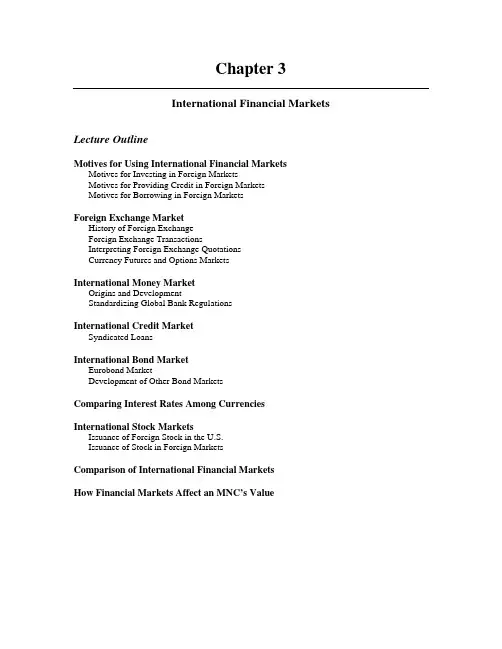
Chapter 3International Financial Markets Lecture OutlineMotives for Using International Financial Markets Motives for Investing in Foreign MarketsMotives for Providing Credit in Foreign MarketsMotives for Borrowing in Foreign MarketsForeign Exchange MarketHistory of Foreign ExchangeForeign Exchange TransactionsExchange QuotationsForeignInterpretingCurrency Futures and Options MarketsInternational Money MarketOrigins and DevelopmentStandardizing Global Bank RegulationsInternational Credit MarketSyndicated LoansInternational Bond MarketEurobond MarketDevelopment of Other Bond MarketsComparing Interest Rates Among CurrenciesInternational Stock MarketsIssuance of Foreign Stock in the U.S.Issuance of Stock in Foreign MarketsComparison of International Financial MarketsHow Financial Markets Affect an MNC’s ValueChapter ThemeThis chapter identifies and discusses the various international financial markets used by MNCs. These markets facilitate day-to-day operations of MNCs, including foreign exchange transactions, investing in foreign markets, and borrowing in foreign markets.Topics to Stimulate Class Discussion1. Why do international financial markets exist?2. How do banks serve international financial markets?3. Which international financial markets are most important to a firm that consistently needsshort-term funds? What about a firm that needs long-term funds?Critical debateShould firms that go public engage in international offerings?Proposition Yes. When a firm issues shares to the public for the first time in an initial public offering (IPO), it is naturally concerned about whether it can place all of its shares at a reasonable price. It will be able to issue its shares at a higher price by attracting more investors. It will increase its demand by spreading the shares across countries. The higher the price at which it can issue shares, the lower is its cost of using equity capital. It can also establish a global name by spreading shares across countries.Opposing view No. If a firm spreads its shares across different countries at the time of the IPO, there will be less publicly traded shares in the home country. Thus, it will not have as much liquidity in the secondary market. Investors desire shares that they can easily sell in the secondary market, which means that they require that the shares have liquidity. To the extent that a firm reduces its liquidity in the home country by spreading its share across countries, it may not attract sufficient home demand for the shares. Thus, its efforts to create global name recognition may reduce its name recognition in the home country.With whom do you agree? State your reasons. Use InfoTrac or some other search engine to learn more about this issue. Which argument do you support? Offer your own opinion on this issue.ANSWER: The key is that students recognize the tradeoff involved. A firm that engages in a relatively small IPO will have limited liquidity even when all of the stock is issued in the home country. Thus, it should not consider issuing stock internationally. However, firms with larger stock offerings may be in a position to issue a portion of their shares outside the home country. They should not spread the stocks across several countries, but perhaps should target one or two countries where they conduct substantial business. They want to ensure sufficient liquidity in each of the foreign countries where they sell shares.Stock Markets are inefficientPropositionI cannot believe that if the value of the euro in terms of, say, the British pound increases three days in a row, on the fourth day there is still a 50:50 chance that it will go up or down in value. I think that most investors will see a trend and will buy, therefore the price is morelikely to go up. Also, if the forward market predicts a rise in value, on average, surely it is going to rise in value. In other words, currency prices are predictable. And finally, if it were so unpredictable and therefore unprofitable to the speculator, how is it that there is such a vast sum of money being traded every day for speculative purposes – there is no smoke without fire.The simple answer is that if that is what you believe, buy currencies that have viewOpposingincreased three days in a row and on average you should make a profit, buy currencies where the forward market shows an increase in value. The fact is that there are a lot of investors with just your sort of views. The market traders know all about such beliefs and will price the currency so that such easy profit (their loss) cannot be made. Look at past currency rates for yourself, check all fourth day changes after three days of rises, any difference is going to be not enough to cover transaction costs or trading expenses and the slight inaccuracy in your figures which are likely to be closing day mid point of the bid/ask spread. No, all currency movements are related to information and no-one knows if tomorrows news will be better or worse than expected.With whom do you agree? Could there be undiscovered patterns? Could some movements not be related to information? Could some private news be leaking out?ANSWER: Clearly there are no obvious patterns. Discussion on the impossibility of obvious patterns is worth emphasizing. However, does market inefficiency necessarily involve patterns, could market manipulation be occasional. There is worrying evidence from share price movements that there is unusual movement before announcements on many occasions, so the ideathat traders do not occasionally collude and move the price without supporting economic evidence is not an unreasonable view. Proof is however difficult as we have to separate anticipation from prior knowledge, the lucky speculator from the speculator who was in the know.Answers to End of Chapter Questions1. Motives for Investing in Foreign Money Markets. Explain why an MNC may invest fundsin a financial market outside its own country.ANSWER: The MNC may be able to earn a higher interest rate on funds invested in a financial market outside of its own country. In addition, the exchange rate of the currency involved may be expected to appreciate.2. Motives for Providing Credit in Foreign Markets. Explain why some financial institutionsprefer to provide credit in financial markets outside their own country.ANSWER: Financial institutions may believe that they can earn a higher return by providing credit in foreign financial markets if interest rate levels are higher and if the economic conditions are strong so that the risk of default on credit provided is low. The institutions may also want to diversity their credit so that they are not too exposed to the economic conditions in any single country.3. Exchange Rate Effects on Investing. Explain how the appreciation of the Australian dollaragainst the euro would affect the return to a French firm that invested in an Australian money market security.ANSWER: If the Australian dollar appreciates over the investment period, this implies that the French firm purchased the Australian dollars to make its investment at a lower exchange rate than the rate at which it will convert A$ to euros when the investment period is over.Thus, it benefits from the appreciation. Its return will be higher as a result of this appreciation.4. Exchange Rate Effects on Borrowing. Explain how the appreciation of the Japanese yenagainst the UK pound would affect the return to a UK firm that borrowed Japanese yen and used the proceeds for a UK project.ANSWER: If the Japanese yen appreciates over the borrowing period, this implies that the UK firm converted yen to pounds at a lower exchange rate than the rate at which it paid for yen at the time it would repay the loan. Thus, it is adversely affected by the appreciation. Its cost of borrowing will be higher as a result of this appreciation.5. Bank Services. List some of the important characteristics of bank foreign exchange servicesthat MNCs should consider.ANSWER: The important characteristics are (1) competitiveness of the quote, (2) the firm’s relationship with the bank, (3) speed of execution, (4) advice about current market conditions, and (5) forecasting advice.6. Bid/ask Spread. Delay Bank’s bid price for US dollars is £0.53 and its ask price is £0.55.What is the bid/ask percentage spread?ANSWER: (£0.55– £0.53)/£0.55 = .036 or 3.6%7. Bid/ask Spread. Compute the bid/ask percentage spread for Mexican peso in which the askrate is 20.6 New peso to the dollar and the bid rate is 21.5 New peso to the dollar.ANSWER: direct rates are 1/20.6 = $0.485:1 peso as the ask rate and 1/21.5 = $0.465:1 peso as the bid rate so the spread is[($0.485 – $0.465)/$0.485] = .041, or 4.1%. Note that the spread is fro the Mexiccan peso not the dollar.8. Forward Contract. The Wolfpack ltd is a UK exporter that invoices its exports to the UnitedStates in dollars. If it expects that the dollar will appreciate against the pound in the future, should it hedge its exports with a forward contract? Explain..ANSWER: The forward contract can hedge future receivables or payables in foreign currencies to insulate the firm against exchange rate risk. Yet, in this case, the Wolfpack Corporation should not hedge because it would benefit from appreciation of the dollar when it converts the dollars to pounds.9. Euro. Explain the foreign exchange situation for countries that use the euro when theyengage in international trade among themselves.ANSWER: There is no foreign exchange. Euros are used as the medium of exchange.10. Indirect Exchange Rate. If the direct exchange rate of the euro is worth £0.685, what is theindirect rate of the euro? That is, what is the value of a pound in euros?ANSWER: 1/0.685 = 1.46 euros.11. Cross Exchange Rate. Assume Poland’s currency (the zloty) is worth £0.17 and theJapanese yen is worth £0.005. What is the cross (implied) rate of the zloty with respect to yen?ANSWER: £0.17/£0.005 = 34 zloty:1 yen12. Syndicated Loans. Explain how syndicated loans are used in international markets.ANSWER: A large MNC may want to obtain a large loan that no single bank wants to accommodate by itself. Thus, a bank may create a syndicate whereby several other banks also participate in the loan.13. Loan Rates. Explain the process used by banks in the Eurocredit market to determine the rateto charge on loans.ANSWER: Banks set the loan rate based on the prevailing LIBOR, and allow the loan rate to float (change every 6 months) in accordance with changes in LIBOR.14. International Markets. What is the function of the international money market? Brieflydescribe the reasons for the development and growth of the European money market. Explain how the international money, credit, and bond markets differ from one another.ANSWER: The function of the international money market is to efficiently facilitate the flow of international funds from firms or governments with excess funds to those in need of funds.Growth of the European money market was largely due to (1) regulations in the U.S. that limited foreign lending by U.S. banks; and (2) regulated ceilings placed on interest rates of dollar deposits in the U.S. that encouraged deposits to be placed in the Eurocurrency market where ceilings were nonexistent.The international money market focuses on short-term deposits and loans, while the international credit market is used to tap medium-term loans, and the international bond market is used to obtain long-term funds (by issuing long-term bonds).15. Evolution of Floating Rates. Briefly describe the historical developments that led to floatingexchange rates as of 1973.ANSWER: Country governments had difficulty in maintaining fixed exchange rates. In 1971, the bands were widened. Yet, the difficulty of controlling exchange rates even within these wider bands continued. As of 1973, the bands were eliminated so that rates could respond to market forces without limits (although governments still did intervene periodically).16. International Diversification. Explain how the Asian crisis would have affected the returnsto a UK. firm investing in the Asian stock markets as a means of international diversification.[See the chapter appendix.]ANSWER: The returns to the UK firm would have been reduced substantially as a result of the Asian crisis because of both declines in the Asian stock markets and because of currency depreciation. For example, the Indonesian stock market declined by about 27% from June 1997 to June 1998. Furthermore, the Indonesian rupiah declined against the U.S. dollar by 84%.17.Eurocredit Loans.a.With regard to Eurocredit loans, who are the borrowers?b. Why would a bank desire to participate in syndicated Eurocredit loans?c. What is LIBOR and how is it used in the Eurocredit market?ANSWER:a. Large corporations and some government agencies commonly request Eurocredit loans.b. With a Eurocredit loan, no single bank would be totally exposed to the risk that theborrower may fail to repay the loan. The risk is spread among all lending banks within the syndicate.c. LIBOR (London interbank offer rate) is the rate of interest at which banks in Europe lendto each other. It is used as a base from which loan rates on other loans are determined in the Eurocredit market.18. Foreign Exchange. You just came back from Canada, where the Canadian dollar was worth£0.43. You still have C$200 from your trip and could exchange them for pounds at the airport, but the airport foreign exchange desk will only buy them for £0.40. Next week, you will be going to Mexico and will need pesos. The airport foreign exchange desk will sell you pesos for £0.055 per peso. You met a tourist at the airport who is from Mexico and is on his way to Canada. He is willing to buy your C$200 for 1500 New Pesos. Should you accept the offer or cash the Canadian dollars in at the airport? Explain.ANSWER: Exchange with the tourist. If you exchange the C$ for pesos at the foreign exchange desk, the C$200 is multiplied by £0.40 and then divided by £0.055 ie a ratio of £0.40/0.055 = 7.27 pesos to the C$. The total pesos would be 200 x 7.27 = 1454 pesos, a little less than is being offered by the tourist.19. Foreign Stock Markets. Explain why firms may issue stock in foreign markets. Why mightMNCs issue more stock in Europe since the conversion to a single currency in 1999?ANSWER: Firms may issue stock in foreign markets when they are concerned that their home market may be unable to absorb the entire issue. In addition, these firms may have foreign currency inflows in the foreign country that can be used to pay dividends on foreign-issued stock. They may also desire to enhance their global image. Since the euro can be used in several countries, firms may need a large amount of euros if they are expanding across Europe.20. Stock Market Integration. Bullet plc a UK firm, is planning to issue new shares on theLondon Stock Exchange this month. The only decision still to be made is the specific day on which the shares will be issued. Why do you think Bullet monitors results of the Tokyo stock market every morning?ANSWER: The UK stock market prices sometimes follow Japanese market prices. Thus, the firm would possibly be able to issue its stock at a higher price in the UK if it can use the Japanese market as an indicator of what will happen in the UK market. However, this indicator will not always be accurate.Advanced Questions21. Effects of September 11. Why do you think the terrorist attack on the U.S. was expected tocause a decline in U.S. interest rates? Given the expectations for a potential decline in U.S.interest rates and stock prices, how were capital flows between the U.S. and other countries likely affected?ANSWER: The attack was expected to cause a weaker economy, which would result in lower U.S. interest rates. Given the lower interest rates, and the weak stock prices, the amount of funds invested by foreign investors in U.S. securities would be reduced.22. International Financial Markets. Carrefour the French Supermarket chain has established retail outlets worldwide. These outlets are massive and contain products purchased locally as well as imports. As Carrefour generates earnings beyond what it needs abroad, it may remit those earnings back to France. Carrefour is likely to build additional outlets especially in China.a. Explain how the Carrefour outlets in China would use the spot market in foreign exchange.ANSWER:The Carrefour stores in China need other currencies to buy products from other countries, and must convert the Chinese currency (yuan) into the other currencies in the spot market to purchase these products. They also could use the spot market to convert excess earnings denominated in yuan into euros, which would be remitted to the French parent.b. Explain how Carrefour might utilize the international money markets when it isestablishing other Carrefour stores in Asia.ANSWER: Carrefour may need to maintain some deposits in the Eurocurrency market that can be used (when needed) to support the growth of Carrefour stores in various foreign markets. When some Carrefour stores in foreign markets need funds, they borrow from banks in the Eurocurrency market. Thus, the Eurocurrency market serves as a deposit or lending source for Carrefour and other MNCs on a short-term basis. (Eurocurrency refers to international currencies, most likely the dollar, not just the euro!)c. Explain how Carrefour could use the international bond market to finance theestablishment of new outlets in foreign markets.ANSWER: Carrefour could issue bonds in the Eurobond market to generate funds needed to establish new outlets. The bonds may be denominated in the currency that is needed; then, once the stores are established, some of the cash flows generated by those stores could be used to pay interest on the bonds.23.Interest Rates. Why do interest rates vary among countries? Why are interest rates normallysimilar for those European countries that use the euro as their currency? Offer a reason why the government interest rate of one country could be slightly higher than that of the government interest rate of another country, even though the euro is the currency used in both countries.ANSWER: Interest rates in each country are based on the supply of funds and demand for funds for a given currency. However, the supply and demand conditions for the euro are dictated by all participating countries in aggregate, and do not vary among participating countries. Yet, the government interest rate in one country that uses the euro could be slightly higher than others that use the euro if it is subject to default risk. The higher interest rate would reflect a risk premium.Blades plc Case Study。
Intermediate Financial Management
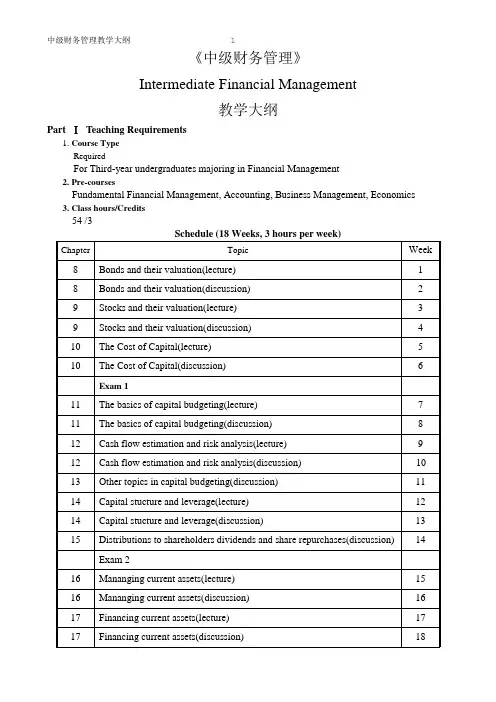
《中级财务管理》Intermediate Financial Management教学大纲Part ⅠTeaching Requirements1. Course TypeRequiredFor Third-year undergraduates majoring in Financial Management2. Pre-coursesFundamental Financial Management, Accounting, Business Management, Economics3. Class hours/Credits54 /3Part Ⅱ: Course ContentsCourse OverviewThis course is continued with fundamental financial management. Ihe same textbook are used in this semester. The course covers four parts of textbook. Part Ⅲcovers the valuation of stocks and bonds. Part IV applies the concepts covered in earlier chapters to decisions related to fixed asset investments. Part Ⅴdiscusses how firms should finance their long-term assets. In part Ⅵ, the focus shifts from long-term, strategic decisions to short-term, day-to-day operating decisions. Specific contentsⅠ. Financial AssetsThis part covers the valuation of stocks and bonds. Chapter 8 focuses on bonds, and Chapter 9 considers stocks. Both chapters describe the relevant institutional details, then explain how risk and time value jointly determine stock and bond prices.Chapter 8 Bonds and their valuationThis chapter is to describe the different types of bonds governments and corporations issue, explain how bond prices are established, and to discuss how investors estimate the rates of return they can expect to earn. We will also discuss the various types of risks that investors face when they buy bonds.Contents:1.Who issues bonds?2.Key characteristics of bonds3.Bond valuation4.Bond yields5.Bonds with semiannual coupons6.Assessing the riskiness of bond7.Default risk8.Bond marketsChapter 9 Stocks and their valuationThis chapter shows how stock value are determined, and also how investors go about estimating the rates of return they expect to earn.Contents:1.Legal rights and privileges of common stockholders2.Types of common stock3.The market for common stockmon stock valuation5.Constant growth stocks6.Expected rate of return on a constant growth stock7.Valuing stocks that have a nonconstant growth rate8.Valuate the entire corporation9.Stock market equilibrium10.Actual stock prices and returns11.Preferred stockⅡ. Investing in Long-Term AssetsChapter 10 The Cost of CapitalChapter 10 uses the rate of return concepts covered in previous chapters, along with the concept of the weighted average cost of capital (WACC), to develop a corporate cost of capital for use in capital budgeting.Contents:1. E xplain what is meant by a firm’s weighted average cost of capital.2. Define and calculate the component costs of debt and preferred stock.3. Explain why retained earnings are not free and use three approaches to estimate the component cost of retained earnings.4. Briefly explain why the cost of new common equity is higher than the cost of retained earnings, calculate the cost of new common equity, and calculate the retained earnings breakpoint--which is the point where new common equity would have to be issued.5. Briefly explain the two alternative approaches that can be used to account for flotation costs.6. Calculate the firm’s composite, or weighted average, cost of capital.7. Identify some of the factors that affect the overall, composite cost of capital.8. Briefly explain how firms should evaluate projects with different risks, and the problems encountered when divisions within the same firm all use the firm’s composite WACC when considering capital budgeting projects.9. List and briefly explain the three separate and distinct types of risk that can be identified, and explain the procedure many firms use when developing subjective risk-adjusted costs of capital.10. List some problem areas in estimating the cost of capital.Chapter 11 The basics of capital budgetingContents:1. Discuss difficulties and relevant considerations in estimating net cash flows, and explain the four major ways that project cash flow differs from accounting income.2. Define the following terms: relevant cash flow, incremental cash flow, sunk cost, opportunity cost, externalities, and cannibalization.3. Identify the three categories to which incremental cash flows can be classified.4. Analyze an expansion project and make a decision whether the project should be accepted on the basis of standard capital budgeting techniques.5. Explain three reasons why corporate risk is important even if a firm’s stockholders are well diversified.6. Identify two reasons why stand-alone risk is important.7. Demonstrate sensitivity and scenario analyses and explain Monte Carlo simulation.8. Discuss the two methods used to incorporate risk into capital budgeting decisions.Chapter 12 Cash flow estimation and risk analysisContents:1. Use the replacement chain method to compare projects with unequal lives.2. Explain why conventional NPV analysis may not capture a project’s impact on the firm’s opportunities.3. Define the term option value, and identify four different types of embedded real options.4. Explain what an abandonment option is, and give an example of a project that includes one.5. Explain what a decision tree is and provide an example of one.6. Explain what an investment timing option is, and give an example of a project that includes one.7. Explain what a growth option is, and give an example of a project that includes one.8. Explain what a flexibility option is, and give an example of a project that includes one.9. List the steps a firm goes through when establishing its optimal capital budget in practice.Chapter 13 Other topics in capital budgetingContents:1. Explain why capital structure policy involves a trade-off between risk and return, and list the four primary factors that influence capital structure decisions.2. Distinguish between a firm’s business risk and its financial risk.3. Explain how operating leverage contributes to a firm’s business risk and conduct a breakeven analysis, complete with a breakeven chart.4. Define financial leverage and explain its effect on expected ROE, expected EPS, and the risk borne by stockholders.5. Briefly explain what is meant by a firm’s optimal capital structure.6. Specify the effect of financial leverage on beta using the Hamada equation, and transform this equation to calculate a firm’s unlevered beta, bU.7. Illustrate through a graph the premiums for financial risk and business risk at diffe rent debt levels.8. List the assumptions under which Modigliani and Miller proved that a firm’s value is unaffected by its capital structure, then explain trade-off theory, signaling theory, and the effect of taxes and bankruptcy costs on capital structure.9. List a number of factors or practical considerations firms generally consider when making capital structure decisions.10. Briefly explain the extent that capital structure varies across industries, individual firms in each industry, and different countries.Ⅲ. CAPITAL STRUCTURE AND DIVIDEND POLICYChapter 14 Capital stucture and leverageContents:1. Define target payout ratio and optimal dividend policy.2. Discuss the three theories of investors’ dividend preference: (1) the dividend irrelevan ce theory, (2) the “bird-in-the-hand” theory, and (3) the tax preference theory; and whether empirical evidence has determined which theory is best.3. Explain the information content, or signaling, hypothesis and the clientele effect.4. Identify the two components of dividend stability, and briefly explain what a “stable dividend policy” means.5. Explain the logic of the residual dividend policy, and state why firms are more likely to use this policy in setting a long-run target than as a strict determination of dividends in a given year.6. Explain the use of dividend reinvestment plans, distinguish between the two types of plans, and discuss why the plans are popular with certain investors.7. List a number of factors that influence dividend policy in practice.8. Discuss why the dividend decision is made jointly with capital structure and capital budgeting decisions.9. Specify why a firm might split its stock or pay a stock dividend.10. Discuss stock repurchases, including advantages and disadvantages, and effects on EPS, stock price, and the firm’s capital structure.Chapter 15 Distributions to shareholders dividends and share repurchasesContents:1. Define basic working capital terminology.2. Calculate the inventory conversion period, the receivables collection period, and the payables deferral period to determine the cash conversion cycle.3. Briefly explain the basic idea of zero working capital.4. Briefly explain how a negative cash conversion cycle works.5. Distinguish among relaxed, restricted, and moderate current asset investment policies, and explain the effect of each on risk and expected return.6. Explain how EVA methodology provides a useful way of thinking about working capital.7. List the reasons for holding cash.8. Construct a cash budget, and explain its purpose.9. Briefly explain useful tools and procedures for effectively managing cash inflows and outflows.10. Explain why firms are likely to hold marketable securities.11. State the goal of inventory management and identify the three categories of inventory costs.12. Identify and briefly explain the use of several inventory control systems.13. Monitor a firm’s receivables position by calculating its DSO and reviewing aging schedules.14. List and explain the four elements o f a firm’s credit policy, and identify other factors influencing credit policy.ⅣWORKING CAPITAL MANAGEMENTChapter 16 Mananging current assetsContents:1. Identify and distinguish among the three different current asset financing policies.2. Briefly explain the advantages and disadvantages of short-term financing.3. List the four major types of short-term funds.4. Distinguish between free and costly trade credit, calculate both the nominal and effective annual percentage costs of not taking discounts, given specific credit terms, and explain what stretching accounts payable is and how it reduces the cost of trade credit.5. Describe the importance of short-term bank loans as a source of short-term financing and discuss some of the key features of bank loans.6. Calculate the effective interest rate for (1) simple interest, (2) discount interest, (3) add-on interest loans; and explain the effect of compensating balances on the effective cost of a loan.7. List some factors that should be considered when choosing a bank.8. Explain why large, financially strong corporations issue commercial paper, and why this source of short-term credit is typically less reliable than bank loans if the firm gets into financial difficulties.9. Define what a “secured” loan is and what type of collateral can be used to secure a loan.Chapter 17 Financing current assetsContents:1. Briefly explain the following terms: mission statement, corporate scope, corporate purpose, corporate objectives, and corporate strategies.2. Briefly explain what operating plans are.3. Identify the six steps in the financial planning process.4. List the advantages of computerized financial planning models over “pencil-and-paper” calculations.5. Discuss the importance of sales forecasts in the financial planning process, and why managers construct pro forma financial statements.6. Briefly explain the steps involved in the percent of sales method.7. Calculate additional funds needed (AFN), using both the projected financial statement approach and the formula method.8. Identify other techniques for forecasting financial statements discussed in the text and explain when they should be used.Part Ⅲ:Teaching MethodBased on the integrative problems of each chapter to lecture and discussPart ⅣGradingHomework assignments are due at the beginning of class following the class in which they are assigned, unless otherwise indicated. There will be a final exam and a project due at the end of the course. Class participation is expected and students will be called upon in class. Final grades are determined by the following formula:Grade =0.10(attendance)+0.10(homework) +0.10(quizzes) + 0.70(final)Part ⅤTextbook and Reference BooksTextbookEugene F. Brigham, and Joel F. Houston, Fundamentals of financial management9th edition by CITIC Publishing HouseReference BooksKeown, Martin, Petty, and Scott, Financial Management: Principles and Applications, Ninth Edition, Pearson Education, Inc., 2002Stephen A. Ross, Randolph W. Westerfield, and Bradford D. Jordan, Fundamentals of corporate finance (six edition) 2002 by China Machine Press.《公司理财精要》,斯蒂芬·罗斯等著,张建平译,人民邮电出版社,2003年1月《财务管理原理》,(英)理查德·布雷利(Richard A·Brealey)(美)斯图尔特·C·迈尔斯(Stewart C·Myers)机械工业出版社英文版原书第6版。
财务管理学(计算题总结及答案)
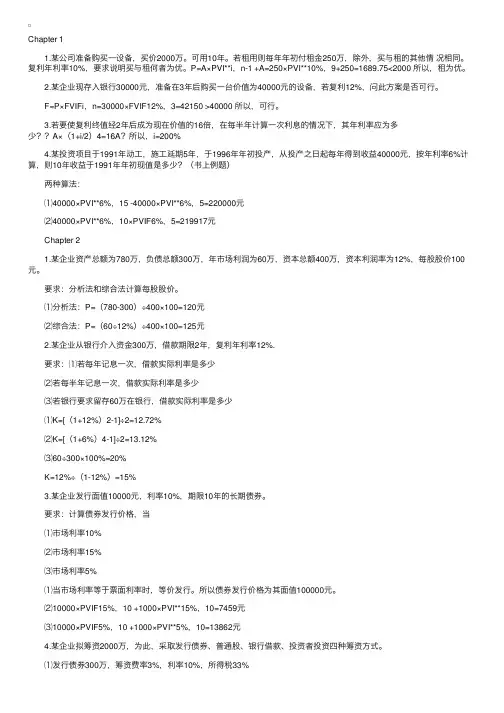
Chapter 1 1.某公司准备购买⼀设备,买价2000万。
可⽤10年。
若租⽤则每年年初付租⾦250万,除外,买与租的其他情况相同。
复利年利率10%,要求说明买与租何者为优。
P=A×PVI**i,n-1 +A=250×PVI**10%,9+250=1689.75<2000 所以,租为优。
2.某企业现存⼊银⾏30000元,准备在3年后购买⼀台价值为40000元的设备,若复利12%,问此⽅案是否可⾏。
F=P×FVIFi,n=30000×FVIF12%,3=42150 >40000 所以,可⾏。
3.若要使复利终值经2年后成为现在价值的16倍,在每半年计算⼀次利息的情况下,其年利率应为多少??A×(1+i/2)4=16A?所以,i=200% 4.某投资项⽬于1991年动⼯,施⼯延期5年,于1996年年初投产,从投产之⽇起每年得到收益40000元,按年利率6%计算,则10年收益于1991年年初现值是多少?(书上例题) 两种算法: ⑴40000×PVI**6%,15 -40000×PVI**6%,5=220000元 ⑵40000×PVI**6%,10×PVIF6%,5=219917元 Chapter 2 1.某企业资产总额为780万,负债总额300万,年市场利润为60万,资本总额400万,资本利润率为12%,每股股价100元。
要求:分析法和综合法计算每股股价。
⑴分析法:P=(780-300)÷400×100=120元 ⑵综合法:P=(60÷12%)÷400×100=125元 2.某企业从银⾏介⼊资⾦300万,借款期限2年,复利年利率12%. 要求:⑴若每年记息⼀次,借款实际利率是多少 ⑵若每半年记息⼀次,借款实际利率是多少 ⑶若银⾏要求留存60万在银⾏,借款实际利率是多少 ⑴K=[(1+12%)2-1]÷2=12.72% ⑵K=[(1+6%)4-1]÷2=13.12% ⑶60÷300×100%=20% K=12%÷(1-12%)=15% 3.某企业发⾏⾯值10000元,利率10%,期限10年的长期债券。
公司理财[罗斯]第十章节
二、 WACC举例
某企业账面反映的长期资金共2000万元,其 中长期借款额400万元,应付长期债券300万 元,普通股1100万元,保留盈余200万元, 其个别资本成本分别为7%、8%、9%、10% ,则该 企业的加权平均资本成本为多少? WACC=400/2000×7%+300/2000×8%+1 100/2 000×9%+200/12000×10%=7.7%
总复习
第六章 贴现现金流量估价 1、区分四类不同种类年金的含义。 2、名义利率(报价利率)与实际年利率关系? 第七章利率和债券估价 1、 债券价值的计算? 2、区别特有风险与市场风险? 3、债券的利率风险? 4、公司负债融资与权益融资的主要特点? 5、哪些融资形式属于直接融资或间接融资? 6.货币市场与资本市场的类型? 7、什么是公募? 8、什么是可转换证券?
Chapter 10 筹资管理:资本成本
本章主要内容
1、权益成本 2、债务成本 3.WACC
资本成本: 一些预备知识
1、什么是资本成本 有吸引力的投资方案期望报酬率高于金融市场上具有 相同系统风险的投资的期望报酬率。一项投资要吸引 人所必须提供的最低期望报酬率(或最低必要报酬率) 称为这个项目的资本成本。 2、资本成本、必要报酬率、适当贴现率可等同。 资 本成本主要取决于资金的运用风险,而不是资金的来 源。 投资决策(资本预算)→融资决策 3.金融市场决定的最低必要报酬率:对金融市场发行 证券的公司叫资本成本;对金融市场从证券上取得报 酬的投资者叫报酬率。在理想金融市场无发行成本的 情况下二者是相等的。通过观察金融市场上各种资产 要求的报酬率可以确定资本成本。
缺陷:没有考虑时间价值
2.到期收益率(1-税率)
第二节 加权平均资本成本 WACC
财务管理课后答案第十章
Chapter 10Discussion Questions10-1. How is valuation of any financial asset related to future cash flows?The valuation of a financial asset is equal to the present value of future cash flows.10-2. Why might investors demand a lower rate of return for an investment in Exxon Mobil as compared to Armco Steel?Because Exxon Mobil has less risk than Armco Steel, Exxon Mobil has relatively highreturns and a strong market position; Armco Steel has had financial difficulties.10-3. What are the three factors that influence the required rate of return by investors?The three factors that influence the demanded rate of return are:a.The real rate of returnb.The inflation premiumc.The risk premium10-4. If inflationary expectations increase, what is likely to happen to yield to maturity on bonds in the marketplace? What is also likely to happen to the price of bonds?If inflationary expectations increase, the yield to maturity (required rate of return) willincrease. This will mean a lower bond price.10-5. Why is the remaining time to maturity an important factor in evaluating the impact of a change in yield to maturity on bond prices?The longer the time period remaining to maturity, the greater the impact of a differencebetween the rate the bond is paying and the current yield to maturity (required rate ofreturn). For example, a two percent ($20) differential is not very significant for one year,but very significant for 20 years. In the latter case, it will have a much greater effect on thebond price.10-6. What are the three adjustments that have to be made in going from annual to semiannual bond analysis?The three adjustments in going from annual to semiannual bond analysis are:1.Divide the annual interest rate by two.2.Multiply the number of years by two.3.Divide the annual yield to maturity by two.10-7. Why is a change in required yield for preferred stock likely to have a greater impact on price than a change in required yield for bonds?The longer the life of an investment, the greater the impact of a change in the required rateof return. Since preferred stock has a perpetual life, the impact is likely to be at a maximum.10-8.What type of dividend pattern for common stock is similar to the dividend payment for preferred stock?The no-growth pattern for common stock is similar to the dividend on preferred stock.10-9.What two conditions must be met to go from Formula 10-8 to Formula 10-9 in using the dividend valuation model?()910g-K D P e 10-=To go from Formula (10-8) to Formula (10-9):The firm must have a constant growth rate (g).The discount rate (k e ) must exceed the growth rate (g).10-10.What two components make up the required rate of return on common stock?The two components that make up the required return on common stock are:a. The dividend yield D 1/P o .b. The growth rate (g). This actually represents the anticipated growth in dividends,earnings, and stock price over the long term.10-11.What factors might influence a firm's price-earnings ratio?The price-earnings ratio is influenced by the earnings and sales growth of the firm, the risk (or volatility in performance), the debt-equity structure of the firm, the dividend policy, the quality of management, and a number of other factors. Firms that have bright expectations for the future tend to trade at high P/E ratios while the opposite is true of low P/E firms.10-12.How is the supernormal growth pattern likely to vary from the normal, constant growth pattern?A supernormal growth pattern is represented by very rapid growth in the early years of a company or industry that eventually levels off to more normal growth. The supernormal growth pattern is often experienced by firms in emerging industries, such as in the early days of electronics or microcomputers.10-13.What approaches can be taken in valuing a firm's stock when there is no cash dividend payment?In valuing a firm with no cash dividend, one approach is to assume that at some point in the future a cash dividend will be paid. You can then take the present value of future cash dividends.A second approach is to take the present value of future earnings as well as a futureanticipated stock price. The discount rate applied to future earnings is generally higher thanthe discount rate applied to future dividends.Problems(For the first nine bond problems, assume interest payments are on an annual basis.)10-1. Burns Fire and Casualty Company has $1,000 par value bonds outstanding at 11 percent interest. The bonds will mature in 20 years. Compute the current price of the bonds if thepresent yield to maturity is:a. 6 percent.b. 8 percent.c. 12 percent.Solution:Burns Fire and Casualty Companya. 6 percent yield to maturityPresent Value of Interest PaymentsPV A = A x PV IFA (n = 20, i = 6%) Appendix D PV A = $110 x 11.470 = $1,261.70Present Value of Principal Payment at MaturityPV = FV x FV IF (n = 20, i = 6%) Appendix B PV = 1,000 x .312 = $312Present Value of Interest Payment $1,261.70 Present Value of Principal Payment 312.00 Total Present Value or Price of the Bond $1,573.70 10-1. Continuedb. 8 percent yield to maturityPV A = A x PV IFA (n = 20, i = 8%) Appendix D PV A = $110 x 9.818 = $1,079.98PV = FV x PV IF (n = 20, i = 8%) Appendix B PV = $1,000 x .215 = $215$1,079.98215.00$1,294,88 c. 12 percent yield to maturityPV A = A x PV IFA (n = 20, i = 12%) Appendix D PV A = $110 x 7.469 = $821.59PV = FV x PV IF (n = 20, i = 12%) Appendix B PV = $1,000 x .104 = $104$821.59104.00$925.59 10-2. Midland Oil has $1,000 par value bonds outstanding at 8 percent interest. The bonds will mature in 25 years. Compute the current price of the bonds if the present yield to maturityis:a. 7 percent.b. 10 percent.c. 13 percent.Solution:Midland Oila. 7 percent yield to maturityPresent Value of Interest PaymentsPV A = A x PV IFA (n = 25, i = 7%) Appendix D PV A = $80 x 11.654 = $932.32Present Value of Principal Payment at MaturityPV = FV x PV IF (n = 25, i = 7%) Appendix BPV = $1,000 x .184 = $184Total Present ValuePresent Value of Interest Payments $ 932.32 Present Value of Principal Payments 184.00 Total Present Value or Price of the Bond $1,116.32 b. 10 percent yield to maturityPV A = A x PV IFA (n = 25, i = 10%) Appendix D PV A = $80 x 9.077 = $726.16PV = FV x PV IF (n = 25, i = 10%) Appendix B PV = $1,000 x .092 = $92$726.1692.00$818.16 10-2. Continuedc. 13 percent yield to maturityPV A = A x PV IFA (n = 25, i = 13%) Appendix D PV A = $80 x 7.330 = $586.40PV = FV x PV IF (n = 25, i = 13%) Appendix B PV = $1,000 x .047 = $47$586.4047.00$633.4010-3. Exodus Limousine Company has $1,000 par value bonds outstanding at 10 percent interest.The bonds will mature in 50 years. Compute the current price of the bonds if the percentyield to maturity is:a. 5 percent.b. 15 percent.Solution:Exodus Limousine Companya. 5 percent yield to maturityPresent Value of Interest PaymentsPV A = A x PV IFA (n = 50, i = 5%) Appendix D PV A = $100 x 18.256 = $1,825.60Present Value of Principal PaymentPV = FV x PV IF (n = 50, i = 5%) Appendix B PV = $1,000 x .087 = $87Present Value of Interest Payment $1,825.60 Present Value of Principal Payment 87.00 Total Present Value or Price of the Bond $1,912.6010-3. Continuedb. 15 percent yield to maturityPresent Value of Interest PaymentsPV A = A x PV IFA (n = 50, i = 15%) Appendix D PV A = $1,000 x 6.661 = $666.10PV = FV x PV IF (n = 50, i = 15%) Appendix B PV = $1,000 x .001 = $1Present Value of Interest Payment $666.10 Present Value of Principal Payment 1.00 Total Present Value or Price of the Bond $667.10 10-4. Harrison Ford Auto Company has a $1,000 par value bond outstanding that pays 11 percent interest. The current yield to maturity on each bond in the market is 8 percent.Compute the price of these bonds for these maturity dates:a. 30 years.b. 15 years.c. 1 year.Solution:Harrison Ford Auto Companya. 30 years to maturityPresent Value of Interest PaymentsPV A = A x PV IFA (n = 30, i = 8%) Appendix DPV A = $110 x 11.258 = $1,238.38Present Value of Principal PaymentPV = FV x PV IF (n = 30, i = 8%) Appendix B PV = $1,000 x .099 = $9910-4. ContinuedTotal Present ValuePresent Value of Interest Payment $1,238.38 Present Value of Principal Payment 99.00 Total Present Value or Price of the Bond $1,337.38 b. 15 years to maturityPV A = A x PV IFA (n = 15, i = 8%) Appendix D PV A = $110 x 8.559 = $941.49PV = FV x PV IF (n = 15, i = 8%) Appendix B PV = $1,000 x .315 = $315$ 941.49315.00$1,256.49 c. 1 year to maturityPV A = A x PV IFA (n = 1, i = 8%) Appendix D PV A = $110 x .926 = $101.86PV = FV x PV IF (n = 1, i = 8%) Appendix B PV = $1,000 x .926 = $926.00$ 101.86926.00$1,027.86 10-5. Kilgore Natural Gas has a $1,000 par value bond outstanding that pays 9 percent annual interest. The current yield to maturity on such bonds in the market is 12 percent. Computethe price of the bonds for these maturity dates:a. 30 years.b. 15 years.c. 1 year.Solution:Kilgore Natural Gasa. 30 years to maturityPresent Value of Interest PaymentsPV A = A x PV IFA (n = 30, i = 12%) Appendix D PV A = $90 x 8.055 = $724.95PV = FV x PV IF (n = 30, i = 12%) Appendix B PV = $1,000 x .033 = $33Total Present ValuePresent Value of Interest Payments $724.95 Present Value of Principal Payment 33.00 Total Present Value or Price of the Bond $757.95b. 15 years to maturityPV A = A x PV IFA (n = 15, i = 12%) Appendix D PV A = $90 x 6.811 = $612.99PV = FV x PV IF (n = 15, i = 12%) Appendix B PV = $1,000 x .183 = $183 $612.99 183.00 $795.9910-5. Continuedc. 1 year to maturity PV A = A x PV IFA Appendix D PV A = $90 x .893 = $80.37PV = FV x PV IF Appendix B PV = $1,000 x .893 = $893.00 $ 80.37 893.00 $973.37 10-6. For Problem 5 graph the relationship in a manner similar to the bottom half. of Figure 10-2.Also explain why the pattern of price change occurs.Solution:Kilgore Natural Gas (Continued)30 25 15 5 0$1,000 Years10-7.Go to Table 10-1 which is based on bonds paying 10 percent interest for 20 years. Assume interest rates in the market (yield to maturity) decline from 11 percent to 8 percent:a. What is the bond price at 11 percent?b. What is the bond price at 8 percent?c. What would be your percentage return on investment if you bought when rates were 11percent and sold when rates were 8 percent?Solution:a. $920.30b. $1,196.80c. Sales price (8%) $1,196.80 Purchase price (11%) 920.30 Profit $ 276.50%04.3030.920$50.276$Price Purchase Profit ==10-8.Using Table 10-2:a. Assume the interest rate in the market (yield to maturity) goes down to 8 percent forthe 10 percent bonds. Using column 2, indicate what the bond price will be with a 5-year, a 15-year, and a 30-year time period.b. Assume the interest rate in the market (yield to maturity) goes up to 12 percent for the10 percent bonds. Using column 3, indicate what the bond price will be with a 5-year, a 10-year, and a 30-year period.c. Based on the information in part a , if you think interest rates in the market are goingdown, which bond would you choose to own?d. Based on information in part b , if you think interest rates in the market are going up,which bond would you choose to own?Solution: a.MaturityBond price 5 year $1,080.30 15 year 1,170.9030 year1,224.80b. . MaturityBond price 5 year 927.50 15 year 864.11 30 year 838.50c. Based on information in Part a, you would want to own the longest-term bond possible to maximizeyour gain.d. Based on information in Part b, you would want to own the shortest-term bond possible to minimizeyour loss.10-9. Jim Busby calls his broker to inquire about purchasing a bond of Disk Storage Systems.His broker quotes a price of $1,180. Jim is concerned that the bond might be overpricedbased on the facts involved. The $1,000 par value bond pays 14 percent interest, and it has25 years remaining until maturity. The current yield to maturity on similar bonds is 12percent. Compute the new price of the bond and comment on whether you think it isoverpriced in the marketplace.Solution:Jim Busby – Disk Storage SystemsPresent Value of Interest PaymentsPV A = A x PV IFA (n = 25, i = 12%) Appendix D PV A = $140 x 7.843 = $1,098.02Present Value of Principal Payment at MaturityPV = FV x PV IF (n = 25, i = 12%) Appendix B PV = $1,000 x .059 = $59$1,098.0259.00$1,157.02 The bond has a value of $1,157.02. This indicates his broker is quoting too high a price at $1,180.10-10. Tom Cruise Lines, Inc., issued bonds five years ago at $1,000 per bond. These bonds had a 25-year life when issued and the annual interest payment was then 12 percent. This returnwas in line with the required returns by bondholders at that point as described below:Real rate of return .................................................... 3%Inflation premium (5)Risk premium (4)Total return ............................................................ 12%Assume that five years later the inflation premium is only 3 percent and is appropriatelyreflected in the required return (or yield to maturity) of the bonds. The bonds have 20 yearsremaining until maturity.Compute the new price of the bond.Solution:Tom Cruise Lines, Inc.First compute the new required rate of return (yield to maturity).Real rate of return 3%Inflation premium 3Risk premium 4Total return 10%Then use this value to find the price of the bond.Present Value of Interest PaymentsPV A = A x PV IFA (n = 20, i = 10%) Appendix D PV A = $120 x 8.514 = $1,021.68Present Value of Principal Payment at MaturityPV = FV x PV IF (n = 20, i = 10%) Appendix B PV = $1,000 x .149 = $149$1,021.68149.00$1,170.68 10-11. Further analysis of problem 10:a. Find the present value of 2 percent x $1,000 (or $20) for 20 years at 10 percent. The$20 is assumed to be an annual payment.b. Add this value to $1,000.c. Explain why the answers to problem 11b and problem 10 are basically the same.(There is a slight difference due to rounding in the tables.)Solution:Further Analysis of Problem 10a. PV A = A x PV IFA (n = 20, i = 10%) Appendix DPV A = $20 x 8.514 = $170.28b. $1,000.00170.28$1,170.28c. The answer to problem 11b of $1,170.28 and problem 10 of $1,170.68 are basically the same because inboth cases we are valuing the present value of a $20 differential between actual return and required return for 20 years.In problem 11b we take the present value of the $20 differential to arrive at $170.28. We then add this value to the $1,000.00 par value to determine a value of $1,170.28.In problem 10, we accomplish the same goal by valuing all future benefits at a two percent differential between actual return and required return to arrive at $1,170.68.10-12. Wilson Oil Company issued bonds five years ago at $1,000 per bond. These bonds had a 25 year life when issued and the annual interest payment was then 8 percent. This return was inline with the required returns by bondholders at that point in time as described below:Real rate of return .................................................... 2%Inflation premium (3)Risk premium (3)Total return ............................................................ 8%Assume that 10 years later, due to bad publicity, the risk premium is now 6 percent and isappropriately reflected in the required return (or yield to maturity) of the bonds. The bondshave 15 years remaining until maturity. Compute the new price of the bond.Solution:Wilson Oil CompanyFirst compute the new required rate of return (yield to maturity).Real rate of return 2% Inflation premium 3% Risk premium 6% 11% total required returnThen use this value to find the price of the bond.Present Value of Interest Payments PV A = A x PV IFA (n = 15, i = 11%) Appendix D PV A = $80 x 7.191 = $575.28Present Value of Principal Payment at Maturity PV = FV x PV IF (n = 15, i = 11%) Appendix B PV = $1,000 x .209 = $209.00 $575.28 209.00 Bond Price = $784.2810-13. Bonds issued by the Crane Optical Company have a par value of $1,000, which is also theamount of principal to be paid at maturity. The bonds are currently selling for $850. They have 10 years remaining to maturity. The annual interest payment is 9 percent ($90). Compute the approximate yield to maturity, using Formula 10-2.Solution:Crane Optical CompanyApproximate Yield to Maturity is represented by Y'payment)(Principal .4 bond) the of (Price .6maturity to years of Number bondthe of Price payment Principal payment interest Annual Y'+-+=()()%54.11910$105$910$1590$400510$10150$90$000,1$ 4.850$ 6.10850000,1$90$==+=++=+-+=10-14.Bonds issued by the West Motel Chain have a par value of $1,000, are selling for $1,100, and have 20 years remaining to maturity. The annual interest payment is 13.5 percent ($135). Compute the approximate yield to maturity, using Formula 10-2 on page 277.Solution:West Motel ChainApproximate Yield to Maturity is represented by Y'payment)(Principal .4 bond) the of (Price .6maturityto years of Number bondthe of Price payment Principal payment interest Annual Y'+-+=()()%26.12060,1$130$060,1$5135$400660$20100$135$000,1$ 4.100,1$ 6.20100,1000,1$135$==-=+-+=+-+=10-15.Optional —for Problem 14, use the techniques in Appendix 10A to combine a trial and error approach with interpolation to find a more exact answer. You may choose to use a handheld calculator instead.Solution:West Motel Chain (Continued)In using the trial and error approach in this instance, we can reasonably infer the answer is between 12 and 13 percent based on the information in problem 14. Even if we did not have this information, we could infer the yield is somewhat below 13.5 percent because the bonds are trading above the par value of $1,000. Let'sbegin the trial and error process at 12 percent.Present Value of Interest PaymentsPV A = A x PV IFA (n = 20, i = 12%) Appendix D PV A = $135 x 7.469 = $1,008.32Present Value of Principal Payment at MaturityPV = FV x PV IFPV = $1,000 x .104 = $104$1,008.32104.00$1,112.32 The discount rate of 12 percent gives us too high a present value in comparison to the bond price of $1,100. So we next use a higher rate of 13 percent.Present Value of Interest PaymentsPV A = A x PV IFA (n = 20, i = 13%) Appendix D PV A = $135 x 7.025 = $948.3810-15. ContinuedPresent Value of Principal Payment at MaturityPV = FV x PV IF (n = 20, i = 13%) Appendix B PV = $1,000 x .087 = $87$ 948.3887.00$1,035.38 The discount rate of 13 percent provides too low a value. The actual value falls between 12 and 13 percent. Using interpolation:$1,112.32 PV at 12% $1,112.32 PV at 12%–1,035.38 PV at 13% –1,100.00 bond price$ 76.94 $ 12.3212% + $12.32/$76.94 (1%) = 12% + .16 (1%) = 12.16%The answer is 12.16%.(For the next two problems, assume interest payments are on a semiannual basis.)10-16. Robert Brown III is considering a bond investment in Southwest Technology Company. The $1,000 bonds have a quoted annual interest rate of 8 percent and interest is paid semiannually.The yield to maturity on the bonds is 10 percent annual interest. There are 25 years tomaturity. Compute the price of the bonds based on semiannual analysis.Solution:Robert Brown III—Southwest Technology8% interest/2 = 4% semiannual interest rate4% x $1,000 = $40 semiannual interest25 x 2 = 50 number of periods (n)10%/2 = 5% yield to maturity expressed on a semiannual basis (i)Present Value of Interest PaymentsPV A = A x PV IFA (n = 50, i = 5%) Appendix D PV A = $40 x 18.256 = $730.24Present Value of Principal Payment at MaturityPV = FV x PV IF (n = 50, i = 5%) Appendix B PV = $1,000 x .087 = $87$730.2487.00$817.24 10-17. You are called in as a financial analyst to appraise the bonds of the Holtz Corporation. The $1,000 par value bonds have a quoted annual interest rate of 14 percent, which is paidsemiannually. The yield to maturity on the bonds is 12 percent annual interest. There are 15years to maturity.a. Compute the price of the bonds based on semiannual analysis.b. With 12 years to maturity, if yield to maturity goes down substantially to 8 percent,what will be the new price of the bonds?Solution:Holtz Corporationa. Present Value of Interest PaymentsPV A = A x PV IFA (n = 30, i = 6%) Appendix D PV A = $70 x 13.765 = $963.55Present Value of Principal Payment at MaturityPV = FV x PV IF (n = 30, i = 6%) Appendix B PV = $1,000 x .174 = $174$ 963.55174.00$1,137.55 b. PV A = A x PV IFA (n = 20, i = 4%) Appendix DPV A = $70 x 13.590 = $951.30PV = FV x PV IF (n = 20, i = 4%) Appendix B PV = $1,000 x .456 = $456$ 951.30456.00$1,407.30 10-18. The preferred stock of Ultra Corporation pays an annual dividend of $6.30. It has a requiredrate of return of 9 percent. Compute the price of the preferred stock.Solution:Ultra Corp.70$09.30.6$K D P p p p ===10-19.North Pole Cruise Lines issued preferred stock many years ago. It carries a fixed dividend of $6 per share. With the passage of time, yields have soared from the original 6 percent to 14 percent (yield is the same as required rate of return).a. What was the original issue price?b. What is the current value of this preferred stock?c. If the yield on the Standard & Poor's Preferred Stock Index declines, how will the priceof the preferred stock be affected?Solution: North Pole Cruise Linesa. Original price100$06.00.6$K D P p p p ===b. Current value86.42$14.00.6$=c. The price of preferred stock will increase as yields decline. Since preferred stock is a fixed incomesecurity, its price is inversely related to yields as would be true with bond prices. The present value of an income stream has a higher present value as the discount rate declines, and a lower present value as the discount rate increases. 10-20. Venus Sportswear Corporation has preferred stock outstanding that pays an annual dividendof $12. It has a price of $110. What is the required rate of return (yield) on the preferred stock?Solution:Venus Sportswear Corporation%91.10110$12$P D K p p p ===10-21.Analogue Technology has preferred stock outstanding that pays a $9 annual dividend. It has a price of $76. What is the required rate of return (yield) on the preferred stock?Solution:Analogue Technology%84.1176$9$P D K p p p ===(All of the following problems pertain to the common stock section of the chapter.)10-22.Static Electric Co. currently pays a $2.10 annual cash dividend (D 0). It plans to maintain the dividend at this level for the foreseeable future as no future growth is anticipated. If the required rate of return by common stockholders (K e ) is 12 percent, what is the price of the common stock?Solution:Static Electric Co.50.17$12.10.2$K D P e 00===10-23.BioScience, Inc., will pay a common stock dividend of $3.20 at the end of the year (D 1).The required return on common stock (K e ) is 14 percent. The firm has a constant growth rate (g) of 9 percent. Compute the current price of the stock (P 0).Solution:BioScience Inc.00.64$05.20.3$09.14.20.3$K D P g -e 10==-==10-24.Friedman Steel Company will pay a dividend of $1.50 per share in the next 12 months (D 1). The required rate of return (K e ) is 10 percent and the constant growth rate is 5 percent.a. Compute P 0.(For parts b, c, and d in this problem all variables remain the same except the one specifically changed. Each question is independent of the others.)b. Assume K e , the required rate of return, goes up to 12 percent, what will be the newvalue of P 0?c. Assume the growth rate (g) goes up to 7 percent, what will be the new value of P 0?d. Assume D 1 is $2, what will be the new value of P 0?10-24. ContinuedSolution:Friedman Steel CompanygK D P e 10-=00.40$05.00.2$05.10.00.2$ d.00.50$03.50.1$07.10.50.1$ c.43.21$07.50.1$05.12.50.1$ b.00.30$05.50.1$05.10.50.1$ a.==-==-==-==-10-25. Maxwell Communications paid a dividend of $3 last year. Over the next 12 months, thedividend is expected to grow at 8 percent, which is the constant growth rate for the firm (g). The new dividend after 12 months will represent D 1. The required rate of return (K e ) is 14 percent. Compute the price of the stock (P 0).Solution:Maxwell Communications()()54$06.024.3$08.14.24.3$P 24.3$08.1 00.3$g 1 D D gK D P 001e 1==-===+=-=10-26.Haltom Enterprises has had the following pattern of earnings per share over the last five years: Year Earnings per Share 2000 ............................................. $3.00 2001 ............................................. 3.18 2002 ............................................. 3.37 2003 ............................................. 3.57 2004 ............................................. 3.78The earnings per share have grown at a constant rate (on a rounded basis) and will continue to do so in the future. Dividends represent 30 percent of earnings.a. Project earnings and dividends for the next year (2005). Round all values in thisproblem to two places to the right of the decimal point.b. If the required rate of return (K e ) is 10 percent, what is the anticipated stock price at thebeginning of 2005?10-26. ContinuedSolution:Haltom Enterprisesa. Earnings have been growing at a rate of 6 percent per year.2000 Base Period 2001 $3.18/3.00 6% growth 2002 $3.37/3.18 6% growth 2003 $3.57/3.37 6% growth 2004 $3.78/3.57 6% growthThe projected EPS for 2005 is $3.78 (1.06) = $4.01Dividend for 2005 represent 30% of earnings or $1.20.This is the value for D 1.b. K e (required rate of return) is 10% and the growth rate is 6%.()30$04.20.1$06.10.20.1$g K D 2005 P e 10==-=-=10-27. A firm pays a $4.90 dividend at the end of year one (D 1), has a stock price of $70, and a constant growth rate (g) of 6 percent. Compute the required rate of return.Solution:%13%6%7%600.70$90.4$K g P D K e 01e =+=+=+=10-28.A firm pays a $1.90 dividend at the end of year one (D 1), has a stock price of $40 (P 0), and a constant growth rate (g) of 8 percent.a. Compute the required rate of return (K e ). Also indicate whether each of the followingchanges would make the required rate of return (K e ) go up or down. (For parts b , c , and d below, assume only one variable changes at a time. No actual numbers are necessary.)b. The dividend payment increases.c. The expected growth rate increases.d. The stock price increases.Solution:%75.12%8%75.4%800.40$90.1$K g P D K a.e 01e =+=+=+=b. If the dividend payment increases, the dividend yield (D 1/P 0) will go up, and the required rate of return(K e ) will also go up.10-28. Continuedc. If the expected growth rate (g) increases, the required rate of return (K e ) will go up.d. If the stock price increases, the dividend yield (D 1/P 0) will go down, and the required rate of return (K e )will also go down. 10-29. Cellular Systems paid a $3 dividend last year. The dividend is expected to grow at aconstant rate of 5 percent over the next three years. The required rate of return is 12 percent (this will also serve as the discount rate in this problem). Round all values to three places to the right of the decimal point where appropriate.a. Compute the anticipated value of the dividends for the next three years. That is,compute D 1, D 2, and D 3; for example, D 1 is $3.15 ($3.00 x 1.05). Round all values throughout this problem to three places to the right of the decimal point.b. Discount each of these dividends back to the present at a discount rate of 12 percentand then sum them.c. Compute the price of the stock at the end of the third year (P 3).g-=e 43K D P(D 4 is equal to D 3 times 1.05)d. After your have computed P 3, discount it back to the present at a discount rate of 12percent for three years.e. Add together the answers in part b and part d to get P 0, the current value of the stock.This answer represents the present value of the first three periods of dividends, plus the present value of the price of the stock after three periods (which, in turn, represents the value of all future dividends).f. Use Formula 10-9 to show that it will provide approximately the same answer as part e .gK D P e 10-=For Formula 10-9 use D 1 = $3.15, K e = 12 percent, and g = 5 percent. (The slight difference。
财务管理(英语)-教学大纲
《财务管理基础(双语)》教学大纲课程编号:课程类型:专业课总学时:32 讲课学时:32 实验(上机)学时:0 学分:2适用对象:先修课程:财务会计、概率与统计一、课程的教学目标Financial management is a foundation course for undergraduate students in accounting school. Financial management draws on the knowledge acquired in other areas of accounting, including terms and concepts from the fields of financial accounting, managerial economics, and quantitative methods. A solid understanding of basic mathematics and its application in business contexts is required.Financial management emphasizes on the major decisions made by financial executives of an organization. Topics introduced in this course include the following: • Financial planning• Working capital management• Capital budgeting• Strategic decision making• Cost of capital• Security valuation二、教学基本要求1.Teaching RequirementsFirstly, a learning bridge between theory and practice should be built. While teaching, teachers should emphasize on the financial theories and the role in guiding practice. The ability of using theory knowledge to analysis typical financial cases andsolve practical problems should be trained. Thirdly, a variety of teaching methods should be used. Theory teaching should combine with case study and classroom teaching should combine with students’self-study. Various learning methods are encouraged to be adopted to help students to consolidate the learned knowledge.2. Selection Principles of Teaching MaterialsThe content of teaching materials should cover the main points and basic methods of corporate finance and the framework of teaching materials should be universally accepted in China. However, the framework of the teaching materials should be strict in structure and have a clear logic relationship. While explaining the basic theories and methods of finance, the teaching materials should combine those theories with practice to conform the trend. The latest development of corporate finance should also be included in the teaching materials.3. Teaching Method and Grade sTeaching Method: While teaching, the key points should be focused and difficult points should be taught clearly. Modern means of teaching are encouraged to be used. Exercises are used to help students to prepare and review the lessons. Extra newspapers, magazines and website should be provided, and students are encouraged to use these channels to collect information combined with theory principles learned in the class to analyze and solve practical problems. Homework are required to be completed by individuals or discussed in groups according to the difficulty of the problems.Grades:Homework and test in classroom: 30%;Final Examination: 70%.三、各教学环节学时分配教学课时分配四、教学内容Part 1 Introduction of Financial ManagementChapter 1 The Role of Financial ManagementWhat is Financial Management?The Goal of the FirmCorporate GovernanceOrganization of the Financial Management FunctionKey Learning Points:What is Financial Management?The Goal of the FirmObjectives:After Studying Chapter 1, you should be able to: Explain why the role of the financial manager today is so important. Describe "financial management" in terms of the three major decision areas that confront the financial manager.Identify the goal of the firm and understand why shareholders' wealth maximization is preferred over other goals. Understand the potential problems arising when management of the corporation and ownership are separated (i.e., agency problems). Demonstrate an understanding of corporate governance.Discuss the issues underlying social responsibility of the firm. Understand the basic responsibilities of financial managers and the differences between a "treasurer" and a "controller."Questions:1. If all companies had an objective of maximizing shareholder wealth, would people over-all tend to be better or worse off?2. Contrast the objective of maximizing earnings with that of maximizing wealth.3. What is financial management all about?4. Explain why judging the efficiency of any financial decision requires the existence of a goal?5. What are the three major function of the financial manager? How are they related?6. Should the managers of a company own sizable amounts of common stock in the company? Why are the pros and cons?7. As an investor, do you think that some managers are paid too much? Do their rewards come at your expense?8. How does the notion of risk and reward govern the behavior of financial managers?9. What is corporate governance? What role does a corporation’s board of directors play in corporate governance?10. Compare and contrast the role that a firm’s treasurer and controller have in the operation of the firm.Chapter 2 The Business, Tax, and Financial EnvironmentsThe Business EnvironmentThe Tax EnvironmentThe Financial EnvironmentKey Learning Points:The Tax EnvironmentThe Financial EnvironmentObjectives:After Studying Chapter 2, you should be able to: Describe the four basic forms of business organization in the United States – and the advantages and disadvantages of each. Understand how to calculate a corporation's taxable income and how to determine the corporate tax rate - both average and marginal. Understand various methods of depreciation. Understand why acquiring assets through the use of debt financing offers a tax advantage over both common and preferred stock financing. Describe the purpose and make up of financial markets. Demonstrate an understanding of how letter ratings of the major rating agencies help you to judge a security’s default risk. Understand what is meant by the term “term structure of interest rates”and relate it to a “yield curve.”Questions:1. What is the principal advantage of the corporate form of business organization? Discuss the importance of this advantage to the owner of a small family restaurant. Discuss the importance of this advantage to a wealthy entrepreneur who owns several businesses.2. What are some of the disadvantages of (a) a sole proprietorship? (b) a partnership? (c) a limited liability company (LLC)?3. Are individual tax rates progressive or regressive in the sense of increasing or decreasing with income levels?4. The method of depreciation does not alter the total amount deducted from income during the life of an asset. What does it alter and why is that important?5. What is the purpose of financial markets? How can this purpose be accomplished efficiently?6. What is meant by making the financial markets more efficient? More complete?7. What are the major sources of external financing for business firms?8. In addition to financial intermediaries, what other institutions andarrangements facilitate the flow of funds to and from business firms?Part 2 ValuationChapter 3 The Time Value of MoneyThe Interest RateSimple InterestCompound InterestAmortizing a LoanCompounding More Than Once per YearKey Learning Points:Simple InterestCompound InterestObjectives:After Studying Chapter 3, you should be able to: Understand what is meant by "the time value of money." Understand the relationship between present and future value. Describe how the interest rate can be used to adjust the value of cash flows – both forward and backward – to a single point in time. Calculate both the future and present value of: (a) an amount invested today; (b) a stream of equal cash flows (an annuity); and (c) a stream of mixed cash flows.Distinguish between an “ordinary annuity” and an “annuity due.” Use interest factor tables and understand how they provide a shortcut to calculating present and future values. Use interest factor tables to find an unknown interest rate or growth rate when the number of time periods and future and present values are known. Build an “amortization schedule” for an installment-style loan.Questions:1. What is simple interest?2. What is compound interest? Why is it important?3. What kinds of personal financial decisions have you made that involve compound interest?4. What is an annuity? Is an annuity worth more or less than a lump sum payment received now that would be equal to the sum of all the future annuity payment?5. What type of compounding would you prefer in your savings account? Why?6. Contrast the calculation of future (terminal) value with the calculation of present value. What is the difference?7. What is the advantage of using present value tables rather than formulas? Chapter 4 The Valuation of Long-Term SecuritiesDistinctions Among Valuation ConceptsBond ValuationPreferred Stock ValuationCommon Stock ValuationRates of Return (or Yields)Key Learning Points:Bond ValuationPreferred Stock ValuationCommon Stock ValuationObjectives:After Studying Chapter 4, you should be able to: Distinguish among the various terms used to express value. Value bonds, preferred stocks, and common stocks. Calculate the rates of return (or yields) of different types of long-term securities. List and explain a number of observations regarding the behavior of bond prices.Questions:1. What connection, if any, does a firm’s market value have with its liquidationand/or going-concern value?2. Could a security’s intrinsic value to an investor ever differ from the security’s market value? If so, under what circumstances?3. In what sense is the treatment of bonds and preferred stock the same when it comes to valuation?4. A20-year bond has a coupon rate of 8%, and another bond of the same maturity has a coupon rate of 15%. If the bonds are alike in all other respects, which will have the greater relative market price decline if interests increase sharply? Why?5. Why are dividends the basis for the valuation of common stock?6. Why is the growth rate in earnings and dividends of a company likely to taper off in the future? Could the growth rate increase as well? If it did, what would be the effect on stock price?7. Using the constant perpetual growth dividend valuation model, could you havea situation in which a company grows at 30% per year (after subtracting out inflation) forever? Explain.Chapter 5 Risk and ReturnDefining Risk and ReturnUsing Probability Distributions to Measure RiskAttitudes Toward RiskRisk and Return in a Portfolio ContextDiversificationThe Capital Asset Pricing Model (CAPM)Efficient Financial MarketsKey Learning Points:Using Probability Distributions to Measure RiskAttitudes Toward RiskDiversificationThe Capital Asset Pricing Model (CAPM)Objectives:After Studying Chapter 5, you should be able to: Understand the relationship (or “trade-off”) between risk and return. Define risk and return and show how to measure them by calculating expected return, standard deviation, and coefficient of variation. Discuss the different types of investor attitudes toward risk. Explain risk and return in a portfolio context, and distinguish between individual security and portfolio risk. Distinguish between avoidable (unsystematic) risk and unavoidable (systematic) risk and explain how proper diversification can eliminate one of these risks. Define and explain the capital-asset pricing model (CAPM), beta, and the characteristic line. Calculate a required rate of return using the capital-asset pricing model (CAPM). Demonstrate how the Security Market Line (SML) can be used to describe this relationship between expected rate of return and systematic risk. Explain what is meant by an “efficient financial market” and describe the three levels (or forms) of market efficiency.Questions:1. If investors were not risk averse on average, but rather were either risk indifferent (neutral) or even liked risk, would the risk- return concepts presented in this chapter be valid?2. Define the characteristic line and its beta.3. Why is beta a measure of systematic risk? What is its meaning?4. What is the required rate of return of a stock? How can it be measured?5. Is the security market line constant over time? Why or why not?6. Suppose that you are highly risk averse but that you still invest in common stocks. Will the beta of the stocks in which you invest be more or less than 1.0? Why?7. If a security is undervalued in terms of the capital-asset pricing model, whatwill happen if investors come to recognize this undervaluation?Part 3 Tools of Financial Analysis and PlanningChapter 6 Financial Statement AnalysisFinancial StatementsA Possible Framework for AnalysisBalance Sheet RatiosIncome Statement and Income/Balance Sheet RatiosTrend AnalysisCommon-Size and Index AnalysisKey Learning Points:Balance Sheet RatiosIncome Statement and Income/Balance Sheet RatiosObjectives:After Studying Chapter 6, you should be able to: Understand the purpose of basic financial statements and their contents. Understand what is meant by “convergence” in acco unting standards. Explain why financial statement analysis is important to the firm and to outside suppliers of capital. Define, calculate, and categorize (according to liquidity, financial leverage, coverage, activity, and profitability) the major financial ratios and understand what they can tell us about the firm. Define, calculate, and discuss a firm’s operating cycle and cash cycle. Use ratios to analyze a firm's health and then recommend reasonable alternative courses of action to improve the health of the firm.Analyze a firm’s return on investment (i.e., “earning power”) and return on equity using a DuPont approach. Understand the limitations of financial ratio analysis. Use trend analysis, common-size analysis, and index analysis to gainadditional insights into a firm's performance.Questions:1. What is the purpose of a balance sheet? An income statement?2. Why is the analysis of trends in financial ratios important?3. Auxier Manufacturing Company has a current ratio of 4 to 1 but is unable to pay its bills. Why?4. Can a firm generate a 25% return on assets and still be technically insolvent (unable to pay its bills)? Explain.5. The traditional definitions of collection period and inventory turnover are criticized because in both cases balance sheet figures that are a result of approximately the last month of sales are related to annual sales (in the former case) or annual cost of goods sold (in the latter case). Why do these definitions present problems? Suggest a solution.6. Explain why a long-term creditor should be interested in liquidity ratios?7. Which financial ratios would you be most likely to consult if you were the following?a. A banker considering the financial of seasonal inventoryb. A wealthy equity investorc. The manager of a pension fund considering the purchase of a firm’sbondsd. The president of a consumer products firm8. In trying to judge whether a company has too much debt, what financial ratios would you use and for that purpose?9. Why might it be possible for a company to make large operating profits, yet still be unable to meet debt payments when due? What financial ratios might be employed to detect such a condition?10. Does increasing a firm’s inventory turnover ratio increase its profitability? Why should this ratio be computed using cost of goods sold (rather than sales, asis done by some compilers of financial statistics)?Chapter 7 Fund Analysis, Cash-Flow Analysis, and Financial Planning Flow of Funds (Sources and Uses) StatementAccounting Statement of Cash FlowsCash-Flow ForecastingRange of Cash-Flow EstimatesForecasting Financial StatementsKey Learning Points:Forecasting Financial StatementsObjectives:After Studying Chapter 7, you should be able to: Explain the difference between the flow of funds (sources and uses of funds) statement and the statement of cash flows –and understand the benefits of using each. Define "funds" and identify sources and uses of funds. Create a sources and uses of funds statement, make adjustments, and analyze the final results. Describe the purpose and content of the statement of cash flows as well as implications that can be drawn from it. Prepare a cash budget from forecasts of sales, receipts, and disbursements – and know why such a budget should be flexible. Develop forecasted balance sheets and income statements. Understand the importance of using probabilistic information in forecasting financial statements and evaluating a firm's condition.Questions:1. Contrast flow of funds (sources and uses) statements with cash budgets as planning tools.2. What is the purpose of a statement of cash flow?3. Discuss the benefits that can be derived by the firm from cash budgeting.4. Explain why selling inventory to credit customers is considered a source offunds when in fact no “funds” were generated?5. Is depreciation a source of funds? Under what conditions might the “source”dry up?6. Why do bankers closely analyze cash flow statements and/or sources and usesof funds statements in considering credit applications?7. What are the major points of difference between a cash budget and the sourcesand uses of funds statement?8. On what items should the financial manager concentrate in order to improvethe accuracy of the cash budget? Explain your reasoning.9. Why is the sales forecast so important in preparing the cash budget?10. What are the two principal ways by which one can prepare forecast financialstatements?Part 4 Working Capital ManagementChapter 8 Overview of Working Capital ManagementWorking Capital ConceptsWorking Capital IssuesFinancing Current Assets: Short-Term and Long-Term MixCombining Liability Structure and Current Asset DecisionsKey Learning Points:Working Capital ConceptsCombining Liability Structure and Current Asset DecisionsObjectives:After Studying Chapter 8, you should be able to: Explain how the definition of "working capital" differs between financial analysts and accountants. Understand the two fundamental decision issues in working capital management –and the trade-offs involved in making these decisions. Discusshow to determine the optimal level of current assets. Describe the relationship between profitability, liquidity, and risk in the management of working capital. Explain how to classify working capital according to its “components” and according to “time” (i.e., either p ermanent or temporary). Describe the hedging (maturity matching) approach to financing and the advantages/disadvantages of short- versus long-term financing. Explain how the financial manager combines the current asset decision with the liability structure decision.Questions:1. What does working capital management encompass? What functional decisions are involved, and what underlying principle or trade-off influences the decision process?2. Utilities hold 10% of total assets in current assets; retail trade industries hold 60% of total assets in current assets. Explain how industry characteristics account for this difference.3. Distinguish between “temporary” and “permanent” working capital.4. If the firm adopts a hedging (maturity matching) approach to financing, how would it finance its current assets?5. Some firms finance their permanent working capital with short-term liabilities (commercial paper and short-term notes). Explain the impact of this decision on the profitability and risk of these firms.6. Suppose that a firm finances its seasonal (temporary) current assets with long-term funds. What is the impact of this decision on the profitability and risk of this firm?7. At times, long-term interest rates are lower than short-term rates, yet the discussion in the chapter suggests that long-term financing is more expensive. If long-term rates are lower, should the firm finance itself entirely with long-term debt?8. How does shortening the maturity composition of outstanding debt increase the firm’s risk? Why does increasing the liquidity of the firm’s assets reduce the risk?9. What are the costs of maintaining too large a level of working capital? Too small a level of working capital?10. How is a margin of safety provided for in working capital management? Chapter 9 Cash and Marketable Securities ManagementMotives for Holding CashSpeeding Up Cash ReceiptsS-l-o-w-i-n-g D-o-w-n Cash PayoutsElectronic CommerceOutsourcingCash Balances to MaintainInvestment in Marketable SecuritiesKey Learning Points:Cash Balances to MaintainInvestment in Marketable SecuritiesObjectives:After Studying Chapter 9, you should be able to: List and explain the motives for holding cash. Understand the purpose of efficient cash management. Describe methods for speeding up the collection of accounts receivable and methods for controlling cash disbursements. Differentiate between remote and controlled disbursement, and discuss any ethical concerns raised by either of these two methods. Discuss how electronic data interchange (EDI) and outsourcing each relates to a company’s cash collections and disbursements. Identify the key variables that should be considered before purchasing any marketable securities. Define the most common money-market instruments that a marketable securities portfolio manager would consider for investment.Describe the three segments of the marketable securities portfolio and note which securities are most appropriate for each segment and why. Questions:1. Define the function of cash management?2. Explain the concept of concentration banking.3. Explain how the lockbox system can improve the efficiency of cash management.4. Money market instruments are used as investment vehicles for otherwise idle cash. Discuss the most important criterion for asset selection in investing temporarily idle cash.5. Discuss the impact of lockbox banking on corporate cash balance.6. What are compensating ban balance, and why are they not the same for all depositors?7. What is net float? How might a company “play the float” in its disbursements?8. Under what conditions would it be possible for a company to hold no cash or marketable securities? Are these conditions realistic?9. What are the three motives for holding cash?10. What is outsourcing? Why might a company outsource some or all of its cash management processes? What is business processing outsourcing (BPO)? Chapter 10 Accounts Receivable and Inventory ManagementCredit and Collection PoliciesAnalyzing the Credit ApplicantInventory Management and ControlKey Learning Points:Analyzing the Credit ApplicantInventory Management and ControlObjectives:After Studying Chapter 10, you should be able to: List the key factors that can be varied in a firm's credit policy and understand the trade-off between profitability and costs involved. Understand how the level of investment in accounts receivable is affected by the firm's credit policies. Critically evaluate proposed changes in credit policy, including changes in credit standards, credit period, and cash discount. Describe possible sources of information on credit applicants and how you might use the information to analyze a credit applicant. Identify the various types of inventories and discuss the advantages and disadvantages of increasing/decreasing inventories. Describe, explain, and illustrate the key concepts and calculations necessary for effective inventory management and control, including classification, economic order quantity (EOQ), order point, safety stock, and just-in-time (JIT).Questions:1. Is it always good policy to reduce the firm’s bad debts by “getting rid of the deadbeats”?2. Is an increase in the collection period necessarily bad? Explain.3. What are the principal factors that can be varied in setting credit policy?4. If credit standards for the quality of accounts accepted are changed, what things are affected?5. Why is the saturation point reached in spending money on collections?6. What is the purpose of establishing a line of credit for an account? What are the benefits of this arrangement?7. The analysis of inventory policy is analogous to the analysis of credit policy. Propose a measure to analyze inventory policy that is analogous to the aging of accounts receivable.8. What are the principal implications to the financial manager of ordering costs, storage costs, and cost of capital as they relate to inventory?9. Explain how efficient inventory management affects the liquidity and profitability of the firm.10. How can the firm reduce its investment in inventories? What costs might the firm incur from a policy of very low inventory investment?11. Do inventories represent an investment in the same sense as fixed assets?12. Should the required rate of return for investment in inventories of raw materials be the same as that for finished goods?Chapter 11 Short-Term FinancingSpontaneous FinancingNegotiated FinancingFactoring Accounts ReceivableComposition of Short-Term FinancingKey Learning Points:Factoring Accounts ReceivableComposition of Short-Term FinancingObjectives:After Studying Chapter 11, you should be able to: Understand the sources and types of spontaneous financing. Calculate the annual cost of trade credit when trade discounts are forgone. Explain what is meant by "stretching payables" and understand its potential drawbacks. Describe various types of negotiated (or external) short-term borrowing. Identify the factors that affect the cost of short-term borrowing. Calculate the effective annual interest rate on short-term borrowing with or without a compensating balance requirement and/or a commitment fee. Understand what is meant by factoring accounts receivable.Questions:1. Explain why trade credit from suppliers is a “Spontaneous source of funds”.2. Trade credit from suppliers is very costly source of funds when discounts arelost. Explain why many firms rely on this source of funds to finance their temporary working capital.3. Suppose that a firm elected to tighten its trade credit policy from “2/10, net 90”to “2/3f0”. What effect could the firm expect this change to have on its liquidity?4. Why are accrued expenses a more spontaneous source of financing than tradecredit from suppliers?5. Why is the rate on commercial paper usually less than the prime rate chargedby bankers and more than the Treasury bill rate?6. Why would a firm borrow bank funds at higher rates instead of issuingcommercial papers?7. Who is able to issue commercial paper and for what purpose?8. How do bankers’acceptances differ from commercial paper as a means offinancing?9. Compare and contrast a line of credit and a revolving credit agreement.10. Would you rather have your loan on a “collect basis” or a “discount basis” ifyou were a borrower, all other things being the same? If you were a lender?11. What determines whether a lending arrangement is unsecured or secured?12. As a lender, how would you determine the percentage you are willing toadvance against a particular type of collateral?13. As a financial consultant to a company, how would you go aboutrecommending whether to use an assignment of accounts receivable or a factoring arrangement?14. In choosing the composition of short-term financing, what factors should beconsidered?Part 5 Investment in Capital Assets。
工程联营体财务管理手册
*****-****.J V财务管理办法第一章总则Chapter One General第一条为了规范联营体财务行为,加强财务管理和会计核算,根据中国有关部门法律法规和〈〈*****-****.JV协议〉〉,制定本管理办法。
Article 1 T o normalize financial affairs of *****-**** Joint Venture, this Regulation is established based on related laws and regulations of China, Agreement of *****-**** Joint Venture.第二条本办法适用于联营体所属的各部门和内部各核算单位,是联营体制定其他财务管理实施细则、办法的指导文件。
联营体在本办法原则下,制定〈〈会计核算办法〉〉、〈〈财务支付审批规定〉〉、《业务招待费管理办法》、《职员差旅费报销规定》等有关办法、制度。
Article 2 This Regulation applies for departments and internal accounting units of T-C Joint Venture. It's a supervising document for formulating other enforcement regulations of financial management for T-C Joint Venture. By the principle of this Regulation, related measures and systems, such as Measures of Bookkeeping Operation, Examination and Approval Provision of Finance Payment, Management Measures of Business Entertainment and Provision of Travel Expense Claim for Staff, are established.第三条联营体财务管理的目的是:科学合理地筹集、运用和分配资金,实现联营体财富最大化。