
冀教版七年级下册英语Unit 1 Lesson 4 A Visit to Lanzhou
冀教版英语七年级下册Unit 4:Lesson 19 A Dinner Date. 教案 (1)

1 / 2 冀教版 七年级下册
Lesson 19: A Dinner Date
Teaching Analysis
1. Teaching Aims
Knowledge Section:
(1)Master the following words:activity, volleyball, practice, chess, club, both, nothing
(2)Common phrases:do well in, come over
Skill Section
Continue to build up the ability in listening, speaking, reading, writing and translating, especially
enable the students to make sentences in English about their plans.
Affect Section
Get students to know how to express their plan correctly.
2. Teaching Focus
Vocabulary and patterns in this lesson
3. Difficult points
Use of “be going to”
Teaching Aids
Multimedia, radio-tape
Teaching Procedures
Greeting and free talk
T: What’s the date today?
S1:It’s …….
T: What day is it today?
S2: It’s …….
T: Look out of the window. What’s the weather like today?
S3: It’s …….
冀教版英语七年级下册《Lesson 4 A Visit to Lanzhou》导学案
Lesson 4 A Visit to Lanzhou
第一阶段预学案
目标导航
学习目标
掌握本课单词group,bridge,cross,wide,cheese及短语 go for a walk,take a picture的意思及用法。
重点难点
1).重点:单词、短语和句型。
2).难点:如何表达某物的长、宽和高等
自主预习检测
一.判断正(T)误(F)。
1.The group takes a bus to Lanzhou. ( )
2.The Lanzhou Zhongshan Bridge is the first bridge over the Yellow River. ( )
3.They can’t take a picture in front of the statue. ( )
二、在文中勾画出单词、短语和重点句型,并结合语境猜测其含义。
1.单词group_________ bridge_________ 横跨/穿_________
2.短语 a visit to... ________________ go for a walk ________________
turn left________________ take a picture________________
3.句子(1) Let’s go down this street and turn left at the traffic lights.
_____________________________________________
(2) This road will lead us to the Yellow River.
____________________________________________
初中英语冀教版七年级下册Unit 1 Lesson 4 A Visit to Lanzhou教案 教学设计
Unit 1 Lesson 4
教材 冀教版英语
七年级下册 授 课 时 间 主讲人
授 课 班 级
课 题 Lesson 4 A Visit to Lanzhou 课时安排 课型
教学目标 1. Remember the new words and phrases, master the meaning of text.
2. Make sure the Ss can learn to introduce experience seeing Lanzhou.
3. Master the important expressions and structures.
教学重点 Words and phrases, Learn about Lanzhou
教学难点 1. Know the difference between Chinese and western culture.
2. Make up new dialogue according to the text.
教学方法 Listening, speaking, reading, writing and practice.
教学资源 Electronic whiteboard, Multimedia courseware, A recorder
教学步骤 教师活动 学生活动 调整与思考
教
学
过
程
设
计
Step 1 Analysis of the student.
Ask some students listen and write the words on the
blackboard, check answer as a class.
Step 2 Lead in.
1. Greet the students in English and make sure they can
response correctly.
冀教版英语七年级下重点词句与篇章
冀教版英语七年级下重点词句与篇章
Unit 1 A Trip to the Silk Road
1 Guess what!
2 We’re learning about the Silk Road this month in school. That’s in China.
3 May I ask you a question? Sure./ Sorry, you may not.
4 Some students from my class will go to China and travel on the Silk Road.
5 (1)Who will lead the trip? Who will you go with? (2)Follow me! I will lead you there.
6 Here is the note from my school. Let’s read the note.
7 Leave a note for your parents so they won’t worry about you.
7 This is a good chance for you. Then you will have a chance to see the Great Wall.
8 I’m planning to go on a trip to Beijing this summer
9 How exciting!
10 We will travel along the Silk Road together. WangMei and I will meet you in Beijing. Our first
trip will be Xi’an. How far is it from Beijing to Xi’an? The Silk Road is about 6500 kilometres
冀教版七年级英语下册Unit4单元测试卷
Unit 4综合测试卷
(总分120分,时间120分钟)
一、单项选择。(15分)
( ) 1. My father me a nice present next week.
A. is giving B. is going to give C. give D. gives
( ) 2. -Tom, do you enjoy pop music (流行音乐) ? -Yes, I do.
A. listen to B. listening to C. listening D. hearing
( ) 3. Practice health.
A. is good for B. is good at C. is good to D. does well in
( ) 4. -How is Helen in the new school? -She is doing very well. There is to worry about.
A. something B. anything C. nothing D. everything
( ) 5. The story is funny. It will make you
A. laugh B. to laugh C. laughing D. laughed
( ) 6. We often have lunch together. A. a B. an C. the D. /
( ) 7. Now old Henry is very sad, so he doesn't want to do
A. something B. nothing C. anything D. everything
冀教版七年级英语下引导自主学习学案(1—6课)
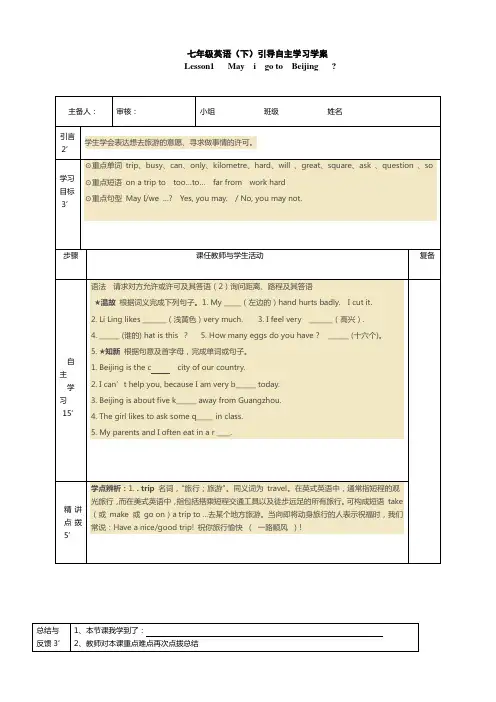
总结与反馈3’ 1、本节课我学到了: 2、教师对本课重点难点再次点拨总结 七年级英语(下)引导自主学习学案 Lesson1 May i go to Beijing ? 主备人: 审核: 小组 班级 姓名 引言2’ 学生学会表达想去旅游的意愿、寻求做事情的许可。 学习 目标 3’ ⊙重点单词 trip、busy、can、only、kilometre、hard、will 、great、square、ask 、question 、so ⊙重点短语 on a trip to too…to… far from work hard ⊙重点句型 May I/we …? Yes, you may. / No, you may not. 步骤 课任教师与学生活动 复备 自主 学习 15’ 语法 请求对方允许或许可及其答语(2)询问距离、路程及其答语 ★温故 根据词义完成下列句子。1. My _____(左边的)hand hurts badly. I cut it. 2. Li Ling likes _______(浅黄色)very much. 3. I feel very _______(高兴). 4. ______ (谁的) hat is this ? 5. How many eggs do you have? ______ (十六个)。 5. ★知新 根据句意及首字母,完成单词或句子。 1. Beijing is the c city of our country. 2. I can’t help you, because I am very b______ today. 3. Beijing is about five k______ away from Guangzhou. 4. The girl likes to ask some q_____ in class. 总结与反馈3’ 1、本节课我学到了: 2、教师对本课重点难点再次点拨总结 七年级英语(下)引导自主学习学案 Lesson2 May I Invite Danny and Jenny? 5. My parents and I often eat in a r ____. 精讲点拨5’ 学点辨析:1. . trip 名词,“旅行;旅游”。同义词为 travel。在英式英语中,通常指短程的观光旅行,而在美式英语中,指包括搭乘短程交通工具以及徒步远足的所有旅行。可构成短语 take(或 make 或 go on)a trip to ...去某个地方旅游。当向即将动身旅行的人表示祝福时,我们常说:Have a nice/good trip! 祝你旅行愉快 ( 一路顺风 )! 主备人: 审核: 小组 班级 姓名 新课导入(2) 以小组形式练习Do you want to go to Beijing?? 对话,引出本课内容 自学目标(3) 1熟记本课单词:invite call wonderful leave (left left) arrive hour invitation 2、熟记句型及短语:May I speak with …? This is ---- .Who is this ? want to do sth.想做某事 leave for动身去某地 arrive in/ at 到达 互学目标(2) 用英语打电话。 教 学 过 程 步骤 课任教师与学生活动 复 备 总结与反馈3’ 1、本节课我学到了: 2、教师对本课重点难点再次点拨总结 七年级英语(下)引导自主学习学案 Lesson3 How Far Is Beijing? 自 主 学 习 (13) 一同学们自己预习后能默写本课单词 :邀请 打电话 ______极好的 _______动身 ________ 到达 小时 邀请(名词) _______ 二短语:(熟记文中的短语并能写出类似的短语) 1、在电话里 2、离„远 3动身去某地、 4、到达 5、在下午 6、想做某事 ___________ 三翻译句子 1、我想邀请詹妮来中国 _________ 2、可以让李夫人接电话吗?我就是。 __________ 3、你们什么时候动身去北京? 4、你们什么时候到达北京? _______________________ 。 5.谢谢你的邀请 ______________________ 四、 小组两人对话 精讲点拨(5) 1、want to do sth想做某事 即want跟动词不定式 2、may和can一样都是情态动词,它们之后要跟动词原型。. 达 标 测 评 (10’) 一、词形转化: call(单三形式) invite(名词) leave(过去时) Mrs.(对应词) 二、选择1、Li Ming wants Danny and Jenny _________ to China. A .come B.to come C: comes D: came 2、Hello! May I speak with Mary? Yes. ___________ Mary . A .it is B. I am C. this is 3、Who ___________? This is Danny speaking . A:are you B.is this C. is she D:is that 4、When do you leave _______ Shanghai ? A.. in B.to C. for D:on 5.Lucy will arrive _______ Beijing at 6:00 ..A .in B. at C .on D. of 三 用所给的词的合适形式填空。 1、Does Danny want ____________(buy). A new computer.. 2、She often _________(walk) to school . 3、We leave for Lanzhou on January 2nd .(对画线部分提问) _________ ________ you leave for Lanzhou ? 主备人: 审核: 小组 班级 姓名 新课导入(2) 以小组形式练习对话Is that … speaking? Yes, this is… ,引出本课内容 自学目标(3) 1熟记本课单词:dinosaur, plan, think, him, worry, be, thousand. 2、熟记句型及短语: How Far Is it from Canada to China? It’s about … kilometers. Go on a trip 旅行;From…to… 从„到„;Don’t worry 别担心; Practice doing sth 练习做某事 互学目标(2) 1、通过学习用英语能打电话。 总结与反馈3’ 1、本节课我学到了:
冀教版七下英语(带翻译)unit
二单元(7-12)
7what`s your project about 你的课题是什么
Did you have a good rest after out trip ? 在我们的旅行之后你好好休息了吗?
Are you ready for your project ? 你准备好你的课题了吗?
We heard a lot about him on the Silk Road
我们在丝绸之路上听说了许多关于他的事情。
My project is about some places of interest in china
我的课题是关于中国的一些名胜古迹
I still can`t believe it 我仍旧不能相信他
They don`t have donuts on the Silk Road 在丝绸之路上他们没有面包圈。
You can find donuts anywhere in china 你可以在加拿大的任何地方找到面包圈
The Silk Road is about history and culture ,hot donuts
丝绸之路是关于文化的而不是面包圈
Let`s go to the library and work on our projects 咱们去图书馆继续做我们的课题
A jok is something funny you say to make people laugh
笑话是你为了让人们笑而说的一些事情
Can you translate any jokes into English? 你能把一些笑话翻译成英语吗?
8 Marco Polo and the Silk Road 马可波罗和丝绸之路
七年级英语下册冀教版
七年级英语下册冀教版 1 / 2
Lesson 1: A Trip to China
1. trip 旅游
a trip to + 地址 “去 ....
go on a trip to + 地址
2. guess 猜想
guess what
about 认识,得悉,学习
4. the Silk Road 丝绸之路
question 问问题
的旅游”
silk 丝绸
能够,神态动词后边加动词原形
May I come in
7.sure 一定,确信 , 自然 be sure of sth 一定,确信
I am sure of it. 我一定 8.plan 计划
planning 双写
plan to do sth 计划做某事
I plan to write a book.
students from my class 我班里的一些学生
on the Silk Road
I go with them 我能够和他们一同去吗 led led 率领;通向
This road leads to Beijing. 这条路通向北京
The old man led us to the village. 老人带我们到了这个村庄
13.This is a good chance for you.
chance 机遇,机遇 Have a chance to do sth 有机遇做某事
a chance for sb 某人的机遇
’m so excited.
excited 喜悦的,修饰人 exciting exciting news 令人喜悦的信息
令人喜悦的。修饰物体
sb sth 送给某人某物 send sth to sb 送给某人某物
tell sb sth 告诉某人某事
tell told told
新冀教版七年级英语初一上册Unit4课文重点整理(Lessons19-21)
新冀教版七年级上册Unit4课文重点整理(Lessons 19-21)
Unit 4: Food and Reastaurants
Lesson 19: Time for Breakfast
1、 seven fifteen____________________ make a salad________________________
一些面包_______________________ 一杯果汁___________________________
some cereal______________________ put …on …_________________________
一杯茶_________________________ 你呢?_____________________________
2、 Time for breakfast! 该吃早饭了!
这一句省略了It is,原句型为It is time for sth.,意为“到……的时间了”;表达“到做
某事的时间了”,用It is time to do sth.;表达“到某人做某事的时间了”,用It is time for sb.
to do sth.。例如:
李明,到你擦黑板的时间了。_____________________________________________________
该吃午饭了。_____________________________或____________________________________
3、What’s for breakfast? 早饭吃点儿什么?
for breakfast作“早餐”讲。介词for在这里的意思是“作为”,但通常不翻译。“What’s
for + 三餐”表示“三餐吃什么?”。
这是一句泛泛的说法,在具体的应用中,常用“What do you have for …?”来向对方提
冀教版英语七年级(下)全册教案.docx
Unit 1 Lessons 1-6 A Trip to the Silk RoacL
New words and Phrases of Unit 1
Studying aims:
1. Read the new words and phrases of unit 1
2. Master and use the news words and phrases of unitl
Teaching procedures:
Stepl: Daily greetings
Step2: Show “Studying aims,,・(l,)
T: Today we will learn the new words and phrases of unitl. Please look at our
'"Studying aims".
T: Are you clear?
S: Yes.
T: OK! Lefs go on.
Step3: Show “Guide One,,to the students.
Guide one (1(f): Read the new words and phrases
T: Please rand the new words and phrases and pay attention to the pronunciation by
yourselves within 4 minutes.
Have a match and see who reads best!
T: Time is up! Now, do you have any difficulties? Who can read?
(Let some students read for the others.)
He/ She reads once, you read three times. Are you clear?
S: Yes.