
人教版初二英语语法知识点归纳总结(一)
人教版初二英语语法知识点归纳总结(一)
人教版初二英语语法知识点归纳
前言
初中英语作为基础学科,在英语学习过程中,语法知识的掌握是非常重要的。本文旨在总结人教版初二英语教材中的语法知识点,帮助广大学生和教师更好地掌握和应用这些知识,提高英语学习的效果和能力。
正文
1. 一般现在时(Simple Present Tense)
• 表示经常性或习惯性的动作、状况或真理等
• 动词原形作主语时,要使用第三人称单数形式的动词(he, she,
it)
2. 一般过去时(Simple Past Tense)
• 表示过去某个时间发生的动作或存在的状态
• 一般过去时的句子中,动词使用过去式形式
3. 一般将来时(Simple Future Tense)
• 表示将来某个时间将会发生的动作或存在的状态 • 一般将来时的句子中,使用将来时态的助动词“will”,或表示将来的其他词语,如“be going to”
4. 现在进行时(Present Continuous Tense)
• 表示现在正在进行的动作或瞬间状态
• 现在进行时使用“be + 动词-ing”构成
5. 过去进行时(Past Continuous Tense)
• 表示过去某个时间正在进行的动作
• 过去进行时使用“was/were + 动词-ing”构成
6. 一般现在时与现在进行时的区别
• 一般现在时表示经常性或习惯性的动作或状态,现在进行时表示现在正在进行的动作或瞬间状态
7. 一般过去时与过去进行时的区别
• 一般过去时表示过去某个时间的动作或状态,过去进行时表示过去某个时间正在进行的动作
8. 一般现在时、一般将来时与一般过去时的比较
• 一般现在时表示经常性或习惯性的动作或状态,一般将来时表示将要发生的动作或状态,一般过去时表示过去某个时间的动作或状态 结尾
以上是人教版初二英语教材中的一些重要的语法知识点的归纳。对于初中英语学习者来说,掌握这些语法知识是非常重要的,能够帮助他们正确理解和表达英语,提高语言水平,并且为进一步学习打下坚实的基础。希望本文对广大学生和教师有所帮助。
8年级上英语语法重点和知识点归纳精讲
1 新人教版八年级英语上册知识点分类归纳总结
新目标八年级英语上册语法复习
1) leave 的用法 (多义词:离开;留下;遗忘)
1.“leave+地点”表示“离开某地”。例如: When did you leave Shanghai 你什么时候离开上海的?
2.“leave for+地点”表示“动身去某地”。例如: Next Friday Alice is leaving
for London. 下周五,爱丽斯要去伦敦了。
3.“leave+地点+for地点”表示“离开某地去某地”。例如: Why are you
leaving Shanghai for Beijing 你为什么要离开上海去北京?
4 leave sth +地点 把某物遗忘在哪里
I left my bags in the car. 我把包遗忘在车里。
2) 情态动词 should “应该” 情态动词
1. 用于表示“应该”或“不应该”的概念。此时常指长辈教导或责备晚辈。 例如:
You should be here with clean hands. 你应该把手洗干净了再来。
2. 用于提出意见劝导别人。例如: You should go to the doctor if you feel ill. 如果你感觉不舒服,你最好去看医生。
3. 用于表示可能性。should 的这一用法是考试中常常出现的考点之一。
例如: We should arrive by supper time. 我们在晚饭前就能到了。
She should be here any moment. 她随时都可能来。
3) What... 与 Which...
1. what 与 which 都是疑问代词,都可以指人或事物,
但是 what 仅用来询问 职业。如: What is your father 你父亲是干什么的?
该句相当于: What does your father do ?
人教版八年级英语上册笔记1--10单元

人教版八年级英语上册笔记1--10单元
精心整理超详细!人教版八年级英语上册笔记1--10单元Unit 1
Where did you go on vacation ?
Section A 知识提纲
一、词形变化
1.wonder v. 想知道→adj. wonderful 精彩的,绝妙的
二、短语
1.go on vacation去度假
2.stay at home待在家里
3.go to the mountains去爬山
4.go to the beach去海滩
5.visit museums 参观博物馆
6.go to summer camp去参加夏令营
7.quite a few相当多 8.study for tests为测验而学习
9.go out出去 10.go out with anyone 跟别人出去
11.most of the time大部分时间 12.of course=sure =certainly当然
13.have a good time doing=have fun doing =enjoy oneself玩得高兴
14.go shopping去购物 15. keep a diary 写日记
三、词法
1. buy sb. sth.=buy sth. for sb.为某人买某物
Buy me some books = Buy some books for me .
2.taste / look/sound/smell good. 尝起来/看起来/听起来/闻起来不错
3.nothing…but+动词原形除了……之外什么都没有
I have nothing to do but watch TV all day .
我整天除了看电视什么也没干。
4.seem link v.(系动词) 似乎,好像,看来 ① seem + adj.
② seem to do sth.
③ It seems that + 陈述句
人教版英语八年级下册单元知识重点复习学案设计(一) Unit1-2 复习(无答案)
人教版英语八年级下册单元重点复习学案(一)Unit1-2
Unit1 What’s the matter?
一、基本知识点
1. What’s the matter (with you)? 怎么了?出什么事了?
也可以用What’s the trouble/ the problem / wrong with sb./ sth.?或者How are you ?
2. I had a cold.我感冒了。
用来描述身体状况的词语有以下这些:
have a cold=catch a cold=have the flu 感冒
have a fever 发热 have a cough咳嗽
have a stomachache胃疼,肚子疼
have a toothache牙疼 have a headache头疼
have a sore throat 喉咙痛
have a sore back 背痛
构词法则:身体部位+ache(疼痛)构成新的复合词
3. too many+ 可数名词复数,意为 太多……
too much+ 不可数名词,意为 太多……
much too+ 形容词/副词,意为 太…… (much作为程度副词修饰too)
例句:I have too many studennts to teach and too much work to do. That is much too hard.
4. enough【形容、副词】足够的/地,enough放在名词前,形容词、副词后。
good enough足够好,enough money=money money
5. maybe “或许”,常用于句首,表示可能性,后加句子。Maybe you are right.
may be,是情态动词+be的结构,意为“可能(是),也许(是)”
人教版初中英语知识点归纳总结(中考必备)

人教版英语中考分册复习知识点
Unit 1-Unit 2
重点句型
1. —My name’s Jenny. —I’m Gina. Nice to meet you.
2. —What’s your/his/her name? —My/His/Her name is … .
3. What’s your/his/her family/first name?
4. —What’s your telephone number? —It’s 218-9176.
5. What’s his/ her telephone number?
6. —What’s this/that in English? —It’s a ruler.
7. —Is this/that your pencil? —Yes, it is./No, it isn’t.
8. How do you spell pencil?/Spell pencil./Can you spell pencil?
9. Is that your computer game in the lost and found case?
10. Call Alan at 495-3539.
重点语法
be在一般现在时中的基本用法:I用am, you用are,is跟着他她它。He ,she ,it用is,we, you they都用are。单数名词用is,复数名词都用are。
be的几种形式:is, am, are —being —was, were —been
主谓一致:
主谓一致的15种常考情况:
1. 表示时间,重量,数目,价格,长度,数学运算等的词或短语作主语时,尽管他们是复数形式,但如果把这些复数形式的词或短语看作是一个整体,谓语动词用单数形式。
Two months is quite a long time. Twenty dollars is enough.
人教版八年级下册英语Unit1知识点语法归纳总结
⼈教版⼋年级下册英语Unit1知识点语法归纳总结
Unit 1 What’s the matter?
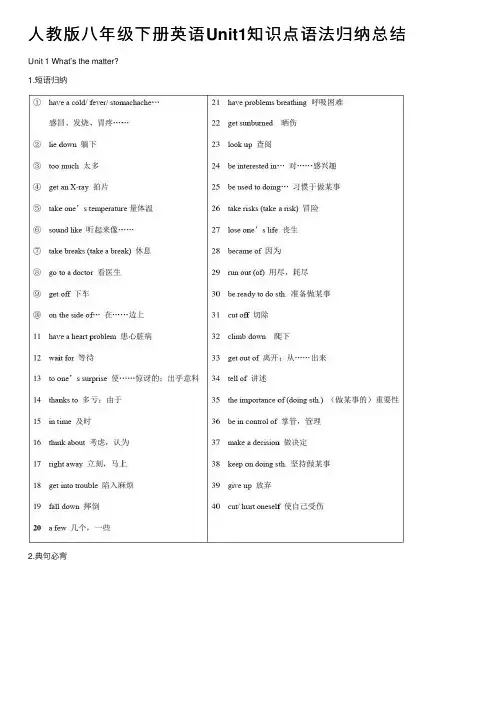
1.短语归纳
2.典句必背
3.⽤法集萃
(1)当别⼈⼼情不好,⾝体不适或遇到⿇烦时,我们可以⽤如下表达表⽰关⼼:?What’s the matter?
What’s the matter with you
What’s wrong with …
What’s the trouble\problem with …
(2)英语中常⽤have描述⾝体的不适,此时have意为“患有”,常⽤结构:
①have a + 疾病
例:have a cold 感冒;have a fever 发烧;have a cough 咳嗽
②have a + ⾝体部位-ache
例:have a headache 头痛;have a toothache ⽛痛
③have a sore + ⾝体部位
例:have a sore throat 咽喉痛;have a sore back 背痛(3)lie down躺下;tell lies/a lie 说谎
(4)maybe & may be
①maybe,“或许”,常⽤于句⾸,表⽰可能性,后加句⼦。例:Maybe you are right.
②may be,是情态动词+be的结构,意为“可能,也许”,后加名词、代词或形容词。
例:He may be angry.(5)sound like & sound
①sound like+名词/代词/从句
例:It sounds like you don’t know the truth. It sounds like a good idea.
②sound+形容词,“听起来,好像”,例:The music sounds nice.(6)…when the driver saw an old man lying on the side of the road. ……
这时司机看到意为⽼⼈躺在路边。
(完整版)人教版初中英语中考复习知识点归纳总结全册
人教版英语中考分册复习知识点
Unit 1-Unit 2
重点句型
1. —My name’s Jenny. —I’m Gina. Nice to meet you.
2. —What’s your/his/her name? —My/His/Her name
is … .
3. What’s your/his/her family/first name?
4. —What’s your telephone number? —It’s 218-9176.
5. What’s his/ her telephone number?
6. —What’s this/that in English? —It’s a ruler.
7. —Is this/that your pencil? —Yes, it is./No, it isn’t.
8. How do you spell pencil?/Spell pencil./Can you spell
pencil?
9. Is that your computer game in the lost and found case?
10. Call Alan at 495-3539.
重点语法
be在一般现在时中的基本用法:I用am, you用are,is跟着他她它。He ,she ,it用is,we, you they都用are。单数名词用is,复数名词都用are。
be的几种形式:is, am, are —being —was, were —been
主谓一致:
主谓一致的15种常考情况:
1. 表示时间,重量,数目,价格,长度,数学运算等的词或短语作主语时,尽管他们是复数形式,但如果把这些复数形式的词或短语看作是一个整体,谓语动词用单数形式。
Two months is quite a long time. Twenty dollars is
人教版初中英语八年级下册全册各单元知识点、语法归纳整理
人教版初中英语八年级下册全册各单元知识点、语法归纳整理
Unit1What’sthematter?
一.重点短语归纳
1.foot---feet脚tooth---teeth牙齿
2.haveacold感冒3.haveastomachache胃疼4.haveasoreback背疼
5.haveasorethroat喉咙疼6.haveafever发烧
7.liedownand(havea)rest躺下休息havearest休息
8.hotteawithhoney加蜜的热茶9.seeadentist看牙医seeadoctor看医生
10.drinklotsofwater多喝水
11.lotsof ,alotof,许多。大量alot
alotof=lotsof,可以修饰可数名词复数和不可数名词,一般用在肯定句中。:
Therearelotsof(alotof)booksinourlibrary.
Thereisalotofwaterontheground
alot,是一个副词词组,跟动词连用;表示十分,很等意思;Thanksalot.
12.haveatoothache牙疼13.That’sagoodidea好主意
14.gotobed去睡觉gotobedearly早上床睡觉
15.feelwell感到好 feelill感到不舒服Idon’tfeelwell=I’mnotfeelingwell我感觉不舒服.
16.startdoing/todosth开始做某事
todo是一件事情完成了,开始做另外一件事情
doing是原来的那件事情做到一半,现在又开始做了,是同一件事情。
17.twodaysago两天前18.getsomerest多休息,休息一会儿
19.Ithinkso我认为是这样20.bethirsty口渴21.behungry饥饿
22.bestressedout紧张23.listentomusic听音乐
24.healthylifestyle健康的生活方式25.traditionalChinesedoctors传统中医
2013(人教版)初二上册英语单词词组句型和语法知识点
资料内容仅供您学习参考,如有不当之处,请联系改正或者删除
----完整版学习资料分享---- 2013 人教版 八年级上册英语知识点/单词/语法/词组
Unit1 Where did you go on vacation?
stay at home待在家里 go on vacation去度假
go to the mountains去爬山 go to the beach去海滩
visit museums 参观博物馆 quite a few相当多
go to summer camp去参观夏令营 study for为……而学习
go out出去 most of the time大部分时间
taste good尝起来很好吃 of course当然
have a good time玩得高兴 go shopping去购物
feel like给…的感觉;感受到 in the past在过去
walk around四处走走 because of因为
one bowl of… 一碗…… the next day第二天
drink tea喝茶 find out找出;查明
go on继续 take photos照相
something important重要的事 up and down上上下下
come up出来
buy sth. for sb. / buy sb. sth. 为某人买某物
人教版八年级下册英语Unit1单元语法知识点总结
第 1 页 共 10 页 人教版八年级下册英语Unit 1单元语法知识点总结
本单元重点短语的具体用法
1. have a fever/cough/toothache/cold:表示患有某种疾病或不适,例如:
- I have a fever and a cough. 我发烧并咳嗽。
- She has a toothache and needs to see a dentist.
她牙疼,需要看牙医。
- I caught a cold and had to stay in bed.
我感冒了,不得不卧床休息。
2. see a dentist:看牙医,例如:
- If you have a toothache, you should see a dentist.
如果你牙疼,应该去看牙医。
3. get an X-ray:拍 X 光片,例如:
- The doctor suggested that I get an X-ray to check my
lungs.
医生建议我拍个 X 光片检查肺部。
4. take one's temperature:量体温,例如:
- The nurse took my temperature to see if I had a fever.
护士给我量了体温,看我是否发烧。
5. lie down:躺下来,例如:
- You should lie down and rest if you feel sick.
如果你感觉不舒服,应该躺下来休息。 第 2 页 共 10 页 6. take breaks:休息,例如:
- It's important to take breaks and relax during the day.
在一天中休息和放松很重要。
7. in the same way:以同样的方式,例如:
- We solved the problem in the same way as the teacher
人教版英语八年级下册 单词 短语 语法
人教版英语八年级下册
Unit 1 What’s the matter?
重点单词
matter n. 问题;事情
stomachache n. 胃痛;腹痛
foot n. 脚;足
neck n. 颈;脖子
stomach n. 胃;腹部
throat n. 咽喉;喉咙
fever n. 发烧
lie v. (lay)躺;平躺
rest v. & n. 放松;休息
cough n. & v. 咳嗽
X-ray n. X射线;X光
toothache n. 牙痛
headache n. 头痛
break n. 间歇;休息
hurt v. (hurt)(使)疼痛;受伤
passenger n. 乘客;旅客
off adv. & prep. 离开(某处);不工作;从……去掉
onto prep. 向;朝
trouble n. 问题;苦恼
hit v. (hit)(用手或器具)击;打
herself pron. (she的反身代词)她自己
sick adj. 生病的;有病的
knee n. 膝;膝盖
ourselves pron. (we的反身代词)我们自己
climber n. 登山者;攀登者
risk n. & v. 危险;风险;冒险
situation n. 情况;状况
kilo(=kilogram) n. 千克;公斤
rock n. 岩石
knife n. (pl. knives)刀
blood n. 血
mean v. (meant)意思是;打算;意欲
importance n. 重要性;重要
decision n. 决定;抉择
control n. & v. 限制;约束;管理
spirit n. 勇气;意志
death n. 死;死亡
nurse n. 护士
重点短语
1. What’s the matter? 怎么了?出什么事了?
2. have a cold 感冒
3. have a stomachache 胃痛