
外研版七年级英语下册Module6教案
外研版七年级英语下册Module6教案
Unit 1 could you tell me how to get to the national stadium?
Teaching objectives:
1. To understand conversations about asking for and giving
directions
2. To understand the sentences about positions
3. To learn how to ask for and give directions
Teaching points:
1.Words:
bank ,museum, along, across ,cross ,opposite, tourist, excuse,
street, turn, third, guidebook, bookshop, right, could, understand,
take
2.Phrases:
excuse me, Why not-----?
3.Patterns:
Excuse me.
Can you tell me the way to----?
Could you tell me how to get to------?
Have a nice day!
Teaching style:
Speaking and practicing.
Teaching aids:
flash cards and radio
Teaching procedures:
Step 1.Review
1. Listen and watch the words and expressions with the
pictures. Ask some students to read and spell the new words one
by one.
2. Read through the lists of words and have the students repeat them after you.
Make sure they understand them all.
3. Ask them to just listen to the recording and focus on the
words first time
through.
4. Play the recording again and ask them to match the words,
then check with
a partner.
Step 2. Listening and reading
1. Ask some students to read the dialogue, and answer some
questions, And
explain some words and sentences.
e.g.Here’s…on the left / on the right. It’s kind of …
2. Read the dialogue again and write a name in front of each
sentence
individually, then check with a partner.
Step 3. Practice
Activity1.Match the words from the box with the pictures.
bank museum restaurant station
Step 4. Listen and repeat
Ask some students to answer questions.
1.How will the tourist get to Wangfujing Dajie from
Tian’anmen Square?
2.Where is the bookshop?
3.Who does the tourist ask for the way to National Stadium?
Step 5. Pronunciation
1. Play the recording and have the students repeat chorally
and individually.
2. Work in pairs and check your answers.
3. Make sure the students swap roles. Step 6. Work in pairs
Read the conversation in Activity 3 again and complete
Step 7. Exercises
1. Activity 4. Complete the questions with the correct form of
the words
1._________me ,is Wangfujing Dajie far from Tian’anmen
Square?
2.There’s a bookshop near here. What’s the name of
the___________?
3.Can a ___________ ask a____________ the way to get to places
in Beijing?
4.____________you tell me how to get to the National Stadium?
5.Where’s the _____________ station?
Keys: 1. Excuse 2. street 3. tourist policeman 4. Could 5.
underground
2. Fill in the blanks.
(1) Mary sits Lucy’s left.
(2) The shop is next the park. (3) Daming is standing the bus stop. (4) There is a map Beijing on the wall.
(5) How do I get the Forbidden City?
Keys: (1) on (2) to (3) at (4) of (5) to
1. Everyday English: Here’s…
Excuse me!
Can you tell me the way to----?
You’re welcome.
Could you tell me how to----?
Have a nice day!
Setp8: Language points
1.如何用英语问路及回答
问路的常用句型有:
Where is the...?
How could/can I get to ...?
Is there a-----near here?
Could/Can you tell me the way to ...?
指路的常用句型有:
Go along …
Turn right / left at the …crossing .
It’s next to …
It’s opposite …
It’s between … and … 等。
例如:
1). Where’s the pose office? 邮局在哪里?
2). Is there a bank near here? 附近有银行么?
3). Do you know the way to the airport?
你知道去机场的路怎么走么?
4). How can I get to the post office? 我怎样去邮局?
5). It’s down bridge Street on the right. 沿着大桥街走,就在右边。 6). Go down Center Street . 沿着中心大街走。.
7). Let me tell you the way to my house. 让我告诉你来我家的路。
8). Walk until the end. 走到头。
9). Turn right at the first traffic light. 在第一个红绿灯处向右拐。
10). You can see it in front of you. 你会看到它就在你的前面。3、get to,arrive in/at ,reach 的区别
get to直接接地点名词,接副词时不用加介词如:
here, there home
arrive in/at也直接加地点名词,接副词时不用加介
词,但in 接大地方,at接小地方
reach直接接地点名词或副词,后不用加介词,
如I reach school。
注意:若只表到达,后不接地点时,用arrive
4.Why not do sth?=Why don’t sb. do st h? 为什么不做某事?
5.take the +交通工具+to+地点=
go to +地点+by +交通工具
意为:乘--------去某地
Homework:
1.Remember all the new words and expressions we’ve
learned today.
2.Learn the dialogue by heart.
Unit 2 The London Eye is on your right.
Teaching aims:
1. To understand conversation about direction.
2. To grasp some sentences.
3. To talk about directions.
Teaching points:
1. Learn the following vocabulary
turn right turn left on the corner of along pointing square
外研版七年级英语下册学生版 Module 6 Around town专题讲解及习题

Module6 Around town专题讲解
一、本单元提纲
1. 主题功能:能够谈论地点或场所。
2. 重点单词:famous, bridge, underground, river等。
3. 重点词组:in front of, turn left, on the right等。
4. 重点句型:
Excuse me! Can you tell me the way to Wangfujing Dajie?
Is there a bookshop near here?
How can I get there?
5. 核心语法:方位的表达方式
二、重难点精讲
1. Excuse me! Can you tell me the way to Wangfujing Dajie?
▲本句是问路的常见用语,结构式“Can you tell me the way to+地点”。
▲问路时其他的表达方式:Excuse me! Where+地点?
How can I get to+地点? Could you tell me how to get to+地点?
2. Go across Dong Chang’an Jie,go along the street and turn left at the third street on the left.
穿过东长安街,沿着这条街道走,在左边第三条街道处左拐。
▲go across意为“穿过、越过”,常和street,road等搭配。
▲常见于turn搭配的词:
turn on打开 turn off关闭 turn up调高 turn down调低 turn over翻转turn into变成 turn in上交 turn left左转 turn right右转 掉头_________
The baby is sleeping. Please _______ the radio.
外研版教材七年级下册Module 6 The Olympic adventure教学提纲

外研版教材七年级下册Module 6 The Olympic adventure教学提纲
发表时间:2011-04-22T17:12:13.110Z 来源:中教版英语周报11年30期 作者: 管延国 张淑娟
[导读] 一、课标表述 1. 所属话题:体育运动。
一、课标表述
1. 所属话题:体育运动。
2. 功能目标:谈论自己喜欢的运动项目。
(1)了解运动。
(2)表达观点。
3. 其它目标:养成爱好体育运动的习惯。
二、细化要求
1. 运动项目。
(1)basketball / table tennis ...
(2)cycling / running / skiing ...
(3)gymnastics ...
2. 表达观点的修饰词
(1)popular / unpopular, boring /exciting, difficult / easy, cheap / expensive, dangerous / safe
(2)slowly, loudly, clearly, quickly, well; badly, carelessly, carefully, quietly ...
3. 表述观点
(1)I think it's more exciting than table tennis.
(2)Basketball is my favorite sport.
(3)I like ...; I don't like ...
4. 综合运用:Talk about your favorite sport. Knowledge: My favorite Olympic sport is ...; I like it because ...; more popular / more exciting ... Ability: Talk about your favorite sport. Resources: events: swimming / running / skiing / cycling / balls ...
外研版英语七年级下册Module6导学案Unit1
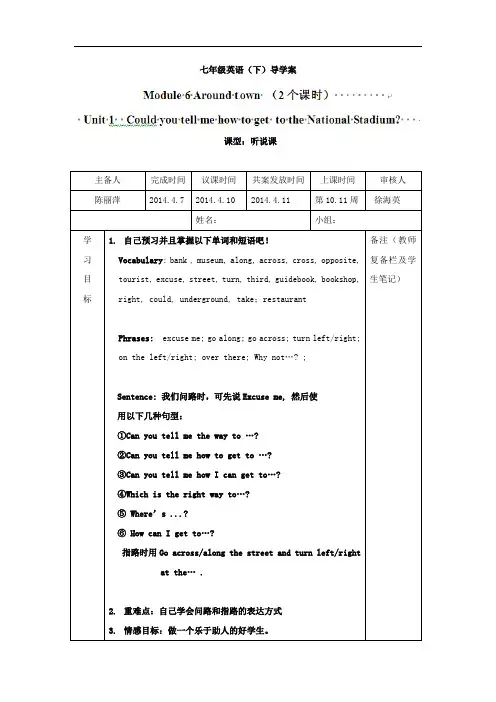
七年级英语(下)导学案
课型:听说课
主备人 完成时间 议课时间 共案发放时间 上课时间 审核人
陈丽萍 2014.4.7 2014.4.10 2014.4.11 第10.11周 徐海英
姓名: 小组:
学
习
目
标 1. 自己预习并且掌握以下单词和短语吧!
Vocabulary: bank , museum, along, across, cross, opposite,
tourist, excuse, street, turn, third, guidebook, bookshop,
right, could, underground, take;restaurant
Phrases: excuse me; go along; go across; turn left/right;
on the left/right; over there; Why not…? ;
Sentence: 我们问路时,可先说Excuse me, 然后使
用以下几种句型:
①Can you tell me the way to …?
②Can you tell me how to get to …?
③Can you tell me how I can get to…?
④Which is the right way to…?
⑤ Where’s ...?
⑥ How can I get to…?
指路时用Go across/along the street and turn left/right
at the… .
2. 重难点:自己学会问路和指路的表达方式
3. 情感目标:做一个乐于助人的好学生。 备注(教师复备栏及学生笔记)
自
主
学
习 学法指导:1.正确朗读生词。 2. 牢记单词的拼写和词意。 3.
通过朗读对话,学会自主预习。
1. 根据音标拼读单词。
2. 寻找宝藏。
外研版七年级下册英语module6精选习题.doc

精品资料
Module6(1)
1. The workers will build a new railroad ____ the two cities. A. since B. between C. as D. during
2. The teacher told us to walk ____ the street carefully. A. over B. off C. through D. across
3. Go ____ the street and turn left, then you’ll find it.A. across B. cross C. through D. away
4. Uncle Tom lives ____ a farm ____ the country.A. in, at B. near, on C. on, in
5. Mr. Green’s office is ____ the 26th floor. You can take the lift there.A. at B. in C. on D. for
6. There are four people ____ my family.A. on B. at C. in D. of
2. —Excuse me. ________?—It is in front of the station.
A. Is there a pay phone near hereB. Where is the pay phoneC. Is the pay phone far away from here
3. —Do you live in front of the big supermarket?—No. I live ________ the supermarket ________ the post office.
外研版英语六年级下册单元教案-MODULE6
外研版英语六年级下册单元教案
Module 6
Unit 1 It was Daming's birthday yesterday
教案
1教学目标
1.能识别认读新单词:home, got(get), space, interested, spaceship, finish,
decide, paper.
2.能听懂会说目标语句:It It was Daming’s birthday yesterday. Sam was
interested in the book, too.
3.能运用一般过去时描述过去发生的事情。
2学情分析
现在的学生从小学三年级就开始学习英语,进入六年级的学生已经对英语熟悉三年了。但是有一部分学生不是很喜欢上英语课,学习兴趣不是很高,个别学生甚至有厌恶感,同时,有些学生还是为学习而学习,谈不上兴趣问题;另一方面,学生有一定的分化,但也不是全部都差,没基础。
3重点难点
能运用一般过去时描述过去发生的事情。不规则过去式动词的运用,如see-saw,buy-bought.
4教学过程
活动1【导入】It was Daming’s birthday yesterday.
一、导入环节
(一)导入新课,板书课题(1分钟)
导入语: Good morning, boys and girls. What did it buy on the earth?
Let’s listen.(播放chant视频)学生跟读。OK, this class, we will learn
Module 6 Unit1 It was Daming’s birthday yesterday. Let’s read together.
(领读模块课题)
(二)展示目标(1分钟):
过渡语:Let’s read the learning goals together.
1.能识别认读新单词:home, got(get), space, interested, spaceship, finish,
外研版英语七年级下册M6U2教学提纲
学习资料
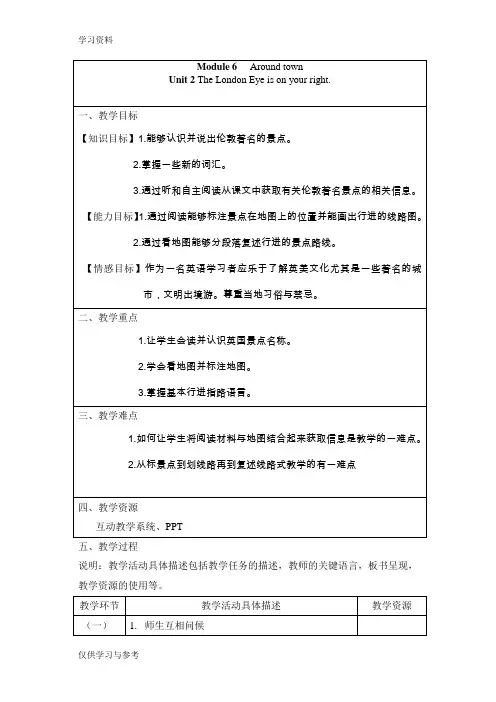
仅供学习与参考 Module 6 Around town
Unit 2 The London Eye is on your right.
一、教学目标
【知识目标】1.能够认识并说出伦敦著名的景点。
2.掌握一些新的词汇。
3.通过听和自主阅读从课文中获取有关伦敦著名景点的相关信息。
【能力目标】1.通过阅读能够标注景点在地图上的位置并能画出行进的线路图。
2.通过看地图能够分段落复述行进的景点路线。
【情感目标】作为一名英语学习者应乐于了解英美文化尤其是一些著名的城市,文明出境游。尊重当地习俗与禁忌。
二、教学重点
1.让学生会读并认识英国景点名称。
2.学会看地图并标注地图。
3.掌握基本行进指路语言。
三、教学难点
1.如何让学生将阅读材料与地图结合起来获取信息是教学的一难点。
2.从标景点到划线路再到复述线路式教学的有一难点
四、教学资源
互动教学系统、PPT
五、教学过程
说明:教学活动具体描述包括教学任务的描述,教师的关键语言,板书呈现,教学资源的使用等。
教学环节 教学活动具体描述 教学资源
(一) 1. 师生互相问候 学习资料
仅供学习与参考 热身导入 2. 英国简介
(1)Ask questions
1) Do you know which city is the capital city of
the UK?
2) Do you know which city held 2012 Olympic
Games?
3) Do you now something about London or do
you know why London is so important or
famous in the word? (预习布置了以上相关内容的收集工作)
外研版英语七年级下册Would you like to go to the cinema全英文教案
初一英语 Module 6 Unit 1
Teaching Plan
Module Six, Unit One “Would you like to go to the cinema?”
Teaching aims and demands:
1. Learn to make and accept invitations with “Would you like to do…?” and “Good idea!”
2. Learn to be polite and active in communicating with others
3. Train Ss’ abilities to listen and speak
4. Cultivate Ss’ spirits to enjoy the beautiful life and entertainments
Main points:
1. Use sentence structure to invite : “Would you like to do…?”
2. Use sentence structures to accept invitations: “Good idea!” and “That’s a good idea!”
“What a good idea!”
3. Talk freely about invitations and entertainment
Difficult points:
1. Free talk about making and accepting invitations
2. The ability to communicate in English and try to make others join in activities and games.
3. Widen the contents and cultivate the creative thinking method and the ability to act.
外研版初中英语七年级下册教案全册
外研版初中英语七年级下册精品教案 全册
Module 1 School Life
Unit 1 There are fifty students in the class. Preparation
在黑板上写出单词 Festival,要求学生回忆并说出已学过的节日名称, 如:New
Year, Christmas Day等,并板书。 组织两人小组活动,内容是在节日时的对话。如下例: Happy New Year... Happy New Year...
Do you...? Yes/No. We...
两人小组活动后, 请几对学生上台演示, 然后要求大家评价。 对演示认真又基本无语言错误的学生给予奖励。
介绍短语 Spring Festival, 带读后转入第 1 小节的学习
1.Look and listen. Then repeat.
1)先不打开书,问学生 :春节后 ,一些同学又见面了, 他们很高兴地在一起交谈,他们谈了些什么呢( What are they talking about ?)? 2)要求学生听一遍录音后,回答上面的问题,然后将答案 School Life 写在 黑板正上方。
3)写出以下问题,要求学生听第二遍录音后回答: How many students are there in the class?
How long are the lessons? How does Feifei go to school?
How long does the bus take to get to school ? 学生回答上述问题后翻开书,跟录音读一遍对话。 组织四人小组操练本段对话,然后要求他们演示和评价。 第 2、 3、4 小节的教学可参考“教师用书”的建议进行。 Unit 2 What’s your favourite lesson?
外研版七年级下册英语module6精选习题
1. The workers will build a new railroad ____ the two cities. A. since B. between C. as D.
during
2. The teacher told us to walk ____ the street carefully. A. over B. off C. through D.
across
3. Go ____ the street and turn left, then you’ll find . across B. cross C. through
D. away
4. Uncle Tom lives ____ a farm ____ the . in, at B. near, on C. on, in
5. Mr. Green’s office is ____ the 26th floor. You can take the lift . at B. in C. on D. for
6. There are four people ____ my . on B. at C. in D. of
2. —Excuse me. ________?—It is in front of the station.
A. Is there a pay phone near hereB. Where is the pay phoneC. Is the pay phone far away from here
3. —Do you live in front of the big supermarket?—No. I live ________ the supermarket ________
the post office.
A. across; from B. next; to C. between; and D. near; to
外研版新版七年级下册英语全册教案
第1 页共89 页外研版新版七年级下册英语全册教案Module 1 Lost and found Unit 1 Whose bag is this? I. 课时1课时II. Type of lesson: Listening and speaking III. Teaching aims: i.Knowledge aim: 学习和掌握名词性物主代词ii.Ability aim: 能听懂有关失物招领的对话并表演在失物招领处发生的事情iii.Emotion aim: 学会与他人交流时言行举止大方得体,对他人提供的帮助表示感谢IV. Teaching important and difficult points i. Teaching important points: Make the students understand and use the dialogue ii. Teaching difficult points: Make sure the students can use the dialogue V. Teaching Aids: Multi-Media Tape , recorder VI. Teaching Procedure Step 1 Lead-in Use a pen that was lost last term and ask whose pen is this? Purpose: Make the students interested in the topic Step 2 Learning the dialogue i.Learn the new words Activity1 Match the words from the box with the pictures 同步练习:Step 3 Pronunciation Step 4 Sum up and exercise Step 5: Homework VII. Blackboard writing VIII. 反思第2 页共89 页Unit 2 Are they yours? I. 课时2课时(课文讲解&练习)II. Type of lesson: Reading and writing III. Teaching aims: iv.Knowledge aim: 学习和掌握新单词v.Ability aim: 能读懂有关失物招领的短文,能写出一则招领启事vi.Emotion aim: 学会与他人交流时言行举止大方得体,对他人提供的帮助表示感谢IV. Teaching important and difficult points i. Teaching important points: Make the students understand the passage ii. Teaching difficult points: Make sure the students can find some useful information from the passage and write a lost and found note. V. Teaching Aids: Multi-Media Tape , recorder VI. Teaching Procedure Step 1 Pre-reading Learn the new words and show the students a lost and found note, lead in the passage. Step 2 While-reading Activity 1: Listen and read the passage. Activity 2: Read the passage and answer the questions. Activity3: Translate and explain the language points Activity 4: Complete the passage with the correct form of the words and expressions from the box. (Activity3 on P5) Step 3 Post-reading Writing (Activity 4 on P5) Step 4 Sum up and exercise Step 5: Homework VII. Blackboard writing VIII. 反思第3 页共89 页Unit 3 Language in use I. 课时2课时(课本练习&练习册)II. Type of lesson: Grammar III. Teaching aims: vii.Knowledge aim: 名词性物主代词和形容词性物主代词的用法viii.Ability aim: 能利用名词性物主代词和形容词性物主代词解决一些问题ix.Emotion aim: 学会与他人交流时言行举止大方得体,对他人提供的帮助表示感谢IV. Teaching important and difficult points i. Teaching important points: Make the students solve some questions ii. Teaching difficult points: Make sure the students do the exercises V. Teaching Aids: Multi-Media Tape , recorder VI. Teaching Procedure Step 1: Activity 1: Work in pairs. Ask and answer questions. The teacher prepare some school things, ask every pair to choose a school thing, show the students a model, like this: --Whose bag is this? Is it yours? --No, it’s not mine. It’s his. Give the students two minutes to make the dialogue, then present in the class. Activity 2: Complete the sentences with the correct form of the words from the box. Give the students three minutes to finish it themselves, then check the answers together. Step 3: Match the words from Box A with the words from Box B. This activity is very easy, so the students can do it together. Step 4: Around the world---The Internet lost and found Ask the students read by themselves, then translate one by one, the teacher explain the language points. Step 5: Activity 4: Work in pairs. The teacher prepares some things such as camera, crayons, football, gloves, mobile phone, wallet, watch and so on. Student A: Think of three or four things he/she has lost or he/she can choose from the 第4 页共89 页box. Describe them. Student B: Think of five or six things you have in your lost and found office or you can choose from the box. Describe them. Then ask and answer questions. Student A: Ask Student B if they’ve got the things you have lost. Answer questions about details. Student B: Answer questions about the things Student A has lost. Ask questions about details. Give the students five minutes to prepare, then act out in the class. Step 6: Homework VII. Blackboard writing Unit 3 Language in use VIII. 反思Module 2 What can you do? Teaching aims: 1. Knowledge aim: 学习和掌握情态动词“can”. 2. Ability aim: 能正确使用情态动词“can”表示能力的肯定、否定与疑问形式。3. Emotion aim: 帮助学生认识并肯定自己的能力,增强自信心,培养竞争意识和为班级体服务的意识。Unit 1 I can play the piano. Ⅰ.Type of lesson: Listening and speaking Ⅱ.Teaching aims: 1.To understand conversations about joining school clubs 2.To talk about one's abilities Ⅲ.Teaching aids: Tape recorder,videos,OHP