
译林版六年级下册英语Unit2 Good habits(第4课时)课件
六年级下册英语 Unit 2 Good habits知识梳理+巩固练习 译林版三起

Unit 2 Good habits
知识梳理+巩固练习(含解析)
一、语音
解析:字母组合or在单词中一般发/ɔ:/
发音方式:这是个长元音,发音时双唇收圆,后舌抬高,牙床半开,肌肉稍紧。
例如:morning shorts more order before
字母组合or在重读音节中,都发/ɔ:/
拓展: 在w后发/ɜ:/,如:work, homework, world, word
在非重读音节中发/ə/, 如:doctor, actor
二、重点单词
四会
habit习惯 never从不 late迟,晚
finish完成 tidy干净的,整齐的 fast快地
三会
bad不好的,坏的 sleepy困的,困倦的 slowly慢速地
badly差地,不好
三、核心短语
good/bad habits好/坏习惯 get up early起床起得早
never go to bed late从不晚睡 brush one's teeth刷牙
before bedtime就寝前 put...in order把…整理得井井有条
finish one's homework完成家庭作业 before dinner晚餐前
listen to his teachers听他老师的话 do well at home在家做得好
keep his room clean and tidy保持他的房间干净、整洁
feel sleepy感到困倦 know...well对…很了解
last night昨夜 walk fast走得快
on time按时 pick one挑选一个
run through the grass奔跑穿过草地 wash one's face洗脸
come to see her来看她 show sb around.…带某人参观…
译林版小学英语六年级下册第二单元知识点

8Unit2Goodhabits
一、重点单词
习惯habit干净的;整齐的tidy快的fast
从不never迟的late完成finish
差的badly困的sleepy慢速地slowly
二、重点短语1、agoodboy一个好男孩
2、havemanygoodhabits有许多好习惯
一个坏习惯abadhabit3、getupearlyinthemorning在早晨早早得起床
4、nevergotobedlate从不晚睡觉
5、gotobedearly早早睡觉
6、beforebedtime睡前
7、gotobedlatelastnight昨晚很晚睡觉
8、finishhishomework完成家庭作业
9、finishprimaryschool小学毕业
10、beforedinner在晚饭前
11、afterlunch午饭后
12、shouldn’tgohomelate不应该晚回家
13、dowellathome在家做得好
14、keephisroomcleanandtidy保持房间干净并整洁
15、alsohelphisparentsdohousework也帮助他的父母亲做家务
16、dohishomeworklateatnight在晚上家庭作业做得晚
17、brushhisteeth刷他的牙齿
18、feelsleepy感觉困倦
19、knowherwell非常了解她
20、alwaysputthingsinorder总是把东西摆得井井有条
21、walkfast/slowly走得快/慢
922、runveryfast跑得非常快
23、listentohisteacheratschool在学校听老师讲
24、havebreakfastontime准时吃早饭
25、shorthorses矮矮的马
26、runthroughthegrass(跑)穿过草丛
27、washyourfaceatseveno’clock在七点洗你的脸
28、cometoseeher来看她
译林版六年级下册英语教案:Unit2 Good habits第四课时

The fourth period
教学内容: Checkout time, ticking time and song time
教学目标:
1.I know some good habits and bad habits.
2.I can use “ early”, “ late”, etc.
教学重点:
I can use “ early”, “ late”, etc.
教学难点:
I can use “ early”, “ late”, etc.
教具准备:PPT
教学过程:
Step1 Warming- up
1. Greetings
Firstly, let’s do some exercise together. Music! Let’s go.
Hello, boys and girls. Just now, we did some exercise. Doing exercise
is a good habit. Today, we’ll go on learning Unit 2 Good habits. Follow
me, Unit 2 Good habit.
2. Show the learning aims
In today’s lesson, we have two learning aims. First one, who can read
it?
Next one, who can have a try?
Step2 Revision 1. T: Firstly, we are going to talk about good habits and bad
habits. Look, who is he?
Ss: He is Wang Bing.
T: In story time, we know he has some good habits. What are his
六年级下册英语教案 Unit2 (4) 译林版(三起)
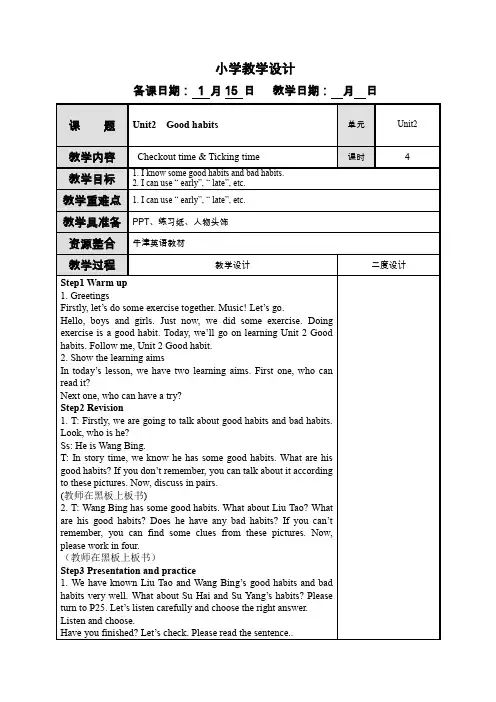
小学教学设计
备课日期:
1 月15 日 教学日期:
月
日
课 题 Unit2 Good habits 单元
Unit2
教学内容 Checkout time & Ticking time 课时 4
教学目标 1. I know some good habits and bad habits.
2. I can use “ early”, “ late”, etc.
教学重难点 1. I can use “ early”, “ late”, etc.
教学具准备 PPT、练习纸、人物头饰
资源整合 牛津英语教材
教学过程 教学设计 二度设计
Step1 Warm up
1. Greetings
Firstly, let’s do some exercise together. Music! Let’s go.
Hello, boys and girls. Just now, we did some exercise. Doing
exercise is a good habit. Today, we’ll go on learning Unit 2 Good
habits. Follow me, Unit 2 Good habit.
2. Show the learning aims
In today’s lesson, we have two learning aims. First one, who can
read it?
Next one, who can have a try?
Step2 Revision
1. T: Firstly, we are going to talk about good habits and bad habits.
Look, who is he?
Ss: He is Wang Bing.
T: In story time, we know he has some good habits. What are his
译林版六年级英语下册第二单元知识点
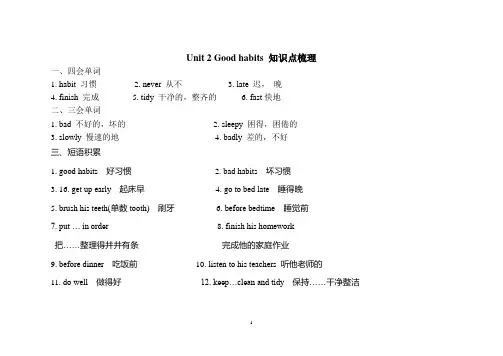
1 Unit 2 Good habits 知识点梳理
一、四会单词
1. habit 习惯 2. never 从不 3. late 迟, 晚
4. finish 完成 5. tidy 干净的,整齐的 6. fast快地
二、三会单词
1. bad 不好的,坏的 2. sleepy 困得,困倦的
3. slowly 慢速的地 4. badly 差的,不好
三、短语积累
1. good habits 好习惯 2. bad habits 坏习惯
3. 16. get up early 起床早 4. go to bed late 睡得晚
5. brush his teeth(单数tooth) 刷牙 6. before bedtime 睡觉前
7. put … in order 8. finish his homework
把……整理得井井有条 完成他的家庭作业
9. before dinner 吃饭前 10. listen to his teachers 听他老师的
11. do well 做得好 12. keep…clean and tidy 保持……干净整洁 2 13. help his parents 帮助他的父母 14. do his homework late 迟做作业
15. feel sleepy 感到困倦 16. know him/her well 非常熟悉他/ 她
(完整版)译林英语六年级下册Unit2教案
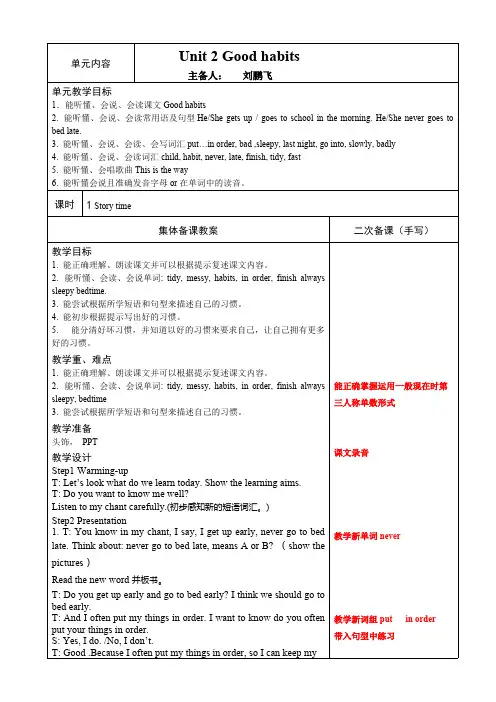
单元内容 Unit 2 Good habits 主备人: 刘鹏飞单元教学目标1.能听懂、会说、会读课文Good habits2. 能听懂、会说、会读常用语及句型He/She gets up / goes to school in the morning. He/She never goes to bed late.3. 能听懂、会说、会读、会写词汇put…in order, bad ,sleepy, last night, go into, slowly, badly4. 能听懂、会说、会读词汇child, habit, never, late, finish, tidy, fast5. 能听懂、会唱歌曲This is the way 6. 能听懂会说且准确发音字母or在单词中的读音。课时1 Story time集体备课教案二次备课(手写)教学目标1. 能正确理解、朗读课文并可以根据提示复述课文内容。2. 能听懂、会读、会说单词: tidy, messy, habits, in order, finish always sleepy bedtime.3. 能尝试根据所学短语和句型来描述自己的习惯。4. 能初步根据提示写出好的习惯。5. 能分清好坏习惯,并知道以好的习惯来要求自己,让自己拥有更多好的习惯。教学重、难点1. 能正确理解、朗读课文并可以根据提示复述课文内容。2. 能听懂、会读、会说单词: tidy, messy, habits, in order, finish always sleepy, bedtime3. 能尝试根据所学短语和句型来描述自己的习惯。教学准备头饰, PPT教学设计Step1 Warming-upT: Let’s look what do we learn today. Show the learning aims.T: Do you want to know me well?Listen to my chant carefully.(初步感知新的短语词汇。)Step2 Presentation1. T: You know in my chant, I say, I get up early, never go to bed late. Think about: never go to bed late, means A or B? (show the pictures)Read the new word并板书。T: Do you get up early and go to bed early? I think we should go to bed early.T: And I often put my things in order. I want to know do you often put your things in order.S: Yes, I do. /No, I don’t.T: Good .Because I often put my things in order, so I can keep my 能正确掌握运用一般现在时第三人称单数形式课文录音教学新单词never教学新词组put in order带入句型中练习
六年级英语下册素材-Unit2Goodhabits课文翻译译林版(三起)
六年级英语下册素材-Unit2Goodhabits课文翻译译林版(三起)
Unit2 Good habits
第二单元好的习惯
Story time
①Wang Bing is a good boy. He has many good habits. He
gets up early in the morning and never goes to bed late. He
brushes his teeth in the morning and before bedtime.
王兵是一个好孩子。他有很多好习惯。他早上很早起床,并且从不很晚睡觉。他在早上和睡觉前刷牙。
At home, Wang Bing always puts his things in order. He
usually finishes his homework before dinner.
在家,王兵总是把他的东西整理得井井有条。他通常在晚饭前完成他的家庭作业。
①Liu Tao is a good boy too. He listens to his teachers at
school. He also does well at home. He keeps his room clean and
tidy. He also helps his parents.
刘涛也是一个好孩子。他在学校听他的老师的话。他在家也做得很好。他保持他的房间干净和整齐。他也帮助他的父母。
But Liu Tao has some bad habits. He often does his
homework late at night and does not go to bed early. He
sometimes feels sleepy in the morning.
但是刘涛有一些坏习惯。他经常在晚上很晚的时候做他的家庭作业,并且不早点儿睡觉。他有时在早上感到很困。
苏教译林版英语 六年级下册 Unit 2 Good habits 知识点总结
苏教译林英语 六年级下册Unit 2
Good habits 知识点
一、词汇
habit习惯 never从不 late迟,晚 finish完成 tidy干净的,整洁的 bad 不好的,坏的
sleepy困的,困倦的 fast快地 slowly慢速地 badly差地,不好 put…in order把……整理得井井有条 last night昨夜
二、句型及语法
1. He has many good habits. 他有很多好的习惯。
many意为“许多”,修饰或代替可数名词复数,与few(少数)相对;而much用来修饰或代替不可数名词,表示量或程度,与little(少量)相对。
【注】常见的用法:
How many…?(问可数名词的“多少”);so many (“如此的多”,修饰可数名词)
How much…? (问不可数名词的“多少”或“询问价格”);so much (“如此的多”,修饰不可数名词)
2. He gets up early in the morning and never goes to bed late. 他早上起床的早,从不晚睡觉。
○1early与late两者既可以为动词,又可以为副词;再此句中均为副词。
○2in the morning 意为“在早上”(用介词“in”)
【注】:常见的词组
on Sunday morning “在周日早上”(要注意用介词“on”)
this morning “今天早上”(要注意不需要加任何介词)
○3never 意为“从不”,为一般现在时的判断词。
3. He brushes his teeth in the morning and before bedtime. 他早上和睡觉前刷牙。
brush one’s teeth 意为“刷牙”;one’s 为形容词性物主代词(my; our; his; her; its; their; your)或者名词所有格形式(Betty’s)等。
译林版英语六年级下册Unit2 Good habits 教案
译林版英语六年级下册Unit2 Good habits 教案
一、教学目标
1. 掌握本课时的单词和短语。
2. 听、说、读、写本课时的故事和对话。
3. 了解交通规则,养成良好的交通安全习惯。
二、教学内容
1. 单词和短语
1. traffic light
2. crosswalk
3. pedestrian
4. car
5. stop
6. go
7. wait
8. safe
9. dangerous
10. habit
2. 故事和对话
本课时的故事和对话主要围绕交通安全习惯展开,以培养学生的交通安全意识和良好习惯。
3. 交通规则
介绍基本交通规则,如行人应走人行道,遇到红灯停,遇到绿灯走等。
4. 交通安全意识
通过故事和对话的讲解,培养学生的交通安全意识,增强学生的交通安全知识。
三、教学方法
1. 情境教学法:通过故事情境和对话情境来引导学生学习和理解。 2. 归纳法:通过解释单词和短语的含义,让学生通过归纳的方式掌握更多相关单词和短语。
3. 听说读写训练法:通过多种训练方式,培养学生听说读写的能力,帮助学生更好地理解和掌握知识。
四、教学步骤
第一步:导入
通过文字、图片等多种方式,让学生对本课时的主题有所了解,调动学生的学习兴趣。
第二步:单词和短语
通过灵活的方式引导学生掌握本课时的单词和短语,如通过分类、图片、句子等方式。
第三步:故事和对话
通过故事和对话的讲解,让学生了解和学习交通安全习惯,培养学生的交通安全意识。
第四步:交通规则
通过讲解基本的交通规则,让学生了解和掌握交通常识,如何在日常生活中保护自己。
第五步:练习
通过听说读写等多种方式,让学生巩固所学的知识和技能。
第六步:总结
通过小组合作或个人发言的形式,让学生回顾所学知识,总结本课的重点和难点。
五、教学评价
1. 观察学生的听说读写能力,了解学生的学习情况。
2. 通过小组合作或个人发言等方式,了解学生对本课的理解和掌握情况。
译林版六年级英语下册作业课件课后练单元导航 Unit 2
1
Unit 2 Good habits
单元导航
单元目标 1.掌握频率副词的使用方法。
2.能熟练讨论日常生活中的习惯。
3.了解字母组合“or”在单词中的发音。
重点单词 1.habit 习惯 2.never 从不 te 迟,晚
4.finish 完成 5.tidy 干净的,整齐的 6.bad 不好的,坏的
7.fast 快地 8.sleepy 困的,困倦的 9.slowly 慢速地
10.badly 差地,不好
重点短语 1.good habits 好习惯 2.never go to bed late 从不睡觉晚
3.put…in order 把……整理得井井有条
4.finish one 's homework 完成某人的家庭作业
5.clean and tidy 又干净又整齐
6.listen to his teacher 听他的老师的话 7.do well 做得好
8.know well 非常了解 9.walk fast 走得快
10.show…around 带……参观 11.go into 走进,走入
12.feel sleepy 感觉困了 13.get up early 起床早
重点句型 1.He brushes his teeth in the morning and before bedtime.
他在早晨和睡觉前刷牙。
2.I always have breakfast on time.我总是按时吃早饭。
3.At home, Wang Bing always puts his things in order.
在家时,王兵总是把他的东西整理得井井有条。
4.He sometimes feels sleepy in the morning.他有时在早上感觉困。
5.He never goes to bed late.他从不睡觉晚。
6.He usually finishes his homework before dinner.