
人教版八年级英语下册9-10单元重难点
Unit 9一、本单元能力要点1. 继续学习现在完成时的用法。
2. 学习和掌握一般过去时和现在完成时的区别。
二、本单元知识点1. neither【讲解】①neither 用作代词,表示“两者都不”。
做主语时,常被看做单数。
②neither 用作形容词,至于单数名词之前。
③neither 用作连词,常用短语neither ……nor…....“既不……也不……”。
当短语做主语时,谓语动词与nor 后面的词在人称和数上保持一致,遵循就近原则。
④neither 用作副词,与not ,no , never 等连用,意为“也不”。
【举例】—I want neither of them. 这两个我都不要。
— I can answer neither question. 这两个问题我都不会回答。
—Neither he nor I have been to Beijing. 他和我都没有去过北京。
—I can’t swim. 我不会游泳。
— Neither can I. 我也不会。
【辨析】neither, either 与both①either两者之中任何一个【举例】— Either you or I am wrong.不是你错就是我错.(不是就是)②neither两者之中没有一个【举例】—It is neither hot nor cold in winter here.这里冬天既不热也不冷。
③both 两者都【举例】—Both these books are expensive.这两本书都很贵【拓展】neither……nor……; either……or……; not only……but also……这三个短语做主语时,谓语动词与后面的主语在人称和数上保持一致,遵循就近原则。
【举例】— Either she or you are going there tomorrow. 要么她,要么你明天去那里。
— Not only you but also your father has known this. 不仅你,而且你爸爸也已知道这个事。
2. have a great time【讲解】have a great time 意为“玩的开心,过得愉快”。
该短语常用与分别或聚会中见面时的祝福,great 也可用good, nice, happy, wonderful, pleasant代替,其中have 为实义动词,意为“经历”。
【举例】—We had a great time in the park yesterday. 昨天我们在公园玩得很开心。
【拓展】同义短语enjoy oneself 或have lots of fun【举例】—Did you have a great time in the zoo? =Did you enjoy yourself in the zoo? = Did you have lots of fun in the zoo?3. attraction【讲解】①attraction 用作名词,意为“有吸引力的事物或人”②attraction 用作不可数名词,意为“吸引,吸引力”【举例】—City life has lots of attractions for me. 城市生活对我有很大的吸引力。
—Beijing Opera has little attraction for young people.京剧对年轻人没有吸引力。
【拓展】attract 用作动词吸引,引起(兴趣,关注,赞赏等)后面的宾语可以是人,也可以是事物。
【举例】—He attracted her because he was so different from other boys.4. end up【讲解】end up 为动词词组,意为“结束,完结”,相当于end 或finish.end up 后只能跟doing sth ;end up with sth 。
【举例】—The class meeting ended up singing out school song.— The meeting ended up with a song. 会议以一首歌曲结束。
【常见短语】by the end 到……末为止;at the end 在……尽头;in the end 最后,终于。
5. especially【讲解】especially 用作副词,意为“特别,尤其”。
【举例】I’m feeling especially tired today.The scene in Beijing is very beautiful especially in autumn.【辨析】especially 与specially①especially是副词,意为“尤其,特别”,通常用来对前面所述的事件进行进一步的说明或补充。
【举例】—It’s especially hot today. 今天天气特别热。
—He likes all subjects,especially English. 他喜欢所有的学科,尤其是英语②specially 也是副词,意为“专门地,特地”,表示“不是为了别的,而只是为了……”,强调唯一目的。
【举例】—He came here specially to say sorry to her. 他特意来这里向她道歉。
— He returned to her hometown specially to see her sick mother.她回到家乡专门看望生病的母亲6. Me neither. 我也没去过【讲解】Me neither. 的完整形式为Neither have I . 此种形式用于表达与上文的人物、事物存在相同的否定情况或者有相同的否定意见等,此时neither 还可以用nor.【举例】—I don’t like the shirt. — Me neither.【拓展】英语中表示后者与前者情形相同,“也不……”时,常用“neither ”引起的倒装句。
Neither + 助动词/系动词be/情态动词+ 主语【举例】—I’m not strong. Neither is he. = He isn’t strong, either.—Li Ping didn’t go to school yesterday. Neither/ Nor did Wang Lin. = Wang Lin didn’t , either.【拓展】Me too 可以看做Me neither 的反义句,即如果上文是肯定答语或者肯定句,可用Me too 我也是做省略回答。
7. discover【讲解】①discover作动词,意为“发现”,发现原本就存在的而不为人知的事物。
②还可译为“了解到,认识到”【举例】—Columbus discovered America in 1492.哥伦布在1492年发现了美洲。
【拓展】discovery 名词,意为“发现;发展”。
【举例】—Scientist have made many important discoveries in biology in the past years.【辨析】discover; invent; find out; find; look for .①discover为发现本来就存在的事物或人。
②invent是“发明”通过思考研究发明了从未存在的新物品。
③find out意为“找到,发现,查出”,一般用于发现真理、奥秘等抽象事物④find意为“找到,发现”,表动作结果。
⑤look for:意为“寻找”,表动作过程,不表结果。
【举例】—I’m looking for my pen but I can’t find it. 我正在找我的钢笔,但找不到。
—Please find out when the first class begins. 请查一下第一节课什么时候开始。
—He discovered America in 1492. 他于1492年发现了美洲。
—He always tries to invent something new. 他一直努力要发明新东西8. guide【讲解】①guide用作名词,译为“向导,导游”②guide作为名词时还可译作“指南,指导”③guide作为动作,意思是“为……领路,带领”【举例】—I know the mountain well, so let me be your guide. 我熟悉那座大山,让我来当你们的向导。
The book can be used as a guide in you study. 这本书可以作为你学习的指南。
Miss Li guided the visitors to the meeting-room.9. southeast【讲解】southeast 是由south和east 构成的合成词,用作方位名词“东南“。
还可以做形容词译为“东南的”。
【举例】—My uncle live in the southeast of the village.—The exchange student is from southeast Asia.【拓展】east 东west 西south 南north 北northeast东北northwest 西北northeast 东北southeast 西南10. wonderful【讲解】wonderful 用作形容词,意为“极好的,精彩的”。
【举例】—He is a wonderful person.—We had a wonderful time during the holidays.【拓展】wonder 名词“奇迹,奇事“也可作动词译为“惊奇,想知道”wonderfully 副词,极度地,精彩地。
11. holiday【讲解】holiday用作可数名词,意为“假日,节日”还可译为“假期”。
英国人喜欢用:summer/winter holidays,美国人喜欢用:summer/winter vacation。
【举例】—New Year’s Day is a public holiday.【常见短语】on holiday 在休假中;take/make a holiday 度假,休假;public holiday 公共休假日。
12. population【用法】population作名词“人口”。
【举例】What’s the population of our country?【拓展】①population指人口总数,做主语时,谓语动词用单数形式。
人教版八年级下册英语9~10单元知识点总结
Unit9 Have you ever been to a museum?
【重点单词】
amusement [ˌəˈmju:zmənt] n.娱乐,消遣,游戏
amusement park游乐场
somewhere [ˈsʌmweə] adv.某处,在某处
camera [ˈkæmərə] n.照相机
2.in a more natural environment在一个更加自然的环境中
3. all year round一年到头,终年
4.be far from离......远
5.in the dark在黑暗中
6. in the past在过去
7.have been to sp去过某地
8.science museum科学博物馆
perfect [ˈpɜ:fɪkt] adj.完美的,理想的,完全的
tea set茶具
itself [itˈself] pron.它自己,它本身
collect [kəˈlekt] v.收集
a couple of一对,两个,几个
German [ˈdʒɜ:mən] n. & adj.德语,德国人(的)
theme [θi:m] n.题目,主题,作文
21.different kinas of各种各样的
22.development of toilets厕所的发展
23.social groups社会团体
24.the tea art performances茶艺表演
25. make a perfect cup of tea with beautiful tea sets.用漂亮的茶具沏一杯完美的茶
人教版八年级下册英语第九单元知识点归纳总结
Unit9 Haveyoueverbeentoamuseum?一、词汇与短语◆重点单词A 局部1.amusement 消遣;玩耍n. 3.somewhere 在某处;到某处adv. 5.camera 照相机;摄影机;摄像机n. 7.invention 制造;制造物n. 9.invent 制造;制造v.2.social 社会的adj.4.peaceful 和平的;清静的adj. 6.performance 表演;演出n. 8.perfect 完善的;完全的adj. 10.itself (it 的反身代词)它自己pron.11.unbelievable 难以置信的;不真实的adj. 12.collect 收集;采集v.13.progress 进步;进展v.&n. 15.rapid 快速的;快速的adj. 17.unusual 特别的;不寻常的adj. 19.toilet 坐便器;厕所n. 14.theme 主题n.16.ride 供乘骑的游乐设施;短途旅程n. 18.province 省份n.20.encourage 鼓舞v.21.German 德国的;德语的;德国人的adj. 德语;德国人n.B 局部1.thousand 一千num. 3.safe 安全的;无危急的adj. 5.simply 仅仅;只;不过adj. 7.fear 几可怕;惧怕v.&n. 9.Indian 印度的adj. 印度人n. 2.fox 狐狸n.4.equator 赤道n. 6.spring 春天n. 8.mostly 主要地;通常adv. 10.location 地点;位置n.11.whether 不管……(还是);或者……(或者);是否conj. 12.Japanese 日本的;日本人的;日语的adj. 日本人;日语n. 13.whenever 在任何……的时候;无论何时conj.◆重点短语A 局部1.amusementpark 游乐场3.teaart 茶艺5.acoupleof 两个;一对;几个7.ahistorymuseum 历史博物馆9.aspacemuseum 太空博物馆11.anartmuseum 艺术博物馆13.awaterpark 水上公园2.learnabout 了解4.leadto 导致6.campinthemountains 在山中宿营8.putupatent 搭帐篷10.haveinformationabout 有关于……的信息12.progressinsucharapidway 进步如此快速14.acoupleoftimes 几次15.inthefuture 在将来17.haveagreattime 过得开心19.afilmmuseum 电影博物馆16.encouragesb.todosth. 鼓舞某人做某事18.somewheredifferent 某个不同的地方20.theteaartperformance 茶艺表演21.takearideontheboatforseveraldays 乘船旅行几天22.thehistoryanddevelopmentof…................. 的历史和进展B 局部1.allyearround 全年3.alotofthetime 大局部时间5.outsideofChina 在中国以外7.duringthedaytime 在白天9.becloseto 靠近;接近11.choosetodosth. 选择做某事2.thousandsof 数以千计的;许很多多的4.inthedark 在黑暗中6.anEnglish -speakingcountry 一个说英语的国家8.haveproblemsdoingsth. 做某事有困难10.thebesttimetodosth. 做某事的最好时间12.befarfrom 远离13.threequartersofthepopulation 人口的四分之三14.ontheonehand ……ontheotherhand ……一方面……另一方面……◆重点句子A 局部1.—Have youever beento thespacemuseum? —你曾去过太空博物馆吗?—Yes,Ihave.Howaboutyou? —是的,我去过。
人教版八年级英语下册各单元语法点汇总
人教版八年级英语下册各单元语法点汇总Unit 1 What’s the matter?一、询问某人的健康问运及遭到麻烦的表达方法(1)询问某人患了何种疾病或遇到了何种麻烦时,常用以下几种结构来表达:What’s the matter (with sb.)?(某人)怎么了?What’s wrong (with sb.)?(某人)怎么了?What’s the trouble (with sb.)?(某人)出什么事了?XXX)?(某人)发生了什么事?Are you OK?你没事吧?XXX?某人有什么事吗?(2)要表达身体疼痛或不舒服,可用以下结构:①某人+have/has+病症.The twins have colds.双胞胎感冒了。
或XXX.XXX.她昨晚肚子痛。
③某人XXX.他喉咙痛。
④某人+hurt(s)+身体部位或反身代词.XXX his XXX.他的腿受伤了。
⑤某部位+hurt(s).My head hurts badly.我头痛得厉害。
⑥或人+have/has+a pain+in one’s+身体部位,I have a XXX.我胸口痛。
⑦(The re is)something wrong with one’s+身体部位.There is something wrong with my right eye..我的右眼有毛病。
⑧其他表达体式格局She has a heart trouble.她故意脏病。
He got hit on the head他头部受到了撞击。
XXX finger.她割破手指了。
二神态动词should的用法1.Should为情态动词,意为“应该;应当”,否定式为shouldn’t,其后接动词原形,无人称和数的变化。
常用来表示征询意见、建议、劝告、要求或义务等。
You should drink hot water with honey.你应该喝加有蜂蜜的开水。
He should put his head back他应该把头后仰。
人教版八年级英语下册各单元知识点总结完整版
Unit 1 What’s the matter?一、重点短语1. have a fever 发烧2. have a cough 咳嗽3. have a toothache 牙疼4. talk too much 说得太多5. drink enough water 喝足够的水6. have a cold 受凉;感冒7. have a stomachache 胃疼8. have a sore back 背疼9. have a sore throat 喉咙痛10. lie down and rest躺下来休息11. hot tea with honey加蜂蜜的热茶12. see a dentist看牙医13. get an X-ray拍X光片14. take one’ s temperature量体温15. put some medicine on sth在……上面敷药16. feel very hot 感到很热17. sound like 听起来像18. all weekend 整个周末19. in the same way以同样的方式20. go to a doctor 看医生21. go along 沿着……走22. on the side of the road 在马路边23. shout for help 大声呼救24. without thinking twice 没有多想25. get off 下车26. have a heart problem 有心脏病27. to one’ s surprise 使……惊讶的28. thanks to 多亏了;由于29. in time及时30. save a life 挽救生命31. get into trouble 造成麻烦32. right away 立刻;马上33. because of 由于34. get out of 离开35. hurt oneself 受伤36. put a bandage on sth. 用绷带包扎37. fall down 摔倒38. feel sick 感到恶心39. have a nosebleed 流鼻血40. cut his knee割伤他的膝盖41. put her head back 把她的头向后仰42.have problems breathing呼吸困难43. mountain climbing登山运动44. be used to doing sth. 习惯做某事45. run out (of) 用完;用尽46. so that 以便47. so…that 如此……以至于……48. be in control of 掌管;管理49. in a difficult situation 在逆境屮50. keep on doing sth.坚持做某事51. make a decision做出决定52. take risks 冒险53. give up 放弃二、知识点解析1. What’s the matter? 怎么了?若是询问“某人怎么了?”要用“What’s the matter with sb.?”拓展:What’s the matter with sb.? 的同义句:What’s wrong with sb.? / What’s the trouble with sb.?2.疾病类短语:have a +疾病. e.g. :have a fever 发烧have a cold 感冒have a cough 咳嗽.have a +身体部位-ache. e.g.: have a headache 头痛have a toothache 牙痛.have a sore+身体部位. e.g.: have a sore throat咽喉痛have a sore back背痛例题:Mom, I____________.I’m sorry to hear that, dear. We must go to see the dentist right away.A. have a headacheB. have a stomachacheC. have a toothacheD. have a fever3. lie down 躺下V. 躺,平躺。
人教版八年级下册各单元英语语法解析知识重点总结
新目标英语八年级(下)重点短语及句型总Unit 1 Will people have robots?1. fewer people 更少的人(fewer 修饰名词复数,表示否定)2. less free time 更少的空闲时间(less 修饰不可数名词,表示否定)3. in ten years 10年后(in 的时间短语用于将来时,提问用How soon)4. fall in love with … 爱上……例:When I met Mr. Xu for the first time, I fell inlove with him at once.当我第一次见到许老师,我立刻爱上他。
5. live alone 单独居住6. feel lonely 感到孤独(比较:live alone/ go alone 等)The girl walked alone along the street, but shedidn't feel lonely.那女孩独自沿着街道走,但她并不感到孤独。
7. keep/ feed a pet pig 养一头宠物猪8. fly to the moon 飞上月球9. hundreds of + 复数数百/几百(概数,类似还有thousands of;millions of)10. the same as 和……相同11. A be different from B A与B不同(= There is a difference/ Thgere aredifferences between A and B)12. wake up 醒来(wake sb. up 表示“唤醒某人”)13. get bored 变得厌倦(get/ become 是连系动词,后跟形容词如tired/angry/ excited 等)14. go skating 去滑冰(类似还有go hiking/ fishing /skating/ bike riding 等)15. lots of/ a lot of 许多(修饰可数名词、不可数名词都可以)16. at the weekends 在周末17. study at home on computers 在家通过电脑学习18. agree with sb. 同意某人(的意见)19. I don't agree. = I disagree. 我不同意。
初中八年级英语下册,Units 9~10,重难点复习策略
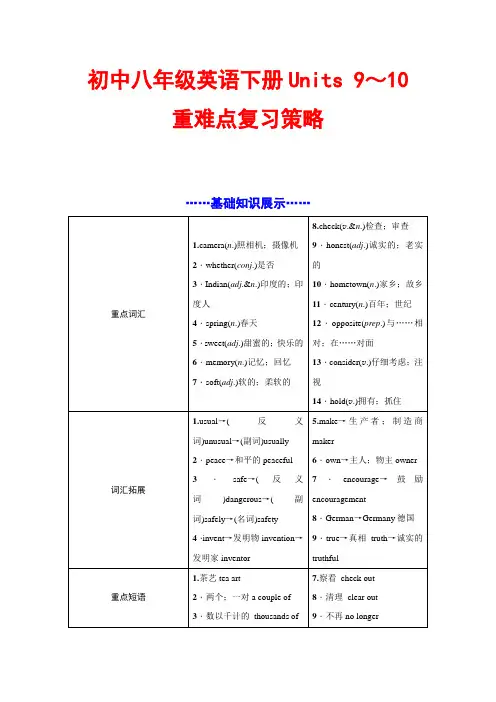
初中八年级英语下册Units 9~10重难点复习策略……基础知识展示…………小试牛刀……一、根据句意及汉语提示,填入适合的单词。
1.It's not special(特别的)for the young men to finish the hard work in such a short time.2.Can you tell me where the public toilets(厕所) are?3.Mr.Wu talked about some social(社会的) problems.4.For certain(某种)reasons,Mr.Li left there without saying anything.5.Jack is an honest(诚实的) boy,so we all like him very much.二、根据句意用所给词的适当形式填空。
6.The house itself(it) is very beautiful.7.Three Germans(German) visited the factory this afternoon.8.We haven't_met(not meet) each other for five years.Both of us left(leave) the factory in 2009.9.The hospitalhas_been(be) there for 15 years.It is(be) the tallest building in our city.10.The children have_never_visited(never visit) the Great Wall before.Their parents will_take(take) them there next month.三、根据汉语完成句子。
[精]人教版八年级下册英语9~10单元知识点总结
人教版八年级下册英语9~10单元知识点总结Unit9 Have you ever been to a museum?【重点单词】amusement [ˌəˈmju:zmənt] n. 娱乐,消遣,游戏amusement park 游乐场somewhere [ˈsʌmweə] adv. 某处,在某处camera [ˈkæmərə] n. 照相机invention [ɪnˈvenʃn] n. 发明,创造invent [inˈvent] v. 发明,创造unbelievable [ˌʌnbɪˈli:vəbl] adj. 难以置信的,不真实的progress [ˈprəʊɡres] n. 进步,进展rapid [ˈræpɪd] adj. 迅速的,快速的unusual [ˌʌnˈju:ʒuəl] adj. 特别的,不寻常的toilet [ˈtɔɪlət] n. 坐便器,厕所encourage [inˈkʌridʒ] v. 鼓励,激励social [ˈsəuʃəl] adj. 社会的peaceful [ˈpi:sful] adj. 和平的,平静的tea art 茶艺performance [pəˈfɔ:məns] n. 表演,演出perfect [ˈpɜ:fɪkt] adj. 完美的,理想的,完全的tea set 茶具itself [itˈself] pron. 它自己,它本身collect [kəˈlekt] v. 收集a couple of 一对,两个,几个German [ˈdʒɜ:mən] n. & adj. 德语,德国人(的)theme [θi:m] n. 题目,主题,作文ride [raɪd] n. & v. 骑,乘;(短途)旅程province ['prɒvɪns] n. 省,省份thousand [ˈθaʊznd] num. 一千thousands of 数以千计的,许许多多的safe [seif] adj. 安全的,保险的simply [ˈsimpli] adv. 仅仅,只,不过fear [fiə] n. & v. 恐惧,害怕whether [ˈweðə(r)] conj.不管…还是,或者…或者,是否Indian [ˈɪndjən] adj. 印度的,印度人的Japanese [ˌdʒæpəˈni:z] n. & adj. 日本人,日语;日本的fox [fɒks] n. 狐狸all year around 全年equator [iˈkweitə] n. 赤道whenever [wenˈevə] conj. 无论何时spring [spriŋ] n. 春天mostly [ˈməustli] adv. 大多数地,主要地,通常location [ləʊˈkeɪʃn] n. 地点,位置【重点短语】1. at night 在晚上2.in a more natural environment 在一个更加自然的环境中3. all year round 一年到头,终年4.be far from 离......远5.in the dark 在黑暗中6. in the past 在过去7.have been to sp 去过某地8.science museum科学博物馆9.history museum 历史博物馆10.amusement park 游乐园11.go somewhere different 去不同的地方12.go skating 去滑冰13.take the subway 坐地铁14.a great way to spend a Saturday afternoon 一个过周六下午的好办法15.all the old movie camera 所有的古老的电影摄影机16. learn about sth 了解有关.....的情况17. on the weekend 在周末18.camp in the mountains 在大山里露营19.put up a tent 搭帐篷20.in such a rapid way 以如此速猛的方式21.different kinas of 各种各样的22.development of toilets 厕所的发展23.social groups 社会团体24.the tea art performances 茶艺表演25. make a perfect cup of tea with beautiful tea sets.用漂亮的茶具沏一杯完美的茶26. a nice place to enjoy tea 一个品茶的好地方27.Thousands of 数以千计的28.international Museum of Toilets 国际厕所博物馆29.the Terracotta Army 兵马俑30.southeast Asia 东南亚31.night Safari 夜间动物园32.three quarters 四分之三33. an English-speaking country 一个讲英语的国家34.have a problem doing sth 做某事很困难35.during the daytime 在白天36. a couple of times 好几次37.right now 现在,目前38. an amusement park with a special theme 一个有特别的主题的游乐园39. Walk around the park 在公园里到处走40. hear of 听说41. take a ride 兜风42. another province 另一个省43. the Bird’s Nest 鸟巢44. encourage sb to do sth 鼓励某人做某事45. on the one hand....on the other hand 一方面,另一方面【重点句型】1. Have you ever been to a science museum? 你曾经去过科学博物馆吗?2.Let's go somewhere different today. 让我们今天去不同的地方吧。
人教版八年级下英语各单元重难点归纳
人教版八年级下英语各单元重难点归纳Unit 1 What’s the matter?本单元考点,重点三个:一、询问身体不适并给出建议的句型二、v.-ing形式的非谓语动词三、反身代词一、询问身体不适并给出建议的句型:(一)对“身体不适”的提问:“怎么了?”1、What’s the matter (with you)?2、What’s the trouble (with you)?= 3.What’s your trouble?4、What’s wrong(with you)?5、What’s up?6、What happens to you?7、What’s the problem(with you)?(二)、“身体不适”的简要表达:1、主语+ have/has + a + 病症(1) I have a cold.= I catch a cold. =I get a cold. =I have the flu.我感冒了。
I have a bad cold.我得了重感冒。
(2) I have a fever.我发烧了。
I have a high fever.我发高烧了。
(3) I have a cough.我咳嗽了。
(4) I have a nosebleed.我出鼻血了。
2、主语+ have /has + a + 身体部位-ache(1) I have a toothache.我牙疼。
I have a bad toothache.我牙疼的厉害。
(2) I have a stomachache.我胃疼。
(3) I have a headache.我头疼。
(4) I have a backache.我后背疼。
3、主语+ have/has + a + sore + 发病部位(1) I have a sore back.我后背疼。
(2) I have a sore throat.我嗓子疼。
I have a very sore throat.我嗓子疼的厉害。
初二英语下册第九、十单元复习总结
初二英语下册第九、十单元复习总结第一篇:初二英语下册第九、十单元复习总结一.重点词语 1.as的用法prep.①(理由)因为……例如:As it rained,I stayed home.(多用于句首)②(比较)as…as… 同…一样例如:He is as tall as I(am).③(表结果、程度)所以,致使例如: I got up so early as to be in time.He spoke so loudly as to be heard by everyone.④书面语虽然…但是;同though 注意词的排序例如: Young as he was,he works hard.2.in the same way in the same way 意思为“同样地,用同样的方式”,常接在动词后用作方式状语。
注意:way 和不同的介词连用,有不同的意思,区别如下:in the way 就这样,用这种方式 by the way 顺便问一下on the way 在去……路上例如:He finally worked out the problem in the way.最后,他就这样解决了问题。
By the way,how old is your son? 顺便问一下,你儿子多大了?On the way to school,he met an old friend of his.在去学校的路上,他碰到了他的一个老朋友。
注意:如果way后接副词时,要省略to。
如: on the way home 在回家的路上 3.prefer的用法,宁可,宁愿,更喜欢。
(1)prefer sth.I’d prefer meat,please.我更喜欢吃肉。
(2)prefer sth./ doing to sth./doingI prefer dogs to cats.我喜欢狗,不太喜欢猫。
I prefer reading to singing.我喜爱读书胜过唱歌。
人教版八年级英语下册Unit9 Have you ever been to a museum知识点梳理及单元复习
Unit 9知识点梳理和单元复习附参考答案1. 单元重点短语归纳:have/has been to曾经去某地;have/has been in+地点待在某地;me neither.我也没;have/has gone to去某地了;somewhere different不同的地方;close to贴近,邻近;encourage sb. to do sth.鼓励某人做某事;thousands of 数以千计的,许许多多的;on the one hand...on the other hand一方面......另一方面......;put up搭建,举起,张贴;take the subway乘地铁;three quarters四分之三;practice doing sth. 练习做某事;have problem doing sth. 做某事遇到困难;2. Have you ever been to a science museum? 你曾经去过科学博物馆吗?【重点】【辨析】have/has been to;have / has gone to ;have/ has been in;(1). have/ has been to 表示“某人曾经去过某地”强调现在已经回来了,不在那里了。
E.g.: We have been to Qingdao. 我们去过青岛。
(现在不在青岛)(2). have gone to表示“某人到某地去了”,强调现在还没有回来,可能在那里或途中。
E.g.: They have gone to Sydney. 他们去悉尼了。
(现在在悉尼或途中)(3). have been in +地点:表示“某人在某地待了很长时间”,常与时间段搭配。
E.g.: I have been in Nanchang for three years. 我在南昌待了3年了。
How long have you been in China? 你在中国待了多长时间?3. 一般过去时与现在完成时的用法比较【重点】&【难点】(1). 一般过去时表示过去某个时间发生的事、存在的状态或经常发生的动作。