
译林版六年级英语下册第一单元教案
1.用中文说说这个故事的大意
2. Read and order
学生初读课文,完成书后的练习
3. Ask and answer
4.Listen and read
5.Read in groups
Step 3 Post- reading
1 .Act it out
2.根据课文图片和板书试着复述课文。
课型
New
第2课时
主备人
授课时间
教学目标
1.能根据提示复述课文。
2.能理解形容词和副词的区别。
3.能扩充故事,并进行表演。
4.能对中外寓言故事有所了解。
重点难点
1.能根据提示复述课文
2.能理解形容词和副词的区别
教具准备
多媒体课件
教学流程预设
个性调整
Step 1 Revision
1. Review the key words and phrases.
S5: The scissors are sharp.
T: Yes, the scissors are sharp.
Step 2 Learning story time
T:Today we’ll learn a story about the lion and the mouse.
一、学生观看动画。然后判断:
S: animals
T: Do you know where it is from?
2.Teach: Aesop’s Fables
T: Look! This is Aesop’s Fables. You can find many animal stories in it.
What stories do you know in Aesop’s Fables? Can you tell us the story?
3.能够应用本课所学的句型:How can you help me?进行问答。
4.能形成互相帮助的好氛围。
重点难点
1.学生对课文中重点词汇和句子的掌握。
2.能根据故事内容改编并表演故事。
教具准备
多媒体课件
教学流程预设
个性调整
Step 1 Warm up and fun time
1.比一比:说说形容词变副词,看谁说的好。
3.自由组词:
run quickly; shout excitedly; talk loudly;
laugh happily; read quietly; cry sadly…
Step 4 Homework
1.抄写并背诵故事中的新单词和词语。
2.复习并牢记不规则动词的过去式。
教后反思或教后感
第1单元
Lion: I am _________. I want to eat the mouse.
Mouse: The lion wants to eat me. I am __________.
……
Lion: Help! Help! Who can help me?
Mouse:I will help you. Look, my teeth are _________.
课题
Unitt1The lion and the mouse
(Fun time & Culture time
课型
New
第3课时
主备人
授课时间
教学目标
1.能对外国的语言故事和我们的成语故事有所了解。
2.能听懂、会说、会读、会写词汇:bite, hole, large, sharp, strong, weak, wake up, let …go。
2)Can you listen to the teacher ________?(careful)
Ss. think:形容词怎么变副词呢?并说一说规则:adj+ly。
找出文中带有副词的句子,用直线划出来,并大声朗读。
The lion asked sadly.The lion laughed loudly.
3.讲一讲自己读过的寓言故事,并说说其中的道理
We can also find many animal stories in it. Can you tell one in Chinese?
守株待兔、亡羊补牢、叶公好龙……
4.学生把书上Culture time的句子认真读一读。
Step4 Homework
S: The lion is … The mouse is…
S1: The lion has a big face, a small nose, a big mouth, small ears, big eyes, big teeth.
T: Great! What about the mouse?
S2: The mouse has big ears. His head is small. His eyes are big. His teeth are small.
T: big Ss:small
同法复习其他形容词:long---short, tall---short, cold---hot, new---old, fast---slow, fat----thin, white---black, .strong---weak.(板书strong---weak)
T: Are you strong?(做strong的动作)Who is strong?在黑板上贴出狮子和老鼠的图片。引导学生结合板书和简笔画描述狮子和老鼠的外貌。
Step 1 Warming up and revision
1.描述人物,复习形容词。
出示人物。T: Can you say something about her? S1: She is tall.
2. Review the adjectives.
T: Tall, thin, beautiful…are all adjectives. (形容词)板书形容词的缩写adj. Let’s play a game of adjectives.
Step 4 Checkout
1. What do you learn from this story?
头练习
Step 5 Homework
1.听磁带,有感情地模仿熟读课文并尝试背诵。
2.和同学脱稿表演
教后反思或教后感
第1单元
课题
Unitt1The lion and the mouse
(Grammar time&checkout)
key words and phrases:
large/big—small/little
strong—weak
sharp—blunt
wake up/get up/go to bed/go to sleep
want to do/would like to do
some day
let sb do
the next day/the following day/the second day
学生说说以前学过的其他形容词或副词:
beautiful- beautifully
careful -carefully
总结归纳:
形容词变副词的规则:
1)一般情况下直接加“ly”,quick---quick;quiet---quietly
2)以辅音字母加y结尾的形容词要变y为i,然后再加-ly。如:happy---happily
4.通过学习本课的故事,让学生懂得人与人之间应该互相帮助。
重点难点
1.能初步听懂、会读单词large、strong、woke、weak、net、bit、sharp、sadly、hole
2.进一步巩固there be一般过去时,并注意不规则动词过去式的写法和读音。
教具准备
多媒体课件
教学流程预设
个性调整
1.学生回家把故事对着父母演一演。
2.尝试用英语讲一讲寓言或成语故事。
教后反思或教后感
第1单元
课题
Unitt1The lion and the mouse
(sound time and Cartoon time
课型
New
第4课时
主备人
授课时间
教学目标
1.能用wh-词来进行提问。
2.能掌握特殊疑问句的语调。
2.Talk about the mouse and the lion.
Complete the story.
Lion: I am a lion. I am big and ________. My teeth are big and ______.
Mouse: I am a mouse. I am small and ______. My teeth are _______ and ______.
S:
The Fox and the源自grapesThe Farmer and the snake
…
T: The book is written by Aesop in ancientGreece. We also have our story book. It is called a Chinese idiom book.
3.能读、演cartoon time,并能掌握其中的知识点。
重点难点
1.能用wh-词来进行提问。
2.能掌握特殊疑问句的语调。
3.能正确地理解并朗读对话内容,在教师的引导和帮助下尝试表演。
教具准备
多媒体课件
教学流程预设
个性调整
Step 1 Revision
1. Greetings
2. T: Boys and girls, do you like sweets?
译林版六年级英语下册Unit 1 The lion and the mouse 教案
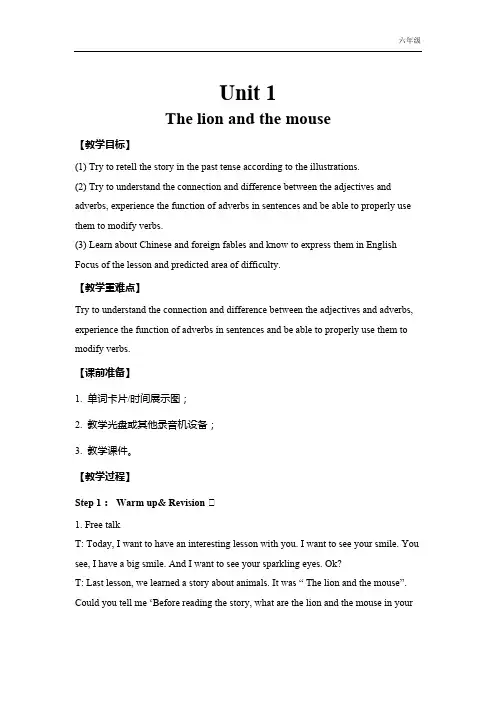
Unit 1The lion and the mouse【教学目标】(1) Try to retell the story in the past tense according to the illustrations.(2) Try to understand the connection and difference between the adjectives and adverbs, experience the function of adverbs in sentences and be able to properly use them to modify verbs.(3) Learn about Chinese and foreign fables and know to express them in English Focus of the lesson and predicted area of difficulty.【教学重难点】Try to understand the connection and difference between the adjectives and adverbs, experience the function of adverbs in sentences and be able to properly use them to modify verbs.【课前准备】1. 单词卡片/时间展示图;2. 教学光盘或其他录音机设备;3. 教学课件。
【教学过程】Step 1:Warm up& Revision1. Free talkT: Today, I want to have an interesting lesson with you. I want to see your smile. You see, I have a big smile. And I want to see your sparkling eyes. Ok?T: Last lesson, we learned a story about animals. It was “ The lion and the mouse”. Could you tell me ‘Before reading the story, what are the lion and the mouse in yourmind?’? For example, I think the lion is the king of the forest and the mouse is always afraid of the cat. What about you?T: After learning the story, do you still think the mouse is always weak? Why?2. Revisiona. Retell the story ( work in groups)T: Do you still remember the whole story? Let’s try to retell it according to the illustrations. Here’s one tip for you. (We often use the past tense to retell the story.) T: Are you ready? This time, let’s try to retell the story in class. Each of us just say one or two sentences and let others continue.Step 2:Presentation1. Grammar timea. Read and feel ( encourage students to recall the dialogue between the lion and the mouse in the text and appreciate the feelings behind their dialogue)E.g:T: Look at the little mouse, is he dancing? No, he is shaking. How did he feel at that time?T: What about this lion? Yes, he was laughing. What made him so happy? Who’d like to be the lion and read this sentence?T: Look at this lion, was he happy? Where was he? So what did he think? How did he say?T: Finally, the mouse helped him. And they became friends. So the lion said happily. Let’s try together.b. Think and discuss ( present the first part in Grammar time and encourage studentsto find out the structure of these sentences)T: Can you tell me the structure of these sentences?T: What are the adverbs for? ( present two sentences to contrast and help them better understand the role of the adverb)T: Which one is better?T: Great! Here are two choices, A is that they can make things clearly and orderly. B is that they can show the actions more vividly.T: Congratulations! You are right. So we often use adverbs to modify verbs. Could you find that where do we often put adverbs?c. Look, match and thinkT: Just now, we talked about adverbs. Now let’s play a game and try to find their friends.E.g: excited--excitedlyT: Can you find some rules?d. Look, guess and say ( present some pictures and conceal some parts of the picture, then encourage students to guess )2. Culture time a. Think and choose (present three choices: A. Aesop’s Fables B. Fairy Tales C. Chinese Idiom books)T: We’ve talked about the story. But do you know where is the story from?b. Know more in details ( encourage students to talk about some stories in these two books)T: Do you find something in common?T: What about their difference? I have some stories here, please judge whether it’s Aesop’s Fables or Chinese Idioms? Are you ready?Step 3:Production1. Make a reading carda. Introduce how to make a reading cardT: Today we’ve talked about many stories. Do you like stories? Do you often read stories? What do you often do after reading a story?T: Do you know what do I usually do after reading a story?T: I’d like to make a reading card. ( prensent one reading card about the lion and the mouse.)T:Do you want to make one by yourself?T: First, you can choose one story you like. Then take out the card you’ve prepared before class. Next write down something about the story, for example, the main characters, your favourite characters and so on.2. Make a reading card by yourself3. Share in class4. Stick reading card to the blackboardT: Wow, you did a good job! It’s really a wonderful reading wall. As we all know, reading is fun. Reading makes us wise. I hope you will like reading and keep this good habits to enrich your life.Step 4:Homeworka. Read and copy the adverbs we learned in class.b. Surf the Internet and learn more about adverbs.c. Read more animal stories after class.【板书设计】Unit 1The lion and the mousehappily sadly loudly quietly sadly【教学反思】教师在单词或词组的教学中,不能只是教读单词或词组。
六年级下册英语教案-Unit1 The lion and the mouse period 4-译林

六年级下册英语教案-Unit1 The lion and the mouse period 4-译林版三起教学目标1.学生能够运用语言表述熟悉的故事情节;2.学生能够从故事中获得道德启示,认识到“微不足道”的力量;3.学生能够掌握本单元出现的重要词汇。
教学重点1.学生能够流利、准确地朗读并复述故事,掌握句式;2.学生能够理解并归纳故事中的道德。
教学难点1.学生能够理解并归纳故事中的道德。
教学过程导入(5分钟)首先,老师可以给出几个情境,让学生用自己的语言描述。
例如,“你曾经帮助过别人吗?别人曾经帮助过你吗?”等。
学习(15分钟)1.让学生朗读课文并理解故事情节;2.向学生提问,询问他们是否了解故事中所表达的道德;3.引导学生思考故事中所想要表达的道德,并并让他们列出本单元中出现的主要单词。
活动(15分钟)在学生理解了故事情节和道德后,老师可以让他们进行一些相关的活动,以加深对道德含义的理解。
老师可以让学生小组合作,在规定时间内完成相关任务。
任务包括: 1. 列举出本单元中所学的所有单词并加以分类; 2. 角色扮演:选一个情境,让学生表演故事,加深对故事情节的理解和记忆; 3. 让学生以问答形式,讨论动物在故事中所表现出的各自属性和个性特点; 4. 利用音乐或其他的艺术形式,展示出故事中的道德意义。
课堂反思(5分钟)最后,老师让学生回顾本节课所学的内容,并思考一下教学效果以及存在的问题。
老师还可以让学生回顾下一节课的教学内容,以加强对主题的理解和记忆。
总结本节课主要是为了帮助学生理解和记忆故事中的情节和道德,并加强对本单元课文中出现的主要单词的掌握。
教师需要科学地设置活动,以加强学生的参与和合作,提高课堂氛围,从而创造适合学习的环境。
完整版苏教版译林英语六年级下册unit1教案
完整版苏教版译林英语六年级下册unit1教案一、教学内容本节课选自苏教版译林英语六年级下册Unit 1《The lion and the mouse》,主要围绕故事《狮子和老鼠》展开。
教学内容包括:Story time部分,学习单词和短语如lion, mouse, trap, weak, strong等;学习理解故事情节,掌握一般过去时的用法。
二、教学目标1. 学生能够听懂、会说、会读故事中的单词和短语,并能运用一般过去时描述故事情节。
2. 学生能够理解并复述故事,培养其英语阅读能力和表达能力。
3. 学生能够通过故事学习到友谊、互相帮助的道理,培养其情感态度。
三、教学难点与重点1. 教学难点:一般过去时的运用,故事情节的理解与复述。
2. 教学重点:单词和短语的学习,故事的主题思想。
四、教具与学具准备1. 教具:PPT,故事图片,单词卡片,录音机。
2. 学具:课本,练习本,彩笔。
五、教学过程1. 导入:通过展示故事图片,引导学生猜测故事主题,激发学生兴趣。
2. 新课内容呈现:播放录音,让学生听懂故事,学习单词和短语。
3. 例题讲解:讲解一般过去时的用法,结合故事情节进行示例。
4. 随堂练习:学生分角色朗读故事,进行一般过去时的句子练习。
5. 小组活动:学生分组,根据故事情节进行角色扮演,培养合作精神。
六、板书设计1. The lion and the mouse2. 单词和短语:lion, mouse, trap, weak, strong,3. 一般过去时句子示例:The lion was sleeping. The mouse woke him up.七、作业设计1. 作业题目:根据故事情节,用一般过去时描述一幅图片。
2. 答案示例:The lion was trapped in a net. The mouse bit the net and set the lion free.八、课后反思及拓展延伸1. 反思:关注学生对故事情节的理解程度,以及一般过去时的掌握情况。
译林版(三起)六年级下册英语教学设计:Unit1 The lion and the mouse(Ch
译林版(三起)六年级下册英语教学设计:Unit1 The lion and the mouse(Checkout time & Ticking time)一、教学目标1.掌握词汇:lion,mouse,roar,squeak,weak,strong,easily,quickly 等。
2.听、说、读、写本单元单词和句型,完成听力、口语、阅读、写作技能训练。
3.培养学生观察和探究形成良好的思维习惯。
4.提高语言交际能力,激发学生听、说、读、写英语的兴趣和自信心。
二、教学重点与难点1.教学重点:掌握单词lion,mouse,roar和squeak的发音与意思。
2.教学难点:让学生理解并掌握短语checkout time及ticking time的含义,并进行语境运用。
三、教学过程Part 1. Revision1.T先播放lion、mouse、roar和squeak等单词的发音,让学生跟读并说出中文的意思。
2.由教师或学生回顾上一单元的课文内容并进行简单复习。
Part 2. Presentation1.T先大声模拟狮子吼叫的动作,并向学生介绍本单元主题:The lion andthe mouse(狮子与老鼠的故事)。
2.T通过课件或图片,展示两只动物的画面,让学生观察图片并简单描述狮子和老鼠的形象、特点。
3.T介绍单词lion和mouse,并向学生分别展示狮子和老鼠的真实图片,让学生认真观察并说出单词的发音和意思。
4.T教授单词roar和squeak,并向学生演示狮子和老鼠叫的声音,让学生说出单词的发音和意思。
Part 3. Practice1.T播放学生听力材料,听取狮子的咆哮和老鼠的吱吱声,并让学生成对回答问题,如问答句:Teacher: What can you hear?(你听到了什么?)Students: I can hear the lion roar and the mouse squeak.(我听到了狮子的咆哮声和老鼠的吱吱声)2.T播放课文录音,让学生跟读,重点掌握单词和短语的发音。
六年级下册英语教案-Unit1Thelionandthemouse(Storytime)译林版
六年级下册英语教案 Unit 1 The lion and the mouse(Storytime)译林版教学目标:1. 学生能够理解并讲述故事《狮子和老鼠》的主要情节。
2. 学生能够正确拼读并使用故事中出现的关键词汇和短语。
3. 学生能够通过故事学习并运用寓言故事的基本要素和道德寓意。
4. 培养学生的合作能力、想象力和创造力。
教学内容:1. 故事《狮子和老鼠》的文本阅读与理解。
2. 故事中出现的关键词汇和短语的学习与应用。
3. 讨论故事的道德寓意,并鼓励学生发表自己的看法。
教学重点与难点:1. 教学重点:学生能够理解并讲述故事的主要情节,掌握故事中的关键词汇和短语。
2. 教学难点:学生能够理解故事的道德寓意,并能够运用所学知识进行创造性表达。
教具与学具准备:1. 教具:PPT展示故事情节,图片,视频等。
2. 学具:学生自备笔记本和文具。
教学过程:1. 导入:通过图片或视频引起学生对故事主题的兴趣,引导学生预测故事情节。
2. 阅读故事:学生跟随老师一起阅读故事,理解故事的主要情节和角色特点。
3. 学习关键词汇和短语:通过PPT展示和讲解,帮助学生学习和掌握故事中出现的关键词汇和短语。
4. 讨论故事情节:学生分组讨论故事情节,分享自己的理解和感受。
5. 道德寓意讨论:引导学生思考故事中的道德寓意,并鼓励学生发表自己的看法。
6. 创造性表达:学生分组进行角色扮演或故事改编,展示自己的理解和创造力。
板书设计:1. 故事和作者。
2. 故事的主要情节和角色特点。
3. 故事中出现的关键词汇和短语。
4. 故事的道德寓意。
作业设计:1. 写一篇关于故事《狮子和老鼠》的读后感,表达自己对故事情节和道德寓意的理解和感受。
2. 用自己的话复述故事,并尽量使用故事中出现的关键词汇和短语。
课后反思:教学重点与难点教学重点教学重点是指学生在学习过程中必须掌握的基本知识、技能和概念。
对于本课的教学重点,我们需要确保学生能够:1. 理解并讲述故事情节:学生需要能够概述《狮子和老鼠》的故事情节,包括故事的开端、发展、高潮和结局。
译林英语六下教案Unit 1 The lion and the mouse 第一课时
译林英语六下教案Unit 1 The lion and the mouse 第一课时教学目标:1. 能正确朗读课文中出现的生词和短语。
2. 能理解课文内容,复述故事情节。
3. 学会使用英语描述动物的外貌、习性等。
4. 学会运用简单的英语句子表达自己的观点、描述图画。
教学重点:1.听说技能的训练。
2.理解课文,能够复述故事情节。
3.学会使用英语描述动物的外貌、习性等。
教学难点:1. 能使用英语表达自己的观点,描述故事情节。
2.能够用英语描述动物的外貌、习性等。
教学过程:Step 1. 导入新课 (5分钟)教师问: Do you like to hear stories about animals? Why?引导学生回答,激发他们的学习兴趣。
Step 2. 预习生词和短语 (10分钟)展示单词和短语:pair, eventually, trap, roarAsk and answer:T: Do you know what 'pair' means?Ss: It means two things that go together.T: Good job. And what about 'eventually'?Ss: It means something that happens eventually will happen after some time.T: Excellent. Can you tell me what 'trap' means?Ss: It means to catch something so it can't get away.T: Great. And what about 'roar'?Ss: It means a very loud noise made by a lion.Step 3. 听录音并朗读课文 (10分钟)播放课文录音,让学生跟读。
六年级下册英语教案 Unit 1 The lion and the mouse (第一课时Story
六年级下册英语教案 Unit 1 The lion and the mouse (第一课时Story time) 译林版(三起)一、教学目标•知识目标:能够听懂、理解和模仿课文,掌握单词lion和mouse的意思,掌握日常用语Do you need help? Can I help you?。
•能力目标:能够在适当的场合使用Do you need help? Can I help you?。
•情感目标:培养学生乐于助人,团结合作的精神。
二、教学重点和难点•教学重点:掌握单词lion和mouse的意思。
•教学难点:培养学生使用日常用语Do you need help? Can I help you?的能力。
三、教学准备•课件•单词图片•角色扮演道具四、教学过程1. Warming-up通过图片、视频等形式,提问学生:“你见过狮子吗?它是一种什么动物?”,教师引导学生回忆狮子的特征,如何认出狮子。
2. Pre-listening用图片让学生学习和理解单词lion和mouse,并用图片展示两种动物。
3. Listening•Step 1.telling the title of the story 用图片展示lion和mouse并引导学生用英语读出两个词,然后告诉学生:“Today we are going to listen toa story called ‘The lion and the mouse’。
”•Step 2.playing the recording 播放课文录音,让学生跟读课文,帮助学生理解并掌握课文中的单词和句型。
•Step 3.checking the understanding 理解与掌握课文后,老师进行问答,让学生回答课文中的问题。
4. Post-listening•Step1.role play 分成小组,每组选出一名学生扮演狮子,另外的学生扮演老鼠,涉及场景是狮子被网住了,需要其他小动物们的帮助,老鼠主动过来帮助狮子。
完整版苏教版译林英语六年级下册unit1教案
完整版苏教版译林英语六年级下册unit1教案一、教学内容二、教学目标1. 学生能够理解并掌握故事内容,学会一般过去时和情态动词的用法。
2. 学生能够运用故事中的词汇和句型进行交流,提高口语表达能力。
3. 学生通过故事学习,培养关爱他人、团结互助的品质。
三、教学难点与重点重点:一般过去时和情态动词的用法。
难点:故事内容的理解和运用。
四、教具与学具准备1. 教师准备:故事课件、图片、单词卡片、录音机等。
2. 学生准备:英语课本、练习本、彩色笔等。
五、教学过程1. 导入:教师展示狮子和老鼠的图片,引导学生讨论这两种动物的特点,激发学生的兴趣。
2. 故事呈现:(1)教师播放故事录音,让学生跟随录音阅读故事。
(2)教师分角色朗读故事,让学生模仿并理解故事内容。
3. 词汇和语法讲解:(1)教师引导学生学习故事中出现的新词汇,如:lazy、sneak、sharp等。
(2)教师讲解一般过去时和情态动词的用法,让学生在语境中理解和运用。
4. 例题讲解:教师给出例句,如:“The lion was sleeping. The mouse sneaked up to him.”,让学生判断句子中的时态和情态动词。
5. 随堂练习:(1)教师分发练习纸,让学生完成句子填空。
(2)学生两人一组,进行角色扮演,复述故事。
六、板书设计板书分为两部分:故事情节和语法知识。
1. 故事情节:狮子和老鼠的故事线索,标注重点词汇。
2. 语法知识:一般过去时和情态动词的用法。
七、作业设计1. 作业题目:(1)根据故事内容,完成句子填空。
(2)运用一般过去时和情态动词,编写一段对话。
2. 答案:(1)The lion was sleeping. The mouse ______ up to him.(sneaked)(2)The mouse ______ the lion's help in the end.(needed)八、课后反思及拓展延伸2. 拓展延伸:(1)让学生课后阅读其他英语寓言故事,提高阅读能力。
译林版(三起)六年级英语下册教案:Unit1Thelionandthemouse5
译林版(三起)六年级英语下册教案:Unit 1 The lion and themouse一、教学目标1. 知识与技能:(1)能正确听、说、读、写本课的生词和重点句子。
(2)能理解课文内容,并能用英语进行简单复述。
(3)能运用本课所学句型进行角色扮演和情景对话。
2. 过程与方法:(1)通过图片、实物等教学媒介,引导学生观察、思考、交流,提高学生的英语表达能力。
(2)通过小组合作学习,培养学生的团队协作能力和解决问题的能力。
3. 情感态度与价值观:(1)培养学生热爱大自然,关爱动物的情感。
(2)培养学生积极向上,勇于面对困难的精神。
二、教学内容1. 词汇:lion, mouse, forest, cage, tail, cry, large, small等。
2. 句型:The lion is large./ The mouse is small./ Can you help me?/ Yes, I can./ No, I can't./ The lion and the mouse are friends.3. 语法:一般现在时态的陈述句、疑问句和否定句。
三、教学重点与难点1. 教学重点:(1)掌握本课的生词和重点句子。
(2)理解课文内容,并能用英语进行简单复述。
(3)运用本课所学句型进行角色扮演和情景对话。
2. 教学难点:(1)一般现在时态的陈述句、疑问句和否定句的用法。
(2)词汇和句型的灵活运用。
四、教具与学具准备1. 教具:PPT、图片、实物、录音机等。
2. 学具:英语课本、练习册、文具等。
五、教学过程1. 导入:(1)通过图片展示,引导学生回顾已学的动物词汇。
(2)通过实物展示,引导学生学习本课的生词。
2. 新课呈现:(1)播放课文录音,让学生跟读并模仿语音语调。
(2)讲解课文内容,帮助学生理解故事情节。
(3)引导学生学习本课的句型和语法。
3. 操练:(1)通过角色扮演,让学生运用本课所学句型进行情景对话。
六年级下册英语 译林牛津第一单元教案
能正确理解、掌握 A 部分会话,并能朗读、初步表演对话。
教学准备
准备录音机和本课 A 部分的磁带,小黑板一块
教学过程
Step1 Free talk T: Who’s taller than xxx? S: xxx is taller than xxx. /xxx is as tall as xxx. (举班级中两个学生为例,一个高一个矮) T: Who’s younger than xxx? S: xxx's (twenty minutes) younger than xxx.(举班级中两个年龄有差异的学生为例) T: Whose school bag is heavier, yours or mine? S: Yours, I think. (拎起两个书包,比比轻重)T: Who is shorter/stronger than xxx? T: Whose rubber is bigger, his or hers? …
教师创设情境或利用图片、食物,操练句型 Who’s taller than xx? Whose … is heavier/ bigger/ smaller/ fatter/ thinner? Step3 Listen, read and practice
1、看图片听录音。2、同桌利用图片或实物,进行操练。 Step4 Consolidation
巩固形容词比较级句型,并能在交际中口头运用比较级句型。
能正确理解,掌握四会单词并能听懂会说句型 Are you as tall as your…? Su Yang’s twenty minutes younger than me.
教具准备:照片(或图片)
教学过程
Step1 Free talk 通过图片和实物,引出师生或学生之间的交谈,复习形容词比较级,如 taller, shorter, stronger, bigger 等。 T: Who’s taller than xxx? S: xxx is. T: Whose ruler is shorter, yours or mine? S: Mine is. Step2Presentation and practice 1、出示图片(第六页),学习新单词和词组 go for a walk, cousin, have a chat T: What day is today? S: It’s Sunday today. T: On Sunday morning, Su Hai went for a walk in the park.(板书 go for a walk, 跟读) Ss: Go for a walk. T: Look at the photo. Who’s he? S: He is Ben. T: Yes. The boy next to him is his cousin, Jack.(板书 cousin, 跟读) Ss: Cousin. T: Su Hai was very glad to see them. They sat down under a big tree. What are they doing? S: They’re chatting. T: Good. We also can say“have a chat”(板书 have a chat, 跟读) 2、出示一张双胞胎姐妹的图片,学习词组 twin sister, look the same, as…as, twenty minutes younger than… T: Su Hai has a twin sister. Her name’s Su Yang. (板书 a twin sister, 跟读) Ss: Twin sister. T: Do they look the same? (板书 look the same, 跟读) Ss: Yes, they do. T: Is Su Hai as tall as Su Yang? (板书 as..as, 跟读) S: No, Su Hai is taller than Su Yang. 利用词组 as..as, 比较两人的高矮,胖瘦等。 T: Who’s younger, Su Hai or Su Yang? S: Sorry, I don’t know. T: Su Yang’s twenty minutes younger than Su Hai .