
七年级英语下册 Unit 3 Food and Drink Lesson 8 At a Restaurant教案 (新版)北师大版
Unit 3 Food And Drink
Lesson 8 At A Restaurant
Unit 3 Food and Drink,话题为购物、食物、点餐、饮食习惯。
其中Lesson 8 At a restaurant 的话题为就餐对话。
【知识与能力目标】
1. Key vocabulary
2. Key structures:
【过程与方法目标】
1. To understand conversations about food and drinks.
2. To talk with the partners about the food and drinks.
【情感态度价值观目标】
Learn to respect others when we talk with others.
【教学重点】
Learn to talk about the food and drinks..
【教学难点】
Learn to use the verb “be”.
Tape recorder, Multimedia
Step 1. Brainstorm
1.Say out the words of food and drink. Let Ss do the brainstorm about “food and drink”.
2. Ask Ss to tell their partners what food and drinks they like using: I like ….
Step 2. Warm-up
Ask Ss how they buy food and drink at a restaurant.
Read all the menu items aloud.
Work in pairs:
Are they all healthy?
If you are at the restaurant, what will you order?
◆课前准备
◆教学过程
Step 3. Reading
1. Show the word builder to the students and ask them to read these words.
2. After reading, ask students to practice ordering in pairs.
Work in pairs.
Act it out.
2.Show some key expressions to the students, and ask them to read these sentences.
3.Ask students to work in groups
Step 4. Listening and tick.
1.Listen and tick what items they ordered.
Check the answers.
2.Listen and write down how many items.
Ask the students to read and check.
Step 5. Read and answer.
Read the dialogue and answer the questions.
What does Sam think the salad?
Why do they say “What” together?
Because dad orders too much.
Some food are not healthy.
Step 6 Read the dialogue and fill in the blanks
Sam: Dad, ________ have two hot dogs, please?
Dad: No. They’re not healthy!
Mum: How about some salad?
Sam: Again? I have salad every day!
Waiter: ________take your order?
Mum: Yes, please. Can I have a green salad?
Waiter: OK. ________________a drink?
Mum: No, thanks.
Sam: _________ a sandwich and a glass of milk, please.
Linda: _________________ a sandwich and a glass of orange juice, please? Waiter: OK. And you , sir? ____________________to have?
Dad: ____________ two sandwiches, two pieces of chocolate
cake, an ice cream and a cup of coffee.
Step 7 Practice
Work in groups of five.
Role-play the dialogue in Exercise2.
略。
七年级英语下册unit3foodanddrinklesson8atarestaurant教案新版北师大版333
Unit 3 Food And DrinkLesson 8 At A RestaurantUnit 3 Food and Drink,话题为购物、食物、点餐、饮食习惯。
其中Lesson 8 At a restaurant 的话题为就餐对话。
【知识与能力目标】1. Key vocabulary2. Key structures:【过程与方法目标】1. To understand conversations about food and drinks.2. To talk with the partners about the food and drinks.【情感态度价值观目标】Learn to respect others when we talk with others.【教学重点】Learn to talk about the food and drinks..【教学难点】Learn to use the verb “be”.Tape recorder, MultimediaStep 1. Brainstorm1.Say out the words of food and drink. Let Ss do the brainstorm about “food and drink”.2. Ask Ss to tell their partners what food and drinks they like using: I like ….Step 2. Warm-upAsk Ss how they buy food and drink at a restaurant.Read all the menu items aloud.Work in pairs:Are they all healthy?If you are at the restaurant, what will you order?Step 3. Reading1. Show the word builder to the students and ask them to read these words.2. After reading, ask students to practice ordering in pairs.Work in pairs.Act it out.2.Show some key expressions to the students, and ask them to read these sentences.3.Ask students to work in groupsStep 4. Listening and tick.1.Listen and tick what items they ordered.Check the answers.2.Listen and write down how many items.Ask the students to read and check.Step 5. Read and answer.Read the dialogue and answer the questions.What does Sam think the salad?Why do they say “What” together?Because dad orders too much.Some food are not healthy.Step 6 Read the dialogue and fill in the blanksSam: Dad, ________ have two hot dogs, please?Dad: No. They’re not healthy!Mum: How about some salad?Sam: Again? I have salad every day!Waiter: ________take your order?。
七年级下册英语八单元课文

七年级下册英语八单元课文Unit 8 Our HealthLesson 1 Healthy LivingOur health is very important for our lives. We need to take care of our bodies. We can do this by keeping a healthy lifestyle. A healthy lifestyle includes eating healthy food, exercising regularly and getting enough rest.Eating healthy food means eating food that is good for our bodies. We should eat lots of fruits and vegetables. We should also avoid eating too much junk food and sugary drinks. We should drink plenty of water and eat at regular intervals.Exercise is also important for our health. We should exercise for at least 30 minutes every day. This can include walking, jogging, swimming or playing sports.Getting enough rest is important too. We should try to get 8 hours of sleep every night. This helps our bodies to rest and recharge.By following these healthy habits, we can improve our health and live a longer, happier life.Lesson 2 Common IllnessesMany people get sick from time to time. Common illnesses include colds, flu and stomach bugs.A cold is a viral infection that affects the nose and throat. Symptoms include a sore throat, runny nose and coughing. Colds usually last for a week or two and can be treated with rest and plenty of fluids.The flu is another viral infection that is more serious than a cold. Symptoms include a high fever, chills and muscle aches. The flu can be treated with rest, fluids and medication. It's important to get a flu shot every year to help prevent getting sick.Stomach bugs can be caused by viruses or bacteria. Symptoms include nausea, vomiting and diarrhea. Stomach bugs usually last for a few days and can be treated with rest and plenty of fluids.By taking good care of ourselves and getting prompt medical attention when needed, we can stay healthy and recover quickly from any illnesses we might get.Lesson 3 Emergency SituationsSometimes emergencies happen that require immediate medical attention. It's important to know how to handle emergency situations.If someone is having a heart attack, call an ambulance immediately. While you wait for help to arrive, have the person sit or lie down and try to keep them calm. If the person is unconscious, start CPR if you know how to do it.If someone is choking, try to dislodge the object by using theHeimlich maneuver. Stand behind the person and wrap your arms around their waist. Make a fist with one hand and place it above their belly button. Use your other hand to push the fist into their abdomen several times.If someone has a severe cut or bleeding, apply pressure to the wound with a clean cloth or bandage. Elevate the affected limb if possible and get medical attention as soon as possible.By staying calm and knowing what to do in emergency situations, we can help ourselves and others in times of need.。
food and drinks
5. It’s cold today. There are _______ people in the park. few
phrases
eat in 1. 店内吃 ____________________ take away 2. 带走 ____________________ 3. 在中国的南方 ____________________ in the south of China Western fast food restaurant 4. 西式快餐馆 ____________________ not care for/dislike/hate 5. 不喜爱 ____________________ 6. 把…..切成小块 cut…into ____________________ small pieces 7. 对……感兴趣____________________ be interested in 8. 和…..谈论 ____________________ talk with sb. 9. 全世界 ____________________ all over the world be good for one’s health 10.对某人健康有好处____________________ be bad for one’s teeth 11.对某人牙齿有害处____________________
Plural Forms of Nouns 名词的复数形式 单数 fork, noodle, student, card 复数
一般情况 以s,
+s
class, watch, dish, box boy, toy, day, key, play
北师大版英语七年级下册Unit 3单词及短语
Unit 3 Food and Drink Getting Ready名词Nouns1. banana香蕉e.g.: The banana bears two crops every year.2. beef牛肉e.g.: They bought so much beef that some went bad.3. carrot 胡萝卜e.g.: When I threw carrot slices, they even came for a nibble.4. chicken鸡肉;鸡e.g.: The chicken was only half cooked.5. grape葡萄e.g.: The grape vine climbed up along the wall.6. ham火腿e.g.: The hams were cooked while.7. milk牛奶e.g.: Do you take milk in your tea?8. pear梨e.g.: She bit into a ripe juicy pear.9. potato马铃薯,土豆e.g.: All main courses are served with chips or baked potato.10. tomato番茄,西红柿e.g.: The tomato hit the wall with a splat.11. watermelon西瓜e.g.: This kind of watermelon is remarkable for its size.12. fruit水果e.g.: The fruit are small and round.13. vegetable蔬菜e.g.: I hope to have a vegetable plot.14. meat肉类;肉e.g.: There’s not much meat on this chop.兼类词Words with Multiple Part of Speech1. drink n.饮料v.喝e.g.: She took a drink from the glass and then put it down.Lesson 7 Shopping for Food名词Nouns1. price价格;价钱e.g.: The price of cigarettes is set to rise again.2. weight重量e.g.: She is trying to lose weight.3. cent分;分币e.g.: House prices rose five per cent last year.4. dollar美元e.g.: Here’s a five dollar bill – please keep the change.5. pound英镑;磅e.g.: What would you do if you won a million pounds?6. kilo = kilogramme = kg千克,公斤e.g.: It weighs a kilo, or just over two pounds.7. bill钞票;账单e.g.: She always pays her bills on time.8. market集市;市场e.g.: We buy our fruit and vegetables at the market.9. unit单位;单元e.g.: The basic unit of society is the family.10. customer顾客e.g.: We aim to maintain high standards of customer care.11. money钱e.g.: We’ll need to raise more money.12. wallet钱包;皮夹子e.g.: I don’t have my wallet with me.形容词Adjectives1. total 总的;全部的e.g.: The club has a total membership of 300.2. fresh新鲜的e.g.: I think it’s time we tried a fresh approach.兼类词Words with Multiple Part of Speech1. change n.零钱;变化v.改变;变成e.g.: I only have a 20 dollar bill, so I can’t give you any change.2. south n.南;南方adj.南方的e.g.: The south of the country was worst affected by the drought.3. cost v.需付费;价钱为n.费用;价钱e.g.: We did not even make enough money to cover the cost of the food.4. any det.任何的;任一的pron.任何;任一e.g.: Are there any stamps?短语Expressions1. unit price 单价e.g.: The unit price is $2.50/kg.Lesson 8 At a Restaurant名词Nouns1. restaurant餐馆,餐厅e.g.: We had a meal in a restaurant.2. menu菜单e.g.: The menu has a good choice of desserts.3. item(一件)物品e.g.: We carefully labelled each item with the contents and the date.4. hamburger汉堡包e.g.: I’d like a hamburger, please.5. salad沙拉e.g.: Can I help you to some more salad?6. sandwich三明治e.g.: I’d like a sandwich and a glass of milk, please.7. soup汤e.g.: We just had soup instead of a full meal.8. tea茶e.g.: Do you take sugar in your tea?9. chocolate巧克力e.g.: I’d like two sandwiches, two pieces of chocolate cake, an ice cream and a cup of coffee.10. sir先生e.g.: Good morning, sir. Can I help you?11. piece一片,一件,一篇e.g.: She wrote something on a small piece of paper.12. bowl一碗;碗e.g.: There’s not much sustenance in a bowl of soup.13. cone锥形蛋卷筒;圆锥体e.g.: She stopped by the ice-cream shop and had a chocolate cone.动词Verbs1. may 可以;也许;可能e.g.: They may or may not be true.2. would打算,想要;过去常常e.g.: I would very much like to see you again.形容词Adjectives1. healthy 健康的;健壮的e.g.: Mary gave birth to a healthy baby girl.兼类词Words with Multiple Part of Speech1. order n.点菜;顺序;命令v.点菜;命令e.g.: Some teachers find it difficult to keep their classes in order.短语Expressions1. hot dog 热狗(香肠面包)e.g.: She bought a hot dog from a stand on a street corner.2. ice cream冰激凌e.g.: I ate two dishes of ice cream.Lesson 9 Food for Sport名词Nouns1. bread面包e.g.: He wiped his plate clean with a piece of bread.2. butter黄油,奶油e.g.: He spread butter on a roll.3. cheese奶酪e.g.: The cheese is left to age for at least a year.4. cookie曲奇饼e.g.: She fed him a cookie.5. egg蛋e.g.: Eggs are graded from small to extra large.6. noodle面条e.g.: Would you prefer rice or noodles?7. pancake烙饼;薄饼e.g.: He can eat three pancakes, three cheese sandwiches and lots of other food at onemeal.8. rice米饭;大米e.g.: They eat lots of fish, rice and vegetables.9. salt盐e.g.: Salt water is much more conductive than fresh water is.10. sugar糖e.g.: The Arsenal players don’t eat any beef, cookies or sugar.11. thought想法e.g.: I don’t like the thought of you walking home alone.12. top最高级别的;顶端e.g.: The title is right at the top of the page.13. kind种类e.g.: Exercises of this kind are very popular.14. swimmer游泳者e.g.: Swimmers usually eat some meat, bread, noodles or rice, vegetables and bananas.15. meal一顿饭;早(或午、晚)餐e.g.: Lunch is his main meal of the day.16. person人e.g.: Each person is different.形容词Adjectives1. different 不同的;有差异的e.g.: It’s very different to what I’m used to.2. heavy重的;比一般严重的e.g.: She was struggling with a heavy suitcase.兼类词Words with Multiple Part of Speech1. secret n.秘密adj.秘密的;保密的e.g.: He tried to keep it secret from his family.短语Expressions1. food for thought 引人深思的想法e.g.: Developments in your career may give you food for thought.Communication Workshop名词Nouns1. snack点心;小吃e.g.: Are your snacks usually fruit or junk food?2. junk无用的东西;无价值的东西e.g.: I’ve cleared out all that old junk in the attic.3. group组e.g.: A group of us are going to the theatre this evening.副词Adverbs1. however 然而;不过e.g.: However carefully I explained, she still didn’t understand.介词Prepositions1. than 比e.g.: He loves me more than you do.兼类词Words with Multiple Part of Speech1. report n.报告;报道;调查报告v.汇报;报道e.g.: I made only a few small changes to the report.2. most det., pron.(数量上)最多,最大;大多数e.g.: She had the most money of all of them.短语Expressions1. junk food 垃圾食品e.g.: He lived on a diet of junk food.。
英语教案-Foodanddrink-Lesson75~.docx
英语教案一Foo danddr i nk~Le s s on7 5 ~ 英语教案一Foodanddrink-Lesson75Lesson75 教学设计示例(一)一、教学内容1.词汇(略)。
2.句型:Howmay-canyousee?3.复习基数词。
二、教具录音机;上一课使用过的图片等。
三、课堂教学设计1.复习。
根据第74课第一部分的插图与学生进行问答练习。
2.打开书,学生看图。
教师就图片内容与学生进行如下问答:T: Whatcany ouseeinthep icture?(规定站起来的学生只说出一样东西。
)S:Icanse esome•••T: H owmany…cany ousee?(教师解释生词。
)S: leans ee…学生两人一组,依照上述方法进行问答练习。
请几组同学表演自己的答案。
教师穿插问几个图上没有的问题,例如:Howmanybag scanyousee(bikes, carse tc.)?指导学生答出:lea nt seean y.3.打开练习册,指导学生做练习册习题。
要求学生用笔头形式完成习题2、304.布置作业1)抄写生词;2)完成练习册习题。
四、难点讲解1・Howman y・・・?由Howma ny…开头的特殊疑问句,后面要加上相应名词的复数形式。
例如:1)Howmanycak escanyousee ?你能看到多少块蛋糕?2)Howmany bananasaret hereontheta, ble?桌子上有多少香蕉?如果对不可数名词提问,应借助一些短语。
例如:Howma nyglassesof watercanyou seeonthetab le?在桌子上你能看到多少杯水?2.some和any的用法。
一般情况下some用在肯定句中,any用在否定句及疑问句中。
例如:1)Idlikeso meapples, pl ease.我想要些苹果。
2)A: Cany ouseeanypea rsonthetabl e?在桌子上你能看到梨吗?B: No, Ic antseeany.不,看不到。
冀教版七年级英语上册课本短语
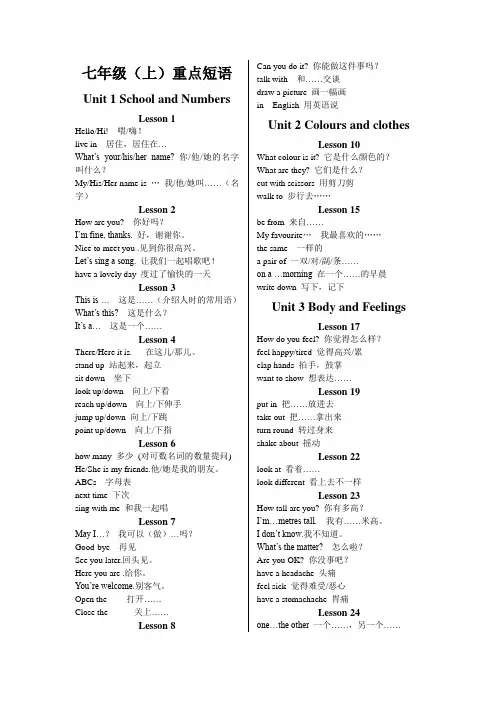
七年级(上)重点短语Unit 1 School and NumbersLesson 1Hello/Hi! 喂/嗨!live in 居住,居住在…What’s your/his/her name? 你/他/她的名字叫什么?My/His/Her name is …我/他/她叫……(名字)Lesson 2How are you? 你好吗?I’m fine, thanks. 好,谢谢你。
Nice to meet you .见到你很高兴。
Let’s sing a song. 让我们一起唱歌吧!have a lovely day 度过了愉快的一天Lesson 3This is … 这是……(介绍人时的常用语)What’s this? 这是什么?It’s a… 这是一个……Lesson 4There/Here it is. 在这儿/那儿。
stand up 站起来,起立sit down 坐下look up/down 向上/下看reach up/down 向上/下伸手jump up/down 向上/下跳point up/down 向上/下指Lesson 6how many 多少(对可数名词的数量提问) He/She is my friends.他/她是我的朋友。
ABCs 字母表next time 下次sing with me 和我一起唱Lesson 7May I…?我可以(做)…吗?Good-bye 再见See you later.回头见。
Here you are .给你。
You’re welcome.别客气。
Open the ____打开……Close the______关上……Lesson 8 Can you do it? 你能做这件事吗?talk with 和……交谈draw a picture 画一幅画in English 用英语说Unit 2 Colours and clothesLesson 10What colour is it? 它是什么颜色的?What are they? 它们是什么?cut with scissors 用剪刀剪walk to 步行去……Lesson 15be from 来自……My favourite…我最喜欢的……the same 一样的a pair of 一双/对/副/条……on a …morning 在一个……的早晨write down 写下,记下Unit 3 Body and FeelingsLesson 17How do you feel? 你觉得怎么样?feel happy/tired 觉得高兴/累clap hands 拍手,鼓掌want to show 想表达……Lesson 19put in 把……放进去take out 把……拿出来turn round 转过身来shake about 摇动Lesson 22look at 看着……look different 看上去不一样Lesson 23How tall are you? 你有多高?I’m…metres tall. 我有……米高。
外研版七年级下册英语Module 6 语法知识点
外研版七年级下册英语Module 6 语法知识点Unit 1 知识点精析1.Betty and Lingling are standing in front o Tian 'anmen Square.贝蒂和玲玲正站在天安门广场前面。
in front of...意为“在.....的前面”,指在物体外部的前面。
例:There is a river in front of the house.房子前面有一条河。
辨析:in front of与in the front ofin front of 表示在某物外部的前面in the front of 表示在某物内部的前面例:There is a tree in front of the classroom.在教室的前面有一棵树。
There is big desk in the front of the classroom.在教室的前面有一张大的书桌。
【助记】in front of 在.....(外部)的前面in the front of 在.....(内部)的前面2.Excuse me! Can you tell me the way to Wangfujing Dajie?打扰一下!你们能告诉我去王府井大街的路吗?excuse me 意为“劳驾,打扰一下”,通常在要打扰别人、打断别人谈话而表示歉意或要引起别人注意时使用。
例:Excuse me, can you help me move the desk?劳驾,你能帮我搬一下这张书桌吗?辨析:Excuse me与I'm sorryExcuse me 用于谈话开始前,为打扰别人表示歉意I'm sorry 常用于对做过不当的事情或不能做某事而表示歉意,也用于听到某种不幸消息而表示遗憾例:-Excuse me, is there a supermarket near here?打扰一下,这附近有一家超市吗?-I'm sorry.I'm new here.对不起。
北师大版初中英语七年级下册知识讲解-Unit 3 Food and Drink(词汇)
Unit 3 Food and Drink词句精讲精练::词汇精讲1. drink(1) drink作名词时,意为“饮料”,是不可数名词;意为“饮料的种类”时,是可数名词。
例如:Have they got any drink? 他们又饮料吗?There are all kinds of drinks in the supermarket. 超市里有各种各样的饮料。
(2) drink 作动词时,意为“喝,饮”。
例如:Please drink a cup of tea. 请喝杯茶。
2. milkmilk作不可数名词,意为“牛奶”。
例如:She drinks a glass of milk before she goes to bed every day. 她每天上床睡觉前喝一杯牛奶。
【拓展】milk还可作动词,意为“挤奶;产奶”例如:Look! She is milking a cow. 看!她正在给奶牛挤奶。
The cows are milking well. 这些奶牛产奶多。
3. price(1) price作名词,意为“价格;代价”。
例如:It is rather cheap at this price.对于这个价钱出售是相当便宜的。
No price is too high for winning their support.为了获得他们的支持, 任何代价均在所不惜。
【注意】price只有high, low(高低)之别,不能以expensive或cheap来修饰。
例如:The car is too expensive. = The price of the car is high. 这个小车很贵。
4. weightweight作名词,意为“重量,体重”。
例如:What’s your weight? 你体重是多少?The weight of the box is 3 kilos. 这个盒子的重量是3千克。
北师大版七年级下册英语课件 Lesson 9 Food for sport (共47张PPT)
Host’s words:
● How about swimmers? Do they eat any beef?
Swimmers usually eat……
问答关系+关键词
● Really? But Michael Phelps eats all those things.
Yes. He…
肯定上文+人称
● Is each sport different?
问句类型+关键词
Yes, and each person is different, too.
● Well, that’s food for thought. Thank you very much.
You are welcome.
交际用语
c) Is each sport different?
d) How about swimmers? Do they问ea答t a关ny系be+ef关? 键词
Host: 2 _________________________ Dr Hill: Yes. He can eat three pancakes, three cheese
1W.hRoeaarde tthheespreakdeiros innttheervinietewrv.iew?
interviewer interviewee
host
Dr Hill
2. Read and complete the host’s words.
a) Really? But Michael Phelps eats all those things.
13、He who seize the right moment, is the right man.谁把握机遇,谁就心想事成。2021/9/42021/9/42021/9/42021/9/49/4/2021 •14、谁要是自己还没有发展培养和教育好,他就不能发展培养和教育别人。2021年9月4日星期六2021/9/42021/9/42021/9/4 •15、一年之计,莫如树谷;十年之计,莫如树木;终身之计,莫如树人。2021年9月2021/9/42021/9/42021/9/49/4/2021 •16、教学的目的是培养学生自己学习,自己研究,用自己的头脑来想,用自己的眼睛看,用自己的手来做这种精神。2021/9/42021/9/4September 4, 2021 •17、儿童是中心,教育的措施便围绕他们而组织起来。2021/9/42021/9/42021/9/42021/9/4
Unit 1 Food and Drinks
Unit 1 Food and Drinks单元备课2012.02.19一、教材分析:本单元教学内容为Lesson One-------Lesson Four,前三课为新授,第四课为复习课。
主要语言功能是谈论并询问饮食爱好。
本单元注重生活情境和情趣化教学,使学生在真实或模拟的情境中培养学生感知和运用英语的能力。
二、教学目标:1.能正确认读和书写字母A~G。
2.能听懂、会说、认读食品和饮料的相关单词:egg, bread,orange, juice,milk,please, fish, vegetable , rice, hungry,drink,apple并能结合句型灵活运用。
3.能听懂、会说、认读与饮食相关的句型:“I like eggs.”“Do you like fish?”“I’d like some apple juice.”4.能运用所学句型谈论饮食及自己和他人的喜好。
5.对中、西方的饮食差异有一定的了解,培养学生良好的饮食习惯。
三、教材重难点:教学重点能听懂、会说以下用语:Do you like milk? Yes ,Ido .Would you like a hamburger?Yes, please .What’s for dinner?We have fish,rice and vegetables.教学难点1.breakfast hungry vegetable 的发音。
2. Do you like---?Would you like---?What’s for din ner?这几个句型的灵活运用。
3.语音、语调的模仿。
四、教学中应注意的问题及教学措施:教师在教学过程中要注意放慢速度。
采用多种教学活动形式,营造宽松、和谐和民主的教学氛围,如游戏、歌曲、童谣等都是很有效的方法,课堂教学的生生互动、师生互动,使学生的学习兴趣得以延伸。
五、教学进度安排:Lesson 1 1课时Lesson 2 1课时Lesson 3 1课时Lesson 4 1课时Lesson 1 I like eggs.2012.02.19一、课型:新授二、教学目标:(一)知识目标1.学生能听懂、会说、认读下列单词:egg,bread,orange,juice,milk2.学生能听懂、会说单词breakfast,som,please3.学生能听懂、会说句型:I like ... I don’t like...4.学生能够听懂会说认读书写下列字母:Aa, Bb,Cc(二)能力目标:通过真实的语言情境,学生能运用所学句型谈论自己对饮食的喜好。