
最新仁爱版七年级英语下册Unit5Topic1SectionA精品课件
1. Review the means of transportation. 2. Read the sounds and words in 3a. 3. Memorize the new words.
Thank you
(3)How does Jane always come to school? Jane always comes to school by bus.
1a Look, listen and say.
1.—Happy New Year! —The same to you.
2.—Do you often come to school by bike? —Yes, I do.
Exaபைடு நூலகம்ple:
A: How do you usually come to school? B: I usually come to school by bike. C: I usually come to school on foot.
…
You may report like this: In our group, three of us come to
1b Read the sentences and choose the correct one for each picture.
C
D
A
B
A. He comes to school on foot. B. She goes to school by bus. C. He comes to school by bike. D. She goes to school by subway.
YeNHsi,acIpedpotyo. HNsoewewdyYooeyuao,rut!ouosu! ally
come to school?
NaIsgTiuNosccahcfsiehtciheuneoonta,soooblcMallilsokymbbremey.c!yeeLeobDcityitmo!koaoeyeruy?.ootuou!
3.—How do you usually come to school? —I usually come to school by subway.
4.—It’s time for class.
1c Work in groups and practice 1a. Then make up a new conversation with the following structures.
1.—Happy New Year! —_T_h_e_s_a_m_e_t_o_y_o_u__.
2.—_D_o_ you often come to school _b_y_ bike? —Yes, I do.
3.—_H_o_w_ do you usually come to school? —I usually come to school _b_y_ subway.
Happy New Year! Nice to see you! How do you usually come/go to school? I usually come/go to school by bus/subway…
Make a survey of your group, asking them how they come to school. Then make a report to your class.
Fill in the blanks according to 1b.
A. Michael comes to school_o_n__f_o_o_t_. B. Jane goes to school_b_y__b_u_s_. C. Kangkang comes to school__b_y_b_i_k_e__. D. Helen goes to school__b_y_s_u_b_w__a_y_.
letter sound
word
ei
/aI/
either neither height
d
/d/
dish deaf do
dge
/dZ/
bridge edge judge
3b Listen and circle the words with the sound /i:/ or /e/.
/i:/ ready read beach mean bean health deep beef /e/ jeans ready seat bread leaf wealth weather great
school by bike…
3a Listen and read the sounds and words aloud.
3a Listen and read the sounds and words aloud.
3a Listen and read the sounds and words aloud.
4.—It’s time _f_or_class.
We learn: 1. some words: gate, plane, train, ship, boat, by, always
2. some phrases: come on, on foot, by bike/car/bus/train/subway/plane/boat
3. some sentences: How do you usually come to school? I usually come to school by subway.
We can: talk about the means of transportation. e.g. I often go to school by bike/bus.
2b Listen and match the means of transportation in 2a with the people.
Mr. Zhang __C_____ Kangkang __B____
A. by subway B. by bike
Ms. Black ___F_____
C. by plane
by bike by car
by bus
by train by subway/ underground
by plane
by boat by ship
on foot
A. by subway B. by bike C. by plane D. on foot E. by car F. by train G. by ship H. by bus I. by boat
Jane’s uncle___E____ D. on foot
Miss Gao __G____
E. by car
Ellen ___H____
F. by train
Zhao Lin ___D______ G. by ship
Mr. Brown_____I_____ H. by bus
Wu Hui___A____
I. by boat
1a Listen, look and say.
(1)Where do Kangkang, Jane and Helen meet? They meet at the school gate.
(2)How does Helen usually come to school? Helen usually comes to school by subway.
仁爱版英语七年级下册 Unit5 Topic1 Section A 教案设计
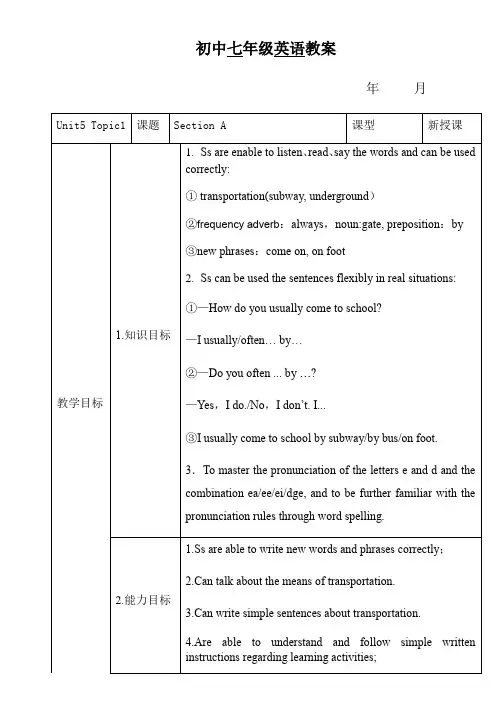
4.Are ableto understand and follow simple written instructions regarding learning activities;
3.情感目标
Cultivate a spirit of friendship and mutual assistance;
e.g.
A: Happy New Year!
B: The same to you. Nice to see you again.
A: Nice to see you, too.
B: Do you go to school by bike?
A: Yes. What about you? How do you often go to school?
②frequencyadverb:always,noun:gate, preposition:by
③new phrases:come on, on foot
2.Ss can be used the sentences flexibly in real situations:
①—How do you usually come to school?
5.Try to read the words in 3b. Circle the words with the sound /i:/ or /e/ individually. Then listen to the tape and check the answersin pairs.
Ⅴ.Make a report and conversation:(10 minutes)
2021学年仁爱版英语七年级下册Unit 5 topic 1 ---3期末 复习课件,
19.打篮球
visit the Great Wall
踢足球 play basketball
20.开车去公园pl野ay餐sodcrciever/afocaortbtaollthe park for a picnic
21.快点;加油;来吧 = go to the park for a picnic by car 22.在平日,在工作日 come on
1. I want to have
and
(一些米饭和鸡肉).
2. I’d like
(两杯水).
3. Please give me some(三ri个ce鸡蛋). chicken
4. I have (许多)vegetables and (许多)fish for supper.
two glasses of water
=I never take the subway/underground to school.
5.你多久来一次图书馆?
How often do you come to the library? 很经常。/一周三次。/很经常/每天。
Three times a week./ Very often ./ Every day. 6.我很少步行上学。
come/go to sp. by subway/underground 31.乘=t公ak共e 汽th车e 来su/b去w某ay处/underground to sp.
come/go to sp.by bus=take a bus to sp. 32.乘火车来/去某处
come/go to sp. by train=take a train to sp.
14.多经常,多久……一次
15.放学后 晚饭后
仁爱英语七年级下册Unit5_Topic1_SectionA_优教精品课件
二、句型转换 1. It’s time for breakfast.(同义句转换) It’s time __to____ _h_a_v_e__ breakfast. 2. They go home by subway.(同义句转换) They go home ___b_y__u_n_d_e_r_g_ro_u_n_d_. 3. My sister goes to school by train.(对画线部分提问) _H__o_w__ _d_o_e_s__ your sister go to school?
D. She goes to school by subway.
Choose correct answers according to 1b.
A. by bus B. by bike C. on foot D. by subway/ underground
Kangkang comes to school ___B____. Jane comes to school ___A____. Helen comes to school ___D____. Michael comes to school____C____.
Homework
1. 登录“优教 同步学习网”完成 SectionA随 堂练习。 2. Review the means of transportation. 3. Read the sounds and words in 3a. 4. Memorize the new words.
2.—_D_o_ you often come to school _b_y_ bike? —Yes, I do.
3.—_H_o_w_ do you usually come to school? —I usually come to school _b_y_ subway.
仁爱版英语七年级下册Unit5Topic1SectionA教学设计
四、教学内容与过程
(一)导入新课
1.教学活动设计:教师通过展示一张世界地图,引发学生对旅游话题的兴趣。邀请学生分享他们向往的旅游目的地,从而导入本章节的学习内容。
2.教学策略:运用提问法,激发学生的好奇心和求知欲,为新课的学习做好铺垫。
(三)学生小组讨论
1.教学活动设计:教师将学生分成小组,每组选择一个旅游目的地,用所学词汇和语法描述该地的景点、设施等。
2.教学策略:运用合作学习法,鼓励学生互相交流、讨论,提高他们的语言运用能力。
(四)课堂练习
1.教学活动设计:教师设计一系列练习题,包括词汇填空、语法改错、听力练习等,帮助学生巩固所学知识。
3.设计丰富的课堂活动,如角色扮演、情景模拟等,帮助学生巩固所学知识,提高他们的语言运用能力。
4.引导学生通过观察、思考、总结,培养自主学习能力和解决问题的能力。
(三)情感态度与价值观
在本章节的学习过程中,学生将形成以下情感态度与价值观:
1.培养学生对英语学习的兴趣和自信心,使他们积极参与课堂活动,主动与同学、老师交流。
(二)讲授新知
1.教学内容:本节课主要学习描述地点、风景的词汇和一般现在时、there be结构的语法。
2.教学活动设计:教师呈现一组与旅游相关的图片,如酒店、海滩、山脉等,引导学生学习并掌握本节课的词汇。接着,通过示例句和情景对话,教授一般现在时和there be结构的用法。
3.教学策略:采用直观教学法,让学生在视觉、听觉上充分感受英语。同时,结合情景教学法,让学生在实际语境中学习语法。
在整个教学内容与过程中,教师应注重以下方面:
1.关注学生的个体差异,因材施教,确保每个学生都能在课堂上获得提高。
仁爱版七年级下册英语:Unit5-Topic1-Section-CPPT课件

2021/6/4
11
Talk with your partner about your day with the help of 1a. Then report it to the class.
• I usually get up at … in the morning. At … o’clock, I have breakfast … … is my partner. He/She usually gets up at … in the morning …
4.Learn about the differences of the school life between American students and Chinese students.
2021/6/4
4
Review
1.Review the adverbs of frequecy,showing the chart in Section B.
New words
2021/6/4
2
2.Learn how to express frequency. How often do you go to the library? Once/Twice/Three times a week./ Verdom …
(5) How does she go home?
放学后
She takes the subway home.
2021/6/4
10
Work in groups of three. Discuss the following pictures and retell the passage in 1a.
2021/6/4
12
Hai Qing play soccer play basketball
Unit 5 Topic 1 Section B(22页)仁爱版七年级下册英语课件

Read 1a again and fill in the blanks.
Helen: Michael,what time do you usually _g_e_t _u_p__?(起床) Michael: I always get up _a_t about six o'clock. Helen: The early bird catches the worm. _H_o_w_do you usually come to school? Michael: I usually come to schoolo_n__fo_o_t, but _so_m__e_ti_m_e_sby bike. How about you ? Helen: I _s_e_l_d_o_m_ walk to school . I _o_f_t_en___ come by subway. What about you Sally? Sally: I _n_e_v_e_r _come to school by subway. I _a_lw__ay_s_ take a bus.
Hale Waihona Puke Activity watch TV in Frequency the afternoon
always
usually
often
sometimes
seldom
never
√
play soccer on Sundays
√
see a movie √
课堂总结
We learn: 1. some words: weekday, early, bird, catch, seldom, walk, never, ride, park, watch 2. some phrases: take a bus/car, do one’s homework watch TV, see a movie, play soccer 3. some sentences: The early bird catches the worm. I never come to school by subway.
最新仁爱版七年级英语下册Unit5 Topic1 SectionA优质课教案
最新仁爱版七年级英语下册Unit5 Topic1 SectionA优质课教案一、教学目标1、知识目标1).掌握单词:subway/underground, plane, train, ship, boat, usually, gate.…2).掌握短语:at the school gate, by boat, on foot..3).掌握句型:—Happy new year!—The same to you.—How do you usually come to school?—I usu ally come to school…2、能力目标1).能正确使用how和by/on来询问及回答日常的交通出行方式。
2).能听懂表达交通方式的简单对话,并能根据图文就交通方式进行口语交流。
3、情感目标1).通过最后的Project联系生活实际,指导学生为不同的目的地选择合理的交通工具,加强学生的生活实践能力。
2).加强校园交通安全意识,珍爱生命。
二、教学重难点教学重点:1).学习表达交通工具的新单词subway/underground, plane, train, ship,boat。
掌握短语at the school gate, by boat, on foot。
2).掌握对交通出行方式提问的句型:How do you usually come to school?教学难点:表达交通出行方式要用by+交通工具,特别注意步行用介词on,即on foot。
三、教学过程Step1.导入(Lead-in)老师通过询问孩子寒假及春节情况来引出歌曲Happy New Year,通过歌曲来调动孩子们学习的积极性。
Step2.热身运动(Warming-up)通过一段与交通工具有关的动画片引出本课的主题,并激发学生对于本堂课的学习兴趣。
其间,设置两个问题1. How many kinds of vehicles are there in the video?2. What are they?让学生带着问题观看动画视频,效果更好。
最新仁爱版英语七年级下册Unit5 Topic1 SectionA精品课件
3. by 在这里的意思为“乘坐(某种交通工具)”。 在交通工具前不加冠词或人称代词。
翻译:乘公共汽车 by bus 乘飞机 by plane 乘轮船 by ship/boat 乘火车 by train
注意: 用来表示交通方式的介词还有in和on。 如: in a car, on a bus等。此时交通工具前要 加限定词。但on foot意为“步行; 走”。 foot前不需任何限定词, foot也不能用复数。
by prep. (表方式,乘车等) 按照;
adv. 经过 always adv. 总是,一直 come on 加油,快点,来
Look at the pictures and know how
people and students go to school or
work.
by bike
by bus by car
Fill in the blanks according to 1b.
A. Michael comes to schoool_n_f_o_o_t ___. B. Jane goes to schoobl_y_b_u_s___. C. Kangkang comes to schoolb_y__b_ik_e____. D. Helen goes to schoolb_y_s_u_b_w_a_y____.
5. do, go, how, home, holidays, you, for, your, usually (连词成句)
How do you usually go home for your holidays?
Write a short passage about your family’s means of transportation.
2021学年仁爱版英语七年级下册Unit 5 topic 1 ---3期末复习课件
E A: ____________
teacher?
B: My favorite sport is basketball.
D. How do you usually
B A: ____________
B: Because it's very exciting(令人兴奋的).
C A: ____________
goes to bed at about a quarter to ten
4. 一般现在时的特殊疑问句
谓语是实意动词的特殊疑问句: 疑问词+助动词(do/does)+主语+动原+…? 1. How do they usually go to school ? 他们通常怎样去上学? 2. Where do they usually have lunch ?他们通常在哪里吃午饭? 3. What do they usually do in their ?他们在空余时间做什么?
2. Do you go to school by subway?(改为同义句)
Do you _t_a_k__e_ _s_u__b_w__a_y___t_o__ school?
4. Jim takes the subway to school.(对画线部分提问)
_H___o_w___ _d_o__e_s___ Jim _g_o______ to school?
adv.
有时 很少
13 /wɔːk/ walk
v.&n. 走路
14 /ˈnevə(r)/ never
adv.
从不
15 /raɪd/
ride
v.
骑
16 /pɑː(r)k/ park
2020年仁爱版英语七年级下册Unit5 Topic1 动词课件(共32张PPT)
go
go 做“去”的时候,与come的用法一样 go to +地点 表示去某个地方 当遇到home,there 这些点副词前面不加to。 如: He usually _g_o_e_s _t_o Beijing by plane. 他通常乘飞机去北京。 They usually __g_o_ t_o_ Beijing by plane. Miss Wang usually __g__o_e_s home on foot. He doesn't want to ___g_o___there, because it's too far from his home.
①She _c_o_m__es_ _t_o_ school by bike.她骑自行车去上学。 ②You mean(that) you usually _c_o_m__e_ _t_o_ school by underground. 你的意思是,你通常乘地铁去学校。
总结:come to +地点,表示到某个地方去。
We train them to make use of reference booa_t_c_h____ The early bird _c_a__tc_h__e_s_ the worm.早起的鸟儿捉虫。 The cat _c__a_tc_h__e_s__ a big mouse.那只猫捉住了一只大老鼠。 They ___c_a_t_c_h___ the thief(贼) quickly.他们很快抓住了那个贼。
练习
1._D__o_______you usually _c_o_m_e_/_g_o___t_o__school by bike? 你通常骑自行车去学校吗? 2.___D_o_e_s____Xiaohua usually _c_o_m__e_/g__o___to__school by underground? 小华通常乘地铁去学校吗? 3.Li Ping usually go to school by bus but she __d_o_e_s_n_'t___