
英语单词语法理论
• But some forms have no meaning, e.g.
– extraposition – (arguably) all of morphology, e.g. {z}, {ing}
What does WG actually claim?
– activation guides inheritance and binding – super-active tokens become permanent types
An utterance as part of the grammar
word noun
verb
preposition ON
What do I believe?
• • • • • • Theory matters and can be improved Truth matters and can be aimed at. Minds matter and can be modelled Texts matter and can be explained Education matters and needs linguistics Neighbouring disciplines matter, and can be learned from.
The1
cat
sat
on
the2
mat.
Usage
• The network is 'usage based'
– built out of episodic memories
• It contains 'ex-tokens': words plus context
– so formulae – and socially constrained
A nice quote
One has to ask … whether a particular claim or assumption in one domain can really be true, given what we know about another domain.
Wray 2009
Word Grammar 1984
• Why recognise phrases? • Daughter-Dependency Grammar + psychological reality – phrases = WG
What am I?
• a lapsed systemicist • a dependency grammarian • a cognitive linguist • a sociolinguist • a descriptive linguist • a theoretical linguist • an educational linguist
Word Grammar in Theory
Dick Hudson Cardiff, May 2013
History
• 1963: PhD on Beja grammar at SOAS • Halliday or Chomsky?
– Halliday was more convincing
• 1964-71: worked with Halliday
SIT, past The cat sat on the mat.
Tokens and syntax
• Each word token is distinct from its type: • It shows the effects of its syntactic context.
– – – – the/1 means 'the cat' on means 'on the mat' sat means 'sat on the mat' but also 'the cat sat on the mat'
• So phrases aren't needed.
Tokens of tokens …
'the cat sat on the mat'
'sat on the mat' 'the cat' 'cat' 'on the mat' 'the mat' 'mat'
sat2
the11 sat1 on1 the21
• So any properties may be generalised
– 'linguistic' – relations to other words – 'non-linguistic' – relations to social constructs
Processing
• • • • Node creation: one node per token Default inheritance to enrich token nodes Binding tokens to existing nodes Spreading activation
For instance …
{on} {a} {round}
labels are NOT part of the analysis
on
aground around1
around around2
round
isa hierarchy
… all around were … … looked around … the soil around the base of the plant … … messing around
CAT
MAT THE SIT past
SIT, past The cat
? sat
on
the
mat
Summary
• Mentalist – just cognitive structures • Just a network of atoms
– Declarative network – Organised round an isa hierarchy
• Procedures:
– node creation – node enrichment (inheritance, binding) – spreading activation
– e.g. He wandered around
• Tokens show modifying effects of context.
An utterance as part of the grammar
word noun
verb
pபைடு நூலகம்eposition ON
CAT
MAT THE SIT past
– e.g. chair:
• • • • comfortable for sitting strong, durable good-looking affordable
Why 'interpersonal'?
For instance
Hearer is part of the meaning of 'question', but not otherwise.
Systemic Grammar
Dependency theory
• 1976: why no wordword dependencies? • Systemic + Dependency = Daughter-Dependency Grammar
Psychological reality
• AI (e.g. Winograd, Schank, Anderson) • Mental networks (Lamb, Halliday) • Linguists (Bresnan, Chomsky) • Sociolinguistics (e.g. Labov, Gumperz)
sentence
clause group word
Hurry!
hurry hurry hurry Classification of mother is always predictable from its head daughter
Constructions
• CxG: a language consists of nothing but constructions. • A construction is a form-meaning pair.
What does 'theme' mean?
Why is this the first choice?
System networks
How might we organise knowledge so tidily? And why?
The rank scale
objections unary branching Headedness
• Language is just ordinary knowledge applied to words. So: • Language is a mental network. • The network nodes (concepts) are atoms. • Concepts are defined solely by their links to other concepts. • Concepts are organised in 'isa' hierarchies.
What don't I believe in?
词汇功能语法_LFG_解析

[关 键 词] 词汇主义;功能;语法;合一 [中图分类号] H314 [文献标识码] A [文章编号] 1672-8610(2009)01-0001-06
一、概述
词汇功能语法 (Lexical Functional Grammar,以下简称 LFG)是继转换语法之后出现的一种重要的非转换语法理论。 该语法的创始人是美国理论语言学家 Bresnan 和计算语言学 家 Kaplan 两位学者。LFG 属于生成语法,它继承了早期转换 语法的某些研究目标和成果,但放弃了转换这一核心机制。 我们知道,转换是句法从一个结构层次向另一个结构层次的 派生手段,放弃转换部分,实际上就是否认存在两个句法结 构层次。LFG 认为,句法结构是单层次的,除句法结构外,还 存在着一个与之平行的语法结构—— —功能结构。句法结构和 功能结构之间不是转换关系,而是映射(mapping)关系。
英语语法入门基础知识

英语语法入门基础知识规则名词单数变复数:一般情况下,名词后加-s,如books。
XXX。
chairs。
词尾是s、x、ch、sh结尾的词,在词尾后加-es,如boxes。
buses。
churches。
dishes。
以辅音字母+y结尾的词,变y为i,再加-es,如babies。
cities。
以y结尾的专有名词或元音字母+y结尾的词,直接加-s,如Marys。
boys。
以+o结尾的词,一般在词尾加-s,如autos。
pianos。
在词尾加-es的词:Negroes。
heroes。
tomatoes。
XXX。
以-f/fe结尾的词,变复数,将-f/fe改为v加es,如leaves。
knives。
不规则名词单数变复数:含man的词一般变为men,如men。
women。
将oo改为ee的有foot-feet。
XXX。
goose-geese。
以en结尾的有child-children。
ox-oxen。
将ouse改为ice的有mouse-mice。
单复数同形的是sheep。
deer。
Chinese。
冠词:冠词通常放在名词前,分为定冠词the,表特指,和不定冠词an(后接元音音素开头的单词)和a(后接辅音音素开头的单词),表泛指。
定冠词使用顺口溜:特指、重提和唯一,岛屿、海峡和海湾;海洋、党派、最高级,沙漠、河流与群山;方位、顺序和乐器,年代、团体与机关;船名、建筑和组织,会议、条约与报刊;姓氏复数、国全名,请你记住用定冠。
零冠词:月、季、星期、节假、周、头衔、职务前、三餐、球类、惯用语、学科、棋类名词前,一般不用任何冠词。
基数词变序数词歌:基变序,有规律,词尾加上-th(fourth。
sixth);一、二、三,特殊例,结尾字母t、d、d(first。
second。
third);八去t,九去e(eighth。
ninth);ve要用f替(fifth。
XXX);ty将y改成i,th前面有个e。
若是碰到几十几,前用基来后用序。
(完整版)英语语法学习资料
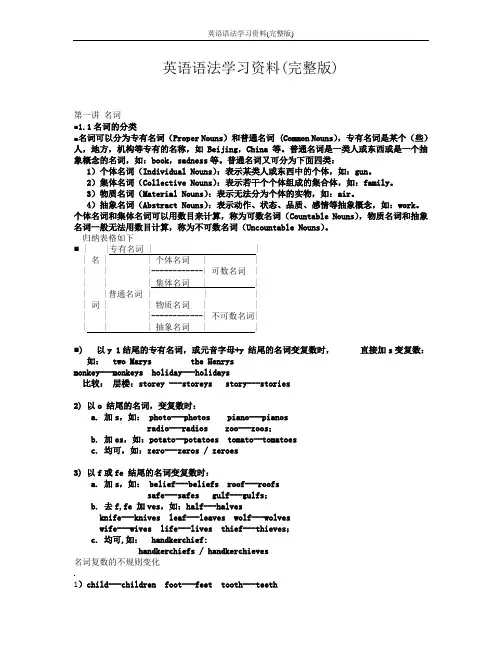
英语语法学习资料(完整版)第一讲名词⏹1.1名词的分类⏹名词可以分为专有名词(Proper Nouns)和普通名词 (Common Nouns),专有名词是某个(些)人,地方,机构等专有的名称,如Beijing,China等。
普通名词是一类人或东西或是一个抽象概念的名词,如:book,sadness等。
普通名词又可分为下面四类:1)个体名词(Individual Nouns):表示某类人或东西中的个体,如:gun。
2)集体名词(Collective Nouns):表示若干个个体组成的集合体,如:family。
3)物质名词(Material Nouns):表示无法分为个体的实物,如:air。
4)抽象名词(Abstract Nouns):表示动作、状态、品质、感情等抽象概念,如:work。
个体名词和集体名词可以用数目来计算,称为可数名词(Countable Nouns),物质名词和抽象名词一般无法用数目计算,称为不可数名词(Uncountable Nouns)。
归纳表格如下⏹ | |专有名词 | || 名 | | 个体名词 | || | |------------| 可数名词|| | | 集体名词 | || |普通名词 | | || 词 | | 物质名词 | || | |------------| 不可数名词|| | | 抽象名词 | |⏹) 以y 1结尾的专有名词,或元音字母+y 结尾的名词变复数时,直接加s变复数:如:two Marys the Henrysmonkey---monkeys holiday---holidays比较:层楼:storey ---storeys story---stories2) 以o 结尾的名词,变复数时:a. 加s,如: photo---photos piano---pianosradio---radios zoo---zoos;b. 加es,如:potato--potatoes tomato--tomatoesc. 均可,如:zero---zeros / zeroes3) 以f或fe 结尾的名词变复数时:a. 加s,如: belief---beliefs roof---roofssafe---safes gulf---gulfs;b. 去f,fe 加ves,如:half---halvesknife---knives leaf---leaves wolf---wolveswife---wives life---lives thief---thieves;c. 均可,如:handkerchief:handkerchiefs / handkerchieves名词复数的不规则变化1)child---children foot---feet tooth---teethmouse---mice man---men woman---women注意:与 man 和 woman构成的合成词,其复数形式也是 -men 和-women。
英语语法体系-9大词法,10大句法

英语语法体系-9大词法,10大句法九大词法:1. 名词(Nouns):表示人、事物、地点或抽象概念的词汇。
2. 代词(Pronouns):用来代替名词的词汇,如I, you, he, she, it 等。
3. 形容词(Adjectives):描述或修饰名词的词汇,如beautiful, smart, happy 等。
4. 副词(Adverbs):修饰动词、形容词或其他副词的词汇,如quickly, very, extremely 等。
5. 动词(Verbs):表示动作或状态的词汇,如run, eat, be 等。
6. 数词(Numerals):表示数量或顺序的词汇,如one, two, first, second 等。
7. 冠词(Articles):包括定冠词the 和不定冠词a/an,用于特指或泛指名词。
8. 介词(Prepositions):表示位置、时间、方向等关系的词汇,如in, on, at, under 等。
9. 连词(Conjunctions):连接句子或词语的词汇,如and, but, or, so 等。
十大句法:1. 句子(Sentences):包含一个完整的表达和独立意思的语言单位。
2. 主语(Subjects):句子中执行动作或被描述的主体。
3. 谓语(Predicates):描述主语的动作、状态或性质。
4. 宾语(Objects):动作的接受者或受影响的对象。
5. 状语(Adverbials):修饰动词、形容词、副词或整个句子的成分。
6. 定语(Attributives):修饰名词或代词的成分。
7. 同位语(Appositives):对名词或代词进行进一步解释或说明的成分。
8. 从句(Clauses):作为句子的一个组成部分,如定语从句、状语从句等。
9. 倒装句(Inversion):句子成分的语序颠倒,以强调或特殊语法结构。
10. 省略(Ellipsis):有意省略句子中的某些成分,但不影响理解。
英语语法要点
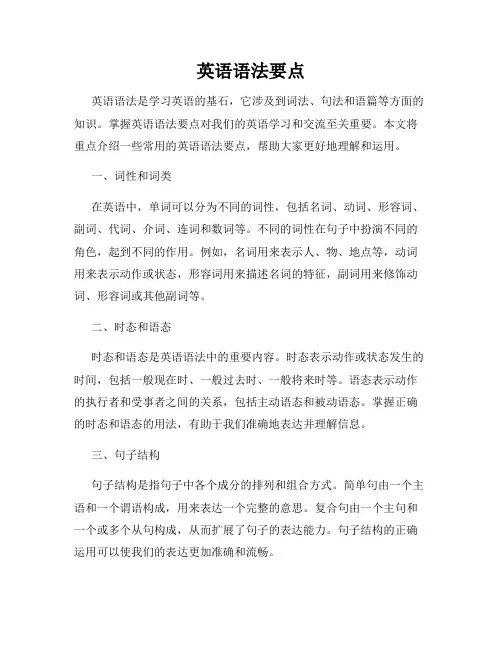
英语语法要点英语语法是学习英语的基石,它涉及到词法、句法和语篇等方面的知识。
掌握英语语法要点对我们的英语学习和交流至关重要。
本文将重点介绍一些常用的英语语法要点,帮助大家更好地理解和运用。
一、词性和词类在英语中,单词可以分为不同的词性,包括名词、动词、形容词、副词、代词、介词、连词和数词等。
不同的词性在句子中扮演不同的角色,起到不同的作用。
例如,名词用来表示人、物、地点等,动词用来表示动作或状态,形容词用来描述名词的特征,副词用来修饰动词、形容词或其他副词等。
二、时态和语态时态和语态是英语语法中的重要内容。
时态表示动作或状态发生的时间,包括一般现在时、一般过去时、一般将来时等。
语态表示动作的执行者和受事者之间的关系,包括主动语态和被动语态。
掌握正确的时态和语态的用法,有助于我们准确地表达并理解信息。
三、句子结构句子结构是指句子中各个成分的排列和组合方式。
简单句由一个主语和一个谓语构成,用来表达一个完整的意思。
复合句由一个主句和一个或多个从句构成,从而扩展了句子的表达能力。
句子结构的正确运用可以使我们的表达更加准确和流畅。
四、语法规则和用法英语语法中有很多规则和用法需要我们掌握和运用。
例如,形容词和副词的比较级和最高级的构成规则、动词的不同时态的变化规则、定冠词和不定冠词的使用规则等。
了解这些规则和用法,可以帮助我们正确地组织句子,使用正确的词语和短语,从而有效地表达我们的意思。
五、倒装句和虚拟语气倒装句是指把句子中的主语和谓语动词的位置调换,用来表达强调、表示条件、提问等功能。
虚拟语气是指用来表示非事实或假设的语气。
掌握倒装句和虚拟语气的用法,可以使我们的句子更具变化和表达力。
六、连接词和从句连接词和从句是用来连接句子或词语的重要工具。
连接词包括并列连词、从属连词和关联词,用来连接并列的词语、句子或从句。
从句是一个可以独立成句的句子,但又作为主句或另一个从句的一部分。
正确使用连接词和从句可以使我们的句子更加连贯和思路清晰。
英语词汇与语法基础知识
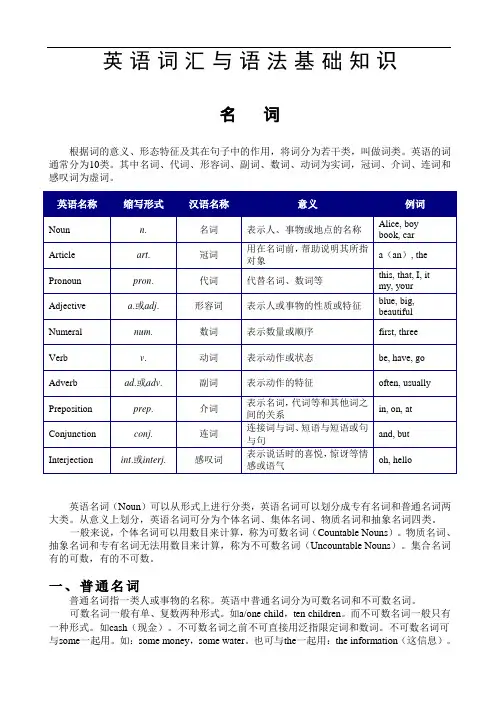
英语词汇与语法基础知识名词根据词的意义、形态特征及其在句子中的作用,将词分为若干类,叫做词类。
英语的词通常分为10类。
其中名词、代词、形容词、副词、数词、动词为实词,冠词、介词、连词和感叹词为虚词。
英语名词(Noun)可以从形式上进行分类,英语名词可以划分成专有名词和普通名词两大类。
从意义上划分,英语名词可分为个体名词、集体名词、物质名词和抽象名词四类。
一般来说,个体名词可以用数目来计算,称为可数名词(Countable Nouns)。
物质名词、抽象名词和专有名词无法用数目来计算,称为不可数名词(Uncountable Nouns)。
集合名词有的可数,有的不可数。
一、普通名词普通名词指一类人或事物的名称。
英语中普通名词分为可数名词和不可数名词。
可数名词一般有单、复数两种形式。
如a/one child,ten children。
而不可数名词一般只有一种形式。
如cash(现金)。
不可数名词之前不可直接用泛指限定词和数词。
不可数名词可与some一起用。
如:some money,some water。
也可与the一起用:the information(这信息)。
(一)可数名词及其复数形式(1)可数名词的复数形式一般由词尾加-s或-es构成,其规则见下表:(2)可数名词复数形式的不规则构成法英语中有一部分名词由于历史或词源原因其复数形式的构成法是不规则的。
这种情况主要有:①元音字母变化。
例如:foot-feet man-men woman-womentooth-teeth goose-geese mouse-mice②结尾为-en。
例如:child-children③单复数同形。
单复数同形的名词主要有:sheep, fish, Chinese, Japanese, deer等。
④只有复数形式。
例如:trousers, goods 等。
(二)可数名词和不可数名词英语中的绝大多数名词既可以用作可数名词也可以用作不可数名词。
英语单词用法规则
英语单词用法规则一、名词(n.)1. 可数名词复数形式。
- 一般情况在词尾加 -s,如:book[bʊk](单数) - books[bʊks](复数)。
- 以s, x, ch, sh结尾的名词,加 -es,如:box[bɒks] - boxes[bɒksɪz]。
- 以辅音字母 + y结尾的名词,变y为i,再加 -es,如:city[ˈsɪti] - cities[ˈsɪtiz]。
- 以f或fe结尾的名词,有些变f或fe为v,再加 -es,如:leaf[liːf] - leaves[liːvz]。
2. 名词所有格。
- 有生命的名词所有格,一般在名词后加's,如:Tom's book。
如果名词复数以-s结尾,只加',如:students' books。
- 无生命的名词所有格常用“of + 名词”结构,如:the window of the room。
二、动词(v.)1. 一般现在时第三人称单数形式。
- 一般情况在词尾加 -s,如:like[laɪk] - likes[laɪks]。
- 以s, x, ch, sh, o结尾的动词,加 -es,如:go[gəʊ] - goes[gəʊz],watch[wɒtʃ] - watches[wɒtʃɪz]。
- 以辅音字母 + y结尾的动词,变y为i,再加 -es,如:study[ˈstʌdi] - studies[ˈstʌdiz]。
2. 动词的过去式和过去分词。
- 规则变化。
- 一般情况在词尾加 -ed,如:work[wɜːk] - worked[wɜːkt]。
- 以e结尾的动词加 -d,如:live[lɪv] - lived[lɪvd]。
- 以“辅音字母 + y”结尾的动词,变y为i,再加 -ed,如:cry[kraɪ] - cried[kraɪd]。
- 重读闭音节且末尾只有一个辅音字母的动词,双写这个辅音字母,再加 -ed,如:stop[stɒp] - stopped[stɒpt]。
英语词汇语法归纳
英语词汇语法归纳英语词汇与语法归纳英语词汇和语法是学习英语的基础,它们相互依存,共同构建了我们对英语的理解和应用能力。
在本文中,我将对英语词汇和语法进行归纳总结,帮助读者更好地掌握和运用英语。
一、英语词汇归纳1. 名词(Noun)名词是表示人、事、物、地点、抽象概念等的词,它通常可以单数和复数形式。
名词的形式变化有时根据规则进行,有时则需要记忆。
- 单数形式:book(书)、cat(猫)- 复数形式:books(书籍)、cats(猫咪)2. 动词(Verb)动词是表示动作、状态或存在的词。
英语动词有时态和语态的变化,也有不规则动词需要单独记忆。
- 时态变化:play(玩)→ played(玩过)→ will play(将要玩)- 语态变化:write(写)→ is written(被写)3. 形容词(Adjective)形容词是用来描述名词特征或性质的词,它可以放在名词前或后。
- 放在名词前:a beautiful girl(一个漂亮的女孩)- 放在名词后:the girl is beautiful(这个女孩很漂亮)4. 副词(Adverb)副词是用来修饰动词、形容词和其他副词的词,表示时间、地点、方式、程度等。
- 修饰动词:He speaks English fluently(他英语说得很流利)- 修饰形容词:She is extremely beautiful(她非常漂亮)5. 介词(Preposition)介词用于表示位置、方向、时间、方法等关系。
在句子中通常与其他词搭配使用。
- 位置关系:in the box(在盒子里)- 方向关系:go to school(去学校)- 时间关系:at 5 o'clock(在五点)二、英语语法归纳1. 时态(Tense)英语时态用来表示动作发生的时间。
常见的时态有一般现在时、一般过去时、一般将来时等。
- 一般现在时:I play football every day(我每天踢足球)- 一般过去时:I played football yesterday(昨天我踢了足球)- 一般将来时:I will play football tomorrow(明天我将踢足球)2. 语态(Voice)英语语态用来表示句子中动作的主动与被动关系。
英语语法大全知识树
英语语法大全知识树一、词法篇1. 名词(Noun)可数名词与不可数名词名词的数、格、性名词修饰语及名词短语2. 代词(Pronoun)人称代词、物主代词、指示代词反身代词、相互代词、疑问代词不定代词、关系代词3. 形容词(Adjective)定语形容词与表语形容词形容词的比较级和最高级形容词的顺序4. 副词(Adverb)状语副词、连接副词、程度副词副词的比较级和最高级副词的位置与排列顺序5. 动词(Verb)动词的分类与形式动词的时态、语态、语气系动词、助动词、情态动词6. 数词(Numeral)基数词、序数词分数、小数、百分数数词的用法7. 介词(Preposition)介词的分类与用法介词短语介词与其他词类的搭配8. 连词(Conjunction)并列连词与从属连词连词的用法与辨析常见连词短语9. 冠词(Article)不定冠词与定冠词零冠词的用法冠词的辨析与注意事项二、句法篇1. 句子成分主语、谓语、宾语定语、状语、补语独立成分与插入语2. 句子类型简单句、并列句、复合句主从句、并列句、倒装句祈使句、感叹句、疑问句3. 句子结构主谓结构、主谓宾结构主系表结构、主谓双宾结构并列结构与从属结构4. 句子时态一般现在时、一般过去时、一般将来时现在进行时、过去进行时、将来进行时现在完成时、过去完成时、将来完成时5. 句子语态被动语态的构成与用法被动语态与主动语态的转换被动语态的注意事项6. 句子语气陈述句、疑问句、祈使句感叹句、虚拟语气语气词的用法与辨析三、章法篇1. 段落结构主题句、支撑句、结论句段落的展开与衔接段落的一致性与连贯性2. 文章结构引言、、结尾文章的层次与过渡文章的连贯性与逻辑性3. 标点符号句号、问号、感叹号逗号、分号、冒号引号、括号、破折号4. 英语书写规范字母大小写词与词之间的空格标点符号与单词的间距通过这棵英语语法大全知识树,我们可以系统地学习和掌握英语语法知识,为英语学习和日常应用打下坚实基础。
英语语法知识大全grammar
一. Tense (1. 时间状语; 2. 动词)1.一般现在时:1) 和时间无关;The sun rise s in the east and set s in the west.2) 在时间和条件状语中,用一般现在时代替将来时。
“主将从现”I’ll ring you as soon as/if he come s back.2.现在进行时:1) 表示厌恶、感激等强烈的感情。
She is always cooking some delicious food for us.He is always finding fault with his employees.3.一般过去时1) 和表示过去的时间状语连用, 如: yesterday, last week, in 1993, at that time, before---, a few days ago, when…等He smok ed forty cigarettes a day at that time.2) used to do, be used to doing, be used to do sthHe used to work fourteen hours a day.I am used to getting up early in the morning.The pen is used to draw the picture.4.现在完成时(Present Perfect )现在完成时的时间状语1)不确定的过去时间状语:(already, yet), before, recently, lately2)频率时间状语:often, sometimes, never, ever, once, twice, three times3)包括现在时间在内时间状语:now, just, today, this morning(week, month),until(up to) now, so far, in the past(last) two days(weeks, months),all day, for three years, since 19905.过去完成时(Past Perfect)1) 过去的过去They fulfill ed the plan earlier than they had expected.2) 过去完成时常和“by the end (time) of + 过去时间”连用3) hardly/scarcely ... when... 和no sooner ....than常用过去完成时=as soon asI had hardly reached the school when the bell rang.No sooner had I reached the school than the bell rang.6. 将来完成时将来完成时常和“by the end(time) of + 将来时间”连用。