
八年级英语上册第五单元重要知识点汇总(人教版)
八年级英语上册第五单元重要知识点汇
总(人教版)
findut查明,弄清bereadtd准备好做某事dressup装扮,乔装打扮taesb`splae代替,替换
dagdb干得好thinf+名词或动词短语认为…
gaeshs游戏节目learnfr 向…学习从…获得
talshs脱口秀sappera 肥皂剧
gn发生athavie 观看一场电影
nef theainreasns最主要的原因之一athasit 观看一部情景喜剧
atinvies动作电影eut出版,发行
trne’sbest尽力,竭尽全力apairf一双,一对…
asfausas一样著名llie看起来像
arundtherld世界各地haveadisussinabut…就……讨论
neda有一天suhas 比如
asblf …的象征sethingenable 令人愉快的东西
interestinginfratin有趣的资料happentdsth 碰巧做某事
expettdsth盼望做某事TVshs电视节目
hatduthinftalshs?Idn’tindthe
IhpetbeaTVreprternedaHabutu?
常用法:
letsbdsth让某人做某事plantdsth 计划做某事
hpetdsth希望做某事inddingsth介意做某事
expettdsth期待做某事Habutding…做某事怎么样?
bealasreadtdsth总是准备做某事,随时随地可以从事某事
trne’sbesttdsth 尽力做某事bee+ad变得…
nts…as不像…那样…;不如…这么…
thanufrdingsth谢谢你做某事
Thanufrsth谢谢你的……
lvedingsth喜爱做某事
1thether,thethers,ther,thers,anther
thether表示特指两个或者两部份中的另一个或另一部分,可直接单数名词或复数名词。
表示两个中的一个……另一个……时,常用ne…thether…。
例:
Hehastbrthers,neisateaher,thetherisadtr
Therearefrtstudentsinurlasstent-nearegirls,thethern ineteenarebs
thethers特指某一范围内的其他的,是thether的复数形式,相当于thether+复数名词。
thether+复数名词
=anther+名词单数。
例:
utstahere,thethersgithe
I’differentfreffbeauseI’luderthanthetheridsinlass
ther作代词或形容词,可修饰可数名词单数或复数。
例:elearnhinese,aths,Englishandthersubets
thers作代词,泛指“其他的人或物”。
例:
Sestudentsaredingher,thersaretalingludl
anther泛指同类事物中的三者或三者以上的“另一个”,只能代替或修饰单数可数名词。
例:
Idn’tliethisnePleasesheantherne
2findut查明,弄清楚,find找到
PleasefinduthenrsGreenillgtBeiing
3gn发生,与taeplae同义
Inderhatasgingn
翻译:隔壁发生了什么??
4happenv发生,一般指偶然发生,主语为事,不能为人。
Sth+happenstsbAtraffiaidenthappenedthiselderbrthere sterda
Sth+happens+地点/时间,意为:某地/某时发生了某事AnaidenthappenednParStreet
Happenv,表示“碰巧”,主语可以是人,后常跟动词不定式t,表示“碰巧……”
Sb+happenstdsth
Ihappenedtseeunlenthestreet
*taeplae意为“发生,举行,举办”,一般指非偶然性事的“发生”,即这种事的发生一定有某种原因或事先的安排。
例:
Greathangeshavetaenplaeinhina
TheeetingilltaeplaenextFrida
expetv期待,盼望,预期,后常接四种结构:
1)expet+名词/代词,期待某事/某人,预计……可能发生。
I’expetingLiLin’sletter
2)expettdsth预计做某事
Lilexpetstebanextee
3)expetsbtdsth
Iexpetthertebaearl
4)expet+从句预计……
IexpetedthatI’llebanextnda
6seriusa严肃的,认真的。
Heisaseriusan
beseriusabutsb/sth对某人/某事当真
PeterisseriusabutennHeantstgetarriedther
beseriusabutdingsth对某事当真He’sseriusabutsellinghishuse。
人教版新课标八年级上册英语Unit 5知识点归纳
人教版新标八年级上册英语Unit 知识点归纳人教版新标八年级上册英语Unit知识点归纳Unitanuetpart?【复习目标】●学习礼貌地发出、接受、拒绝邀请●谈论自己或别人必须做的事情●学会根据日程表中的计划安排自己的活动【语言目标】●anuetbirthdapart?es,I’dlvet/Srr,Ian’tIhavetstudfratestI’srrI’plaingsernSaturda●henisthepart?It’satseven-thirt【语言结构】●用an发出邀请●情态动词havet●用现在进行时表示将来计划或行动【重点词汇】●tda,trr,thedaaftertrr,nextee,/lessn,invitatin 【应掌握的词组】etne’spart参加某人的聚会2nSaturdaafternn在星期六的下午3I’dlvet我非常乐意4I’srr对不起studfratest为测验而学习6gtthedtr去看医生7visitne’saunt看望某人的姑姑8haveapianlessn上一堂钢琴0tuhher太多家庭作业1uhtinteresting有趣得多2abeanthertie也许下一次吧3Thansfrasing(inviting)谢谢邀请4gtthebaseballgae参加棒球比赛BirthdaPart生日聚会6gttheall去购物中心7serpratie足球练习8lfr寻找19findut找到,弄清楚,查明20studfrtheathtest为数学考试而学习21platennisithe和我一起打网球22Ihaveareallbusee我一周很忙23ftballath足球比赛24usin’sbirthdapart我表弟的生日聚会2ritesn尽快回信26studfrsienetest为科学考试而学习27给某人打电话的几种说法:allsbup,allsbphnesbtelephnesbtelephnetsbphnesbUpringsbgivesbaring,givesbaphneaeatelephnealltsb28nThursdanight星期四晚上29benvaatin度假30nextee下周31insb加入某人一起32Pleaseeepquiet!请保持安静,eep+形容词表示“保持某种状态”,eep++ding表示“(使某人)不停地做某事”,eepsth保存某物33ulturelub文化俱乐部34trtdsth努力(企图)做某事,trdingsth试着做某事,trne’besttdsth尽力做某事【应掌握的句子】anuetpartnSaturdaafternn?Sure,I’dlvet星期六的下午你能来参加我的聚会吗?当然,我非常乐意。
八年级上册英语人教版第五单元2b的知识点
八年级上册英语人教版第五单元2b的知识点Unit 5 Our School Life本单元主要介绍了学校生活的各个方面,如学校设施、规则、课程等。
以下是2b部分的知识点:1. ask for permission:请求允许。
如:Can I ask for permission to leave the classroom?2. in the hallway:在走廊上。
如:Please walk in the hallway, not run.3. speak softly:低声说话。
如:Please speak softly in the library.4. keep…clean:保持……的干净。
如:We should keep the classroom clean and tidy.5. be allowed to:被允许做某事。
如:Are we allowed to use mobile phones in the classroom?6. library rules:图书馆规则。
如:The library rules say that we should keep quiet and speak softly.7. check out books:借书。
如:I want to check out a book about dinosaurs.8. obey the rules:遵守规则。
如:It's important to obey the school rules.9. school rules:学校规则。
如:The school rules say that we shouldn't bring pets to school.10. lunchtime activities:午餐时间活动。
如:There are many lunchtime activities, such as playing basketball and singing.以上是2b的知识点。
人教版八年级英语上册1-5单元知识点(词汇+句型+固定搭配)
Unit 1 Howoftendoyou exercise?词汇:1. howoften: 多久一次7.health: 健康,12. on weekends:在周末howmany:多少+可数名词healthy:健康的13. once a week:一周一次2.always(100%)-总是unhealthy: 不健康,twice a week:一周两次usually(80%) –通常keep/stay healthy three times a month: 一月三次often(60%)- 经常=keep/stay in good health: 保持健康14. most:大部分的,绝大多数的sometimes(40%)-有时候8.get good grades: 取得好成绩all:所有的hardly ever(20%)- 几乎不9.the same as:与…不同15.begood for:对…有益never(0%) 从不10. alot of= lots of: 大量,许多+ 可数/不可数名词be bad for: 对…有坏处3. surfthe internet: 上网alot =verymuch: 十分,非常,很1--6.how many:多少, +可数名词4.asfor: 至于,关于11. maybe:也许,大概how m uch: 多少,+不可数名词5. junk food: 垃圾食品maybe: 也许是,或许是(may是情态动词,be是动词原形)howmuch 多少钱,(问价格)6. look after=take care of:照顾12.little:小的,a littleboy: 一个小男孩17. of cou rse =sure 当然look for:寻找little: 少,little少→less更少→least最少(修饰不可数名词)look up:查找(单词、信息) little: 几乎没有,否定词(修饰不可数名词)look at: 看 a little:少许,有一点,肯定词(修饰不可数名词)few:几乎没有,否定词(修饰可数名词)a few少许,有一点,肯定词(修饰可数名词)句型:1.How often doyouexercise?→I exercise three timesa week.How often does sheshop?→Sheshops once amonth.2.What do you usually doon weekends?→I usually watchTV.How often doesshe watch TV? →She watchesTV everyday.3.Howmany hours do you sleepevery night? 你每晚睡几个小时?→Isleepnine hoursevery night.Howmany books do you have?你有多少本书?→I have5books.How muchis the sweater? 这件毛衣多少钱?--How muchwaterdoyou have? 你有多少水?(how much: 多少,后面+不可数名词, water是不可数名词)4.What’s your favorite program? 你最喜欢的电视节目是什么?→It’sAnimal World.固定搭配:try to do sth.: 尽力做某事,设法做某事try doingsth.: 试着做、尝试做某事help sb.(to) do sth: 帮助某人做某事(to可以省略)want sb. to do sth.: 想要某人做某事Unit 2 What’s thematter?词汇:1.have acold 感冒9.few:几乎没有,否定词(修饰可数名词)have a fever发烧 a few少许,有一点,肯定词(修饰不可数名词)have a stomachache肚子痛little: 几乎没有,否定词(修饰不可数名词)have a headache头疼a little: 少许,有一点,肯定词(修饰不可数名--词)have a toothache 牙齿疼10. at themoment= now 现在,此刻haveasorethroat 喉咙疼11. host family 寄宿家庭have a soreback 背部酸疼12. not…until…直到……时候才……2. lie downand have agood rest躺下好好休息13. should应该,情态动词,后+动词原形3.hot tea with honey加了蜂蜜的热茶should not=shouldn’t4.ill 病了的illness 疾病14. see a doctor 看医生5. advice建议(不可数名词) see a dentist 看牙医some advice(不能加”s”) 15.toomany太多…,修饰可数名词toomany students6.be stressed out 有压力的,紧张的too much太多…,修饰不可数名词too much yin7. balance 平衡balanced 平衡的much too太……,much too big太大abalanced diet平衡的饮食16. stay=keep 保持on a diet 节食keep/stay healthy8.get 变得=keep/stayin good health: 保持健康get angry变得生气get tired 变得劳累句型:1.What’s the matter with you? = What’s the trouble with you? =What’s wrong with you? 你怎么了?→Ihavea cold/ havea toothache/ have asore throat….2.Wha t’s thematter? →She hasa cold.--3. Doeshehave acold? →Yes, he does.4. A: What’s the matter?B: I’m not feeling well.(此处不能用good)I have a cold.A:When did it start?B:About two days ago.A: That’stoo bad.You shoulddrinklotsof water.B:Yes, Ithink so.A:Ihopeyou feel/getbetter soon. 我希望你尽快好起来5. A: I have a coldB: Iam sorry tohear that.(当听到对方不好的消息时使用此句)固定搭配:Itis+ 形容词+ (for sb.) todo sth.做某事对某人来说是………的例句: It is easyforme to learn(learn)English. 对我来说学英语是容易的Itis interesting to watch (watch) Animal World.看动物世界时有趣的Unit 3 What are youdoingfor vacation?→→→本单元用现在进行时态表示将来的事情现在进行时态,即be+doing:--词汇:1.go camping去野营 6. a lot = very much 十分、非常、很 2. A: What ar eyoudoing forvacation?go fishing 去钓鱼alot of=lots of许多、大量B: Iam g oing camping.go shopping去购物7. away向远处、离开A:That sounds nice.go swimming 去游泳goaway离开Who are you going with?go hiking 去远足B: I am going withmy parents.go bike riding去骑单车8.stay: 留、停留、呆go sightseeing去观光旅游 3. Linda is goingto Tibetnext summer.(划线提问)2. how long 多久、多长时间句型:→Where is Linda goingnextsummer?3. getback 回来getbacktoschool 1. What are you doingforvacation? 4.He’s going on the 12th.(划线提问)4. befamous for…以……而闻名→I amvisitingmygrandparents. →Whenishe--going?5. leavefor…离开去……地方Whatisyourbrotherdoing for vacation?leave →(过去式)left→Heisgoingcamping. 5.I’m staying there for a week.(划线提问)left:左边、离开→How long areyou staying?6.当听到对方提出的建议,如:What about playingbasketball?Howabout taking a walk withme? Why not goto the movie? 为什么不去看电影? I am going camping.等句子时,回答可用以下句型:That soundsnice/ good/interesting/.That’sa good idea./ Good idea.Thatsounds like a good ide a./Great等.7.当听到对方要去旅行或是准备出行时,如:I am going to Hongkong foraweek. I am goinghiking inthe mountains.时,回答一般用以下句型:Have a good time!8.询问天气: How isthe weather? 或是What’s the weather like?9.询问某人的职业:What do youdo?Whatareyou?What’s your job?你的工作是什么?What does yourmotherdo? What ishe?他是干什么的?10.询问某人的性格:What areyoulike? →Iam outgoing/shy/ quiet.Whatis he like? 他是个什么样的人?→Heis outgoing/ shy/ quiet. 他很外向/害羞/安静10.询问某人长的什么样子:What does he look like?他长的什么样子?→Heisofmediumbuild/height.他--中等身材/身高.What does yourfather look like?→Heis tall.他很高11. 询问某人喜欢什么:What do youlike?你喜欢什么? →I like basketball. 我喜欢篮球固定搭配:1.finish doingsth 完成做某件事例:Ifinished doing my homework.我完成了我的家庭作业Unit1-3 单元课本语法知识&在讲解畅优新课堂时补充的语法知识点与固定搭配:1.情态动词后+动词原形(do)已学情态动词:can 能够, must必须, should 应该, may 也许.would 想,会help sb(to) do sth帮助某人做某事2. 介词后若接动词,则接动词的ing形式:常见的:what about + doingsth? 做………怎么样?常接doing的固定搭配:1. like doing sth 喜欢做某事2. enjoy doingsth享受做某事3. have a good/havefunin doing sth做某事玩的很开心4. finish doing sth完成做某件事5.spend +(时间、金钱、精力)doing sth花时间、金钱、精力做某事--= spend +(时间、金钱、精力) on sth3.不定式,即:to do常接不定式的固定搭配:want sb to do sth 想要某人做某事would like to dosth想做某事tell sb to do sth 告诉某人做某事asksb to do sth要求某人做某事plan to do sth计划做某事decideto do sth决定做某事need todo sth 需要做某事forget to do sth忘记做某事tryto dosth 尽力做某事4. 不定代词+ 形容词结构例:something interesting 一些有趣的事情Unit 4 How do youget to school?词汇:1.get to: 到达arriveat:到达+小地点(学校、医院…)arrive in: 到达+大地点(城市、国家、地区…)reach: 到达2. take the bus= by bus:坐公交车8.howlong: 多久,how far:多远13. take…to…把…带到…3. take the train =by train: 坐火车9.from…to…从…到…14. from: 离…的距离4.take the subway = by subway:坐地铁10. thinkof: 认为thinkabout: 考虑15. not all: 不--是所有5. ride one’sbike = bybike:骑单车11. around theworld =allover the world: 全世界6.walk=on foot:走路12.be different from:与…不同16. more…than…:比…更…, than:比7. depend on:视……而定,决定于……,依靠……17.other 其他的,形容词18. than比others其他的人或其他的事19. more…than…比……更……,形容词比较级的用法the other两者中的另一个,单数概念theothers两部分中的另一部分,复数概念another 另外一个,另外的,第三个的句型:1. How do you getto school?→Itake the bus./ Igoto schoolbybus.How does she getto school? →She takes the bus./ She goes to school bybus.2. How long does it take?→It takesabout/around 10 minutes. →Ittakesabout25minutesto walk and 10 minutes by bus.How long doesittake youtoget from hometo school? →It takes25minutes.3. How far is itfrom your home to school? →It’s 3 miles./10 kilometers.4. Whatdo youthinkof………? = how doyou like……?你认为……怎么样?--5. Howfardo you live fromschool?你住的离学校有多远→I live 10milesfromschool.6. CanI help you? May I helpyou?→Yes,please.固定搭配:1.It takes sb.+ 时间+ to do sth. 例句:It takesme20 minutesto walk (walk)2.need todo sth.需要做某事3.more…than…比……更……,形容词比较级的用法4形容词的比较级&最高级:规则变化:比较级:形容词尾+“er”,最高级:+“est ”,例:big →bigger→the biggest不规则变化:三个音节及以上的形容词(比较长的形容词),比较级:前面+ more,最高级:前面+most,例:popular 流行的→more popular更流行的→themost popular最流行的最高级前面+“the”例:This classroom isbiggerthan that one.这件教室比那间大This classroom is thebiggest. 这间教室是最大的Unit5Can you come to my party?词汇:1. other 其他的The other 另一个(两个中的另一个)9.have to 不得不,要…The others另一部分(两部分中的另一部分) 10. babysit=look after=take care of = carefor 关心,照顾Another 另外的,另一个(三个以上中的另一个)--2.the daybefore yesterday前天句型:yesterday 昨天 1. Can you come to my party?today 今天Yes, I’d love to.(肯定回答)tomorrow 明天I’m sorry,Ican’t. I have to……(否定回答) theday after tomorrow 后天 2. What’s today? 今天星期几,几号?(星期、日期都可以问)3. onweekends在周末It’s Mondaythe 14th. 今天14号星期一。
Unit5单词扩展及短语句型归纳人教版英语八年级上册
Unit 5 Do you want to watch a game show?5. stand [stænd] v.站立;忍受n.standing 地位,经历时间7. expect [ɪk'spekt] v.预期;期待;盼望n.expectation期盼adj.expected 期盼的ant.adjunexpected意想不到的,突然的adv.unexpectedly 意想不到地8. joke [dʒəʊk] n.笑话;玩笑v.说笑话n.joker 开玩笑的人12. culture ['kʌltʃə(r)] n.栽培;文化;教养adj. Cultural 文化的13. famous ['feɪməs] adj.著名的;有名的n.fame名声ant.adj infamous 声名狼藉的14. appear [ə'pɪə(r)] vi.出现;出版;显得ant. V disappear 消失n.disappearance消失n.appearance 外表,外貌15. bee [bɪ'kʌm] v.变成;成为(becamebee )16. rich [rɪtʃ] adj.富有的;富饶的;丰富的v.enrich 使充实,是富足n. richness 肥沃,丰富17. successful [sək'sesfl] adj.成功的;v.succeed成功n.success 成功/successor成功者adv. Successfully成功地ant.adv unsuccessfully 不成功地18. might [maɪt] aux.可能;也许;may的过去式19. main [meɪn] adj.主要的;最重要的adv. Mainly 主要地20. reason ['riːzn] n.原因;理由adj.reasonable合理的ant.adj unreasonable 不合理的,荒谬的adj.reasonless 不合理的,不理智的22. lose [luːz] vt.丢失;失败vi.失败adj.lost迷失的n.loss损失(lost, lost)n.loser 失败者23. ready ['redi] adj.准备好的;乐意的n. readiness准备就绪状态,迅速adv. readily毫不犹豫地,乐意地ant.adj unready 无准备好的24. character ['kærəktə(r)] n.人物;个性n. characteristic 特征,特点25. simple ['sɪmpl] adj.简单的;朴素的;adv.simply简单地v.simplify 简化二、短语1.depend on = rely on 依赖,取决于2.be famous for ... 因....而闻名3.be famous to... 为...而熟知4. b famous as... 作为...而出名5.give out 分发6.look out 向外看7.find out 查明8. e out ①露出,出现;①开花,发芽;①为人所知9.get lost 迷路10.lose one’s way 迷路11.lose heart 失去信心(同义词:loseconfidence)12.lose oneself in... 沉迷于13.be ready for sth. 为某事做好准备14.get ready for sth. 为某事做好准备15.try one’s best 尽某人的最大努力16.a pair of... 一双...17.not so (as)...as... 不如...一样...18.municate with sb. 与某人交流19.get along well with sb. 与某人相处融洽20.take/ have a vacation 休假21.lie down 躺下(过:lay)22.a pair of ... 一双23.an army of.... 许多的24.e from 来自....25.dress up 装扮;乔装打扮26.take sb.’s place 代替,替换27.do a good job 干得好28.on show 在展览29.show sb. sth. =show sth. to sb. 给某人看某物30.stand doing sth. 忍受做某事(常用于否定句和疑问句)31.stand for 代表32.Chinese knot 中国结33.search for 搜索34.wish sb. to do sth. 希望做某事35.wish to do sth. 希望做某事36.look out 当心37.work out 解决,算出38.sth. happened/ happens to sb. 某人发生了某事(常指不好的事)39.sb. happen(s) to do sth. 某人碰巧做...40.it happens that... 碰巧....41.e out ①出版;发行;①出现,露出;①开花;发芽;①为人所知42.the reason why... ....的原因43.have a/ no reason for doing sth. 有/没有理由做某事44.it is mon for sb. to do sth. ...是很常见的三、重点句型1.我希望有一天我能成为一名记者。
人教版八年级英语上册5-12单元知识点(词汇+句型+固定搭配)
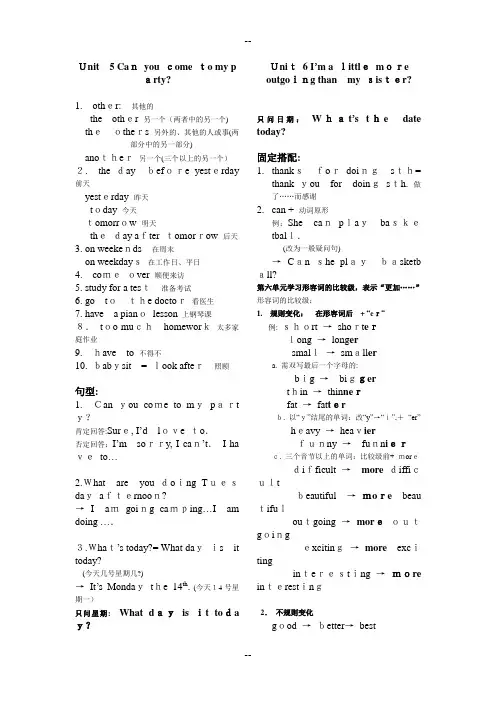
Unit 5 Canyou come to my party?Unit 6 I’m a littlemore outgoing than my sister?1.other:其他的the other 另一个(两者中的另一个)theothers 另外的、其他的人或事(两部分中的另一部分)another另一个(三个以上的另一个)2.the daybefore yesterday 前天yesterday 昨天today 今天tomorrow 明天theday after tomorrow 后天3. on weekends在周末on weekdays在工作日、平日4.comeover 顺便来访5. study for a test准备考试6. go tothe doctor看医生7. have a pianolesson上钢琴课8.too muchhomework太多家庭作业9.have to 不得不10. babysit= look after照顾句型:1.Can you come to mypart y?肯定回答:Sure, I’d love to.否定回答:I’m sorry, I can’t.I ha veto…2.What are you doing Tuesdayafternoon?→I amgoing camping…I am doing ….3.What’s today?= What dayis it today?(今天几号星期几?)→It’s Mondaythe 14th.(今天14号星期一)只问星期:What dayis it toda y?只问日期:What’s the date today?固定搭配:1.thanksfordoingsth=thank you for doingsth. 做了……而感谢2.can + 动词原形例:She canplaybasketball.(改为一般疑问句)→Can she playbasketb all?第六单元学习形容词的比较级,表示“更加……”形容词的比较级:1.规则变化:在形容词后+ “er”例: short →short erlong →long ersmall→small era. 需双写最后一个字母的:big →biggerthin →thin nerfat →fat terb. 以“y”结尾的单词:改“y”→“i”,+“er”heavy →heavierfunny →funn ierc. 三个音节以上的单词:比较级前+ moredifficult →more difficultbeautiful→more beau tifuloutgoing →moreoutgoingexciting→more excitinginteresting →more interesting2.不规则变化good →better→bestbad→worse→worst词汇:1.than比2. as 如同…一样the same as 与……一样as +形+ as:与……相比一样notas +形+ as与…相比不如…= not so + 形+as与…相比不如…3. both 两者都例:they both=bothofthem 他们两个4. have something in common 有共同点5. be goodatdoing sth=dowell in doing sth擅长于做…事句型:1.Tina isshorter than Tara.2.Tinais more athletic thanTara.3.She isa little more outgoingthanme.她比我更外向一点点。
Units1-5单元重要知识点汇总暑假预习2023-2024学年人教版八年级英语上册
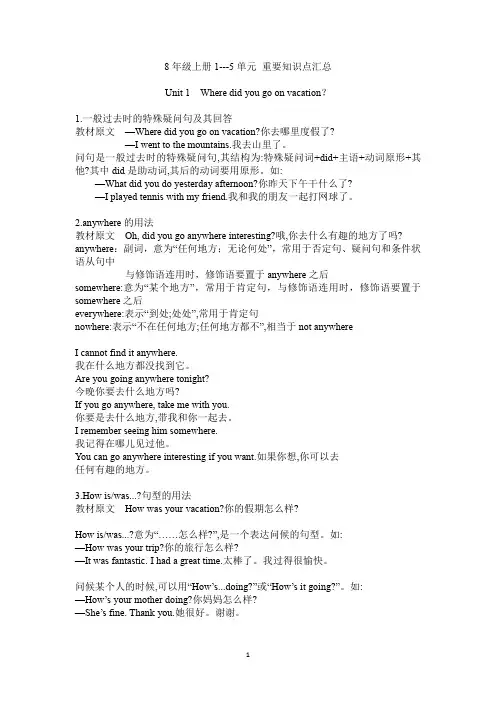
8年级上册1---5单元重要知识点汇总Unit 1 Where did you go on vacation?1.一般过去时的特殊疑问句及其回答教材原文—Where did you go on vacation?你去哪里度假了?—I went to the mountains.我去山里了。
问句是一般过去时的特殊疑问句,其结构为:特殊疑问词+did+主语+动词原形+其他?其中did是助动词,其后的动词要用原形。
如:—What did you do yesterday afternoon?你昨天下午干什么了?—I played tennis with my friend.我和我的朋友一起打网球了。
2.anywhere的用法教材原文Oh, did you go anywhere interesting?哦,你去什么有趣的地方了吗? anywhere:副词,意为“任何地方;无论何处”,常用于否定句、疑问句和条件状语从句中与修饰语连用时,修饰语要置于anywhere之后somewhere:意为“某个地方”,常用于肯定句,与修饰语连用时,修饰语要置于somewhere之后everywhere:表示“到处;处处”,常用于肯定句nowhere:表示“不在任何地方;任何地方都不”,相当于not anywhereI cannot find it anywhere.我在什么地方都没找到它。
Are you going anywhere tonight?今晚你要去什么地方吗?If you go anywhere, take me with you.你要是去什么地方,带我和你一起去。
I remember seeing him somewhere.我记得在哪儿见过他。
You can go anywhere interesting if you want.如果你想,你可以去任何有趣的地方。
3.How is/was...?句型的用法教材原文How was your vacation?你的假期怎么样?How is/was...?意为“……怎么样?”,是一个表达问候的句型。
初二(八年级)上册英语第五单元知识点
初二(八年级)上册英语第五单元知识点一、短语1. come to one's party 参加某人的聚会2. on Saturday afternoon 在星期六的下午3. I'd love to 我非常乐意4. I'm sorry 对不起5. study for a test为测验而学习6. go to the doctor 去看医生7. visit one's aunt 看望某人的姑姑8. have a piano lesson 上一堂钢琴课10. too much homework 太多家庭作业11. much too interesting 有趣得多12. maybe another time 也许下一次吧13.Thanks for asking(inviting)谢谢邀请14. go to the baseball game 参加棒球比赛15. Birthday Party 生日聚会16. go to the mall 去购物中心17. soccer practice 足球练习18. look for 寻找19. find out 找到,弄清楚,查明20. study for the math test 为数学考试而学习21. play tennis with me 和我一起打网球22. I have a really busy week 我一周很忙23. football match足球比赛24. my cousin's birthday party 我表弟的生日聚会25. write soon 尽快回信26. study for my science test 为科学考试而学习27. 给某人打电话的几种说法:call sb. up, call sb. phone sb., phone to sb. telephone sb. telephone to sb.phone sb. up,ring sb. give sb. a ring, give sb. a phonemake a telephone call to sb.28. on Thursday night 星期四晚上29. be (go) on vacation 度假30. next week下周31. join sb.加入某人一起32. Please keep quiet! 请保持安静, keep+形容词表示"保持某种状态",keep+(sb.)+doing 表示"(使某人)不停地做某事", keep sth. 保存某物34. culture club 文化俱乐部35. try to do sth. 努力(企图)做某事,try doing sth.试着做某事,try one' best to do sth. 尽力做某事二、☆重点归纳☆话题Decision making功能项目Talk about consequences词汇Jeans牛仔裤, organize组织, agent代理人, chance机会, charity慈善团体;慈善事业injured受伤的;受损害的,短语Let in让进来, take away拿走, make a living谋生, all the time一直, be able to能够句型1. --I think I’m going to…-- If you do, you’ll…2. -- I’m going to…-- So am I3. -- If I become…, I will…语法要点复习“一般将来时”I think I’ll ride my bike I think I’m going to stay at home学习“If引导的条件状语从句”If you do, you’ll be late. If you do, you’ll be sorry.三、☆典型试题☆例1Simon _______ to see his grandpa if he ________ free next week。
人教版八年级英语上第五单元知识点总结材料
人教版八年级英语上5单元Unit5. Do you want to a game show? 【重点短语】1. find out 查出/发现2. be ready to do 准备做…3. dress up 打扮/化妆成4. take one's place 代替某人5. do a good job 干的好/表演的出色6. think of 想到/思考7. game show 游戏节目8. learn from 向…...学习9. talk show 访谈节目10. soap opera 肥皂剧11. go on 继续12. watch a movie 看电影13. one of…其中之一14. try one’s best to =do one’s best to 竭尽全力15. a pair of 一双16. as famous as 一样闻名/出名17. look like 看起来像18. around the world 世界各地19. have a discussion about 讨论…...20. one day 有一天/某一天21. such as 例如22. a symbol of 一个象征/标志23. something enjoyable 快乐的事情24. interesting information 有趣的信息【重点句型】1. Some people might ask how this cartoon animal became so popular.有些人可能会问这个卡通动物怎样变得如此受欢迎了呢。
2. Mickey was like a common man, but he always tried to face any danger. Mickey. 象一个普通人,但是他总是努力面对任何危险。
3. Mickey was unlucky and had many problems such as losing his house or girlfriend.Mikey是不幸的,总是面对很多问题,如失去房子或女朋友等。
人教版新目标八年级英语上册第五单元大归纳(共12张PPT)
★动词不定式用法 (1)want, hope, decide, agree, choose, would like, plan, fail 等动词(短语)只能 用动词不定式作宾语。
I decide to go to the countryside on vacation.我决定去农村度假。
This time he wants to do something different. 这次他想做点不同的事情。
三、语法专项 动词不定式作宾语
★教材典句 1.I plan to watch Days of Our Past.
我打算观看《我们过去的日子》 2.Because I hope to find out what’s going on around the world.
因为我希望了解世界各地发生的事情。
I forget telling you that before. 我忘了以前告诉过你这事了。
We must remember to turn off the TV. 我们一定要记住关上电视。
I remembered sending you some stamps. 我记得给你邮寄了邮票了。
动词不定式用法 不定式,有标记,to与动词连一起;没有人 称数变化,动词特点它具备;
I find it difficult to learnБайду номын сангаасEnglish.
【拓展】
stop, forget, remember, try 等动词后面既 可以接动词不定式也可以接动名词形式,但 意义上有很大区别:stop to do sth. 表示 “停下来做某事”;stop doing sth.表示 “停止做某事。forget to do sth. 表示“忘 记做某事”(事情还没有做);forget doing sth.表示“忘记做过某事(事情做 了)”remember to do sth.表示“记住做 某事(事情还没有做)”。try to do sth. 设 法做某事;try doing sth.尝试做某事。
人教版八年级英语上第五单元知识点
Unit5 Do you want to watch a game show?1.show可数名词,意为(电视或广播的)节目。
a TV show一档电视节目拓展:1)常见短语:on show在展出,在展览中。
2)show vt. 出示,把…给(别人)看,常用结构,即:show sb. sth.或show sth. to sb. Please show me your English book. = Please show the English book to me.请将你的英语书展示给我。
2. mind vt.介意,反对。
其后可接名词、代词或动词-ing形式。
Do you mind taking care of my cat while I’m out?我外出期间你介意照顾我的猫吗?拓展:mind 还可作名词,意为思想;主意。
Do you want to change your mind? 你想改变你的主意吗?3. news 不可数名词,新闻。
a piece of news一条新闻The news makes the children excited. 这消息令孩子们很兴奋。
4.let使役动词,意为“让”,常用于let sb. do sth.句型,意为让某人做某事。
Let me help you with the housework. 让我帮助你做家务吧。
5. watch vt. 观看,注视。
6. 辨析:1)watch观看;注视;欣赏。
常用于看电视、看戏、看比赛及各种表演等。
2)see看见;看到。
强调“看”的结果,及物动词,后跟名词或代词作宾语。
3)read看;读。
常用于读书、看报、看杂志等。
4)look看;瞧。
强调“看”的动作,不及物动词,如有宾语必须与介词at连用。
7. learn from 向…学习。
该短语用于两种情况:learn from sb./sth.或learn sth. from sb./sth. She learned Chinese from a Chinese girl. 她跟着一个中国女孩学习中文。