
Unit9 sectionA重要知识点讲解课件人教版八年级英语下册
新课标人教版八年级英语下册Unit 9 Have you ever been to an amuse
word
1 / 12 Unit 9 Have you ever been to an amusement park?课文知识点解析
Section A
Talk about past experiences.
谈论过去的经历。
1.Have you ever been to an amusement park?
你曾到过游乐场吗?
(1)本句用现在完成时表示过去发生的事情对现在造成的影响或结果。
have been to 曾到过某地。例如:
I have been to Australia twice.
我曾到过澳大利亚两次。
(2)amusement park游乐场,游乐园
2.—Have you ever been to a water park?
你曾去过水上乐园吗?
—No,I haven’t.不,我没有。
—Neither have I.我也没去过。
Neither (Nor)+助动词/情态动词/be动词+主语,表示“……也没有……”。例如:
—I haven’t been to Sanya before.
我以前没去过某某。
—Neither has Tom./Nor has Tom.
汤姆也没去过。
—They can’t swim.
他们不会游泳。
—Neither can I.我也不会。
若前句是肯定句,用so+助动词/情态动词/be动词+主语。例如:
全析提示
ever常用在完成时态中,作为标志词,“曾经”的意思。
全析提示
这种结构要注意和so+主语+助动词/情态动词/be动词的区别。“……是这样”表示同意第一个人所说的情况。例如:
—I can’t find my ticket.
—Maybe it’s in your pocket.
—So it is.
要点点拨
the map of ... word
2 / 12 —I went to America last summer.
人教版英语八年级上册unit9canyoucometomypartysectiona知识点练习题
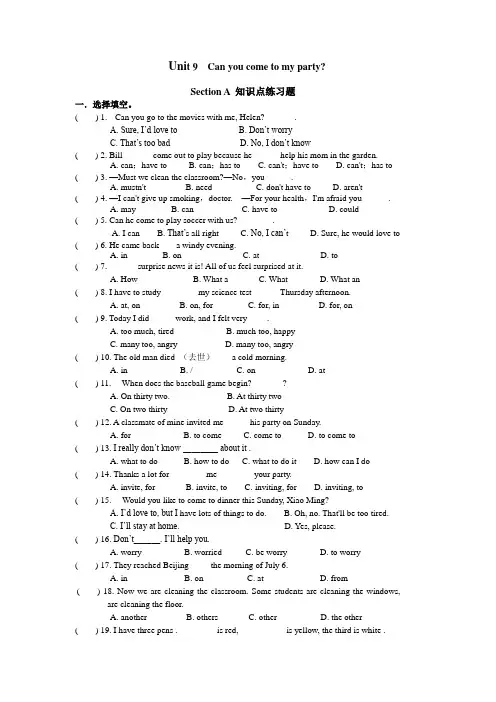
Unit 9 Can you come to my party?
Section A 知识点练习题
一.选择填空。
( ) 1. --Can you go to the movies with me, Helen? --_____.
A. Sure, I’d love to B. Don’t worry
C. That’s too bad D. No, I don’t know
( ) 2. Bill ______ come out to play because he ______help his mom in the garden.
A. can;have to B. can;has to C. can't;have to D. can't;has to
( ) 3. —Must we clean the classroom?—No,you______.
A. mustn't B. need C. don't have to D. aren't
( ) 4. —I can't give up smoking,doctor. —For your health,I'm afraid you______.
A. may B. can C. have to D. could
( ) 5. Can he come to play soccer with us?________.
A. I can B. That’s all right C. No, I can’t D. Sure, he would love to
( ) 6. He came back ___ a windy evening.
人教版英语八年级上册unit9sectiona知识点练习题答案

Unit 9 Can you come to my party?
Section A 知识点练习题答案
一.选择填空。
( A ) 1. --Can you go to the movies with me, Helen? --_____.
A. Sure, I’d love to B. Don’t worry
C. That’s too bad D. No, I don’t know
( D ) 2. Bill ______ come out to play because he ______help his mom in the garden.
A. can;have to B. can;has to C. can't;have to D. can't;has to
( C ) 3. —Must we clean the classroom?—No,you______.
A. mustn't B. need C. don't have to D. aren't
( C ) 4. —I can't give up smoking,doctor. —For your health,I'm afraid you______.
A. may B. can C. have to D. could
( D) 5. Can he come to play soccer with us?________.
A. I can B. That’s all right C. No, I can’t D. Sure, he would love to
( B ) 6. He came back ___ a windy evening.
英语人教版八年级下册Unit9_SectionA(3a-3c)
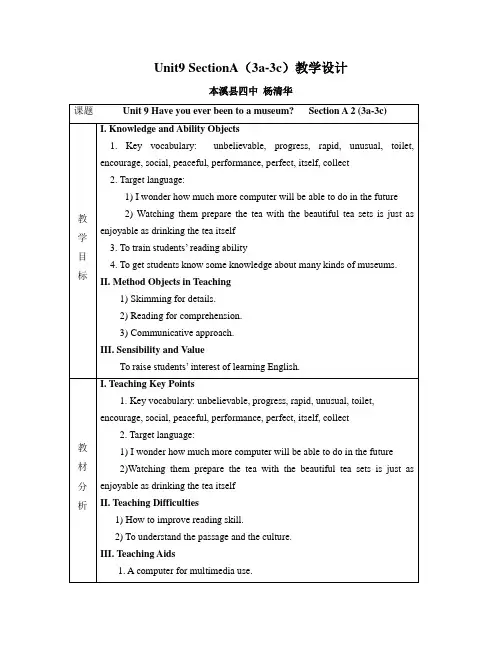
Unit9 SectionA(3a-3c)教学设计
本溪县四中 杨清华
课题 Unit 9 Have you ever been to a museum? Section A 2 (3a-3c)
教
学
目
标 I. Knowledge and Ability Objects
1. Key vocabulary: unbelievable, progress, rapid, unusual, toilet,
encourage, social, peaceful, performance, perfect, itself, collect
2. Target language:
1) I wonder how much more computer will be able to do in the future
2) Watching them prepare the tea with the beautiful tea sets is just as
enjoyable as drinking the tea itself
3. To train students’ reading ability
4. To get students know some knowledge about many kinds of museums.
II. Method Objects in Teaching
1) Skimming for details.
2) Reading for comprehension.
3) Communicative approach.
III. Sensibility and Value
To raise students’ interest of learning English.
教
材
分
析 I. Teaching Key Points
1. Key vocabulary: unbelievable, progress, rapid, unusual, toilet,
人教版英语八年级上册unit9sectiona知识点练习题答案 2
madeofdingshangtuwen
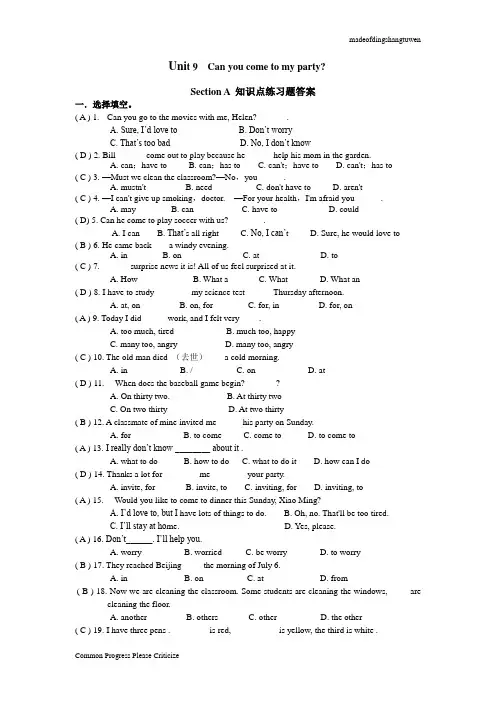
Common Progress Please Criticize Unit 9 Can you come to my party?
Section A 知识点练习题答案
一.选择填空。
( A ) 1. --Can you go to the movies with me, Helen? --_____.
A. Sure, I’d love to B. Don’t worry
C. That’s too bad D. No, I don’t know
( D ) 2. Bill ______ come out to play because he ______help his mom in the garden.
A. can;have to B. can;has to C. can't;have to D. can't;has to
( C ) 3. —Must we clean the classroom?—No,you______.
A. mustn't B. need C. don't have to D. aren't
( C ) 4. —I can't give up smoking,doctor. —For your health,I'm afraid you______.
A. may B. can C. have to D. could
( D) 5. Can he come to play soccer with us?________.
A. I can B. That’s all right C. No, I can’t D. Sure, he would love to
初中英语人教新目标八年级下册Unit 9 Section A预习指导(知识点+练习题)
八年级英语下册
Unit 9 Section A预习指导
一、知识点
1.现在完成时中already, yet, just, never, ever用法区别:
Already “已经”,通常用于陈述句中,位于助动词have/has的后面;也可用于疑问句中,表示期望得到肯定的回答或表示惊异。
Eg: She has already learned 5000 words.
她已经学习了5000个词。
Has she learned 5000 words already?
她已经学习了5000个词?
Yet “还”用于否定句中;也可用于疑问句中,译为“已经”,常常位于句末。
Eg: I haven’t found my watch yet.
我还没有找到我的表。
Have you found your watch yet?
你已经没有找到你的表吗?
Just “刚才”,只能用于陈述句中,位于助动词have/has后面。
Eg: I have just received a letter from Lisa.
我刚刚收到丽萨的来信。
Never “从不”,含有否定意义,位于助动词have/has后面
Eg: I have never been to Beijing.
我从没有去过北京。
Ever “曾经”,常用于疑问句中,位于助动词have/has后面
Eg: Have you ever been to Beijing?
你曾经去过北京吗?
2.Have/has been to + 地点 “去了某地回来了”
Have/has gone to + 地点 “去了某地没回来”
Have/has been in + 地点 “住在某地”
Eg: She has been to Beijing many times.
她去过北京许多次。
-- Where is Mr.Wang?
人教版英语八年级下册试题unit8sectiona知识点总结
Common Progress Please Criticize
金戈铁骑制作
主备人:齐沙沙 备课时间:2015.5 .6 授课时间:2015. 5 . 8 学科组长签字:
姓名: 班级:
课题:Unit 8 Have you read Treasure Island yet?(p+p)
学习目标(Objective): 1.Be able to read the words in SectionA correctly
2.Improve the skills of listening.
环节预设(Steps): 1.Leading- in 5’ 2.Reading 15’ 3.Discussion/ Presentation 15’
4.Listening 15’ 5.Exercise 10’
_______________________________________________________________________
读 学 积 累
1. treasure n. 珠宝,财富(不可数名词);珍藏品(可数名词)
Eg:①They went to there to look for treasure. 他们去那儿寻宝。
②This museum has many art treasures. 这家博物馆收藏了许多艺术珍品。
2.island n. 岛(可数名词)
Eg:an island 一个岛屿 Treasure Island 宝岛
3. classic n. 名著;经典著作(可数名词)
Eg: I like reading classics. 我喜欢阅读名著。
4. page n. 页(可数名词)
Eg: five pages 5页 on page 5 在第五页上
初中英语人教版八年级下册Unit9 SectionA(3a--3c)
人教版新目标初中八年级英语下册
Unit9 Have you ever been to a museum?
Section A(3a-3c)教学设计
梅州市大埔县华侨第二中学 刘俊波
一、教材分析
本节课的教学内容是人教版新目标八年级英语下册第9单元的第二课时,即Section A(3a-3c)。本单元围绕谈论好玩的地方开展多种教学活动,学会运用Have you ever been to …?这个句型来询问别人的经历,谈论曾经去过的地方。其语法项目主要是学习现在完成时态的用法。本节课是一堂阅读课,文章通过三个学生的分别叙述,呈现了三种不同特色的博物馆,并利用以前学习过的一般过去时态和前一节课学习的现在完成时态句型进行课文阅读,进一步加深对目标语言的理解和运用,提高学生阅读能力和综合语言运用能力,并为往后进一步学习过去完成时做一个良好的铺垫。
二、学情分析
该班为八年级学生,他们活泼,好奇心与求知欲望强。同时,经过该单元第一课时及本课的学案预习,他们已经对现在完成时、新词汇及博物馆相关话题有了初步了解,他们的语言学习热情也在逐步增加,为该课的学习做好了充足的语言准备。因此,通过本课的各种教学活动,帮助学生们更好地掌握重点词汇用法,引导学生们用英语介绍他们所搜集的相关博物馆的信息,鼓励每一位学生参与到课堂活动中去,使学生产生“跃跃欲试”的冲动,享受成功的喜悦。
三、 教学目标
1、知识目标
1) Learn&Use the new words: invent, progress, rapid, unbelievable,
unusual, encourage, improve, peaceful. 2) Learn&Use the new phrases:... as adj./adv.原级as... , in such a
rapid way, encourage sb. to do.
人教版八年级下册英语背记手册 Unit 9 Section A1
第1页 共3页 UNIT 9 Have you ever been to a museum?
Section A (1a-4c)
重点单词
1. camera n. 照相机 2.
unbelievable adj. 难以置信的
3. progress v. & n. 进步,进展 4. rapid adj.
迅速的,快速的
5. unusual adj. 特别的,不同寻常的 6. toilet n. 坐便器,厕所
7. encourage v. 鼓励 8. social adj. 社会的
9. peaceful adj. 和平的,安宁的 10. perfect adj.
完美的
11. itself pron. 它自己 12. collect v. 收集,采集
13. German adj. 德国的 n. 德国人,德语 14. ride n. 供乘骑的游乐设施,短途旅程
15. province n. 省份
词形变换
1. believe— believable (形容词)— unbelievable (反义词)
2. rapid— rapidly (副词)
3. usual— unusual (反义词)
4. courage— encourage (动词)— encouragement (名词)
第2页 共3页 5. social— socially (副词)— society (名词)
6. peace— peaceful (形容词)— peacefully (副词)
7. collect— collection (名词)
8. German— Germany (德国)
9. ride— rode (过去式)— ridden (过去分词)
10. it— its (物主代词)— itself (反身代词)
人教版八年级英语下册 Unit 9 Section A 3a-3c 教案
Unit 9 Have you ever been to a museum?
Section A 3a-3c 教案
课题 Section A 3a-3c 单元 Unit 9 Have you ever
been to a museum? 学科 英语 年级 八年级下
学习
目标 一、知识与能力
词汇:
invent,unbelievable.progress.rapid,unusual., toilet.encourage,social,peaceful,
tea art, performance,perfect,
tea set, itself, collect, a couple of, German,theme, ride,province
b. 能正确使用以下常用表达:have been to have gone to
c. 学会使用以下句型:
1)They have information about different computers and who invented them.
2) I have been to the American Computer Museum.
3) It’s unbelievable that technology has progressed in such a rapid way!
4) I’ve recently been to a very unusual museum in India.
5) It also encourages governments and social groups to think about ways to
improve toilets in the future.
6) Last year I went to the Hangzhou National Tea Museum.
2 、能力目标
通过阅读训练,培养学生的良好的阅读理解能力,同时使学生在理解文章的基础上对文章进行进一步的解读,以实现对学生进行有利的情感教育的目的。