
英语人教版八年级下册Unit9 SectionA(1a-2d)
英语人教版八年级下册Unit8 SectionA (1a-2c)
Unit8 Have you read Treasure Island yet? SectionA(1a-2c )教学设计
一、 教材分析
This lesson is the first period of Unit8 Book2 and mainly talks about classic books. It can help
students to know how to describe books that they have read and things that they have experienced.
二、 教学目标
1. knowledge aim
To learn and master some words and sentences: treasure, island, full of
Have you read...yet? No, I haven't./Yes, I have already read it.
What's it like?---It's fantastic.
----What’s it about?---It’s about four sisters growing up.
and Six classics: Alice in Wonderland,Treasure Island,Little Women, Oliver Twist,Robinson Crusoe,Tom Sawyer
2. Ability aim
To be able to talk about and describe books they have read.
To improve their abilities of listening,speaking,reading and writing.
3. Emotion aim
To be able to have more motivation to read books.
英语人教版八年级下册Unit9 Section A 1a—2d
新目标英语八年级下Unit 9 Have you ever been to an musemant park?教学设计
一、教材内容及分析
本单元的目标是运用句型"Have you ever been to...?和I've never been to..’,谈论现在完成时态。本单元的所有活动以“谈论过去的经历”为话题逐一展开。本单元教学分为A,B两部分。A部分使学生积极参加各项学习活动,B部分则巩固学习效果。还应当与文化背景知识的学习与能力训练的有关练习结合起来,使学生能逐步地掌握知识. Section A la-2c首先以图片的形式呈现了本单元的重点语法现象现在完成时的用法,然后设计了听力活动、俩俩对话活动,从听说角度训练了本单元的核心句型,并在Grammar Focus中进行了归纳总结。
Section A 3a-4所设计的活动,则先通过一篇任务型阅读----你曾经去过迪斯尼乐园吗?让学生进一步熟悉这一新的语言现象,再通过两个俩俩结对活动,分别从半开放性的和完全开放性的话题入手,进一步发展学生的听、说技能。Section B la-2b先通过对英语学习目的关注,呈现了听力活动中所要用到的词汇及句子。然后,设计了两个听力活动,分别从两个层面,从宏观到细节,帮助学生掌握如何运用现在完成时谈论过去的经历,从而进一步学习现在完成时的意义、结构和用法.2c-4设计的活动,则通过说、读与写的活动,对学生运用各种时态谈论过去的经历进行了综合训练,旨在帮助学生创造性地运用现在完成时的能力。Sell Check部分让学生通过活动1-3对自己的词汇运用能力及语言综合运用能力进行自我评价·
本单元的阅读材料向我们介绍了东南亚一个漂亮的岛国一新加坡·新加坡是个以旅游闻名的国家,素有“花园城市”的美称,它以干净优雅的环境、多样的饮食文化吸引着全世界旅游观光的人们。又因为那里有众多的华人,所以新加坡也成为中国游客的热门选择.
初中英语人教版八年级下册Unit9 SectionA(1a-2d)
Unit9 Section A(1a-2d)教学设计
课题 Unit 9 Have you ever been to a museum? Section A 1 (1a-2d)
教
学
目
标 1. Knowledge and Ability Objects
(1) Key vocabulary: amusement; neither
(2) Listening practice.
(3) Target language:
1. Lets' go somewhere different today.
2. Have you ever been to…? Yes, I have./ No, I haven’t.
3. How about/what about…?
4. How are we going to get there?
5. We can take the subway/…
(4) To train students’ listening and speaking skills.
2. Method Objects in Teaching
(1) Scene teaching method.
(2) Listening and speaking methods.
(3) Pair work.
3. Sensibility and Value
To be interested in taking part in all kinds of activities in English class.
教学重难点 1. Teaching Key Points
1. Key vocabulary in this period.
2. Target language in this period.
2. Teaching Difficulty
Make conversations freely using the target language.
人教版八年级英语上册unit 9 section a 1a-2c学案
Unit 9
Section A 1a---2c
一、学习目标:
1、掌握P53-54单词
2、学会对多长提问(howlong)和对时间提问(when)的用法,When was he/she born? He/She was born …..
How long did he hiccup ? He hiccupped for 69 years.
二、预习目标:自己学会单词,写出下列单词的过去式play start
Do stop hiccup(现在分词)
三、预习检测:
写出词组:
一位很棒的乒乓球运动员 国际体育明星 在1976年
四、导学:停止做某事stop doing sth , stop to do sth停下来去做某事
五、课堂检测:
I翻译短语
1. 世界纪录___________ 2. 开始打嗝___________ 3. 篮球运动员__________
4. 一位中国运动员_____________ 5. 他哪一年出生?_________________
6.他打嗝打了多长时间? 69年零5个月_____________________________________.
II单项选择:
1. When ______ Deng Yaping born? In 1973.
A. is B. was C.were D.am
2. He started sneezing _____ January 13. 1981.
A. in B. on C. of D. at
3. ___ did Charles hiccup? About 69 years and 5 months.
A. Hong long B. How old C. How many D. How much
英语人教版八年级下册unit1 sectionA(1a-2d)
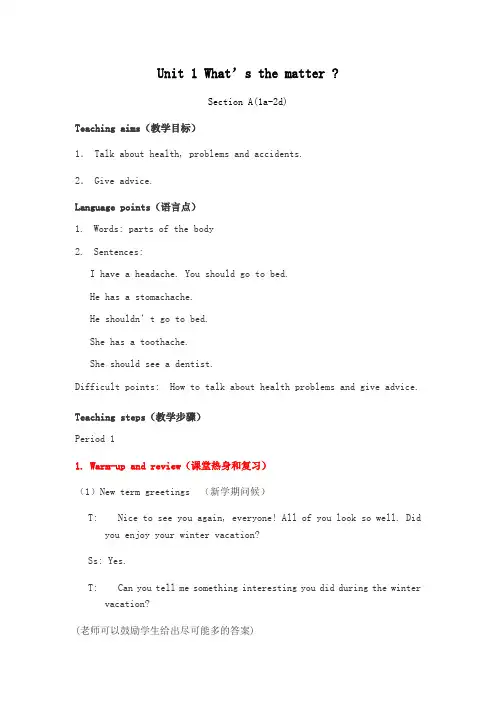
Unit 1 What’s the matter ?
Section A(1a-2d)
Teaching aims(教学目标)
1. Talk about health, problems and accidents.
2. Give advice.
Language points(语言点)
1. Words: parts of the body
2. Sentences:
I have a headache. You should go to bed.
He has a stomachache.
He shouldn’t go to bed.
She has a toothache.
She should see a dentist.
Difficult points: How to talk about health problems and give advice.
Teaching steps(教学步骤)
Period 1
1. Warm-up and review(课堂热身和复习)
(1)New term greetings (新学期问候)
T: Nice to see you again, everyone! All of you look so well. Did
you enjoy your winter vacation?
Ss: Yes.
T: Can you tell me something interesting you did during the winter
vacation?
(老师可以鼓励学生给出尽可能多的答案) T: Oh. What an interesting vacation! I am sure you enjoyed
yourselves very much, but
I was ill during the holiday. Today, we’ll talk about
人教版八年级下册英语Unit 1 SectionA(1a-2d)练习(包含答案)

Unit 1 What’s the matter?
Section A(1a-2d)
一、根据句意首字母或汉语提示完成单词。
1. His temperature is 39C, so he has a f________.
2. I'm very tired. I want to have a r________ for a while.
3. My sister h________ herself while she was running yesterday morning.
4. Tom has a cold. He is c________ a lot all the time.
5. Jack never brushes his teeth before going to bed. He had a t________
again this morning.
二、用所给单词的适当形式填空。
1.He has a ________ (head). He should go to bed early.
2.I cut________ (me).And my mother is helping me put some medicine
on it.
3. When I walked past the park, I saw a big black cat________(lie) under
the tree.
4. Mrs Brown left the classroom without ________( say ) a word.
5.You watch TV all the time.You should ________(go)out and relax.
三、根据汉语意思完成句子。
1.如果你想保护眼睛,你需要远离你的智能手机。
If you want to protect your eyes, you need_________ ________
人教版英语八年级下册第一单元导学案(section A 1a-2d)
人教版英语八年级下册第一单元导学案
温馨提示:此资料包含人教版八年级英语第一单元的导学案,按照课本顺序梳理,内容齐全、总结到位、思路清晰,是教师备课的助手,更是学生自主学习英语的必备资料!
欢迎下载、分享!
Unit1 What’s the matter? Section A (1a—2d)
学习目标:
1、能够正确描述表示身体各部位的名称。
2、学会表达各种身体不适、讨论健康问题,提出合理的建议。
预习导学:
1a 单词过关(写出这些单词的汉语意思)
arm_______ back______ ear______ eyes______ foot_______
hand_______ head______ leg_____ mouth_______ neck______
nose______ stomach_______ tooth_______
单词过关升级:根据汉语提示默写英文单词
手臂_____ 后背_____ 耳朵______ 眼睛______ 脚_____ ______(复数)
手_____ 头______ 腿_____ 嘴______ 脖子______ 鼻子________
胃_________ 牙齿_______ ________(复数)
1c 关于身体不适的表达
表达某人身体不舒服(生病),一般用动词have,表示患病,其形式随人称和时间发生变化,有has和had 等形式。一般用结构:
(1)have a + sore +身体部位,例如:have a sore throat(咽喉疼痛),have
a sore _______(背痛),have a sore _______(腿疼)等等。另外,have a fever表示“发烧”,have a cold 表示“感冒”。
(2)have a + 身体部位ache,例如:have a stomachache(胃疼),have a
人教版八年级英语下册教案Unit 9 Have you ever been to a museum.
人教版八年级英语下册教案Unit 9
Have you ever been to a museum.
1 / 13 Unit 9 Have you ever been to a museum?
Language Goals
【语言目标】 Learn to talk about past experiences.
Knowledge Goals
【知识目标】
Key Words somewhere,camera,invention,invent,unbelievable,progress,rapid,unusual,toilet,social,peaceful,perfect,itself,collect,German,province,safe,simply,fear,whether,Indian,Japanese,fox,whenever,spring
Key Phrases encourage sb.to do sth.,on the one hand… on the other
hand,thousands of,a couple of,all year round
Key Sentences 1.—Have you ever been to a science museum?
—Yes,I have.I went to the National Science Museum last
year.
2.—I have never been camping.—Me neither.
3.It also encourages governments and social groups to
think about ways to improve toilets in the future.
4.—I have been to the art museum many times.
—Me,too.And I have also visited the nature museum.
人教版初中八年级英语下册第九单元Unit 9 教案含教学反思
1
Section A 单词 camera n.照相机;摄影机;摄像机
unbelievable adj.难以置信的;不真实的
progress v.& n.进步;进展 rapid adj.迅速的;快速的
unusual adj.特别的;不寻常的 toilet n.坐便器;厕所
encourage v.鼓励 social adj.社会的
peaceful adj.和平的;安宁的
perfect adj.完美的;完全的
itself pron.它自己 collect v.收集;采集
German adj.德国的;德语的;德国人的 n.德语;德国人
ride n.供乘骑的游乐设施;短途旅程 province n.省份
amusement n.娱乐;游戏
somewhere adv.在某处;到某处
invention n.发明;发明物 invent v.发明;创造
performance n.表演;演出 theme n.主题
短语 amusement park游乐场 lead to导致
put up搭起 think about考虑
make tea沏茶 tea art 茶艺
tea set茶具 2 a couple of两个;一对;几个
take a ride兜风
句型 1.—Have you ever been to a science museum? 你曾去过科学博物馆吗?
—Yes,I’ve been to a science museum./ No,I’ve never been to a
science museum.是的,我去过科学博物馆。/ 不,我从来没有去过科学博物馆。
初中英语人教版八年级下册Unit 9 Have you ever been to a
Unit 9 Have you ever been to a museum?
Section A 1 (1a-2d)
1. Knowledge and Ability Objects
(1) Key vocabulary: amusement; neither
(2) Listening practice.
(3) Target language:
1. Lets' go somewhere different today.
2. Have you ever been to…? Yes, I have./ No, I haven’t.
3. How about/what about…?
4. How are we going to get there?
5. We can take the subway/…
(4) To train students’ listening and speaking skills.
2. Method Objects in Teaching
(1) Scene teaching method.
(2) Listening and speaking methods.
(3) Pair work.
3. Sensibility and Value
To be interested in taking part in all kinds of activities in English class.
4.Teaching Key Points
1. Key vocabulary in this period.
2. Target language in this period.
2. Teaching Difficulty
Teaching Procedures
Step 1 Greetings and Revision
Greet the class and check the homework.