
新人教版六年级上册英语Unit6 B Read and write
PEP英语六年级上册unit 6 Read and write
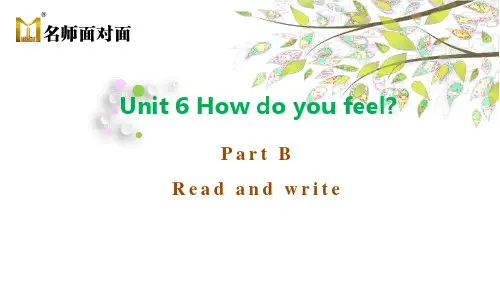
It is a sunny mRoobrnininisg.going to sit on the grass.
Don’t worry , little ant. I won’t sit on you !
Wait! Please don’t sit on me . One day I can help you .
What does the story tell us ?
A. We should always be nice to each other. B. We shouldn’t hurt ants.
T How do you feel?
Part B Read and write
How do you feel?
sad
happy
angry
tired
shy
afraid
Read and draw
Draw faces for each word.
What’s the ant like?
What’s Robin like?
It is a little ant. He is afraid.
“Please don‘t sit on me.
2.What is Robin going to
One day I can help you." do?
“Don‘t worry, little ant. I 3.How does the ant feel?
How do they feel ?
It is a sunny morning.
Robin is going to sit on the grass when he hears “Wait!”
人教pep版六年级上册英语同步课件Unit 6 课时5:Read and write
听力原文
2. Robin: Are you OK? Yifan? Wu Yifan: No, I feel ill. Robin: Oh, dear! Do you have a headache? Wu Yifan: Yes, I do. Robin: Mmm. You should see a doctor.
听力原文
3. Sarah: Oliver, what’s wrong? Oliver: I’m so angry. Sarah: Oh! You should count to ten. Why are you angry? Oliver: Someone took my sunglasses. Sarah: No, they are on your head. Oliver: Oh, yes. Haha!
— _Y_o_u__sh_o_u_l_d_d_o__m_o_r_e__ex_e_r_c_is_e_.____
2. —It’s so cold outside. — Y__o_u_s_h_o_u_ld__w_e_a_r_w__a_rm__c_l_o_th_e_s_.___
课堂导入
聪明的你闯过了几关呢?
A. hear
B. k
Tips for pronunciation
播放音频
Let's talk
知识讲解
知识点 3 爆破音 /t/
爆破音/t/的发音过程可以分为两个步骤: 第一步是舌尖抵上齿龈在口腔形成阻碍;第二步是气流
冲破阻碍发出声音,这叫做爆破。但是,当/t/接连出现两次 或是其他爆破音/p/,/b/,/d/,/k/,/g/之中的任何一个紧接着 /t/出现时,前面的/t/只形成阻碍,不爆破,即不发音。这种只 有阻碍的形成而无爆破的现象被称为失去爆破现象。
PEP版六年级英语上册教学课件unit 6 Read and write

What does the story tell us ?
A. We should always be nice to each other. B. We shouldn’t hurt ants.
Unit 6 How do you feel?
Part B Read and write
How do you feel?
sad
happy
angry
tired
shy
afraid
Read and draw
Draw faces for each word.
What’s the ant like?
What’s Robin like?
a little ant
The next day, it is raining. Robin is in the park.
Robin is stuck in the mud.
陷住、无法移动 泥巴
mud 泥巴
It is the ant and all of his friends. Let us help you .
won't sit on you,says Robin.
It is a sunny mRoobrnininisg.going to sit on the grass.
Don’t worry , little ant. I won’t sit on you !
Wait! Please don’t sit on me . One day I can help you .
is happy.
Retell the story
It is a _s_u_n_n_y morning. Robin is going to s_i_t o_n_ _th_e_ _g_ra_s_s. But he hears _a_ _li_tt_le_ _a_n_t ask him not to sit. The little ant is _a_f_ra_i_d . Robin doesn't sit. The next day, it is _r_a_in_y_. Robin is _s_t_u_c_k in the _m__u_dand he is __w_o_r_r_ie_d_. The little ant and _a_ll_ _o_f _h_is_ _f_ri_e_n_d_s_ help Robin. They are strong. They _p_u_ll him _o_u_t _o_f the mud. Everyone is _h_a_p_p_y_.
六年级上册英语教案Unit6第五课时PartBReadandwritePEP的教学目标与任务
Unit 6 第五课时 Part B Read and write 的教学目标是让学生能够理解和运用日常生活中的英语对话,学习正确使用过去式,提高语言技能的同时增进对英语的兴趣。
针对这一目标,我们需要完成以下教学任务:
1. 听读课文
我们需要带领学生一起听读课文。
理解完整的对话内容,学生才能更好地运用所学知识与技能进行交流。
2. 学习课文中的语言点
我们需要向学生介绍课文所涉及到的语言点。
这包括准确使用过去式、正确使用情态动词“can” 等。
我们可以通过练习对课文中涉及的语言点进行反复强化。
例如,我们可以让学生阅读一些类似的对话,并在其中找出所学语言点的使用。
3. 学习相关生词和短语
在教学过程中,我们需要向学生介绍一些相关的生词和短语。
这些词汇是学生在日后阅读和写作时必需了解的基础。
学生需要通过浏览字典和练习来记忆这些生词和短语。
4. 阅读理解和写作练习
我们需要让学生进行阅读理解和写作练习,帮助他们更好地掌握所学语言点。
我们可以为学生提供一些练习题并鼓励他们使用课文中的语言点进行写作。
Unit 6 第五课时 Part B Read and write 的教学目标是让学生能够理解和运用日常生活中的英语对话,学习正确使用过去式,提高语言技能的同时增进对英语的兴趣。
我们需要通过多方面的教学方式,包括听读课文、学习语言点、学习相关生词和短语、阅读理解和写作练习等,让学生更好地理解和掌握所学内容,并提高英语技能。
人教版小学英语(六年级上册)Unit1-6 Let's talk Read and write
Let's talk(1)罗宾,博物馆商店在哪儿?我想去买一张明信片。
在门的旁边。
谢谢。
邮局在哪?我想今天就把它寄出去。
我不知道。
我去问问。
打扰一下,先生。
哇!一个会说话的机器人!多么棒的博物馆啊!邮局在哪儿?在博物馆旁边。
谢谢。
Let's talk(2)多么有趣的电影!是的,但是现在我饿了。
我知道一家非常棒的意大利餐厅。
我喜欢吃披萨!餐厅在哪儿?它在公园附近的东方街上。
我们怎么去那儿?在书店左转。
然后在医院右转。
好的。
我们出发!Read and write罗宾有导航功能!吴一凡的祖父给了罗宾一个新的功能。
现在它有了导航功能。
他现在能够帮助男孩们找到意大利餐厅。
我们现在在电影院的前面。
直走,然后在书店那里左转。
请跟我走!远吗?不远。
我们现在在医院的后面。
现在我们右转,然后再右转一次。
餐厅在那儿!我的新导航功能起作用了!是的!我会去告诉祖父。
但是让我们先吃饭吧。
我太饿了!Let's talk(1)早上好,史密斯老师!你们好,孩子们。
你们今天来得很早。
你们怎么来学校的?通常我走路来。
有时我也会坐公交车来。
我通常骑自行车来。
你怎么来学校,史密斯老师?开车?有时会,但是我通常走路来。
那是个很好的锻炼方式。
麦克、艾米和史密斯老师怎么来学校的?Let's talk(2)约翰先生,我怎么去复兴医院?去那边乘57路公交车。
谢谢。
哇!这么多自行车照片!这些照片来自我在美国的表弟。
这是什么?一个头盔。
在美国,骑自行车的人必须带(头盔)。
我知道了。
哦,公交车来了!再见,约翰先生。
嗨,别闯红灯!哦,对!谢谢。
我必须注意交通信号灯!关于骑自行车你从对话中学到了什么?Read and write不同的去学校的方法在德国慕尼黑,一些孩子走路去学校。
在美国阿拉斯加,天经常下雪。
一些孩子乘雪橇去学校。
特别快。
在中国江西,一些孩子每天摆渡去学校。
在苏格兰帕帕韦斯特雷岛,孩子们也是摆渡去学校。
但是在2009年,他们开始乘飞机去学校,因为渡船已经不工作了。
英语人教版六年级上册unit6 read and write
Unit 6 How do you feel?Part B Read and write一、教学目标1. 通过表情图复习表达情绪的单词。
2. 能够通过阅读训练在语篇中捕捉不同类型的信息,提炼出文章的主旨大意,完成排序题。
3. 能够根据阅读所获取的信息完成故事缩写活动并能口头复述。
4. 能够根据例句提示在文段中找到更多同类现象,能够正确朗读句子和语篇二、学情分析本课参与学习的为六年级学生。
六年级学生活泼可爱,思维活跃,大部分从三年级开始正式接触英语学习,已经有了三年半的英语学习基础,积累了一定的词汇量,其中就有与本课相关的行为动词。
并且大部分同学已经培养了一定的语感基础,对英语学习有初步的信心和兴趣。
因此,在了解了学生的学习心理和知识基础的情况下,进行有趣高效的教学设计,一定会有精彩的呈现,给学生愉快的学习体验。
三、重点难点Key points:1. 能够通过阅读训练在语篇中捕捉不同类型的信息,提炼出文章的主旨大意,完成排序题。
2. 能够根据阅读所获取的信息完成故事缩写活动并能口头复述。
3. 能够根据例句提示在文段中找到更多同类现象,能够正确朗读句子和语篇Difficult point:能够根据阅读所获取的信息完成故事缩写活动并能口头复述。
四、教学过程(1)、warm upGreet and group students.(设计意图:让学生尽快融入到英语学习的环境,并鼓励孩子多思考,多发言。
)(2)、lead in the topic1. Let’enjoy a song together(The way I feel).2. show some pictures, review the verbs:afraid angry Sad happy.Teacher ask :How do you feel?Students look and talk:When I________,I feel angry \ sad \ afraid \ happy.(设计意图:歌唱孩子们喜爱的歌曲,能让孩子快速进入课堂氛围,并且图片的展示也是为巩固旧知识为下一步新知识的学习做铺垫。
PEP人教版六年级英语上册《Unit6__B__Read__and__write课堂训练》(附答案)
Unit 6 B Read and write课堂训练一、将下列词语分类。
shirt angry rainy cloudy red dressgreen worried snowy sad jacket yellow1. 天气_______________________________________2. 感觉_______________________________________3. 服装_______________________________________4. 颜色_______________________________________二、单项选择。
( ) 1. Mike is________to see a doctor.A. goB. goesC. Going( ) 2. I want to sit________the grass.A. inB. atC. on( ) 3. He is stuck________the mud.A. inB. atC. on( ) 4. Everyone____________happy.A. areB. isC. am( ) 5. They pull Robin out____________the mud.A. ofB. withC. in三、阅读理解,判断文后句子的正(T)误(F)。
It’s Sunday afternoon. The weather is fine. There is a football match between class 2 and class 4. Many students are watching. They’re happy.Now Zhang Peng has the ball. He passes it to Wu Yifan. But Wu Yifan can’t kick the ball. Then John has the ball. He kicks it.Now the ball flies into Zhang Peng’s arm. Zhang Peng is very angry. But the ball flies into the gate. It’s a goal. How does Zhang Peng feel now? Yes! He is so happy!Hooray! Class 4 won the game. Class 2 is very sad.( ) 1. There is a basketball match on S unday afternoon.( ) 2. Wu Yifan can’t kick the ball.( ) 3. Zhang Peng is happy when the ball flies into his arm.( ) 4. Zhang Peng is happy when the ball flies into the gate. ( ) 5. Class 2 is not sad in the encl.Unit 6 B Read and write课堂训练参考答案一、1. rainy cloudy snowy2. angry worried sad3. shirt dress jacket4. red green yellow二、1. C2. C3. A4. A5. A三、1. F2. T3. F4. T5. F。
英语人教版六年级上册Unit6 Read and write
教学设计Unit 6 How do you feel ?Part B Read and write Robin and the ant1. 教材分析这节课通过学习robin 和the ant 的故事,让学生学习和运用本单元的句型和词汇,并教育学生“我们应该总是善待彼此。
”这符合我们六年级应达到新课标的二级语言知识及情感教育的要求。
我坚持教师为主导,以学生为主体,让学生在课堂始终能积极参与活动,积极动脑,让学生在学中用、用中学。
2. 学情分析这个单元的教学内容与学生的实际生活密切相关,所学的语言项目和词组对学生来说有一定难度。
教学时,我注意易难结合,让每个学生都有练习机会,教学面向全体学生,注意照顾本班的一些后进生,使一些平时学习有困难的学生能基本掌握新内容。
在教学过程中我注意创新教法,创设情景,让学生有意识地在生活中运用语言。
由于学习的内容和“感觉”有关,我还利用了全身反应法帮助学生感受语言知识的运用,理解语言。
3. 教学目标(含重、难点)教学目标:1、知识目标:(1)学生能听、说、读、写本课时的重点单词:sit,grass,hear,ant,worry,stuck,mud,pull,everyone. (2)学生能读懂“read and write”部分的故事短文。
(3)学生能完成故事短文后的习题,培养学生的阅读技巧和阅读乐趣。
2、能力目标:(1)学生能听、说、读、写本课时的重点单词:sit,grass,hear,ant,worry,stuck,mud,pull,everyone. (2)学生能读懂“read and write”部分的故事短文。
(3)学生能用自己的英语复述故事“robin and the ant”。
3、情感目标:(1)通过这个故事学习,学生能运用一些关心他人的建议,如:don′t worry. let us help you . (2)学生学习和运用本单元的句型和词汇,能懂得“we should always be nice to each other.”的道理。
小学英语人教PEP新版六年级上册Unit 6-上课用ROBIN
“Don’t worry, little ant. I won’t sit on you,” says Robin.
The next day, it is raining. Robin is in the park. He is stuck in the mud. He is worried.
ill
sorry
good
cold
4
6
Look and guess
Skim and find out P62 快速浏览,找出故事的时间和地点
RLeoaodkagaanindasnady order 再次阅读,给图片排序 Tips
用“—”划出 关键句。
3
2
1
4
Read again and order 再次阅读,给图片排序
cold
Retell the story
WORTRhIEeDaHntAS12i.s.1PIR:LA_PeLacN_tYftYae_rrol_laruat_itdth_oteSr_hAs.etDosAtrFoyRr复yA述表ID故A演N事故G事REYXCITED
(旁白)
BORED
MRADobHinUiNsGSs2Rtu:YcRkobaiTnnIdRE_D_w_o_r_TrH_iIeR_dS_TY_.
MADLeabharlann TIRED THIRSTY
TNShLoeEwEaPenYvtseHrabUyraoeNdnGsetRro_iYsn_ghgs_.aou_pTorp_pdhy_reiys. e_pmd_uu_lld_RiSl_lCo_AbR_iEn_D_o_uws_wteol_olar_rfrym_th_e_.
六年级上册PEP英语第六单元Unit6第5课时B Read and write含朗读音频
Unit 6 How do you feel?
Part B Read and write
Revision
How do you feel?
sad
happy
afraid
worried
angry
sad
happy
afraid
worried
angry
Look and draw the face.
Q3: What does the little ant say?
It is a sunny morning. Robin is going to sit on the grass when he hears, “Wait!” It is a little ant. He is afraid. “Please don’t sit on me. One day I can help you.” “Don’t worry, little ant. I won’t sit on you,” says Robin.
Who are they?
Robin and the Ant
Which is right? A. It's a big ant. B. It's a little ant.
Where are they?
On the grass.
grass
How's the weather? It's sunny.
Q2: How does the little ant feel?
It is a sunny morning. Robin is going to sit on the grass when he hears, “Wait!” It is a little ant. He is afraid. “Please don’t sit on me. One day I can help you.” “Don’t worry, little ant. I won’t sit on you,” says Robin.