
牛津版英语四年级下册课件4B module3 unit1
The … is … The … are ….
1.Where is the aeroplane? 2. What colour is it? 3. Where can you see the temple? 4. Is the tree near the bench?
Ask and answer in pairs Where is /are the …?
Unit 1 Colours and places
Look and read
between /bi`twi:n/
at the top of
above
/ `b∧v/
Fill in the blanks at the top of
table between
above
behind bench
on
Read and answer
Hello, I’m Sally. This is my room. It’s not big, but it has a big window. On the left, there is a small desk and a chair. Beside the desk, there is a sofa. In front of the sofa, there is a cupboard. A big TV is on the cupboard. I like to watch TV. Behind the sofa, there is a lamp. It’s blue. There are two book-shelves in the room. They are on the right. Near the book-shelves, there is a small tree. There is a star at the top of the tree. They are from my parents and my grandma. There is no bed in my room. I sleep on the sofa every night. It’s soft and warm.
What do you think of this room?
Homework for today Draw and introduce your room.
temple /’templ /
Jingan TeБайду номын сангаасple Longhua Temple
bench /bentſ/
Goodbye!
1. The room is big and beautiful. F 2. I can see a sofa beside the desk. T 3. There is a book-shelf in the room. F 4. In the cupboard, there is a big TV. F 5. A blue lamp is behind the sofa. T 6. Sally has got a big bed in her room. F
牛津上海版(一起)四年级下册英语 Module 3 Unit 1 Sounds 第4课时 (共29张PPT)
4BM3U1 Sounds
Learn the sound
/ɛə/ are ear square bear
air
hair
Read a story
The old tortoise and the little bird
• Watch the flash(不要出现文字,观赏整则 故事) • 建议:可以带着2-3个问题聆听。在回答问题 的过程中推出具体的语段学习。
• 分角色或分段落进行朗读与反馈 • 进一步讨论,故事的结尾该如何?进行大 胆想象并表现。 • 总结:声音的重要性,学会分享。
Homework
1.Listen and read ‘Learn the sound’ on page 36 and ‘Read a story’ on page 35
2.Try to read the story ‘The old tortoise and
the little bird’. 3. Make a new ending
It’s my pond.
The old tortoise likes the pond very much. It says:________________________.
• 形成故事的第一段文本,进行朗读训练
bird Hello. I’m a little ________. I’m coming!
Sing, sing, Sing some songs. The little bird always Sing some songs.
• 形成第2段文本,要求学生进行朗读训练。or crying? It’s too loud. I don’t like it.
牛津版英语四年级下册教案 4B Module3 Unit1(1)
Module 3 Things around usUnit 1 Colours and placesPeriod OneLook and readTeaching aims:To learn the new words: afternoon, eveningUsing prepositions to indicate time and position.(e.g. in spring, in the afternoon, on a rock)Using adjective to describe colour. (e.g. It is red in the evening.)Emotion aims:培养学生热爱大自然,热爱我们生存的地球。
Teaching Process:Step One: Warming-up1、Sing a song2.Daily talkS1:How many seasons are there in the year? S2:There are four.S1:What season is it now? S2:It’s summer.S1:Which season do you like best? S3:I like …Step Two: Revision1. Review the words of colours2.Describe the picturesStep Three: Presentation1.(Show two pictures of the same tree at the different time)Learn Picture 1a & 1bAsk “What’s this?” to elicit “It’s a tree.”Ask “What colour are the leaves?” to elicit “They’re green/brown/yellow.”As you know, there are four seasons in a year. The leaves have different coulours when the season changes. Prompt the students to come to a conclusion: the leaves are green in spring. They’re brown and yellow in autumn.Read the two sentences:1a The leaves are green in spring.1b They are brown and yellow in autumn.2.Learn Picture 2a & 2ba.Learn the new words: afternoon, eveningb.Why the sun has different colours?Ask students to think of some animals that can change their colour. Discuss with the students why they change their colour.(e.g. Some animals want to protect themselves.)Ask students what else things in the natural world can change their colour.Step Four: Consolidation1.Listen to the tape and read after it together.2. Grammar Practice Book 4B, page 283. Do an experiment for the students: First take out some paints and a bowl. And put somered paint in a bowl. Then add some green paint. After that mix these colours. Let students guess what colour it is now. Then show them the bowl.4.Ask students to finish the exercises at the bottom of Page 32 of the Students’ Book.5.Do the experiment in groups of 4 or 5. then check the answer if their guesses werecorrect.Step Five: Assignment1.Listen to the tape and read the text for several times2.Copy the new words and the sentences.3.Do the experiment with the parents.。
四年级英语牛津版4BUnit3What’syourjo

四年级英语牛津版4B Unit3 What’s your job?导学案单词waiter waitress单词a driver单词Their What are their jobs?(One.)what’s his job?(a waiter.) 一位男服务员8、小组内讨论答案。
9、(Ppt6呈现男服务员图片)What’s this in English?A waiter. (带读2遍,拼读1遍)学习:a waitress一位女服务员10、跟随Liu Tao一起来和Jack对话。
请听课文动画跟读。
(Ppt7播放前3幅图的动画,暂停跟读)11教师: Our new friend Jack is a waiter. How about his friends? (PPT8呈现Jack和另两个机器人的图片)Jack的朋友们也是男服务员吗?如果不是,他们的职业又是什么呢?Le t’s go on watching. 我们继续跟随LiuTao去看看吧。
(Ppt8播放4、5幅图的动画)12、听、读、探究Look, listen and judgeThey’re waiters, too.Yes. □No.□13、教师:What are their jobs?(PPT9呈现问句What are their jobs?)They’re drivers. Look, this is a driver.(出示单词卡片,带读2遍,拼读1遍)刚才Liu Tao询问那些机器人的职业时,他说的是… Good!What are their jobs? their是“他(她、它)们的”意思,如果我们想问一些人的职业时,我们可以说What are their jobs? Say after me. 跟我一起说。
(看老师口型,带读问句2遍)因为Jack的朋友不止一个人,所以在回答时,我们要说They’re drivers. (PPT10再出示答句,带读2遍)14、Look and guess(看图说话)A: What are their jobs?B: They’re ...waitress的不同处:(wait,加上er就成了waiter男服务员,加上ress就成了waitress女服务员。
2020年四年级下册英语语法课件-Module3 Unit 1 Sounds 现在进行时 牛津上海版(一起) (共13张PPT)
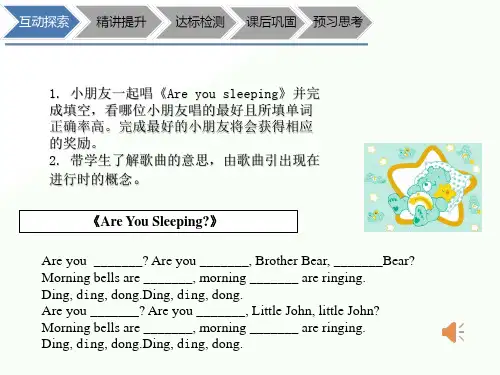
What are you singing?
1. The boy is playing basketball.(对划线部分提问)
1.What is the boy doing?
2. The boy is playing basketball.(对划线部分提问)
Who is playing basketball?.
3. they,the tree,sing,now,under.(用现在进行时连 词成句.)
They are singing under the tree now.
趣味游戏
我做你猜:一名学生做一种动作,老师问What is he/she doing? 其他学生根据动作猜出并回答He/She is … 看哪个 学生配合得好,猜出的动作又准确又迅速。 我有神仙棒:每个学生的食指就是自己的“神仙棒”,当学 生的食指指向某人时,某人就会根据该学生所说的做相应的 动作,如指向Tom并说:“Tom is jumping.” Tom 马上从 座位上站起来做跳跃的动作,并且还要重复:“I’m jumping.”然后Tom就可以用他的“神仙棒”去指挥下一个 学生。
现在进行时
基本概念
变化规则
句型结构
one
two
three
现在进行时
基本概念
现在进行时表示现在或现在一段时间内正 在进行的动作或存在的状态。
变化规则 2.以不发音的e结 尾的动词,去e再 加 ing
1.一般情况下在动词词 尾直接加ing
3.以重读闭音节结尾的动词, 末尾只有一个辅音字母(除a e i o u)时,双写最后一个字 母,再加ing (可简单记成 “辅元辅结尾的动词,双写最 后一个字母再加ing”)
Look, Listen是标志,现在进行正发生; 有时now在句中现,“be+v-ing”时态成. 若问be用何形式,须看主语数、人称. He / She is, I am. We, you, they后are紧跟. v-ing形式更好记,三种构成要分清. 一般问句be提前,be后加not否定成!
牛津版英语四年级下册教案 4B Module3 Unit3(3)
Module 3 Things around usUnit 3 WeatherPeriod Three Read a storyTeaching aims:1.To learn the new story: <The ugly duckling>ing the simple present tense to express simple truth. e.g. It is summer.3.Asking “wh-questions and find out a person’s identity. e.g. Who are you?4.Learn the sounds: -ch, -tch.Emotion aims:通过故事的学习,培养学生正确审美观。
Teaching aids: a recording, a big picture of this story, some small pictures.Teaching Process:Step One: Warming-up1.Say a rhyme:<A typhoon>Listen to the wind! Whoo—whoo! Whoo—whoo!Listen to the thunder! Crack—crack! Crack—crack!Listen to the rain! Pitter-pat! Pitter-pat! On my hat!2.Daily talka.What’s the weather like?b.How many months are there in a year?c.What’s the weather like in January?d.Which season do you like best?e.Why do you like spring?Step Two: Revision1.Review the words of months: January, February,…….December.2.Review the words of days: Sunday, Monday, Tuesday……Saturday.3.Describle the animals.I like rabbits. It’s got two long ears and short tails. It’s white. It can jump. It’s soft. I like itvery much.Step Three: Presentation1.(Show the pictures of this story)T: please look at this picture. What’s in it? Oh, there are some ducks in it.Tell the pupils that they are going to read a story about how the different seasons can bring about wonderful changes in nature.2. Listen to the recording <Read and story>3.Pupils listen and follow in their books.4.T asks and Ps answer:a.It’s spring. What are the ducks doing?b.What is mother duck doing?c.How are the eggs?d.The small duck is “duckling”. How are the ducklings?e.Who’s the ugly duckling’s mother?f.How is its mother?g.The ugly duvkling is a little swan. It will be a beautiful swan. Is it right?5.Read after the tape.6.Read a story.Step Four: Consolidation3.Act the story in front of the class.4.Learn the sounds: The bench is beside the church. The match is on the watch.-ch, -tch: teacher, chair-----Step Five: Assignment1.Listen to the tape and read the story for several times2.Find the ugly duckling from Intnet.Writing on the board:Spring: swim in the pond---make a nest---sit on the nestSummer: open the eggs---beautiful duckling and ugly duckling.Autumn: sit on mother’s back, happy。
牛津版英语四年级下册教案 4B Module1 Unit3(4)
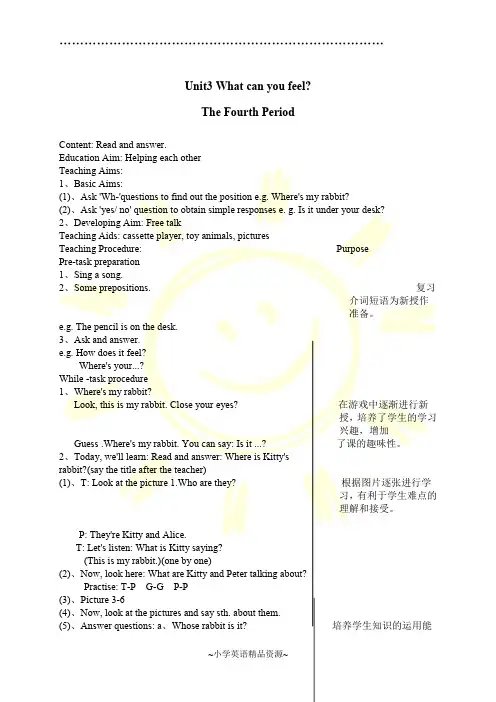
Unit3 What can you feel?The Fourth PeriodContent: Read and answer.Education Aim: Helping each otherTeaching Aims:1、Basic Aims:(1)、Ask 'Wh-'questions to find out the position e.g. Where's my rabbit?(2)、Ask 'yes/ no' question to obtain simple responses e. g. Is it under your desk?2、Developing Aim: Free talkTeaching Aids: cassette player, toy animals, picturesTeaching Procedure: PurposePre-task preparation1、Sing a song.2、Some prepositions. 复习介词短语为新授作准备。
e.g. The pencil is on the desk.3、Ask and answer.e.g. How does it feel?Where's your...?While -task procedure1、Where's my rabbit?Look, this is my rabbit. Close your eyes? 在游戏中逐渐进行新授,培养了学生的学习兴趣,增加Guess .Where's my rabbit. You can say: Is it ...? 了课的趣味性。
2、Today, we'll learn: Read and answer: Where is Kitty'srabbit?(say the title after the teacher)(1)、T: Look at the picture 1.Who are they? 根据图片逐张进行学习,有利于学生难点的理解和接受。
沪教牛津版小学四年级英语下册module1 unit3第3课时课件
3. —When does the sun ____E___ ? —The sun rises in the morning.
4. —When does the sun ___C____ ? —In the evening.
5. —Look at the stars. They are beautiful! —Yes. Let’s go out and ____B____ .
The sun rises in the morning. The shadow is long.
The sun is high in the sky . The shadow is short.
The sun goes down in the evening. The shadow is long.
二、单项选择。
1.Look! The sun ___C__down in the evening.
A. go
B. rises C. goes
2._A__,the sun rises behind the hill.
A. In the morning B. In the afternoon C. At noon 3.Theis___B____.
At night, the moon is high in the sky.
Let’s make sentence. long/short
The sun rises in the morning. The shadow is long.
The sun goes down in the evening. The shadow is long again.
A. happy B. afraid
C. lovely
牛津版小学英语四年级下册4BModule1UsingmyfivesensesUnit3Whatcan
Unit3 What can you feel?The First PeriodContent: Look and say.Education Aim: Helping each other.Teachi ng Aims:1、Basic Aims:(1) 、Use nouns to ide ntify ani mals. e.g. don key(2) 、Use imperatives to give in struct ions. e.g. Feel the don key.5E2RGbCAP2、Developing Aim: Free talkTeachi ng Aids: cassette player, word and picture Cards.EanqFDPwTeachi ng ProcedurePre-task preparati on Purpose DXDiTa9E3d1、Song2、Ask and answer:⑴、What's this? It's a mon key. (lion cat, rabbit...)(2)、Where's its nose?(mouth ,face) It'shere. Where're its eyes?(ears ,legs) They'rehere. While-task procedure:1、This is its...These are its...(1)、T: This is a is its tailP: This is a rabbit. This is its tail.(2) 、Look and say.(Lear n: donkey)(3) 、T: There are its eyes.P: There are...Compare: This is its...There are its...2、Feel the don key. Put the tail on the don key. (1)、Guess: Can you see? What's this? Please feel . 歌曲能使学生集中注意力,迅速进入RTCrpUDGiT学习状态。
牛津版英语四年级下册教案4B Module2 Unit3 period1
Unit3 A busy familyPeriod 1一、主要新授内容(new contents)New words: busy, dish, dry, homework, letter, watchNew phrases: watch television, dr y the dishes, do one’s homework, write a letter Pattern: Here are… …am/is/are doing…二、学习目标(Objectives)1.学习用现在进行时描述图片。
2.学习如何进行看图写话,了解看图写话的顺序。
3. 让学生了解文章的结构。
三、教学建议1、任务前期准备阶段(Pre-task preparation section)Activity 1(Song)1、教学辅助(Aids)视频2、活动过程(Process)Activity 2(Word ‘busy’)1、教学辅助(Aids)图片2.活动过程(Process)Activity 3 (Old phrases and new phrases)1、教学辅助(Aids)图片2.活动过程(Process)2、任务中期实施阶段(While-task procedure section)Activity 1(About the Chens)1、教学辅助(Aids)图片2、活动过程(Process)Activity 2(About the Lis)1、教学辅助(Aids)图片2、活动过程(Process)3、任务后期完成阶段(Post-task activity section)Activity 1(The whole story)1、教学辅助(Aids)图片、练习纸2、活动过程(Process)。
四年级英语下册 4B unit3(1)课件 苏教牛津
a worker
工人
a farmer a cook
厨师;炊事员 农民;农场主
Look, listen and read
a policeman a policewoman
a waiter
a waitress
a driver
a worker
a cook
a farmer
What’s missing?
What’s missing?
(苏教版)牛津英语课件4B unit3
Unit 3 What’s your job? The second period
Let’s review!
A: How old are you? B: I’m … A: What’s your job? B: I’m a (an) … A: What are their jobs? B: They’re …
Let’s review
a doctor
a nurse
a teacher
Let’s review
a waiter
a driver
Let’s learn
a policeman
男警察
a policewoman
女警察
Let’s learn
a waiter
a waitress
女服务员
Let’s learn
Guess: Who’s my friend?
Is your friend a boy? No, my friend is a girl. How old is she? She’s twelve.
Guess: Who’s my friend?
Are her eyes big? Yes, her eyes are big.