
英语句子结构(简单句)
英语句子结构一,按句子结构分,句子可分为三类:简单句,并列句,复合句。
二,简单句的结构五大类型:(1)主语+不及物动词谓语(2)主语+及物动词谓语+宾语(3)主语+及物动词谓语+间接宾语(人)+直接宾语(物)(见附录:可接双宾语的38个常用动词)(4)主语+及物动词谓语+宾语+宾语补足语(5)主语+系动词+表语三,英语句子的成分:主语,谓语,宾语,表语,同位语,补语,定语,状语。
独立成分。
1.英语单词的词性: 1 名词noun(n)2 代词pronoun (pron.)3 形容词adjective (adj). 4 副词adverb (adv.)5 动词verb (vt. vi. Link v)6 数词numeral (num).7 冠词article (art.)8 介词preposition (prep).9 连词conjunction (conj.) 10 感叹词interjection (interj).前六类叫实词,后四类叫虚词。
2. 主语:主语是一个句子的主干部分之一,通常由名词、代词、数词、动词不定式、动名词主语从句充当,正常语序中,主语在一个句子的句首。
Betty likes her new bike.(名词)。
They usually go to school on foot. (代词)。
Two plus two is four. (数词)To learn a foreign language is not easy. (动词不定式短语)Playing basketball after school is great fun. (动名词短语)That the earth runs around the sun is known to everyone. (主语从句)It is known to everyone that the earth runs around the sun. (主语从句)谓语:和主语一样,是一个句子的主干部分之一,表示主语所做到动作、具有的特征及所处的状态。
通常由动词充当实义动词、连系动词、情态动词及助动词。
情态动词和助动词不能单独充当谓语,它们必须和实义动词或系动词一起构成谓语。
实义动词包括及物动词和不及物动词,及物动词后要带宾语。
通常情况下,谓语位于主语之后。
They work very hard. (行为动词)Tom feels much better now. (系动词+表语)We can speak English very well. (情态动词+实义动词)They are playing over there. (助动词+实义动词)表语:表语用以说明主语的身份、特征和状态,它一般位于系动词(状态系动词<即be动词>、持续系动词< keep保持, remain仍然, stay保持>、表像系动词< seem看起来像, look看起来像>、感官系动词< feel感觉起来, smell 闻起来, sound听起来, taste尝起来, look看起来 >、变化系动词<become变得, turn变得, get变得, go变得>、终止系动词<prove证实>)之后用来说明主语的身份、特征或状态。
表语一般由名词、代词、形容词、分词、数词、不定式、动名词、介词短语、副词及表语从句表示。
Her sister is a nurse. (名词)When she heard the news, she got angry. (形容词)His cup is broken. (过去分词)----where are you?----I’m here. (副词)Why didn’t I go to school? The reason is that I was ill. (从句)注意:现在分词作表语不要与现在进行时混淆:My job is putting these parts together.(现在分词做表语)I am putting these parts together.(现在进行时)宾语:宾语表示谓语动词动作的对象或承爱者,一般接在及物动词后面或介词后面。
通常由名词、代词、数词、动词不定式、动名词以及宾语从句构成。
Tom bought a storybook last week. (名词)----How many books do you want?----I want seven. (数词)He wanted to have a cup of tea. (动词不定式短语)He enjoys playing basketball. (动名词短语)Our teacher said that he would go there. (宾语从句)有些动词需要带两个宾语,一个是直接宾语,另一个是间接宾语。
(双宾语)Please show me you ticket. (间接宾语+直接宾语)指人的通常是间接宾语,指物的通常是直接宾语。
如give, show, send, bring等Will you give me some milk?= Will give some milk to me?同位语:当两个指同一人或事物的句子成分放在同等位置时,若其中一个句子成分是用于说明或解释另一个句子成分的,那么用于起说明或解释作用的句子成分就叫做另一成分的同位语。
Mr. Smith,our new teacher,is very kind to us.He told me that his brother John is a world-famous doctor.We Chinese people are brave and hardworking.补语:英语补语的作用对象是主语和宾语,具有鲜明的定语性描写或限制性功能,在句法上是不可或缺的。
补语是起补充说明作用的成份。
最常见的是宾语补足语。
名词、动名词、形容词、副词、不定式、现在分词、过去分词都可以在句子中作宾补。
①宾语补足语:英语中有些及物动词,除有一个直接宾语以外,还要有一个宾语补语,才能使句子的意义完整。
带有宾语补足语的一般词语为:某些及物动词(如make等+宾语+宾补等使役动词,半系词见表语系动词部分)。
宾补可由名词、形容词、副词、不定式、分词、介词短语和从句充当。
注意:使役动词是表示使、令、让、帮、叫等意义的不完全及物动词,主要有ask(让).make(使,令), let(让), help(帮助), have(有;让;从事;允许;拿)等。
You may call me Charles or Mr. liu. (名词)We must keep our classroom clean. (形容词)John asked me to help him. (动词不定式短语)Keep the lights on while you are out. (副词)We made him clean the room yesterday. (动词不定式短语)----he was made to clean the room yesterday.(主语补足语)I found it pleasant to be with your family.(it 做形式宾语)To her surprise, she found herself in a different world.②主语补足语:补充说明主语的特性或所处状态的句子成分,可由名词、分词、形容词、不定式、介词短语和从句从当The dog is called Karl.(名词)He was seen playing basketball yesterday.(现在分词)The door was painted white. (形容词)The glass was found broken. (过去分词)He was seen to come upstairs.(动词不定式)He was found in good health.(介词短语)The boy has been made what he is.(从句)定语:修饰名词或代词的词、短语或从句称为定语。
可由形容词,物主代词,名词,动名词,现在分词,过去分词,不定式短语,介词短语,定语从句充当。
分为前置定语和后置定语。
This is a green jeep. (形容词)The building is their teaching-building. (形容词性物主代词)The woman doctor is his wife. (名词)Attention, please. I have something to tell you. (动词不定式短语)The man in front of the gate is Mr. Li. (介词短语)There is something wrong with my tape-recorder. (形容词后置)Every student has an English book. (不定代词)The book that I bought yesterday is written by Lu Xun.. (从句)单个单词作定语一般位于被修饰的名词或代词前,但是当形容词修饰不定代词如something, everything, anything, nothing, someone,等时,常常放在这些词后面。
--- is there anything serious?---no, nothing serious.He has something important to do this afternoon.短语和定语从句必须放在被修饰词的后面。
This is the book that I want to buy.The book on the desk is mine.The man standing under the tree is Mr. Guo.The book given to him is written in English.状语:修饰动词、形容词、副词或整个句子,说明动作或状态特征的句子成分,叫做状语。
可由副词,形容词,动名词,现在分词,过去分词,不定式短语,介词短语,状语从句充当。
状语的功能:状语说明地点、时间、原因、目的、结果、条件、方向、程度、方式和伴随状况等。
You are quite right. (副词)She will arrive on Monday. (介词短语)He came here in order to learn English. (动词不定式短语)We are on holiday today. (名词)If it rains tomorrow, we’ll stay at home. (从句)As soon as she comes back, I’ll go and see her. (从句)独立成分:与主句没有语法关系的句子成分叫做句子的独立成分。
英语五种句子结构

英语五种句子结构精选英文英语五种句子结构:英语五种句子结构解析1. 简单句(Simple Sentence): 这是最基本的句子结构,只包含一个主语和一个谓语。
例如:She sings beautifully. (她唱得很美。
)2. 并列句(Compound Sentence): 由两个或更多的简单句通过并列连词(如and, but, or等)连接而成。
例如:She sings beautifully, but he dances gracefully. (她唱得很美,但他跳得很优雅。
)3. 复合句(Complex Sentence): 包含一个主句和一个或多个从句。
从句不能独立成句,需要依赖主句来表达完整的意思。
例如:I know that she is coming tomorrow. (我知道她明天要来。
)4. 并列复合句(Compound-Complex Sentence): 这是由并列句和复合句结合而成的句子。
它包含两个或多个主句,其中至少有一个主句包含一个或多个从句。
例如:She sings beautifully, and I know that she practices every day. (她唱得很美,我知道她每天都练习。
)5. 省略句(Ellipsis): 这是一种不完全的句子,省略了某些词或词组,但在上下文中仍然能够理解其意义。
例如:Is she coming? (Yes,) She is. (她会来吗?是的,她会来。
)这五种句子结构在英语中非常常见,掌握它们对于理解和运用英语句子非常有帮助。
中文对照翻译:Analysis of Five Sentence Structures in English1. Simple Sentence: This is the most basic sentence structure that only contains onesubject and one predicate. For example: She sings beautifully (She sings beautifully.)2. Compound Sentence: It is composed of two or more simple sentences connected by coordinate conjunctions (such as and, but, or). For example: She sings beautifully, but she dances gracefully (She sings beautifully, but he dances gracefully.)3. Complex Sentence: Contains a main clause and one or more subordinate clauses. A subordinate clause cannot form an independent sentence and needs to rely on the main clause to express the complete meaning. For example: I know that she is coming tomorrow (I know she will come tomorrow.)4. Compound Compound Sentence: This is a sentence formed by combining a compound sentence with a compound sentence. It contains two or more main clauses, with at least one main clause containing one or more subordinate clauses. For example: She sings beautifully, and I know that she practices every day (She sings beautifully, and I know she practices every day.)5. Ellipsis: This is an incomplete sentence that omits certain words or phrases, but its meaning can still be understood in the context. For example: Is she coming? (Yes, she is.) These five sentence structures are very common in English, and mastering them is very helpful for understanding and applying English sentences.。
英语简单句结构
英语简单句结构简单句通常由主语和谓语两个部分构成。
主语通常由名词词组充当,谓语由动词词组充当。
句子=主语+谓语(名词词组+动词词组)名词词组是以名词为中心词的词组,由限定词+名词中心词构成,可加其他修饰语。
These intelligent girl students in my class, who you know very well, all speak English very fluently.除名词外,代词、数词以及某些非限定动词和名词性分句都可起名词词组的作用。
He is our monitor.Three from seven leaves four.Reading makes a full man.To study one foreign language is not enough.What caused the accident is still investigated.某些形容词,特别是形容人和表示国籍的形容词,一旦与定冠词搭配便可充当名词词组。
The poor are in need of food.The chinese are a great people.动词词组是以动词为中心词的词组。
动词中心词的性质决定着动词词组的构成。
Mary is a typist.(连系动词+主语补语)The baby cried.(不及物动词)He rang the bell.(单宾及物动词+宾语)He bought me a skirt.(双宾及物动词+间接宾语+直接宾语)They elected him president.(复杂及物动词+宾语+宾语补语)We live in Beijing.(不及物动词+状语)She puts the pillow in the cradle. (及物动词+宾语+状语)动词词组中心词叫做谓语动词。
谓语动词又分为简单形式和复杂形式。
简单谓语动词仅由一个主动词构成,而复杂谓语动词由一个或一个以上的助动词+主动词构成。
简单句句子结构
简单句的基本句型简单句是英语中的基本句子,了解和掌握这五种基本句型对学好英语极为重要。
这六种基本句型是:1.主语+谓语结构:常用来表示主语的动作。
常与表示时间、距离、重量、价值等的副词修饰语连用。
如:They worked day and night. 他们夜以继日地工作。
2.主语+系动词+表语(主系表结构)本结构是由"主语+系动词+表语"组成,主要用以说明主语的特征、类属、状态、身份等。
此句型中常见的系动词:be, become, come, get, smell, taste, feel, sound, remain, stay, appear, go, turn, fall, keep等。
(1)主语+系动词+形容词(作表语)如:It feels good to be home.在家的感觉真好。
(2)主语+系动词+名词(作表语)如:He is a student. 他是个学生。
(3)主语+系动词+副词、介词短语或反身代词(作表语)如:He is near. 他在附近。
3. 主语+谓语+宾语(主谓宾结构)此结构其中的谓语动词须是及物动词(短语),宾语须是名词或相当于名词的成分。
(1)主语+及物动词+名词或代词(作宾语)如:May I use your computer ? 我能用一下你的电脑吗?(2)主语+及物动词+动名词(作宾语)。
此类及物动词(短语)有:advise, consider, avoid, mind, miss, suggest, finish, practice, imagine, enjoy, delay, escape, feel like, put off, give up,等。
如:You shouldn’t giv e up studying. 你不该放弃学习。
(3)主语+及物动词+不定式(作宾语)。
此类及物动词有:afford, agree, ask, expect, hope, want, wish, manage, pretend, decide, determine, learn, offer, plan, refuse等。
英语简单句子结构
英语的句子结构
S (subject)- 主语 V (verbal phrase)- 谓语
P (predicative) - 表语
O (object)-宾语 Oi-间接宾语 Od-直接宾语 C (complement) -补语
简单句的五种句型
1)SV 主语+谓语
ain stopped.
英语简单句子结构英语简单句子结构英语的句子结构sssubjectsubject主语主语vvverbalphraseverbalphrase谓语谓语predicative表语表语ooobjectobject宾语宾语ooii间接宾语间接宾语oodd直接宾语直接宾语cccomplementcomplement补语补语简单句的五种句型简单句的五种句型1sv主语谓语eg
插入语、同位语
句子成分的构成 一、主语
主语可以用以下这些表示: 1. 名词;2. 代词; 3. 数词;4. 动名词;5. 不定式; 6. 词组或复合结构;7. 从句;8. 名词化的其他词类。eg: Mary is a good student. Who is speaking, please? This is Jack speaking. Two will be enough. Smoking is very dangerous. To see is to believe. Whether we’ll go depends on the weather. “A” is an article.
5) SVOC 主语+谓语+宾语+补语 eg. They called him a panda She found the children sleeping.
*在阅读句子的时候,第一个任务就是要找到谓语! *做谓语的动词有时态、语态和数的变化;还有 及物动词与不及物动词的区别。
英语简单句6种句型
英语简单句的基本句型由一个主语和一个谓语动词所组成的句子是简单句。
谓语动词有及物动词、不及物动词和连系动词之分。
正是谓语动词的特点决定着句子的不同结构,如连系动词后要接表语;大多数及物动词后接一个直接宾语,有的及物动词要接直接宾语和间接宾语,还有的及物动词要接复合宾语(宾语+宾语补足语)。
要想写好简单句,我们必须记住以下六种句型,它们是语言的基本模式。
【句型一】主语+ 谓语(不及物动词) + (状语[副词、名词、介词短语等]) The children are listening quietly. 孩子们在静静地听着。
He runs fast in the street. 他在街上跑得飞快。
The meeting begins at nine. 会议9点开始。
They worked day and night. 他们夜以继日地工作。
【点津】主语和不及物动词是组成本句型不可缺少的必要成分。
上述句子虽然长短不一,但都属于这一基本句型。
常见不及物动词:act(行动), agree(同意),apologize(道歉), arrive(到达), ap pear(出现),blow(刮风),come(来),cough(咳嗽), close(关闭,结束),cook(做饭),c ry(哭), decrease(减少)die(死), disagree(不同意),disappear(消失), exist(生存), fall (跌落), go(去), grow(生长), happen(发生),jump(跳),leave(离开),live(居住), look(看), listen(听), lie(说谎,位于),last(持续), open(开张), play(玩), rise(升起,起床), ring(铃响),run(跑), smile (微笑),talk(讲话),tremble(颤抖),work (工作),walk(步行)【句型二】主语+ 谓语(及物动词) + 宾语( + 状语)He didn’t like the film. 他不喜欢这部电影。
常用英语短句句型结构
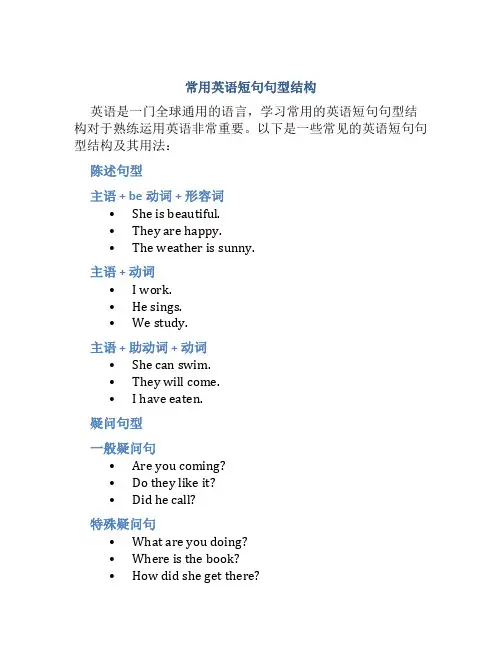
常用英语短句句型结构英语是一门全球通用的语言,学习常用的英语短句句型结构对于熟练运用英语非常重要。
以下是一些常见的英语短句句型结构及其用法:陈述句型主语 + be动词 + 形容词•She is beautiful.•They are happy.•The weather is sunny.主语 + 动词•I work.•He sings.•We study.主语 + 助动词 + 动词•She can swim.•They will come.•I have eaten.疑问句型一般疑问句•Are you coming?•Do they like it?•Did he call?特殊疑问句•What are you doing?•Where is the book?•How did she get there?祈使句型动词 + 宾语•Close the door.•Eat your dinner.•Be quiet.Let’s + 动词•Let’s go.•Let’s eat.•Let’s play.状态句型主语 + feel/look/sound + 形容词•She looks sad.•He sounds happy.•The music feels relaxing.主语 + seem/appear + to be•She seems to be tired.•They appear to be lost.•The situation seems to be changing.虚拟句型If + 主语 + 动词,主语 + 动词•If I were you, I would study harder.•If they had known, they would have come.•If she had time, she would help.以上是一些常见的英语短句句型结构,熟练掌握这些句型将有助于提高英语表达能力。
英语句子结构(简单句)
英语句子结构一,按句子结构分,句子可分为三类:简单句,并列句,复合句。
二,简单句的结构五大类型:(1)主语+不及物动词谓语(2)主语+及物动词谓语+宾语(3)主语+及物动词谓语+间接宾语(人)+直接宾语(物)(见附录:可接双宾语的38个常用动词)(4)主语+及物动词谓语+宾语+宾语补足语(5)主语+系动词+表语三,英语句子的成分:主语,谓语,宾语,表语,同位语,补语,定语,状语。
独立成分。
1.英语单词的词性: 1 名词noun(n)2 代词pronoun (pron.)3 形容词adjective (adj). 4 副词adverb (adv.)5 动词verb (vt. vi. Link v)6 数词numeral (num).7 冠词article (art.)8 介词preposition (prep).9 连词conjunction (conj.) 10 感叹词interjection (interj).前六类叫实词,后四类叫虚词。
2. 主语:主语是一个句子的主干部分之一,通常由名词、代词、数词、动词不定式、动名词主语从句充当,正常语序中,主语在一个句子的句首。
Betty likes her new bike.(名词)。
They usually go to school on foot. (代词)。
Two plus two is four. (数词)To learn a foreign language is not easy. (动词不定式短语)Playing basketball after school is great fun. (动名词短语)That the earth runs around the sun is known to everyone. (主语从句)It is known to everyone that the earth runs around the sun. (主语从句)谓语:和主语一样,是一个句子的主干部分之一,表示主语所做到动作、具有的特征及所处的状态。
高中英语 语法 句子结构 简单句
Whether we can finish the job is still unknown.
谓语:
谓语说明主语做什么,是什么,怎么样,由 简单动词或者动词短语构成. They are teachers.
She looks well.
He studie.
主--谓(及物动词)--宾
I miss you. We will call you.
主--谓--宾--宾语补足语
We will call you Kitty. We made you the president. His parents want Tommy to be honest. I find the work difficult. Don’t consider him a bad man.
n o w . R i g h t : H e i s s e n d i n g a l e t
s e n d i n g
2)不及物动词 本身意义完整后面不须跟宾语的实义动词,叫 做不及物动词(intransitive verb)。如: Birds fly.鸟会飞。 It happened in June 1932.这件事发生于一九三; 年六月。 My watch stopped.我的表停了。 She spoke at the meeting yesterday evening. 她在昨天晚上的会上发了言
3)表像系动词 用来表示"看起来像"这一概念,主要有seem, appear, look, 例如: He looks tired. 他看起来很累。 He seems (to be) very sad. 他看起来很伤心。
4)感官系动词 感官系动词主要有feel, smell, sound, taste, 例如: This kind of cloth feels very soft. 这种布手感很软。 This flower smells very sweet. 这朵花闻起来很香。
英语简单句子结构分析
英语简单句子结构分析简单句的五种基本句型1. 主语+谓语 S+V2. 主语+谓语+宾语 S+V+O3. 主语+谓语动词+宾语+宾补 S+V+O+C4. 主语+谓语+间接宾语人+直接宾语物 S+V+O+O5. 主语+系动词+表语 S+LV+P英语句子当中的成分分为:主、谓、宾、定、状、补六类。
宾语:表示动词的对象、承受者或后果。
定语:用来修饰、限定、说明名词或代词的品质与特征的。
状语:句子重要修饰成分,是谓语的另一个附加成分,附加在谓语中心语补语:起补充说明作用的部分,作用对象是主语和宾语,具有鲜明的定语性描写或限制性功能。
1. 主语S+谓语Vi不及物动词I see. I’ll try. Time flies.He can swim. Who knows? That depends.Everybody smiled. Water flows.The children are playing. Tim is sleeping.She is crying. He is reading. It’s snowing.该句型中的动词为不及物,不及物动词词义自身完全,不需要宾语补足其意义,但有些动词词义必须由一个状语不能没有状语进行补充。
Birds sing beautifully. He reads loudly. He went on holiday.We go for a walk. They sit under the tree. Your sister dances beautifully. Jim and Tom study together every day. She swims like a fish.Her lecture lasted an hour. She is studying hard at the university.There be句型也属于这一结构。
There本身无词义常弱读,其后的动词be具有”存在”之义,所以是一实意动词。
英语简单句中五种基本句型
英语简单句中五种基本句型
英语简单句的五种基本句型是:
1. 主语+谓语(不及物动词):S+V
例如:The sun rises. 太阳升起。
2. 主语+谓语(及物动词)+宾语:S+V+O
例如:I like apples. 我喜欢苹果。
3. 主语+谓语+间接宾语+直接宾语:S+V+IO+DO
例如:He gave me a book. 他给了我一本书。
4. 主语+系动词+表语:S+V+P
例如:She is a doctor. 她是一名医生。
5. 主语+谓语+宾语+宾语补足语:S+V+O+OC
例如:We made him our monitor. 我们选他当班长。
需要注意的是,这些句型只是英语简单句的基本结构,实际应用中还有很多复杂的句型和变化。
同时,英语句子的语序和汉语句子的语序也有所不同,需要在学习中逐渐适应。