
形容词修饰不定代词的用法
形容词修饰不定代词的
用法
Company number:【WTUT-WT88Y-W8BBGB-BWYTT-19998】
形容词修饰不定式代词的用法
something interesting意为“一些有趣的东西”,形容词修饰不定代词或不定副词时,须位于不定代词或不定副词之后,作后置定语。
Last night,I saw someone strange lying on the ground near my home.
昨晚在我家附近,我看见一个陌生人躺在地上。
Many people like to go somewhere interesting to have a vacation.
许多人喜欢去有趣的地方度假。
1,My host family tried to cook_______for me when I studied In New Zeanland.
A ,different something B,different anything
C,something different D,anything different
2,You have just read the newspaper. Did you find_____in it
A ,interesting anything B,anything interesting C,interesting something
3,Old Henry is so lonely that he hopes to know about________every day.
A ,special something B,special anything C,something special D,anything special
4,There is_______with my computer. Can you help me mend it
A ,nothing wrong B,anything wrong C,something wrong D,wrong something
5,格林夫妇计划去某个轻松的地方度假。
The Greens are planning to go_______ _____for vocations.
答案
1,C,2,B,3,C,4,C,5,somewhere relaxing。
形容词修饰不定代词的用法

形容词修饰不定代词的用法
1. 哇塞,不定代词 something 可有不少奇妙的用法呢!比如“ There is something interesting in this book. ”(这本书里有一些有趣的东西),你看,这里用“interesting”这个形容词来修饰“something”,多贴切呀!
2. 嘿,不定代词 anything 也很特别哦!“Is there anything wrong? ”(有什么不对劲的吗),“wrong”很好地修饰了“anything”,是不是
很奇妙?
3. 呀,不定代词 nothing 也能这样用呢!“He has nothing important to say. ”(他没什么重要的事要说。
),这里“important”修饰“nothing”,是不是很有意思呀!
4. 哎呀,不定代词 somebody 也能这么搭配哟!“There is somebody nice waiting for you. ”(有个很好的人在等你。
),“nice”让“somebody”更加生动形象啦!
5. 哟呵,不定代词 anybody 也不例外呢!“Anybody intelligent can do it. ”(任何有才智的人都能做这件事。
),“intelligent”对“anybody”的修饰太妙啦!
6. 哈哈,不定代词 nobody 也是一样呀!“Nobody famous came to the party. ”(没有什么出名的人来参加聚会。
),“famous”把“nobody”
描述得好准确呀!总之,形容词修饰不定代词的用法真的超有趣,让我们能更准确地表达意思,大家可要好好掌握呀!。
不定代词的用法

一、选择 1. Is there ____ in today's newspaper ? A. funny anything B. anything funny C. something funny 2. Please keep quiet, everyone! I have ____to tell you. A. important anything B. anything important C. somThere is ____ with my computer. Can you help me mend it? A. nothing wrong B. wrong anything C. something wrong.
作业:
从方框中选择适当的不定代词填空。 anything, someone, everyone, anyone, everything, something, nothing anyone 1.I don't know _______ at this school because I am new. Everyone 2. _______ is ready. Let's start the party. anything 3. -Look ! Can you see ________ behind the tree? -Yes, I think it's a cat.
everyone 5. - Yang Bin, is _________ here today? - No, Jim isn't here. He's ill. anything 6. -Do you have ________to say for yourself? - No, I have ________ to say. nothing
英语中形容词的用法

2) 表示三者或三者以上(人或事物)的 比较用最高级,最高级的前面一般要加
定冠词the,后面可带of(in,among)
短语来说明比较的范围
*Shanghai is the biggest city in China.
*Lucy sings (the) best of all.
*He is the most careful among us.
5)几种比较级的使用句型 1.“ 比较级 + and + 比较级 ” 表示“ 越来越······”
*Your English is getting better and better. 你的英语越来越好了。 *These days more and more people are learning English. 现在学英语的人越来越多了。
3) 在表示 “和······一样······” 和 “不及······” 这类概念时,可以用 “as+原级+as” 和 “not as(so) +原级+as”的句型
*Our teacher is as busy as before.
*He does not run so (as) fast as 用来修饰名词或代词, 表示人或 事物的性质, 状态,和特征。
二、形容词的用法:
1. 作定语,一般放在名词之前, 不定 代词 something,anything,nothing, everything 等之后。
eg. It’s a sunny day today.
今天是个阳光灿烂的日子。
电影里有什么有趣的内容吗?
There is nothing dangerous here. 这儿一点都不危险。
形容词-副词的用法

形容词 副词的用法形容词: 一、形容词在句子中的作用及位置: 1. 作定语。
a. 形容词作定语时一般放在它所修饰的词的前面;I have a good book. He is a strange man. b. 形容词修饰不定代词(由 some, any, every, no+ thing, one, body 构成)时 要放在不定代词之后; He has something important to tell you. There is nothing interesting in the book. ) c. enough 修饰名词时可放在名词之前或之后; 修饰形容词、副词和动词 时一定要放在这些词之后. They have enough money to buy the car. They have money enough to buy the car. The hole is large enough. d. else 只作后置定语,修饰疑问代词 what, who, whom, whose 和不定代词 something, anything, nothing, somebody, anybody nobody 等;( else 作副词 时, 修饰疑问副词 when, where 等放在其后) What else can you do Is there anyone else e. 形容词短语作定语时必须放在它所修饰的词的后面。
All countries, big and small, should be equal. 任何国家,无论大小,一律平 等. f. 表示计量(长、宽、高、深)及年龄的形容词,应放在相应的名词之 后。
< 2. 作表语。
在系动词和半系动词 feel(感到),look(看起来),sound(听起来), smell(闻起来),taste(尝起来),become(变成)get(变成),turn (变成),fall(变成), seem(似乎,好象)后,用形容词作表语。
形容词修饰不定代词的用法
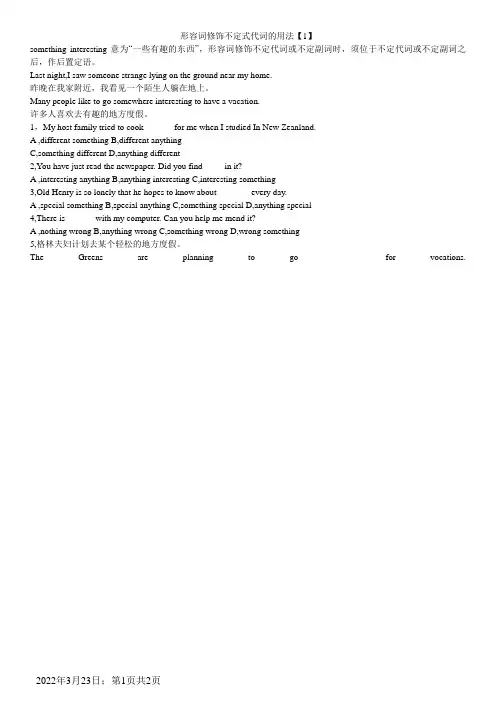
形容词修饰不定式代词的用法【1】something interesting意为“一些有趣的东西”,形容词修饰不定代词或不定副词时,须位于不定代词或不定副词之后,作后置定语。
Last night,I saw someone strange lying on the ground near my home.昨晚在我家附近,我看见一个陌生人躺在地上。
Many people like to go somewhere interesting to have a vacation.许多人喜欢去有趣的地方度假。
1,My host family tried to cook_______for me when I studied In New Zeanland.A ,different something B,different anythingC,something different D,anything different2,You have just read the newspaper. Did you find_____in it?A ,interesting anything B,anything interesting C,interesting something3,Old Henry is so lonely that he hopes to know about________every day.A ,special something B,special anything C,something special D,anything special4,There is_______with my computer. Can you help me mend it?A ,nothing wrong B,anything wrong C,something wrong D,wrong something5,格林夫妇计划去某个轻松的地方度假。
形容词副词的用法

形容词一、形容词的一般用法:形容词是指用来修饰、说明名词或不定代词,表示人或物的性质、特征和状态。
一般放在它所修饰的名词前作定语,也可独立作表语或宾语补足语等。
1.作定语,一般放在所修饰词的前面。
It’s a cold and windy day.2.作表语,放在系动词的后面。
(look,feel,smell,sound….)He looks happy today.3.形容词修饰something,anything,nothing,everything等复合不定代词时,须放在其后。
Would you like something hot to drink?4.表示长、宽、高、深及年龄的形容词,应放在相应的名词之后。
How long is the river? It’s about two hundred metres long.5.只能作表语的形容词:afraid;alone;asleep;awake;alive;well健康的;ill;frightened The man is ill.(正)The ill man is my uncle.(误)6.只能作定语的形容词:little小的;only唯一的;wooden木质的;woolen羊毛质的;elder 年长的My elder brother is in Beijing.(正)My brother is elder. (误)7.貌似副词的形容词:lonely;friendly;lively;lovely二、形容词常用句型1.“It’s +adj.+of+sb.+不定式”表示“某人(做某事)怎么样”。
=Sb +be +adj+to do sth 注意:这一句型中常用描述行为者的性格、品质的形容词,如good,kind,nice,polite ,clever ,foolish ,lazy ,careful,careless,right(正确的),wrong等。
人教目标九年级英语全一册Unit 1 形容词修饰不定代词不定副词的用法
创新微课
形容词修饰不定代词/不定副词的用法
Is there anywhere else for us to live?
What shall we do ?
创新微课
形容词修饰不定代词/不定副词的用法
What a beautiful place! How cozy(舒服的)!
创新微课
•
9、要学生做的事,教职员躬亲共做; 要学生 学的知 识,教 职员躬 亲共学 ;要学 生守的 规则, 教职员 躬亲共 守。20 21/7/2 12021/ 7/21We dnesda y, July 21, 2021
C something wrong D wrong something
形容词修饰不定代词/不定副词的用法
回顾总结
1 不定代词
不定副词
肯定句 否定句/ 疑问句
创新微课
同学,下节再见
• 15、一年之计,莫如树谷;十年之计,莫如树木;终身之计,莫如树人。2021年7月2021/7/212021/7/212021/7/217/21/2021
• 16、提出一个问题往往比解决一个更重要。因为解决问题也许仅是一个数学上或实验上的技能而已,而提出新的问题,却需要有创造性的想像力,而且标志着科学的真正进步。2021/7/212021/7/21July 21, 2021
创新微课
形容词修饰不定代词/不定副词的用法
格林夫妇计划去某个轻松的地方度假。 The Greens are planning to go _s_o_m__e_w_h_e_r_e_ _re_l_a_x_in_g______ for vo1cations.
创新微课
形容词修饰不定代词/不定副词的用法
创新微课
形容词的用法
形容词:一、用法:六种1、做定语,修饰名词,放在名词前2、做表语,放在系动词之后3、做宾语补足语4、修饰不定代词,放在不定代词之后5、修饰一类人,the+形容词+动词原形6、多个形容词修饰同一个名词(限观形龄色国材)二、形容词等级(原级、比较级、最高级)1、原级公式:2个(A和B一样A不如B)A和B一样:A+be动词+as+形容词原级+as+BA不如B: A+be动词+as/so+形容词原级+as+B2、比较级公式:4个(A比B更怎样越来越怎样越….就越…. 二者中比较怎样的一个)A比B更怎样:A+be动词+比较级+than+B越来越怎样; 比较级+and+比较级越….就越….:the+比较级,the+比较级二者中比较怎样的一个:A+be动词+one of the two+名复+动单3、最高级公式:1个(A是最怎样的)A是最怎样的:A+ be动词+the+最高级+of/in+范围三、同义句转换:A+ be动词+the+最高级+of/in+范围= A+be动词+比较级+than+any other+名单+范围=A+be动词+比较级+than+the other+可复+范围= A+be动词+比较级+than+anybody/anything+else+范围四、形容词比较级和最高级的变换1、一般情况下,比较级+er 最高级+est2、以e结尾的比较级+r, 最高级+st3、辅音字母+y结尾的,变y为i后,比较级+er最高级+est4、辅音+元音+辅音结尾的,双写末尾的辅音字母后比较级+er最高级+est5、多音节和双音节词,比较级+more 最高级+most6、不规则good/well--better--best bad/badly—worse--worstmany/much—more—most little—less—leastold—older/elder—oldest/eldestfar—farther/further—farthest/furthest。
形容词的基本概念及用法
形容词的基本概念及用法一、形容词的定义:形容词是用来修饰名词或代词的,在句中可用作定语、表语和宾语补足q五坐语等。
二、形容词的用法:⑴ 用作前置定语,即放在名词前修饰该名词。
例如:China is a great country with a long history. 中国是一个历史悠久的国家。
⑵ 用作后置定语。
形容词修饰不定代词或形容词短语修饰名词时,需要后置。
例如:He has something important to tell you. 他有重要的事告诉你。
She is a girl good at singing. 她是一位擅长唱歌的女孩。
⑶ 用作表语。
例如:It was rainy yesterday, but today it is sunny. 昨天下雨,今天天晴。
Your mother seems angry. 你母亲看上去生气了。
The milk in the glass has gone bad. 玻璃杯里的牛奶发臭了。
The leaves turn yellow in autumn. 树叶在秋天变黄。
注意:有一些形容词在句中只能用作表语,我们称之为“表语形容词”。
初中英语中常见的表语形容词有:afraid, alive, alone, asleep, glad, ill (生病的), ready, sorry, sure, unable, well (健康的)等。
例如:I ' m sorry not to have been ready for the party. 很抱歉,晚会我还没有准备好。
The children were asleep ju st now, but now they ' re 孩Wa们e刚才在睡觉,现在醒了。
They were unable to help us. 他们没法帮助我们。
⑷ 用作宾语补足语。
例如:The news made her happy. 那个消息使她很开心。
形容词用法教案
形容词用法教案形容词是英语中一种非常重要的词类,它用来形容名词的性质、特征和状态。
正确使用形容词不仅可以丰富词汇,还可以使语言更加具体生动。
本教案将详细介绍形容词的基本用法和常见的修饰结构。
通过本教案的学习,学生可以提高对形容词的运用能力,从而提升英语写作和口语表达的水平。
一、形容词的基本用法1. 形容词的定义:形容词是用来描述名词的词,表示名词的性质、特征和状态。
2. 形容词的位置:形容词通常位于名词之前,修饰名词。
3. 形容词的变化:形容词有三种变化形式,即原级、比较级和最高级。
原级表示基本程度,比较级表示两者之间的程度对比,最高级表示三者或三者以上之间的程度对比。
4. 形容词的形式:形容词在变化形式上有规律变化和不规则变化两种情况。
5. 形容词的用法:形容词可以直接修饰名词,也可以通过连系动词与名词构成表语,还可以作为定语修饰名词的词组。
二、形容词的修饰结构1. 形容词+名词:形容词可以单独修饰一个名词,起到修饰、限制或补充名词的作用。
2. 形容词+不定代词:形容词可以修饰不定代词,增加对不定代词所代表的对象的描述。
3. 形容词+介词短语:形容词可以和介词短语搭配使用,构成更复杂、更具体的修饰结构。
4. 形容词+副词:形容词和副词可以相互修饰,形成更加精确的描述。
5. 形容词+定语从句:形容词可以与定语从句结合使用,修饰名词的同时提供额外的信息。
三、形容词的常见错误用法1. 形容词与副词的混淆:形容词用来修饰名词,副词用来修饰动词、形容词或其他副词。
2. 形容词的位置错误:形容词通常位于名词之前,如果放在名词之后,需要使用连系动词将其与名词联系起来。
3. 形容词的比较级和最高级错误:形容词的比较级和最高级需要根据规则进行变化,不能随意加上-er或-est。
4. 形容词的过度使用:使用过多的形容词会使语言显得冗杂,影响文章的流畅性和可读性。
四、形容词的练习与巩固1. 词汇积累:积累常见的形容词,通过词汇卡片、单词表或课堂练习等方式进行记忆。