
八年级下册英语所有知识点大汇总
nit1 what' s the matter?
1. It’s +形容词 + for sb. + to do sth. 做某事对某人来说是…的。
It’s important to do sth. 做某事很重要。
It’s important for me to eat a balanced diet. 平衡饮食对我来说是很重要的.
It’s easy to do sth. 做某事是容易的。
It’s easy for us to find out the answer. 找出答案对我们来说是容易的。
2. 情态动词should的用法
should是情态动词,它的基本用法是必须和其他动词一起构成谓语。意为"应该......"。
should(应当,应该)用于所有人称,表示劝告或建议。
eg. ---I have a very bad cold. 我感冒很厉害。
---You should lie down and have a rest. 你应该躺下,多喝水。
3. maybe与may be
(1)maybe是副词,译为“也许、可能”,相当于“perhaps”。如:Maybe he can
answer the question. 也许他能回答那个问题。
He maybe is from the USA, too. 他可能也来自美国。
(2)may be中的may为情态动词,译为“可能是......”。如:
He may be from the USA, too. 他可能也来自美国。
She may be our English teacher. 她可能是我们的英语老师。
4. few、a few、little、a little的区别和联系:
(1)few / a few用来修饰可数名词,few表示否定意义,没有,几乎没有;a few表示肯定意义, 有几个。 例如:
He has few friends here, he feels lonely. 他这里没朋友,他感觉寂寞。
There are a few eggs in the basket. 篮子里有几个鸡蛋。
(2)little / a little用来修饰不可数名词,little表示否定意义,没有,几乎没有; a little 表示肯定意义,有一点儿。 例如:
There is little ink in my bottle. Can you give me a little ink? 我的瓶子里没有墨水了,你能给我点儿墨水吗?
5. not…until 直到…(否定句) 才......,动词为短暂性或瞬间性动词。 She didn’t leave until we came.
He went shopping after he got up.
=He didn’t go shopping until /before he got up.
...until/till 直到......(肯定句)动词为延续性动词
We stayed here till/until 12 o’clock.
Unit2 I'll help clean the city parks.
1. 短语动词小结
常见动词短语结构有下面几种:
(1)动词+副词 如:give up 放弃;turn off 关掉;stay up 熬夜
这种结构有时相当于及物动词,如果其宾语是代词,就必须放在动
词和副词之间,如果是名词,则既可插在动词和副词之间,也可放
在短语动词后。
(2)动词+介词 如:listen of 听;look at 看;belong to 属于
这种结构相当于及物动词,后面跟宾语。
(3)动词+副词+介词 如:come up with 提出,想出; run out of 用完,耗尽
(4)动词+名词+介词 如:take part in参加;catch hold of 抓住
2. each 每个,各自的,强调事物的个别情况,常与of 连用
every 每个,每一个的,一切的,有“全体”的意思不能与of 连用
3. help sb. (to) do 帮助某人做某事 help him (to) study
help sb. with sth. 帮助某人做某事 help him with English
help do 帮助做某事 help study
4. spend...doing... 花费…做…
I spent a day visiting Beijing. 我花了一天的时间去参观北京。
spend… on sth. 花费…在… I spent 3 years on English.
5. join 参加 (指参加团体、组织) 如:join the Party 入党
take part in 参加 (指参加活动) 如:take part in sports meeting 参加运动会
6. run out 与 run out of
(1)run out (become used up). 其主语往往为物。如时间,食物,金钱,油等,本身就含有被动意义。
His money soon ran out. 他的钱很快就花光了。
Our time is running out. 我们剩下的时间不多了。
(2)run out of 主语为人,表示主动含义。
He is always running out of money before pay day. 他总是在发工资的日子还没有到就把钱花完了。
两者在一定条件下可以互换
如:The petrol is running out. 汽油快用完了= We are running out of
petrol.
Our time is running out. 我们剩下的时间不多了。= We are running out
of time.
7. work out
(1)结局,结果为
The strategies that he came up with worked out fine. 他提出的这个策略效果很好。
(2)算出,制订出,消耗完(精力等)
He never seems to be worked out. 他好像永远不会疲乏似的。
He worked out a plan. 他制订了一个计划。
I have worked out our total expenses. 我已经算出了我们总的费用。
8. hang out 闲荡 闲逛
I like to hang out at mall with my friends. 我喜欢和我的朋友一起去购物中心闲荡。
9. be able to do 能,会
be unable to do 不能,不会
10. for sure 确实如此,毫无疑问
You don’t have money. That’s for sure. 你没有钱,这是毫无疑问的。
11. fill… with… 使…充满… 用…填充…
She filled the bowl with water. 她用水填满碗。
12. hand out 分发 hand out bananas
give out 分发 give out sth to sb. 分….给某人
give up doing 放弃… give up smoking 放弃吸烟
give away 赠送 捐赠 give away money to kids
give sb. sth. 给某人某东西 give me money 给我钱
give sth. to sb. 给某人某东西 give money to me 给我线
13. help sb. out 帮助…做事,解决难题(摆脱困境)
I can’t work out this math problem. Please help me out. 我不能算出这道数学问题,请你帮我解决。
14. train n. 火车 v. 训练
train sb. to do. 训练某人做某事
She trains her dog to fetch things. 她训练她的狗去取东西。
15. at once == right away 立刻 马上 如:
Do it at once. 马上去做。
I’ll go there at once/ right away. 我马上去那里。
16. one day 有一天 (指将来/过去)
some day 有一天(指将来) 如:
One day I went to Beijing. 有一天我去了北京。
Some day I’ll go to Beijing. 有一天我将去北京。
Unit3 Could you please clean your room?
1. 关于 to 的短语总结
have to do sth. 不得不/必须做某事
need to do sth. 需要做某事
hate to do sth. 讨厌做某事
like to do sth. 喜欢做某事
want to do sth. 想做某事
love to do sth. 热爱做某事
forget to do sth. 忘记做某事
start to do sth. 开始做某事 begin to do sth. 开始做某事
ask sb to do sth. 请某人做某事
2. ---Could you please clean your room?
---Yes, sure. / Sorry, I can't. I have to do my homework first.
---Could I please use the car?
---Sure. / Certainly. / Of course. / No, you can't. I have to go
out.
在表示请求帮助或请求允许的疑问句中,常用 could 代替 can,以表示礼貌,委婉或不确定的语气,而 can 则不具备这些语气。这种情况下不能把 could 看作 can
的过去式。以上两句中用 could 是为了表示礼貌的请求。表示请求帮助或请求允许时,除了 can, could 之外,还可以用 may,句子的表达方式也各有不同,可以用不同的方式来表示同一个概念。例:
Could / Can / May I use your car for a day?
作允答可以各种各样:
如同意可以说 Yes,或 Sure 或 Certainly,还可说 Yes, (do) please.或 Of
course. (you may / can). 或 That's OK / all right.
如果不同意,可以说 I'm sorry you can't. 或 I'm really sorry, but I have
to use it today. 要避免说 No, you can't. 这样显得很不礼貌。否定回答通常用委婉语气。
八年级下册英语语法知识点归纳总结
八年级下册英语语法知识点归纳总结如下:
一、动词时态
一般现在时:描述经常发生的动作或状态。主语为第三人称单数时,动词要加-s或-es。
例子:She often reads books in the evening. (她晚上经常看书。)
一般过去时:描述过去发生的动作或状态。动词要用过去式。
例子:I went to the park last Sunday. (我上周日去了公园。)
现在进行时:描述正在进行的动作或状态。结构为“be动词(am/is/are)+动词-ing”。
例子:They are playing football now. (他们现在正在踢足球。)
过去进行时:描述过去某个时间点正在进行的动作。结构为“was/were+动词-ing”。
例子:When I called you, you were studying. (我打电话给你时,你正在学习。)
二、形容词和副词的比较级和最高级
比较级:用于比较两个事物或人的特征。一般在形容词或副词后加-er。
例子:This book is cheaper than that one. (这本书比那本便宜。)
最高级:用于比较三个或更多事物或人的特征。在形容词或副词后加-est,或在前面加the
most。
例子:She is the tallest girl in her class. (她是她班级里最高的女孩。)
三、情态动词
can/could:表示能力或可能性。
例子:I can swim. (我会游泳。)
may/might:表示可能性或请求。
例子:You may borrow my book. (你可以借我的书。)
must:表示必须或义务。
例子:You must finish your homework tonight. (你今晚必须完成家庭作业。)
四、被动语态
被动语态用于描述事物的状态或描述被动发生的动作。结构为“be动词(am/is/are/was/were)+动词的过去分词”。
人教版八年级下册英语全册知识点大全

Unit 1
重点短语:
have a stomachache have a cold lie down
take one’s temperature have a fever go to a doctor
to one’s surprise agree to (do sth.) get into trouble
be used to take risks run out (of)
cut off get out of be in control of
keep on ( doing sth.) give up
语言知识归纳:
1. What’s the matter (with you)?
此句用来询问别人的病情。类似的句子还有:
What’s wrong with you?/ What’s the trouble?
matter作动词用,意为“要紧”“有关系”,主要用于疑问句和否定句。
What does it matter? It doesn’t matter.
【例题】Does it ________ if we can’t finish it today?
A. mind B. minds C. matter D. matters
2. I have a sore throat.
have “患病”,常用“have a /an+ 名词”.
人教版八年级英语下册各知识点归纳总结

人教版八年级英语下册各知识点归纳总结
Knowledge Summary of People's Education Edition Eighth
Grade English Textbook
Unit 1 Dream Jobs
In this unit, students learn about different occupations and
career paths. They practice talking about their dream jobs and
discussing the pros and cons of different professions. Vocabulary
includes words related to jobs, such as lawyer, engineer, chef, etc.
Grammar points include the present simple tense for expressing
routines and habits, as well as future forms for talking about
future plans.
Unit 2 Healthy Eating
This unit focuses on the importance of a balanced diet and
healthy eating habits. Students learn about different food groups,
nutrients, and the benefits of eating a variety of foods.
Vocabulary includes words related to food, such as
carbohydrates, proteins, vitamins, etc. Grammar points include
八年级英语下册知识点归纳总结

八年级英语下册知识点归纳总结
同学们学习英语要有方法,方法是抓好学习的最关键因素,有了好的学习方法,能收到事半功倍的效果.下面是小编为大家整理的有关八年级英语下册知识点归纳,希望对你们有帮助!
八年级英语下册知识点归纳1
He said I was hard-working.
重点语法:宾语从句
结构:主语 + 谓语动词 + 宾语从句(主语 + 谓语动词 + 宾语/表语)
例句:----Im good at English. He says. (改为加宾语从句的复合句)
----He says Im good at English.
注意:①主句是一般现在时态,宾语从句的时态不受其影响.
例句:He says Im good at English now.
He says I was good at mathematics when I was young.
②主句是过去时态,宾语从句也要用过去时态.
例句:He said I was good at mathematics when I was young yesterday.
He said I was good at English now yesterday.
③宾语从句是客观真理时永远用一般现在时态.
例句:Our teacher says 24 hours make a day.
Our teacher said the sun gives us so many energy yesterday.
④动词原形不能作主语,必须用其 -ing 形式.
例句:She said helping others changed her life.
重点短语:direct speech 直接引语
reported speech = indirect speech 间接引语
人教版八年级英语下册各知识点归纳总结 2
初二下学期英语知识点
人教版八年级英语下册各知识点归纳总结
Untilwhat ' s the matter?
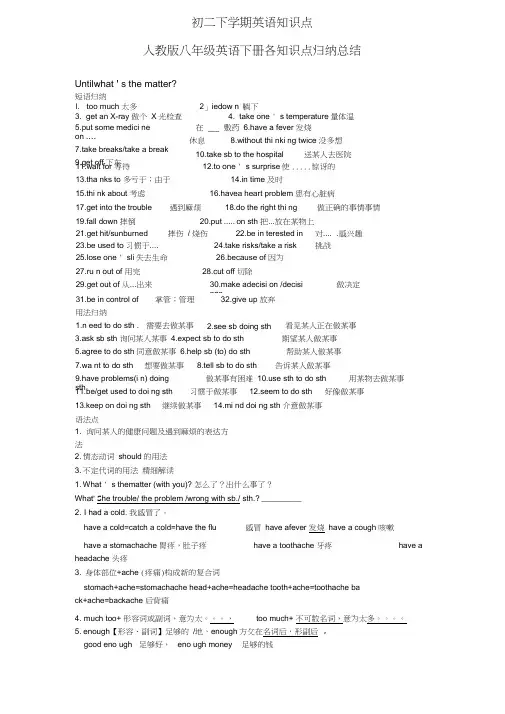
短语归纳l. too much 太多 2」iedow n 躺下3. get an X-ray 做个 X光检查 4. take one ' s temperature量体温
5.put some medici ne
on .…
7.take breaks/take a break
9.get off 下车 在 ___ 敷药 6.have a fever 发烧
休息 8.without thi nki ng twice 没多想
10.take sb to the hospital 送某人去医院
11.wait for 等待
13.tha nks to 多亏于;由于
12.to one ' s surprise使 ..... 惊讶的
14.in time 及时
15.thi nk about
考虑 16.havea heart problem 患有心脏病
17.get into the trouble 遇到麻烦 18.do the right thi ng 做正确的事情事情
19.fall down 摔倒 20.put ..... on sth 把...放在某物上
21.get hit/sunburned 摔伤 / 烧伤
22.be in terested in 对.... .感兴趣
23.be used to
习惯于.... 24.take risks/take a risk 挑战
25.lose one ' sli失去生命 26.because of 因为
27.ru n out of 用完 28.cut off 切除
29.get out of 从...出来 30.make adecisi on /decisi
ons 做决定
31.be in control of 掌管;管理 32.give up 放弃
人教版八年级英语下册知识点全总结

人教版最新八年级英语下册知识点全总结!
Unit1 what' s the matter?
1. It’s +形容词 + for sb. + to do sth. 做某事对某人来说是…的。
It’s important to do sth. 做某事很重要。
It’s important for me to eat a balanced diet. 平衡饮食对我来说是很重要的.
It’s easy to do sth. 做某事是容易的。
It’s easy for us to find out the answer. 找出答案对我们来说是容易的。
2. 情态动词should的用法
should是情态动词,它的基本用法是必须和其他动词一起构成谓语。意为"应该......"。
should(应当,应该)用于所有人称,表示劝告或建议。
eg. ---I have a very bad cold. 我感冒很厉害。
---You should lie down and have a rest. 你应该躺下,多喝水。
3. maybe与may be
(1)maybe是副词,译为“也许、可能”,相当于“perhaps”。如:Maybe he can
answer the question. 也许他能回答那个问题。
He maybe is from the USA, too. 他可能也来自美国。
(2)may be中的may为情态动词,译为“可能是......”。如:
He may be from the USA, too. 他可能也来自美国。
She may be our English teacher. 她可能是我们的英语老师。
4. few、a few、little、a little的区别和联系:
(1)few / a few用来修饰可数名词,few表示否定意义,没有,几乎没有;a few表示肯定意义, 有几个。 例如:
人教版八年级下册英语必考知识点梳理(期末复习必备)
人教版八年级下册英语必考知识点梳理(期末复习必备)
八年级下册英语知识点
Unit 1 What’s the matter?
【重点短语】
1.have a fever 发烧
2.have a cough 咳嗽
3.have a toothache 牙疼
4.talk too much 说得太多
5.drink enough water 喝足够的水
6.have a cold 受凉;感冒
7.have a stomachache 胃疼
8.have a sore back 背疼
9.have a sore throat 喉咙痛
10. take risks 冒险
11.hot tea with honey 加蜂蜜的热茶
12.see a dentist 看牙医
13.get an X-ray 拍X 光片
14.take one’ s temperature 量体温
15.put some medicine on sth. 在……上面敷药
16. give up 放弃
17. sound like 听起来像
18. all weekend 整个周末
19. in the same way 以同样的方式
20. go to a doctor 看医生
21. go along 沿着……走
22. on the side of the road 在马路边
23. shout for help 大声呼救
24. without thinking twice 没有多想
25. get off 下车 26. have a heart problem 有心脏病
27. to one’ s surprise 另某人惊讶的是
28. thanks to 多亏了 ;由于
29. in time 及时
30. make a decision 做出决定
31. get into trouble 造成麻烦
32. right away 立刻;马上
八年级下册英语各单元知识点
八年级下册英语各单元知识点
一、单元一:日常交流与词汇
1. 词汇:
- 常见日常活动词汇(如:clean, read, play, study等)
- 描述人物特征的形容词(如:friendly, hardworking,
creative等)
- 学校科目名称(如:math, science, history等)
2. 语法:
- 现在进行时的使用
- 形容词的比较级和最高级
3. 句型:
- 描述正在进行的活动(I am + 动词-ing)
- 询问和描述人物特征(He is... / She likes...)
4. 听力与口语:
- 练习听懂关于日常活动的对话
- 练习用现在进行时描述自己和他人的活动
二、单元二:旅行与交通
1. 词汇:
- 交通方式(如:by car, by train, by plane等)
- 旅行相关词汇(如:hotel, museum, tourist等)
- 地理名称和方位词(如:left, right, straight ahead等)
2. 语法:
- 一般将来时的使用
- 可数名词和不可数名词的区分
3. 句型:
- 表达将来的计划(I will go... / We are going to...)
- 询问和指示方向(Turn left at the traffic lights...)
4. 听力与口语:
- 练习听懂关于旅行计划和交通方式的对话
- 练习制定和讨论旅行计划
三、单元三:节日与文化
1. 词汇:
- 各种节日名称(如:Christmas, Halloween, New Year等)
- 与节日相关的活动和习俗(如:trick or treat, fireworks,
gift等)
- 文化差异的表达(如:custom, tradition, culture等)
八年级下册英语知识点
八年级下册英语知识点
1. 语法
1.1. 动词时态
- 现在时:描述现在正在进行的动作或常规动作
- 过去时:描述过去发生的动作或状态
- 将来时:描述将来要发生的动作或计划
1.2. 名词单复数
- 单数名词:表示一个人、物或概念
- 复数名词:表示多个人、物或概念
- 不规则名词复数形式:有些名词复数形式不规则,需要特别记忆
1.3. 形容词和副词
- 形容词:描述名词的性质、特征或状态
- 副词:描述动词、形容词或其他副词的方式或程度
1.4. 介词 - 介词用来表示位置、方向、时间、原因等概念
1.5. 比较级和最高级
- 比较级:用来比较两个事物之间的差异
- 最高级:用来比较三个或三个以上事物之间的差异
2. 词汇
2.1. 常用词汇
- 常见单词和短语,包括日常生活、学校、家庭、工作等方面的词汇
2.2. 同义词和反义词
- 同义词:具有相同或类似意义的词语
- 反义词:意义相反的词语
2.3. 词汇搭配
- 常见的词语搭配,包括动词搭配名词、形容词搭配名词等
3. 句型结构
3.1. 简单句
- 由主语和谓语组成,表达一个完整的意思
3.2. 复合句
- 由一个主句和一个或多个从句组成,从句可以是名词从句、形容词从句或副词从句
3.3. 疑问句
- 用于提问,通常以助动词、疑问词或倒装结构开头
3.4. 否定句
- 用于否定一个陈述或命令
4. 阅读理解技巧
4.1. 预测答案
- 在阅读文章之前,根据标题、开头和结尾等信息预测可能的答案
4.2. 标记关键词
- 在阅读过程中标记关键词,帮助理解文章内容和寻找答案
4.3. 概括文章
- 通过概括文章的主要内容,加强对文章的理解
4.4. 推理判断
- 根据文章中的信息进行推理判断,判断某个观点是否正确
以上是八年级下册英语的知识点概述,希望对你的学习有所帮助!
人教版八年级英语下册各单元知识点
人教版八年级英语下册各单元知识点
Unit 1 Making a Difference
Vocabulary
- volunteer 志愿者
- charity 慈善
- donation 捐赠
- organization 组织
- foundation 基金会
- orphan 孤儿
Grammar
- Simple present tense 简单现在时
- Imperatives 祈使句
- Adverbs of frequency 频度副词
Unit 2 Robots
Vocabulary
- robot 机器人
- artificial intelligence 人工智能 - function 功能
- task 任务
- instruction 指令
Grammar
- Future tense 将来时
- Conditional sentences 条件句
- Infinitives 动词不定式
Unit 3 Ancient Civilizations
Vocabulary
- civilization 文明
- monument 纪念碑
- emperor 皇帝
- dynasty 朝代
- pyramid 金字塔
- tomb 坟墓
Grammar
- Past continuous tense 过去进行时 - Time clauses 时间从句
- Passive voice 被动语态
Unit 4 Our World
Vocabulary
- pollution 污染
- environment 环境
- recycle 回收利用
- eco-friendly 环保的
- global warming 全球变暖
- ecology 生态学
Grammar
- Present continuous tense 现在进行时
- Adjectives and adverbs 形容词和副词