
仁爱版英语九年级上册Unit4 Topic2 SectionB课件
仁爱版九年级英语上册Unit3Topic2SectionB教案

1 仁爱版九年级英语上册 Unit 3 Topic 2 Section B 教案
课题 Unit 3 Topic 2 Section B 课型 Conversation
practice 时间 xxx年x月x日
教学目标 三维目标 1. Learn the new words and some phrases:
see … off, put out, ask for a ride, get in, pick up, victory
2. Learn some useful sentences:
(1)The foreigner is asking for a ride.
(2) It’s quite all right.
(3) I hope I won’t have much difficulty communicating.
(4)Whenever you need help, send me an e-mail or call me.
3. Go on learning present continuous to show the future:
(1)My uncle is meeting us tomorrow.
(2)When are you leaving for Disneyland?
(3)I’m leaving this afternoon.
4. Talk about sign language and body language.
教学重难点 1.Go on learning present continuous to show the future
2.Master the useful sentences.
教学
策略
学法
指导 Listening and reading, revision, discussion, pair work, group work
最新仁爱版英语七年级上册Unit4 Topic2 SectionB精品教案
Unit 4 Having Fun
Topic 2 Would you like to cook with us? 教学设计
Section B
The main activities are 1a and 2a. 本课重点活动是1a和2a。
Ⅰ. Teaching aims and demands 教学目标
1. Learn some useful words and expressions:
sing, song, have to, fun, fly, fly a kite, afraid, time, carry, speak to, ask, back,
call… back, evening.
2. (1) Learn the invitation:
①—Would you like to sing some songs with me?
—I’m sorry I can’t. I have to cook.
②—Would you like to cook with us?
—Yes, I’d love to.
③—How about flying a kite with me?
—I’d like that, but I’m afraid I have no time.
(2)Talk about making telephone calls:
①—Hello! May I speak to Maria?
—Oh, sorry. She isn’t in now.
②—Who’s this?
—This is Sally.
③—Could you ask her to call me back this evening?
—Sure.
Ⅱ. Teaching aids 教具
图片/录音机/小黑板/课件
Ⅲ. Five-finger Teaching Plan 五指教学方案
九年级英语上册Unit4 Topic2精品教案 整个话题39页 最新仁爱版
Unit4Topic2SectionA教学设计
Ⅰ.Materialanalysis
本课是九年级第四单元第二话题的第一课时。主活动是1a和2a。1a通过Kangkang和Maria谈论即将放映的电影来引入新时态:一般将来时的被动语态。
除了引入新时态,也引入了新话题:未来的新事物。1b以训练听力技能为主,让
学生在听觉上感受新时态。1c通过把对话转换成短文的形式,让学生巩固1a的
内容。2a要求学生观察、体验新时态的构成。2b则要求学生能基本运用新时态。3在内容上承接了2b。2b提到有些科学家认为在外太空存在外星人。3则是以听
力的形式来呈现Kangkang和Maria对此问题的讨论,并且在听的过程中,学生要
完成两个任务,进一步训练听力技能。
Ⅱ.Teachingaims1.Knowledgeaims:
掌握本课的重点词汇和短语,初步学习一般将来时的被动语态。2.Skillaims:
能够通过2a环节,自行找到一般将来时的被动语态的构成方法。
能够根据时间名词,正确的运用已经学习过的被动语态。3.Emotionalaims:(optional)
4.Cultureawareness:(optional)
Ⅲ.Thekeypointsanddifficultpoints1.Keypoints:
Wordsandphrases:screen,display,alien,inthefuture,oneday,beabletodosth.,
cometrue,inorderto,learnabout
Sentences:Whatfun!Ican’twait.
Awonderfulmoviewillbeshowntonight.
Houses,schools,andhospitalswillbebuiltonMars.
Ihopeourdreamsofspacetravelwillcometrue.
Grammar:will+be+pp
2.Difficultpoints:
仁爱版英语九年级上册Unit 4 Topic 2
仁爱版英语九年级上册Unit 4 Topic 2
(满分100分,时间90分钟)
题号 第一部分 第二部分 第三部分 总分
Ⅰ Ⅱ Ⅲ Ⅳ Ⅰ Ⅱ Ⅲ Ⅳ Ⅰ Ⅱ Ⅲ
得分
第一部分 听力 (20分)
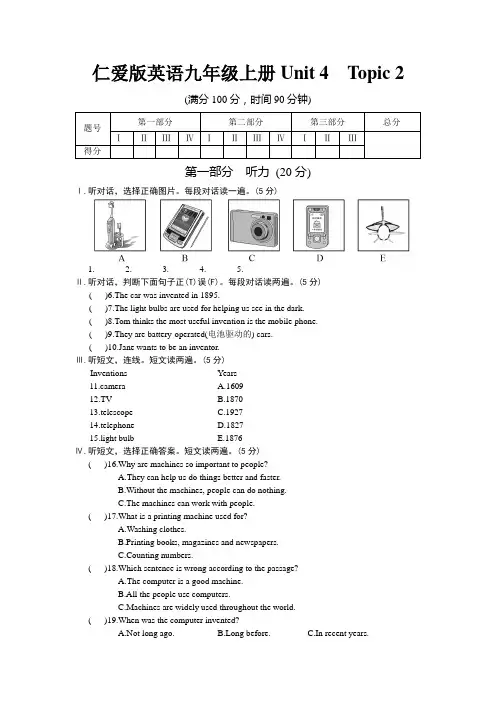
Ⅰ.听对话,选择正确图片。每段对话读一遍。(5分)
1._____ 2._____ 3._____ 4._____ 5._____
Ⅱ.听对话,判断下面句子正(T)误(F)。每段对话读两遍。(5分)
( )6.The car was invented in 1895.
( )7.The light bulbs are used for helping us see in the dark.
( )8.Tom thinks the most useful invention is the mobile phone.
( )9.They are battery-operated(电池驱动的) cars.
( )10.Jane wants to be an inventor.
Ⅲ.听短文,连线。短文读两遍。(5分)
Inventions Years
11.camera A.1609
B.1870
13.telescope C.1927
14.telephone D.1827
15.light bulb E.1876
Ⅳ.听短文,选择正确答案。短文读两遍。(5分)
( )16.Why are machines so important to people?
A.They can help us do things better and faster.
B.Without the machines, people can do nothing.
C.The machines can work with people.
( )17.What is a printing machine used for?
仁爱版九年级英语上册Unit4Topic3SectionB教案

Section B
Ⅰ. Material analysis
本课是九年级第四单元第三话题的第二课时。主活动是1a。1a通过Kangkang向Mr. Brown了解宇宙飞船的相关知识,把话题的内容由宇宙飞船引入到电脑科技并继续学习定语从句。1b主要是培养学生运用已知的知识来推断未知的知识的能力。1c则是通过完成短文来复述1a的内容。2是训练“听并排序”和“听并记录”的技能,在训练技能的同时拓展了学生的知识面。3是典型的语法操练,巩固定语从句关系代词的运用。4将语音语调的训练与定语从句结合了起来。
Ⅱ.Teaching aims
1. Knowledge aims:
掌握本课的重点词汇和短语,继续学习定语从句。
2. Skill aims:
能够运用已知的经验来预测未知的领域。
能够在2中进行“听并排序”和“听并记录”,并且能运用速记技巧完成句子。
能够通过4,学习长句的停顿、弱读并把握正确的语音语调。
3. Emotional aims: (optional)
激励学生努力学习电脑知识,使之更好地服务于人类社会。
4. Culture awareness: (optional)
Ⅲ. The key points and difficult points
1. Key points:
Words and phrases: electronic, spacesuit, telescope, used to do, use sth. to do sth., advise sb.to do sth., make sb/sth. do sth., make up one’s
mind to do sth., add sth. to… Sentences: Spaceships which now mainly use eletronic controls used to be controlled by astronauts.
2019-2020年九年级英语上册Unit4Topic2WhenwasitdevelopedSect
2019-2020 年九年级英语上册 Un it 4 Topic 2 When was it developed
Section C 教案 仁爱版
The main activity is 1a. 本课重点活动是 1a。iu
I . Teach ing aims and dema nds 教学目标
1. Lear n some new words and expressi ons:
serva nt, for certa in, housework, make a con tributi on to
No one knows for certa in, but most people think that robots will be part of
our lives.
2. Discuss the adva ntages and disadva ntages of robots.
n . Teaching aids 教具
录音机/单词卡片/写有单词释义的卡片/多媒体课件/ 一些机器人的图片(或教学挂图”
幻灯片
川.Five-fi nger Teachi ng Pla n 五指教学方案
Step 1 Review 第一步 复习(时间:13分钟)
1.(出示幻灯片,同学们根据幻灯片的图表,用过去时的被动语态做对话练习。 )
Inven ti on Inven tor Year
car Karl Benz 1885
radio Guglielmo Marconi 1895
light bulb Thomas Edis on 1879
T: Boys and girls, we have learned many inventions during the last period. Look
at the table and make dialogs like this:
A: When was the car inven ted?
仁爱版九年级英语上册Unit4Topic2SectionB教案
Section B
Ⅰ. Material analysis
本课是九年级第四单元第二话题的第二课时。主活动是1a和3a。1a 通过Kangkang 和Maria 由谈论航天之旅延伸到各自的理想,继续学习一般将来时的被动语态。1b是检测学生的听力技能,1c通过完成句子,让学生巩固一般将来时被动语态的结构。2是学生比较感兴趣的UFO,重点是培养学生通过问题预测听力内容的能力。3a把语法知识和语音语调巧妙地融合在一起。3b属于半开放式拓展训练,是对3a的延续。通过本课的学习,学生基本能掌握一般将来时的被动语态。
Ⅱ.Teaching aims
1. Knowledge aims:
掌握本课的重点词汇和短语,继续学习一般将来时的被动语态。
2. Skill aims:
能够通过1c, 3a和3b环节,基本掌握一般将来时的被动语态的结构。
能够听懂含有一般将来时的被动语态的对话,并且能够正确运用这一时态。
3. Emotional aims: (optional)
做一个有理想的中学生,并为实现理想而刻苦学习。
4. Culture awareness: (optional)
Ⅲ. The key points and difficult points
Key points:
Words and phrases: realize, dancer, admire, master, take part in, grow up, prefer…to…
Sentences: What are you going to be?
I’d like to be an astronaut when I grow up. But I prefer science to dance.
Then our dreams will be realized.
仁爱版英语九年级上册Unit 4 Topic 2
Unit 4 Topic 2
Section A
I. 根据所给提示填空,每空填一词。
1. I seldom eat junk food _________ ________ ________ keep healthy.(为了)
2. Can you tell me which river is the longest river_____ ______ ______(在地球上)
3.There will be a wonderful movie this evening. I’m excited and _______ ______ _____
watch it.(迫不及待地)
4.I believe that our dream ________ _________ _________ one day.(将会实现)
5. He _________ playing the guitar _________ playing the piano.(和…比,更喜欢)
II. 根据要求完成句子。
1. Many people discussed aliens those days.(改为被动语态)
Aliens ____________ __________ by many people those days.
1. Robots will drive the buses and taxis in 2048. (改为被动语态)
The buses and taxis_________ ________ _________ by robots in 2048.
2. We will plant trees and flowers under the sea in the future.(改为被动语态)
Trees and flowers _________ ________ _________ under the sea in the future.
仁爱版九年级上册英语教学案Unit4Topic2SectionB【精校版】
仁爱版精品英语资料(精校版)
Section B
Ⅰ. Material analysis
本课是九年级第四单元第二话题的第二课时。主活动是1a和3a。1a 通过Kangkang 和Maria 由谈论航天之旅延伸到各自的理想,继续学习一般将来时的被动语态。1b是检测学生的听力技能,1c通过完成句子,让学生巩固一般将来时被动语态的结构。2是学生比较感兴趣的UFO,重点是培养学生通过问题预测听力内容的能力。3a把语法知识和语音语调巧妙地融合在一起。3b属于半开放式拓展训练,是对3a的延续。通过本课的学习,学生基本能掌握一般将来时的被动语态。
Ⅱ.Teaching aims
1. Knowledge aims:
掌握本课的重点词汇和短语,继续学习一般将来时的被动语态。
2. Skill aims:
能够通过1c, 3a和3b环节,基本掌握一般将来时的被动语态的结构。
能够听懂含有一般将来时的被动语态的对话,并且能够正确运用这一时态。
3. Emotional aims: (optional)
做一个有理想的中学生,并为实现理想而刻苦学习。
4. Culture awareness: (optional)
Ⅲ. The key points and difficult points Key points:
Words and phrases: realize, dancer, admire, master, take part in, grow up, prefer…to…
Sentences: What are you going to be?
I’d like to be an astronaut when I grow up.
But I prefer science to dance.
Then our dreams will be realized.
仁爱版九年级英语上册Unit3Topic2SectionB教案 2
Section B
Ⅰ. Material analysis
本课是九年级第三单元第二话题的第二课时。主活动是1a和2a。通过Jane和Yukio不同的问候方式,进入本课的重点:谈论肢体语言。1a通过对话引入话题,1b和1c都是基于1a 而进行的理解练习。2a和2b则让学生学习收集常见的肢体语言。3要求学生完成排序,通过排序的过程,让学生在阅读中理解肢体语言在沟通中的重要性。4是一个很有趣的活动,贴近学生的生活。通过这个活动,也是要求学生在生活中要善于观察,学会“察言观色”。通过本课的学习,让学生通过肢体语言,知道一些讲英语国家的交际礼仪。
Ⅱ. Teaching aims
1. Knowledge aims:
掌握本课的重点词汇和短语,了解一些讲英语国家的常见肢体语言。
2. Skill aims:
能看懂一些常见的肢体语言。
能在沟通中合理地运用肢体语言。
3. Emotional aims: (optional)
培养学生在生活中善于观察,并能据此作出适当反应的能力。
4. Culture awareness: (optional)
让学生知道语言具有多元性,知道肢体语言也是文化的一部分。
Ⅲ. The key points and difficult points
1. Key points:
Words and phrases: silence, praise, research, secret, victory, misunderstanding, be known as, use sth. to do sth., help sb. with sth., avoid doing sth.
Sentences: I wonder if body language means the same thing in all cultures.
I think that is known as body language.