
Module 4 Home alone Unit 3-1 公开课教学PPT课件(外研版九上)
外研版中考英语课内阅读九上M4home alone
Module 4 Home alone Unit2 I became so bored with their orders that I wished they would leave me alone
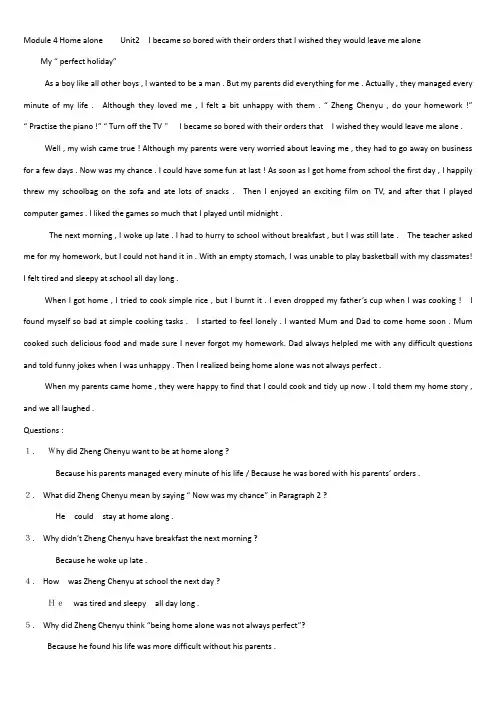
My “ perfect holiday”
As a boy like all other boys , I wanted to be a man . But my parents did everything for me . Actually , they managed every
minute of my life . Although they loved me , I felt a bit unhappy with them . “ Zheng Chenyu , do your homework !”
“ Practise the piano !” “ Turn off the TV" I became so bored with their orders that I wished they would leave me alone .
Well , my wish came true ! Although my parents were very worried about leaving me , they had to go away on business
for a few days . Now was my chance . I could have some fun at last ! As soon as I got home from school the first day , I happily
threw my schoolbag on the sofa and ate lots of snacks . Then I enjoyed an exciting film on TV, and after that I played
外研版(新标准)英语九年级上册Module 4 Home alone Module4 Unit 1教案
1 Module 4 Unit1 Home alone
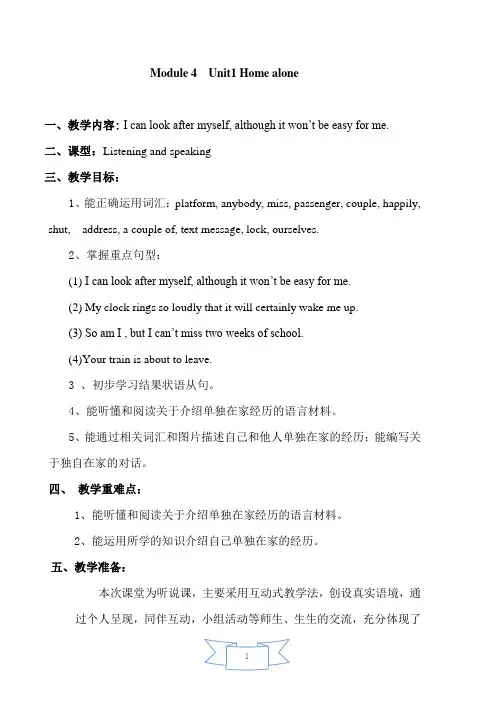
一、教学内容: I can look after myself, although it won’t be easy for me.
二、课型:Listening and speaking
三、教学目标:
1、能正确运用词汇:platform, anybody, miss, passenger, couple, happily,
shut, address, a couple of, text message, lock, ourselves.
2、掌握重点句型:
(1) I can look after myself, although it won’t be easy for me.
(2) My clock rings so loudly that it will certainly wake me up.
(3) So am I , but I can’t miss two weeks of school.
(4)Your train is about to leave.
3 、初步学习结果状语从句。
4、能听懂和阅读关于介绍单独在家经历的语言材料。
5、能通过相关词汇和图片描述自己和他人单独在家的经历;能编写关于独自在家的对话。
四、 教学重难点:
1、能听懂和阅读关于介绍单独在家经历的语言材料。
2、能运用所学的知识介绍自己单独在家的经历。
五、教学准备:
本次课堂为听说课,主要采用互动式教学法,创设真实语境,通过个人呈现,同伴互动,小组活动等师生、生生的交流,充分体现了 2 学生在学习过程中的主体地位,教师只是课堂的引导者,组织者和合作者,让学生在使用中学会英语,综合培养学生的英语语言运用能力。在教学过程中,采用多媒体手段辅助教学,利用各种图片和习题任务贯穿整个教学过程。因此,本节课需准备:PPT课件、录音机、课堂练习、奖品。
外研版九年级上册英语Module 4 Home alone知识点总结

初三英语上册(外研版)Module 4 Home alone
知识点总结
一、重点词汇
· 原文再现
It’s leaving from Platform 2.
它将在2号站台出发。
· 基本用法
1. platform n. 月台;站台。如:
Any train from this platform stops at Gatwick.
从这一月台开出的火车都在盖特维克停。
2. platform n. 讲台。如:
Jane walked boldly up to the platform without faltering.
简沉着大胆地走上讲台。
· 原文再现
The meeting in Lhasa is very important for us…
在拉萨的会议对我们而言很重要……
· 基本用法
meeting n. 会议;集会,at meeting意为“在会议上”。如:
Our meeting in Beijing was later than I expected.
我们在北京的会面比我们预想的要晚。
I’m sorry Mr. Wang is at meeting now.
很抱歉王先生正在开会。
have/hold a meeting 意为:开会
The manager is having a meeting.
经理正在开会。
· 知识拓展--相关单词
meet v. 遇见;满足(过去式:met 过去分词:met 现在分词:meeting 第三人称单数:meets) meet with. “遇到;碰到”强调偶然性;还常表示“遭遇;经历;遭到”。
I met with a childhood friend on the bus.
我在汽车上遇到一个儿时的朋友。
They met with an accident on their way back.
外研九上Module 4 Home alone讲义和练习(无答案)
外研九上Module 4 Home alone讲义和练习(无答案)
1 / 6 Module 4 Home alone
Unit 1 I can look after myself,although it won’t be easy for me.
考点精析:
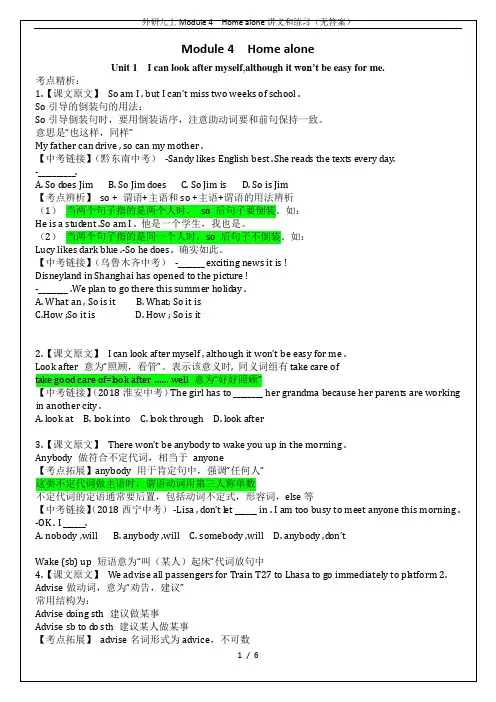
1.【课文原文】 So am I , but I can’t miss two weeks of school .
So引导的倒装句的用法:
So引导倒装句时,要用倒装语序,注意助动词要和前句保持一致。
意思是“也这样,同样”
My father can drive , so can my mother .
【中考链接】(黔东南中考) -Sandy likes English best .She reads the texts every day.
-__________.
A. So does Jim B. So Jim does C. So Jim is D. So is Jim
【考点辨析】 so + 谓语+主语和so +主语+谓语的用法辨析
(1) 当两个句子指的是两个人时, so 后句子要倒装。如:
He is a student .So am I . 他是一个学生,我也是。
(2) 当两个句子指的是同一个人时,so 后句子不倒装。如:
Lucy likes dark blue .-So he does . 确实如此。
【中考链接】(乌鲁木齐中考) -_______ exciting news it is !
Disneyland in Shanghai has opened to the picture !
-________ .We plan to go there this summer holiday .
A. What an , So is it B. What; So it is
C.How ;So it is D. How ; So is it
Module 4 Unit 1 外研版英语九年级上册知识点详解
1 / 5 外研版九(上)Module 4 Home alone知识点详解
重点知识清单
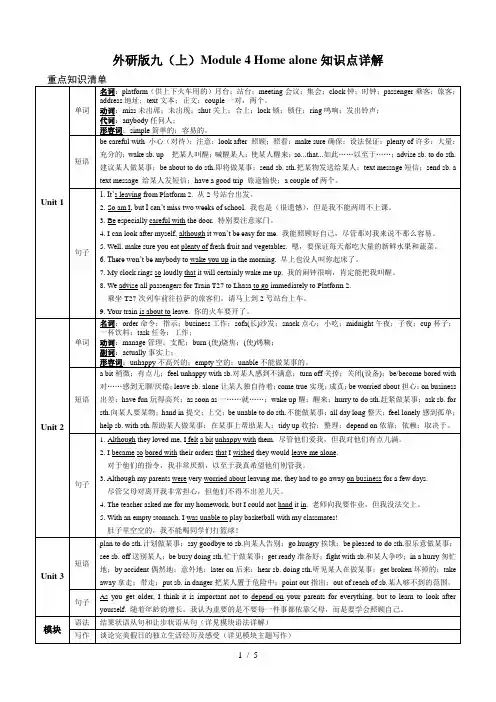
Unit 1 单词 名词:platform(供上下火车用的)月台;站台;meeting会议;集会;clock钟;时钟;passenger乘客;旅客;address地址;text文本;正文;couple一对,两个。
动词:miss未出席;未出现;shut关上;合上;lock锁;锁住;ring鸣响;发出铃声;
代词:anybody任何人;
形容词:simple简单的;容易的。
短语 be careful with 小心(对待);注意;look after 照顾;照看;make sure确保;设法保证;plenty of许多;大量;充分的;wake sb. up 把某人叫醒;喊醒某人;使某人醒来;so...that...如此……以至于……;advise sb. to do sth.建议某人做某事;be about to do sth.即将做某事;send sb. sth.把某物发送给某人;text message短信;send sb. a
text message 给某人发短信;have a good trip 旅途愉快;a couple of两个。
句子 1. It’s leaving from Platform 2. 从2号站台出发。
2. So am I, but I can’t miss two weeks of school. 我也是(很遗憾),但是我不能两周不上课。
3. Be especially careful with the door. 特别要注意家门。
4. I can look after myself, although it won’t be easy for me. 我能照顾好自己,尽管那对我来说不那么容易。
5. Well, make sure you eat plenty of fresh fruit and vegetables. 嗯,要保证每天都吃大量的新鲜水果和蔬菜。
外研版英语九年级上册模块4 Unit 1 听说课教案

外研版英语九年级上册模块4 Unit 1 听说课教案
1 / 4 Module 4 Home alone
Unit 1 I can look after myself,although it won’t be
easy for me.
(听说课教案)
Ⅰ、Teaching model:Listening and speaking
Ⅱ、Teaching method:Communicative approach
Ⅲ、Teaching Objectives
Knowledge objective
Key vocabulary:
----platform,meeting,miss,shut,lock,simple,anybody,clock,ring,passenger,address,
test,test message,couple,a couple of
Key structures:-----although和 so...that...引导的状语从句。
Ability objective
1. To listen and understand sentences with although and so...that....
2. To understand the conversation.
3. To learn to use although and so ...that....
Moral objective
1. To talk about things staying at home alone..
2.. To develop the ability to cooperate with others.
Ⅳ、Teaching importance and difficulty
1. To learn about some expressions in the passage.
人教版2020九年级英语上册 Module 4 Home alone词句精讲精练 (新版)外研版
1 Module 4 Home alone
词句精讲精练
【词汇精讲】
1. miss
miss为动词,意为“想念,思念”。例如:
I’ll miss you when you go to Canada. 你到了加拿大以后,我一定会想你。
【拓展】
(1) miss作动词还有“未击中,未抓住”的意思。例如:
I tried to hit the ball but I missed. 我努力地想击中球,但却未成功。
(2) miss还可意为“未赶上,错过”,是动词。例如:
I missed the football match on TV last night. 我错过了昨天晚上电视中的足球赛。
(3) miss与like; mind; finish; enjoy; practice; be busy; stop; can’t help; give up等词一样后接动词的-ing形式。例如:
I don’t want to miss seeing that film on television tonight.
我不想错过今晚在电视上看那部影片的机会。
2. hand in
hand in是固定搭配,意为“上交;交出”,hand在此处为动词。例如:
— Must he hand in his homework this morning? 他必须今天上午交作业吗?
— No, he needn’t. 不,不必了。
hand还可以作名词,意为“手”。例如:
Mike put his hand up three times during the class.
在这节课内,Mike举了三次手。
Did you notice his hand shaking?
你有没有注意到他的手在抖?
3. though
(1) though可以作连词,意为“虽然;即使;纵然”,放在从句的开头和中间均可。例如:
2022年外研版九上《Module 4 Home alone 导学案 (附答案)
Module 4 Home alone
Unit 1
学习目标
一、掌握本单元shut , lock , ring , wake sb. up ,be about to do sth.等单词和短语. 〔重点〕
二、掌握并灵活运用以下句子:〔重点〕
1. So am I .
2. Have a good trip !
三、听懂日常生活中父母嘱咐孩子留神某事的对话理解父母的苦心并能就父母的一些言行发表自己的看法.
自主预习
一、新词自测读写单词或短语并熟记看谁记得快.
1.未出席;未出现 v. miss
2.锁;锁住 v. lock
3.简单的;简易的 adj. simple
4.叫某人起床 wake sb. up
5.乘客 n. passenger
6.地址 n. address
7.短信 text message
8.一对;两个 n. couple .
二、根据汉语意思完成句子.
1.--你不能和我们一起去我很难过.
- 我也是.
- I’m sorry that you can’t go with us.
- So am I .
2.我的闹钟很响, 当然能叫我起床.
My alarm clock rings so loudly that it will certainly wake me up.
3.两周后见.
See you in a couple of weeks.
课堂导学
1. So am I ,but I can’t miss two weeks of school.
我也是但我不能两周都不上学.
句型1:so+助动词/连系动词/情态动词+主语. ……也一样
so+助动词/连系动词/情态动词+主语, 意为“……也一样〞, 表示前者的情况同样适合后者, 其时态应和上一句保持一致, 前后两个句子的主语指不同的人或物.
英语九年级上册重点短语(Module 4 Home alone)-导学案-外研版(三起)
初中英语 重点短语(Module 4 Home alone)
学生基本能够掌握本模块重点短语,并尝试用新学知识点造句。
重点:come with sb., wake up, advise sb. to do sth., be about to, a
couple of等短语的用法。
难点:各短语在考试和实际中的灵活运用。
知识梳理:
【短语学习】
1. come with sb.
和某人一起去
I’m sorry you can’t come with us, Betty.
真对不起,贝蒂,你不能和我们一起去了。
come相关的词组,希望大家能够在课下进行系统总结:
come along 来吧
come back 回来
come down 落下
come from 来自
come in 进来
come on 加油,跟我来
come out 出版
请用相关词组填空:
come back come out come from
① She ________________ China.
② His book ________________ last year.
③ She didn’t have supper until her mother _______________.
答案:comes from, came out, came back
思路分析:结合具体句意得出答案。
2. wake up
叫醒
There won’t be anybody to wake you up in the morning.
每天早晨不会有人叫醒你。
wake在这里用作及物动词。
Try not to wake the baby up.
wake还有不及物动词的用法,表示“醒来”
What time do you usually wake (up) in the morning?
翻译句子:
我今天早晨起得很早。
外研版-英语-九上-九上Module4 Home alone单元二教案
初中-英语-打印版
初中-英语-打印版 Module 4 Home alone
【教材分析】
Module 4的主要内容为运用让步状语从句和结果状语从句来描述自己单独在家的经历。从全书来看,本模块承接上一模块对状语从句的学习和运用,内容有层次的展开,学生容易接受。
Unit 2 I became so bored with their orders that I wished they would leave me alone.
【教学目标】
Knowledge objective
Key vocabulary:
actually, manage, unhappy, order, business, sofa, snack, midnight, empty, burn, cup,
task
Key structures:
turn off, be worried about, on business, have fun, hand in, unable to do, all day, tidy
up, wake up, hurry to do sth.
Ability objective
To get information about exercise activities.
To master the adverbial clause of concession.
Moral objective
To know more about other person’s problems and master some basic skills in the
life.
【教学重点】
1.To learn some expressions in the passage.
2.To learn the adverbial clause of concession.
【教学难点】
1. To get information from the article.