
high school
U1P2HighSchoolHints重点词句型句子翻译

Passage 2 High School Hints 高中生活指南Words:1. stand on stage at least once: 站在舞台上至少一次2. win an award: 赢得一个奖3. read as many books as possible: 读尽可能多的书as many/much…as possible: 尽可能多的…4. graduate from our school last June: 去年六月从我们学校毕业5. be about to go to college: 将要上大学6. share your suggestions with us: 和我们分享你的建议7. as if/though: 好像,似乎8. a fantastic opportunity for new students: 对于新生来说一个极好的机会9. make friend s with …:与…交朋友10. keep an open mind: 保持一个开放的心态11. take part in activities as much as possible 尽可能多地参加活动12. That’s sound advice for sure. 那当然是合理的建议。
sound (adj.): 明智的,合理的,正确的;健康的,健全的n. 音量,声音vi./vt.: (使)发声,(使)响~ an alarm;发…音/听起来~beautiful 13. deal with a new challenge: 处理一个新的挑战deal with: 处理=do with deal, dealt, dealt challenge (n./vt.)14. have a chemistry test at the end of the first week: 在第一周结束的时候有一个化学测试15. at the sight of the test paper: 一看到试卷16. go all out and see what happens: 全力以赴,看看发生什么17. hold your head up: 把头抬起来/不要气馁18. must have had some moments: 一定有过一些时刻19. be selected for the endofyear petition: 被选中参加年底的比赛petition (n.): 竞争,比赛pete (vi.): 竞争,参加比赛(~ for food: 争夺食物)petence (n.): 能力,胜任petent (adj.): 有能力的,称职的petitive (adj.): 竞争性的,有竞争力的;好强的20. at first: 刚开始later: 后来at last:最后21. kept working hard yesterday: 昨天一直努力工作22. totally agree: 完全同意totally (adv.): 全然地;完全地total (adj.): 总的,全部的;完全的;彻底的n. 总数,合计in total: 总共23. would like to share with us: 想要和我们分享24. look back on my high school life: 回顾我的高中生活25. give your friends a hand: 帮助你的朋友give sb. a hand: 帮助某人give sb. sth.=give sth. to sb. 给某人某物give=offer=hand 给26. Good luck with your exam!祝你考试好运!good luck with sth./to sb.: 祝.../某人好运Sentences:It’s a fantastic opportunity for new students to get to know the school and the other students.对于新生来说,这是一个了解学校和其他学生的绝佳的机会。
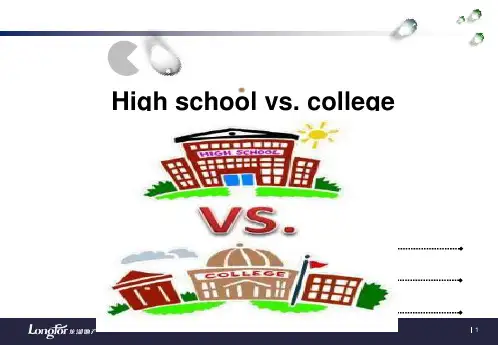
college vs high school 高中和大学的区别
You are expected to take responsibility for what you do and don't do, as well as for the consequences of your decisions.
11
Have you encountered some difficulties in the transition to college?
Teachers carefully monitor class attendance.
Professors may not always check completed homework, but they will assume you can perform the same tasks on tests.
12
Suggestions
On study
On life
Find the ideal place forgyootuotcolasstusdy.
Seek a balance. Manage your
Take advantage of the fLineaanrncetso. cope with
SUCCEEDING IN COLLEGE CLASSES
Classes generally have no more Your classes could range from
than 70 students.
as few as 24 students to as
many as 100 or more!
5
Grades
GRADES IN GRADES IN HIGH SCHOOL COLLEGE
You feel upset even if You are overjoyed as
读高中的好处英文作文
读高中的好处英文作文英文:As a high school student, I strongly believe that there are numerous benefits to attending high school. Firstly, high school provides students with a solid foundation for their future academic pursuits. Through rigorous coursework and challenging assignments, students are able to develop critical thinking skills and hone their intellectual abilities. Additionally, high school offers a variety of extracurricular activities such as sports teams, clubs, and volunteer opportunities, which allow students to explore their interests and develop their passions.Furthermore, high school is an important time for personal growth and development. It is during this timethat students begin to discover who they are and what they want to do with their lives. They are exposed to a diverse range of people and ideas, which helps them to broadentheir perspectives and become more open-minded individuals.High school also offers opportunities for students to develop important life skills such as time management, communication, and leadership.In my personal experience, attending high school has been incredibly beneficial. I have been able to develop my academic abilities and pursue my interests through extracurricular activities. I have also made lifelongfriends and developed important life skills that will serve me well in the future.中文:作为一名高中生,我坚信参加高中有许多好处。
HighSchoolVSCollege
High School VS CollegeMost of us may find that it is different between high school and college. Personally, I think the distinctions are always in study and life.In high school, teachers help us study. Our teachers showed us how to solve every problem by detailed explanations and elaborate examples. W e did whatever they told us just as tools. Every day we did the same things, practicing and practicing. All of us have the same dreams.In high school, we lived a dependent life. Most of our time is spent on study, everything was linked with study. We live with our parents, we need not to worry about such things as making decisions, balancing our budget, etc. They would always prepare everything and solve every difficulty for us.In college, however, we study by ourselves. The teachers only tell us the different approaches to problems and we are left with a lot of spare time to study and solve these problems by ourselves. W e have more free time to do whatever we want to or interested.In college, we live an independent life. College life is colorful but a little difficult. W e live in school, far from home, with classmates and friends, and we will meet people from different place. W e should learn to get along well with others. What’s more, we will also meet some difficulties and problems in our daily and study life, we need to overcome and solve them on our own.In a word, whether high school or college is just like two kinds of coffe e, in fact, both are filed with bitterness and sweetness. W e should use a right attitude to face it.。
My high school我的高中

My high schoolI am a college student now after three years’ high school. Although high school is the most hardest, and we must do lots of homework. High school is the most impressive. And I am glad to introduce my high school which in my deep memory.My high school lies in the side of the most busy road---the national road 301 in my hometown. When you stand in the road, you can see the grand gate which has several words ‘The Second Senior High School of Lingyuan’on the top. Then you go into the school, you can see two beautiful lawns with many trees and flowers in it and a path between two lawns at first. The lawns may have 200 meters. Next, you can pass into a main teaching building through the path.My school have four buildings in all. Two main teaching buildings, a library building and a dormitory building. The first main teaching building when you go into which I said above is the building that students mainly attend the classes. And on the left side is another teaching building. This one is mostly used by liberal students. In the opposite, there is a library with lots of books,magazines and so on, and many students go to study there. These three buildings are connected with two passages.Behind the teaching building you can see a plastic playground with a basketball court and a table tennis court on the right side and the dormitory building on the left side. You may ask me where the mess hall is. Let’s me tell you, it is in the basement of the dormitory building. And the food is very delicious.This is my high school, and i think it is the best school of the world.I like everything there. I love it.。
高中生英语作文:我的高中生活My High School Life

高中生英语作文:我的高中生活My High SchoolLife【篇一】我的高中生活My High School LifeAs a Senior Grade Three students, I am very busy in preparing for the college entrance examination. I have seven classes a day, and two self-study classes at night. And only a day left for the weekend. So, most of the time I have to spend on the study, after all the college entrance examination is very important for almost all of us. Aside of study, I would play football with my friends after school and the weekend. I like playing football very much. When I run on the football field, I can put the examination thing off my mind for a while, only sweat and laugh left. It is a good exercise for health and a good way to relax from the busy study too. This is my high school life, busy and fulfilling.作为一个高三的学生,我忙于为高考做准备。
我一天有7节课,还有两节晚自习。
周末只剩下一天。
所以,我把绝大部分时间都花在学习上,毕竟高考对我们绝大部分人来说都十分重要。
high school hints教学设计
high school hints教学设计题目:高中生活中的学习指南导引:高中是许多学生人生中的重要阶段,同时也是各种挑战和压力的来源。
为了帮助高中生更好地应对学习任务,掌握有效的学习方法和策略,我们提供以下高中生活中的学习指南,帮助他们在学业上取得成功。
第一步:制定目标和规划1. 设立明确的学习目标:为了取得成功,高中生需要制定明确的学习目标。
这些目标可以是每学期的成绩目标、选取参加的课外活动目标或大学录取的目标等。
明确的目标有助于给学习活动一个方向,并提供持久的动力和动力。
2. 制定学习规划:制定一个合理的学习规划对于高中生来说至关重要。
这包括编排一个每日学习时间表,确定每天需要完成的任务和事项,并合理分配时间。
学习规划还应包括复习和休息的时间,确保学生在忙碌的日程中保持平衡。
第二步:建立良好的学习环境1. 寻找适合的学习空间:选择一个安静、明亮且整洁的学习环境非常重要。
在这里,学生可以集中精力并避免分散注意力。
一个有序的学习空间有助于提高效率和专注度。
2. 消除干扰:确保学习环境没有任何分散注意力的因素,如电视、手机和社交媒体。
在学习期间,将手机和其他娱乐设备放在一边,集中精力完成任务。
3. 使用适当的学习工具和资源:为了取得最佳的学习效果,高中生应该学会正确使用各种学习工具和资源。
这包括图书馆、参考书籍、在线学习平台和教师提供的资料等。
充分利用这些资源,扩大学习的广度和深度。
第三步:学习方法和策略1. 主动参与课堂:在课堂上积极参与并提问问题是学生取得成功的重要一步。
积极参与课堂讨论有助于加深理解和记忆,并通过与同学和老师的交流来拓展知识。
2. 阅读技巧:高中生需要学会使用一些阅读技巧来更好地理解文本。
这包括主动阅读、划重点、做笔记和与同学进行讨论等。
3. 有效记笔记:良好的记笔记习惯对于学习至关重要。
学生应该学会聚焦关键信息、用简洁的表达方式记录、整理和复习笔记。
这有助于加深理解和记忆。
大学与高中的区别英语作文
College and high school are two distinct phases in a students educational journey, each with its unique characteristics and experiences. Here are some of the key differences between the two:1. Academic Freedom: In college, students enjoy a higher degree of academic freedom. They can choose their courses, often within a broader range of subjects, and have more control over their study schedules. In contrast, high school students typically follow a more structured curriculum with fewer choices.2. Responsibility: College students are expected to be more selfreliant and responsible for their learning. They must manage their time effectively, keep track of assignments, and often handle more complex coursework without the constant guidance of teachers.3. Teaching Style: Professors in college often use a more discussionbased approach to teaching, encouraging students to think critically and engage with the material. High school teaching tends to be more didactic, with teachers providing direct instruction and students absorbing information.4. Class Size: College classes can vary greatly in size, from small seminars to large lectures with hundreds of students. High school classes are generally smaller and more consistent in size, allowing for more personalized attention.5. Extracurricular Activities: Both college and high school offer extracurricular activities, but the range and depth may differ. Colleges often have a wider variety of clubs, sports teams, and organizations, catering to diverse interests.6. Social Life: The social environment in college is often more diverse and independent. Students live away from home, make new friends, and experience a greater degree of personal freedom. High school social life is typically centered around the school and local community, with more parental involvement.7. Career Preparation: College is a stepping stone towards a career, with many programs offering internships, career services, and networking opportunities. High school provides foundational knowledge and skills but is less focused on immediate career preparation.8. Living Arrangements: Many college students live on campus in dormitories, which can be a new experience compared to living at home during high school. This change can be both exciting and challenging as students adjust to a new way of life.9. Financial Aspects: College often involves greater financial responsibility, with studentspotentially managing loans, scholarships, and parttime jobs to cover tuition and living expenses. High school students typically do not face these financial burdens.10. Transition to Adulthood: The college years are a critical period of transition into adulthood, where students learn to navigate independence, make important life decisions, and prepare for their future careers.In conclusion, while both high school and college are essential stages in education, they offer different experiences that shape students in unique ways. The transition from high school to college is a significant milestone, marking the beginning of a new chapter in personal and academic growth.。
高考英语词汇high school素材延伸学习
high school中文是什么意思•中文翻译•high adj. 1.高的〔指物,形容人的身高用tall〕;高...•be in high school 上高中•high school, secondary school 专科学校•secondary school = high school 高中•high school high 之高•after high school = leave school 中学毕业后•middle school; junior high school 初级中学•secondary school; senior high school 高中• a high school of learning 是“中学”湖南大学怎么会是• a high school student 崔扬; 一个高中生•aid for high school pupils 给中学生的援助•chengdu shude high school 树德中学•chevy chase high school 切维─蔡斯中学•chinese high school 华侨中学•chinese independent high school 董教总; 独立中学; 独中; 立中•chung ling high school 钟灵中学•columbine high school 哥伦拜恩中学•columbine high school massacre 哥伦拜恩校园事件; 科拜校事件; 科伦拜校园事件•comprehensive high school 综合高中•comprehensive senior high school 综合高中•cromartie high school 魁!!天兵高校; 魁!!天兵高校•daan vocational high school 大安区台北市立大安高级工业职业学校•daojiang high school of commerce大同区台北市私立稻江高级商业职业学校•例句与用法1.Seth orinda was a black high school teacher .塞恩奥林达是位黑人中学教员。
High school高中的定义
Information of High schoolHigh school is the name used in some parts of the world (in particular Scotland, North America and Australia) to describe an institution which provides all or part of secondary education. The term originated in Scotland and spread to the New World countries as the high prestige that the Scottish educational system had at the time led several countries to employ Scottish educators to develop their state education systems.[citation needed] The precise stage of schooling provided by a high school differs from country to country, and may vary within the same jurisdiction. In all of New Zealand and parts of Australia and Canada, high school is synonymous with secondary school, and encompasses the entire secondary stage of education. High school can also be the point in life for many students where they mature and develop a deeper sense of understanding about themselves and the people around them. Alternatively, some students will undergo this transitional stage later on in life when they enter college or university, although this is usually a continued progression that originates in high school.BrazilIn Brazil, high school is officially called "Ensino Médio" and is also informally known as "Colegial" or "Segundo Grau". It is the last phase to basic education. Brazilian high school lasts 3 years, attempting to deepen what students learn in elementary school and junior high. A Brazilian high school student is referenced by their year - 1st, 2nd and 3rd years.Unlike some countries, Brazilian students don't have a final test to conclude studies. Their approval depends only on their final grade on each subject. Each university elaborates its own test to select new students - this test, the "vestibular", generally happens once a year. Enem, a non-mandatory national exam, evaluates high school students in Brazil and is used to rank both private and public schools.The best scores in vestibular and in Enem and the best universities are concentrated on the Southern region of the country, mainly in the states of São Paulo, Rio de Janeiro, Minas Gerais, Espírito Santo, Rio Grande do Sul, Santa Catarina and Paraná, and in the Federal District. The lack of funds and historical and social problems contribute to poor attendance from the students, especially those in public schools. Nevertheless, some are national models, such as the Colégio Pedro II, named after the 19th century emperor.Private establishments, on the other hand, may be recognized as academically excellent or merely as investments in social networking. Schedules vary from school to school. The subjects taught, however, are conceived by the Ministério da Educação (Ministry of Education) which emphasises the hard sciences.The educational year begins in February and finishes in December; institutions are permitted to define their own actual start and end dates. They must, however, provide 200 days of classes.Universities are also divided into public and private. At this level, public ones are considered excellent and their vestibular exam is very competitive (the exam for med school in UNICAMP may hit 300 candidates per place). For better preparation, therefore, many students take a "curso pré-vestibular" (university prep. course). The larger private high schools offer this course.Czech RepublicThe Czech school system is, due to historic reasons, almost same as The German school system. The school system is free and mandatory to age 16. After the Základníškola (Elementary School) in age of 16 , students are directed to three different optional secondary education schools:∙Střední odborné učiliště (SOU) - designed for students going into a trade(e.g., carpentry, masonry, auto-mechanic etc.) Education is 3 years long andentrance exam free, combined with practice(one week study in school/oneweek practice in factory, bakery,building site... etc.), finished with acertificate.∙Střední odborná škola (SOŠ) - designed for students going into a profession (accountant, technician, kindergarten teacher..) and finishes with maturita asexit exam. The leaving exam consist of 2 compulsory and 2 optional subjects.Compulsory subjects are Czech language and World Literature and one other language. Optional ones depend on the type of school (mathematics, physics,accounting, etc.) The study is 4 years long and you need to pass an entranceexam (Czech Language and Mathematics or Physics, varies with the type ofschool)∙Gymnasium (Gym) - designed for students going to university/college and finishes with a maturita exam. Also with 2 mandatory subjects Czechlanguage and World Literature and one other language. Optional subjectsvary, usually between humanistic and science. The study is 4,6 or 8 yearslong. In case of 6 (8) years one, the pupils finish elementary school two (four) years earlier and this two (four) years has harder studying programme onGymnasium. There are also entry exams to all these programmes.The maturita is required for study in University. The Abitur from Gymnasium is better for Humanistic pointed University and SOŠ Abitur is better for Technical pointed university.England and WalesDespite originating the term "high school", it is not used widely in England or Wales (some secondary schools call themselves high schools).Secondary schools in the state sector in the UK generally cater for children between the ages of 11 and 16 or 18. Until 2009, education was compulsory only up until the age of 16, though many students continued to stay on at school until the age of 18. However, the Education and Skills Act 2008 dictates that children must now remain in secondary education until the age of 17, from 2013, moving to 18 from 2015. The first to be affected by the changes will be those children turning 11 in 2009. Most secondary schools have their own sixth forms for years 12 and 13 (ages 16 to 18), but in some areas students continue their education at a dedicated sixth form college. In the private sector pupils often transfer to the final stage of education at age 13. In the UK school years run from September 1st to August 31st. The term high school is used specifically in some counties as follows:∙In Leicestershire, the label "high school" applies to a small group of middle schools, which accept pupils between the ages of 10 and 14, before moving on to their final stage of secondary education.∙In Liverpool and its surrounding area secondary schools are named high schools (eg Broadgreen High School)∙Most secondary schools in Manchester are named high schools (see list of secondary schools in Manchester)∙In Herefordshire, many state secondary schools name themselves high schools.∙In Kent and other English counties which still retain their grammar schools, their non-selective comprehensive schools are often called high schools.∙The Isle of Wight retains a three-tier schooling system. Its five state-run 'High Schools' are so named to differentiate them from secondary schools, whichhave a different age range.∙In Northumberland and some areas in Suffolk, Somerset and Staffordshire there still exists a three-tier education system comprising of First, Middle and High school. High Schools within Northumberland and Suffolk cater forpupils from Year 9 to Sixth Form (ages 13 to 18). There is currently a fairlyhigh-profile campaign within Northumberland to save the three-tier system as it has been proposed to abolish it and adopt the standard Primary andSecondary school system as in the rest of England.FinlandThe Finnish education system is a comparatively egalitarian Nordic system. This means for example no tuition fees for full-time students and free meals are served to pupils. There are private schools but they are made unattractive by legislation.The second level education is not compulsory, but an overwhelming majority attends. There is a choice between upper secondary school (lukio, gymnasium in Swedish) and vocational school (ammatillinen oppilaitos, yrkesinstitut).Upper secondary school, unlike vocational school, concludes with a nationally graded matriculation examination (ylioppilaskoe, studentexamen). Passing the test is a de facto prerequisite for further education. The system is designed so that approximately the lowest scoring 5% fails in each exam and also 5% get the best grade. The exam allows for a limited degree of specialization in either natural sciences or social sciences. The graduation is an important and formal family event, like christening, wedding, and funeral.In the OECD's international assessment of student performance, PISA, Finland has consistently been among the highest scorers worldwide; in 2003, Finnish 15-year-olds came first in reading literacy, science, and mathematics; and second in problem solving, worldwide. The World Economic Forum ranks Finland's tertiary education #1 in the world.FranceIn France, school is compulsory from six to sixteen years old. From nursery school to higher education, families have the option of sending their children to free and coeducational public schools, or to pay for private ones.The French school system If you choose a state-run school for your child, you must choose one in your neighborhood. The local city hall (mairie) will tell you what your options are.From the age of 2 or 3 children can attend the local kindergarten (maternelle), which is state run and administered by the local authorities.GermanyThe German school system is free and mandatory to age 18. After the Grundschule (Elementary School, 4 years), students are suggested to three different secondary education schools, on which they have the final say about; a forth type is accompanying an apprenticeship students have to decide on if they haven't reached the age of 18 (usually when having decided for Hauptschule or Realschule, previously):∙Hauptschule - designed for students going into a trade (e.g., carpentry, masonry, etc.) and is finished at the 9th or 10th class.∙Realschule - designed for students going into a profession and is finished at the 10th class.∙Berufsschule - designed for accompanying an apprenticeship after Haupt- or Realschule; mandatory to age 18.∙Gymnasium - designed for students going to university/college and finishes at the 12th (G8) or 13th (G9) class.IndiaIn India, high school is a grade of education which includes Standards IX to XII. Standards XI and XII are also called Senior Secondary School or Junior College. Some states refer to Standards IX and X as High School, while XI and XII are termed as Intermediate. Other states refer to VI, VII, VIII, IX and X (grades 6, 7, 8, 9 and 10) as Secondary School and XI and XII (grades 11 and 12) as Senior Secondary School. Usually, students from ages 14 to 18 study in this section. These schools may be affiliated to national boards like CBSE or ICSE or various state boards. Education is compulsory until age 14.IranIn Iran, "High school" known in Persian as "Dabirestan" (The word from old Persian "Dipi" -used first by Darius the Great, during Achaemenid Persian Empire-, in middle Persian "Dabir"), which is for 3 years, after the Secondary school (Rahnamai) and before the University-preparatory school (Pishdaneshgahi). After the first year of highschool, the student should chose his general branch (one of these: Mathematics and Physics, Experimental sciences, Human sciences and Art).IrelandIn Ireland, students attend secondary school from first year through sixth (usually aged 12 to 18), with a sometimes optional 4th year known as Transition Year, however some schools make 4th year madatory. Once a student turns 16, they have the option to legally leave school. Secondary school is divided into three parts; the Junior Cycle, encompassing first year through third, at the end of which students sit the Junior Certificate; Transition Year, a sometimes optional fourth year; and the Senior Cycle, from fifth year through sixth, at the end of which students sit the Leaving Certificate.The senior cycle does include work from 4th year as well, but 4th year is mainly made up of things like work experience,commuinity work,charity work and out of the ordinary classes like fencing,interior designing and 'mini business' classes.IsraelIn Israel, high school or Tichon (intermediary school, in Hebrew) is a three-year school period, from the 10th to the 12th grade. yet most pupils in Israel attend high school. High school prepares the pupil to the Bagrut examination, which is obligatoryin order to continue to higher education institution and in order to be accepted for most jobs.JapanThe Japanese word for a high school is kōtōgakkō (高等学校; literally high school), or kōkō (高校) in short. High school in Japan covers grades 10 through 12. Although it is not mandatory, some 99% of Japanese people attend high school. The third year of high school in Japan is allotted for students to prepare for college exams known as "juken" (受験). Others may wish to settle for a job instead. High schools in Japan are referred to by MEXT as "upper secondary schools." However most English-language newspapers and sources use the term "high school". Many school boards also use "high school"; for instance the Tokyo Metropolitan Government Board of Education uses "senior high school".LithuaniaIn Lithuanian education system, aukštoji mokykla, which is a literary translation of high school, actually refers to a college or a university but not an institution that provides secondary education. Therefore, universitetas (university) and kolegija (college) are both covered by the umbrella term aukštoji mokykla'.Secondary education is provided by institutions that are approved by the government for this type of education. There are three types of these institutions:∙pagrindinė mokykla (the general school) - covers ages 7 to 16 (grades 1 to 10) ∙gimnazija, licėjus (gymnasium, lyceum) - covers ages 15 to 18 (grades 9 to12)∙vidurinė mokykla (secondary school) - covers ages 7 to 18 (grades 1 to 12) Pagrindinė mokykla provides only incomplete secondary education as it is not sufficient if one wants to start studies at a university. People who want to continue their education to obtain the full secondary education diploma, which would allow them to join a university, must upon completing the pagrindinė mokykla either enter a gymnasium (or a lyceum) or a vidurinė mokykla.Vidurinė mokykla is the most universal type of these institutions as it offers all levels of pre-college education, starting from elementary level up to the secondary level. Republic of MacedoniaHi gh school in Republic of Macedonia is called "средно училиште" or "middle school", and the structure is left from the socialists period. Reforms are conducting at the moment, so the education would be appropriate with the most of the leading world countries.That means that there are still many forms. In general there is high schoolfor preparing for every faculty on the university. There are: electro technical high school, mechanical high school, economics high school, pharmaceutical, medical,...and natural sciences and linguistics gymnasium. The high school is attended between the years of 14 and 18.MalaysiaIn Malaysia, primary students who would like to continue into Secondary (High) School are required to undergo the UPSR (Ujian Penilaian Sekolah Rendah)/Primary School Evaluation exams in their final primary year (standard 6 - Age:12). In Malaysia, secondary schools have two levels -PMR level:-∙Form 1 (Tingkatan 1) (Age: 13)∙Form 2 (Tingkatan 2) (Age: 14)∙Form 3 (Tingkatan 3)= (Age: 15)(=) this symbol means that PMR (Penilaian Menengah Rendah)/Lower Certificate of Education has to taken by students of this FormSPM level:-∙Form 4 (Tingkatan 4) (Age: 16)∙Form 5 (Tingkatan 5)= (Age: 17)(=) this symbol means that SPM has to be taken by students of this Form. SPM (Sijil Pelajaran Malaysia)/Malaysian Certificate of Education is the last and final examination before proceeding to matriculation or Form 6 (which STPM is taken, should they choose).NetherlandsIn The Netherlands, high school is called "middelbare school" (literally: "medium school)" and starts right after the 6th grade of primary school (group 8). The pupils who attend high school are around the age of 12. Because the education in the Netherlands is compulsory between the ages of 5 and 16 (and partial compulsory between the ages of 16 and 18), all pupils must attend high school.The high schools are part of the "voortgezet onderwijs" (literally: "continued education"). The "voortgezet onderwijs" consist of 3 main streams; vmbo (has 4 grades), havo (has 5 grades) and vwo (has 6 grades). Recommendation for a particular stream is done by means of a test (CITO) and the advice of the group 8 teacher. The final choice for a stream remains with the pupil and his/her parents. It is possible toswitch between streams and a pupil can also do havo after it has completed vmbo. The same for a pupil who wants to follow vwo education after it has completed havo. New ZealandThe term 'High School' is commonly used as a term for secondary school in New Zealand. 'College' is another term often used in the North Island and for private schools and, unlike the United States, does not always refer to University.'High School' in New Zealand usually begins at Year 9, or, 3rd form, which is for ages 12-14, up to Year 13, or, 7th form, which is 17-18 years, though students can leave at the age of 16 (15 with an exemption). Pupils usually stay at 'High School' for 5 years before going into University education or the workforce.The current and most common qualification system implemented throughout New Zealand secondary schools is currently NCEA (National Certificate of Educational Achievement). NCEA 'standards' or tests/assignments begin usually in 5th form (NCEA Level 1) and continue through to NCEA Level 2 at 6th form and NCEA Level 3 at 7th form. Some assignments/tests are completed as early as 4th form depending on the school and individual students.At 'High School' students in New Zealand are taught a range of subjects relevant to both education in general and NCEA specific also. In year 9 the compulsory subjects are Mathematics, English, P.E. (Physical Education) and Science, as well as optional classes such as Wood Work, Music and a choice of languages being mostly Maori, Spanish, French or Japanese depending on the geographic location of the school and availability of teachers able to teach the respective subjects.It is common for students in New Zealand to wear uniforms. Uniform styles vary widely between schools and are generally more casual compared to the more 'formal' uniforms worn in Australian equivalent schools. It is common for Year 13 students of public schools to be allowed to wear 'Mufti' or everyday clothing of their choice. Although many schools require students of all year levels to wear uniform with upper years often having a different one to the rest of the school.PortugalIn Portuguese, the word for high school is liceu or now commonly called Escola Secundária (secondary school which also includes 7 to 9 grade) and covers grades 10 through 12 (ages 14 or 15 to 17 or 18). After this period, students will ingress into a Universidade (University) or Politécnico (Polytechnic). Students may choose to pursue an artistic career instead of continuing their studies. Nowadays, the Portuguese government is pondering about extending compulsory education to grade 12 or 18 years of age, instead of grade 9. In the Portuguese high schools, one cannot pass ontothe next year until he or she got the correct grades to pass, to fail in Portuguese is (chumbar) or (passar) to pass.ScotlandBalwearie High School in Kirkcaldy - an example of a High School in ScotlandSecondary institutions are normally called high schools in Scotland. However, there is no specific education level called "high school". School names are often officially abbreviated to H.S. (e.g. St. Modan's H.S.). Unofficially, school names are abbreviated in one of two ways: generally the school is dropped from the full name (Stirling High School->Stirling High, Wallace High School->Wallace High) but where the school name consists of two words, high school may be dropped in its entirety (St. Modan's High School->St. Modan's).SingaporeIn Singapore, schooling for those in the age range of 13 to 16 takes place in a secondary school, in accordance with the British system in England and Wales. Certain schools are known as high schools such as the Dunman High School and Singapore American School. This suggests that the school follows a U.S. curriculum and syllabus in addition to British "O"-levels or incorporate core elements of U.S. education system, such as equal emphases in both the sciences and the arts, offering a variety of subject options. Due to the intensely competitive nature of the education system, graduates of top high schools, excluding the other public schools known as "secondary schools", students would have attained all the elements required for U.S. college admission as their counterparts in the States, as early as 16. In order to be admitted into a U.K. university, however, the students need to matriculate in a "junior college" for preparation for the university entrance exams known as "A-levels" and "S-levels" (for advanced placement in first year of university, applicable for Oxbridge entrants). These studies are extremely specialized and typically last 2 intense years, some completing it in three years, and is equivalent to academic work of a standard freshman or sophomore in a U.S. college. The most difficult academic routes are the Humanities program (offered to only 100 top scholars nationally destined for Ivy League and Oxbridge universities) and the triple science program (a pre-med track). The easiest routes are those offering Mathematics and Commerce subjects, as these produce a glut of distinctions and/or are unpopular due to perception of quality. South AfricaIn South Africa, high school begins at 8th Grade. Students study for five years, at the end of which they write what is known as "matric" The system used to be based on Higher or Standard grade. As of 2008; students must attain a pass in their Home Language, Additional Language, Mathematics or Mathematical Literacy and Life Orientation to progress on to university. Officially the Senior Certificate is to bechanged to the National Senior Certificate in 2008 and the system of higher and standard grade has been dropped. An alternative examination is possible in the Independent Examinations Board (IEB) exams. They are set up by a board, representing many private schools.South KoreaIn South Korea, students from grades 10 through 12 attend high schools. A student may choose, however, the class he or she wishes to take for liberal arts. High schools in South Korea may also have subject specialty tracks. For example, students who have a talent for science, foreign language, physical activity, art, etc.. may choose to go to an academic science or foreign language and other specialty high school(Hangul:특수목적고등학교, Revised:Teuksu-Mokjeok Godeung Hakgyo)These highschools are often hard to get into, especially Science and foreign language, which creates competition to go to a good high school.Unlike most developed countries, high schools in South Korea are neither free nor compulsory. However, 97 per cent of Korean students do complete high school, according to a 2005 OECD study.Most Korean students may choose to go to common high school (Hangul:인문계고등학교; Revised:Inmungye godeung hakgyo) ; and other students may choose avocational track high school which emphasizes agriculture, commerce, or technicaltrade curricula (hangul:전문계고등학교; Revised:'Jeonmungye godeung hakgyo)High schools are called 고등학교(Revised: Godeung Hakgyo, McCune-Reischauer: Kodŭng Hakkyo).SwedenIn Sweden there is no direct equivalent to American "high school". It is mandatory to be in school until 9th year of school education, but a majority of pupils between ages 16 to 18 or 19 usually go through the "Gymnasium", which is University-preparatory. Starting age for compulsory school education is 6 or 7 years old, with an optionalpre-school year which close to every child attends.TaiwanThe secondary education in Taiwan includes junior high school, senior high school, vocational high school, military school and complete high school. The traditionalsecondary education institutions were established during the Japanese colonial era (1895-1945)." Today, they include many features from the United States.After six years in elementary school, the rules typically state that children must enter junior high school, or their parents may be fined. There are three grades in junior high. Children who achieve the third grade can choose to enter senior high school, vocational high school or complete high school. If children want to continue their formal education, they must sit for an exam. Generally speaking, the grade to enter high school and complete high school is highest, while it is lower to go on to vocational high school and military school.Senior high school has three grades. Graduates from senior high school often continue on to university. Vocational high school has three grades as well. Children who complete vocational high school can then enter a technological university. Complete high school is like that of American high schools, in that it has grades seven to grade twelve.There are also international schools such as Taipei American School (TAS), National Experimental High School (NEHS) and Taipei European School (TES). These schools offer grades from Kindergarten to grade 12. English is instructed for all courses. Since the curriculum concurs with the corresponding country's curriculum, graduates from these international schools generally do not stay in Taiwan for their undergraduate degree.ThailandThe present Government of Thailand has adopted a policy of bureaucratic reform so as to have in place an efficient administrative system with a lean structure. The new system is suitable to the prevailing situation and responsive to the needs for national economic and social development. Urgent measures have therefore been taken for enactment of the legislations for streamlining the different ministries and agencies to attune to global trends as well as the national economic and social changes. The recent bureaucratic reform focuses on obtaining a leaner organization and attaining higher efficiency. It allows greater participation of the people as well as the society. New budgeting techniques are availed of, serving as tools for moving forward the bureaucratic reform. The remuneration system which also includes salaries has been improved so as to attract professional civil servants of integrity who are entirely devoted to the common interest.Regarding the Ministry of Education, the 1999 National Education Act and its 2002 Amendment as well as the 2003 Act for Streamlining of Ministries and Governmental Agencies mandate the amalgamation of the 3 ministries and agency responsible for education, namely, Ministry of Education, Ministry of University Affairs, and Office of the National Education Commission into a single Ministry of Education with a new administrative structure.。