
人教版新目标七年级英语下册Unit10教案
—1—
人教版新目标七年级英语下册Unit10教案
Unit 10
I’d like some noodles.
Period 1
Ⅰ.Teaching Aims and Demands Knowledge Objects Key vocabulary. Ta
rget language.
2. Ability Object Train 2. Ability Object Train students’students’students’ listening and speaking skills. listening and speaking skills.
3. Moral Object Noodles are popular with people. They are trad
itional Chinese food. Ⅱ. Teaching Key Points Key vocabulary, espe
cially the names of food. Countable and uncountable nouns. Ⅲ. Teac
hing Difficulties Train hing Difficulties Train students’students’students’ listening and speaking skills. listening and speaking skills. Ⅳ. Teac
hing Methods Listening and speaking methods. Scene teaching
methods Ⅴ. Teaching Aids A tape recorder. Ⅵ. Teaching Procedures Step
Ⅰ. Warming-up and lead-in Oral speech.
→ I like I like…I’…I’…I’d like some noodles. Stepd like some noodles. Step
Ⅱ. New words learning Step
Ⅲ. Presentation (1a) 1. Write the letter after the name of the food. 2.
Have students match the words with the foods on their 初一全科
目课件教案习题汇总语文数学英语历史地理
own. 3. Go over the answers. Step
Ⅳ. Listening (1b) Listen and put a check before the noodles the m
an ordered. Step
—2—
Ⅴ. Pairwork(1c) Ask students to practice similar conversation
s in pairs. Students take turns to be the customer and the noodles ma
ker. Step
Ⅵ. Summary and homework Remember the words and practice the
target language.
Period 2
Ⅰ.Teaching Aims and Demands 1. Knowledge Objects Target language
Ability Object Train Ability Object Train students’students’students’ listening and speaking skills. Train stude listening and speaking skills. Train stude
nts’nts’ communicative competence. Moral Object Noodles are popular communicative competence. Moral Object Noodles are popular
with people. They are traditional Chinese food. Ⅱ. Teaching Key Poi
nts The target language used for ask for and gi
ve personal information. Order food. Ⅲ. Teaching Difficulties
Train Train students’students’students’ listening and speaking skills. Train listening and speaking skills. Train listening and speaking skills. Train students’students’students’ commu commu
nicative competence. Ⅳ. Teaching Methods Listening and speaking
methods. Scene teaching methods Ⅴ. Teaching Aids A tape recorder
Ⅵ. Teaching Procedures Step
Ⅰ. Warming-up and revision Oral speech and free talk. Step
Ⅱ. Listening (2a 2b) 1. . Listening (2a 2b) 1. YYou’re
to listen and check the names of the
foods you hear on the tape. 2. Play the recording twice. Then che
ck the answers. 3. Play the same recording again. List
en carefully and fill in the blanks. Step
—3—
Ⅲ. Pairwork (2c,2d) 1. Work with a partner. One is a customer and t
he other is a waiter. 2. Invite several pairs of students to act out the
ir conversations in front of the class. 3.Have some students role-p
lay the conversations in pairs,then explain it to the class. Step
Ⅳ. Grammar Focus Guide
the
students
to
make
some
sentences with I’d, He’d and and They’d.They’d.They’d. Step Step
Ⅴ. Conversation practice (3a ,3b) 1. You are to match each question wi
th an answer. 2. Get students to do the task in pairs. 3. Put students i
nto pairs. One is working in a noodles house. The other is
the customer. Get the pairs to start the activity. Ste
p
Ⅵ. Summary and homework 1. Summary
the
target
lang
uage we’ve learned in this class. 2. Reread the conversa
tion in 3a. try to recite it. 3. Write down the conversation in 3c.
Period 3
Ⅰ. T. Teaching Aims and Demands Knowledge Objects Key vocabularyeaching Aims and Demands Knowledge Objects Key vocabulary. T. Tarar
get language. 2. Ability Object Train get language. 2. Ability Object Train students’students’ listening and speaking skill
s. Train s. Train students’students’students’ communicative competence. 3. Moral Object Every communicative competence. 3. Moral Object Every
one should choose foods which are good for his health. Ⅱ. Teachi
ng Key Points Learn how to ask for and give personal information an
d write down the information. Ⅲ. Teaching Difficulties Learn how
—4—
to ask for and give personal information and write down the i
nformation. Ⅳ. Teaching Methods Practicing methods. Scene teach
ing methods Ⅴ. Teaching Aids A tape recorder Ⅵ. Teaching Procedures
Step
Ⅰ.Warming-up and lead-in Oral speech. Describe one.Warming-up and lead-in Oral speech. Describe one’’s preferenc
es. Step
Ⅱ. New words learning. Porridge onion fish pancake Step
Ⅲ. Presentation (1a 1b) 1. Match the words with the pictures.
Write the letter of the food on the blank line before its name.
2. Circle the things you like in the picture. And make an “×”“×” nex nex
t to the things you t to the things you don’tdon’tdon’t like. Step like. Step
Ⅳ. Listening (1c,1d) 1. Listen carefully and circle in activity 1a th
e words that you hear on the tape. 2. Play the same recording again.
W Write down the rite down the rite down the customer’scustomer’scustomer’s address, telephone number and what he or address, telephone number and what he or
(完整版)七年级英语下册_Unit10单元练习题_人教新目标版
1 1.rain(形容词) ______ 2.beach(复数)_________3.friendly(反义词__________4.go(过去式) ____________
5.expensive(反义词) __________ 6.photo(复数) ____________ 7. study(单三) ____________ 8.my (名词性物主代词)________ 9.find(过去式) ____________ 10.visit(现在分词) ___________
1.Why did you s________ at home? 2.There was not too much to see, the museum was b___________.
3.The vacation was r_________ , I feel great. 4.Where did you go? I v__________ a museum.
5.She studied for the e__________ yesterday.6.It was r________ , so we had to stay at home.
7.My friends w___________ free last weekend.8.The pants are too e__________, I can’t afford them.
9.The fried fish is very d___________. 10.There were many people on the bus, and it’s c___________.
11.The dog didn’t let me in. It was u_________ to me.
七年级英语下册 全册教案 人教新目标版

1 Unit 1 Where’s the post office?
单元主题:Ask for and give directions. 询问方位,以及给出方位。
单元目标:
(1)学习并掌握一些表示方位的介词。
(2)学习并掌握一些形容词的用法。
(3)学习并掌握一些常见地方的名称。
主要句型和交际用语:
(1)Where‘s the park?
(2)It‘s on center street.
(3)The supermarket is across from the bank.
(4)The pay phone is next to the post office.
(5)The library is between the video arcade and the supermarket.
(6)Is there a pay phone in the neighborhood?
(7)It‘s down the Bridge Street on the left.
主要词汇:
post office,Is there …?,bank,near,here,center,street,bridge,hotel,video,arcade,supermarket,pay,pay phone,park,across,across from,next to,between,avenue,down,neighborhood,right,left,quiet,big,dirty,busy,false,welcome,garden,district,turn,off,enjoy,walk,take a walk,through,will,see,house,begin,beginning,tour,come,get,money,buy
二. 重点、难点分析:
1. across 介词―横过‖
Be careful when you walk across the busy street.
人教版七年级下册英语Unit10知识点

人教版七年级下册英语Unit10知识点名词:人教版七年级下册英语Unit10知识点beef 牛肉potato 土豆size 大小;尺码bowl 碗meat 肉dumpling 饺子fish 鱼;鱼肉pancake 烙饼;薄饼world 世界cake 蛋糕candle 蜡烛age 年龄the UK 英国candy 糖果idea 想法;主意
人教版七年级下册英语Unit10知识点人教版七年级下册英语Unit10知识点blow 吹will 将要;会人教版七年级下册英语Unit10知识点人教版七年级下册英语Unit10知识点different 不同的lucky 幸运的popular 受欢迎的;普遍的
人教版七年级下册英语Unit10知识点yet(常用于否定句和疑问句)还;仍然连词:if 如果兼类词:人教版七年级下册英语Unit10知识点order n&v 点菜;命令answer n答案 v回答
人教版七年级下册英语Unit10知识点人教版七年级下册英语Unit10知识点take one's order 点菜one(large)bowl of……一(大)碗……around the world 世界各地make a wish 许愿blow out吹灭get popular 受欢迎;流行cut up 切碎bring good luck to……给……带来好运人教版七年级下册英语Unit10知识点1、(1)would like(表示意愿)愿意;喜欢,与代词连用would可缩写成 'd would是情态动词,没有人称变化would like sth 喜欢/想要某物would like to do sth 想要做某事would like sb(not)to do sth 想要做某事She would like a cup of tea. 她想要一杯茶。Tom would like to play basketball. Tom想打篮球。I'd like you to be more safe when you drive. 我希望你开车时能更加小心。(2)—What would you like(to eat/drink)?你想要(吃/喝)什么?—I'd like……我想要……—What would you like to drink?你想喝什么?—I'd like a glass of orange juice. 我想和一杯橙汁。2、order n&v 点菜;命令(1)order sth 点餐;订购某物take one's order 点菜;订餐我订购了一台新电脑。We can take our order on the phone. 我们可以通过电话订餐。(2)give orders 下命令take orders(from sb)听(某人的)命令She takes orders only from his father. 她只听从她父亲地吩咐。(3)order sb to do sth 命令某人做某事The policeman orders him to stay here. 警察命令他待在这。3、May I do sth?我可以做某事吗?征求意见(1)肯定回答:Yes, you can/may. Of course (you can). Sure. Yes, please . (2)否定回答:No, you can't / mustn't. I'm afraid you can't. You'd better not. 注意:否定回答不能用 No, you may not . —May I use your book?我能用你的自行车吗?—Sure. —May I play soccer?我能踢足球吗?—No, you can't / mustn't. 4、one/a bowl of sth 一碗……There is a bowl of noodles. 这有一碗面条。数词 + 量词 + of + 名词,常用来表示不可数名词的量,加可数名词也可以数词 > 1,量词变复数,常见量词cup(杯),glass(杯),piece(片;张),bottle(瓶),pair(双)等I'd like to buy two bottles of milk. 我想买两瓶牛奶。5、询问型号、尺码What size……?—What size it is?它有多大?—Size M. M号的。—What size do you take?你穿多大尺码的?—I wear size 39. 我穿39码的。6、with (1)和;跟I'd like a cup of coffee with milk. 我想要一杯加牛奶的咖啡。(2)具有;带有Do you know the girl with long hair?你认识这个长发女孩吗?She came back with a letter. 她拿着一封信回来了。(3)用;使用Chinese people eat with chopsticks. 中国人用筷子吃饭。7、fish 鱼;鱼肉(1)鱼,可数名词,单复数同形They bought three fish. 他们买了三条鱼。(2)鱼肉,不可数名词The boy likes eating fish. 这个男孩喜欢吃鱼肉。(3)不同种类的鱼,可数名词,复数形式fishes There are many fishes in the river. 这条河里有许多鱼。(4)go fishing 去钓鱼Let's go fishing this weekend. 咱们这个周末去钓鱼吧。8、or (1)和,肯定句中用and,否定句中用or I like apples and bananas. 我喜欢苹果和香蕉。I don't like apples or bananas. 我不喜欢苹果和香蕉。(2)或者,表示选择—Is your sister tall or thin?你妹妹高还是矮?—She is very tall. 她很高。(3)否则,用于“祈使句 + or + 陈述句”结构Put on your sweater, or you may have a cold. 穿上毛衣,否则你可能感冒。9、be different from与……不同America is different from China. 美国和中国不同。10、the number of…… ……的数量,谓语动词用单数a number of + 可数名词复数,大量/许多……,谓语动词用复数The number of students in my class is 40. 我们班的学生数量是40人。A number of boys are playing soccer. 许多男孩正在踢足球。11、will do sth 将要做某事will是情态动词,没有人称变化She will go to London. 她将要去伦敦。12、get popular 受欢迎;流行be popular with 受……的欢迎、We Chat is getting popular. 微信正变得流行。English songs are popular with young people. 英语歌受年轻人的欢迎。13、foot 食物(1)某种食物,可数名词There are lots of foods in the supermarket, such as fish, beef, chicken and so on.
人教版新目标七年级英语下册Unit10单元检测卷(含答案详解)
1
Unit 10 I’d like some noodles
1. would like“想要”,相当于want, 用法亦同want,但比want委婉。
1)want/would like sth. 想要某物 I’d like some noodles
2)want/would like to do sth. 想要做某事 I’d like to play the piano 我想要弹钢琴。
3)want/would like sb. to do sth. 想要某人做某事
I would like him to help me. 我想要他帮助我。
6)would you like sth. 你想要某物吗?(委婉地询问对方的要求时的用语)
肯定回答:Yes, please.
否定回答:No, thanks.
7) Would you like to do sth?你想要/愿意做某事吗?(向对方有礼貌地提出建议或邀请)
肯定回答:Yes, I’d like/love to. 是的,我愿意。
否定回答:Sorry, + 原因。
Would you like to go shopping with us? 你想要/愿意和我们一起去购物吗?
Yes, I’d like/love to. 是的,我愿意。
Sorry, I have a lot of homework to do.
2. noodle “面条”,可数名词,复数noodles。
3.What kind of….would you like?你想要那种……?
kind
1)种类 ①a kind of....一种......②many kinds of....多种.....③all kinds of....各种各样的......
2)仁慈的,和蔼的,好意的,友爱的
①He is a kind man.
新版新目标英语七年级下册unit10知识点总结
Unit 10 I’d like some noodles
Section A
1. would like想要=want, 用法亦同want,但比want委婉。
(1)want/would like sth. 想要某物 I’d like some noodles
(2)want/would like to do sth. 想要做某事 I’d like to play the piano 我想要弹钢琴。
(3)want/would like sb. to do sth. 想要某人做某事 I would like him to help me. 我想要他帮助我。
(4)What would sb. like 某人想要什么 What would they like 他们想要什么
(5)What would sb. like to do 某人想要做什么
(6)Would you like sth. 你想要某物吗(委婉地询问对方的要求时的用语)
肯定回答:Yes, please. 否定回答:No, thanks.
Would you like some more food 你想再要些食物吗
Yes, please. 想要,谢谢。 No, thanks. 不用了,谢谢。
(7)Would you like to do sth你想要/愿意做某事吗(向对方有礼貌地提出建议或邀请)
肯定回答:Yes, I’d like/love to. 是的,我愿意。
否定回答:Sorry, + 原因。
Would you like to go shopping with us 你想要/愿意和我们一起去购物吗
Yes, I’d like/love to. 是的,我愿意。
Sorry, I have a lot of homework to do.
人教版英语七年级下册Unit10测试题
金戈铁骑 初中英语学习材料
madeofjingetieji
七年级下Unit 10 测试题
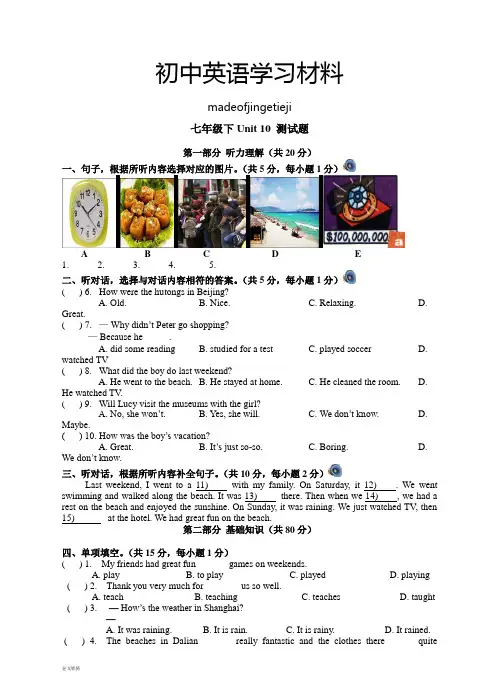
第一部分 听力理解(共20分) 一、句子,根据所听内容选择对应的图片。(共5分,每小题1分)
A B C D E
1. _____ 2. _____ 3. _____ 4. ______ 5. ______
二、听对话,选择与对话内容相符的答案。(共5分,每小题1分)
( ) 6. How were the hutongs in Beijing?
A. Old. B. Nice. C. Relaxing. D.
Great.
( ) 7. — Why didn’t Peter go shopping?
— Because he _____.
A. did some reading B. studied for a test C. played soccer D.
watched TV
( ) 8. What did the boy do last weekend?
A. He went to the beach. B. He stayed at home. C. He cleaned the room. D.
He watched TV.
( ) 9. Will Lucy visit the museums with the girl?
A. No, she won’t. B. Yes, she will. C. We don’t know. D.
Maybe.
( ) 10. How was the boy’s vacation? A. Great. B. It’s just so-so. C. Boring. D.
人教版新目标七年级英语下册Unit10教案.doc
精品资料
1 / 7—1— 人教版新目标七年级英语下册Unit10教案
Unit 10 I’d like some noodles.
Period 1
Ⅰ.Teaching Aims and Demands Knowledge Objects Key vocabulary. Target language.
2. Ability Object Train students’ listening and speaking skills.
3. Moral Object Noodles are popular with people. They are traditional Chinese food. Ⅱ. Teaching Key Points Key vocabulary, especially the names of food. Countable and uncountable nouns. Ⅲ. Teaching Difficulties Train students’ listening and speaking skills. Ⅳ. Teaching Methods Listening and speaking methods. Scene teaching
methods Ⅴ. Teaching Aids A tape recorder. Ⅵ. Teaching Procedures StepⅠ. Warming-up and lead-in Oral speech.→ I like…I’d like some noodles. StepⅡ. New words learning StepⅢ. Presentation (1a) 1. Write the letter after the name of the food. 2. Have students match the words with the foods on their 初一全科目课件教案习题汇总own. 3. Go over the answers. StepⅣ. Listening (1b) Listen and put a check before the noodles the man ordered. Step精品资料
人教版英语七年级下册Unit10测试题 2
Common Progress Please Criticize
金戈铁骑制作
七年级下Unit 10 测试题
第一部分 听力理解(共20分)
一、句子,根据所听内容选择对应的图片。(共5分,每小题1分)
A B C D
E
1. _____ 2. _____ 3. _____ 4. ______ 5. ______
二、听对话,选择与对话内容相符的答案。(共5分,每小题1分)
( ) 6. How were the hutongs in Beijing?
A. Old. B. Nice. C. Relaxing. D.
Great.
( ) 7. — Why didn’t Peter go shopping?
— Because he _____.
A. did some reading B. studied for a test C. played soccer D.
watched TV
( ) 8. What did the boy do last weekend?
A. He went to the beach. B. He stayed at home. C. He cleaned the room. D.
He watched TV.
( ) 9. Will Lucy visit the museums with the girl?
A. No, she won’t. B. Yes, she will. C. We don’t know. D.
Maybe.
( ) 10. How was the boy’s vacation?
A. Great. B. It’s just so-so. C. Boring. D.
【最新】【人教版】新目标七年级下英语Unit10测试题(含答案)
最新教学资料·人教版英语
Unit 10
姓名________ 班级________ 得分________
一、听力理解 (略)
二、单项选择 (每小题1分,共15分)
从A、B、C、D四个选项中,选出可以填入空白处的最佳选项。
( )31. — What do you need for the dish, Mom?
— ________ onion, _________ potato and some water.
A. A; a B. An; a C. A; a D. An; an
( )32. I would like a bowl of noodles ______ beef and tomatoes.
A. in B. of C. with D. to
( )33. ________ you like this job, you can tell me.
A. Because B. So
C. If D. And
( )34. — Are there _______ eggs on the table?
— No. There are ________ apples on it.
A. any; some B. any; any
C. some; some D. some; any
( )35. — What’s your favorite _____, Nancy?
— Fish!
A. fruit B. vegetables
C. meat D. mutton
( )36. — When will you come back from New York?
— Maybe next Friday. I’m not sure ___________.
2013新目标人教版七年级英语下册unit10同步练习
1
自编资料 By Wang Qiming Unit 10 I’d like some noodles. Section A
◆基础知识巩固练习
一、单项选择。
1. --_______? --Yes, I‘d like a salad, please.A. Can I help you B. What do you do C.
Who are you D. Where are you
2. We have four ______ porridge in our restaurant. A. size B. kinds of C. kind of D.
kind
3. She likes___ dumplings for lunch. A.chicken and cabbage B.chickens and cabbages
C.a chicken and cabbage D. chicken and a cabbage
4. Millie would like ______ some tea. A.to eat B.to drink C.have D. drink
5. ______your sunglasses, Sally. The sun is so bright. A.Put down B.Put up C.Put
away D. Put on
二、用名词的适当形式填空。
1. There are lots of ______ (tomato) in the basket on the table. 2. Whose
______ (photo) are there?
3.—What are they? —They are ______ (watch). 4.Jack would not like _______