
八年级英语上册第一单元教案
学科组 八年级英语备课组 主备人 执教人
课 题 Module1 Unit 1 课 时 第一课时 时 间
课时
教学
目标 1. To understand conversations involving advice on learning English.
2. To get information about how to learn English from the conversation.
3. To understand the way of giving advice.
4. To practise giving advice on English learning.
教学
设想 教学重点: 1. Key vocabulary:
Key structures: 1) We/You should… 2) Let’s try to… 3) Why not…? 4)
It’s a good idea to… 5) How about…? 6) Why don’t we/you…?
7) It’s better not do…
知识难点:1. Listening and understanding familiar topics (English study).
2. Talking about problems in English study and giving advice, conducting
conversations in several turns.
课前准备:早读预习并教读本课新单词;PPT课件;听力材料
教 学 程 序 与 策 略 个性修改
Step 1 Warming up
1.Elicit the topic: How to learn English well?
2. Learn the new words and expressions.
Step 2 Listening and vocabulary
1. Read the instructions in Activity 1and check(√) the ones you understand.
1) Work in pairs. Ask and answer the questions.
2) Correct the spelling.
3) Listen and check the words you hear.
4) Practise saying the words.
5) Match the words with the meaning.
6) Complete the sentences with the words in the box.
Ask the students to compare their answer with a partner.
2. Listening
1) Ask the students to read the word and expressions in Activity 2.
2) Read through the questions.
3) Play the recording and ask the students to listen to the recording
carefully.
4) Listen again and answer the questions. Use the words and expressions
from the box.
5) Play the recording again, then they can check their answer with a
partner.
6) Call back the answer from the whole class and check the answer.
Step 3 Listen and read.
1. Show some pictures, and ask the students to talk about good ways to
learn English.
2. Ask the students to read the conversation silently.
3. Play the recording and ask the students to listen and read the
conversation.
4. Work on Activity 3 on page 3.
5. Learn “Everyday English” and practise them.
Step 4. Practice the conversation in groups and pairs.
Step 5. Practice
Work on Activity 4 on page 3.
1. Ask the students to read through the passage.
2. Underline the correct words and expressions.
3. Check with a partner.
4. Call back the answers from the whole class.
5. Read the passage together.
Step 6. Exercises and Sum up
Do some exercises and check them.
Step7. Homework
Read the dialogue and remember the key words and structures.
教
后
反
思
学科组 八年级英语备课组 主备人 执教人
课 题 Module1 Unit 1 课 时 第二课时 时 间
课时
教学
目标 1. Function: Giving suggestions (English study)
2. Structure: Giving advice:
1) We/You should… 2) Let’s try to… 3) Why not…? 4) It’s a good idea
to… 5) How about…? 6) Why don’t we/you…? 7) It’s better not to…
3. Skills: 1) Listening and understanding familiar topics (English study).
2) Talking about problems in English study and giving advice,
conducting conversations in several turns.
教学
设想 教学重点: Learn the usage of giving advice
知识难点:Talking about problems in English study and giving advice,
conducting conversations in several turns.Task: Write your English study plan.
课前准备:PPT课件;Tape recorder,OHP.
教 学 程 序 与 策 略 个性修改
Step 1 . Revise and read.
1. Ask the students to talk about good ways to learn English.
2. Ask the students to read the conversation in pairs.
Step 2 Language points.
1. Practise saying the words.
practise用作动词,意为“练习”,后面可跟名词、代词或动词-ing形式作宾语。如:John is practising tennis in the playground.
Peter likes basketball very much. He practises it every day.
Susan often practises singing in the park.
【运用】根据句意从括号内选出一个适当形式补全句子。
Simon is practising _________(to speak / speaking) English in the classroom.
2. Well, I usually look it up in the dictionary.
look up是动词短语,可以表示“查;查找”。如果其宾语为名词,可放在up之前或之后;如果其宾语为代词,只能放在look与up之间。如:
Please look up the time of your plane. = Please look the time of your plane up.
If you don’t know the word, you can look it up in the dictionary.
【运用】根据汉语意思完成英语句子, 每空词数不限。
我在这本书里查不到这个新单词。我想试着在那本书里查找它。
I can’t ________ in this book. I would like to try to _______ in that book.
3. Why not write down our mistakes in our notebooks?
Why not …? 用来表示提出某种建议
e.g. ________ take a walk in the park? 为什么不在公园里散散步?
八年级上册英语教案 人教版八年级英语教案
第 1 页 共 27 页
八年级上册英语教案 人教版八年级英语教案
【篇一】八年级上册英语教案2022年新目标英语八年级上全册教案
2022年下期八年级英语全册教案(人教版)
Unit 1 Where did you go on vacation?
Section A 1 (1a-2d)
一、教学目标:
1. 语言知识目标:
1) 能掌握以下单词:anyone, anywhere, wonderful, quite a few, most,
something, nothing, everyone, of course, myself, yourself
能掌握以下句型:
① —Where did you go on vacation? —I went to the mountains.
② —Where did Tina to on vacation? —She went to the beach.
③ —Did you go with anyone?
2) 能了解以下语法:
—复合不定代词someone, anyone, something, anything等 的用法。
—yourself, myself等反身代词的用法。
第 2 页 共 27 页
3) 一般过去时态的特殊疑问句,一般疑问句及其肯定、否定回答。
2. 情感态度价值观目标:
学会用一般过去时进行信息交流,培养学生的环保意识,热爱大自然。
二、教学重难点
1. 教学重点:
1) 用所学的功能语言交流假期去了什么旅行。
2) 掌握本课时出现的新词汇。
2. 教学难点:
1) 复合不定代词someone, anyone, something, anything等 的用法。
2) yourself, myself等反身代词的用法。
人教版八年级上册英语全册教案

Unit 1 Where did you go on vacation?
教学课题 第一课时 Section A(1a-2d )
教学目标 【知识目标】
Important words:anyone,anywhere,wonderful,few,most
Important phrases:quite a few,on vacation,anything interesting
Important sentences:
1.Where did you/he/she/they go on vacation?
2.Did you/he/she/they go to Central Park?
【能力目标】
能用目标语言谈论过去发生的事件。
【情感目标】
通过听力训练、角色扮演等方式,学会与他人分享经历,并提高学生的英语听说能力。
教学重难点 重点:动词一般过去时态的应用。
难点:动词过去式的变化规则。
教学过程
◆Step 1 Leading in
1.Guess:Get Ss to guess what the teacher did on vacation:
①Where did I go on vacation?
②What did I do on vacation?
2.Free talk:Guide Ss to talk about their own vacation.
①How was your summer vacation?
②Where did you go on vacation?
③Did you do anything special/great?
④Did you go anywhere interesting/beautiful...?
⑤Did you meet anyone interesting?
设计意图 通过情境设计,从学生身边的问题导入新课,减少难度,从而调动了学生参与课堂教学活动的热情,提高学生的学习积极性。
八年级英语Unit 1 教案

Unit 1 Where did you go on vacation?
Language Goal
【语言目标】 Learn to talk about past events: in this unit, students learn to talk
about where they went and what things they did in the past.
Knowledge
Goals
【知识目标】 Key Words anyone, anywhere, wonderful, few, most,
something, nothing, everyone, myself,
yourself, seem, bored, someone, decide,
try, wonder, difference, wait, below,
enough, hungry, as, dislike
Key Phrases quite a few, of course, feel like, because of,
on vacation, keep a diary, have a good time
Key Sentences 1. Where did you go on vacation?I went to the
mountains.
2.Did you. . . ?Yes, I did. /No, I didn't.
3.How was your vacation?
Key Grammar 1. “Where”cause of special questions and
answers(where引导的 特殊疑问句及其回答) .
2.The use of indefinite pronouns(不定代词的 用法) .
八年级上册英语教案第一单元教案

1 教学内容 Unit1 Where did you go on
vacation?Section(A1a-2c) 课时安排
备课日期 授课日期
教
学
目
标 1.L earn the new words and phrases.
2. 复合不定代词(anyone,anything,something,everything,nothing)含义及用法。
3.能用一般过去时描述过去发生的事情。
教学
重点
难点 1.复合不定代词(anyone,anything,something,everything,nothing)含义及用法。2.一般过去式的规则动词与不规则动词。
板书设计 Unit 1 Where did you go on vacation?
New words\phrases
anyone anywhere wonderful few most something
go with anyone, do anything interesting,
Where did you go on vacation? I went to ……
教学准备 PPT and tape recorder.
教学过程 二次备课
Step 1 导入新课
1. warming-up
T: How was your summer vacation going?
S: It is great\boring.
T: What did you do on your summer vacation?
2. Read the learning aims
Step 2 设疑自探
Ask the Ss to design their own questions according to the
text.
预设问题:
1. New words and expressions.
八年级上英语Unit1教案
• Unit1 Where did you go on vacation?第二课时
一、教学目标:
1. 语言知识目标:
1) 能掌握以下单词:decide, try, paragliding, feel like, bird, bicycle, building, trader, wonder, difference, top, wait, umbrella, wet, because
of, below, enough, hungry
2) 能掌握以下句型:
① Where did??
② What did??
③ How was?? / How were??
④ Did she/he??
2. 情感态度价值观目标:
通过分享假期的活动,增进同伴之间的了解。
• 重点难点
二、教学重难点
1. 教学重点:
1) 掌握本课时出现的生词及表达方式。
2) 进行听力训练,提高综合听说能力。
3)阅读短文,获得相关信息,提高学生们的综合阅读能力。
2. 教学难点 听力训练
• 教学方法
听力训练技巧,小组合作
• 课时安排
第2课时
• 课前准备
录音机,多媒体,图画
• 教学过程
Ⅰ. Warming- up and revision
1. Daily greeting.
2. Check the homework. Let some Ss report where did they go on vacation.
3. Review the “复合不定代词”
4. Review the “反身代词”
5. Show a movie of paragliding.
Ⅱ. Writing
Work on 1a:
1. Point to the six words. delicious, expensive, exciting, cheap, terrible, boring
2. Read the words and let Ss read after the teacher. 3. Point to the last picture and say: This is a cake. It’s delicious. Then do the same thing for all six pictures.
新八上英语第一单元集体备课教案
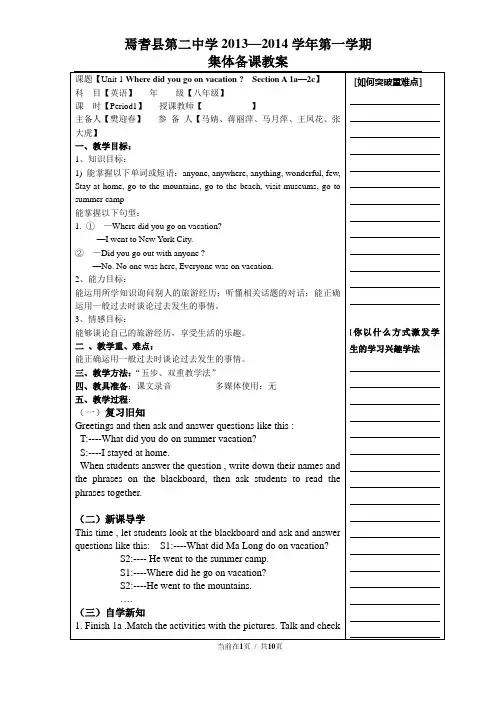
焉耆县第二中学2013—2014学年第一学期
集体备课教案
当前在1页 / 共10页
课题【Unit 1 Where did you go on vacation ? Section A 1a—2c】
科 目【英语】 年 级【八年级】
课 时【Period1】 授课教师【 】
主备人【樊迎春】 参 备 人【马婧、蒋丽萍、马月萍、王凤花、张大虎】
一、教学目标:
1、知识目标:
1) 能掌握以下单词或短语:anyone, anywhere, anything, wonderful, few,
Stay at home, go to the mountains, go to the beach, visit museums, go to
summer camp
能掌握以下句型:
1. ① —Where did you go on vacation?
—I went to New York City.
② —Did you go out with anyone ?
—No. No one was here, Everyone was on vacation.
2、能力目标:
能运用所学知识询问别人的旅游经历;听懂相关话题的对话;能正确运用一般过去时谈论过去发生的事情。
3、情感目标:
能够谈论自己的旅游经历,享受生活的乐趣。
二 、教学重、难点:
能正确运用一般过去时谈论过去发生的事情。
三、教学方法:“五步、双重教学法”
四、教具准备:课文录音 多媒体使用:无
五、教学过程:
(一)复习旧知
Greetings and then ask and answer questions like this :
T:----What did you do on summer vacation?
S:----I stayed at home.
2008.人教版八年级英语上册Unit 1 教案
Unit 1 Where did you go on vacation?
Language Goal
【语言目标】 Learn to talk about past events:in this unit,students learn to talk
about where they went and what things they did in the past.
Knowledge
Goals
【知识目标】 Key Words anyone,anywhere,wonderful,few,most,something,nothing,everyone,myself,yourself,seem,bored,someone,decide,try,wonder,difference,wait,below,enough,hungry,as,dislike
Key Phrases quite a few,of course,feel like,because of,on
vacation,keep a diary,have a good time
Key Sentences 1.Where did you go on vacation?I went to the
mountains.
2.Did you...?Yes,I did./No,I didn't.
3.How was your vacation?
Key Grammar 1.“Where”cause of special questions and
answers(where引导的特殊疑问句及其回答).
2.The use of indefinite pronouns(不定代词的用法).
Ability Goals
【能力目标】 1. Through the learning to gain the ability to talk about the past
人教版英语八年级上册第一单元教案
学习好资料 欢迎下载
Unit 1 How often do you exercise?
Ⅰ.Teaching Aims and Demands
1.Knowledge Objects
Names of activities.
Adverbs of frequency.
What do you usually do on weekends?
—I often go to the movies.
2.Ability Objects
Writing skill.
Listening skill.
Communicative competence.
3.Moral Object
Take exercise
Ⅱ.Teaching Key Points
what does she do on weekends?
—She often goes to the movies.
How often do you exercise?
—Three times a week
Ⅲ.Teaching Methods
Discover method.
Listening and writing methods.
Pairwork.
Ⅳ.Teaching Aids
A tape recorder.
Large monthly calendar showing the days of the week.
A projector.
Ⅴ.Teaching Procedures 学习好资料 欢迎下载
Step Ⅰ Greet the class
Step Ⅱ Section A 1a (This activity introduces the key vocabulary.)
Look at the picture. Ask a few students to say what they see in the
八年级英语上册 unit 1 教学设计 人教新课标版 教案
word
1 / 10 Unit One How often do you exercise?
Topic How often do you exercise?
教
学
目
标 语言目标 描述时间频度的词汇及开展周末活动的调查
能力目标 听:能听懂谈论生活习惯、学习习惯和饮食习惯的对话材料。
说:能谈论生活习惯、学习习惯和饮食习惯。
读:能读懂介绍个人生活习惯的文章。
写:能写出Section A和Section B中的重点单词和重点句型,并能够描述自己的生活习惯。
情感目标 通过开展周末活动调查问卷,引导学生正确处理好学习和娱乐之间的关系。
跨学科学习 通过谈论谁的饮食习惯更健康,引导学生了解什么样的饮食习惯,才能保持健康的体质。
语言结构 What do you usually do on weekends? I usually play
soccer.
How often do you shop? I shop once a month.
语言功能 Talk about how often you do things.
教学重点 掌握What do …? 和How often…?的句型。
掌握表示时间频度的词汇。
教学难点 辨析:always usually often sometimes hardly never
辨析:all most some no
学习策略与思维技巧 通过对比和反复操练,掌握频度副词间的区别和它们的具体用法。
教学准备 A tape recorder The blackboard word
2 / 10 教学课时 Four periods
Section A
语言目标 What do you usually do on weekend?I usually play soccer.
How often do you shop? I shop once a month.
八年级上册英语unit1教案(共5课时)
Unit 1 How often do you do exercise
Teaching aims of this unit: Language goals :
1.Vocabulary: always usually often sometimes hardly ever never ,once a day ,twice a week ,three
times a month, my eating habits ,healthy /unhealthy lifestyle , keep in good health, junk food ,eat less meat, the same as, be different from ,the difference between…and…, of course ,look after, be
good /bad for, sleep nine hours every night all /most /some /no students ,maybe, although exercise
=do/play sports
2.Ask and answer : What do you usually do on weekends?
I often watch TV on weekends.
How often do you watch TV?
I watch TV twice a week..
How long do you sleep every night?
I sleep nine hours every night.
What are the differences?