
Unit 1 A healthy food 课件 1
雅思阅读UNIT 1 Food
UNIT 1
Food
Warm up-Thinking about the Topic
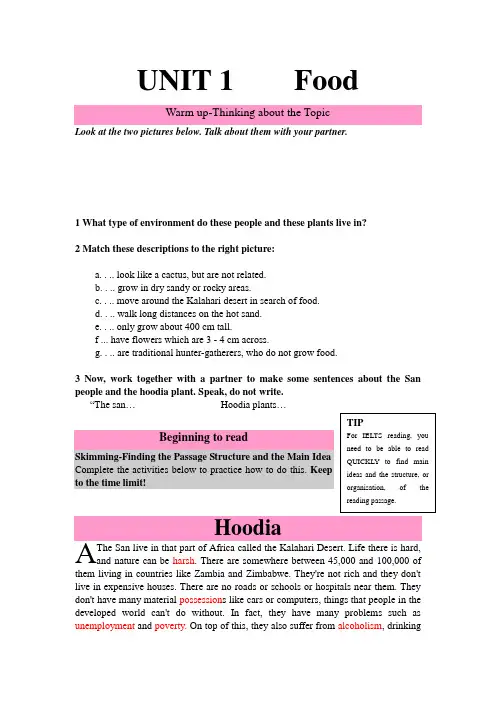
Look at the two pictures below. Talk about them with your partner.
1 What type of environment do these people and these plants live in?
2 Match these descriptions to the right picture:
a. . .. look like a cactus, but are not related.
b. . .. grow in dry sandy or rocky areas.
c. . .. move around the Kalahari desert in search of food.
d. . .. walk long distances on the hot sand.
e. . .. only grow about 400 cm tall.
f ... have flowers which are 3 - 4 cm across.
g. . .. are traditional hunter-gatherers, who do not grow food.
3 Now, work together with a partner to make some sentences about the San
people and the hoodia plant. Speak, do not write.
“The san… Hoodia plants…
Beginning to read
Skimming-Finding the Passage Structure and the Main Idea
Module4-healthy-food-复习练习 (1)
1
Module 4 Healthy food
一、根据句意及首字母或汉语提示写出单词。
1. Rice and tomatoes are _________(健康的) food.
2. We have some v_____________ and meat for lunch at school.
3. Do you like eating___________(水果)? 4. Have you got any____________(牛奶) at home?
5. Little children like ___________(饮料).
二、短语翻译
1. 拥有_______________ 2. 去购物_______________ 3. 许多;大量的_______________
4 . 好吧_______________ 5. 橘子汁_______________ 6. 对……有好处_______________
7. 好主意_______________ 8. 饮食_______________ 9. 对……有坏处_______________
10.太多_______________ 11.在家_______________ 12.一张购物清单_______________
三、写出下列单词的复数形式
1.teacher___________ 2.box______________ 3.Chinese___________4.foot_____________ 5.photo___________6.city______________ 7.student__________8.man______________ 9.boy____________10.girl______________ 11.woman________12.potato_____________ 13.family_________14.child______________ 15.fish___________16.book______________ 17.parent__________18.deer(鹿)__________ 19.tomato________20.Japanese___________21.tooth___________22.bag______________ 23.bus___________24.hand______________ 25.desk______________
_Module4_healthy_food(健康饮食)_unit2(1)
Module4 Healthy food
Unit2 Is your food and drink healthy
教 学 目 标:
知识目标:1.掌握一些表示食物的英语单词:hamburger, noodle, coke, rice„
2.掌握以下重点交际用语:What is your favourite food?
技能目标:能阅读关于食品的文章; 能谈论健康食品。学会用“but” 连接两个简单句。
情感目标:通过谈论健康食品,懂得健康饮食的重要。Eating healthy food is
good for your health.
教学重点:识别哪些是健康食物,哪些是不健康的食物。
教学难点:用“but” 连接两个简单句。
课前预习: Write down their names as many as possible.
Vegetables: _____________________________________________________
Fruit: __________________________________________________________
Drink: __________________________________________________________
教学过程
Step1 Revision
Step 2 Lead in
Work in pairs
A: What’s your favourite food? B: My favourite food is fish.
A: Is it healthy? B: Yes, it is.
Step 3 Reading Comprehension
1. Healthy food: meat, fish, _______, rice, ________vegetables
七年级英语上册 Module 4 Unit 1 Healthy food教案
外研版七年级英语上册教学案 Module 4 Unit 1 Healthy food教案
年级 七年级 学科 英语 第一备课
第二备课
课题 Unit 1 Healthy food 课型 前置语法课
备课时间 授课时间 第 周 星期 第 节
学习目标 1、朗读本课所学的新单词。
2、区分some,any的用法。
3、区分可数名词和不可数名词,掌握可数名词和不可数名词的正确用法。
4、继续巩固have/has got 的用法。
重点 区分some,any的用法。
难点 继续巩固have/has got 的用法。
教学准备
读出下列单词,并能与实物或图片相匹配:
apple beef carrot chichen juice melon milk Coke hamburger
onion orange pork potato tomato water noodle candy ice cream
2、翻译短语或句子:
(1)、six apples ____________ two tomatoes ___________
a carrot ___________ some water ___________
an onion __________ some rice ___________
some bananas ________ ten potatoes ___________
(2)、They have got some milk.
(3) 、They haven’t got any melons.
(4)、-Have we got any meat in the fridge? -No, we haven’t any meat.
Unit 7 A healthy Lifestyle 学案(1)

Unit 7 A healthy Lifestyle 学案
( The first period)
Learning contents: Warming up
Learning aims: To training the Ss’ listening ability
Learning procedures:
Ⅰ.(学习指导)To talk about the sports and learn some new words.
Ⅱ. ( 分配任务)
Group1: Try to write the name of sports as much as possible they learned
before.
Group2: Look at the picture and discuss the following questions:
1. Which sport is she playing?
2. Do you like to play it too?
3. Do you think sports are good for your health?
Group3: Learn the new words. Match them with the pictures.
Go jogging go swimming play badminton
Play basketball play volleyball practice tai chi
Group4: Answer the questions:
1. What kind of sport do you often do?
2. How often do you do it?
3. Is it your favorite sport? Why or why not?
Group5: Read and explain the new words:
Module 4 Healthy food Unit 1 We've got lots of apples 教案1

1 Module 4 Unit 1
教案一
ⅠTeaching model
Listening and speaking
ⅡTeaching method
Bottom-up approach to listening
ⅢTeaching aims
1. To understand conversations involving food and drink.
2. To talk about food.
ⅣTeaching Objectives
Key vocabulary: food, drink, candy, fruit, meat, vegetable, apple, bean, beef, carrot, chicken,
chocolate, coffee, cola, juice, milk, potato, tea, tomato., water, shop, have, get,
have got, some, much, kind, so, has, bad
Key phrase: go shopping, lots of, too much
Key structures: have / has got How about…?
ⅤTeaching aids
Tape recorder, OHP, video
ⅥTeaching Steps
Step 1 Warming-up
1. Show some pictures of food and drink. Say what they are.
2. Look at the pictures. Label the food and drink.
2
Answers:
1. fruit 2. meat 3. vegetables 4. drink
a. melon b. apple c. orange d. chicken e. pork f. beef g. tomato
雅思阅读UNIT1Food
UNIT 1 Food
Warm up-Thinking about the Topic
Look at the two pictures below. Talk about them with your partner.
1 What type of environment do these people and these plants live in?
2 Match these descriptions to the right picture:
a. . .. look like a cactus, but are not related.
b. . .. grow in dry sandy or rocky areas. c. . .. move around the Kalahari desert in search of food.
d. . .. walk long distances on the hot sand.
e. . .. only grow about 400 cm tall. f ... have flowers which are 3 - 4 cm across.
g. . .. are traditional hunter-gatherers, who do not grow food.
3 Now, work together with a partner to make some sentences about the San
people and the hoodia plant. Speak, do not write.
“The san…Hoodia plants…
Beginning to read
Skimming-Finding the Passage Structure and the Main IdeaComplete the activities below to practice how to do this. Keep