
英语学术论文写作技巧academicwritingskills(全英文版)
英语满分作文技巧

英语满分作文技巧Essay Writing Tips for a Perfect Score。
Essay writing is an essential skill for students to master, as it is often used as a form of assessment in many academic settings. Whether it's for an exam, a class assignment, or a standardized test, knowing how to write a well-structured and coherent essay can make all the difference in achieving a high score. Here are some tips to help you improve your essay writing skills and achieve a perfect score.First and foremost, it is crucial to understand the prompt or question before you begin writing. Take the time to carefully read and analyze the prompt, and make sure you fully comprehend what is being asked of you. Pay attention to key words and phrases, and consider the purpose and audience of your essay. This will help you stay focused and on track as you write.Once you have a clear understanding of the prompt, it's important to brainstorm and plan your essay. Organize your thoughts and ideas, and create an outline to guide your writing. Consider the main points you want to make, and think about how you will support them with evidence and examples. A well-structured outline will help you stay organized and ensure that your essay flows logically from start to finish.When it comes to actually writing the essay, it's important to pay attention to your language and tone. Use clear and concise language, and avoid using overly complex or convoluted sentences. Be mindful of your tone, andstrive to maintain a formal and academic style throughout your essay. Additionally, be sure to use proper grammar, punctuation, and spelling to convey your ideas effectively.Another key aspect of essay writing is the use of evidence and examples to support your arguments. When making a point, be sure to back it up with relevant evidence and examples. This could include data, statistics, quotes from experts, or real-life examples. Providingstrong evidence will make your arguments more persuasive and help you build a convincing case for your position.In addition to using evidence, it's important to consider counterarguments and address them in your essay. Acknowledging and refuting opposing viewpoints demonstrates critical thinking and strengthens your own argument. It also shows that you have considered multiple perspectives on the issue at hand, which can impress your readers and earn you extra points.Finally, don't forget to revise and edit your essay before submitting it. Take the time to review your work, checking for any errors or inconsistencies. Look for opportunities to improve your language and structure, and make sure that your essay is well-organized and coherent. Consider seeking feedback from a teacher, tutor, or classmate to get a fresh perspective on your writing.In conclusion, essay writing is a skill that can be developed and refined with practice. By understanding the prompt, planning your essay, using clear and persuasivelanguage, providing evidence, addressing counterarguments, and revising your work, you can improve your essay writing skills and achieve a perfect score. Keep these tips in mind as you continue to practice and refine your writing, and you will be well on your way to becoming a proficient and effective essay writer.。
Academic Writing Skill

Preparation
Take down basic points from as many sources as you can manage and compare what the authors are saying as you are reading. There will be both similarities and differences in their views and it helps if you can begin to classify authors together.
Writing Style
Argument - an argument is a main idea backed up with evidence and support the idea
You need to challenge the idea , either defend it , refute it or offer some new idea of your own.
Introduction
Set the context of the essay Include a few opening sentences that
announce the title, and briefly explain the topic of the text. Present the aim of the text and summarize the main finding or key argument. Conclude the introduction with a brief statement of your evaluation of the text. This can be a positive or negative evaluation or, as is usually the case, a mixed response.
Essay Writing Skills 英文论文写作技能

Essay Writing SkillsThis guide is designed to help students to structure their work. Like any written work, essays require careful planning, reading and note taking, appropriate academic style, referencing and structure.An essay is different from a report in that it is generally written as one flowing document that uses paragraphs to separate ideas, without the section headings, underlining, numbering and bullet points that are used in reports. Usually, essays do NOT have diagrams or appendices.Essays have 4 vital sections: Introduction, Main Body, Conclusion and References/Bibliography. The word count applies to three essay sections, NOT including the References or Bibliography.The Introduction paragraph/sectionThis helps set the context for the essay. It introduces the main ideas of the essay and draws the reader into the subject. A good Introduction gets to the heart of the subject and captures(俘获)the interest of the reader, acting as a trailer to what is to follow. It tells readers what to expect by addressing Who, What, When, Where, Why and How? The Introduction outlines the main issues on which you intend to focus and others you just intend to mention. In this way it sets your parameters. It defines any terms or concepts that you need and acknowledges possible issues raised by the question and explains your approach. It could include a comment upon the importance of the topic. It may act as an overview in summarising the issues to show an understanding of the exact question and present the method of research or experiment. It is often about 10% of the length of the essay.An example of a basic Introduction for ‘Discuss the relevance of the marketing mix for a tourism organisation’ might be:The purpose of this essay is to… (repeat the essay task in your own words, i.e. discuss …). The basic marketing mix is known as the 4Ps and is attributed to McCarthy over 40 years ago. It is stilluseful and quoted today. This essay will use examples from P&O Cruises to discuss the relevance of the 4Ps – i.e. product, place, promotion and price. Because a tourism organisation offers an intangible service, the 4Ps apply in a different way to many products.A good Introduction might be:McCarthy’s 4Ps model of the marketing mix (1960) appears to have global recognition and is widely used. However, since the 1980s other academics such as Booms and Bitner (1981) have developed his theory and extended the marketing mix in order for it to apply more effectively to tourism by including other elements such as ‘People’ (as tourism is an intangible, non-standard, perishable product reliant on people delivering the service). This essay will define and discuss various marketing mix models and consider various views for either keeping a simple 4Ps or extending to 5Ps, 7Ps or more, and consider whether all aspects are equally relevant. The relevance of these marketing mixes will be applied to a tourist board, as this faces special challenges.The main body is the place for your evidence!The main section of the work should be organised into paragraphs which present the facts and develop the arguments. The structure will depend upon what you are asked to do, e.g. compare and contrast, analyse, critically evaluate, explain, etc..Address the exact task and focus of the question set. It is this difference that gives work better grades. Never write all you know about a topic!Decide on your main points. Organise these points in appropriate paragraphs to build your work in a series of logical steps to suit the essay’s length, complexity and purpose. P aragraphs group related sentences to develop each main idea, making it easier to follow your points. In each paragraph include PEEEL–P oint, E vidence, E xample, E xplain, L ink.Paragraphs need a key P oint which is often the first sentence. Define your point, clearly and concisely. Then include supporting E vidence, quote definitions, refer to facts, and other people’s theories that relate to the same point. Apply relevant E xamples to clarify. E xplain the relevance to the main point in following sentences. Often paragraphs have four to eight sentences that show your evidence and comments upon it. Make sure paragraphs L ink with preceding or subsequent content and use signposts and linking expressions frequently. Remember to keep linking to the essay title. The final sentence of a paragraph acts as link forward to the information of the next paragraph.So paragraphs share characteristics (UCOD). All the sentences in a paragraph have U nity as they should relate to the same point/ topic. Each paragraph should be C oherent, containing sentences in logical order, with linking words helping to make transitions between sentences. The O rder of information should be clear, whether it is chronological or by order of importance. Paragraphs can be D eveloped by using examples, comparison, contrast, statistics, definitions, analysis or a combination of these, depending on the purpose of writing o r the subject matter. Always check that you define (before you develop) important ideas/ concepts used in your work. Avoid long and rambling sentences and paragraphs. Consider the length of each paragraph and if the points could be more clearly expressed and if separate paragraphs are needed.Write as concisely as possible. Remember KISS; K eep I t S hort and S imple to make your meanings clear. Use Academic Style to check Business School requirements, which generally avoid using slang, informality and persona l pronouns like ‘I’or ‘We’or ‘You’.Use signposting words and phrases (e.g. therefore, however, conversely, again) to help readers follow your work. Phrases such as "The underlying reason" may be used to address thecause/effect and show relationships between concepts, etc. "It is disputable whether" may be used in arguments (i.e. giving and evaluating information). "The first factor to consider” may be used to order or process (showing how something is done).When you provide specific detail/s as evidence, follow Harvard Referencing system. Show how each reference used relates to the exact task and supports your points. You are the detective giving all possible evidence to support the case! State your evidence for all assertions. Avoid generalisations (e.g. All authors consider…), assumptions (e.g. People in Britain are British) and rhetorical questions (e.g. Why does this happen?). Choose your quotes carefully, keeping them brief and explaining the importance and relevance of each. You need to use as much evidence as possible! Quotes need to be within quotation marks and clearly state Author (year: page number). Paraphrased references need Author (year). Copy all reference details into the References/ Bibliography immediately, fully and accurately as this is better than compiling the list later.Refer to all your sources in 2 places:∙in the main body of your work in the abbreviated form∙in the last section, in a detailed list of References/Bibliography.Conclusions – Summarising key points in the last section/paragraphsRestate your focus by emphasising the key points, drawing together the threads of your work. A basic conclusion refers back to the main points, linking them to the exact task to prove that you have addressed it exactly. For example, ‘This essay has looked at the issues of… and found…’DO NOT include any new information/evidence because you are ‘summing up’ (as for a jury!). For this reason, you generally do not include any text citations but you may cross reference. Check your Conclusion refers back to the Introduction. Link them in case the reader was not paying attention! Make sure that your ending does not tail off weakly as a conclusion should be strong!This may be the place for you to form a judgement - your own personal conclusion/personal observations. Sometimes this is the place to make recommendations. Lecturers will advise you what they expect. Ask if you are unsure.References/ BibliographyFollow Harvard Referencing for all referencing and quotations. Referencing is the process of recording details of the secondary sources (books, journal articles, electronic sources etc.). Read the Harvard Referencing for examples of how to reference any sort of material. Check your Harvard Referencing is thorough - that you have included all your sources. Cross-reference points where possible to avoid repetition.Remember References at the back of your essay ONLY contain sources that you have referred to in the text. Bibliographies contain all the sources that you used in your research, e ven if you did not quote or refer to them specifically in your text. Your lecturer will advise you which they require.Finally - Hand in on time to avoid penalty!。
完整地英文作文技巧

完整地英文作文技巧1. Writing a complete English essay can be a challenging task, especially if you want to make it sound natural and conversational.2. One important tip is to vary your sentence structure and length to keep the reader engaged. Short, punchy sentences can create a sense of urgency, while longer, more complex sentences can add depth and detail to your writing.3. Another key aspect of writing a complete English essay is to pay attention to your vocabulary. Using a diverse range of words and phrases can make your writing more interesting and expressive.4. It's also crucial to consider the tone and style of your writing. Depending on the topic and audience, you may want to adopt a formal, informal, or even humorous tone to effectively convey your message.5. Additionally, be mindful of your grammar and punctuation. Proper use of these elements can significantly impact the clarity and coherence of your writing.6. Lastly, don't be afraid to inject your ownpersonality and voice into your writing. This can help you connect with your readers and make your essay more memorable.7. In conclusion, writing a complete English essay involves paying attention to various aspects such as sentence structure, vocabulary, tone, grammar, and personal voice. By mastering these skills, you can create compelling and engaging essays that effectively communicate your ideas.。
英文学术论文写作技巧(写作常用句型)
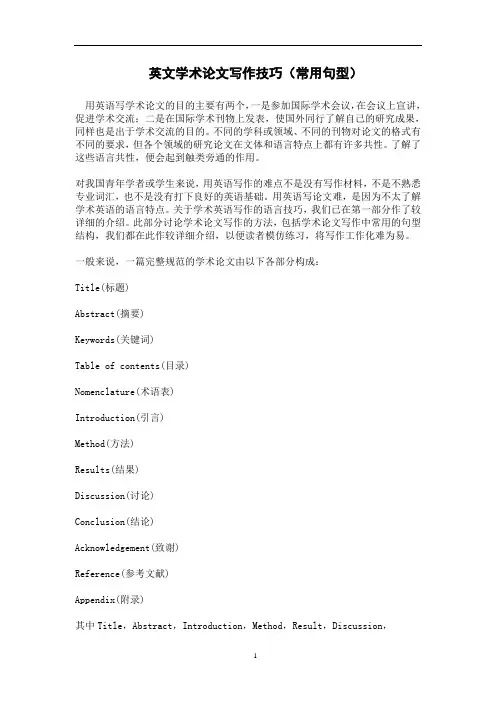
英文学术论文写作技巧(常用句型)用英语写学术论文的目的主要有两个,一是参加国际学术会议,在会议上宣讲,促进学术交流;二是在国际学术刊物上发表,使国外同行了解自己的研究成果,同样也是出于学术交流的目的。
不同的学科或领域、不同的刊物对论文的格式有不同的要求,但各个领域的研究论文在文体和语言特点上都有许多共性。
了解了这些语言共性,便会起到触类旁通的作用。
对我国青年学者或学生来说,用英语写作的难点不是没有写作材料,不是不熟悉专业词汇,也不是没有打下良好的英语基础。
用英语写论文难,是因为不太了解学术英语的语言特点。
关于学术英语写作的语言技巧,我们已在第一部分作了较详细的介绍。
此部分讨论学术论文写作的方法,包括学术论文写作中常用的句型结构,我们都在此作较详细介绍,以便读者模仿练习,将写作工作化难为易。
一般来说,一篇完整规范的学术论文由以下各部分构成:Title(标题)Abstract(摘要)Keywords(关键词)Table of contents(目录)Nomenclature(术语表)Introduction(引言)Method(方法)Results(结果)Discussion(讨论)Conclusion(结论)Acknowledgement(致谢)Reference(参考文献)Appendix(附录)其中Title,Abstract,Introduction,Method,Result,Discussion,Conclusion,Reference等八项内容是必不可少的(其他内容根据具体需要而定)。
在这八项内容中,读者最多的是Title,Abstract和Introduction部分,读者会根据这些内容来决定是否阅读全文。
也就是说,一篇研究论文赢得读者的多少,在很大程度上取决于Title,Abstract和Introduction写得好坏。
因此这三项内容将各分章详细加以讲述。
学术论文的正文一般包括Method,Result,Discussion三个部分。
有关写作技能的英语作文

有关写作技能的英语作文英文回答:Writing is a fundamental skill that requires a combination of cognitive, analytical, and creative abilities. It is essential for effective communication, academic success, and professional advancement.The Importance of Writing Skills.Writing skills play a crucial role in:Expression and Communication: Writing allows individuals to convey their thoughts, ideas, and emotions in a clear and concise manner.Critical Thinking and Analysis: Writing encourages individuals to critically evaluate information, synthesize ideas, and form logical conclusions.Problem Solving: Writing helps individuals explore different solutions to problems and present them in a persuasive and organized manner.Academic Achievement: Writing is a key component of academic success, enabling students to demonstrate their knowledge, analysis, and research skills.Professional Advancement: Strong writing skills are highly valued in the workplace, where effective communication is essential for building relationships, conveying information, and advancing projects.Developing Strong Writing Skills.Developing strong writing skills requires consistent practice and dedication. Here are some key strategies:Read Widely: Reading exposes individuals to different writing styles, expanding their vocabulary and understanding of grammar.Write Regularly: Regular writing practice builds fluency and strengthens writing muscles. Starting with freewriting or journaling can be beneficial.Seek Feedback: Constructive criticism from peers, instructors, or writing tutors can help identify areas for improvement.Study Grammar and Usage: A strong foundation in grammar and usage ensures clarity, accuracy, and consistency in writing.Use Writing Aids: Dictionaries, thesauruses, and grammar checkers can provide quick assistance with vocabulary, spelling, and grammatical issues.Revise and Edit: Writing is an iterative process that involves multiple rounds of revision and editing. This helps refine ideas, eliminate errors, and improve clarity.Conclusion.Writing skills are essential for personal and professional success. By reading widely, writing regularly, seeking feedback, and embracing grammar and usage, individuals can develop strong writing abilities that empower them to communicate effectively, think critically, and achieve their goals.中文回答:写作技能的重要性。
英语学术论文写作技巧academic writing skills(全英文版)共38页文档
protection/copyright protection” Discuss the following with a partner: Look at the project title above and highlight the key words/phrases. How is the title framed (e.g. statement/question/heading)? What does the title ask you to do?
- gathering information from various sources;
- organizing this information so that it appropriately answers the needs of the task that the writer has to complete;
The reasons why students carry out extended academic writing activities may s their ideas; to provide evidence to support their ideas; to dispute or support existing theories; to display knowledge.
Internet. e) Write down the details of your sources. f) Decide if you need to do more reading. g) Write the contents page, bibliography, title page and abstract. h) Arrange a tutorial with your tutor. i) Do some reading. j) Decide on a topic. k) Write the first complete draft. l) Highlight/take notes of relevant information. m) Plan the contents in detail. n) Work on establishing a clear focus. o) Make a rough outline plan of your ideas. p) Check that sources are available/accessible.
Academic Writing Skills (Part II)2011
Things that you should not do
Colloquialisms: don’ I’ they’ Colloquialisms: don’t, I’lore English, Chinglish, and other hundreds of dialects; Slang: British slang—”bad” means slang— bad” good
First 2-3 words of the work title, no article 2The book College Bound Senior (1979) …study finds (“On Free Care,” 1982 ) Care,”
Works from Electronic Sources
Other tips for academic writing
Check your paper using spelling checking in MS Word software. Ask and exchange your paper for proof-reading. proofSave your paper in at least two places (use your email box or web-storage service). webKeep a record for each of your revision paper.
Academic Writing Skills (Part II)
LU Mingtian
Formal vs. informal (common & colloquial )
ESP: academic writing: social science About 30 different academic styles, styles, infor from the Internet.
英语学术论文写作技巧academic writing skills(全英文版)
Introduction
Main body
Conclusion
1) 2)
3) 4) …
1) 2)
3) Developing a focus Steps in getting started:
Choosing a topic Brainstorming ideas Narrowing the focus by asking yourself questions Establishing a working title which is flexible and developmental Choosing some of your sources by looking at journals, books and websites
6)
Task 3: Starting Project
Work on this project by answering the following questions, which are grouped under the three broad headings Introduction, Main body and Conclusion. First read the questions.
Task 1: What do students write? Essay Extended essay or project Report Thesis Dissertation Case study
Whatever form of extended writing students are expected to do, the process will usually involve the following steps: - gathering information from various sources; - organizing this information so that it appropriately answers the needs of the task that the writer has to complete; - planning the text; - drafting and redrafting the text until it communicates the information and ideas fully and clearly.
如何有好的书法英语作文
Writing a good calligraphy in English involves a combination of artistic skill and technical precision. Here are some steps to help you achieve a beautiful and legible script:1. Choose the Right Tools: Select a pen that suits your writing style. Fountain pens and calligraphy pens are popular choices for their ability to create varying line widths.2. Understand the Basics: Learn about the different styles of English calligraphy, such as Copperplate, Spencerian, or Modern Calligraphy. Each has its own unique characteristics and techniques.3. Practice Basic Strokes: Start by practicing basic strokes like the downstroke, upstroke, and the oval. These are the building blocks of more complex letters.4. Learn Letter Formation: Study the formation of each letter in the style you have chosen. Pay attention to the angles, curves, and the way the letters connect to each other.5. Consistency is Key: Ensure that your letters are consistent in size, slant, and spacing. This will make your writing look more professional and aesthetically pleasing.6. Guidelines and Grids: Use guidelines or a grid to help maintain consistent letter height and spacing. This is especially important for beginners.7. Hold the Pen Correctly: The way you hold your pen can greatly affect your writing. Hold it at a slight angle and use a relaxed grip to allow for fluid movement.8. Posture Matters: Sit up straight and position your paper at a comfortable angle. This will help you maintain control and reduce strain on your hand and wrist.9. Practice Regularly: Like any skill, calligraphy requires practice. Dedicate time each day to writing and refining your technique.10. Experiment with Ink: Different inks can affect the look of your calligraphy. Experiment with various types to see which one you prefer.11. Study Examples: Look at examples of good calligraphy to understand the flow and rhythm of the script. This can inspire your own writing.12. Personalize Your Style: Once you have mastered the basics, feel free to add your own personal touches to your calligraphy. This could be in the form of unique letter connections or flourishes.13. Patience: Developing good calligraphy takes time and patience. Dont be discouraged if your writing doesnt look perfect right away.14. Seek Feedback: Share your work with others and ask for constructive criticism. This can help you identify areas for improvement.15. Enjoy the Process: Calligraphy is an art form. Enjoy the process of creating something beautiful with your own hands.By following these steps and dedicating time to practice, you can develop your skills and create impressive calligraphy in English. Remember, the key to good calligraphy is patience, practice, and a keen eye for detail.。