
一般现在时和一般过去时
一般现在时讲解及练习1、定义与讲解一般现在时:表示经常性的事情,经常性的动作或一般性事实。
时间状语:often 经常,usually通常,always 总是,every+名词每个,sometime s 有时,once a week ,on Sundays ,if 的从句at …在几点钟2. 表示客观真理,科学原理,自然现象,等客观事实或格言,谚语等。
The sun rises in the east and sets in the west every day.The man who has never been to the Great Wall is not a real man.Tomorrow is Tuesday.只有在第三人称单数用动词的“三单变化”,其他用动词的原形。
三单变化:(1)直接在动词词尾加-s.ask---asks work---works get---gets stay---stays(2)以字母s, x, ch, sh或o结尾的动词,在词尾直接加-es.watch---watches wish---wishes fix---fixes pass---passes(3)以“辅音字母加- y”结尾的动词,要先变y为i再加-es.try---tries study---studies cry---cries fly---flies play —plays2.不规则变化:be---- is are have----has do---does go---goes三、一般现在时的句子转换:(1)当句子中有be动词或情态动词时,则把be 动词或情态动词(can,could等等)提到主语的前面变成疑问句;在be动词或情态动词后面加not变成否定句陈述句She is a student.疑问句Is she a student? 否定句She is not a student.陈述句:I can swim.疑问句→ Can you swim否定句→ I can not swim.(2)当句子中即没有be动词,也没有情态动词时,则在主语前加助动词do (you,以及复数), does(单数she,he,it)变成问句;在主语后谓语动词前加助动词don’t(I, you,以及复数), doesn’t(单数she,he,it)变成否定句,助动词后的动词要变成动词原形。
陈述句:We get up at 7:00 every morning.疑问句Do you get up at 7:00 every morning?否定句→We don’t get up at 7:00 every morning.陈述句:She has a little brother.疑问句→ Does she have a little brother?否定句She doesn’t have a little brother.(一).用动词的适当形式填空1. She _________(go) to school at seven o’clock.3. He usually ___________ up at 17:00.(get )4. She ___________ (live) in Beijing.5. Amy _________ (be) here just now.6. _______ (be)there a fly on the table just now?7. My father __________ (watch) TV every evening .8. My father _______________ (make) toys these days.9.?________ Amy _________ (read) English every day10. Chen Jie sometimes _________(go)to the park with her sister.(二).选择填空1.I want____homework now. A. doing B. to do C. to do my D. do my 2.It's time______.A. go to schoolB. play gamesC. to go homeD. to do my homeworks 3.______go and help her. A. Let's me B. Let's us C. Let's D. Let's to4.Do they have a new car? Yes,_____.A .they are B.they have C. they don't D. they do5.He often _________ supper at 6:00 in the evening.A. haveB. has c. is having D. is eating6. We _____________ any Chinese classes on Friday.A. are havingB. aren’t havingC. don’t haveD. are have (三)、用括号内动词的适当形式填空。
1. He often _________ (have) dinner at home.2. Daniel and Tommy _________ (be) in Class One.3. We _________ (not watch) TV on Monday.4. Nick_________ (not go) to the zoo on Sunday.5._______ they _________ (like) the World Cup?6. What ____they often_________ (do) on Saturdays?7. your parents _________ (read) newspapers every day.8. The girl _________ (teach) us English on Sundays.9. She and I _________ (take) a walk together every evening.10. There _________ (be) some water in the bottle.11. Mike_________ (like) cooking.12. They _________ (have) the same hobby.13. My aunt _________ (look) after her baby carefully.14. You always _________ (do) your homework well.15. I _________ (listen) to the English songs twice a day ,16 Tom ____ (go) to school from Monday to Friday.17. Liu Tao _________ (do not ) like PE.18. The child often _________ (watch) TV in the evening. 21. We often___________(play) in the playgound.22. He _________(get) up at six o’cl ock.23. __________you _________(brush) your teeth every morning.24. What ________he usually__________ (do) after school?25. Danny usuallly ______(study) English,Chinese ,Science and Art at school.26. Mike sometimes __________(go) to the park with his sister.27. she always __________(watch) TV with his parents.28. ________ Mike________(read) English every day?29. We will go shopping if it____ tomorrow.A don't rain B. didn't rain C.doesn't rain D. isn't rain9. How many lessons_________your classmate________(have) on Monday?10.What time_________his mother_________(do) the housework?1. Do you often play football after school? (肯定回答)2. I have many books. (改为否定句)3. Gao Shan’s sister likes playing table tennis (改为否定句)4. She lives in a small town near New York. (改为一般疑问句)5. I watch TV every day. (改为一般疑问句)6. David has got a goal. (改为一般疑问句)7. We have four lessons.(否定句)8. Nancy doesn’t run fast (肯定句)9. My dog runs fast. 否定句:一般疑问句:10. Mike has two letters for him.一般疑问句:否定句:11. I usually play football on Friday afternoon.否定句:一般疑问13. Mingming usually waters the flowers every day否定一般疑问句:划线提问14. Tom does his homework at home.否定句:一般疑问句:划线提问1.写出下列动词的三单形式go__________ catch_________ brush(刷)_____ wash___________do________ like________ have___________ watch________drink ___________ fly___________ say_______ learn ___________eat___________ read___________ sing___________ buy__________study_______ stay __________ make __________ look ____pass__________ carry ____ come_________ teach_______ buy_________ 3.选择题1. I ________to school at 7:00 in the morning.A. go B. going C. goes2. They ____books every day in the library. A.reads B. read C. reading3. The monkey_____eating bananas very much.A.like B. likes C. liking4. My father ________to read newspaper after supper every day.A.likeB. likesC. liking5. I like watching TV, but my mother __like it.A. don’t B. doesn’t C. does6. ____your father drink milk every day? A.do B. are C. does8. He said the sun ____in the east and ____in the west.A rose; setB rises; setsC rises, setD rise; sets9.Wang Mei ____ music and often ____ to music.A like; listenB likes; listensC like; are listeningD liking ; listen10. Jenny____ English every evening.A has studyB studiesC studyD studied4.改错(划出错误的地方,将正确的写在横线上)1. Is your brother speak English? __________________2. Does he likes going fishing? __________________3. He likes play games after class. __________________4. Mr. Wu teachs us English. __________________5. She don't do her homework on Sundays. _________________5.把下列句子变成一般疑问句(并作肯定和否定回答)、否定句I don't like cooking.1.My friends like playing soccer.2.They speak English every day.3.Daniel watches TV every evening4.John is from Canada.5.Tom does his homework at home.6.My dog runs fast.7Amy likes playing computer games.8She can play the piano well.一、一般过去时的定义一般过去时表示过去某一时候或某一段时间所发生了的事情或存在的状态。
一般现在时和一般过去时讲解及练习
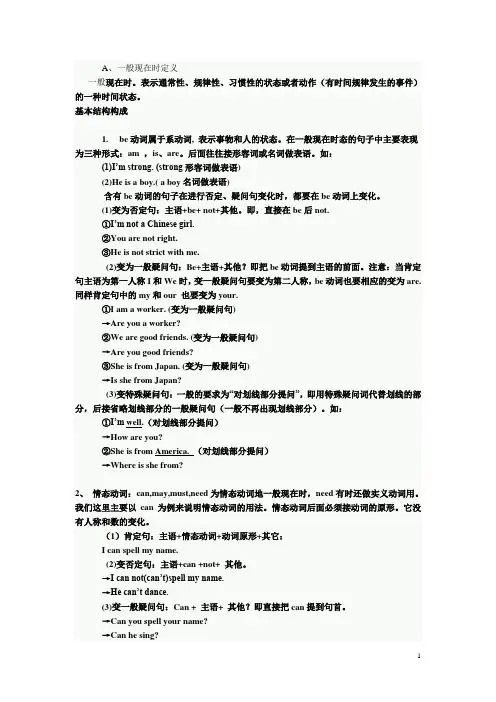
A、一般现在时定义一般现在时。
表示通常性、规律性、习惯性的状态或者动作(有时间规律发生的事件)的一种时间状态。
基本结构构成1. be动词属于系动词, 表示事物和人的状态。
在一般现在时态的句子中主要表现为三种形式:am ,is、are。
后面往往接形容词或名词做表语。
如:(1)I’m strong. (strong形容词做表语)(2)He is a boy.( a boy名词做表语)含有be动词的句子在进行否定、疑问句变化时,都要在be动词上变化。
(1)变为否定句:主语+be+ not+其他。
即,直接在be后not.①I’m not a Chinese girl.②You are not right.③He is not strict with me.(2)变为一般疑问句:Be+主语+其他?即把be动词提到主语的前面。
注意:当肯定句主语为第一人称I和We时,变一般疑问句要变为第二人称,be动词也要相应的变为are.同样肯定句中的my和our 也要变为your.①I am a worker. (变为一般疑问句)→Are you a worker?②We are good friends. (变为一般疑问句)→Are you good friends?③She is from Japan. (变为一般疑问句)→Is she from Japan?(3)变特殊疑问句:一般的要求为“对划线部分提问”,即用特殊疑问词代替划线的部分,后接省略划线部分的一般疑问句(一般不再出现划线部分)。
如:①I’m well.(对划线部分提问)→How are you?②She is from America. (对划线部分提问)→Where is she from?2、情态动词:can,may,must,need为情态动词地一般现在时,need有时还做实义动词用。
我们这里主要以can为例来说明情态动词的用法。
情态动词后面必须接动词的原形。
一般现在时和一般过去式区分

一般现在时通常与时间状语如“always”、“often”、“every day”等连用;一般过去式则与时间状语 如“yesterday”、“last week”、“in 2022”等连用。
常见误区提醒
误区一
误区三
认为一般现在时只用于现在时态,实际上它 还可以表示将来时态,如“The train leaves at 5 o'clock.”(火车5点钟开。)
练习题与答案解析
1 2 3
答案
goes; walked解析第一空表示经常性动作,用一般现在时第三人称 单数形式“goes”;第二空表示昨天发生的动作, 用一般过去式“walked”。
练习题二
判断下列句子时态是否正确,不正确的请改正。
练习题与答案解析
1. I am always late for school. ( )
两者在时态上的区别
时间点不同
一般现在时表示现在的动作或状 态,而一般过去时表示过去的动
作或状态。
动词形式不同
一般现在时使用动词原形(第三 人称单数动词后加-s/-es),而 一般过去时使用动词的过去式。
使用情境不同
一般现在时用于描述经常性、习 惯性或普遍性的动作或状态,以 及客观事实或真理;而一般过去 时用于描述过去某个时间发生的
go动词
现在时为go,过去式为 went
eat动词
现在时为eat,过去式为 ate
04 句式结构差异分析
一般现在时句式结构特点
主语 + 动词原形(或第三人称单数形式) + 其他成…
I like apples.(我喜欢苹果。)
表示经常性、习惯性或普遍性的动作或状态。例如
She always wears a smile.(她总是面带微笑。)
一般过去时与一般现在时的区分

一、一般过去时与一般现在时定义及结构的区分1)概念一般过去时:过去发生的动作或是状态a.表示过去某个时间里发生的动作或状态;b.过去习惯性、经常性的动作、行为;c.过去主语所具备的能力和性格。
一般现在时:现在通常性、规律性、习惯性的动作或是状态a. 表示经常发生的动作,是一般情况不是具体的某一件事;b. 长期存在的一种状态;c. 永恒的事实或真理,谚语等。
2) 基本构成A.谓语动词是实义动词时的结构:一般过去时:肯定句:主语+动词过去式+其他否定句:主语+did+not+动词+其他疑问句:Did+主语+动词+其他特殊疑问句:特殊疑问词+did+主语+动词+其他否定疑问句:Did+主语+not+动词+其他一般现在时:肯定句:主语+动词或(动词+s)+其他否定句:主语+do/does+not+动词+其他疑问句:Do/Does+主语+动词+其他特殊疑问句:特殊疑问词+do/does+主语+动词+其他否定疑问句:Do/Does+主语+not+动词+其他注:变化最大的在于:do/does→did (过去式的动词变化)B. 谓语动词是助动词时:a.Be 动词一般过去时:肯定句:主语+was (were) +表语否定句:主语+was (were) +not+表语疑问句:Was (Were) +主语+表语特殊疑问句:特殊疑问词+was (were) +主语+表语否定疑问句:Was (Were) +主语+not+表语一般现在时:肯定句:主语+be动词+表语否定句:主语+be动词 +not+表语疑问句:Be动词 +主语+表语特殊疑问句:特殊疑问词+be动词+主语+表语否定疑问句:Be动词 +主语+not+表语注意:am(I)、is(he/she/it)→wasAre(we/you/they)→were第三人称时,动词要进行变化。
注意:不管是过去时还是现在时,疑问句都需要助动词did或do.c.情态动词过去式:一般过去时:将情态动词变成过去式,后面加原形,其他句型转变的规则与be动词基本一致。
一般过去时和一般现在时的知识梳理
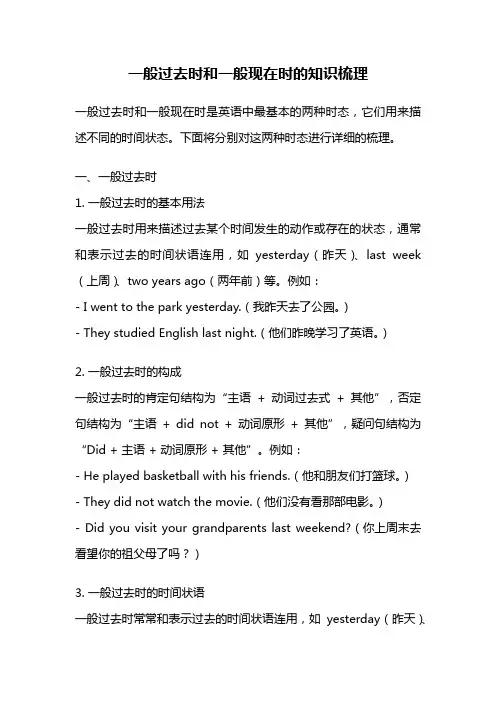
一般过去时和一般现在时的知识梳理一般过去时和一般现在时是英语中最基本的两种时态,它们用来描述不同的时间状态。
下面将分别对这两种时态进行详细的梳理。
一、一般过去时1. 一般过去时的基本用法一般过去时用来描述过去某个时间发生的动作或存在的状态,通常和表示过去的时间状语连用,如yesterday(昨天)、last week (上周)、two years ago(两年前)等。
例如:- I went to the park yesterday.(我昨天去了公园。
)- They studied English last night.(他们昨晚学习了英语。
)2. 一般过去时的构成一般过去时的肯定句结构为“主语+ 动词过去式+ 其他”,否定句结构为“主语+ did not + 动词原形+ 其他”,疑问句结构为“Did + 主语 + 动词原形 + 其他”。
例如:- He played basketball with his friends.(他和朋友们打篮球。
)- They did not watch the movie.(他们没有看那部电影。
)- Did you visit your grandparents last weekend?(你上周末去看望你的祖父母了吗?)3. 一般过去时的时间状语一般过去时常常和表示过去的时间状语连用,如yesterday(昨天)、last month(上个月)、in 1999(在1999年)等。
时间状语可以出现在句首、句中或句末。
例如:- Last night, I watched a movie.(昨晚,我看了一部电影。
)- He lived in New York for five years.(他在纽约住了五年。
)二、一般现在时1. 一般现在时的基本用法一般现在时用来描述当前的状态、习惯或经常发生的动作。
它表示的是客观事实或普遍真理,与时间无关。
例如:- The sun rises in the east.(太阳从东方升起。
一般现在时和一般过去时区别
一般现在时和一般过去时的区别他每天都来。
He comes every day.他昨天来了。
He came yesterday.他已经来了。
He has come.他明天来。
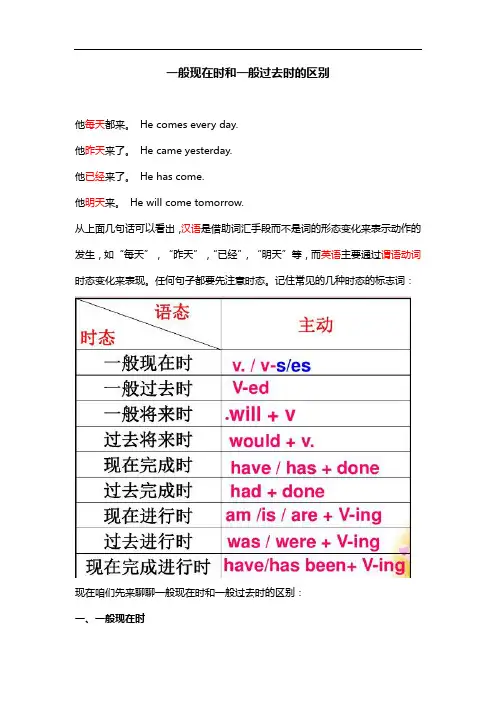
He will come tomorrow.从上面几句话可以看出,汉语是借助词汇手段而不是词的形态变化来表示动作的发生,如“每天”,“昨天”,“已经”,“明天”等,而英语主要通过谓语动词时态变化来表现。
任何句子都要先注意时态。
记住常见的几种时态的标志词:现在咱们先来聊聊一般现在时和一般过去时的区别:一、一般现在时概念:经常、反复发生的动作或行为及现在的某种状况。
时间状语:always, usually, often, sometimes, every week (day, year, month...), once a week, on Sundays, etc.基本结构:一般现在时通常是以动词原形表示的,但在主语为第三人称单数时,动词词尾要加-s或-es,规则如下:(1)当动词以-s, -ss, -sh, -ch, -x, -o结尾时,加-es。
如:kiss—kisses wash—washes teach—teaches box—boxes go—goes (2)当动词以“辅音字母+y" 结尾时,改y为i再加-es,如:carry—carries fly—flies try—tries study—studies(3)动词be的一般现在时表现形式是:am, is, are, 根据人称和数的不同而分别采用。
(4)have的第三人称单数形式是has。
(5)除上述情况外,其余动词在词尾加-s。
一般现在时的用法:1、表示客观真理和科学事实、格言以及其他没有时间限制的客观存在。
如:Twice two is four. 2的两倍是4。
The Great Wall is the longest wall in the world. 长城是世界上最长的城墙。
五种时态一般现在时的_一般过去式_现在进行_现在完成时_一般将来时
• • • • • • • • • • • • • • • • • • • • • • • • • • •
( ) 19. The day after tomorrow they ________ a volleyball match. A. will watching B. watches C. is watching D. is going to watch ( ) 20. There ________ a birthday party this Sunday. A. shall be B. will be C. shall going to be D. will going to be ( ) 21. They ________ an English evening next Sunday. A. are having B. are going to have C. will having D. is going to have ( ) 22. ________ you ________ free next Sunday? A. Will; are B. Will; be C. Do; be D. Are; be ( ) 23. He ________ there at ten tomorrow morning. A. will B. is C. will be D. be ( ) 24. ________ your brother ________ a magazine from the library? A. Are; going to borrow B. Is; going to borrow C. Will; borrows D. Are; going to borrows ( ) 25. – Shall I come again tomorrow afternoon? –________ (好的). A. Yes, please B. Yes, you will. C. No, please. D. No, you won’t. ( ) 26. It ________ the year of the horse next year. A. is going to be B. is going to C. will be D. will is ( ) 27. ________ open the window? A. Will you please B. Please will you C. You please D. Do you
简单的时态一般现在时一般过去时和将来时
简单的时态一般现在时一般过去时和将来时时态是语法中的一个重要概念,它主要用来表示动作或状态发生的时间。
在英语中,时态分为一般现在时、一般过去时和将来时三种。
一、一般现在时一般现在时表示经常性的或习惯性的动作,或者表述普遍真理、自然规律等。
1.形式一般现在时的动词形式为原形动词。
例如:I eat an apple every day.He speaks English fluently.2.用法(1)表示日常习惯、常态或经常性的动作。
例如:She always brushes her teeth before going to bed.They usually go for a walk after dinner.(2)表示客观事实、普遍真理或自然规律。
例如:The sun rises in the east.Water boils at 100 degrees Celsius.(3)表示评论、观点或感受等。
例如:I think he is a talented musician.She looks beautiful in that dress.二、一般过去时一般过去时表示过去某个时间发生或完成的动作。
1.形式一般过去时的动词形式为动词的过去式。
例如:I studied English last night.He played basketball with his friends yesterday.2.用法(1)表示过去某个时间发生的动作。
例如:We visited the museum last week.She met her old friend at the party.(2)表示过去经常性的动作。
例如:He always ate breakfast at home when he was a child.(3)表示过去的习惯、惯常动作。
例如:Every morning, she woke up early and went jogging.三、将来时将来时表示将来某个时间发生或完成的动作。
一般过去时_一般现在时_一般将来时
变化规则
例词
一般在词尾加—ed
play→played
以不发音的e结尾的,只 like →liked
加--d
love →loved
以辅音字母+y 结尾的, study →studied
变y为i ,再加—ed
carry →carried
以一个辅音字母结尾的 重读闭音节,先双写这 个辅音字母,再加-ed
7. At 8:00 A.M, she w__a_tc_h_e_s_(watch) TV with her parents. 8. __D__o_es___ Mike__r_e_a_d___(read) English every day? 9. How many lessons _d_o_e_s__ your classmate__h_a_v_e__
Some day people will not go to the moon . 一般疑问句:把will 提到句子主语之前,结尾变问号。
Will Some day people go to the moon ?
特殊疑问句:特殊疑问词+will +主语+动词原形+其他?
Where will some people go ?
4)We will meet at the stop at 10:30.(一般疑问句) _W__il_l _____ you _m__e_e_t _ at the bus stop at 10:30?
5)She’s going to listen to music after school(划线提问) __W__h_a_t___ is she going to __d_o______ after school?
一般现在时和一般过去时的区别
一般现在时和一般过去时1.满招损,谦受益.Pride hurts, modesty benefits2.世上唯有贫穷可以不劳而获.Nothing is to be got without pain but poverty.3.伟业非一日之功/冰冻三尺非一日之寒.Rome was not built in a day.一般现在时一、定义与讲解一般现在时:表示经常性的事情,经常性的动作或一般性事实。
时间状语:often 经常,usually通常,always 总是,every每个,sometimes 有时,at …在几点钟只有在第三人称单数用动词的“三单变化”,其他用动词的原形。
三单变化:1.多数在动词后+s play — plays like — likes(1)直接在动词词尾加-s.ask---asks;work---works;get---gets;stay---stays(2)以字母s, x, ch, sh或o结尾的动词,在词尾直接加-es.watch---watches;wish---wishes;fix---fixes;do---does;go---goes;pass---passes (3)以“辅音字母加- y”结尾的动词,要先变y为i再加-es.try---tries study---studies cry---cries fly---flies情况构成方法读音例词一般情况加-s 清辅音后读/s/ 浊辅音和元音后读/z/swim-swims;help-helps;like-likes以辅音字母+o结尾的词加-es 读/z/ goes,does以s,sh,ch,x等结尾的词加-es 读/iz/ watches,washes以辅音字母+y结尾的词变y 为i再加es 读/z/ study-studies不规则变化have和be 动词变have 为has变be为am,is,arehave-has be-am,is,are2.不规则变化:be---- is are have----has 二、一般现在时的用法1、一般现在时表示经常性或习惯性的动作,常与表示频度的时间状语every day, usually, always, often, sometimes, on Sunday等连用。
一般现在时,与一般过去时
借 对了!我可以 一个助动词do
DDido they buy any milk?
过去式转移到第一个动词
否定句
He wwoorkrekds in the city.
He dodiedns’tn’t work in the city.
在过去时态里,动词只有一种 过去式 形式。
特殊疑问句
does
原形 过去式
一般现在时:事实,实际 情况(大实话,大白话); 习惯,经常
This is a tree.
We have some classes every day.
特殊疑问词+did+主语+动原+ 其它?
Why did he go home?
时 态
一 般 现 在 时 一般过去时
第三人 不是第三 无论主语是第
主 语
称单数 人称单数
he ,she 形式
,it ,
we,you,
几人称,也不 管数量是多少
Kate they
(1个,1万个)
动
第三人 称单数
词 形式
is has
一般现在时
与
一般过去时
在同一种句子中,二者 在句子成分的顺序, 语序上没有区别。所 不同的是一般现在时 变为一般过去时,只 要把动词由原形或第 三人称单数形式变为 过去式
I wamasat home .
一般现过去在时
规律:一般现在时变为一 般过去时,变化的是:am was 其余的 不变
sHhe wisaslate.
一般现过去在 时
一般现在时变为一般过去时
,只要把 is wa,s 其余的
不变
TYWhoeeuy awreere from Shandong.