
Unit 1 Festivals around the world
Unit 1 Festivals around the world一、复习目标:帮助学生巩固和强化运用本单元重点单词、短语、句型和语法二、复习重点、难点:重点词汇: in memory of dress up gain award admire look forward to turn up重点句型: 1. do you think 作插入语2. 非限定性定语从句语法:情态动词三、复习过程(精讲精练)1。
in memory of【点拨】 in memory of 意为“为了纪念……”。
又如:I send you this card in memory of our happy summer together.随时练1. He founded the charity _________his late wife.A. in favor ofB. in memory ofC. instead ofD. in search of2. Washington, the capital of the United States, was named __________one of the greatest American presidents.A. in memory ofB. in charge ofC. in spite ofD. in view of2. dress up【点拨】 dress up 意为“盛装,打扮,装饰”。
又如:We dressed up for our friends’ wedding.【拓展】 dress up 后多用in,表示服装的名词,翻译成“(小孩)穿别人的衣服闹着玩”,或者加as短语,翻译成“打扮成了某人/某物”。
例如:1) The boy likes dressing up in his brother’s clothes.2) The children tried to dress themselves up as monsters.随时练1. It is quite an informal gathering; you needn’t _________for it.A. dress downB. dress upC. dressD. dress on2. She ________in Korean clothes. She thought she looked as if she were from Korea.A. dressed asB. woreC. dressed upD. made up【答案】1. B 2. C3. gain【点拨】gain为及物动词,意为“获得,得到”,后通常加与钱无关且不可触及的抽象名词。
如:经验(experience),知识(knowledge),教育(education),尊敬(respect),注意力(attention)等。
例如:I gained the impression that the matter had been settled.在我印象里,事情已经解决了。
【拓展】gain 本身还有名词词性,意为“获益,利润,增加”。
例如:These policies have resulted in great gains in public health.这些政策使公共卫生得到了极大改善.No pains, no gains. 不劳无获。
随时练1. He ________much experience when he worked abroad.A. wonB. earnedC. gainedD. awarded【解析】本题考察的是gain一词的用法。
本题句意为“当他在国外工作是获得了许多经验”。
【答案】 C4. award【点拨】 award为及物动词,意为“颁发,授予,判给”, 常用词组为award sb. sth. ( for sth./ doing sth.),award sth to sb. (for sth./doing sth.),(因为……)向某人颁发某物。
如: He was awarded the prize for being the fastest runner.【拓展】 award还可用做名词,意为“奖励,奖品,奖金,判定”。
随时练1. Martin was once ______ the title of “ Advanced Worker” for his excellent work in his company.A. paidB. prizeC. rewardedD. awarded2. Langlang was _______the first prize for his excellent performances in the competition.A. offeredB. givenC. awardedD. rewarded【答案】 1. D 2. C5. admire【点拨】 admire为及物动词,意为“钦佩;赞赏;羡慕”,常用词组为admire sb. for sth.或admire sth.,又如: I admire his capacity of work.随时练1. After she made herself up, she_________herself in the mirror.A. foundB. admiredC. showedD. enjoyed2. I _______ him for his success in business.A. believeB. admireC. appreciateD. show【答案】1. B 2. B6. look forward to【点拨】look forward to 意为“盼望……”,to 为介词,所以后面接n. 或doing。
又如:I am looking forward to seeing you again.随时练1. The day we are looking forward to _______ at last.A. comingB. cameC. have comeD. having come2. She looks forward to his return as he himself _________her.A. to seeB. to seeingC. seesD. seeing【答案】1. B 2. B7. turn up【点拨】turn up 意为“出现”,又如:You are always turning up late for everything!【拓展】turn up 还有“被发现,增强……的声音、力量等”。
如:随时练1. We agreed to meet at 10 at the bus stop, but he _______ so far.A. didn’t turn upB. hasn’t turned upC. didn’t turn offD. hasn’t turned off2. Maybe those who sit at the back can’t hear; please ________the DVD.A. turned downB. turn upC. turn offD. turn in【答案】1. B 2. B重点句型1.do you think 作插入语。
在“疑问词+ do you think+其他”句型中,应注意句子语序为陈述语序。
注意事项:(1)I do n’t think that中存在否定转移如:I do n’t think that he is right,is he ?(2)I think 是插入语,用逗号与句子其他部分隔开,也可以在句末.随时练1. Who do you think ______________(赢得这次比赛)2. - What fruit is in season now ?- Pears and apples ,__________.A.I knowB. I thinkC. I seeD. I feel3.__________ you will burn up in a relay race ?A. Do you think how much energyB. How much you think energyC. How do you think much energyD. How much energy do you think解析: 1.句子语序为陈述语序。
所以答案为 will win the game.2. I think插入语,意为“我认为”。
3.how much energy 应放在一起,do you think 为插入语。
选C 。
2. 非限定性定语从句【原句回放1】Some festivals are held to honour the dead or to satisfy the ancestors, who might return either to help or to do harm.【原句回放2】China and Japan have mid-autumn festivals, when people admire the moon and in China, enjoy mooncakes.【点拨】此两句中的who might return either to help or to do harm. 和when people admire the moon and in China, enjoy mooncakes. 都是非限定性定语从句。
非限定性定语从句前面须用逗号与主句分开,它只是先行词的附加说明,省去后不会影响主句意思。
这也是它与限定性定语从句的区别。
句1中先行词为ancestors指人,在从句中做主语,所以用who引导。
句2中先行词为festivals为时间,在从句中做时间状语,所以用when引导。
随时练1. The famous basketball star, ______ tried to make a come-back, attracted a lot of attention.A. whereB. whenC. whichD. who【解析】who此处引导非限定性定语从句, 来修饰先行词basketball star。
who在从句中做主语。
本题意思为“那个想复出的篮球明星引起了广泛的关注”。
【答案】D2. I shall never forget those years______ I lived in the country with the farmers, _____ hasa great effect on my life.A. that; whichB. when; whichC. which; thatD. when; who【解析】 when引导限定性定语从句,修饰先行词those years,在从句中做时间状语。
20版:(步步高) (全国) Unit 1 Festivals around the world
Book 3Unit 1Festivals around the worldⅠ.阅读理解话题:节假日活动难度星级:☆There are many unique festivals around the world.Here are some of them.Las Fallas,SpainLas Fallas is one of Spain’s strangest and craziest festivals.The focus of this festival is to create and destroy dolls.These dolls are lifelike and usually make fun of dishonest politicians and famous people in Spain.Many dolls are several feet tall.They remain complete until March 19th,after which men fill them with fireworks.All the streetlights are turned off and the dolls are set on fire on March 19th.Day of the Dead,MexicoDay of the Dead is traditionally celebrated on the 1st and 2nd of November in Mexico.This festival celebrates the lives of loved ones around you who have died.Celebrations can take a humorous tone as celebrants remember funny events about the dead.Toys are brought for the dead children and bottles of wine for adults.Mardi Gras,U.S.A.This day can occur anytime between February 3rd and March 9th,depending on when Easter is held that year.It is also called Fat Tuesday,reflecting the practice of eating richer and fatty foods.Other practices include wearing masks and parades,etc.Night of the Radishes,MexicoIt’s one of the most colorful and unique festivals of Mexico.It is celebrated on December 23rd.As crazy as it sounds,the festival lasts only a few hours due to the limited lifetime of vegetables as folk art.语篇解读本文主要介绍了世界上比较特殊的四个节日:西班牙的法雅节、墨西哥的亡灵节、美国的狂欢节和墨西哥的萝卜节,并对这四个节日的意义以及活动内容作了简要介绍。
人教版高中英语必修三Unit1Festivalsaroundtheworld
人教版必修三Unit 1 Festivals around the world智慧课堂中“节日”话题的词汇教学设计Lesson Plan●教材分析Teaching material analysis:本节词汇复习课紧扣人教版必修3,Unit1 “节日”话题——“Festivals around the world”,利用自选课外篇章An interesting festival学习和复习有关节日和民俗的词汇和表达,如origin, take place, reunion, religious,take place等。
引导学生发现英语词汇中的词缀,以此帮助了解不同的词性构成法,并有意识地应用该方法扩大词汇量。
利用本校引进的“慧学云”智能授课交互系统进行针对性的训练。
最后,鼓励学生利用所学词汇和表达,创设任务情景,请学生分享/创造重要/有趣的节日。
本课坚持“词不离句,句不离篇”的词汇学习原则,把词汇放到具体的语境中学习,并通过不同方式进行训练,让学生理解、记忆、复习与巩固与节日相关的词汇和表达。
同时,教会学生如何通过前缀和后缀进行词汇学习和拓展。
本课结合布鲁姆的认知目标分类,在教学中注重记忆、理解、应用、分析/评价、创造层层递进的教学环节,实现教学目标。
●学情分析Students analysis:高一(12)班是年级的重点班,同学对英语学习的热情较高,大部分同学在课堂上专注学习,但是课后未能有效运用所学的词汇和表达。
同时,他们对于单词的记忆方法不够科学,大部分限于拼读和生硬的记忆背诵。
此外,学生初步具有利用多媒体技术进行学习和动手实践的能力,具备一定的小组合作精神。
●教学目标Teaching aims:1. 语言知识和技能方面:1) 通过学习,学生能够对了解和掌握与“节日”话题相关的词汇和表达;2)学生能学以致用,应用所学词汇介绍中西方一些重要节日和民俗;3)学生能根据词缀构词法改善词汇学习和记忆单词的方法。
高一Unit 1《Festivals around the world》教案人教版

高一Unit 1《Festivals around theworld》教案人教版高一Unit1《Festivalsaroundtheworld》教案人教版本单元为人教版《高中英语》(NSEc)必修模块3Unit1.Festivalsaroundtheworld.本单元的中心话题是“谈论世界各地的节日”,该阅读课Reading:APioneerForAllPeople。
是本单元第一课时,内容涉及到各国的节日名称,时间,方式和原因,使学生了解不同国家的文化和风俗。
以独立的内容块进行叙述。
的结构特点是平行并列。
针对内容和结构的特点,本课以培养学生阅读比较信息和归纳信息的能力为主,分别将获取的信息通过列表比较,图片匹配,问答游戏等方式,进行比较,使学生找到各国节日庆祝方式的相同和不同之处,归纳总结各国节日产生的原因,推理出人们到对节日的态度,探究到节日是人类对生活怀有美好祝福的心理,是生命的传承实践,从而提高学生跨文化交际的能力和意识。
教学目标知识与技能目标:Thestudentswillbeableto.identifythedifferentfestivalsbycomparingtheinf ormationaboutcelebrations.2.explainthereasonwhythefestivalscomeintobeingbyfin dingoutthesimilaritiesanddifferences.3.describetheirfavoritefestivalsbyusingthelanguagef romthetext.教学重点和难点)为全体学生进行有效性阅读策略的指导,包括语篇分析、猜测词义,逻辑推理、归纳概括等技巧。
2)通过比较信息,归纳总结各国节日产生的原因,推理出人们到对节日的态度和节日的意义。
教学过程教学步骤教学活动设计意图Pre-reading:Step1.Brainstorm:motivatetheSsbyaskingsomequestions.Q1:Doyouanyfestivalsaroundtheworld?Step2.matchthecelebrationwiththefestivals.Q2:DoyouknowhowpeoplecelebratetheseFestivals?Doaquiz.Step2.DiscussionSsdiscussthefollowingquestionsQ1:Howdotheycomeintobeing?Q2:whatdotheyhaveincommon?Andwhataretheredifference amongthem?问题引发了学生的思考,调动学生的已知,将学生的思维活动引导到课文主题上来。
必修3 Unit 1 Festivals around the world
【本讲教育信息】一、教学内容必修3 Unit 1 Festivals around the world(一)重点单词(二)重点短语(三)重点句型二、知识精讲(一)重点单词1. belief n. 信任;信仰;信心He has great belief in his doctor. 他对他的医生无比信赖。
He came to me in the belief that I could help him.他到我这里来,相信我能帮助他。
The cruelty of the murders was beyond belief.凶手的残忍让人难以置信。
知识拓展:believe vt. & vi. believable / unbelievable adj.They need a leader they can believe in.他们需要一个可以信赖的领导。
Believe it or not, he asked me to marry him.信不信由你,他向我求婚了。
—Does he still work there? 他还在那里工作吗?—I believe so / not. 我想是/不是。
2. gain vt. 获得;得到; 赢得He has gained rich experience in these years.这些年他已获取了丰富的经验。
He has gained the respect of his friends.他赢得了朋友们的尊重。
He gained weight after recovery from his illness.康复后他的体重增加了。
I gained a lot by / from my former experience.我从以前的经验中学到很多东西。
知识拓展n. 收益;利润No pains; no gains.(谚语)不劳无获3. gather vt.采集;收集;积累;聚集The farmers are gathering (in ) crops in the field.农民们正在田野里收割庄稼。
Unit 1 Festivals around the world
Book 3 Unit 1 Festivals around the worldⅠ.单项填空1.As the storm drew nearer, black clouds were________over the sky.A.smoothing B.disappearingC.gathering D.picking答案C[考查动词词义的辨析。
smooth使平整;使光滑;disappear消失;gather聚集;pick选择;挑选。
由语境可知C项正确。
句意:随着暴风雨的来临,乌云在天空聚集起来。
]2. We have bought so much food now that Suzie won’t be with us for dinner.A.may not B.needn’t C.can’t D.mustn’t答案B [may not不可以,needn’t不需要,can't不可能,mustn't绝不可能。
本句句意为:既然Suzie不和我们一起吃晚饭,所以我们就不需要买这么多食物。
] 3.Kathy________some French while she was away on a business trip in France.A.picked up B.took upC.made up D.turned up答案A[考查动词短语的辨析。
pick up拾起;捡起;无意中学会;take up开始从事;make up 弥补;编造;turn up 出现;调大音量。
句意:Kathy在去法国出差时学会了一些法语。
]4.It is________that he has been addicted to the drugs and has difficulty quitting it.A.obviously B.apparentlyC.possibly D.likely答案D[考查句型的搭配。
Unit 1 Festivals around the world
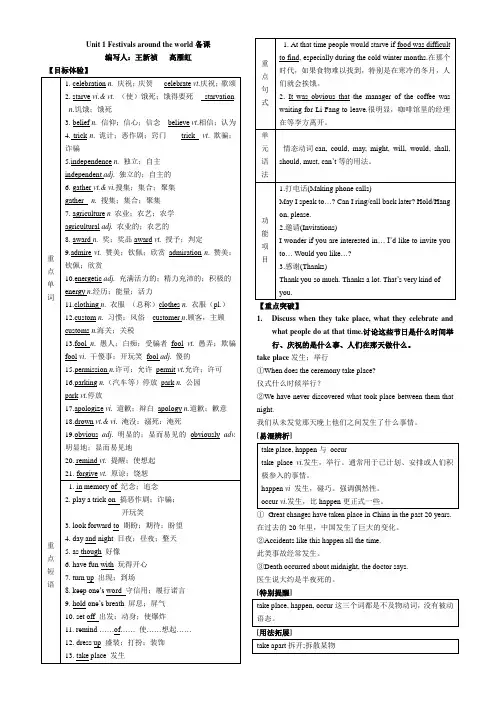
Unit 1 Festivals around the world备课编写人:王新祯高雁虹【目标体验】【重点突破】1.Discuss when they take place, what they celebrate andwhat people do at that time.讨论这些节日是什么时间举行、庆祝的是什么事、人们在那天做什么。
take place发生;举行①When does the ceremony take place?仪式什么时候举行?②We have never discovered what took place between them that night.我们从未发觉那天晚上他们之间发生了什么事情。
在过去的20年里,中国发生了巨大的变化。
②Accidents like this happen all the time.此类事故经常发生。
③Death occurred about midnight, the doctor says.医生说大约是半夜死的。
①Let’s take the radio apart and see what’s wrong with it.我们把收音机拆开看看有什么毛病。
②These books must not be taken away from the library.这些书不准带出图书馆。
③I take back what I said about you being selfish.我承认我不该说你自私。
④The army is threatening to take over if civil unrest continues. 军方声称如内乱不平息将实行军官。
[即景活用]They decided that the meeting should_______ on Monday.A. holdB. happenC. be taken placeD. take place [自我校对]D2. At that time people would starve if food was difficult to find, especially during the cold winter months.在那个时代,如果食物难以找到,特别是在寒冷的冬月,人们就会挨饿。
人教版高中英语必修3 unit1 Festivals around the world 课件
Mexico
Halloween
western countries
Dragon Boat Festival
China
Festivals to Honor People
Columbus Day
USA
Festival to Honor Gandhi
India
Harvest Festivals
Thanksgiving
Unit 1 Festivals around the world
Spring Festival Christmas
Unit 1 Festivals around the world
Tibetan New Year
Unit 1 Festivals around the world
Task 1
Scanning
Easter and some western
carnivals
countries
Cherry Blossom Japan Festival
Kinds of Festivals
Names of Festivals
Countries
Obon
Japan
Festivals of the Dead
Day of the Dead
A. 生病 B. 发疯
C. 受伤 D. 挨饿
2.Which one is used to honour someone?
A. Spring Festival
B. Thanksgiving
C. Dragon Boat Festival
D. Mid-autumn Day
3. Which of the following is not mentioned?
必修三Unit1 Festivals around the world
、
2 . 美: 美人 n . b e a u t y 3 . 祖先 : 祖宗 n . a n c e s t o r 4 . 集合 ; 聚集 ; 搜集 v t . &v i . &n . g a t h e r 5 . 起源 ; 由来 ; 起因 n . o r i g i n 6 . 习惯 ; 风俗 n . c u s t o m 7 . 诡计 ; 恶作 剧 n . 欺骗 ; 诈骗 v t .t r i c k 8 . 奖; 奖品 n .授予 ; 判定 v t . a w a r d 9 . 盛宴 , 宴会 , ( 宗 教 的) 节日n . f e a s t 1 0 . 诗人 凡 . p o e t 1 1 . 遍及 全世 界 的 . w o r l d w i d e l 2 . 基督 徒 n . 基督教的 耐 . C h i r s t i a n l 3 . 游行 : 阅兵 : 检 阅 . &V . p a r a d e 1 4 . p r e d i c t i o n/ / , . 预言: 预 报 1 5 . f a s h i o n n . 时尚; 样子 : 方 式 1 6 . p a r k i n g n . f 汽 车等 ) 停 放 1 7 . a p o l o g i z e v i . 道歉 ; 辩 白 1 8 . w e e p n . &v i . 哭: 哭 泣 1 9 . w i p e v t . 擦: 揩; 擦去
Fe s t i r a l S a r o u n d me wo r l d
◇ 广东 省博 罗县 华侨 中学 周春 萍
考 点 梳 理
重 点单 词 1 . 收获 : 收割 n . &v t . &v i . h a r v e s t
【语法讲解】Unit1Festivalsaroundtheworld精讲语法
【语法讲解】Unit 1 Festivals around the world 精讲语法情态动词(I)一、概述情态动词表示说话人的某种感情或语气,对某一动作或状态的某种态度,表示“需要”“可以”“必须”“应当”等意义。
情态动词有以下特征:1. 不能单独作谓语,除ought to和used to以外,后面只能接不带to的不定式。
2. 没有人称和数的变化。
但有些情态动词,如can, will, dare有一般时和过去时的变化。
3. 情态动词的“时态”的形式并不是区分时间的主要标志。
不少情况下,情态动词的现在时形式和过去时形式都可用来表示现在时间、过去时间或将来时间。
二、用法归纳1. can和could(1)表示能力,常译为“能,会”。
e.g. I can speak Japanese, but I can't write it. 我会说日语,但是不会写。
(2)表示允许,常译为“可以”;could还可以表示更加委婉地请求或许可。
e.g. —Can/Could I have a look at your photos? 我可以看看你的照片吗?—Of course you can.当然可以了。
You can smoke in this room. 你可以在这间屋子里吸烟。
(3)表示对现在或过去情况的推测,只用于疑问句或否定句中。
e.g. —Can she be in the classroom? 她可能在教室吗?—No, she can't be in it. 不,她不可能在教室里。
Can what he said be true? 他说的可能是真的吗?(4)用于肯定的陈述句中,表示理论上或习惯上的可能性。
e.g. Accidents can happen at any time.事故随时会发生。
It could be very interesting to go out for a drive.出去开车兜风可能会很有趣。
Unit1_Festivals_around_the_world_Reading(包括语言点)教材
2019/4/23
in/for fun :开玩笑地,为了好玩 make fun of := laugh at 嘲笑,讥笑 have fun with : 和...玩的快乐/ 开心 We had fun with each other at the party held last Sunday. We are playing cards just for fun. fun : n [u] What fun it is to swim in summer!
2019/4/23
in memory of : 纪念,作为…的纪念 = to the memory of sb The museum was built in memory of the famous scientist. 类似短语有: in honor of in favor of in search of in charge of in need of
2019/4/23
award [ə'wɔːd]
n. 奖品,奖项,奖金, 助学金 ……
vt. 授予……裁定……奖励...... award sb sth = award sth to sb Mary got an award and was able to finish her study. She won the best actress award. reward n ,v 报酬,奖金,酬劳,奖赏