
英美文学古世纪中世纪英语
(一) The Old and Medieval English Period
1. Two Major Foundations in Western Culture
(1)Greco-Roman foundation : based on rationality (理性) and humanism(人文主义)希腊罗马的理性传统
(2)Judeo-Christian foundation : based on divinity (神性) and faith(信仰); focusing on exploring the soul world. 犹太-基督教传统
(3)两希文明:希腊;希伯来Hebrew
2.Old English Literature (449-1066)
(1)Old English, or Anglo-Saxon period extends from the invasion of Teutons(Germans)to the Norman Conquest.
(2)The three tribes :Angles(盎格鲁人), Saxons(撒克逊人)and Jutes(朱特人)developed into one single language: Anglo-Saxon , or old English.
(3)Main literary forms: poetry and prose
(4)Two divisions: pagan/secular (Beowulf) & religious (Caedmon, Cynewulf)
3.The Song of Beowulf 贝奥武甫
(1)An Anglo-Saxon poetry & a national epic of English people.
(2)originally in the oral form in 6th century and the present one written in 10th.
(3)3182 lines
(4)It is essentially concerned with the heroic ideal of kings and kingship in Northern Europe: courage,strength and wisdom. Beowulf is shown not only as a great hero, but also as a savior of the people.
4.The significance of Beowulf
(1)It is the longest & finest of extant(现存的)old English poems & the national epic of the English people.
(2)This glorious epic presents us a vivid picture of the life of Anglo-Saxon people and highly praises the brave and courageous spirit of the fighting against the elemental forces.
(3)The epic reflects the situations and life of pagan tribalism and of the Christianized feudal society.
(4)The epic gives the vivid portrayal of a great national hero, strong and courageous people. 5.Epic(史诗)
It is, originally, an oral narrative poem, majestic both in theme and style. Epics deal with legendary or historical events of national or universal significance, involving action of broad sweep and grandeur. Most epics deal with the exploits of a single individual, thereby giving unity to the composition. Great epics include The Iliad 伊利亚特and The Odyssey奥德赛by Homer.
6.Artistic features
(1)Alliteration 头韵
In alliterative verse, certain stressed words in a line begin with the same consonant or consonant clusters. There are 4 stresses in a line generally, three or two of which begin with the same sound or letter.
(2)Kennings 隐喻
A metaphorical phrase or compound word used to name a person, place, thing, or event indirectly.
A kenning enhances the literal meaning of the words. A kenning gives the listener an idea of how
the words connect to an idea or concept that is richer and more emotionally complex.
A metaphor expresses the unfamiliar in terms of the familiar.
(3)Understatements 低调陈述
It is a speech of figure used to mean simply “more” than what is literally stated. The speaker says P but means more than P. The use of understatements gives an impression of reserve, and at times, a tinge of ironical humor. This quality is often regarded as a permanent characteristic of English.
Medieval English Literature(1066-1485).
7.Ballad
(1)The most important form of English folk literature is the ballad.
(2)Oral literature of English people
(3)a story told in song
(4)usually in 4-line stanzas, with the second and fourth lines rhymed (a b c b ).
(5)Various kinds: historical, legendary, fantastical, lyrical and humorous.
(6)Various subjects: the struggle of young lovers against feudal-minded families, the conflict between love and wealth, the cruelty of jealousy and the criticism of the civil war.
(7)Robin Hood Ballads was the most important ballad of that time.
8.Robin Hood Ballads
(1)Origin: peasants’ struggle against the landlords, local officials and the king’s judges
(2)Character: Robin Hood is a partly historical and partly legendary character. Hatred for the cruel oppressors and love for the poor; pious in religion; reverence for the King.
(3)Social Significance: showing the fighting spirit, courage and revolutionary energy of English peasantry.。
中古英语时期解读

1st the Medieval Period中古英语时期1.The Middle Ages中世纪European history: the 5th century AD --- the end of the 15th centuryThe Anglo-Saxon period: 446AD --- 1066 + 400 years欧洲的历史:公元5世纪---15世纪的结束盎格鲁- 撒克逊时期:446AD---1066+400年一.The major literary forms一,主要文学形式1. Epic --- Beowulf贝奥武甫Epic, a poem that celebrates in the form of a continuous narrative the achievements of one or more heroic personages of history or tradition史诗,一首诗,庆祝连续叙述形式的历史和传统中的一个或多个英雄人物的成就—— Basic information基本信息1)the national epic of the Anglo-Saxon and English people 盎格鲁- 撒克逊和英国的民族史诗2)a long poem of about 3,000 lines(2)一首长诗约3000线3)a folk legend brought to England by the Anglo-Saxons from their continental home. (3)一个民间传说带到英格兰的盎格鲁- 撒克逊人从他们的大陆的家。
——Features特点(1)The use of alliteration (certain accented words in a line beginning with the same consonant sound, generally 4 accents in a line, three of them showing alliteration. 1)在一条线上,使用头韵(某些重音单词开头的辅音相同的声音,一般4口音在一条线上,他们三个显示头韵。
英国文学简史期末考试资料

英国文学简史期末考试资料英国文学简史英美文学史名词翻译Neoclassicism (新古典主义) Renaissance (文艺复兴)Metaphysical poetry (玄学派诗歌) Classism (古典主义)EnlighteXXXent (启蒙运动) Romanticism (浪漫主义)Byronic Hero (拜伦式英雄) Aestheticism(美学主义)Stream of consciousness (意识流) the Age of Realism (现实主义阶段) Naturalism (自然主义) Local Colorist (乡土文学)Imagism (意象主义) The Lost Generation (迷惘的一代)Surrealism (超现实主义) The Beat Generation (垮掉的一代) Metaphysical poets (玄学派诗人)New Criticism (新批判主义)Feminism(女权主义) Hemingway Code Hero (海明威式英雄) Impressionism (印象主义) Post modernity (后现代主义)Realism (现实主义) Allegory (寓言)Romance (传说) epic(史诗)Blank Verse (无韵诗) Essay (随笔)Masques or Masks (假面剧) Spenserian Stanza (斯宾塞诗节)Three Unities (三一.原则) Meter (格律)Soliloquy (独白) Cavalier poets (骑士派诗人)Elegy (挽歌) . Action/plot (情节)Atmosphere (基调) Epigram (警句)The Heroic Couplet (英雄对偶句) Sentimentalism (感伤主义文学)Aside (旁白) Denouement (戏剧结局)parable (寓言) Genre (流派)Irony (反讽) Satire (讽刺)Lyric (抒情诗) Ode (颂歌)Pastoral (田园诗) Canto (诗章)Lake Poets (湖畔诗人) Image (意象)Dramatic monologue(戏剧独白)Psychological novel (心理小讲)Allusion (典故) Protagonist and Antagonist (正面人物与反面人物) Symbolism (象征主义) Existentialism (存在主义)Anti-hero (反面人物) Rhyme (押韵)Round Character (丰满的人物) Flat character (平淡的人物)Oedipus complex (俄狄浦斯情结/蛮母厌父情结) Iambic pentameter (抑扬格五音步)Poetic license (诗的破格) Legend (传奇)Myth (神话) Pessimism (悲观主义)Tragicomedy (悲喜剧) Comedy of manners (风俗喜剧)Free Verse (自由体诗歌) Magic realism (魔幻现实主义) Autobiography (自传) Biography (传记)Foot (足注) Protagonist (正面人物)Psychological Realism (心理现实主义) Setting (背景)Chronicle《编年史》Ballads 民谣consonant(协调,一致) repetition (反复)repeated initial(开头的)一、中世纪文学(约5世纪—1485)《贝奥武甫》(Beowulf)《高文爵士和绿衣骑士》(Sir Gawain and the Green Knight )杰弗利·乔叟(Geoffrey Chaucer) ―英国诗歌之父(Father of English Poetry)《坎特伯雷故事》(The Canterbury Tales )二、文艺复兴阶段文学(15世纪后期—17世纪初)托马斯·莫尔(Thomas More )《乌托邦》(Utopia)埃德蒙·斯宾塞(Edmund Spenser)《仙后》(The Faerie Queene)弗兰西斯·培根(Francis Bacon)《论讲文集》(Essays)克里斯托弗·马洛(Christopher Marlowe)《帖木儿大帝》(Tamburlaine)《浮士德博士的悲剧》(The Tragical History of the Life and Death of Dr. Faustus)《马耳他岛的犹太人》(The Jew of Malta )威廉·莎士比亚(William Shakespeare )四大悲剧: Hamlet(哈姆雷特)、Othello(奥瑟罗)、King Lear(李尔王)、Macbeth(麦克白)四大喜剧:A Midsummer Night's Dream《仲夏夜之梦》As you like it《皆大欢喜》Twelfth Night 《第十二夜》The merchant of Venice 《威尼斯商人》三、17世纪文学约翰·弥尔顿John Milton 《失乐园》(Paradise Lost)(诗人、政论家;失明后写《失乐园》、《复乐园》、《力士参孙》。
英国文学与美国文学学习笔记摘抄

英国文学与美国文学学习笔记摘抄I.Literature文学i)English Literature英国文学I .Old and Medieval English literature(450-1066)&(1066-15世纪后期)上古及中世纪英国文学Background:英伦三岛自古以来遭遇过3次外族入侵,分别为古罗马人、盎格鲁-萨克逊人&诺曼底人。
其中后两次在英国文学史上留下了深远影响。
中世纪时期(约1066-15世纪后期)即从诺曼底征服起到文艺复兴前夕,为英国封建社会时期的文学,盛行文学形式为民间抒情诗(the folk ballad)和骑士抒情诗(the romance)。
I)The Anglo-Saxon Period(450-1066)盎格鲁撒克逊文明兴盛时期(上古时期)文学表现形式主要为诗歌散文。
i代表人物和主要作品:第一部民族史诗(the national epic)《贝奥武甫》Beowulf,体现盎格鲁撒克逊人对英雄君主的拥戴和赞美,歌颂了人类战胜以妖怪为代表的神秘自然力量的伟大功绩。
"Down off the moorlands' misting fells cameGrendel stalking;God's brand was on him.大踏步地走下沼泽地,上帝在每个人身上都打下了烙印。
"II)The Norman Period(1066-1350)诺曼时期In the early 11th century all England was conquered by the Danes for 23 years. Then the Danes were expelled, but in 1066 the Normans came from Normandy in northern France to attack England under the leadship of the Duck of Normandy who claimed the English throne. For the last Saxon king, Harold ,had promised that he would give his kingdom to William, Duck of Normandy, as an expression of his gratitude for protecting his kingdom during the invasion by the Danes. This is known as the Norman Conquest.诺曼征服Middle English中世纪英语III)The Age of chaucer(1350-1400)乔叟时期The Hundred Years' War英法百年战争Geoffrey Chaucer杰弗里.乔叟-中世纪最伟大诗人、英国民族文学奠基者。
中古英语时期解读
1st the Medieval Period中古英语时期1.The Middle Ages中世纪European history: the 5th century AD --- the end of the 15th centuryThe Anglo-Saxon period: 446AD --- 1066 + 400 years欧洲的历史:公元5世纪---15世纪的结束盎格鲁- 撒克逊时期:446AD---1066+400年一.The major literary forms一,主要文学形式1. Epic --- Beowulf贝奥武甫Epic, a poem that celebrates in the form of a continuous narrative the achievements of one or more heroic personages of history or tradition史诗,一首诗,庆祝连续叙述形式的历史和传统中的一个或多个英雄人物的成就—— Basic information基本信息1)the national epic of the Anglo-Saxon and English people 盎格鲁- 撒克逊和英国的民族史诗2)a long poem of about 3,000 lines(2)一首长诗约3000线3)a folk legend brought to England by the Anglo-Saxons from their continental home. (3)一个民间传说带到英格兰的盎格鲁- 撒克逊人从他们的大陆的家。
——Features特点(1)The use of alliteration (certain accented words in a line beginning with the same consonant sound, generally 4 accents in a line, three of them showing alliteration. 1)在一条线上,使用头韵(某些重音单词开头的辅音相同的声音,一般4口音在一条线上,他们三个显示头韵。
英语八级英美文学整理
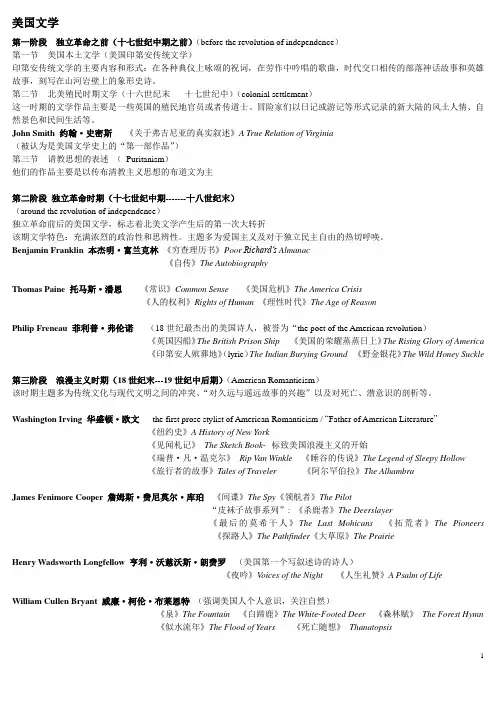
美国文学第一阶段独立革命之前(十七世纪中期之前)(before the revolution of independence)第一节美国本土文学(美国印第安传统文学)印第安传统文学的主要内容和形式:在各种典仪上咏颂的祝词,在劳作中吟唱的歌曲,时代交口相传的部落神话故事和英雄故事,刻写在山河岩壁上的象形史诗。
第二节北美殖民时期文学(十六世纪末-----十七世纪中)(colonial settlement)这一时期的文学作品主要是一些英国的殖民地官员或者传道士、冒险家们以日记或游记等形式记录的新大陆的风土人情、自然景色和民间生活等。
John Smith 约翰·史密斯《关于弗吉尼亚的真实叙述》A True Relation of Virginia(被认为是美国文学史上的“第一部作品”)第三节请教思想的表述(Puritanism)他们的作品主要是以传布清教主义思想的布道文为主第二阶段独立革命时期(十七世纪中期-------十八世纪末)(around the revolution of independence)独立革命前后的美国文学,标志着北美文学产生后的第一次大转折该期文学特色:充满浓烈的政治性和思辨性。
主题多为爱国主义及对于独立民主自由的热切呼唤。
Benjamin Franklin 本杰明·富兰克林《穷查理历书》Poor Richard’s Almanac《自传》The AutobiographyThomas Paine 托马斯·潘恩《常识》Common Sense 《美国危机》The America Crisis《人的权利》Rights of Human《理性时代》The Age of ReasonPhilip Freneau 菲利普·弗伦诺(18世纪最杰出的美国诗人,被誉为“the poet of the American revolution)《英国囚船》The British Prison Ship 《美国的荣耀蒸蒸日上》The Rising Glory of America《印第安人殡葬地》(lyric)The Indian Burying Ground 《野金银花》The Wild Honey Suckle第三阶段浪漫主义时期(18世纪末---19世纪中后期)(American Romanticism)该时期主题多为传统文化与现代文明之间的冲突、“对久远与遥远故事的兴趣”以及对死亡、潜意识的剖析等。
01、古英语文学和中世纪文学

一、古英语文学和中世纪文学(中古英语)Chapter One The Old English Literature and the Medieval English Literature (about the 5th century - 1485)●古英语文学:(450-1066)The Old English Literature (also called The Anglo-Saxon Period)Ⅰ. Social BackgroundThe year 450 marked the coming of the Anglo-Saxons to England to settle in Wessex, while the year 1066 witnessed William Duke of Normandy conquering England.Ⅱ. Literary Characteristics and Major Writers and WorksBeowulf 贝尔武夫--------英雄史诗The earliest English poem we have known is Beowulf, composed in Anglo-Saxon about 700 by an unknown minstrel who composed poems that praised Anglo-Saxon ideals. This great epic tells of the adventures of Beowulf and his victories over the monster Grendel and Grendel’s mother. It ends with Beowulf’s final battle with a dragon and the hero’s death.记住“a saint, a cowman and a King 一个圣人,一个牧牛人,一个国王”Bede 比德(676-735) ---the first Anglo-Saxon who wrote the history in LatinHe is one early poet. His works survive in manuscripts across Europe and in Russia.Ecclesiastical History of the English People 英吉利教会史Caedmon 凯德蒙---the father of English songsAccording to Bede, the earliest known poet in English literature was Caedmon, a cowherd at Whitby Abbey in Northumbia. (在睡梦中创作出《创世纪》的赞歌)Caedmon’s Hymn 凯德蒙赞歌(一首9行头韵体赞美诗,一般认为这首对上帝的赞美诗就是最初他在梦里所做的)King Alfred the Great 阿尔弗雷德大帝(849-899)Alfred the Great was King of Wessex from 871 to 899. Alfred is noted for his defence of the Anglo-Saxon kingdoms of southern England, becoming the only English king to be accorded the epithet "the Great". He was the first who commissioned the writing of The Anglo-Saxon Chronicles in old English vernacular.The Anglo-Saxon Chronicles 盎格鲁撒克逊编年史翻译比德的作品●中世纪文学:(1066-1485)The Medieval English LiteratureⅠ. Social BackgroundMiddle English literature refers to the literature in the period from Norman Conquest to the end of the Wars of the Roses and the accession of Henry Ⅶ. The evolution of something new is most apparent in some of the developments in religious writing in Middle English literature. The literature was various and deeply influenced by French.Ⅱ. Literary Characteristics and Major Writers and WorksTwo main literature forms:Medieval Romance (浪漫传奇:原本指中世纪早期地中海沿岸西部地区的一种用诺曼语讲述的故事。
中英对照英美文学知识大全
Hamlet, King Lear, Othello, Macbeth
喜剧
A Midsummer Night’s Dream;The Merchant of Venice;As You Like It《皆大欢喜》;Twelfth Night
历史剧
Henry VI, Henry IV, Richard III
传奇剧
Pericles《泰尔亲王配力克里斯》;Cymbeline《辛白林》;The Winter’s Tale;Tempest《暴风雨》
8. Ben Jonson (本•琼森)
comedy of manners (风俗喜剧的奠基人);
Every Man In His Humor《人性互异》
9. John Donne (约翰•多恩)
7. Richard Steel & Joseph Addison
(理查德•斯蒂尔 & 约瑟夫•艾迪生)
The Tatler《闲谈者》;The Spectator《旁观者》
8. William Blake (威廉•布莱克)
Songs of Innocence;Songs of Experience
9. Robert Burns (罗伯特•彭斯)
A Red, Red Rose;Auld Lang Syne《昔日好时光》
10. Samuel Johnson (塞缪尔•约翰逊)
A Dictionary of the English Language《英语辞典》;
A Letter to Lord Chesterfield《致切斯特菲尔德爵爷书》
被誉为文人脱离贵族提携和保护的宣言书;
The Lives of the Poets《诗人传》
英美文学
英美文学默认分类2010-05-02 16:15:36 阅读334 评论0 字号:大中小订阅0.英格兰和苏格兰民谣,叠句(refrain)和递增重复是主要特点。
多关于Robin Hood and his partners.Iambic tetrameterIambic trimetreIambic tetrameterIambic trimetre1.中古传奇文学:中世纪封建社会忠告贵族的骑士所经历的冒险生活和浪漫爱情,反应骑士阶层的思想情感。
主题: 冒险,爱情,宗教关于亚瑟王和圆桌骑士代表作sir Gawain and the green knight 用了alliteration2. Geoffrey Chaucer 英国诗歌之父the Canterbury Tale 英国中世纪第一部完美的现实主义作品。
Chaucer是英国文学史上第一个用民族语言(盎格鲁萨克孙语)进行创作的文学家。
3. Thomas More 英国早期人文主义者代表作Utopia 世界文学史上第一部空想社会主义小说,开创这里幻想小说的先河。
4. Edmund Spencer 英国杰出诗人代表作长诗The Faerie Queen 歌颂伊丽莎白女王,宣扬人文主义。
斯宾塞诗体5. Francis Bacon 17世纪英国杰出散文家第一部Essays : Of Studies Of Truth Of BeautyThe Advancement of Learning6. Shakespeare 人文主义杰出代表37部戏剧三个时期:1 : 以历史剧:Richard III,Henry IV喜剧:A Midsummer Night’s Dream, The Merchant of Venice, As You Like It,Twelfth Night2: 悲剧为主:四大悲剧3:浪漫主义传奇剧:Cymberline, The Winter’s Tale, The Tempest.157首sonnet 四,四,四,二编排:abab, cdcd, efef, gg.最后两句为总结性语句。
英美文学选读复习要点中英文对照
Chapter2 The Neoclassical Period(1660—1798)新古典主义1. In short, it was an age full of conflicts and divergence of values。
总之,这一时期是矛盾与价值观分歧的时期。
2. The eighteenth-century England is also known as the Age of Enlighte nment or the Age of Reason.英国的十八世纪也同时是启蒙主义时代,或曰理性时代.3. Its purpose was to enlighten the whole world with the light of modern philosophical and artistic ideas。
运动的主旨便是用当代哲学与艺术思想的晨光启迪整个世界。
4。
Enlighteners held that rationality or reason should be the only,the f inal cause of any human thought and activities。
They called for a refere nce to order,reason and rules。
启蒙者主张理性是任何人思想与行动的唯一缘由.他们大力提倡秩序,理性及法律。
5。
As a matter of fact, literature at the time, heavily didactic and morali zing,became a very popular means of public education.其实,当时的文学作品种充满了说教与道德理念,就已经成为大众教育的良好工具。
6. Famous among the great enlighteners in England were those great wr iters like John Dryden, Alexander Pope,Joseph Addison and Sir Richar d Steele,the two pioneers of familiar essays,Jonathan Swift,Daniel Defoe,Richard Brinsley Sheridan, Henry Fielding and Samuel Johnson.英国著名的启蒙主义文学家有约翰.德莱顿,亚历山大.蒲柏,约瑟夫.艾迪森与理查.斯蒂尔(这两位是现代散文的先驱),乔纳森.斯威夫特,丹尼尔.迪福,理查. B。
古英语和中世纪英语 英国文学考点
第一章古英语时期和中世纪时期的英国文学考点1. The Old English poetry can be divided into two groups: the religious group and the secular one. The Bible consists of the Old Testament and the New Testament. Beowulf 《贝尔武夫》, a typical example of Old English poetry, is regarded as the greatest national epic of the Anglo-Saxons. The epic describes the exploits of a Scandinavian hero, Beowulf, in fighting against the monster Grendel, his revengeful mother, and a fire-breathing dragon in his declining years. While fighting against the dragon, Beowulf was mortally wounded. However, he killed the dragon at the cost of his life. Beowulf is shown not only as a glorious hero but also as a protector of the people.2. Romance is a popular literary form in the medieval England. It sings knightly adventures or other heroic deeds. Chivalry (such as bravery, honor, generosity, and kindness to the weak and poor) is the spirit of romance.3. John Gower is the author of Sir Gawain and the Green Knight, the best romance of the period.William Langland is a more realistic writer who dealt with the religious and social issues of his day in Piers Plowman《农夫皮尔斯》.4. Geoffry Chaucer is the greatest writer of Middle Ages. His masterpiece The Canterbury Tales《坎特伯蕾故事集》presents, for the first time in English literature, a comprehensive realistic picture of the medieval English society and creates a whole gall ery of vivid characters from all walks of life. In “The Canterbury Tales”, Chaucer developed his art of poetry still further towards drama and the art of the novel. In Troilus and Criseyd, he gave the world what is virtually the first modern novel. Chaucer wrote in Middle English and did much in making London dialect the foundation for modern English language. Though essentially still a medieval writer, Chaucer bore marks of humanism and anticipated a new era to come. As a forerunner of humanism, he praises man’s energy, intellect, quick wit and love of life. His tales exposed and satirized the evils of his time. These tales attacked the degeneration of the noble, the heartlessness of the judge, the corruption of the church, etc. In his works, he developed his characterization to a higher level by presenting characters with both typical qualities and individual dispositions. “The Wife of Bath” is a famous tale in which the heroine is depicted as the new bourgeois. Taking the stand of the rising bourgeoisie, he affirms men and opposes the dogma of asceticism preached by the church. Chaucer introduced from France rhymed stanzas of various types into English poetry to replace the Old English alliterative verse. It was he who used for the first time in English the rhymed couplet of iambic pentameter that was later called the “heroic couplet”. The Chaucer’s reputation has been securely established as one of the best English poets for his wisdom, humor, and humanity. John Dryden called Chaucer the father of English poetry.第二章文艺复兴时期的英国文学考点1. Renaissance refers to the transitional period from the medieval to the modern world. It first started in Italy in the 14th century, lasting into the 17th century. The Renaissance means rebirth or revival. It was marked by a humanistic revival of ancient Roman and Greek classics expressed in a flowering of the arts and literature and by the beginnings of modern science. Humanism is the essence of the Renaissance. The English Renaissance did not begin until the reign of Henry VIII. It was usually regarded as England’s Golden Age, especially in literature. Among the literary giants were Shakespeare, Spenser, Johnson, Sidney, Marlowe, Bacon and Donne, and John Milton was the last great poet of the English Renaissance. The real mainstream of the English Renaissance is the Elizabethan drama.2. Humanism is the essence of the Renaissance. It emphasizes the dignity of human beings and the importance of the present life. Humanists voiced their beliefs that man was the center of the universe and man did not only have the right to enjoy the beauty of the present life, but had the ability to perfect himself and to perform wonders.3. Petrarch was regarded as the fountainhead of literature by the English writers. Wyatt introduced the Petrarchan sonnet into England. Surrey brought in blank verse (无韵体诗),i.e. the unrhymed iambic(抑扬格的)pentameter(五音步的)line.4. Renaissance drama: the Elizabethan drama is the real mainstream of the English Renaissance. English dramas were influenced by the Greek and Roman classics. Thomas Kyd wrote the earliest popular tragedy of blood and revenge, The Spanish Tragedy. The most famous dramatists in the Renaissance England are Christopher Marlowe, William Shakespeare, and Ben Johnson. Elizabethan drama reached its peak in Shakespeare’s works. Shakespeare’s compassionate understanding of the human fate has perpetuated his greatness and made him the representative figure of English literature for the whole world. Francis Bacon was the first important English essayist. He was the founder of modern science in England. His writing paved the way for the use of scientific method.5. University Wit refers to any of a notable group of pioneer English dramatists writing during the last 15 years of the 16th century. They transformed the native dramatic inheritance of interlude and chronicle play into a potentially great drama by writing plays of quality and diversity. In doing so they prepared the ground for genius of William Shakespeare. Their forerunner was John Lily, Christopher Marlowe, Thomas Nashe, Robert Green, and Thomas Kyd, etc. All these writers except Thomas Kyd took degrees from universities like Oxford and Cambridge.6. Edmund Spenser: The Shepherd’s Calendar is his early work. Spenser’s masterpiece is the Faerie Queene 《仙后》, a great poem of its age. There are five main qualities in Spenser’s poetry: a perfect melody; a rare sense of beauty; asplendid imagination; a lofty moral purity and seriousness, and a dedicated idealism. It is Spenser’s idealism, his love of beauty, and his exquisite melody that earn him the title of “the poets’ poet.” (诗人的诗人)The Faerie Queene is written in the stanza invented by Spenser himself, the Spenserian stanza, i.e., a stanza(诗的一节)of nine lines, with the first eight lines in iambic pentameter and the last line in iambic hexameter(六音步), rhyming ababbcbcc.7.Christopher Marlowe:(1) As the most gifted of the “University Wits”, Marlowe composed six plays within his short lifetime. Among them the most important are: Tamburlaine, Dr. Faustus, The Jew of Malta and Edward II. Tamburlaine is a play about an ambitious and pitiless Tartar conqueror in the fourteenth century who rose from a shepherd to an overpowering king. By depicting a great hero with high ambition and sheer brutal force in conquering one enemy after another, Morlowe voiced the supreme desire of the man of the Renaissance for infinite power and authority. Dr. Faustus is a play based on the German legend of a magician aspiring for knowledge and finally meeting his tragic end as a result of selling his soul to the Devil. It celebrates the human passion for knowledge, power and happiness; it also reveals man’s frustration in realizing the high aspirations in a hostile moral order. And the confinement to time is the cruelest fact of man’s condition. The play is a good example to illustrate the idea that a man gains the whole world but loses his own soul.(2) Marlowe’s greatest literary achievement lies in that he perfected the blank verse and made it the principal medium of English drama. He brought vitality and grandeur into the blank verse with his “mighty lines” which carry strong emotions. Marlowe’s second achievement is his creation of the Renaissance hero for English drama. Such hero is always individualistic and full of ambition, facing bravely the challenge from both gods and men. Such a hero embodies Marlowe’s humanistic ideal of human dignity and capacity. With the endless aspiration for power, knowledge, and glory, the hero embodies the true Renaissance spirit.8. William Shakespeare (1564—1616):(1) Shakespeare was born on April 23, 1564, into a merchant’s family in Stratford-on-Avon. In 1582, he got married and had three children. It was probably because he had to support his growing family that he left for London. Shakespeare wrote 38 plays, 154 sonnets and 2 long poems. He is the greatest dramatist of the English Renaissance. Shakespeare is above all writers in the past and in the present time. Robert Greene, one of the “University Wits”, resentfully declared him to be “an upstart crow.” He died on April 23, 1616. Shakespeare is surpassingly great because his works never fail to bear a kind of closeness to human life and never fail to be the mirror reflecting human nature. Shakespeare is so great that maybe only Ben Johnson’s praising poem will somewhat cover his greatness: “…Soul of the Age! The applause! delight! The wonder of our stage! Triumph, my Britain, thou hast one toshow To whom all scenes of Europe homage owe. He was not of an age, but for all time!”(2) Shakesp eare’s four dramatic periods:a. His first dramatic period was one of apprenticeship. He wrote five history plays: Henry VI, Parts I, II, and III, Richard III, and Titus Andronicus; and four comedies: The Comedy of Errors, The Two Gentlemen of Verona, The Taming of the Shrew, and Love’s Labour’s Lost.b. His second dramatic period was highly individualized. He wrote five history plays: Richard II, King John, Henry IV, Parts I and II, and Henry V; six comedies: A Midsummer Night’s Dream, The Merchant of Ve nice, Much Ado About Nothing, As You Like It, Twelfth Night, and The Merry Wives of Windsor; and two tragedies: Romeo and Juliet and Julius Caesar. Romeo and Juliet eulogizes the faithfulness of love and the spirit of pursuing happiness. The play, though a tragedy, is permeated with optimistic spirit. Shakespeare’s history plays of these two periods are mainly written under the principle that national unity under a mighty and just sovereign is a necessity.c. His third period includes his greatest tragedies and his so-called dark comedies. The tragedies of this period are: Hamlet, Othello, King Lear, Macbeth, Antony and Cleopatra, Troilus and Cressida, and Coriolanus. The two comedies are: All’s Well That Ends Well and Measure for Measure. Hamlet, Othello, King Lear, and Macbeth are Shakespeare’s four greatest tragedies. They have some characteristics in common. Each tragedy portrays a noble hero, who faces the injustice of human life and is caught in a difficult situation and whose fate is closely connected with the fate of the whole nation. Each hero has his weakness of nature: Hamlet, the melancholic scholar-prince, faces the dilemma between action and mind; Othello’s inner weakness is made use of by the outside evil force; the old King Lear who is unwilling to totally give up his power makes himself suffer from treachery and infidelity. In King Lear, Shakespeare has not only made a profound analysis of the social crisis in which the evils can be seen everywhere, but also criticized the bourgeois egoism; an d Macbeth’s lust for power stirs ups his ambition and leads him to incessant crimes. In these tragedies Shakespeare portrays the weakness of each hero and shows the conflict between the individual and the evil force in the society.d. Shakespeare’s last p eriod includes romantic tragicomedies: Pericles,Cymbeline, The Winter’s Tale, The Tempest, Henry VIII and The Two Noble Kinsmen. The Tempest is the best of his final romances. It typically shows Shakespeare’s pessimistic views towards human life and society in his late years.e. Shakespeare’s non-dramatic poetry consists of two long narrative poems: Venus and Adonis and The Rape of Lucrece,and 154 sonnets. Shakespeare’s sonnets are the only direct expression of the poet’s own feelings. His sonnets numbered 1-126 are addressed to a young man, Shakespea re’s beloved friend. The sonnets numbered 127-152 involve a mistress of Shakespeare, a mysterious “Dark Lady”. His sonnets’ most common themes concern the destructive effects of time, the quickness of physical decay, and the loss of beauty, vigor, and love. Sonnet 18 is one ofShakespeare’s most beautiful sonnets. In the poem he has a profound meditation on the destructive power of time and the eternal beauty brought forth by poetry to the one he loves. A nice summer’s day is usually transient, but the beau ty in poetry can last for ever. Thus Shakespeare has a faith in the permanence of poetry. The rhyme of the poem is abab cdcd efef gg.(3) Shakespeare’s literary ideas:As a humanist writer, Shakespeare has accepted the Renaissance views on literature. He holds that literature should be a combination of beauty, kindness and truth, and should reflect nature and reality. He claims through the mouth of Hamlet that the “end” of dramatic creation is to give faithful reflection of the social realities of the time. He also says that literary works which have truly reflected nature and reality can reach immortality.(4) The Merchant of Venice:The play has a double plot: an impoverished young man, Bassanio asks his friend, Antonio, for a loan so that he might marry Portia, a rich and beautiful heiress of Belmont. They fall in love with each other at first sight. Bassanio passes the test of the caskets and he chooses the right one containing Portia’s portrait. However, their rejoicing is interrupted by a letter fro m Antonio; Antonio’s money is all invested in mercantile expeditions. He has to borrow money from Shylock, the Jewish usurer. Shylock has made a strange bond requiring Antonio to surrender a pound of his flesh if he fails to repay him within a certain peri od of time. Antonio’s letter reads that his ships are lost at sea, and he is penniless, and will have to pay the pound of flesh. The most famous part of the comedy is Act IV, Scene I. It is the major climax of the play. It takes place in a court of law at which Portia appears disguised as a young lawyer instructed to judge the case. She first appeals to Shylock to have mercy. But when he insists on the letter of the law, she lets him have it. He may take his pound of flesh, but there is no mention of blood in the bond; if he sheds a single drop of a Christian’s blood, his lands and goods will be confiscated by the State according to the law of Venice. Thus Antonio is saved, and Shylock has to undergo certain severe penalties, including compulsory conversion to Christianity. The traditional theme of the play is to praise the friendship between Antonio and Bassanio, to idealize Portia as a heroine of great beauty, wit and loyalty, and to expose the Insatiable greed and brutality of the Jew. But people today ten d to regard the play as a satire of the Christian’s hypocrisy and their false standards, their cunning ways of pursuing worldliness and their unreasoning prejudice against Jews.(5) HamletHamlet is considered the greatest of Shakespeare’s tragedies. It has the qualities of a “blood-and-thunder” thriller and a philosophical exploration of life and death. Shakespeare takes the bare outlines of Revenge Tragedy used in Thomas Kyd in his The Spanish Tragedy. The timeless appeal of Hamlet lies in its combination of intrigue, emotional conflict and searching philosophic melancholy. In the play Hamletis urged by the ghost of his father (who is murdered by Claudius) to seek revenge. Hamlet hesitates in his revenge not because he is incapable of action, but because the cast of his mind is so speculative, so questioning, and so contemplative that action, when it finally comes, seems almost like defeat, diminishing rather than adding to the stature of the hero. He lives suspended between fact and fiction, language and action. For Hamlet, soliloquy is a natural medium,a necessary release of his anguish. “To be or not to be” soliloquy is the best known and often felt to be central to Hamlet’s personality. It provides an excellent example of Hamlet not doing anything. In his case we can conclude that too much thinking makes action impossible. The play is also Shakespeare’s most detailed expose of a corrupted court----“an unweeded garden” in which there is nothing but “a foul and pestilent congregation of vapours”(汇集着各种罪恶肮脏的气体).(6) MacbethMacbeth is one of Shakespeare’s four greatest tragedies. He is introduced in the play as a warrior hero, whose fame on the battlefield wins him great honor from the king. His physical courage is joined by a consuming ambition and a tendency to self-doubt----the prediction that he will be king brings him joy, but it also creates inner turmoil. These three attributes----bravery, ambition, and self-doubt----struggle for mastery of Macbeth throughout the play. Shakespeare uses Macbeth to show the terrible effects that ambition and guilt can have on a man who lacks strength of character.(7) King LearLear’s basic flaw at the beginning of the play is that he values appearances above reality. He wants to be treated as a king and to enjoy the title, but he doesn’t want to fulfill a king’s o bligations of governing for the good of his subjects. Similarly, his test of his daughters demonstrates that he values a flattering public display of love over real love. But his values do change over the course of the play. As he realizes his weakness and insignificance in comparison to the awesome forces of the natural world, he becomes a humble and caring individual. Eventually, Lear displays regret, remorse, empathy, and compassion for the poor, a population that Lear has not noticed before. He comes to cherish Cordelia above everything else and to place his own love for Cordelia above every other consideration, to the point that he would rather live in prison with her than rule as a king again. King Lear’s madness: The madness in King Lear enables him to realize the essence of a corrupt society, in which each is ready to destroy the other. He not only sympathizes with the poor but realizes for the first time with much remorse for his former tyranny and indifference toward the suffering multitude. The mad ness is also the course of Lear’s spiritual pilgrimage from arrogance into humiliation, misery, and finally a rebirth into a childlike simplicity and humility. Moreover, King Lear also presents Shakespeare’s affirmation of national unity and royal responsibility. Shakespeare seems to point out that the king, however great he might be, should be responsible to the people. If, in one way or another, he betrays the people’s trust, history will condemn him. It is just at this point, when heseems to have earned an innocent happiness, that his tragic suffering culminates, since Cordelia meets her death in the very hour of victory.9. Francis BaconFrancis Bacon, a representative of the Renaissance in England, is a well-known philosopher, scientist and essayist. He lays the foundation for modern science with his insistence on scientific way of thinking and fresh observation rather than authority as a basis for obtaining knowledge. His Essays is the first example of that genre in English literature. Bacon borro wed the term “essay” from Montaigne, the first great modern essayist, the predecessor of Bacon. The Advancement of Learning is a great tract on education. Here Bacon highly praises knowledge, refuting the objections to learning and outlining the problems with which his plan is to deal. Also he answers the charge that learning is against religion. Novum Organum (The New Instrument) is a successful treatise written in Latin on methodology. The argument is for the use of inductive method of reasoning (归纳推理的方法) in scientific study. Of Studies is the most popular of Bacon’s essays. It analyzes what studies chiefly serve for, the different ways adopted by different people to pursue studies, and how studies exert influence over human character. Forceful and persuasive, compact and precise, the essay reveals to us Bacon’s mature attitude towards learning. Famous quotations from Bacon: Studies serve for delight, for ornament and for ability. Reading makes a full man, conference a ready man, and writing an exact man.10. Metaphysical Poetry(玄学派诗歌)The term “metaphysical poetry” is commonly used to name the work of the 17th-century writers who wrote under the influence of John Donne. With a rebellious spirit, the metaphysical poets tried to break away from the conventional fashion of the Elizabethan love poetry. The diction is simple as compared with that of the Elizabethan or the Neoclassical periods, and echoes the words and cadences of common speech. The imagery is drawn from actual life. The form is frequently that of an argument with the poet’s beloved, with God, or with himself. Modern poets like T. S. Eliot, John Ransom, and Allen Tate are examples who have been mostly affected by the metaphysical influence. 11. metaphysical conceit: The metaphysical conceit, associated with the Metaphysical poets of the 17th century, is a more intricate and intellectual device. It sets up an analogy, usually between one entity’s spiritual qualities and an object in the physical world, that sometimes controls the whole structure of the poem. For example, in John Donne’s A Valediction: Forbidding Mourning, two lovers’ souls are compared to a draftsman’s compass.11. John DonneJohn Donne is the leading figure of the “metaphysical school”. The most striking feature of Donne’s poetry is precisely its tang of reality, in the sense that it seems to reflect life in a real rather than a poetical world. John Donne is a religious poet. His great prose works are his sermons. It is the obsession with death that characterizesDonne’s mature re ligious works. The Songs and Sonnets is probably his best-known lyrics. Love is the basic theme. Donne holds that the nature of love is the union of soul and body. In his poetry, Donne frequently applies conceits(奇想/夸张的比喻), i.e. extended metaphors involving dramatic contrasts. His poem, The Sun Rising, is taken from his Songs and Sonnets. The speaker in the poem is showing his annoyance at the sun entering the lover’s secret room without their approval. Also he me ans that lover’s schedule needn’t follow the sun’s movement. His poem, Death, Be Not Proud, is taken from his Holy Sonnets. The poem means that shortly after we die we will wake up (as from sleep) and live eternally. It reveals the poet’s belief in life af ter death: death is but momentary while happiness after death is eternal.12. John MiltonJohn Milton is a versatile writer. He wrote sonnets, elegies, long narrative poems, short lyrics, and prose works. His literary ambition of his youth was to write an epic which England would “not willingly let die.” As a real revolutionary, a master poet and a great prose writer, Milton holds an important place in the history of English literature. His literary achievements can be divided into three groups: the early poetic works, the middle prose pamphlets and the last great poems. In his early works, Milton appears as the inheritor of all that was best in Elizabethan literature. Lycidas, an elegy dedicated to a drowned friend, is a typical example. His powerful pamphlets in his middle period make him the greatest prose writer of his age. Areopagitica 《论出版自由》is probably his most memorable prose work. It is a great plea for freedom of the press. But, Milton’s highest achievements were made in the final period of his writing career. In the last period, he wrote three major poetic works: Paradise Lost, Paradise Regained and Samson Agonistes. Among the three, the first is the greatest, indeed the only generally acknowledged epic in English literature since Beowulf; and the last one is the most perfect example of the verse drama after the Greek style in English. Paradise Regained, a long narrative poem, tells how man, in the person of Christ, withstands the tempter and is established once more in the divine favor. In Samson Agonistes, a verse drama modeled on the Greek tragedy, Milton presents to us a picture of how Samson, the Israel’s mighty champion, brings destruction down upon the enemy at the cost of his own life. The whole poem strongly suggests Milton’s passionate longing like Samson’s that he too could bring destruction down upon the enemy at the cost of his own life. In this sense, Samson is Milton. Paradise Lost Paradise Lost, the only generally acknowledged epic in English since Beowulf, is Milton’s highest achieve ment (his masterpiece). The story is taken from the Bible. The theme of the epic is the “Fall of Man,” i. e. man’s disobedience and the loss of Paradise, with its prime cause ---- Satan. It intends to expose the ways of Satan and to “justify the ways of God to men.” In Heaven, Satan led a rebellion against God. Defeated, he and his angels were cast into Hell. However, Satan refused to accept his failure, vowing that “all was not lost” and that he would seek revenge for his downfall. In order to achieve his ambition, Satan, in the shape of a snake, managed to tempt Adam and Eve, the first human beings created by God, to eat fruit from the tree of knowledge against God’s instruction. For their disobedience, Adam and Eve weredriven out of Paradise. Satan is the real hero of the poem. Satan, in the image of a rebel, remains obeyed and admired by those who follow him down to hell. The features of his character include his boldness, unbending ambition and “unconquerable will”. The poem is full of biblical and clas sical allusions. The majesty of expression suits well the sublimity of the poet’s thought. John Milton’s style reminds one of Roman poet Virgil.第三章新古典主义时期的英国文学1. The Enlightenment Movement(启蒙主义运动)The eighteenth-century England is known as the Age of Enlightenment or the Age of Reason. The Enlightenment Movement was a progressive intellectual movement which flourished in France and swept through Western Europe at the time. The movement was a furtherance of the 15th and 16th centuries. Its purpose was to enlighten the whole world with the light of modern philosophical and artistic ideas. The enlighteners celebrated reason or rationality, equality and science. They called for a reference to order, reason and rules and advocated universal education. Famous among the great enlighteners in England were those great writers like John Dryden (约翰﹒德莱顿), Alexander Pope(亚历山大﹒蒲柏), Joseph Addison(约瑟夫﹒艾迪森)and Sir Richard Steele(理查﹒斯蒂尔), the two pioneers of familiar essays(随笔散文), Jonathan Swift(乔纳森﹒斯威夫特),Richard Bringsley Sheridan(谢拉丹), Daniel Defoe(丹尼尔﹒笛福), Henry Fielding(亨利﹒菲尔丁)and Samuel Johnson(塞缪尔﹒约翰逊).2. Neoclassicism(新古典主义)In the field of literature, the Enlightenment Movement brought about a revival of interest in the old classical works. This tendency is known as neoclassicism. According to the neoclassicists(新古典主义者), all forms of literature were to be modeled after the classical works of the ancient Greek and Roman writers (Homer, Virgil(维吉尔), and so on.) and those of the contemporary French ones. They believed that the artistic ideals should be order, logic, restrained emotion and accuracy, and that literature should be judged in terms of its service to humanity. This belief led them to seek proportion(协调性), unity(统一性), harmony(和谐性)and grace (典雅性)in literary expressions, in an effort to delight, instruct and correct human beings, primarily as social animals. Thus, a polite, urbane,witty, and intellectual art developed. The middle part of the 18th century was predominated by a newly rising literary form---the modern English novel, which gives a realistic presentation of life of the common English people. This is the most significant phenomenon in the history of the development of English literature.3. The Graveyard School (墓地派诗歌)It refers to a school of poets of the 18th century whose poems are mostly devoted to a sentimental lamentation or meditation on life, past and present, with death and graveyard as themes. Thomas Gray(托马斯﹒格雷)is considered to be the leading figure of this school and his “Elegy Written in a Country Churchyard”《写在乡村教堂墓地的挽歌》is its most representative work. In this poem, Gray reflects on death, the sorrows of life, and the mysteries of human life with a touch of his personal melancholy. The poet compares the common folk with the great ones, wondering what the commons could have achieved if they had had the chance. Here he reveals his sympathy for the poor and the unknown, but mocks the great ones who despise the poor and bring havoc on them.4. The Heroic Couplet(英雄体偶句)It means a pair of lines of a type once common in English poetry, in other words, it means iambic pentameter rhymed in two lines.5. Gothic Novel(哥特式小说)It is a school of novel that appeared in the 18th century. Such a novel is often of mystery and horror which takes place in some haunted or dilapidated Middle Ages castles.6. John BunyanBunyan is a religious novelist whose style was modeled after that of the English Bible. His concrete and living language and vivid details made it possible for the reader of the least education to share the pleasure of reading his novel and to relive the experience of his character. His masterpiece, The Pilgrim’s Progress《天涯历程》, is the most successful religious allegory, tells of the experience of a devout Christian the Pilgrim with a neighbor named Faithful in a world full of vice and wickedness. Through the Christian the Pilgrim’s allegorical journey from the doomed city to the Celestial City, Bunyan means to urge people to comply with Christian doctrines and seek salvation through constant struggles with their own weaknesses and all kinds of social evils. The novel is not only about something spiritual but also bears much relevance to the time. Its predominant metaphor ---life as a journey--- is simple and familiar. The Vanity Fair is a famous scene where all such merchandise sold, as houses, lands, trades, places, honors, titles, countries, kingdom, lusts, pleasures, wives, husbands, children, blood, bodies, souls, gold, pearls…, etc. except one thing---truth.A wise saying goes, “All that cometh is vanity.”7. Alexander PopeAs a representative of the Enlightenment, Pope was one of the first to introduce rationalism to England. He was the greatest poet of the Neoclassical period. He。