
人称代词和物主代词的读法
人称代词和物主代词的读法
人称代词和物主代词是英语语法中非常重要的两个概念,它们在句子中起到指代作用,使表达更加简洁明了。
下面我们来学习一下人称代词和物主代词的读法。
一、人称代词
人称代词是用来代替人或事物的代词,包括第一人称(I, we)、第二人称(you)和第三人称(he, she, it, they)。
1. 第一人称:I(我)读作/aɪ/,we(我们)读作/wiː/。
2. 第二人称:you(你)读作/juː/,your(你的)读作/jɔː(r)/。
3. 第三人称:he(他)读作/hiː/,him(他)读作/hɪm/;she(她)读作/ʃiː/,her(她)读作/hɜː(r)/;it(它)读作/ɪt/,its(它的)读作/ɪts/;they(他们、她们、它们)读作/ðeɪ/,their(他们的、她们的、它们的)读作/ðeər/。
二、物主代词
物主代词是用来表示所有关系的代词,包括形容词性物主代词和名词性物主代词。
1. 形容词性物主代词:my(我的)读作/maɪ/,your(你的)读作/jɔː(r)/,his(他的)读作/hɪz/,her(她的)读作/hɜː(r)/,its(它的)读作/ɪts/,our(我们的)读作/aʊər/,their(他们的、她们的、它们的)读作/ðeər/。
2. 名词性物主代词:mine(我的)读作/maɪn/,yours(你的)读作/jɔːrz/,his(他的)读作/hɪz/,hers(她的)读作/hɜːrz/,its(它的)读作/ɪts/,ours(我们的)读作/aʊərz/,theirs(他们的、她们的、它们的)读作/ðeərz/。
三、注意事项
1. 在使用人称代词时,要根据句子的主语来判断使用哪种人称代词。
例如:I am a student.(我是学生。
),You are my friend.(你是我的朋友。
),He is reading a book.(他正在看书。
)。
2. 在使用物主代词时,要注意区分形容词性物主代词和名词性物主代词。
形容词性物主代词用来修饰名词,名词性物主代词可以单独作为句子的主语或宾语。
例如:This is my book.(这是我的书。
),My book is on the table.(我的书在桌子上。
)。
人称代词与物主代词的区分
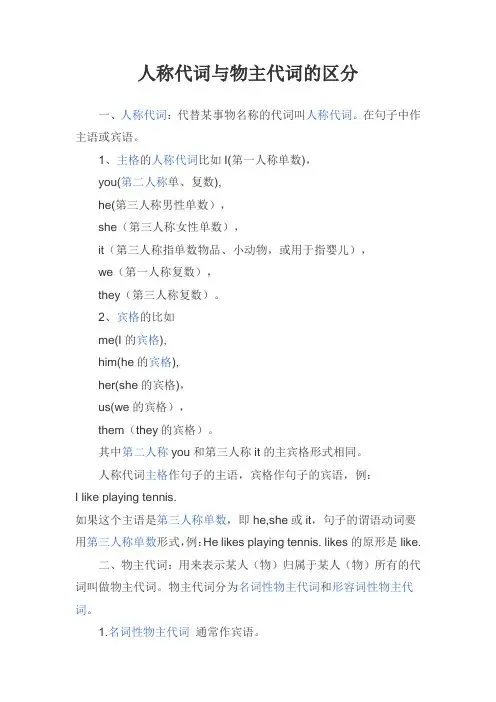
人称代词与物主代词的区分一、人称代词:代替某事物名称的代词叫人称代词。
在句子中作主语或宾语。
1、主格的人称代词比如I(第一人称单数),you(第二人称单、复数),he(第三人称男性单数),she(第三人称女性单数),it(第三人称指单数物品、小动物,或用于指婴儿),we(第一人称复数),they(第三人称复数)。
2、宾格的比如me(I的宾格),him(he的宾格),her(she的宾格),us(we的宾格),them(they的宾格)。
其中第二人称you和第三人称it的主宾格形式相同。
人称代词主格作句子的主语,宾格作句子的宾语,例:I like playing tennis.如果这个主语是第三人称单数,即he,she或it,句子的谓语动词要用第三人称单数形式,例:He likes playing tennis. likes的原形是like.二、物主代词:用来表示某人(物)归属于某人(物)所有的代词叫做物主代词。
物主代词分为名词性物主代词和形容词性物主代词。
1.名词性物主代词通常作宾语。
有mine(我的),yours[你(们)的],his(他的),her(她的),its(它的),our(我们的),theirs[他(她,它)们的]等。
2.形容词性物主代词相当于形容词,与形容词的用法相同。
有my(我的),your(你的),his(他的),her(她的),its(它的),their[他(她,它)们的]等。
注意:(1)与形容词一起修饰名词时,放在形容词的前面。
(2)在句中只能用作定语修饰名词,而且后面必须跟名词。
(3)如果名词前用了形容词性物主代词,就不能再用冠词(包括定冠词the和不定冠词a/an)、指示代词(this, that, these, those)等修饰词。
例句:That pencil is my pencil. 那支铅笔是我的铅笔。
That pencil is mine.那支铅笔是我的。
句中的my pencil=mine.人们也更习惯于用名词性物主代词代替前文提到过的、以形容词性物主代词修饰的名词。
小学英语语法知识 I、my、you、your、he、him、she、her、they、them、it、its各种区别用法

小学英语语法知识英语 I, my, me, mine的用法:1、I, 代词, 一般做主语, 意思是“我”;用法, 通常作为主语放在句首, 后加动词(包括Be);例: I am a good person. -- 我是一个好人2、me, 代词, 一般做宾语, 意思也是“我”;用法, 通常作为宾语放在句尾, 放在在动词后面;例: Don't hit me. -- 别打我。
3、my, I的所有格形式, 形容词性物主代词,翻译为“我的”;用法, 跟一般形容词一样, 后面加名词;例: He is my brother. -- 他是我的兄弟。
4、mine, I的所有格形式, 代词, 翻译为“我的(东西)”;用法, 可做主语,宾语等等,例: He's a friend of mine (= one of my friends) . -- 他是我的一个朋友。
英语 you、your、yours 有什么区别?1、you 指“你”。
your 指“你的,你们的”you可以直接放在句首做主语,而 your 不能单独使用,必须加上名词使用。
如:you are interesting. 你有趣。
(you直接做主语)your book is interesting. 你的书有趣。
(注意这里your book 才是主语)you可以直接做宾语,而your不可以,必须加上名词使用。
(可以和上面一条比较,只是位置不一样)如:I like you.我喜欢你。
I like your book.我喜欢你的书。
your 你的,你们的yours你的(东西),你们的(东西)your 是形容词性物主代词,后接名词yours名词性物主代词,后面不接名词,相当:your+名词据个例子你就明白了:this is my book and thatis your book.this is my book and that is yours.英语he、him、his有什么区别?首先他们都是代词,但是he是主格人称代词;him是宾格人称代词;his是形容词性的物主代词,他们运用在一个句子的不同地方。
(完整版)英语人称代词和物主代词
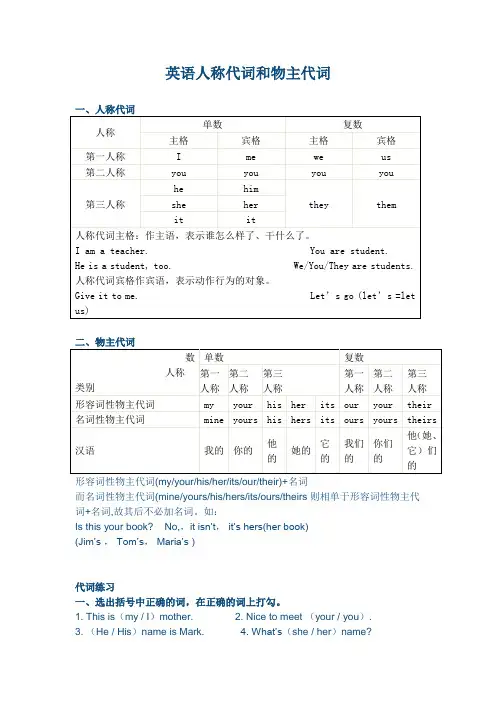
5. Excuse(me / my / I).6. Are(your / you)Miss Li?7.(I/ My)am Ben. 8.(She / Her)is my sister.9. Fine , thank (your / you). 10. How old is (he / his)二、用所给代词的正确形式填空。
1. These are ______ ( he ) brothers.2. That is _______( she ) sister.3. Lily is _______ ( Lucy ) sister.4. Tom, this is _____ ( me ) cousin, Mary.5. Now _____________(her parent) are in America.6. Those __________ ( child ) are _____ ( I ) father’s students.7. Do you know ______ ( it ) name?8. Mike and Tom __________ ( be ) friends.9. Thanks for helping ________( I ).10. ______(Ann安)mother is ______(we) teacher.三、单项选择。
()1. My family ____ a big family. My family ____all here.A. is, isB. are, areC. is, areD. are, is()2. This is __________.A. a picture of familyB. a picture of my familyC. a family’s pictureD. a family of my picture()3. Let’s __________ good friends.A. beB. areC. isD. am()4. Is she your aunt? Yes, __________.A. she’sB. her isC. she isD. he is ()5. Are __________ coats yours? Yes, they are .A. theyB. theseC. thisD. there ()6. Is that __________ uncle? No, it isn’tA. heB. sheC. herD. hers()7. Mrs. Green is __________ grandmother.A. Jim and KateB. Jim and Kate’sC. Jim’s and Kate’sD. Jim and Kates’()8. Do you know the name _____Mr. Green’s son?A. inB. ofC. onD. or ()9. __________ the great photo of your family.A. thank forB. Thanks forC. Thank forD. thanks for()10. Are those your friends? __________.A. Yes, they’reB. No, they areC. Yes, they areD. Yes, those are答案:一.my you His her me you I she you he二.1.his 2.her 3.Lucy’s 4.my 5.her parents 6. children my 7. its 8.are 9. me 10.Ann’s our三.CBACBCBBBC。
七年级上册人称代词、物主代词和指示代词的用法讲解+配套习题(含答案)

人称代词、物主代词和指示代词的用法【概念引入】代词是代替名词的一种词类。
大多数代词具有名词和形容词的功能。
英语中的代词,按其意义、特征及在句中的作用分为:人称代词、物主代词、指示代词、反身代词、相互代词、疑问代词、关系代词、连接代词和不定代词九种。
本单元我们主要讲解人称代词、物主代词和指示代词的用法。
【用法讲解】一、人称代词的用法。
1.人称代词的意义和分类。
英语中用来表示“你、我、她”这样含义的词叫人称代词。
人称代词可以分为主格和宾格,例如:“我”的主格是“I”,宾格是“me”。
主格在句子中做主语,宾格在句子中做宾语。
例如:I am a student. 我是个学生。
这句话中的“我”是主语,所以用主格“I ”。
My mother likes me. 我的妈妈喜欢我。
这句话中的“我”是宾语,所以用宾格“me”。
2.人称代词主格和宾格的进一步区分。
汉语中的人称代词没有主格、宾格的区别,例如“我帮助你”跟“你帮助我”中的“我”和“你”都是同一个字;然而在英语中,它们由于扮演语法成分的不同,使用的是不同的词。
例如: I help you. 我帮助你。
You help me. 你帮助我。
这两句里“我”分别担任主语和宾语,但担任主语时是“I”,担任宾语时是“me”。
两句中的“you”虽然形式相同,但实际担任的成分是不同的,只不过因为“you”的主格和宾格“长得一样”罢了。
因此代词的主格、宾格内容是英语初学者容易犯错误的地方。
需要同学们加以注意。
1.定义和分类。
汉语中“你的、她的、我的……”这样含义的词在英文中翻译为“your, her, my…”;这些表示所属关系的代词称为物主代词。
物主代词可以分为形容词性物主代词和名词性物主代词。
本单元我们重点要掌握的是形容词性物主代词。
2.具体用法。
1)形容词性物主代词翻译为“……的”,它的用法相当于形容词,后面可以接名词,不可以单独使用。
例如:my book 我的书her bike 她的自行车2)在形容词性物主代词和名词之间还可以加入其他的形容词做修饰语。
人称代词及形物名物的用法5份

人称代词及形物名物的用法5份第一篇:人称代词及形物名物的用法5份人称代词一、含义:表示我(们)、你(们)、他/她/它(们)的词叫作人称代词。
一、人称代词有:I 我you你、你们 he他 she她 it它 they他们we我们me(我)、him(他)、her(她)、it(它)、us(我们)、you(你、你们)、them(他们、她们、它们)。
二、人称代词的主格和宾格单数形式:I-me,you-you,he-him,she-her,it-it复数形式:we-us,you-you,they-them三、人称代词在句中的作用1)主格作主语。
如:I am Chinese.我是中国人。
2)宾格作宾语,放在及物动词或介词之后,有时还可以在口语中用作表语。
如:①I don't know her.我不认识她。
(动词宾语)②What's wrong with it?它怎么了?(介词宾语)③Open the door,please.It's me.请开门,是我。
(表语)四、人称代词并列用法的排列顺序1)单数人称代词并列作主语时,其顺序为:第二人称->第三人称->第一人称即:you and I;he/she/itandI;you,he/she/it and I(但表示认错或承担责任时,I应放在首位)2)复数人称代词作主语时,其顺序为:第一人称->第二人称->第三人称即:we and you;you and they;we,you and they五、特殊用法:国家、城市、可爱的小动物等,用she来代替;体积庞大的动物或猛兽,用he来代替;小孩、婴儿或性别不明的人、天气、时间等用it来代替。
注:you既是“你”或“你们”的主格,又是它们的宾格;her既是“她”的所有格,又是它的宾格。
我们可以根据它们在句子中的位置来判断它们属于主格、所有格还是宾格。
and是一个我们常用来连接两个词的连接词。
人称代词物主代词用法大全
人称代词物主代词用法大全人称代词和物主代词是我们日常语言中经常使用的一类词语,它们用来表示人或事物的身份、归属关系或指示关系。
正确使用人称代词和物主代词对于准确表达意思非常重要。
接下来我将为你制作一份2000字的关于人称代词和物主代词用法的大全。
一、人称代词的基本概念人称代词是用来代替人或物的词语。
它能够表示说话人、听话人和被谈论的人或物之间的关系。
人称代词分为主格、宾格和所有格。
1. 主格代词主格代词用来作主语,通常出现在句子最前面,如“I, you, he, she, it, we, they”。
2. 宾格代词宾格代词用来作宾语,通常出现在动词或介词之后,如“me, you, him, her, it, us, them”。
3. 所有格代词所有格代词用来表示所属关系,通常出现在名词后面,如“my, your, his, her, its, our, their”。
二、人称代词的用法人称代词在句子中用来指代特定的人或物,并根据不同的语境和句法结构来使用。
下面是人称代词在不同情况下的用法:1. 作主语- I am a student.- You are my friend.- He is a teacher.- She likes singing.- It is a cat.- We are a team.- They are classmates.2. 作宾语- John called me.- Can you help him?- She saw her at the party. - Please give it to him.- They invited us.- We love them.3. 作表语- It is me.- Are you the winner?- He seems happy.- The winner is she.- It is mine.- The title is theirs.4. 作定语- This is my book.- Do you like our school?- His car is blue.- Her house is big.- Its tail is long.- Our teacher is strict.- Their cat is cute.5. 作独立主格- He and I are good friends.- You and he can go together.- She is as tall as I.- They are more careful than we.三、物主代词的基本概念物主代词是用来表示所有关系的代词,用来表明某人或某物的所属关系,在句中通常紧跟在名词后面。
英语人称代词和物主代词讲解
yours and the blue one is mine. 看那两支铅笔,红的是你的笔,蓝的是我的笔。 2. He likes my pen. He doesn”t like hers. 他喜欢我的钢笔。不喜欢她的钢笔。
人称 代词
第一人称 主格
宾格
I , we me , us
第二人称 you
you
第三人称 he, she , him , her
it ,they It them
物主代词
表示所有关系的代词叫做物主代词。 物主代词分为形容词性物主代词和名 词性物主代词两种。 物主代词有人称和数的变化。 第三人称单数的物主代词还有性的变 化。
• 3.She is____m__y____( I ) friend. • 4.Miss Li often look after (照
顾)___h_e_r____(she) brother. • 5.—Are these___t_h_e_ir___(they) bags ? • --No,they aren’t _t_h_e_i_rs___(their). They
- It’s_t_h_e_i_r____(their/theirs)car . _M__in__e_____is new.
• II.用括号中单词的适当形式填空 • 1.--Are these____y_o_u_r____(you) pencils?
• --Yes ,they are__o_u_r_s____(our). • 2. –Whose pencil is this ?—It’s___m_i_n_e___( I ).
人称代词主格宾格及形容词性名词性物主代词
一、人称代词二、物主代词1.形容词性物主代词(my/your/his/her/its/our/their)+名词2.而名词性物主代词(mine/yours/his/hers/its/ours/theirs则相单于形容词性物主代词+名词,故其后不必加名词。
如:Is this your book No,,it isn’t,it’s hers(her book)物主代词可分为形容词性物主代词和名词性物主代词:1.形容词性物主代词起形容词的作用,作前置定语,用在名词前。
例:1) This is my book. 这是我的书。
2) We love our motherland. 我们热爱我们的祖国。
2. 名词性物主代词起名词的作用。
名词性物主代词= 形容词性物主代词+名词,为避免重复使用名词,有时可用“名词性物主代词”来代替“形容词性物主代词+名词”的形式。
例:1)My bag is yellow,her bag is red,his bag is blue and your bag is pink.物主代词为避免重复使用bag,可写成My bag is yellow,hers is red,his is blue and yours is pink2) He likes my pen. He doesn’t like hers. = He doesn’t like her pen.他喜欢我的钢笔。
不喜欢她的。
3.注意:在使用名词性物主代词时,必须有特定的语言环境,也就是要省略的名词大家已经知道,已经提起过。
例:It’s hers. 是她的。
(单独使用大家不知是怎么回事,不可以这样用)There is a book. It’s hers. 那有本书。
是她的。
(先提及,大家才明白)用所给词的适当形式填空班级:姓名:1. That is not _________ kite. That kite is very small, but _________ isvery big. ( I )2. The dress is _________. Give it to _________. ( she )3. Is this _________ watch (you) No, it’s not _________ . ( I )4. _________ is my brother. _________ name is Jack.Look! Those pens are _________. ( he )5. Here are many boxes, which one is _________ ( she )6. I can find my pen, but where’s _________ ( you )7. I have a beautiful cat. _________name is Mimi.8. Shall _________ have a look at that classroom That is_________classroom. ( we )9. _________ is my aunt. Do you know _________ job ( she )10. Where are _________ I can’t find _________.Let’s call _________ parents. ( they )11. _________ don’t know her name.Would you please tell _________. ( we )12. So many dogs. Let’s count _________. ( they )13. I have a lovely brother. _________ is only 3.I like _________ very much. ( he )14. May I sit beside _________ ( you )girl behind _________ is our friend. (she )16. ________(I) am a teacher.17. My father is talking with _______(I).18. _______(he) often plays basketball after school.19. _______(he) teacher is good.20. _______(we) buy a pair of shoes for _______(he).21. _______(they) are listening to the radio.22. This is _______(my) book. That is__________(they)23. _______(he) chair is blue. _____________(we) is yellow.24. _______(we) classroom is (you) is small.25. _______(he) often plays basketball after school.26. _______(he) teacher is good. _____(she)is good too.27. My book is blue. _________(you) is red.28. Our chair is better than _________ (they).29. I will give the presents to________(they).30. These books are_______(I), and those are____(you).31. My ruler is long. ________ (you) is short.32. My bike is broken. May I borrow______ (she)?33. Can you show ______(I) your book?34. It’s time for ______(they) to go home.35. Mr. Green often tells _______(we) some stories.36. These are not your desks. They are _____(our).37. This is not my shirt. It’s _______(he)38. I saw ______(she) in the shop yesterday.。
人称代词、物主代词、反身代词及名词所有格的用法
1、人称代词顺口溜:人称代词有两类,一类主格一类宾;主格代词本领大,一切动作由它发;宾格代词不动脑,介动之后跟着跑。
2、物主代词顺口溜:物主代词不示弱,带着‘白勺’来捣乱;形容词性物主代,抓住名词不放松;最后只剩名词性,海阔天空任它走。
人称代词的用法1、人称代词的主格在句子中作主语或主语补语。
一般在句首,动词前。
例如:John waited a while but eventually he went home.约翰等了一会儿,最后他回家了。
John hoped the passenger would be Mary and indeed it was she.约翰希望那位乘客是玛丽,还真是她。
说明:在复合句中,如果主句和从句主语相同,代词主语要用在从句中,名词主语用在主句中。
在电话用语中常用主格。
例如:When he arrived, John went straight to the bank.约翰一到就直接去银行了。
I wish to speak to Mary. This is she.我想和玛丽通话,我就是玛丽。
2、人称代词的宾格在句中作宾语或表语,在动词或介词后。
例如:Do you know him?(作宾语) 你认识他吗?Who is knocking at the door?It’s me. (作表语)是谁在敲门?是我。
说明:单独使用的人称代词通常用宾格,即使它代表主语时也是如此。
例如:I like English. Me too.我喜欢英语。
我也喜欢。
3、注意:在动词be 或to be 后的人称代词视其前面的名词或代词而定。
例如:I thought it was she.我以为是她。
(主格----主格)I thought it to be her.(宾格----宾格)I was taken to be she.我被当成了她。
(主格----主格)They took me to be her.他们把我当成了她。
人称代词、物主代词、反身代词详解及测试题(含答案)
人称代词、物主代词、反身代词详解一、综合列表(人称代词、物主代词、反身代词)二、基本用法1.主格人称代词,主要用作主语,但有时候也用作表语。
如:2.宾格人称代词主要用作宾语和表语。
如:3.形容词性物主代词做定语,起修饰作用。
如:4.名词性物主代词相当于名词,既代替事物又表明所属关系,在句子中往往独立地作主语、宾语或者表语,后面不再跟名词。
5.反身代词,句子中可以做宾语、表语、同位语等,但不能做主语。
6.三个不同人称同时出现,或者主语中包含“我”时,按照“you→he→I”的顺序表达。
Both he and I are working at that computer company.人称代词、物主代词、反身代词测试题一、用所给代词的正确形式填空。
1.These are __________ (he) books.2.That is __________ (she) sister.3.Lily is __________ (Lucy) sister.4.Tom, this is __________ (me) cousin, Mary.5.Now __________ (her parent) are in America.6.Those children are __________ (I) father’s students.7.Do you know __________ (it) name?8.Mike and Tom __________ (be) friends.9.Thanks for helping ________(I).10.__________ (Ann) mother is __________ (we) teacher.11.__________is my aunt.We often visit __________ (she)12.China is a developing country._________is in the east of Asia. (its)13.I own a blue bike.The red one isn’t __________. (I)14.These new houses are so nice.__________ are very expensive. (them)15.The fishermen caught a lot of fish,didn’t__________? (them)16.Ling Ling is a girl.__________ studies in a primary school.__________ brother lives with __________ and often helps__________ with__________ lessons. (she)17.Mike is my classmate.__________ is good at English. (his)18.Kate wants a glass of milk.Will you pass it to__________? (she)19.What’s the weather like today?__________ is cloudy. (its)20.— I ate up all__________ sandwiches yesterday. (I)— Can I have one of__________? (you)21.George has lost__________ (his)pen.Ask Mary if she can lend him__________. (she) 22.Jack has a dog and so have I.__________ (he) dog and__________ (I)had a fight. 23.The teacher wants you to return that book of__________ (he)24.Mr.and Mrs.Green and a friend of__________are coming to see us. (they)25.We are going to Paris to stay with a French friend of__________. (we)二、用适当的人称代词和物主代词填空A.从括号内选择正确的代词填空26.Your football clothes are on the desk. Please put_________ (they, them, their, theirs)away. 27.(We, Us, Our, Ours) _________English teacher is Mrs.Green. We all like_________ (she, her, hers).28.(I, Me, My, Mine) _________can’t get my kite.Could you help_________ (I, me, my, mine)? 29.Tom can’t get down from the tree. Can you help_________ (he, him, his)?30.These are_________ (he, him, his)model planes. Those are_________ (I, me, mine).B.填入正确的人称代词和物主代词31.This isn’t ________ knife._________is green. (she)32.These are your books,Kate.Put__________in the desk, please. (they)33._________ must look after_________ things. (you)34.Wei Fang, is that_________ ruler?Yes, it’s. (you)35.They want a football.Give_________ the green one,please. ( they)36.It’s Lin Tao’s bag.Give it to__________. (he)37.Is this pencil-box Li Lei’s?No,___________is very new. (he)38.This box is too heavy.I can’t carry_________.(it)Don’t worry, Let__________ (I)help__________. (you)39._________ is a boy and_________ name is Mike.Mike’s friends like_________ very much.(he)40.My sister is in_________ room._________is a teacher. (she)三、选择填空41.— Who’s singing over there?—________is Sandy’s sister.A.ThatB.ItC.SheD.This42.________will spend the summer holiday in Hawaii.A.She,you and IB.You,she and IC.I,you and sheD.Her,me and you43.My uncle bought a new bike for________.A.theirsB.theyC.meD.I44.— Here’s a postcard for you,Jim!—Oh,________is from my friend,Mary.A.heB.itC.sheD.it’s 45.Little Baby knows that he should not take the things that do not belong to __________.A.heB.hisC.herD.him 46.— Is she your aunt?— Yes, __________.A. she’sB. her isC. she isD. he is 47.— Are __________ coats yours?— Yes, they are.A. theyB. theseC. thisD. there 48.— Is that __________ uncle?— No, it isn’tA. heB. sheC. herD. hers 49.— Will anyone go on a trip with him?—Not__________.A.IB.meC.mineD.he 50.Among those lovely toys,the brown toy dog was given by__________.A.heB.hisC.himD.he’s 51.— I saw grandma shop online. Who taught ________ that?— Nobody. She learned it by _________.A. she; herB. her; herC. her; herselfD. herself; her 52.On the way to Lijiang, the scenery was so beautiful that all of us lost ______ in it.A. myselfB. themselvesC. ourselvesD. yourselves 53.— Did anyone call me when I was out?— Yes. A man who called _________ Tom.A. myselfB. himselfC. herselfD. yourself 54.— What a nice model plane!— Thanks. I made it with 3-D printer by _________.A. meB. himC. itselfD. myself55.Dad, don’t worry about me. I can look after _________.A. myselfB. herselfC. himselfD. yourself 56.— Huang Wei rides a bike very well. Who taught him?— No one. He taught _________.A. himB. heC. hisD. himself 57.— Can you make _________ understood in English?— Yes, I can.A. yourselfB. youC. yoursD. your 58.— Judy and I will go to the beach tomorrow.— It s so nice. Enjoy _________.A. yourselvesB. yourselfC. herselfD. ourselves 59.My brother is old enough to dress _________ now.A. herselfB. himselfC. myselfD. yourself 60.— I’ll have a tennis game tomorrow. I m a little bit nervous.— Believe in _________. You’re the best in our club.A. herselfB. myselfC. yourselfD. himself四、改错题61.Andrew and myself will conduct today’s meeting.62.Myself will conduct today’s meeting.63.You may submit your expenses to Mr. Martin or myself before Friday.测试题参考答案1.his2.her3.Lucy’s4.my5.her parents 6.my 7.its8.are9.me10.Ann’s; our 11.She; her12.It is13.mine14.They15.they 16.She; Her;17.He18.her19.It is20.my; yours He; her; her21.his; hers22.His; mine23.His24.theirs25.ours 26.them27.Our; her28.I; me29.him30.his; mine 31.her; hers32.them33.You; your34.your35.them 36.him37.his38.it; me; you39.He; his; him40.her; She 41.B42.B43.C44.B45.D46.C47.B48.C49.A50.C51.C52.C53.B54.D55.A56.D57.A58.A59.B60.C 61.Andrew and myself will conduct today’s meeting.Andrew and I will conduct today’s meeting.62.Myself will conduct today’s meeting.I will conduct today’s meeting.63.You may submit your expenses to Mr. Martin or myself before Friday.You may submit your expenses to Mr. Martin or me before Friday.。