
外研版-英语-九上-九上Module2 1单元 教案
九上Module 2 Unit 1 教案
【教材分析】
本模块以“Public holidays”为话题,以学习谈论各国的节日为主线,介绍了节日在人们生活当中的重要意义。
通过模块学习,学生将重点掌握5个主要连接副词或词组的用法,并能在写作过程中运用这些副词或词组。
Unit 1通过听、读、说训练,初步谈论节日。
【教学目标】
听: Listen to people talking about public holidays
说: Talk about holiday plans and Chinese festivals
读: Read articles about public holidays
写: Write about public festivals
【教学重点】
1. To learn and review some words and expressions about festivals.
2. To learn some expressions about an adverbial clause of time.
【教学难点】
An adverbial clause of time
【教学方法】
PWP method, task-based method and interactive approach
【教学手段】
A tape recorder, multimedia and some pictures
【教学过程】
Teaching Procedures:
Step 1 Presentation
Look and say. The teacher shows the pictures of new words and let the students to say as quickly as possible.
Step 2 Lead-in
Ss look the pictures and talk about the holiday.
Step 3 Look at the picture and answer the questions.
1. Which public holiday are people celebrating?
2. When is this holiday in China?
Step 4 Complete the sentences with the dates of the following holidays in China, the UK and the US.
Look at each picture and fill in the blanks with the dates.
1. Labour Day in China is on ________________.
2. May Day in the UK is on _______________.
3. Labour Day in the US is on _____________.
Step 5 Listen and check.
Step 6 Listen and answer the following questions.
1. When was the People’s Republic of China founded?
2. Do people have one day off on Independence Day?
3. Does Lingling have any plans for the National Day this year?
4. When is the start of the vacation season in the US?
5. Do people have a national day in the UK?
Step 7 Reading
1. Now complete the table.
2. Complete the sentences with the correct form of the words in the box.
activity flag found vacation
1. The Americans celebrate Independence Day on 4th July. It is the start of the
________ season.
2. On 1st October, you can see the national ________ everywhere in China.
3. The US was _________ in 1776.
4. What kinds of __________ are there on 1st January?
Step 8 Language points
Let Ss know about the main points in the passage and master. 1. The People’s Republic of China was founded on 1st October 1949.
found表示“建立,创立”。
它的过去式和过去分词都加ed。
find表示“找到”,它的过去式和过去分词为found。
e.g. Her family founded the college in 1895.
她的家庭于1895年创办了这所学院。
2. People have celebrated the National Day since then.
since then表示“从那以后”。
是现在完成时的标志。
e.g. He has lived in Beijing since then.
从那以后他就一直住在北京。
3. … but we only have one day off.
off表示“不上课/ 班,休息”。
e.g. I’m taking a week off over Christmas.
圣诞节期间我会休假一星期。
I’m going to have some time off.
我准备休一段时间假。
4. On that day, there are all kinds of holiday activities.
all kinds of 表示“各种各样的”
e.g. You can taste all kinds of delicious food.
你能品尝各种各样美味的食物。
5. … and most people take a vacation sometime in July or August.
take a vacation 表示“去度假”
e.g. He will take a vacation next week.
他下周将去度假。
6. And is there anything special on that day?
anything special表示“特别的事”
用形容词修饰不定代词或不定副词时,形容词要放在不定代词或不定副词的后面,如anything special, somewhere interesting。
e.g. Don’t do anything stupid.
不要做傻事。
7. Kids have great fun.
have fun意为“玩得高兴、玩得愉快”,相当于enjoy oneself和have a good time。
have fun 后跟动词时,要用V-ing形式。
8. And my family always go somewhere interesting as soon as the holiday begins.
as soon as表示“一……就……”。
用来引导时间状语从句。
强调主句和从句动作的同时性。
e.g. Please call me as soon as you get to the hotel.
你一回到酒店就给我打电话。
Step 9 Pronunciation and speaking
1. Listen and repeat.
To learn about the ordinal numeral.
2. Say the dates.
(1) Now ask and answer questions about important dates in pairs.
(2) Ask and answer questions about a Chinese public holiday in groups.
(3) Present the Chinese public holiday to the whole class.【出处:21教育名师】
Step 10 Exercises
Step 11 Homework
Make up a dialogue about the National Day. Including the date, duration, ways of
celebration and year the celebration started. About 60 words.。
Module2Unit1外研版英语九年级上册教案详解
(三)实践活动(用时10分钟)
1.分组讨论:学生们将分成若干小组,每组讨论一个喜欢的西方音乐类型,并探讨这种音乐给他们的感受。
2.实验操作:为了加深理解,我们将进行一个简单的音乐欣赏活动。通过聆听不同类型的音乐,学生尝试用现在进行时态描述音乐的特点。
(二)新课讲授(用时10分钟)
1.理论介绍:首先,我们要了解西方音乐的基本概念。西方音乐有着丰富的类型,如古典、爵士、蓝调等。每种音乐都有其独特的风格和表达的情感。了解和欣赏西方音乐是拓宽我们文化视野的重要途径。
2.案例分析:接下来,我们来看一个具体的案例。这个案例展示了爵士乐的特点和它在放松心情方面的应用。
举例:通过音乐表演和实时描述,让学生感受并运用现在进行时态。
(4)阅读理解:理解课文内容,提取关键信息,提高阅读技能。
举例:设计问题链,引导学生逐步深入理解课文,提取音乐类型、乐器、音乐感受等关键信息。
2.教学难点
(1)词汇的准确运用:学生在使用新学词汇时可能会出现搭配不当或语境误用的情况。
突破方法:通过例句展示、同义词对比和词汇游戏等方式,加强学生对词汇用法的理解。
突破方法:引入相关的文化背景知识,通过视频、讨论等形式,增强学生对西方音乐文化的认识和理解。
四、教学流程
(一)导入新课(用时5分钟)
同学们,今天我们将要学习的是《Module 2 Unit 1外研版英语九年级上册》的"Western music"这一章节。在开始之前,我想先问大家一个问题:“你们在日常生活中喜欢听什么类型的音乐?”这个问题与我们将要学习的内容密切相关。通过这个问题,我希望能够引起大家对音乐类型的兴趣和好奇心,让我们一同探索西方音乐的奥秘。
外研版-英语-九上-九上Module1 2单元 精品教案
九上Module 1 Unit 2 精品教案课题: M1Unit2 The Grand Canyon was not just big.(第二课时)知识目标:1、让学生学会使用本课的单词和重点短语。
2、学生能在情景对话或写作中熟练运用所学知识。
能力目标:能熟练掌握本课对世界奇迹的表达法,并能准确运用。
情感目标:通过了解大峡谷,锻炼学生用英文描述某事物,并热爱、保护大自然。
教学重点:1. clear, sign, reply, silent, below, path, grey,shine, etc.fall away, get out of, go through, look over,at the bottom of,...2. There was nothing to see, but I knew it was there.“you’ll get there in five minutes.”教学难点:动词的六大时态。
重难点突破:以介绍为核心,通过小组活动,在听、说、读、写中使单词及句型以不同的形式反复出现,从而强化学习重难点。
教、学法:任务型教学法,讲授法,小组合作学习法,情A. toB. forC. ofD. on( ) 2. ---________ will he come back?--- In two hours.A.How longB. How farC. How oftenD. How soon( ) 3. The river lies 200 metres ______ him.A. onB. underC. belo wD. in( ) 4. He didn’t say a word and got _____ a taxi angrily.A. onB. inC. intoD. onto( ) 5. --- I think maths is too difficult. I’m afraid I can’t learn it well.---You should _____ the difficulty with courage(勇气).A. meetB. giveC. riseD. face板书设计:M1u21.get out of, on the top of,at the bottom of, on eachside of, far awaygo through, look over2. to do , in +段时间3.六种时态的定义、构成及用法。
外研版九年级英语上册教案 Module1 Unit2 (1)
Listen and read quickly and choose the paragraph for each title.
Step6
Readagainand choose the correct answer.
Step7
Knowledge Extension:The Seven Natural Wonders of the World
Vocabulary
shine, sign, silent, sky, grey, beside, reply, clear, nearly, remain
get out of, go through, fall away, on top of,look across
Periods
1
Procedure
Lead-in
Review.Translate the phrasesin Unit 1into English.
Step 1
Free talk. Show some adjectives and ask Ssto describe a building, a mountain, a river, a waterfall or a tower.
Unit2The Grand Canyon was not just big.
Class Type
Reading and writing
Objectives
Tounderstand the passage about the trip to theGrand Canyon;
To know the way of writing about what you see and your feelings when trvelling.
外研版-英语-九上-外研九上英语教案Module2 1单元

标
教
学 重点:掌握本单元的重点词汇 、短语、句型和语法。
重 难点:训练学生的听说能力。
难
初中-英语-打印版
初中-英语-打印版
点
教学过程
◆Step 1 Warming up and leading in
T:Boys and girls,do you like festivals?Can you tell me something about Chinese festivals?
◆Step 2 Pre-listening Complete the sentences(完成句子)
T:Read the three sentences in Activity 2 and work with your desk partner,guess the correct dates.
(1)Labour Day in China is on
C.Both A and B.
设计 意图
通过设计由浅入深、不同层次的听力问题,使学生把握对话主旨与内容,通过三遍听力,锻炼学生的 听力,促进学生听力水平的提高,同时让学生了解中外节假日的日期、庆祝方式和文化习俗,为后期 的说积累了语言材料。
◆Step 4 Reading and saying 1.Read the dialogue by yourselves and act out the dialogue with your partner. 2.Work in groups.Ask and answer questions about a Chinese public holiday. (1)When is the holiday? (2)What do your family do during the holiday?
外研版-英语-九上-九上Module2 1单元 听说课教学设计
本节是一节听说课,目标是了解中国国庆和美国独立日的相关情况;能够正确的表达日期;理解并掌握时间状语从句的用法。学生先听对话,从中了解有关中国国庆与美国独立日的信息,再用目标语言结合实际情况进行对话练习。这符合“学生在语境中接触、体验和理解真实语言,并在此基础上学习和运用语言”。
九上Module 2 Unit 1 听说课教学设计
教材及年级名称
外研社九年级
章节名称:
Module2 Unit 1
课型
Listening & speaking
教学内容分析
1、本单元以holidays为主线,功能是运用由while, when, before,as soon as, until等连接的时间状语从句对某个节日进行描述。
板书设计:
Module 2 Unit 1My family always go somewhere interesting
as soon as holiday begins.
Teaching aims:
1.Recite the new words
2.To learn about the national day in China and US and how people celebrate it.
学生通过看我展示的图片,用目标语言猜测与图片有关的节日信息,在真实场景中运用了目标语言。
Step 2: Pre-task
出示几个问题让学生讨论:
What festivals do you know in China?
How can we say in English?
Do you know something about the National Day in other countries?
外研版英语九年级上册模块2,Unit 2 读写教案
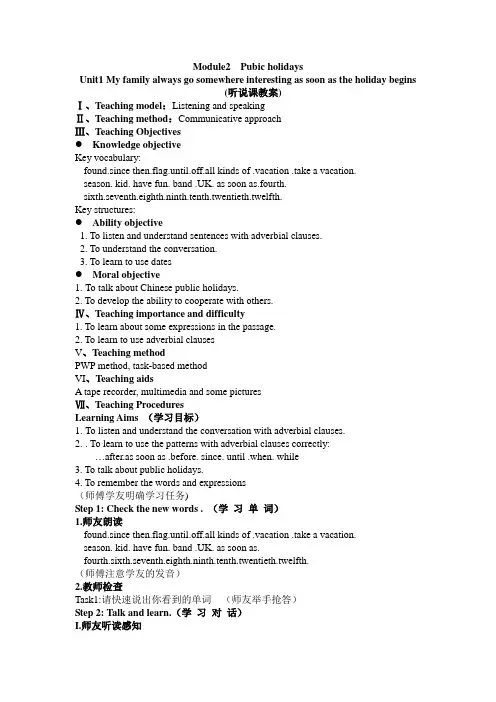
Module2 Pubic holidaysUnit1 My family always go somewhere interesting as soon as the holiday begins(听说课教案)Ⅰ、Teaching model:Listening and speakingⅡ、Teaching method:Communicative approachⅢ、Teaching Objectives●Knowledge objectiveKey vocabulary:found.since then.flag.until.off.all kinds of .vacation .take a vacation.season. kid. have fun. band .UK. as soon as.fourth.sixth.seventh.eighth.ninth.tenth.twentieth.twelfth.Key structures:●Ability objective1. To listen and understand sentences with adverbial clauses.2. To understand the conversation.3. To learn to use dates●Moral objective1.To talk about Chinese public holidays.2. To develop the ability to cooperate with others.Ⅳ、Teaching importance and difficulty1. To learn about some expressions in the passage.2. To learn to use adverbial clausesV、Teaching methodPWP method, task-based methodVI、Teaching aidsA tape recorder, multimedia and some picturesⅦ、Teaching ProceduresLearning Aims (学习目标)1.To listen and understand the conversation with adverbial clauses.2.. To learn to use the patterns with adverbial clauses correctly:…after.as soon as .before. since. until .when. while3. To talk about public holidays.4. To remember the words and expressions(师傅学友明确学习任务)Step 1: Check the new words . (学习单词)1.师友朗读found.since then.flag.until.off.all kinds of .vacation .take a vacation.season. kid. have fun. band .UK. as soon as.fourth.sixth.seventh.eighth.ninth.tenth.twentieth.twelfth.(师傅注意学友的发音)2.教师检查Task1:请快速说出你看到的单词(师友举手抢答)Step 2: Talk and learn.(学习对话)I.师友听读感知1)Look and talk about the picture.(Activity 1)2)Complete the sentences with the dates(Activity2)(先自主完成再互助交流)3)Listen and check.(先自主完成再互助交流)4)Listen to the passage and pay attention to the pronunciation.5)Read again and complete the table.(Activity3)(先自主完成再互助交流)( 1)学友自主在课文中找到每日英语原句勾画出来When is your national day?Do you have any plans for?We only have one day off.( 2)学友读给师傅听,互助交流用法。
Module2Unit1同步教案外研版英语九年级上册
4.学习能力:鼓励学生自主探究、合作学习,提高他们解决问题的能力和自主学习策略,为终身学习奠定基础。
5.情感态度:培养学生对环境问题的关注和责任感,激发他们积极参与环境保护行动,形成正确的价值观和积极的生活态度。
-句型:能够运用“will+动词原形”和“be going to+动词原形”结构进行句子构建,描述未来的计划和打算。
-情感态度:培养学生对未来环境问题的关注和责任感。
举例:
-学生需要能够正确使用“By 2050, the Earth's temperature will rise by 2 degrees Celsius, causing more severe natural disasters.”这样的句子来表达对未来环境的预测。
具体难点内容:
-词汇应用:例如,学生可能知道“pollution”的意思,但在具体描述环境污染的影响时,可能不知道如何运用。
-语法区分:解释何时使用“will”表示突发或未计划的未来事件,何时使用“be going to”表示计划或打算做的事情。
-情感认同:通过讨论和角色扮演等活动,帮助学生理解环境问题的紧迫性,并激发他们的情感共鸣。
在新课讲授环节,我发现理论介绍部分,学生们对一般将来时的理解和掌握程度较好。但在案例分析环节,有些学生在将一般将来时应用到具体情境中时遇到了困难。这让我意识到,在今后的教学中,需要更多地设计一些实际情境,让学生在实践中掌握语法知识。
实践活动环节,分组讨论和角色扮演活动让学生们积极参与,课堂氛围十分活跃。但我也观察到,有些小组在讨论过程中,个别成员参与度不高。针对这个问题,我计划在下次活动中,更加关注每个学生的参与情况,鼓励他们积极投入到小组讨论中。
外研版九年级英语上册 Module 9 unit2 .教案 (1)
外研社新标准九年级(上)Module 9 Great inventionsUnit 2 Will books be replaced by the Internet?一、教材分析本模块以发明为中心话题,围绕数码相机的使用、纸和印刷术的发明与作用展开。
发明创造对初中生来讲既神秘又有吸引力,通过本课的学习使学生了解历史上的发明对人类生活产生的巨大影响,从而激发学生进行发明创造的愿望,引导学生刻苦学习、大胆想象,拓展学生的思路,培养他们的创造性思维。
二、学情分析:1.初三的学生,已经储备了大量的单词,大部分学生可以自如运用一些日常单词口头表达或者书面表达自己的意愿,而且他们在这时,已经初步形成了自己的世界观和人生观,会表现出鲜明的个性。
所以,本课时中的discussion, writing等活动,能给学生提供一个自由交流的平台。
2.初三的学生,还面临中考的来临,所以,他们也迫切需要词汇习得的学法指导,以及skimming ,scanning等阅读策略,除此之外,他们还需要掌握和运用中考考纲中要求必须掌握的语法,即本模块的情态动词和完成时态的被动语态。
3.初三的学生,更有思想。
他们知识面广,也乐于做进一步的思考,我想,本课的阅读不应该只停留于文本内容阅读的表面,我应该努力拓宽学生的视野和思维,师生互动,生成新内容,培养他们的创造性思维。
三、教学目标:1知识目标:1)理解并能运用本课的目标词汇,如produce, invention, look through, create, atthe beginning of, knowledge, spread…2)读懂纸、印刷术、电脑等发明的相关阅读材料,并能读懂他们对人类产生的影响。
2.能力目标:1)能在老师的引导下,学会通过观察词根,及在上下文本中推断词义,猜测词义。
2)能在老师的引导下,关注并理解现在完成时和带情态动词的被动语态的概念和用法,并能在写作中自然地运用。
外研版九年级上册英语全册教案
Module 1 Wonders of the worldUnit 1 What is a wonder of the world?上课教师学生年级教材课时教学设计课型Listening and speaking教材分析This unit aims to review the learnt tenses so far and help students to be able to present some important and creative ideas about writing a school magazine.教学目标To learn and understand the topic words through talking and listening.To know something about the pyramids and the Grand Canyon.To understand the conversation about starting a school magazine involving different tenses.知识与能力 1. Vocabulary and expressions: ancient, club, composition, pupil, meeting, call, event, listen up. That’s news to me. Anyone else?2. To enable the Ss to express in different tenses according to the set situations.3. To learn to give ideas on writing a school magazine.过程与方法 1. Top-down approach, enabling Ss to understand and talk about writing a school magazine.2. To learn by listening, speaking and discussing.情感、态度与价值观To help students enlarge their vision on wonders of the world and help to know more about writing a school magazine of their own.教学过程教学步骤教师活动学生活动活动目的Step 1Lead-in Start the lesson by showing groups of pictures about the wonders of the world on the screen including the ancient pyramids. Ask students to talk about the picture on Page 2.T: Where can you see the pictures and the brief introduction probably? (Newspaper / the Internet / Magazine…)T: Yes, magazines like Crazy English / National Geography…Who started…?Learn the new vocabulary. (ancient, py ramid, review, wonder…)Have a talk about the picture using the words in Activity 1. Learn a bit about magazines. Get the Ss to be attentive and focus on the theme of the lesson. (Magazine)Step 2Listening &Vocabulary Play the tape and check the words. Listen to the tape again. Make up possible questions according to the answers. Give examples. Listen and check the words. Make up questions according to the given answers.( Wh-questions) Practise listening and get specific information. Check their understanding by making questions.Step 3.Listen &read Play the tape for the 1st time. Ask Ss questions.T: What are the children doing?Is there a school magazine inDa Ming’s school?Listen to the tape and get the answers. Listen to get a general idea for the 1st time.Play the tape again and ask students to decide T OR F.①Crazy feet is a band.②Becky Wang started a school magazine.③Da Ming watched the interview on TV yesterday④Tony is writing a composition. Listen more carefully for the 2nd time. Decide whether they are true or false. Check the answers with the class. Listen for the specific information and understand the details of the conversation.Step 4.Read Play the tape again and get Ss to practise the conversation. Check the language points. Focus on everyday English and useful expressions.(Listen up, Anyone else? do some review, do an interview, on=about, get better grades)Get Ss to make a list of the articles in magazines.Check the answers in Activity 4. Read theconversation aloud, and read in role. Answer the questions in Activity 4. Practise reading and go over how to give suggestions when in discussion. Learn more about writing a school magazine.Step 5.Pair work Go through the five questions and highlight the key words. Ask for more answers on Question 3. Ss take turns to answer the questions. Consolidate the key words and transit to the next step by Question 3.Step 6.Discussion Tell the Ss:If your school decides to start a magazine, what are you going to write about? And why? They can make up lists and take Activity 3 as an example.Report their discussion. Work out the lists and talk about their plans to write the magazine. Beginning: Our school will start a magazine. What articles are you going to write... Learn to discuss in the way as the children do. Check Ss’ creativity.作业布置Collect information about the seven wonders of the world. (Pictures and brief introductions)板书设计Unit 1 What is a wonder of the world?school magazine That’s news to me!a wonder What’s it about?ancient pyramids listen upwrite a composition Any more ideas?/ Anyone else?do some reviews about… on=aboutdo an interview withUnit 2 Iwas on the edge of the Grand Canyon.上课教师学生年级教材课时教学设计课型Reading and writing教材分析By example this unit presents a good way to describe what one sees and feels after a journey. It can help students to know more about the Grand Canyon, and inspire Ss to love and explore the natural wonders.教学目标To get information from the reading material about the Grand Canyon;To learn the way of writing about what you see and your feelings when traveling;知识与能力 1. Vocabulary and expressions: waterfall, stranger, rock, ground, canyon, reply, rise, face, get out of, look over, disappear into, look (across) to…light-dark, clear, huge, beside, below, at the bottom of, reach the top. …too…to…2. To enable the Ss to express in different tenses according to the set situations.3. To love the wonders of the natural world and give facts and opinions.过程方法 1. Interactive approach.2. To improve Ss reading skills and get them to talk and practise writing by imitating.情感、态度与价值观To help students enlarge their vision on wonders of the world and help to write a description of a wonder that they have seen or visited.教学过程教学步骤教师活动学生活动活动目的Step 1Lead-in Ask Ss to show information about the seven natural wonders. (The teacher can get the related pictures ready beforehand)Present words in Activity 1. Talk and give facts about the wonders. Encourage Ss to describe withthe words given. Check up Ss’ homework and start the new topic.(Wonders)Step 2.Ask andanswer Ask Ss to make questions about facts of the natural wonders.Demonstrate and get Ss to follow. Ask andanswer.How tall/deep…is it?It’s…meters tall/deep.Practise asking about detailed information and learn the sentence pattern.Step 3.Read(Skimming)Tell Ss to read the passage in Activity 2. Find out the name of the wonder and its facts.T: Where did the writer visit?How deep/wide/long is it? Read thepassage andanswer thequestions. Find out the facts and write them down in Activity 5. Practise reading skills and get specific information.Step 4Readand match Play the tape and get Ss to follow silently. Find out the main idea of each paragraph. Present the five topic sentences on the screen (Bb).A. The writer arrived there on the rainymorning;B. The first impression/sight of theGrand Canyon.C. The Grand Canyon is the greatestwonder in his opinion.D. Details about the Grand Canyon.E. After minutes’ walk, he came to it.Ss follow the lines and match thetopic sentences tothe paragraphs.(or they canconclude the main idea by themselves if possible) R ead for the main idea of each paragraph. Learn to sum up and help to understand the whole passage.Step 5Read aloudGet Ss to read aloud after the tape and find the details about the trip.①When did he get to the GrandCanyon?②Why was there nothing to see?③Where was he facing on the edge ofthe Grand Canyon?④How did he feel about the Canyon? Read aloud and answer questions in Activity 3. Ask for help if they have any problems. Practise reading and learn about the details, check their understanding.Step 6.Focus Now get Ss’ attention to those phrasal verbs and prepositional phrases. Try to check by a gap-filling exercise.(get out of, go through, look over, fall away, on the edge of, look down/across to, at the bottom of,disappear into, ask oneself ) Learn the verbs and phrases. Practising usingthem with thehelp of thegap-filling. Focus on the phrasal verbs and prepositions.Step 7.Match Activity 4Ask Ss to find these words in the passage and guess their meaning within the sentence.Underline thewords and match the Englishmeaning. Practise guessing the meaning of words in the context.Step 8.Writing Tell Ss to imagine they have seen (some of them did see) one of the wonders of the world. Write sentences describing how they felt. Remind them of the four keywords: saw, size, happened, felt.First get them to work in pairs and then report the sentences or passage if possible. Write sentences according to the given beginning. Report theiranswers and tryto make theminto a passage. Practise writing and using the language on the basis of imaging and personal experience.作业布置Finish writing the description of one of the wonders of the world, trying to collect some details and take the text as a model.板书设计Unit 2 I was on the edge of the Grand CanyonThe seven natural wonders of the worldHow tall/wide/deep is it? It’s…tall/wide/tall.get out of on the edge of ask oneselfgo through look down/across to huge=very very biglook over at the bottom of the greatest wonderfall away disappear intoUnit 3 Language in use上课教师学生年级教材课时教学设计课型Revision and application教材分析This unit serves to give a review and summary towards the language points learnt in U1&.2.And it helps to clarify the exact differences among tenses.教学目标To review and check the words learned in this module;To summarise and consolidate tenses learnt before;知识与能力 1. Vocabulary and expressions: height, lift, view, attract, description, location, design2. To enable the Ss to differ the tenses learned in situations.3. To make a poster of a wonder of the world/ one’s hometown.过程方法 1. Formal and interactive practice, task-based.2. Comprehensive ways of practising and consolidating.情感、态度与价值观To help students enlarge their vision on wonders of the world;To make a poster of a wonder of the world or his hometown and help to love one’s motherland.教学步骤教师活动学生活动活动目的教学过程Step 1Revision Ask Ss to watch and listen to the MV Chinese by Andy Lau. Get them to find out the wonder in it.Encourage Ss to describe what they see in it , e.g.The Great Wall is a great wonder.Andy Lau went to the Great Wall.He was singing on it.He has sung many popular songs.…Watch and talk about things appear in the MV. Learn to tell the differences amongthe tenses. Help to establish the concepts of tenses in situations.Step 2.Grammar focus 1. Read through the sentences in the box with the whole class. Call back ideas about the structure highlighted from the students.2. Give hand-out to Ss and ask them to match the exact meaning with the corresponding sentence. (Activity 1)Check the answers right after that. 1. Read aloud the seven sentences. And tell the making-up of each tense.2. Read through the 5 pairs of sentences in different tenses and match. Practise telling the differences and meanings.Step 3.Writing1. Go back to the picture of the Great Wall. Give examples by matching the three parts.The Great Wall + is + about 6,700 km long.Give Ss tips on how to decide.2. Encourage Ss to observe and decide the forms of verbs in different tenses. 1. Observe thesubjects and theadverbial or even the phrasal verbs. Match the three parts to make possiblesentences.2. Read through the uncompleted passage and try to give the correct forms of verbs in the situations. Learn to observe and practise language in different tenses.Step 4Speaking 1. Show up the photo of visiting the Great Wall. Get Ss to ask the teacher questions in Activity 4. (Example)Get Ss to work in pairs, and ask and answer the questions.2. Present wonders in the local area.Get Ss to talk about them. 1. Ss follow theteacher and make up their ownconversations.Perform in front of the class.2. Learn the example in Activity 5 and make a similar introduction to the wonders in local area.Practise speaking and enable Ss to use the language and understand its meaning.Step 5VocabularyGame Present nine pictures about wonders of the world, each of which links an exercise in Activity 6/8. Get Ss to finish them first and check in forms of game. Elaborate on the Pyramids in Egypt. (More related photos) Finish the multiple- choices exercises and choose the pictures they’re interested in to check the answers. With the help of games, Ss can review the phrasal verbs and concepts of tenses.Step 6.Listening Present the three photos in Activity 7Ask about facts about any one of them. Play the tape for Ss to learn more. Listen and match the notes with the photos.Check the answers after listening and report about the three wonders with the help of the table.Learn more about the three wonders, practising describing.Step 7.Around the world Get Ss to look at the picture and read silently through the introduction. Give questions to check theirunderstanding. Read and decide, trying to grasp the main information. Learn about another wonder of the world.Step 8.Module task Tell Ss to work in groups of 4. Read through the instructions. Help them to decide what to write about.Hold up a show-and-tell session where Ss can display and discuss. Work in groups of 4 and write about one wonder they like. Collect sufficient information and make the poster. Take part in the show-and-tell session.Take this task as an extensive learning activity to get Ss to learn more about the wonders.作业布置Finish off the poster after class and get ready for the show at the back wall of the classroom. Prepare the show-and-tell session in groups of four.板书设计Unit 3 Language in useStructures of different tenses ancientThe Great Wall is a wonder… modern wondersAndy Lau went to the Great Wall. naturalHe was singing on it height—What’s the height of…?We are listening to him now. on the journey of…He has sung many pop songs. because / because ofHe will visit it some other day.Module 2 Great books一、教学内容分析本模块的话题是谈论书、作家、思想家、戏剧、电影、诗歌等。
外研版九年级英语上册教案 Module1 Unit2 (1)
多媒体课件
教 学 过 程
二次设计
Step 1
Warming
up and
leading in.
(Act. 1)
1. Ask the students to work in pairs and talk about a great wonder.
2. Show the following questions on the screen.
5. I didn’t r_______long in that city. I came back after two days.
Ⅱ.用所给词的适当形式填空
1. Why did you keep_______(silence) at the meeting? Didn’t you have anything to say?
3. Try to find passages with facts to read.
教学反思
本节课的教学设计, 抓住学生的好奇心理, 活化我们的英语教材, 透过扩展教材资料或活动步骤, 充分激发他们勤于思考、敢于创新的兴趣, 鼓励他们多角度、多方向、新颖独特的提出问题、解决问题; 提倡一题多议, 敢破常规, 使教学向纵深发展。其次, 抓住了阅读技巧, 课堂教学方明确向, 加强学生实际练习、多运用, 确立以“知识理解型”教学模式向“思维训练型”教学模式的转变。
⑤Far below me, the ground fell away and down to a river.
教学难点
1. Get the key information quickly from the reading material.
2. Know how to write about what you see and your feeling when you travel.