
最新小学英语四种时态的综合讲解及练习
一般将来时:定义:一般将来时表示将来某一时刻的动作或状态,或将来某一段时间内经常的动作或状态。
构成:(1)be going to + 动词原形(2)will/shall + do用法:1)表示将来的动作或状态一般将来时常与一些表示将来的时间状语连用,如:tomorrow(明天),next week(下周),from nowon(从现在开始);in the future(将来);someday (未来的某一天) 等。
2)表示将来经常发生的动作I’ll teach you English every Wednesday next month.★★★“be going to+动词原形”表示即将发生的或最近打算进行的事。
例如:①It is going to rain. 要下雨了。
②We are going to have a meeting today. 今天我们开会。
Step Three: Do Some Exercise一、用will 或will not 以及括号中的动词完成句子1、I a Chinese song.(sing)2、Sally the tennis match.(not win)3、You the one-day trip to Guangzhou.(enjoy)4、Flora at home this weekend.(not stay)二、用括号内的词和be going to 完成问答1、(when/we/ have dinner? We / it / at seven o’clock)A When are we going to have dinner?B We are going to have it at seven o’clock.2、(Where / you /meet your friends? We / them /at the school gate)AB3、(you and Ling / play football/ today? No / we/ table tennis)AB现在进行时be+动词ing。
一般过去时动词+ed一般将来时be going to+实义动词原形;一般现在时用动词原形,主语是第三人称单数时,动词要加s/es。
动词变化一般现在时主语是第三人称单数时,动词要加s/es。
动词+s的变化规则1.一般情况下,直接加-s,如:cook-cooks, milk-milks2.以s. x. sh. ch. o结尾,加-es,如:wash-washes, watch-watches, go-goes3.以“辅音字母+y”结尾,变y为i, 再加-es,如:study-studies;现在进行时动词加ing的变化规则1)一般情况下,直接加ing,如:cook-cooking2)以不发音的e结尾,去e加ing,如:make-making, taste-tasting3)如果末尾是一个元音字母和一个辅音字母,双写末尾的辅音字母,再加ing,如:run-running, stop-stopping,swim-swimming动词过去式变化规则:1)一般在动词末尾加-ed,如:pull-pulled, cook-cooked2)结尾是e加d,如:taste-tasted3)末尾只有一个元音字母和一个辅音字母的重读闭音节,应双写末尾的辅音字母,再加-ed,如:stop-stopped4)以“辅音字母+y”结尾的,变y为i,再加-ed,如:study-studied5)不规则动词过去式将来时be going to+实义动词原形;标志一般现在时usually, often, every day, never ,always,seldom ,sometimes等现在进行时:now ,look,listen!等一般过去式: a moment ago, just now, yesterday, last…”等。
一般将来时tomorrow, next day(week, month, year…),练习:一、用be动词的适当形式填空1. I ______ an English teacher now.2. She _______ happy yesterday.3. They _______ glad to see each other last month.4. Helen and Nancy ________ good friends.5. The little dog _____ two years old this year.6. Look, there ________ lots of grapes here.7. There ________ a sign on the chair on Monday..8. Today _____ the second of June. Yesterday ______ the first of June. It _____ Children’s Day. All the students ______ very excited.二、句型转换1. There was a car in front of the house just now.否定句:________________________________________________一般疑问句:____________________________________________肯、否定回答:__________________________________________肯、否定回答:__________________________________________三、用行为动词的适当形式填空1. He _________ (live) in Wuxi two years ago.2. The cat ________ (eat) a bird last night.3. We _______ (have) a party last Halloween.4. Nancy ________ (pick) up oranges on the farm last week.5. I ________ (make) a model ship with Mike yesterday.6. They ________ (play) chess in the classroom last PE lesson.7. My mother _______ (cook) a nice food last Spring Festival.8. The girls ________ (sing) and _______ (dance) at the party.9. I ______ (watch) a cartoon on Saturday.10. Her father _______ (read) a newspaper last night.11. We _________ to zoo yesterday, we _____ to the park. (go)12. ______ you _______ (visit) your relatives last Spring Festival?四种时态分类练习一般现在时练习题现在进行时练习题一般过去式练习一般将来时练习一、用动词的适当形式填空1. It _____ (be) the 2nd of November yesterday.Mr White ________ (go) to his office by car.2. Gao Shan ________ (put) the book on his head a moment ago.3. Don’t ______ the house. Mum _______ it yesterday. (clean)4. What ____ you ______ just now? I _______ some housework. (do)5. They _________ (make) a kite a week ago.6. I want to ______ apples. But my dad _______ all of them last month. (pick)7. _______ he ______ the flowers this morning? Yes, he _____. (water)8. She ____ (be) a pretty girl. Look, she _____ (do) Chinese dances.9. The students often _________ (draw) some pictures in the art room.10.What ______ Mike do on the farm? He ________ cows. (milk)11. It ______ (be) Ben’s birthday last Friday.12. We all ______ (have) a good time last night.13. He ________ (jump) high on last Sports Day.14. Helen ________ (milk) a cow on Friday.15. She likes ______ newspapers, but she ______ a book yesterday. (read)16. He _______ football now, but they _______ basketball just now. (play)17. Jim’s mother _________ (plant) trees just now.18. _______ they ________ (sweep) the floor on Sunday? No, they _____.19. I _______ (watch) a cartoon on Monday.20. We ___________ (go) to school on Sunday.二、句型转换1. Su Hai took some photos at the Sports day.否定句:________________________________________________一般疑问句:____________________________________________ 肯、否定回答:__________________________________________2. Nancy went to school early.否定句:________________________________________________一般疑问句:____________________________________________肯、否定回答:__________________________________________3. We sang some English songs.否定句:________________________________________________一般疑问句:____________________________________________ 肯、否定回答:__________________________________________。
小升初英语四大时态复习讲解及真题专项练习含答案

小升初英语四大时态复习讲解及真题专项练习含答案一、重点讲解考点一:动词的基本形式1.动词原形(分实义动词、助动词、系动词、情态动词4类)(1)助动词(do/does/did)紧随其后的动词用原形;(2)情态动词(can/could/should/must/would/will/shall/maybe)紧随其后的动词用原形;(3)祈使句(表示命令式的语句)用原形;Eg: Open the door, please.(4)固定搭配。
let sb do sth/help sb do sth/make sb do sth/why not do sth.2.第三人称单数(用于一般现在时)变形规则:(1)一般在动词词尾加s。
如: work→works、read→reads、look →looks、live→lives。
(2)以ch、sh、s、x结尾的,在词尾加es。
如: catch→catches、finish→finishes、guess→guesses、。
(3)以o结尾的动词,分2种情况:有生命的加es,如:hero,tomato,potato;没有生命的加s,如:radio,photo。
(4)以辅音字母加y结尾的动词,变y为ies。
如: fly→flies、study →studies、carry→carries.(5) 不规则变化。
如: have→has ,are→is,were→was3.现在分词(用于现在进行时)变形规则:(1)一般在动词后加ing。
如: work→working、read→reading、look →looking、wait→waiting。
(2)以不发音的e结尾的动词,去掉e,再加ing。
如: smile→smiling、move→moving、take→taking、write→writing。
(3)以重读闭音节结尾的且词尾只有一个辅音字母的,双写这个辅音字母加ing。
如: sit→sitting、stop→stopping、cut→cutting、run →running、swim→swimming.(4)少数几个以ie结尾的动词,将ie改为y加ing。
小学英语四大时态总结及练习题
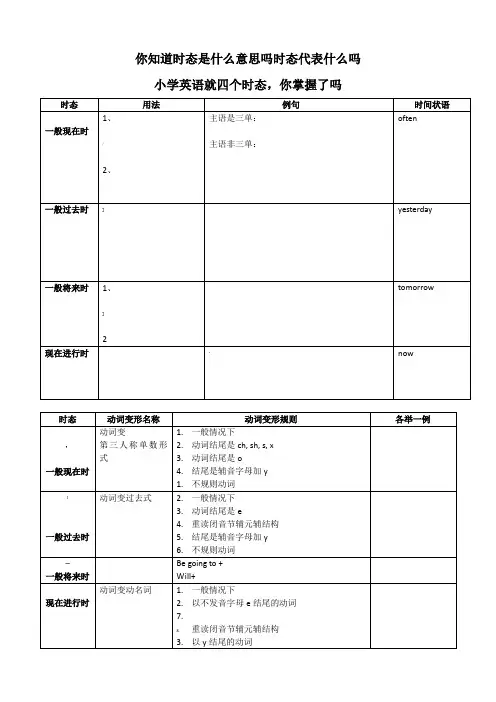
你知道时态是什么意思吗时态代表什么吗小学英语就四个时态,你掌握了吗你能发现它们之间的共同点和不同点吗勤加练习,百战不殆I.把下列动词变为第三人称单数形式。
1. clean--2. go--3. have--4.do-6. fly--7. come-- brush-9. watch-- 10. study-- 11. ask--(13. swim-- 14. catch-- 15. write--16. eat-- 17. make-- 18. paint—19. learn-- 20. phone-- 21. run—22. hop-- 23. sing-- 24. pick—II.把下列动词变成过去式is\am________ fly______ plant________are________ drink_________ play_______go________ make ______ does_________dance________ worry________ ask _____ taste_________ eat__________ draw________put ______ throw________kick_________ pass_______ do ________III.把下列动词变成动名词形式。
Wake________ make__________ come____________have____________!Take_________ leave__________ rid_________, regret__________, Begin________,cut________, get_________, hit_________, run_________, set_________, sit__________, spit__________, stop_________, swim________,beg_________, drop__________, fit_________, nod_________, dig___________, forget_________, travel_________visit_________Carry_________ enjoy___________ play ___________ study ________die_________ lie_________多加练习,百战不殆之时态篇一、用单词的正确形式填空:1.Mike _________ (do) his homework every day.2.There __________(be) some water in the glass.3.We like ________ (play) basketball after class.4.I like singing. I often _________(listen) to the music in the evening.5.【6.My grandma_________(watch) TV every day.二、判断句子的正误, 并改正。
(完整版)四种时态及其练习(完整版)
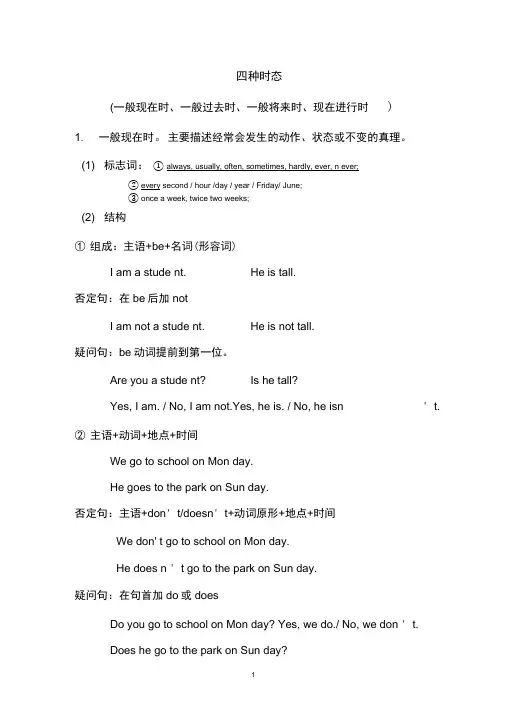
四种时态(一般现在时、一般过去时、一般将来时、现在进行时)1. 一般现在时。
主要描述经常会发生的动作、状态或不变的真理。
(1) 标志词:① always, usually, often, sometimes, hardly, ever, n ever;②every second / hour /day / year / Friday/ June;③once a week, twice two weeks;(2) 结构①组成:主语+be+名词(形容词)I am a stude nt. He is tall.否定句:在be后加notI am not a stude nt. He is not tall.疑问句:be动词提前到第一位。
Are you a stude nt? Is he tall?Yes, I am. / No, I am not.Yes, he is. / No, he isn ' t.②主语+动词+地点+时间We go to school on Mon day.He goes to the park on Sun day.否定句:主语+don' t/doesn' t+动词原形+地点+时间We don' t go to school on Mon day.He does n ' t go to the park on Sun day.疑问句:在句首加do或doesDo you go to school on Mon day? Yes, we do./ No, we don ' t.Does he go to the park on Sun day?Yes, he does./ No, he does n (3) 动词三单变化:① 在原单词末尾加s ,如:like - likes② 单词以 o, sh, ch, s, x 结尾力口 es,女口: go - goes ③ 单词末尾为辅音+y 结尾去y 加ies 女口: study- studies 2.现在进行时:主要叙述正在发生的事情。
小学四大时态知识点讲解以及四大时态综合训练题
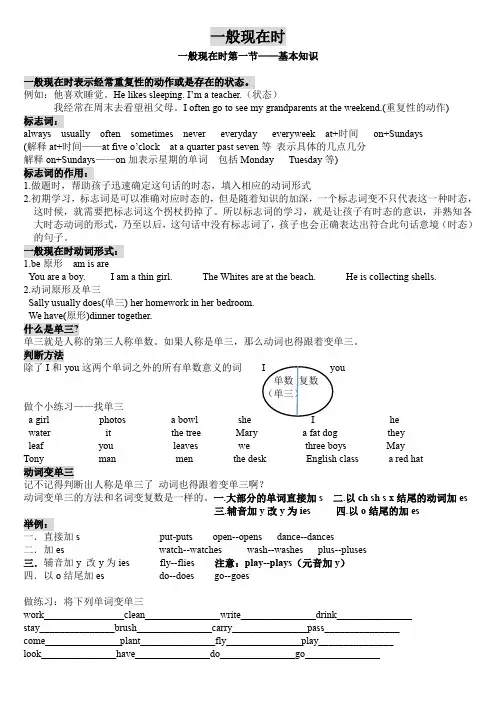
一般现在时一般现在时第一节——基本知识一般现在时表示经常重复性的动作或是存在的状态。
例如:他喜欢睡觉。
He likes sleeping. I’m a teacher.(状态)我经常在周末去看望祖父母。
I often go to see my grandparents at the weekend.(重复性的动作)标志词:always usually often sometimes never everyday everyweek at+时间on+Sundays(解释at+时间——at five o’clock at a quarter past seven等表示具体的几点几分解释on+Sundays——on加表示星期的单词包括Monday Tuesday等)标志词的作用:1.做题时,帮助孩子迅速确定这句话的时态,填入相应的动词形式2.初期学习,标志词是可以准确对应时态的,但是随着知识的加深,一个标志词变不只代表这一种时态,这时候,就需要把标志词这个拐杖扔掉了。
所以标志词的学习,就是让孩子有时态的意识,并熟知各大时态动词的形式,乃至以后,这句话中没有标志词了,孩子也会正确表达出符合此句话意境(时态)的句子。
一般现在时动词形式:1.be原形am is areYou are a boy. I am a thin girl. The Whites are at the beach. He is collecting shells.2.动词原形及单三Sally usually does(单三) her homework in her bedroom.We have(原形)dinner together.什么是单三?单三就是人称的第三人称单数。
如果人称是单三,那么动词也得跟着变单三。
判断方法除了I和you这两个单词之外的所有单数意义的词I you单数复数(单三)做个小练习——找单三a girl photos a bowl she I hewater it the tree Mary a fat dog theyleaf you leaves we three boys MayTony man men the desk English class a red hat动词变单三记不记得判断出人称是单三了动词也得跟着变单三啊?动词变单三的方法和名词变复数是一样的。
(完整版)小学六年级英语四大时态总复习练习

小学英语四种时态复习一提到时态,就必定用到动词。
第一要明确两个观点:动词有五种形式,即:原形(形式),第三人称单数(形式),过去式(形式),此刻分词(形式),过去分词(形式)。
小学阶段,句子有以下四种常有时态,即:一般此刻时态;一般过去时态;一般未来时态;此刻进行时态。
式,意思就是各样不一样的形式,是对应着动词来说的;时态,意思就是表达各样不一样的时间的事情,是对应着句子来说的。
式与时,先搞懂差别。
一、一般此刻时态一般此刻时用法口诀一般此刻时, every, usually, often, sometimes.第一、二人称和复数,动词原形不变换。
除了 I, you,复数外,动词后加s(es)别忘却。
要变一般疑问句, be 动词提早很简单。
假如没有 be动词, Do 和 Does 开头要注意。
否认句,很简单, not 在 be 动词后边站。
假如没有 be 动词, do, does加 not 要切记。
请把这些规律记,一般此刻时没问题。
一般此刻时态,可能是两种意思。
第一,表示常常性的动作,常与 often, sometimes, usually, every day, every week,every month, every year等表示频次的副词连用。
比如:He often goes swimming in summer.I usually go to work by bike.Sam visits China every year.第二,表示此刻的状态。
如: My mother is a worker.There is a computer in our classroom.注意问题:be (am, is, are)动词就是独立的谓语动词,一个句子中有了be(am, is, are)就有了谓语动词了。
句子中不可以同时出现两个谓语动词。
许多同学常常出这样的错误:The boy is often eats hamburgers(.错)应改为: The boy often eats hamburgers.二、此刻进行时态正在进行时态口诀此刻分词用途多,进行时态不用说。
小学四种时态讲解及练习
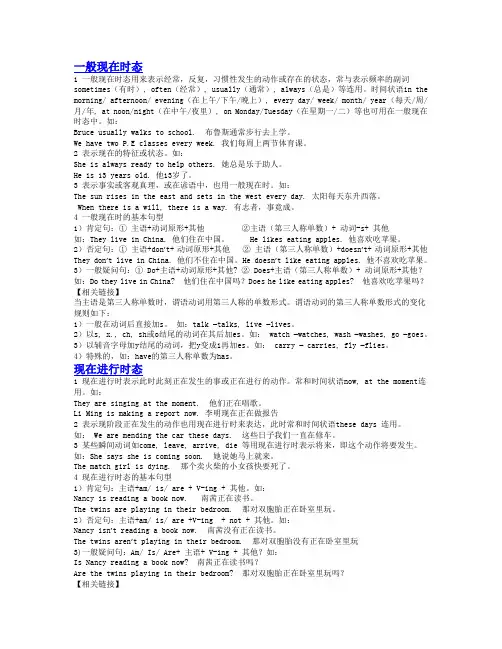
一般现在时态1 一般现在时态用来表示经常,反复,习惯性发生的动作或存在的状态,常与表示频率的副词sometimes(有时), often(经常), usually(通常), always(总是)等连用。
时间状语in the morning/ afternoon/ evening(在上午/下午/晚上), every day/ week/ month/ year(每天/周/月/年, at noon/night(在中午/夜里), on Monday/Tuesday(在星期一/二)等也可用在一般现在时态中。
如:Bruce usually walks to school. 布鲁斯通常步行去上学。
We have two P.E classes every week. 我们每周上两节体育课。
2 表示现在的特征或状态。
如:She is always ready to help others. 她总是乐于助人。
He is 13 years old. 他13岁了。
3 表示事实或客观真理,或在谚语中,也用一般现在时。
如:The sun rises in the east and sets in the west every day. 太阳每天东升西落。
When there is a will, there is a way. 有志者,事竟成。
4 一般现在时的基本句型1)肯定句:①主语+动词原形+其他②主语(第三人称单数)+ 动词-s+ 其他如:They live in China. 他们住在中国。
He likes eating apples. 他喜欢吃苹果。
2)否定句:①主语+don’t+ 动词原形+其他②主语(第三人称单数)+doesn’t+ 动词原形+其他They don’t live in China. 他们不住在中国。
He doesn’t like eating apples. 他不喜欢吃苹果。
3)一般疑问句:① Do+主语+动词原形+其他? ② Does+主语(第三人称单数)+ 动词原形+其他?如:Do they live in China? 他们住在中国吗?Does he like eating apples? 他喜欢吃苹果吗?【相关链接】当主语是第三人称单数时,谓语动词用第三人称的单数形式。
pep小学英语四个时态及其练习打印
小学英语四种时态及练习一、一般现在时1.意义:表示习惯或者爱好。
如:I get up at six every day.我每天六点起床。
I like drawing pictures.我喜欢画画。
2.结构:I am a boy.我是一个男孩。
We study English.我们学习英语。
注意:当主语为第三人称单数(he, she,it,Mike)时,要在动词后加"-s"或"-es"。
如:Mary likes Chinese.玛丽喜欢汉语。
3.时间标志:usually,ofen, sometimes, always, everyday, on Sundays4.动词+s的变化规则1)一般情况下,直接加-s,如:cook-cooks, milk-milks2)以s. x. sh. ch. o结尾,加-es,如: wash-washes, watch-watches, go-goes 3)以“辅音字母+y”结尾,变y为i, 再加-es,如:study-studies练习一般现在时用法专练:一、写出下列动词的第三人称单数drink ________ go _______ stay ________ make ________look _________ have_______ pass_______ carry ____come________ watch______ plant_______ fly ________study_______ brush________ do_________ teach_______二、用括号内动词的适当形式填空。
1. He often ___has_____(have) dinner at home.2. Daniel and Tommy _are______(be) in Class One.3. We _don’t_watch_____(not watch) TV on Monday.4. Nick _doesn’t___go___(not go) to the zoo on Sunday.5. __Do____ they ____like____(like) the World Cup?6. What __do_____they often ___do____(do) on Saturdays?7. ___Do____ your parents __read_____(read) newspapers every day?8. The girl _______(teaches) us English on Sundays.9. She and I _____take___(take) a walk together every evening.10. There ___is_____(be) some water in the bottle.11. Mike _______(likes) cooking.12. They _______(have) the same hobby.13. My aunt _______(looks) after her baby carefully.14. You always _______(do) your homework well.15. I ___am____(be) ill. I’m staying in bed.16. She ___goes____(go) to school from Monday to Friday.17. Liu Tao ___does____(do) not like PE.18. The child often _______(watches) TV in the evening.19. Su Hai and Su Yang _______(have) eight lessons this term.20. -What day ____is___(be) it today?-It’s Saturday.三、按照要求改写句子1. Daniel watches TV every evening.(改为否定句)______________________________________________________2.I do my homework every day.(改为一般疑问句,作否定回答)____________________________________________________3. She likes milk.(改为一般疑问句,作肯定回答)_______________________________________________________4. Amy likes playing computer games. (改为一般疑问句,作否定回答)___________________________________________________5. We don’t go to school every morning.(改为肯定句)_______________________________________________________6. He doesn’t speak English very well.(改为肯定句)_____________________________________________________7. I like taking photos in the park.(对划线部分提问)_____________________________________________________8. John comes from Canada.(对划线部分提问)____________________________________________________9. She is always a good student?(改为一般疑问句,作否定回答)________________________________________________________10. Simon and Daniel like going skating.(改为否定句)___________________________________________________五、改错(划出错误的地方,将正确的写在横线上)1. Is your brother speak English? __________________2. Does he likes going fishing? _________________3. He likes play games after class. __________________4. Mr. Wu teachs us English. __________________5. She don’t do her homework on Sundays. _________________二、现在进行时1.意义:现在进行时表示现在正在进行或发生的动作。
(完整版)小学英语四大时态总结及练习题
你知道时态是什么意思吗?时态代表什么吗?小学英语就四个时态,你掌握了吗?你能发现它们之间的共同点和不同点吗?勤加练习,百战不殆I.把下列动词变为第三人称单数形式。
1. clean--2. go--3. have--4. do-5.play--6. fly--7. come-- brush-9. watch-- 10. study-- 11. ask-- 12.answer--13. swim-- 14. catch-- 15. write--16. eat-- 17. make-- 18. paint—19. learn-- 20. phone-- 21. run—22. hop-- 23. sing-- 24. pick—II.把下列动词变成过去式is\am________ fly______ plant_____ are________ drink_________play_______ go________ make ______ do_________dance________ worry_____ask _____ taste_________ eat________draw________ put ______ throw________ kick_________pass_______ do ________III.把下列动词变成动名词形式。
wake________ make__________ come____________ have____________take_________ leave__________ rid_________, regret__________,begin________ cut________, get_________, hit_________, run_________, set_________, sit__________, spit__________, stop_________, swim________, beg_________, drop__________, fit_________, nod_________, dig___________, forget_________, travel_________ visit_________ carry_________ enjoy___________ play ___________ study _____die_________ lie_________多加练习,百战不殆之时态篇一、用单词的正确形式填空:1.Mike _________ (do) his homework every day.2.There __________(be) some water in the glass.3.We like ________ (play) basketball after class.4.I like singing. I often _________(listen) to the music in the evening.5.My grandma_________(watch) TV every day.三、选择最佳的答案:1. ____Alice often play the piano? No, she _____. A. Do; do B. Does; does C. Does; doesn't2. ___ your penpal __ in Beijing? A. Do; live B. Do; lives C. Does; live3. Tom and Mike __ very excited, they will take a trip. A. is B. are C. am4. I like ________ very much. What about you? A. dance B. danced C. dancing5. The kite ____ a bird. A. look like B. is looking C. looks like6. Bill and I ___ good friends. A. is B. are C. am7. Sandy often ___ his homework on Sundays . A. do B. does C. did8. What do you usually do on the weekend? I __________.A. went swimmingB. go swimmingC. visited grandparents9. What do you usually do on your holiday? I usually __________.A. saw elephantsB. sing and danceC.took picture10. I ____ a student. I go to school ____bus every day. A. is; by B. am; on C. am; by11. I ____ a brother. She ____ a sister. A. have; has B. has; has C. have; have12. You ____ a student. He ____ a teacher. A. is; is B. are; is C. are; are13. He always _____ football games. A. watches B. watch C. doesn't14. My best friend _____ shells. A. collects B. collect C. often15. She doesn’t _____ listening to the music. A. often B. like C. likes16. My mother and I ___ always watch romantic films. A. doesn’t B. don’t C. do17. ---When _____ he get home on Friday?----He gets home at four on Friday. A. do B. does C. did18.Summer _________ spring.A. comes afterB. comes ines before二、用单词的适当形式填空:1. look! Chen Jie and Mike are ___________(sing)now.2. The small bear is _____________ (climb) the tree.3. Mike is ________________ (draw) picture.4. She is ________________ (do) the dishes.5. My brother __________ (make) kites now.6. My father is ___________ (read) a newspaper in living room.7. Ted is __________(answer) the phone.8. My uncle is ____________ (drive) a car.9. The students are ______________(listen) to their teacher carefully.10. Chen Jie is _________(wash) clothes.11. His sister _______ (be) writing an e-mail.12. We ______(be) cleaning the classroom now.13. I____ (be)working on my computer.14. They _____ (be)playing basketball.15. Look, The tiger ________ __________(walk).16. Look, The elephants ______ _____________(drink) water with their trunk.17. Look, The monkeys ________ ___________ (swing).18. Peter _________ ______________(take) pictures now.19. They _____ ________(take)up the apples now.20. We _______ ________(catch) butterflies now.三、选择正确答案1. Every one ____ to their teacher in the classroom. A. are listening B. is listening C. listen2. They are singing and ___ together at the party now. A. dance B. danced C. dancing3. Listen! The birds ____. A. is singing B. are sing C. are singing4. Look! The kite ___ in the sky. A. fly B. flies C. is flying5. They ____ riding a forse. A. is B. are C. am6. Kate ____ playing chess. A. am B. is C. are7. Are you washing clothes? A. Yes, you are B. Yes, I am C. No, I am8. Is he ____ TV?Yes, he is. A. watch B. watching C. not9. ____ they taking pictures.? Yes, they are. A. Am B. Be C. Are10. It’s 10 o’clock. Ben _____ TV in the bedroom. A. watch B. is watching C. watches五、根据中文填空。
小学英语四种时态的综合讲解及练习
一般将来时:定义:一般将来时表示将来某一时刻的动作或状态,或将来某一段时间内经常的动作或状态。
构成:(1)be going to + 动词原形(2)will/shall + do用法:1)表示将来的动作或状态一般将来时常与一些表示将来的时间状语连用,如:tomorrow(明天),next week(下周),from nowon(从现在开始);in the future(将来);someday (未来的某一天) 等。
2)表示将来经常发生的动作I’ll teach you English every Wednesday next month.★★★“be going to+动词原形”表示即将发生的或最近打算进行的事。
例如:①It is going to rain. 要下雨了。
②We are going to have a meeting today. 今天我们开会。
Step Three: Do Some Exercise一、用will 或will not 以及括号中的动词完成句子1、I a Chinese song.(sing)2、Sally the tennis match.(not win)3、You the one-day trip to Guangzhou.(enjoy)4、Flora at home this weekend.(not stay)二、用括号内的词和be going to 完成问答1、(when/we/ have dinner? We / it / at seven o’clock)A When are we going to have dinner?B We are going to have it at seven o’clock.2、(Where / you /meet your friends? We / them /at the school gate)AB3、(you and Ling / play football/ today? No / we/ table tennis)AB现在进行时be+动词ing。
小学英语四种时态的综合讲解及练习(汇编)
一般将来时:定义:一般将来时表示将来某一时刻的动作或状态,或将来某一段时间内经常的动作或状态。
构成:(1)be going to + 动词原形(2)will/shall + do用法:1)表示将来的动作或状态一般将来时常与一些表示将来的时间状语连用,如:tomorrow(明天),next week(下周),from nowon(从现在开始);in the future(将来);someday (未来的某一天) 等。
2)表示将来经常发生的动作I’ll teach you English every Wednesday next month.★★★“be going to+动词原形”表示即将发生的或最近打算进行的事。
例如:①It is going to rain. 要下雨了。
②We are going to have a meeting today. 今天我们开会。
Step Three: Do Some Exercise一、用will 或will not 以及括号中的动词完成句子1、I a Chinese song.(sing)2、Sally the tennis match.(not win)3、You the one-day trip to Guangzhou.(enjoy)4、Flora at home this weekend.(not stay)二、用括号内的词和be going to 完成问答1、(when/we/ have dinner? We / it / at seven o’clock)A When are we going to have dinner?B We are going to have it at seven o’clock.2、(Where / you /meet your friends? We / them /at the school gate)AB3、(you and Ling / play football/ today? No / we/ table tennis)AB现在进行时be+动词ing。