
Unit 3 Lesson 3 Grammar and usage -牛津译林版高中英语选择性必修
新高中译林牛津英语必修三U1L3 Grammar and usage 教案
1
《英语》(必修·第三册)
Unit 1 Nature in the balance
Grammar and usage
I. Learning objectives
By the end of the lesson, students will be able to:
1. master the rules of ellipsis;
2. use the rules of ellipsis to improve their compositions;
3. raise their awareness of environmental protection.
II. Key competence focus
Develop the thinking ability by comparing and summarizing.
III. Predicted area of difficulty
1. Explore the rules of ellipsis.
2. Convey ideas using ellipsis correctly and properly.
IV. Teaching procedures
Step 1 Lead-in
T asks Ss to look at some elliptical sentences in the daily life to arouse their interest.
• No smoking (is allowed here).
• Parking (is allowed here).
• No photos (is allowed here).
• No fishing (is allowed here).
【设计意图:创设情景,激活学生认知,自然地引入主题。】
Step 2 Introduction of ellipsis
高中英语_unit3_grammar_and_usage教案_牛津译林版高二选修7
Unit 3 The world online
Grammar and usage
Teaching aims:
1. After learning auxiliary verbs, the students will know about some basic information about
auxiliary verbs (words used as auxiliary verbs; function of auxiliary verbs);
2. After learning auxiliary verbs, the students will be able to summarize usages of common and
important auxiliary verbs;
3. After learning auxiliary verbs, the students will apply what they’ve learned about auxiliary
verbs.
Teaching procedures:
Step 1 Lead-in (PPT 4)
Q: What are auxiliary verbs?
A: Auxiliary verbs are used in forming tenses, moods and voices of other verbs. The verbs used
for this purpose include be, do, have and modals.
Step 2 Introduction (PPT 5)
Point out the auxiliary verbs.
1. He doesn't like English.
2. He is singing.
3. He has got married.
4. He was sent to England.
高中英语必修三:unit3 Grammar and usage 教案
高中英语试卷、习题、教案精品资料
Unit 3 Back to the past Grammar and usage
Object complement & Either …or… and neither … nor… & Subject-verb agreement
Teaching Aims: Learn the grammar:
Object complement
Either… or and neither… nor Subject-verb agreement
Teaching Points:
How to use the object complement / either… or / neither… nor / subject-verb
agreement in different situations. The key point is to help students guess the exact
usage from the context.
Teaching Methods:
1. Inductive method 2. Comparative method
3. Communicative approach
Teaching Aids:
1. A multimedia
2. A blackboard
Teaching Procedures:
Step 1 Object complement
(1)Situation one — Did you find anything special when you went to the classroom?
—No, I didn’t.
—You found the door open, didn’t you?
—Oh, yes. But I found nobody in the classroom.
(2) Position
牛津译林版高中英语必修三《Unit3 Back to the past》 Grammar and usage 教案 1

1 牛津译林版高中英语必修三
Unit 3 Grammar and usage教学设计
单元:Unit 3 Looking good, feeling good
板块:Grammar and usage (Question tags)
Thoughts on the design:
本单元的第二个语法项目是反意疑问句。笔者采取了从情景对话、规则到语感的高中英语语法教学思路。强调了情景化的对话呈现、对比体验式的语法规则讲解,尤其是语感形成在英语语法教学中的重要作用。针对本单元的语法项目进行有效教学,首先选取能激发学生兴趣的素材,考虑它的趣味性、情景性和实用性。趣味性是指该素材能吸引学生的注意力,让他们产生学习兴趣;所谓情景性是指该素材应借助于一定的情景,有助于激发学生的想象力;实用性是指该素材包括本单元的语法项目,重点突出,又简单易懂。
附加疑问句的语调在具体的语境中起着至关重要的作用,所以本节课开始时借助于简单的课堂用语,既引出附加疑问句的类型,同时也运用正确的语调把要介绍的信息传达给学生。借助与对话情景呈现所要教学的语法项目,让学生在故事或对话情景中体会和领悟语法规则,进而通过老师的引导、分析和适当的练习,巩固所学习的语法项目,最终达到语法规则运用自动化。在本节课的巩固环节中充分利用现有教材资源并加以改编,让语法在一定的情景中进行操练,最后再通过让学生反复阅读,强化语感的培养和形成。
Teaching aims:
1. After reviewing the usage of intonation, the students will be able to learn how to read
question tags;
2. After learning the forms of the question tags, the students will learn what question tags
译林版高中英语必修二Unit3 Grammar and usage(含答案)(雅礼版)
1 B2 Unit 3 过去将来时练习题
1. Every time they met, they ____ talk about former classmates they remembered.
A. could B. would C. should D. will
2. They made up their mind that they______ a new house once Larry changed jobs.
A. bought B. would buy C. have bought D. had bought
3. We had to be patient because it ________some time________ we got the full results.
A. has been; since B. had been; until C. was; after D. would be; before
4. When Peter __________ the car door, he found the key left in his car. So he had to call for help.
A. opened B. was opening C. was to open D. had opened
5. John was given the same suitcase his father and grandfather _______with them to school.
A. took B. have taken C. were taking D. would take
6. Johnson was much depressed as he didn’t sell half as many computers as he thought he____ .
译林牛津高二英语模块七unit 3 Grammar and usage 基础练习(含答案)
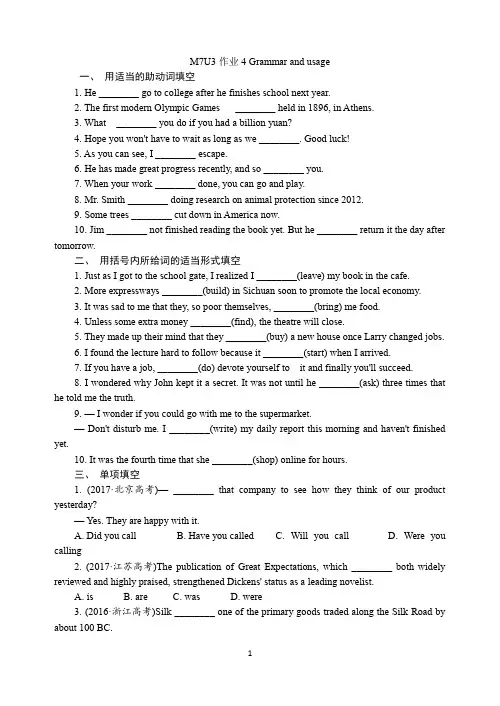
1 M7U3作业4 Grammar and usage
一、 用适当的助动词填空
1. He ________ go to college after he finishes school next year.
2. The first modern Olympic Games ________ held in 1896, in Athens.
3. What ________ you do if you had a billion yuan?
4. Hope you won't have to wait as long as we ________. Good luck!
5. As you can see, I ________ escape.
6. He has made great progress recently, and so ________ you.
7. When your work ________ done, you can go and play.
8. Mr. Smith ________ doing research on animal protection since 2012.
9. Some trees ________ cut down in America now.
10. Jim ________ not finished reading the book yet. But he ________ return it the day after
tomorrow.
二、 用括号内所给词的适当形式填空
1. Just as I got to the school gate, I realized I ________(leave) my book in the cafe.
2. More expressways ________(build) in Sichuan soon to promote the local economy.
译林版高中英语必修三Uint3 Grammar and usage (I) 教案(雅礼版)
Unit 3 The world on line
Grammar and usage (Ⅰ)
Verb-ing forms as attributives, adverbials and object
complements
内容分析:
本板块围绕单元话题,要求学生在语篇中观察、探究动词-ing形式的功能及意义,自主归纳动词-ing形式做定语、状语和宾语补足语的核心规则;教师应引导学生分析动词-ing形式在具体语境中所充当的不同成分及其对应的含义,并能正确、灵活地使用;最后要求学生恰当使用动词-ing形式完成一个图片描述任务。
教学目标:
By the end of this section, students will be able to:
1. categorize the functions of verb -ing forms and summarize the general rules;
2. change sentence structures with verb -ing forms;
3. apply verb -ing forms in new situations appropriately.
教学重难点:
1. To summarize the general rules;
2. To apply the rules correctly and properly;
教学过程:
Step 1 Read and answer the question.
Have the students read the article on page 34 and answer the following question.
Q: Why did Fiona Lin set up the website JustDance?
A: Because she wanted to introduce more people to dance since she had realized that
高二英语(牛津译林版)教学资源M8Unit3Grammarandusage
The film they want to watch begins at seven.
If you want to learn to play a musical instrument, it might be a good idea to begin on
something simple.
The word 'cat' begins with the letter 'c'.
The meeting began promisingly, but then things started to go wrong.
[+ ing form of verb] Jane has just begun learning to drive.
[+ to infinitive] After waiting for half an hour she was beginning to get angry.
[+ speech] "Well, " he began (= started by saying). "I don't quite know how to tell you
this."
beginner
n. [C]
This class is for beginners (= people who are just starting to do the activity) only.
beginning
n. [C usually singular; U]
Notes on how to use this dictionary can be found at the beginning of the book.
She sat down and read the book straight through from beginning to end.
I enjoyed my job at/in the beginning (= when I started it), but I'm bored with it now.
译林版高中英语扩展创新学程一Unit3 Grammar and usage 教案
1 《英语》(选修·第一册)
Unit 3 On the move
Grammar and usage
I. Learning objectives
By the end of the lesson, students will be able to:
1. master the formation of if-clause subjunctive mood;
2. understand if-clause subjunctive mood;
3. practice application of if-clause subjunctive mood;
4. make a conversation about how to improve their hometowns’ traffic using unreal conditionals;
5. practise the words: *cater, cater for, hotspot, upgrade*, ferry, *frustration, *install, *emission.
II. Key competence focus
1. Develop the techniques of the flexible use of language.
2. Improve the power of cognition and comprehension.
3. Apply learning strategies to practice.
III. Predicted area of difficulty
1. Applying the tips of if-clause subjunctive mood;
2. Using if-clause subjunctive mood.
IV. Teaching procedures
新教材译林版必修二Unit 3 Grammar and usage
Period Three Grammar and usage—Future in the past
语法感知
感知以下句子,完成方框下的小题
1.She was about to find out.
2.She was going to sell her hair.
3.And the next day would be Christmas.
4.Would Jim still think she was pretty?
5.If she was to buy a nice gift for her husband Jim,she would need more money.
6.With the money she received for it,she would buy Jim a perfect gift.
以上句子都使用了过去将来时,表示从过去看将要发生的动作。
语法精析
一、过去将来时的常见结构
1.should/would+动词原形
(1)表示从过去某时看来将要发生的动作或存在状态。常用于宾语从句中。
He said that he would wait for us at the bus stop.
他说他要在车站等我们。
She hoped that they would meet again someday.
她希望将来有一天他们能再见面。
(2)表示过去的某种习惯性行为,只用would。
Whenever we had trouble,he would come to help us.
每当我们遇到困难时,他总会给予帮助。
2.“was/were going to+动词原形”表示准备、计划做某事,或将要发生某事。
She was not going to do anything that evening.
那天晚上她不准备做任何事。
When they arrived the plane was just going to take off.