
人教版英语七下第三单元第一课时教案
1
第三届全国中小学“教学中的互联网搜索”优秀教学案例评选
人教版新目标 七年级下Unit 3 Why do you like koalas?
教学设计
2 第三届全国中小学“教学中的互联网搜索”优秀教学案例评选
人教版新目标 七年级下Unit 3 Why do you like koalas?教学设计
一、 教案背景
面向学生:中学生
学科:英语
课时:第一课时1
学生课前准备:复习指路用语,网上搜索石家庄动物园资料和自己喜欢的动物图片。
教师课前准备:unit3演示文稿,网上搜索关于pandas 的资料,/view/4667.htm
二、教学课题
人教版新目标 七年级下Unit 3 Why do you like koalas?教学设计
三、教材分析
本课是新目标英语七年级下册第3单元第一课时。本单元主要是通过学习动物名称和常见的描述动物的形容词,学会用适当的形容词表达对动物的喜爱原因,能运用所学英语单词和句型简单描述出自己喜欢的动物,从而增强学生对动物的热爱并勇敢地将保护动物付诸于日常行动中去。本课设计由情景导入,首先展示网上搜索到的去动物园的地图,让学生通过看地图复习已学过的问路指路句型,然后导出本课内容。为了提高学生自主学习的能力,本课我设计了三个任务:任务一通过链接展示学生网上搜索到的有关动物的图片,引入本课的重点词汇与句型,学习有关动物的名词和询问喜欢哪种动物以及表达喜欢的原因的句子。任务二是让学生挑选自己最喜欢的一种动物进行对话练习,并引导学生变换不同人称时,句子所做的变化,然后做替换练习。任务三让学生做听力练习,对课堂进一步进行延伸和巩固,同时也能提高学生学习兴趣。
四、教学目标
知识与技能
1、掌握表示动物的名词和描述动物特征的形容词,例如:koala ,tiger ,elephant,dolphin,panda,lion,penguin,giraffe;cute,smart,interesting,fun。
2、能用英语简单的谈论、描述动物并用合适的形容词表达自己对动物的喜爱,如:
What animals do you want to see? Lions.
What animals do you like? I like pandas.
What animals does he/she like? He/She likes giraffes.
3 Why do you like tigers? Because they’re very fun.
Why does he/she like elephants? Because they’re kind of interesting.
过程与方法
通过学习动物名称和常见的描述动物的形容词,学会用适当的形容词表达对动物的喜爱原因,能运用所学英语单词和句型简单描述出自己喜欢的动物。
情感态度与价值观
增强学生对动物的热爱并勇敢地将保护动物付诸于日常行动中去。
五、教学重、难点
1.祈使句Let’s do...的用法
2.Why引导的特殊疑问句询问原因,
六、教学方法
情景导入,将听说,朗读,对话三种方式融入课堂,把小组合作学习法和任务型教学法相结合。
七、教学过程
教师活动 学生活动 设计意图
情情景导入 假设本周末要去参观动物园,问学生怎么走,复习指路问路的常用语,以及教授新单词zoo,animal。
T: Do you want to go to the zoo?
Ss:Yes,we do.
T:Where is the zoo ?
Ss:Go down..., turn left/right on....It’s
on the left/right of ...
T: Do you like animals?
Ss:Yes,I do.
T: What animals do you know?
Ss:..... 学生展示自己搜索的去石家庄动物园的地图,复习指路常用语/?newmap=1&s=inf%26uid%3D7427a9160e4dbeed5b109336%26c%3D150&fr=alasg&from=alamap,在教师引导下学习新单词zoo,animal。 设计故事情景导入,展示学生网络搜索结果,提高学生学习兴趣,创设轻松氛围。
词词汇1.通过展示学生搜索的动物图片,教授本课新单词tiger,elephant,koala,dolphin,panda,lion,penguin,giraffe。让学生展示自己在网络中搜索到的关于动物的图片。
/sucai/UploadPic/2006-2/2006217101622527.jpg 展示图片,提高学生学习 4 学习 重点强调单词发音,通过领读、齐读以及问答多种形式练习单词发音。提醒学生elephant前用不定冠词an。
T: What animal is it?
Ss: It’s an elephant.
T: Do you like it?
Ss: Yes,I do ./No,I don’t. /photo/lu0xnAo921wBkdmcnhS7AQ==/2612932208805264849.jpg
/20100324/4484182_210635068065_2.jpg
/47/09/300000938214129543091735781_950.jpg
/attachments/images/c090321/123kb3cv040-134513.jpg
/it/u=1620019195,3952418052&fm=52&gp=0.jpg
/20090330/2032714_095859015_2.jpg
/it/u=3212346953,205916167&fm=52&gp=0.jpg
并学习有关动物的名词。 兴趣,增强对词汇的印象。
句句型操练 1.根据图片加强动物单词的练习,指导并纠正学生发音。
2.出示描述动物的形容词interesting,
fun, cute,smart。教授新单词,引导学生学习句型:
T:What animals do you like?
Ss:I like tigers/ lions/ pandas...
T:Why do you like tigers/
lions/pandas...?
Ss:Because they ‘re cute/fun/smart...
3.对话练习。在课件中展示的多种动1.巩固刚学的动物名词,做简单对话练习。
A:What’s this?
B:It’s a/an ...
A:Do you like tigers/lions...?
B:Yes, I do./No,I don’t.
2.在教师指导下,学习描述动物的形容词,通过教师演示学习新句型。
A:What animals do you like?
B:I like tigers/ lions/ pandas...
A:Why do you like tigers/
lions/pandas...?
B:Because they ‘re cute/fun/smart...
3.出示幻灯片,展示学过的动物名称及时纠正学生发音,避免出现误读发生。
小组活动 5 物中选择一类自己喜欢的动物和一个可以描述其特点的形容词,四人进行对话练习,做不同人称的替换练习。要求学生表演自然,可加入自己学过的句型进行会话练习和情景表演,鼓励学生自由发挥,可适当拓展,进一步掌握该单元的重要句型和单词。至少要求5组学生进行现场表演。
4.打开课本,朗读1a中的单词并做练习。做1b的听力练习。 Check the
answers。再放一次录音让学生重复重点句子。要求学生仿照1c中句型,用1a中的动物名词和1c中的形容词,进行替换练习。此练习至少3组学生当堂展示。
5.做2a和2b的听力练习。播放一次录音,要求按2a要求写出动物名字的单词,并与形容词相匹配。Check the
answers。第二次播放录音,要求学生填写所缺单词。Ask a students to read
her/his answers to check the answers,then repeat the conversation. 并让学生仿照此段对话用其他学过的动物和形容词进行替换练习
A: Let’s see the koalas.
B: Why do you like koalas?
A: Because they are kind of cute.What
about you?
B:…… 和形容词,将这些形容词和动物相匹配,并用其进行小组会话练习。
A:What animals do you like?
B:I like tigers/ lions/ pandas...
A:Why do you like tigers/
lions/pandas...?
B:Because they ‘re cute/fun/smart...
C:What animals does he/she like?
D: He/She likes...
C:Why?
D:Because they’re...
4.听录音,划出所听到的内容。听第二遍并重复听力内容。仿照1c中句型,用1a中的动物名词和1c中的形容词,进行替换练习。
A:Let’s see the pandas first.
B:Why?
A:Because they’re very cute.
5.听录音,按2a要求写出动物名字的单词,并与形容词相匹配。一名学生读自己答案,全部订正。听第二遍录音,填写所缺单词,全班订正答案。然后仿照此段对话用其他学过的动物和形容词进行替换练习
A: Let’s see the koalas.
B: Why do you like koalas?
A: Because they are kind of cute.What
about you?
B:……
可以取长补短,提高学生自主学习能力。变化不同人称代词,让学生对本单元重点句型进一步巩固掌握。通过听力练习
检查单词掌握效果,发现问题及时纠正。替换练习可以让学生对新知识学以致用,增强其熟练掌握的程度。
人教版七下英语第三单元备课 - 副本

1 单元备课专用纸
年级 七 科目 英语 主备人 时间
单元 Unit4 课题 Don’t eat in class.
单
元
教
材
分
析
本单元是人教版《新目标》的第四单元。这本教材的词汇量很大,内容新颖,尤其是生动活泼的卡通化的画面,很符合七年级学生的年龄特点和心理特点,其中还囊括了很丰富多彩的文化知识,以及合作探究的活动,十分贴近学生的实际生活经验。本单元的话题Talk about rules.与日常生活密切相关。作为一名中学生,遵守学校班级、家庭和社会公共场所的规章制度是必须的。在谈论规则时,一般运用祈使句、情态动词can和have to等。这是英语新课程标准中规定所必须掌握的内容,是交际英语中必不可少的项目。因此,本单元对于提升学生的学习兴趣而提高学生的听、说、读、写能力有很大的帮助。并通过self check检测,积极地、及时地寻找各自的不足,以便学生树立良好的内在动机,不断获得成就感。
2 学
情
分
析
1.经过上学期的学习,已经有了一定的英语基础知识和听说能力,正逐渐向读写过渡,同时,学生们对英语学习还保持着较浓厚的兴趣。在加上受新课程理念的熏陶及实践,能巩固所学知识,又能提高解决问题的能力以及综合运用语言的能力。
2、从年龄特征看,学生们也很在乎他人的评价。在学习过程中通过“兵教兵”小组训练,鼓励性评价等措施,提高学生综合语言技能。
单
元
教
学
目
标
知识目标
这一单元主要话题是“Talk about rules谈论规则”,其中主要涉及内容如下:
A、Functions功能:谈论规则,并制定规则。
B、Structures语法结构:祈使句和情态动词Can和have to的用法。
C、Target Language日常交际用语:
Don’t eat in class!
Can we wear hats? No,we can’t.
We don’t have to wear a school uniform等。
人教版初中英语七年级下册全册英教案(全英文版)
人教版初中英语七年级下册教案 新目标人教版英语七下
全册教案
(全英文版)
Unit 1 Wheres your pen pal from?
Language goals:
• In this unit students learn to talk about countries, nationalities and Ian
guages.
• Ask and tell where people live.
New languages:
• Where's he / she from?
• He / She is from Australia / England / China / France / Singapore / Australia.
• Where does he / she live? He / She lives in Sydney.
• What language do you speak? I speak English.
• What's your / his / her favorite subject?
• My / His / Her favorite subject is English.
• Does he / she have any brothers and sisters? Yes, he/ she does. / No, he /
she doesn't. 人教版初中英语七年级下册教案
Difficult points:
1. Liste ning for the in formation about cou ntries, natio nalities and Ian guages.
Write an e-mail about on eself. Describe the new stude nts in class.
2. Where questions with from
2020-2021学年人教版七年级英语下 Unit 3 第一课时Section A(1a—2e)
Unit 3How do you get to school?
第一课时Section A(1a—2e)
Ⅰ.根据句意及首字母提示补全单词。
1.My home is four k from school.
2.An hour is sixty m .
3.Seventy and thirty is one h .
4.It's not a n car.It's very old.
5.—What's forty and fifty?
—It's n .
Ⅱ.根据句意及图片提示完成下列句子。
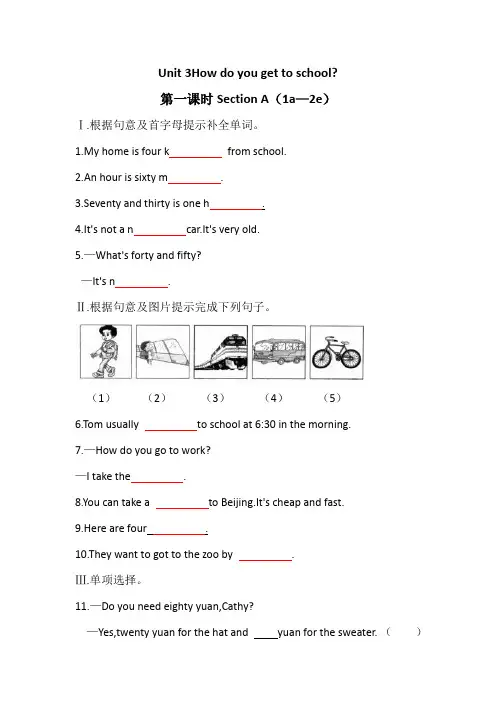
(1) (2) (3) (4) (5)
6.Tom usually to school at 6:30 in the morning.
7.—How do you go to work?
—I take the .
8.You can take a to Beijing.It's cheap and fast.
9.Here are four .
10.They want to got to the zoo by .
Ⅲ.单项选择。
11.—Do you need eighty yuan,Cathy?
—Yes,twenty yuan for the hat and yuan for the sweater. ( ) A.sixty B.thirty C.seventy D.fifty
12.—Is this your bike? Can I it? ( )
—Sure.
A.ride B.look C.take D.eat
13.It takes me three minutes to the classroom. ( )
七下英语第三单元SectiinA复习教案
七下英语第三单元SectiinA复习教案
篇1
一、教学目标
1. 学生能够熟练掌握七下英语第三单元 SectionA 的单词、短语和句型,如
take the bus/subway、ride a bike 等。
2. 通过复习,学生能够准确运用所学知识进行对话和写作,描述自己及他人的出行方式。
3. 培养学生的听力和口语表达能力,让学生在课堂互动中敢于开口说英语。
二、教学重点与难点
重点:SectionA 的重点单词、短语和句型的掌握与运用。难点:学生在实际情境中准确运用不同的出行方式表达进行交流,以及对第三人称单数形式的正确运用。考虑到学生可能在第三人称单数的变化上存在薄弱环节,需要重点复习巩固。
三、教学方法
1. 情景模拟法:设置不同的出行场景,如上学路上、去公园等,让学生在情景中运用所学知识进行对话。
2. 小组竞赛法:将学生分成小组,进行单词接龙、句型问答等竞赛活动,激发学生的竞争意识和学习积极性。
3. 多媒体辅助教学:通过播放与出行方式相关的视频、图片等,加深学生对知识的理解和记忆。
四、教学过程
(一)复习导入
师:“同学们,咱们今天呀,要来一场英语大冒险,复习咱们七下英语第三
单元 SectionA 的内容。在开始冒险之前呢,老师先给大家放一段超有趣的英文短视频。”(播放与本单元主题“交通方式”相关的短视频,视频中有各种交通工具以及人们使用不同交通工具的场景)
师:“哇哦,视频看完啦!同学们,你们在视频里都看到了哪些交通工具呀?”
生 1:“I see a bike.”
生 2:“There is a bus.”
生 3:“I saw a car.”
师:“非常棒!那大家想想,在我们的日常生活中,你们都是怎么去上学或者去其他地方的呢?用英语来说说看。”
生 4:“I go to school by bike.”
生 5:“I take the bus to school.”
新人教版七年级英语下册教案(全)

Unit 1 Can you play the guitar? 第一课时Section A (1a-2d)一、教学目标:1. 语言知识目标:1) 能掌握以下单词:guitar, sing, swim, dance, chess, play chess, draw, speak, speak English, join, club 能掌握以下句型:①—Can you play the guitar? —Yes, I can./ No, I can't. ②—What can you do? —I can dance. ③—What club do you want to join? —I want to join the chess club. 2) 能了解以下语法:情态动词can的用法want to do sth.的用法2. 情感态度价值观目标:该部分内容贴近学生的生活,谈论的话题是能力。通过互相询问或谈论自己或对方在某一方面的能力,可以培养学生的一种群体意识。二、教学重难点1. 教学重点:1) 学习询问和谈论彼此的能力和特长;2) 掌握一些弹奏乐器的表达方式。2. 教学难点:情态动词can的构成和使用。三、教学过程Ⅰ. Lead in 1. 教师可携带一些易于演奏的乐器,也可带一些演奏乐器的图片,一边演示乐器,一边说: I can play the guitar.…等;再指着图片说:He/She can play the violin.But I can’t play it.等;然后询问学生:Can you play the guitar?….并引导学生进行简单的回答。2. Ss look at the picture in 1a. Then read the words and phrases. Let Ss match the activities with the people. Then Check the answers with the class together. Ⅱ. Presentation 出示一些反映各种活动的图片、幻灯片或播放课件,引导学生谈论活动:He/She can dance/swim/sing/"··But I can’t dance/swim/sing/...等,学习表达活动的动词短语。Ⅲ. Game (What can I do?) T: Tell your partners what you can do. For example: I can play the guitar. I can sing and dance. Ss work in groups. The let some Ss talk to their classmates in front of the class. Ⅳ. Listening 1. T: Now let’s listen to the tape, find out the right conversation, and number them 1-3. (播放lb部分的录音让学生听,引导学生根据所听到的内容,选出对话的顺序,完成1b部分的教学任务。)2. Check the answers: (3, 2, 1 ) Ⅴ. Pair work 1.Ask the Ss to practice the conversations in 1b with a partner. Then make their own conversations. (引导学生展开Pairwork活动,完成lc部分口语交际的教学任务,学会运用can询问和表达能力。) Ⅵ. Listening 1. Work on 2a; T: Now, look at the pictures on P2, listen to the four conversations. Just listen. (Play the recording for the first time, students only listen carefully.) Then, listen to the recording again, and circle the clubs you hear. Check the answers with the class. 2. Work on 2b; 引导学生根据对话内容用正确的单词填空,补全对话,再播放听力材料一遍。让学生进行校对,练习听力和写作能力,完成2b部分的教学任务。Check the answers with the Ss. Ⅶ. Pair work 1. Look at 2b and talk about what the people can do and the clubs they want to join. 老师可以和一名优秀的学生做一个对话的例子,让学生们明白如何去问答,例如:T: What club does Lisa want to join? S1: She wants to join the chess club. T: Can she play chess?S1: No, she can't. 2. Ss work in pairs to practice asking and answer about Lisa, Bob and Mary. 3. Ask some pairs to act out their conversations. Ⅷ. Role-play 1. Ask Ss to look at the picture in 2d. Then Ss read the dialogue by themselves and try to find out the answers to these questions. ①What club does Bob join? ②What club does Jane join? Ss read the conversation by themselves and find the answers to the questions. Then check the answers: ①Bob joins the soccer club. ②Jane joins the English and art club. 2. Explain something that Ss can't understand. 3. Let Ss read after the teacher or play the recording and let Ss read after the recording. 4. Ss work in pairs to act out the conversation. 5. Ask some pairs come to the front of the classroom. They try to act out the conversation.
初中英语_人教版七年级下册第三单元SectionA教学设计学情分析教材分析课后反思

A Teaching Design
of Unit Three SectionA
I. 学习目标Learning objectives:
After this class, students are expected to:
知识目标: Listen to and understand, talk about, read, and write
different ways of transportation, and three questions:
How do you get to …?
How long does it take you…?
How far is it from…to…?
能力目标:Finish listening tasks.
Ask and answer questions about how to get to places, how
long it takes and how far it is.
Can make a survey and write a report, with the help of
group members.(The report may be left as homework if
unfinished)
情感目标:Choose the right way of transportation if possible.
II.学习重难点 What will be difficult to learn:
1. How to ask and answer the three questions:How do you get to …?
How long does it take you…?How far is it from…to…? Especially the
last two.
2. Make a survey and write the report.
人教版七年级下英语第三单元unit 3教案新部编本课件
精品教学教案设计 | Excellent teaching plan
育人犹如春风化雨,授业不惜蜡炬成灰
教师学科教案
[ 20 – 20 学年度 第__学期 ]
任教学科:_____________
任教年级:_____________
任教老师:_____________
xx市实验学校
精品教学教案设计 | Excellent teaching plan
育人犹如春风化雨,授业不惜蜡炬成灰 教师: 唐美美 学生: 杨雅兰 年级: 初二
科目: 语文
时间: 20 13 年 7 月 30 日 七下三单元 课次: 11
一、教学目的与考点分析
1.三单元重难点单词短语
2.会简单表达自己的喜好
3.复习上册5---6单元
教学内容及步骤
一.单词短语
1.表达好看漂亮的单词:
1)good-looking 用来描述任何长得好看的人(不论男女)
2)pretty 用来描述长得好看的女性
3)beautiful - 用来描述长得好看的女性(包括大人小孩)
4)handsome - 用来描述长得好看的男性
5)cute - 用来描述长得可爱的小孩
1.那边那个相貌好看的青年是谁?
Who is the good-looking young man over there?
2.那个留着长发的漂亮女士是他的妈妈。
The pretty lady with long hair is his mother.
3.我很喜欢这件漂亮的礼服。
I like this pretty dress very much.
2.smart 伶俐的,精干的,帅气的
1)看那个聪明的小孩!
Look at that smart boy!
2)你今天看上去很帅气。
You look smart today.
人教版七下英语书第三单元第一部分讲解
人教版七下英语书第三单元第一部分讲解
全文共3篇示例,供读者参考
篇1
Unit 3 Our Hobbies
Part 1: Reading
In this part, we will introduce some key points and exercises
in Unit 3 of the seventh-grade English textbook of People's
Education Press.
1. Reading strategy: Predicting
Before reading the passage, ask the students to look at the
title and pictures, and make predictions about the content of the
passage. This will help them understand the text better as they
read.
2. Vocabulary
- skateboard (n.): a short narrow board with wheels on the
bottom, which you stand on and ride like a small vehicle
- kite (n.): a toy consisting of a light frame with thin material
stretched over it, flown in the wind at the end of a long string - boating (n.): the activity of traveling in a boat
3. Reading comprehension questions
初中英语人教版七年级下册三单元 阅读教案
Unit3 How do you get to school?
授课人:龙琴 时间:2017年3月14日
班级:初2016级3班 课型:阅读课
一、教学内容分析
本节课选材为人教版Go for it,七年级下册Unit3 How do you get to school?的Section B 部分的阅读文章,介绍了一个偏远山区孩子上学的故事。文章贯穿了不同交通方式的表达,阅读后能激起珍惜自己的学习条件和自己的生活。
二、学情分析
本课的教授对象是初2016级3班:
1.大部分学生有较强的语言组织和表达能力,愿意参加课堂活动。
2.上阅读课喜欢记笔记,课堂安静。
三、教学目标分析
1. 知识与技能:
(1)重点词汇及短语:cross,bridge,boat,afraid,leave,villager;come
true, between...and…
(2)重难句子: One 11-year-old boy, Liangliang , crosses the river every
school day. But for the students in one small village in China ,it is
difficult.
2.过程与方法:
主要采用task-based method ,communicative approach ,头脑风暴,小组讨论和团队合作来打开学生思维,训练学生的思维发散能力,锻炼学生的思考问题能力,提高学生的合作能力。 大活动从文章出发,以采访的形式让学生回忆课文,思考问题和表达观点。
3.情感态度价值观: 学会珍惜自己的生活和学习,鼓励学生努力奋斗。
四、教学重难点
1. 如何使用阅读策略快速且准确的找出关键信息,利用关键信息定位解题。
英语人教版七年级下册Unit 3 Section A 2e—3c教案
第三单元第二课时 Section A(Grammar Focus ~ 3c)
知识目标
类别 课时要点
重点单词 drive(v.)开车
car(n.)小汽车;轿车
live(v.)居住;生活
重点词组 take the bus 乘坐公共汽车
walk to school 步行去学校
ride one’s bike 骑自行车
drive to work 开车上班
重点句式 1.—Does Jane walk to school?简步行去学校吗?
—No,she doesn’t.She goes by bike.不,她不是。她骑自行车去(学校)。
2.—Do they take the bus to school?他们是乘坐公共汽车去学校吗?
—No,they don’t.They walk.不,他们不是。他们是步行去(学校)。
课堂环节
§自主学习方案
学生自学新单词(教材P15的单词),看谁记得又快又准。(2分钟)
1.drive
开车
2.car 小汽车;轿车
3.live 居住;生活
4.take the bus 乘坐公共汽车
5.walk to school 步行去学校
6.ride one’s bike 骑自行车
7.drive to work 开车上班
【新词自查】
根据首字母或汉语提示完成句子。
1.I usually go to school by bus.
2.Miss Li,our English teacher,lives five miles from our school.
3.My parents often drive to work(开车上班)every day.
4.He rides his bike(骑自行车)to the bus station.
5.It takes me about half an hour to walk to school(步行去学校).