
大学英语文化口语教程Unit-1
Andy
Been here for about a year now. Where are you from?
Richard Canada, Vancouver actually.
Andy
You didn’t fly in today, did you?
Richard Oh, no no no, I’ve lived in London for the past two years.
大学英语文化口语教程
Culturally Speaking 上
PPT课件
主编:Simon Greenall(1英)
UNIT
1
Getting to know you
Unit objectives
In this unit, you’ll learn how to:
• exchange greetings with others in formal / informal occasions through different cultures,
PPT课件
10
Activity 2
Conversation 1
Look and decide where the expressions go
Hey! I missed you. How do you do?
Picture 1: How are you? / Hello! / Hi!
Picture 3: Hello! / Pleased to meet you. / How are you?
Picture 2: Pleased to meet you. / How do you do? Picture 4: Hi! / Hey!/ I missed you.
Andy
(3)_e___F_in_e__, _th__a_n_k_s_. Oh … There’s someone else you
ought to meet. Charlotte!
Charlotte Coming!
Andy
(4)_c__H__a_v_e_y_o__u_m__e_t_ Charlotte?
What about you?
Andy
Oh, actually I’m from London, born and bred. I’m Andy by
Richard
the way.
(1)_f__I_d__id_n_’_t_c_a_t_c_h__y_o_u_r_n_a__m_e_. Sorry, Richard. (2)_d___H_o_w___a_re__y_o_u_?
• give a presentation on meeting and greeting the Chinese.
PPT课件
2
UNIT
1
Getting to know you
Starting out Speaking through cultures Speaking about cultures
Richard Hey.
Andy
Oh … Can I help? You must be the new flatmate.
Richard Yeah, moving in today. Here, hold this.
Andy
Moving into the spare room?
Richard Yeah. Do you live here too?
• who the people are: flatmates • where they are: in the flat
PPT课件
8
Conversation 1
Now watch Conversation 1
PPT课件
9
Conversation 1
Activity 2 Decide where the expressions go
PPT课件
3
Starting out
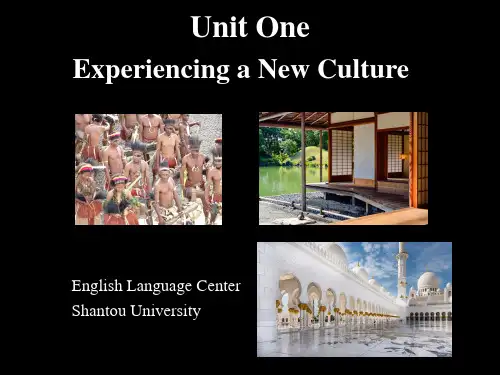
Activity 1 Look at the photos and discuss
• who the people are
Maori; businessmen who meet first; heads of the state; friends
• what they are doing
• identify the rituals of the handshake and greetings in different cultures,
• comprehend the meanings of smiling and eye contact in different cultures,
rub noses; bow; shake hands; hug
• how well they know each other
guest and host or friends; strangers; acquaintance; intimate
PPT课件
4
ቤተ መጻሕፍቲ ባይዱ
Starting out
Activity 2
PPT课件
6
Speaking through cultures
Listen out Speak out
Conversation 1 Conversation 2 Conversation 3
Act out
PPT课件
7
Conversation 1
Activity 1 Look at the photos and discuss
Use the words and expressions to describe the photos
shake hands wave smile kiss say hello bow hug rub noses
Picture 1: smile, rub noses
Picture 3: shake hands, smile, say hello
Picture 2: bow, shake hands
Picture 4: smile, hug
PPT课件
5
Starting out
Activity 3
Discuss the expressions Hello! How are you? Pleased to meet you.
Hi! Good to see you again.
Unit1Culture文化

Do you know what a cultural relic is?
A cultural relic is something that can represent cultures, which has survived for a long time to tell the history, and it is very rare and valuable. Cultural relics can be craftworks, buildings, books, paintings music, and so on.
Prepare for the next period.
•
•
Do you know these?
According to the definition, what characteristics does a cultural relic have?
rare precious
valuable
old
cultural relic
… mysterious
Cooperative learning
• Mausoleum of Maussollos 毛索洛斯墓庙
Warming up
• Does a cultural relics always have to be rare and valuable? • Look at the pictures and discuss whether they are cultural relics or not.
Other Cultural relics
• • • • • The statue of Zeus of Olympia 奥林匹亚宙斯神像 The Mausoleum at Halicarnassus 摩索拉斯陵墓 The Colossus of Rhodes 罗德斯岛巨像 The Temple of Artemis 阿提密斯神殿 Qin Shi Huangs Buried Sculpture Legion秦始皇兵马俑
大学英语文化口语教程Unit 1

Conversation 2
Activity 4 Listen and find out
who the following people are:
Janet
secretary or receptionist
`
Fan Xiping
new employee
Bob Armstrong Fan’s boss
Good restaurants in the area.
(7)_h___T_h_a_t_’_s_a_l_ri_g_h_t. I think I’ll just settle in. I’m a bit tired.
Right. Well, good to meet you, and uh, see you later.
Starting out
Activity 1 Look at the photos and discuss
• who the people are Maori; businessmen who meet first; heads of the state; friends
• what they are doing rub noses; bow; shake hands; hug
Talking about what you’re going to do:
I’ll show you around. / I’ll introduce you to everyone. / Let’s go and meet your boss.
Conversation 3
Activity 7 Look at the sentences and answer the questions
Conversation 1
大学英语Unit_1_口语

introduce 介绍
Introduce …to… 将某人介绍给另外一个人
Let me introduce Lucy to you. 让我向您介绍露西。
New Practical English 1
flight 航班
商务会面常用语: How is your flight? 旅途怎样?
New Practical English 1
Unit 1 Say Hi to People
New Practical English 1
PART II
Section I Learn the new words学习新单词 Section II Listening听对话 Second III Practice the dialogue 对话演练
New Practical English 1
Speaking Development:商务接机常用语
New Practical English 1
Oral practice
John: Are you Mr. Smith? 您是史密斯先生吗? Smith: Yes, I am. 是的,我是。 John : Nice to meet you!很高兴见到您. This is my name card.这是我的名片。 Smith: Glad to meet you, Mr. John. 很高兴见到您, 约翰先生。 John: How is your flight? 您路程还好啊? Smith: Very nice.很好。( A little bit tired)(有点儿累)
New Practical English 1
Section I Learn the new words
New Practical English 1
大学英语口语教程unit 1

situation 1 :
Excuse me, is anyone sitting here?
Step I.
Lead-in
situation 2 : You are waiting for the bus to the office. The bus is not still coming. You find a person next to you is reading the newspaper, the section of sports. So how to start the talk……
(Comment on current physical surroundings/ Making requests)
④
situation: You are at a barbecue. Your friend who has invited you is now busily attending to the other guests. You find yourself standing quite close to a young man
(Comment on current physical surroundings/ Making requests)
⑥ situation: It is a sunny morning on your winter vacation. You are visiting Greenwich Observatory. You arrive there about 10 minutes before it opens. There are a few other tourists waiting at the gate. You find yourself standing close to one of them.
文化与跨文化交际——大学英语视听说 教学课件Unit 1
Watch the video again, and figure out the answer to each of the following questions.
assign corridor headmistress
bleep
1. to give or allocate 2. long passage in a building or train,
especially with rooms on either side 3. a female headteacher 4. a short, high sound made by a
What does “Beverly Hills, 90210” imply in the context?
A. a phone number B. a mail address C. a life style D. a hot spot
Speaking and Critical Thinking
machine, especially if it is repeated
Useful words and expressions
medieval 5. related to the Middle Ages (= the
period in uropean history from about
AD 600 to AD 1500)
Listening and Speaking Tips
How do you read each of the following sentences? What do you expect them to sound like when others read or say them?
新编跨文化交际英语教程_参考答案unit1

Unit 1Communication Across CulturesReading IIntercultural Communication:An IntroductionComprehension questions1. Is it still often the case that “everyone’s quick to blame the alien” in the contemporary worldThis is still powerful in today’s social and political rhetoric. For instance, it is not uncommon in today‘s society to hear people say that most, if not all, of the social and economic problems are caused by minorities and immigrants.2. What’s the difference between today’s intercultural con tact and that of any time in the pastToday‘s intercultural encounters are far more numerous and of greater importance than in any time in history.3. What have made intercultural contact a very common phenomenon in our life todayNew technology, in the form of transportation and communication systems, has accelerated intercultural contact; innovative communication systems have encouraged and facilitated cultural interaction; globalization of the economy has brought people together; changes in immigration patterns have also contributed to intercultural encounter.4. How do you understand the sentence “culture is everything and everywhere”Culture supplies us with the answers to questions about what the worldlooks like and how we live and communicate within that world. Culture teaches us how to behave in our life from the instant of birth. It is omnipresent.5. What are the major elements that directly influence our perception and communicationThe three major socio-cultural elements that directly influence perception and communication are cultural values, worldview (religion), and social organizations (family and state).6. What does one’s family teach him or her while he or she grows up in itThe family teaches the child what the world looks like and his or her place in that world.7. Why is it impossible to separate our use of language from our culture Because language is not only a form of preserving culture but also a means of sharing culture. Language is an organized, generally agreed-upon, learned symbol system that is used to represent the experiences within a cultural community.8. What are the nonverbal behaviors that people can attach meaning to People can attach meaning to nonverbal behaviors such as gestures, postures, facial expressions, eye contact and gaze, touch, etc.9. How can a free, culturally diverse society existA free, culturally diverse society can exist only if diversity is permitted to flourish without prejudice and discrimination, both of which harm all members of the society.Reading IIThe Challenge of GlobalizationComprehension questions1. Why does the author say that our understanding of the world has changed Many things, such as political changes and technological advances, have changed the world very rapidly. In the past most human beings were born, lived, and died within a limited geographical area, never encountering people of other cultural backgrounds. Such an existence, however, no longer prevails in the world. Thus, all people are faced with the challenge of understanding this changed and still fast changing world in which we live.2. What a “global village” is likeAs our world shrinks and its inhabitants become interdependent, people from remote cultures increasingly come into contact on a daily basis. In a “global village”, members of once isolated groups of people have to communicate with members of other cultural groups. Those people may live thousands of miles away or right next door to each other.3. What is considered as the major driving force of the post-1945 globalizationTechnology, particularly telecommunications and computers are considered to be the major driving force.4. What does the author mean by saying that “the ‘global’ may be more local than the ‘local’”The increasing global mobility of people and the impact of newelectronic media on human communications make the world seem smaller. We may communicate more with people of other countries than with our neighbors, and we may be more informed of the international events than of the local events. In this sense, “the ‘global’ may be more local than the ‘local’”.5. Why is it important for businesspeople to know diverse cultures in the worldEffective communication may be the most important competitive advantage that firms have to meet diverse customer needs on a global basis. Succeeding in the global market today requires the ability to communicate sensitively with people from other cultures, a sensitivity that is based on an understanding of cross-cultural differences.6. What are the serious problems that countries throughout the world are confronted withCountries throughout the world are confronted with serious problems such as volatile international economy, shrinking resources, mounting environmental contamination, and epidemics that know no boundaries.7. What implications can we draw from the case of Michael FayThis case shows that in a world of international interdependence, the ability to understand and communicate effectively with people from other cultures takes on extreme urgency. If we are unaware of the significant role culture plays in communication, we may place the blame for communication failure on people of other cultures.8. What attitudes are favored by the author towards globalizationGlobalization, for better or for worse, has changed the world greatly. Whether we like it or not, globalization is all but unstoppable. It is already here to stay. It is both a fact and an opportunity. The challenges are not insurmountable. Solutions exist, and are waiting to be identified and implemented. From a globalistic point of view, there is hope and faith in humanity.Case StudyCase 1In this case, there seemed to be problems in communicating with people of different cultures in spite of the efforts made to achieve understanding.We should know that in Egypt as in many cultures, the human relationship is valued so highly that it is not expressed in an objective and impersonal way. While Americans certainly value human relationships, they are more likely to speak of them in less personal, more objective terms. In this case, Richard‘s mistake might be that he chose to praise the food itself rather than the total evening, for which the food was simply the setting or excuse. For his host and hostess it was as if he had attended an art exhibit and complimented the artist by saying, “What beautiful frames your pictures are in.”In Japan the situation may be more complicated. Japanese people value order and harmony among persons in a group, and that the organization itself-be it a family or a vast corporation-is more valued than the characteristics of any particular member. In contrast, Americans stress individuality as a value and are apt to assert individual differences when they seem justifiably in conflict with the goals or values of the group.In this case: Richard‘s mistake was in making great efforts to defend himself. Let the others assume that the errors were not intentional, but it is not right to defend yourself, even when your unstated intent is to assist the group by warning others of similar mistakes. A simple apology and acceptance of the blame would have been appropriate. But for poor Richard to have merely apologized would have seemed to him to be subservient, unmanly.When it comes to England, we expect fewer problems between Americans and Englishmen than between Americans and almost any other group. In this case we might look beyond the gesture of taking sugar or cream to the values expressed in this gesture: for Americans, ―”Help yourself”; for the English counterpart, ―”Be my guest”. American and English people equally enjoy entertaining and being entertained but they differ somewhat in the value of the distinction. Typically, the ideal guest at an American party is one who ―makes himse lf at home, even to the point of answering the door or fixing his own drink. For persons in many other societies, including at least this hypothetical English host, such guest behavior is presumptuous or rude.Case 2A common cultural misunderstanding in classes involves conflicts between what is said to be direct communication style and indirect communication style. In American culture, people tend to say what is on their minds and to mean what they say. Therefore, students in class are expected to ask questions when they need clarification. Mexican culture shares this preference of style with American culture in some situations, and that‘s why the students from Mexico readily adopted the techniquesof asking questions in class. However, Korean people generally prefer indirect communication style, and therefore they tend to not say what is on their minds and to rely more on implications and inference, so as to be polite and respectful and avoid losing face through any improper verbal behavior. As is mentioned in the case, to many Koreans, numerous questions would show a disrespect for the teacher, and would also reflect that the student has not studied hard enough.Case 3The conflict here is a difference in cultural values and beliefs. In the beginning, Mary didn’t realize that her Dominican sister saw her as a member of the family, literally. In the Dominican view, family possessions are shared by everyone of the family. Luz was acting as most Dominican sisters would do in borrowing without asking every time. Once Mary understood that there was a different way of looking at this, she would become more accepting. However, she might still experience the same frustration when this happened again. She had to find ways to cope with her own emotional cultural reaction as well as her practical problem (the batteries running out).Case 4It might be simply a question of different rhythms. Americans have one rhythm in their personal and family relations, in their friendliness and their charities. People from other cultures have different rhythms. The American rhythm is fast. It is characterized by a rapid acceptance of others.However, it is seldom that Americans engage themselves entirely in a friendship. Their friendships are warm, but casual, and specialized.For example, you have a neighbor who drops by in the morning for coffee. You see her frequently, but you never invite her for dinner --- not because you don‘t think she could handle a fork and a knife, but because you have seen her that morning.Therefore, you reserve your more formal invitation to dinner for someone who lives in a more distant part of the city and whom you would not see unless you extended an invitation for a special occasion. Now, if the first friend moves away and the second one moves nearby, you are likely to reverse this --- see the second friend in the mornings for informal coffee meetings, and the first one you will invite more formally to dinner.Americans are, in other words, guided very often by their own convenience. They tend to make friends easily, and they don‘t feel it necessary to go to a great amount of trouble to see friends often when it becomes inconvenient to do so, and usually no one is hurt. But in similar circumstances people from many other cultures would be hurt very deeply.。
现代大学英语口语(1)UnitOne精品PPT课件
Vocabulary-building
• Text One
• TV series and movies:Prison Break, Lost, Ugly Betty,
• The Big Bang Theory, Home of Lies, Friends, American Got Talents, Brave Heart, Forrest Gump…
• others:Wild China, CCTV Speaking Contest, 21st Century Speaking Contest, New concept English, BBC Documentary, Discovery…
•
添加视频
课程考核
• 1. 形成性考核
•
形成性考核占课程总成绩的30%,成绩根据
个人课前展示、在口语课上的综合表现以及参加
小组活动和其他学习中心组织的活动的情况综合
而定。
• 2. 总结性考试
•
期末考试成绩占课程总成绩的70%。考试形式
待定。
Unit One
First Day in College
• Go ahead表示允许或者鼓励别人的用语。
• How are you!
• hello • 建议阅读:《最容易搞错的英语文化常识268例》,汪
静主编,天津科技翻译出版公司,2009,9.
• 3.话题讨论:通过对不同话题的讨论加深对英、美等主 要英语国家文化背景和生活习俗的了解,学会在具体语 境中进行正确得体的交际
Note:We introduce people who don’t know each other and we introduce ourselves to people who don’t know us.We can do this either in a formal way or in an informal way.When introducing people,we must follow the rule:a man is introduced to a woman,unless he is much older and more senior,young men are introduced to older men, and young women to older women.
大学英语文化口语教程下答案unit1
大学英语文化口语教程下答案unit11、My sister _______ listen to music when she was doing her homework.[单选题] *A. used to(正确答案)B. use toC. is used toD. uses to2、Our campus is _____ big that we need a bike to make it. [单选题] *A. veryB. so(正确答案)C. suchD. much3、The reason I didn't attend the lecture was simply _____ I got a bad cold that day. [单选题] *A. becauseB. asC. that(正确答案)D. for4、Which is _______ city, Shanghai, Beijing or Chengdu? [单选题] *A. largeB. largerC. largestD. the largest(正确答案)5、There are about eight ______ students in my school.()[单选题] *A. hundred(正确答案)B. hundredsC. hundred ofD. hundreds of6、When you’ve finished with that book, don’t forget to put it back one the shelf, ____? [单选题] *A. do youB. don’t youC. will you(正确答案)D. won’t you7、I’ve _______ a job interview today. [单选题] *A. haveB. had(正确答案)C. hasD. have gone to8、He gathered his courage and went on writing music. [单选题] *A. 从事B. 靠······谋生C. 继续(正确答案)D. 致力于9、We got up early this morning and took a long walk after breakfast. We walked _____ the business section of the city. [单选题] *A. amongB. betweenC. through(正确答案)D. upon10、You should finish your homework as soon as possible. [单选题] *A. 赶快地B. 尽能力C. 一...就D. 尽快地(正确答案)11、You needn’t _______ me. I’m old enough to take care of myself. [单选题] *A. worry about(正确答案)B. write downC. put awayD. wake up12、Can I _______ your order now? [单选题] *A. makeB. likeC. giveD. take(正确答案)13、(), it would be much more sensible to do it later instead of finishing it now. [单选题] *A. FinallyB. MildlyC. Actually(正确答案)D. Successfully14、You’d ______ give up smoking. [单选题] *A. goodB. wellC. better(正确答案)D. best15、Betty works as a waitress to earn money for her education. [单选题] *A. 服务员(正确答案)B. 打字员C. 秘书D. 演员16、Don't tell me the answer, I'll work out the problem _____. [单选题] *A .by meB. myself(正确答案)C. meD. mine17、I gave John a present but he gave me nothing_____. [单选题] *A.in advanceB.in vainC.in return(正确答案)D.in turn18、Tony is a quiet student, _______ he is active in class. [单选题] *A. soB. andC. but(正确答案)D. or19、73.The moonlight goes ____ the window and makes the room bright. [单选题] * A.acrossB.through(正确答案)C.overD.in20、My friend and classmate Selina()running in her spare time. [单选题] *A.likeB. likes (正确答案)C. is likedD. is liking21、48.—________ is your new skirt, Lingling?—Black. [单选题] *A.HowB.What colour(正确答案)C.WhichD.Why22、Mr. Bliss became the first person to die in a car accident. [单选题] *A. 事故(正确答案)B. 竞赛C. 检阅D. 交易23、--What’s your _______, Jim Green?--Jim. [单选题] *A. full nameB. first name(正确答案)C. last nameD. family name24、The children were all looking forward to giving the old people a happy day. [单选题]*A. 寻找B. 期盼(正确答案)C. 看望D. 继续25、How lovely a day,()? [单选题] *A. doesn't itB. isn't it(正确答案)C.shouldn't itD.hasn't it26、Don’t swim in the river. It’s too _______. [单选题] *A. interestingB. easyC. difficultD. dangerous(正确答案)27、--Mom, I will not eat fast food this year. Believe me.--If you make a _______, you must keep it. [单选题] *A. jokeB. noiseC. mistakeD. promise(正确答案)28、So many people will _______ to their work after the Spring Festival. [单选题] *A. get inB. get onC. get offD. get back(正确答案)29、As soon as he _______, he _______ to his family. [单选题] *A. arrived, writesB. arrived, writtenC. arrived, wrote(正确答案)D. arrives, write30、You have coughed for several days, Bill. Stop smoking, _______ you’ll get better soon. [单选题] *A. butB. afterC. orD. and(正确答案)。
大学英语-Unit-1-Never-Say-GoodbyePPT课件
Never Say Goodbye
Department of Foreign Languages of NAU
Contents
1
Pre-reading question
2
Global reading
3
Detailed understanding
4
Post-reading activities
1. Organization: chronological order
2. What do blue expressions imply?
3. Share with us your experience of saying goodbye to your
beloved friends, friends, etc.
say goodbye” D. To tell the story of his grandpa’s death.
Part division
Part1
Para.1-Para.4 The author found it hard to overcome the sadness as the moment of parting drew near. So he turned to his grandpa for help.
1. Why did author’s grandpa take him to see the rosebush in the front yard?
2. How do you understand the italicized sentence?
Para.10-Para.12
His eyes met mine again. Billy, I planted these roses a long, long time ago before your mother was even a dream. I put them into the soil the day my first son was born. It was my way of saying thank-you to God. That boy’s name was Billy, just like yours. I used to watch him pick roses for his mother.
大学跨文化英语 综合教程I Unit 1 How to Live Wisely课文翻译
Reading & DigestingHow to Live WiselyRichard J. Light1 Imagine you are Dean for a day. What is one actionable change you would implement to enhance the college experience on campus?2 I have asked students this question for years. The answers can be eyeopening. A few years ago, the responses began to move away from “improve the history course” or “change the ways labs are structured.” A di fferent commentary, about learning to live wisely, has emerged.3 What does it mean to live a good life? What about a productive life? How abouta happy life? How might I think about these ideas if the answers conflict with one another? And how do I use my time here at college to build on the answers to these tough questions?4 A number of campuses have recently started to offer an opportunity for students to grapple with these questions. On my campus, Harvard, a small group of faculty members and deans created a non-credit seminar called “Reflecting on Your Life.” Here are three exercises that students find particularly engaging. Each is designed to help freshmen identify their goals and reflect systematically about various aspects of their personal lives, and to connect what they discover to what they actually do at college.5 For the first exercise, we ask students to make a list of how they want to spend their time at college. What matters to you? This might be going to class, studying, spending time with close friends, perhaps volunteering in the off-campus community or reading books not on any course’s required reading list. Then students make a list of how they actually spent their time, on average, each day over the past week and match the two lists.6 Finally, we pose the question: How well do your commitments actually match your goals?7 A few students find a strong overlap between the lists. Te majority don’t. T hey are stunned and dismayed to discover they are spending much of their precious time on activities they don’t value highly. Te challenge is how to align your time commitments to reflect your personal convictions.8 In the core values exercise, students are presented with a sheet of paper with about 25 words on it. The words include “dignity,” “love,”“fame,” “family,” “excellence,” “wealth,” and “wisdom.” They are told to circle the five words that best describe their core values. Now, we ask, how might you deal with a situation where your core values come into conflict with one another? Students find this question particularly difficult. One student brought up his own personal dilemma: He wants to be a surgeon,and he also wants to have a large family. So his core values include the words “useful” and “family.” He said he worries a lot whether he could be a successful surgeon while also being a devoted father. Students couldn’t stop talking about his example, as many saw themselves facing a similar challenge.9 The third exercise presents the parable of a happy fisherman living a simple life ona small island. Te fellow goes fishing for a few hours every day. He catches a few fish,sells them to his friends, and enjoys spending the rest of the day with his wife and children, and napping. He couldn’t imagine changing a thing in his relaxed and easy life.10 Let’s tweak the parable: A recent M.B.A. visits this island and quickly sees how this fisherman could become rich. He could catch more fish, start up a business, market the fish, open a cannery, maybe even issue an I.P.O.Ultimately he would become truly successful. He could donate some of his fish to hungry children worldwide and might even save lives.11 “And then what?” asks the f isherman.12 “Then you could spend lots of time with your family,” replies the visitor. “Yet you would make a difference in the world. You would have used your talents, and fed some poor children, instead of just lying around all day.”13 We ask students to apply this parable to their own lives. Is it more important to you to have little, be less traditionally successful, yet be relaxed and happy and spend time with your family? Or is it more important to you to work hard, perhaps start a business, or even make the world a better place along the way?14 Typically, this simple parable leads to substantial disagreement. These discussions encourage first-year undergraduates to think about what really matters to them, and what each of us feels we might owe, or not owe,to the broader community — ideas that our students can capitalize on throughout their time at college.15 At the end of our sessions, I say to my grou p: “Tell me one thing you have changed your mind about this year,” and many responses reflect a remarkable level of introspection. Three years later, when we ask them again, nearly all report that the discussions had been valuable, a step toward turning college into the transformational experience it is meant to be.参考译文如何智慧地生活理查德·J·莱特想象一下你要当一天的院长。