
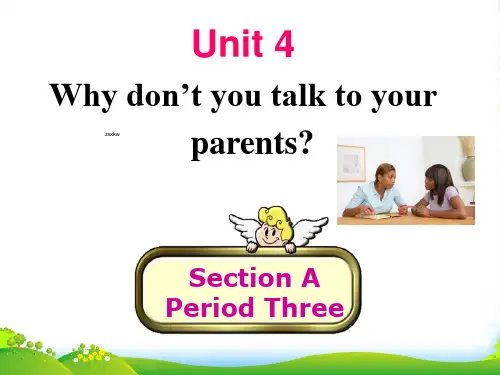
Unit 4 Why don't you talk to your parents?Section A 1
Why not read some interesting books at home?
What’s wrong?
I have too many afterschool classes.
Why not talk about it with your parents?
1. allow v. 允许;准许 allow sb. (not)to do sth. (不)允许某人做某事
You’re right. Thanks for your advice.
No problem. Hope things work out.
1. I guess you could tell her to say sorry. guess v. 猜测;估计 e.g. Let us guess the height of the building. 让我们来猜一下这个建筑物的高度。
2. Although she's wrong, it’s not a big deal. big deal是英语中的一个固定搭配,表 示 “重要的事情或状况”,多用于非正式 交流。作否定用法时,常说It’s not a big deal或It’s no big deal.表示说话人并不认 为某事有什么了不起。 e.g. There's a soccer game on TV this evening but I don’t have to watch it. It’s no big deal. 今天晚上电视上有一场足球 赛,但我不一定要看。没什么大不了的。
have no enough money
have no time to watch TV argument between parents have an argument with friends.
There is something wrong with my computer.
A: What’s wrong? too many rules to obey at school B:…. A: Maybe you should…
Did she give them back to Kim?
Yes, Is he still angry with her. What should he do?
Well, I guess you could tell her to say sorry. But why don’t you forget about it so that you can be friends again? Although she’s wrong, it’s not a big deal.
If your car is dirty, You should…
If you are ill, you should
If you are thirsty, you should
If the room is dirty, you should
If you don’t know the way, you should---
Well, you should call him so that you can say you’re sorry.
2d Role-play the conversation.
What’s wrong with Kim?
He found his sister looking through his things yesterday. She took some of his new magazines and CDs.
2. I have too much homework so I don’t have any free time to do things I like.
Байду номын сангаас
Why don’t you go to a movie this evening?
3. My parents don’t allow me to hang out with my friends. Why not read some interesting books at home?
3. Hope things work out. 希望事情会好起来。 这是一种常见的表达法,表示某些不 如人意的事情会随时间的推移逐渐有所 改观。
work out 解决(问题);算出
e.g. Mike worked out the difficult problem by himself. 迈克自己算出了那道难题。
What problems do you have? at home at school
too much homework.
have to get up too early
too many examinations
can’t get good grades can’t choose subjects we like have to go to school early have too much pressure have to wear the school uniform often fail in the exams
e.g. My parents don’t allow me to stay up late. 我父母不允许我熬夜。 Mr. Smith allowed Mike to drive there. 史密斯先生允许迈克开车去那里。
What’s the matter, Peter?
I had a fight with my best friend. What should I do?
If you are too fat, you should---
A: What’s the matter with him/her?/ What’s wrong with him/her? B: …. A: What should he/she do? B: He/she should…. A: That’s a good idea.
I'm really tried because I studied until midnight last night.
Why don’t you go to sleep earlier this evening?
What’s wrong?
My parents don’t allow me to hang out with my friends.
It’s a big deal, David, bigger than you know. 这事挺重要的,戴维,比你所知道的要重 要。 What's the big deal? It’s only a birthday, not the end of the world. 有什么了不起的?这不过是个生日,又不 是世界某日。
hang out.
What’s wrong with her?
She had a fight with her friend. She got into a fight with her friend.
Why don’t you try to talk to them?
Discuss these problems and give some advice. 1. I have to study too much so I don’t get enough sleep. Why don’t you go to sleep earlier this evening?
4. I have too many after-school classes.
Why not talk about it with your parents?
5. I got into a fight with my best friend.
Why not call him up?
What’s wrong?
What’s the matter?
My brother plays his CDs too loud. I hate it .What should I do? Why don’t you talk to him about it? Maybe you should talk to him about your problems.
What's the matter with him? What’s wrong with him?
【思】
He has too much homework . Why not spend more time on studying?
What’s the matter?
My clothes are out of style. 过时
What should I do? Why don’t you buy a new one?
What’s the matter?
My parents want me to stay at home every night. What should I do?
Why don’t you talk to your parents?
What's wrong with them?
They have to study too much until midnight. They should start studying earlier.
What’s wrong with him?
His parents doesn’t allow him to He could try to talk to his parents.
Is it possible to work out the problem? 有可能解决这个问题吗?
Write three conversations about your problems and your friends’ suggestions. A: I have too many after-school classes. What could I do? B: You could …
Unit4why-don't-you-talk-to-your-parents-sectionA-Grammar-Focus-4c
___________better, we need to talk more with our parents. A. Communicate B. Communicating C. To communicate D. Communicated
我起得早,以便于赶公交车
I got up early so that I can catch the bus. I got up early in order that I can catch the bus. I got up early in order to catch the bus.
--It’s to late. I have to go now. -- Oh, it’s raining outside. Don’t leave ________ it stops. A. since B. until C. while D. so ________he has little knowledge, the old worker has a lot of experience. A. Although B. Because C. If D. so
允许某人做某事 allow doing sth 允许做某事 sb be allow to do sth 某人被允许做某事 be allowed 被允许
1.My parents don't allow me _______TV _____school nights. A. watch, in B. to watch, in C. watching, on D. to watch, on
although 表示“虽然,尽管”
人教八年级英语下册《Unit 4 Why don't you talk to your parent
4. Kids shouldn’t play computer games until late at night. They should rest early.
◆You could do … : “你(可以) 做……” ◆ Let’s do … : “让我们做……吧!” ◆ “主语+had better (not)+动词原形” :
“……最好(不要)做某事” You’d better go to school on time. ◆ It’s best to do ... : “做……再好不过 了。”
• 3. You could save more money __s_o_t_h_a_t_ you can buy a gift for your friend’s birthday.
4. Kids shouldn’t play computer games ___u_n_t_i_l __ late at night. They should rest early.
Guess
1. H__o_w__a_b_o_u_t going out for a walk? 2. W__h__a_t _a_b_o_u_t_ another cake? 3. W__h__y_d_o_n_’_t_ you _t_u_r_n__to__ the
reference book? 4.Why _d_id_n_’_t you s_e_e_ the football match? 5.W__h_y__d_o_n_’_t _y_o_u_ go there with us? 6. W__h__y_n_o_t_ go fishing today?
人教版八年级英语下册Unit 4 Why don’t you talk to your parent
1. Why don’t you talk to your parents? 为什么不跟你的父母谈谈呢?
【自主领悟】(1)Why don’t you do sth. ? 这是一个否定疑问 句, “为什么不……? ”常用来征求意见和提出建议, 相当于 Why not do sth. ? 句式。例如: Why don’t you go with us? = Why not go with us? 为什么不同我们一起去呢? (2)talk to sb. 意为“同某人谈话”。例如: He talked to me about my study. 他跟我谈了关于我的学习的事情。
Unit 4 Why don’t you talk to your parents?
Section A (1a-2d)
Ⅰ. 短语互译 1. get enough sleep 2. have a fight with sb. 3. look through 4. hang out 5. 把……归还给…… 6. 允许某人干某事 7. 成功地发展; 解决 答案: 1. 有足够的睡眠 2. 跟某人打架 3. 浏览 4. 闲逛 5. give. . . back to. . . 6. allow sb. to do sth. 7. work out
【归纳拓展】allow的不同搭配 (1)allow sth. /doing sth. 允许(做)某事 例如: We don’t allow eating in the classroom. 我们不允许在教室里吃饭。 (2)allow sb. sth. (双宾语)给予某人某物 例如: He allows his son too much money. 他给他儿子太多的钱。
speak to sb. “跟某人讲话”
Unit4_Why_don't_you_talk_to_your_parents_Sect

课时重点回顾
so that be always doing sth. cut out compare…with… in one’s opinion Although it’s normal to want successful children, it’s even more important to have happy children.
3. Does Dr. Green agree with Cathy or Linda? What does she say?
Dr. Green agrees with Linda. She says, “Kids should have time to relax and think for themselves, too. Although it’s normal to want successful children, it’s even more important to have happy children.”
2. Does Linda Miller agree with Cathy? What’s her opinion? No. She thinks it is unfair to compare their kids with other children. She thinks people shouldn’t push their kids so hard.
Practise
小男孩节省每一分钱,以便他能够给妈 妈在母亲节买一份礼物。 The little boy saved every coin so that he could buy his mother a present on Mother’s Day. 我被骤雨淋了,所以衣服都湿透了。 I was caught in a shower, so that all my clothes got wet.
【中考考纲词汇详解】Unit4 Why don’t you talk to

解释,说明
真题例句
The more you explain, the less trust I have in you.
你解释越多,我就越不相信你。
[klɪə(r)]
adj.
清晰的
词形变化
clearly adv.清晰地
真题例句
Before you talk with your parents, it helps to get clear on what you want them to do.
在南京地铁里面不允许吃东西。
[rɒŋ]
adj.
错误的,有毛病的
常用短语
go wrong犯错误,做错事
经典例句
What‘s wrong with you你怎么了
[ɡes]
v.
猜测,估计
真题例句
After tasting, they have to guess what kind of vegetable or fruit it is.
[kɔːz]
v.
n.
造成,引起
原因
真题例句
I’m strongly against smoking because it may cause cancer.
我坚决反对吸烟,因为它会导致癌症。
['juːʒuəl]
adj.
寻常的;平常的
词形变化
usually adv.通常
unusual adj.不寻常的
真题例句
Blue sky and white clouds were also painted by Roy.
蓝天白云也被罗伊描绘出来了。
['eldə(r)]
adj.
unit4-Why-don27t-you-talk-to-your-parents全单元知识点和练习

Unit 4 Why don’t you talk to your parents【解析】Why don't you do sth. = Why not do sth. 为什么不......呢【拓展】用于提建议的句型有:(1) What about doing sth. =How about doing sth. ….怎么样(2) Why don’t you do sth.= Why not do sth. 为什么不呢(3) Let’s do sth. 让我们一起做某事吧。
(4) Shall we/I do sth. 我们做…好吗(5) had better do/not d o sth. 最好做/不做某事(6) Will/Would you please do sth. 请你做…好吗(7) Would you like t o do sth. 你想去做某事吗(8) Would you mind doing sth.你介意做某事吗【回答】(1). 同意对方的建议时,一般用:◆ Goo d idea. / That’s good idea. 好主意◆OK/ All right. / Great. 好/ 行/太好了◆ Yes, please. / I’d love to. 是的/ 我愿意◆ I agree with you. 我同意你的看法◆ No problem. 没问题◆Sure./ Of course./ Certainly. 当然可以◆Yes, I think so. 对,我也这样想(2).对对方的帮助或要求表示委婉谢绝时,一般用:◆ I don’t think so. 我认为不是这样◆Sorry, I can’t. 对不起,我不能◆I’d love to, but…我愿意,但恐怕……【解析】allow sb.. to do sth. 允许某人做某事【拓展】allow v 允许allow doing sth. 允许做某事They don’t allow smoking.allow sb.. to do sth. 允许某人做某事My mother allows me to watch T V.【解析】What’s wrong( with sb../ sth.) (某人/物)怎么了【解析】go to sleep 去睡觉(强调“入睡,睡着”这一动作)这一状态)【解析】look 看起来(系动词,后跟形容词作宾语)【拓展】:系动词:后跟adj.作表语一是:(be)am /is /are be quiet=keep quiet 保持安静二保持:stay/keep (表示持续状态)stay healthy=keep healthy 保持健康三变化:become/get/turn (表示状态变化)【解析】call up (v + adv) call on 拜访;号召【解析】find sb.. doing sth. 发现某人正在做某事Mr. Wang found Li Dong reading a storybook in the class.类似动词:hear,watch, see, feel【解析】be angry with sb.. 生某人的气【拓展】angry adj.生气的→ angrily adv. 生气地(1)be angry with sb.. =be mad at sb.. 对某人生气【with后接人】(2)be angry at/about sth.对某事感到生气【at后接事】(3)be angry to do sth. 做某事感到生气10. It’s not a bi g deal. 没什么大不了;不是什么大事(常用于口语中)You left your homework at home. 你把作业忘在家里了。
unit4-why-don't-you-talk-to-your-parents教案
Unit 4 Why don’t you talk to your parents?Section A 1 (1a-2d)一、教学目标:1. 语言知识目标:1) 能掌握以下单词:allow, wrong, guess, deal, work out能掌握以下句型:①—What’s wrong?—I’m really tried because I studied until midnight last night.②You could give him a ticket to a ball game.③I think you should ask your parents for some money.④Why don’t you talk to him about it?2) 能了解以下语法:(1)能够运用所学知识谈论问题和困难、提出建议并做出选择;(2)能根据对方所提出的问题,给出一些合理的建议。
2. 情感态度价值观目标:培养学生良好的合作意识,鼓励学生大胆表达自己的想法和意愿。
正确认识生活中的一些困难,能采用正确的方式解决生活中的问题。
二、教学重难点1. 教学重点:1) Talk about the problems.2) Learn the new language points.2. 教学难点:能根据对方所提出的问题,给出一些合理的建议。
学会表达建议的一些方式。
三、教学过程Step 1 Warming up1. 导入学生们平时在学校和生活中存在的问题。
T: What’s the matter/ What’s wrong?S: He has too much homework to do.T: Do he like to do it?S1:No, he doesn’t. Because he doesn’t have any free time to do things he likes.…Step 2 Talking1. Look at these problems. Do you think they are serious or not? Ss discuss with their partners and give some advice.①I have to study too much so I don’t get enough sleep.②I have too much homework so I don’t have any free time to do things I like.③My parents don’t allow me to hang out with my friends.④I have too many after-school classes.⑤I got into a fight with my best friend.Step 3 Listening1. T: Tell Ss to read the sentences in 1a again. Make sure they know the meaning of the sentences.2. Play the recording for the Ss to listen and circle the problems you hear in 1a.3. Play the recording again. Check the answers with the Ss.Step 4 Pair work1. Let Ss read the conversation in the box.2. Use the information in 1a to make other conversations.3. Let some pairs act out their conversations.e.g. A: What’s wrong?B: I’m really tied because I studied until midnight last night.A: Why don’t you go to sleep earlier this evening?4. Language points1) allow v. 允许;准许allow sb. (not)to do sth. (不)允许某人做某事e.g. My parents don’t allow me to stay up late. 我父母不允许我熬夜。
Unit4Why don’t you talk to your parents
Unit4:Why don’t you talk to your parents?1.Why don’t you talk to your parents? 你为什么不和你打父母谈谈呢?【解析】Why don't you do sth. ?= Why not do sth.? 为什么不......呢?【拓展】用于提建议的句型有:(1) What about doing sth. ?=How about doing sth.? ….怎么样?(2) Why don’t you do sth.?= Why not do sth.? 为什么不呢?(3) Let’s do sth. 让我们一起做某事吧。
(4) Shall we/I do sth.? 我们做…好吗?(5) had better do/not do sth. 最好做/不做某事(6) Will/Would you please do sth. 请你做…好吗?(7) Would you like to do sth.? 你想去做某事吗?(8) Would you mind doing sth.?你介意做某事吗?【回答】(1). 同意对方的建议时,一般用:◆ Good idea. / That’s good idea. 好主意◆OK/ All right. / Great. 好/ 行/太好了◆ Yes, please. / I’d love to. 是的/ 我愿意◆ I agree with you. 我同意你的看法◆ No problem. 没问题◆Sure./ Of course./ Certainly. 当然可以◆Yes, I think so. 对,我也这样想(2).对对方的帮助或要求表示委婉谢绝时,一般用:◆ I don’t think so. 我认为不是这样◆Sorry, I can’t. 对不起,我不能◆I’d love to, but…我愿意,但恐怕……◆ I’m afraid…恐怕……【2013天津4】35.— Why not go to Lao She Teahouse tonight?— ______.A. It doesn't matter.B. Thank you.C. Sorry to hear that.D. Sounds great.【2013广东广州4】25.—I feel really tired.—______A. Lucky you!B. You’d better work harder.C. Congratulations!D. Why not go and have a rest?【2013四川凉山3】37. —It’s a nice day, isn’t it?—Yes. ______ going hiking and relax ourselves?A. Why notB. Why don’tC. What about【2013湖南益阳】You look too tired. Why not _____ a rest?A. Stop to haveB. to stop havingC. stop having2.I have to study too much so I don’t get enough sleep. 我要学的太多,因此我睡眠不足。
Unit 4 Why don’t you talk to your教案
Unit 4 Why don’t you talk to your parents?Section A (3a-3c)一、教学目标:1. 学习并掌握新词汇:relation, communicate, communication, argue, cloud, elder, instead, whatever, nervous, offer, proper, secondly, explain, clear, copy, return, anymore2. 能正确使用以下常用表达:get on with, elder brother, refuse to do sth, instead, feel lonely and nervous, mind sb doing sth, enough sleep, a big deal, so that3. 学会谈论成长的烦恼和给别人提建议的表示法:A: What’s wrong?B: My sister borrows my clothes without asking. What should I do?A: Well, you could tell her that this makes you angry so that she will ask you next time.二、教学重难点1. 在理解书信情节的基础上对文章进行进一步的学习。
2. 重点词汇、常用表达及讲述自己的烦恼和给别人提建议的句型。
三、教学过程Ⅰ. Lead-inLook and say about the pictures, answer 3 questions:(1)Can you get on with your family?(2)How do you communicate with your parents?(3)Who do you ask for help when you have problems?Invite some students to share their opinions.Ⅱ. Learning objectivesTopic: Teenager problems; After classes, you will understand Sad and Thirteen’s problems and feelings. And also you will get the advice Mr. Hunt gave to him/her.Ⅲ. Pre-readingFast reading : Read the following parts and answer the questions.(1)Who has a problem? - Sad and Thirteen.(2)Who gives advice? - Robert Hunt. (School counselor)Ⅳ. While-reading1st reading: Look at the picture and guess what the passage is about.(1)What can you get from the name “Sad and Thirteen” ? - Maybe he is 13 years old, he feels sad.(2)What’s Sad and Thirteen’s problem about? - His family.After that, show the reading skill for them. Reading skill: Look at the title, the words and pictures of the article and predict the content of the article. This is helpful to understand the content of the article.2nd reading: Read the first letter & complete the chart about problems and feelings.After that, let them try to retell Sad and Thirteen's problems and feelings with his parents and elder brother.Practice: Show the long and difficult sentence: When they argue, it’s like a big, black cloud hanging over our home.Look and say, make sentences like this.3rd reading: Read the second letter and underline Mr. Hunt's advice.- Why don’t you talk about these feelings with your family?- Why don’t you sit down and communicate with your brother?- You should explain...Make a summary for them: In Mr. Hunt's opinion, communication is important.Ⅴ. Post-readingLet them think about these questions and try to open their mind:(1)Do you think that communication is the best way to solve problems?(2)Do you agree with Mr. Hunt?(3)What other advice can you think of?Ⅵ. Task : Write a letter about your problem to Robert Hunt.[Example]Dear Mr. Hunt:My problem is that ...problems+ feelingsIs that normal? What can I do?Yours,XX[Checklist] Format(格式) 2’; Problems 3’; Feelings 3’; Correct 2’Ⅶ. SummaryⅧ. Moral teachingHow should we get on well with our family?L isten to each other.O pen your mind.V oice your true feelings.E qual to each other.Ⅸ. HomeworkRetell the passage; Polish the letter.。
Unit-4-Why-don’t-you-talk-to-your-parents教材分析
Unit 4 Why don’t you talk to your parents?教材分析I.单元教材分析:本单元的话题(Topic)是“Interpersonal communication(人际交往)”。
功能项目(Functions)是“Talk about problems (谈论困难);Give advice (提出建议)。
本单元主要探讨当代中小学生所面临的种种压力和困境。
学会询问、陈述自己或他人的困难和麻烦;并针对别人的困境,使用情态动词could,should 以及Why don’t you...?句型提出解决的办法和建议;阅读文章Maybe You Should Learn to Relax,通过学习比较了东西方家长对子女教育的态度和做法,通过该部分学习,让学生学会换位思考,帮助他们逐步建立正确、积极的生活态度和价值观。
II.学情分析:本单元话题是人际交往,这个话题与学生实际生活紧密相关,主要探讨当代中小学生所面临的种种压力和困境,并针对针对这些问题给予合理地建议。
重点学习用What’s wrong?询问他人的麻烦;学习用What should I do?征求别人的建议;学习使用情态动词could,should以及Why don’t you...?句型提出解决的办法和建议;学习使用连词until,so that,although。
在Unit1已经学习力用What’s the matter with...?询问病情,其中也涉及了What’s wrong的学习,对于学生来说,已是比较熟悉的句型;而在前几个单元中,逐步学习了情态动词should,could表示建议,相信学生掌握起来也很容易;学习连词until,so that,although的用法,是本单元的重点也是难点,教师要多举例子,让学生真正明白状语从句的使用。
III.教学目标1.知识目标:A.掌握以下词汇:allow,wrong,midnight ,guess,deal,relation,communication,argue,cloud,elder,instead,whatever,nervous,offer,proper,secondly,communicate,explain,clear,copy,return,anymore,member,pressure,compete,opinion,skill,typical,football,quick,continue,compare,crazy,push,development,cause,usual,perhaps。