
人教版七年级英语语法总结
5、目前学过的后跟动词原形的有: ①情态动词:can, may,could,would,will后 ②助动词do,don‟t,does,doesn‟t后 (does,doesn‟t一出现,三单式要滚蛋); ③动词please(请)后:如:Please tell him about the picnic. ④短语Why not…/Why don’t you…后; ⑤动词let 后;如:Let Jane help you. Let’s go home.
would like sb. to +动词原形. want sb. to +动词原形.(想叫某人做某事) ⑤have to +动词原形(必须/不得不做某事) ⑥Nice/Glad/happy to +动词原形(很高兴 做某事) 如:Nice to meet you. I‟m glad to be here.
七年级语法总复习
• A tidy tiger tied a tie tighter to tidy her tiny tail. 一只老虎将领带系紧,清洁它 的尾巴。
我有一种想法,但是我的这种想法不是 我曾经想到的那种想法。如果这种想法 是我曾经想到的想法,我就不会想那么 多了。 I thought a thought. But the thought wasn’t the thought I thought I thought. If the thought I thought I thought had been the thought I thought, I wouldn’t have thought so much.
It‟s time for going home =It‟s time to go home. Thank you for helping me =Thank you for your help. ③go +动词ing——go fishing去钓鱼; go shopping去购物 ④do some shopping购物 ⑤like/love +动词ing (喜欢做某事)
3、目前学过的情态动词有can, may, could,would和will等五个。
学好情态动词必须把握三个用法: ①后必须跟动词原形 ; ②没有三单式(其后不能加s); ③可以把情态动词提到句首构成疑问句; 可以在情态动词后面加上not构成否定句
4、目前学过的后跟动词不定式(to+ 动词原形)的有: ①would like to+动词原形(想要做某 事); want to+动词原形(想要做某事); ②forget to+动词原形(忘记要做某 事); ③like to +动词原形(喜欢做某事) love to +动词原形(喜欢做某事) ④ask sb. to +动词原形. tell sb. to +动词原形.
4) mouse—mice (老鼠) child—children(儿童) 5)合成词中一般变后面的词: apple tree---apple trees(苹果树) 但下列需前后都变: man teacher---men teachers woman doctor---women doctors
②be动词: 单数am, is; 复数 are ③行为动词:复数:动词原形 单数:在行为动词后加s或es (即动词的三单式)。 如:Maria likes milk.(likes是三 单式,为单数) Maria and Jane like milk.(like 是动词原形,为复数)
8.名词+’s所有格 单数名词后直接加 “ ’s ”: Jim’s coat 吉姆的外套 Jeff’s mother杰夫的妈妈 以s结尾的复数名词,只加“’” Teachers’ Day教师节 the twins’ books双胞胎的书 不以s结尾的不规则的名词复数,加“ ’s ” Children’s Day 儿童节 men’s shoes男式鞋
.用所给的词选择填空 1、These are pens and those ____ are pencils. (that, this, those) 2、Tom was sick yesterday. ___ is why he That missed school. ( That, Those, These) these shirts are Tom's ( These, 3、Which of _____ this, that) that is hers. ( those, this, 4、This desk is mine, ___ that) that of 5、The map of Beijing is better than _____ Tianjing. (this, that, these).
• (2)、在下面的短文中填上恰当be动词。 is I ______ a girl. My name _______ Mary. am I ______ am 12 years old. Here ______ my family photo. is are my parents and those Look! These ______ _______ are my grandparents. This boy ______ my brother. is is He ________ 15 years old now. is my cat, Mimi. That ______ is It ______ very lovely.
注意:boy ---boys play---plays toy--toys way---ways 4)以 f, fe结尾的,变f, fe为v,加es. half---halves(一半) knife---knives(小刀) yourself(你自己)--yourselves(你们自己)
(2) 特殊变化的词 1) a 变e: man—men(男子) woman— women(女子) snowman---snowmen(雪人) Englishman--- Englishmen(英国人) 2) o变e: foot---feet(脚) tooth---teeth(牙齿) 3) 单复数同形: Chinese---Chinese(中国人) fish---fish(鱼) yuan---yuan(人民币元)
①动词原形;如:do;have;பைடு நூலகம்ike
②动词的单三式(常在动词原形后加 s);如:get-gets ③动词不定式(to+动词原形);如: meet-to meet ④动词ing式(动词原形后加ing)如: look-looking
2、表示征求意见或建议邀请的礼貌用语 Would you like +to+动词原形? (你想要……吗?) How about+动词ing ? (……怎么样?……好不好?)
What about +动词ing?
(……怎么样?……好不好?)
Why not +动词原形? (为什么不……呢?) Why don‟t you +动词原形 ? (你为什么不……呢?) Let‟s +动词原形.(让我们……吧。)
表示同意、答应:
①Yes,I’d like to./Oh,I’d love to. ②All right/OK. ③Great! ④Sure.
6)集体名词,以单数形式出现,但实为复数 例如:people(人们) police(警察们) 本身就是复数,family指“全家人”时,本 身也是复数,它们都不能加s. 如: The Chinese people are very kind. 中国人民都 很友好。 Kangkang’s family are all tall and thin. 康康全家人都又高又瘦。
⑤Good idea! ⑥Thanks.I‟ll be glad to ⑦Thanks.That would be very nice.
⑧I‟d like that.
表示不同意、拒绝: ①No,thanks.②Sorry,I can’t. ③I’d like to.But I’m afraid I can’t /I have no time.
④指示代词 单数:this这个 that那个 复数:these这些 those那些
指示代词 this, that, these, those 作主语,一 般疑问句的简略回答:
1. Is this / that your aunt ? Yes , it is . /No , it isn‟t .简略回答时,用主格代词 it 代替 2. (2)、Are these / those your uncles ? Yes , they are . No , they aren‟t .简略回答 时,用主格代词 they 代替
• while we were walking, we were watching window washers' wash washington's windows with warm washing water. 当我们走路时,我们看着清洁窗户的 人用暖水清洗华盛顿的窗户
1、目前所学的动词的形式有4 种:
⑥动词help后,也可带to; 如:Let’s help Maria (to) carry water. ⑦祈使句以动词原形开头, 如:Have a seat , please.请坐下。
6、目前学过的后跟动词ing的有: ①Be动词后的动词;如: Are you kidding? I’m just looking. This is Michael speaking. ②所有的介词后;已学过的介词有:at, for,about,in,on,from,of,to,with,after等。 What about +动词ing? —What about flying a kite with me ?
(完整版)人教版初中英语语法完整总结
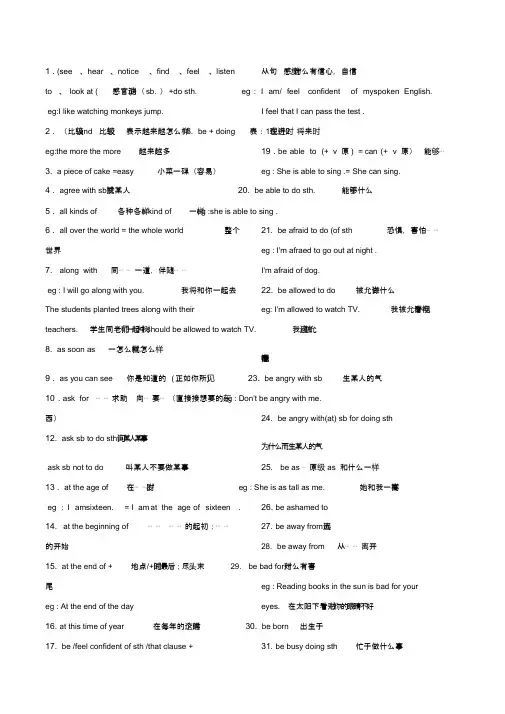
1 . (see 、hear 、notice 、find 、feel 、listen 从句感觉/对什么有信心,自信to 、look at ( 感官动词)+(sb. )+do sth. eg : I am/ feel confident of myspoken English. eg:I like watching monkeys jump. I feel that I can pass the test .2 . (比较级and 比较级)表示越来越怎么样18. be + doing 表:1现在进行时2将来时eg:the more the more 越来越多19 . be able to (+ v 原) = can (+ v 原)能够⋯⋯3. a piece of cake =easy 小菜一碟(容易)eg : She is able to sing .= She can sing.4 . agree with sb赞成某人20. be able to do sth. 能够干什么5 . all kinds of 各种各样a kind of 一样e g :she is able to sing .6 . all over the world = the whole world 整个21. be afraid to do (of sth 恐惧,害怕⋯⋯世界eg : I'm afraed to go out at night .7. along with 同⋯⋯一道,伴随⋯⋯I'm afraid of dog.eg : I will go along with you. 我将和你一起去22. be allowed to do 被允许做什么The students planted trees along with their eg: I'm allowed to watch TV. 我被允许看电视teachers. 学生同老师们一起种树I should be allowed to watch TV. 我应该被允8. as soon as 一怎么样就怎么样许看电视9 . as you can see 你是知道的(正如你所见)23. be angry with sb 生某人的气10 . ask for ⋯⋯求助向⋯要⋯(直接接想要的东e g : Don't be angry with me.西)24. be angry with(at) sb for doing sth12. ask sb to do sth询问某人某事为什么而生某人的气ask sb not to do 叫某人不要做某事25. be as ⋯原级⋯as 和什么一样13 . at the age of 在⋯⋯岁时eg : She is as tall as me. 她和我一样高eg :I amsixteen. = I am at the age of sixteen . 26. be ashamed to14. at the beginning of ⋯⋯⋯⋯的起初;⋯⋯27. be away from远离的开始28. be away from 从⋯⋯离开15. at the end of + 地点/+时间最后;尽头;末29. be bad for对什么有害尾eg : Reading books in the sun is bad for youreg : At the end of the day eyes. 在太阳下看书对你的眼睛不好16. at this time of year 在每年的这个时候30. be born 出生于17. be /feel confident of sth /that clause + 31. be busy doing sth 忙于做什么事be busy with sth 忙于⋯⋯eg: Be late for class 上课迟到32. be careful 当心;小心48. be like 像⋯⋯eg : I'm like my mother .33. be different from ⋯⋯和什么不一样49. be mad at 生某人的气34. be famous for 以⋯⋯著名50. be made from 由⋯⋯制成( 制成以后看不见原35. be friendly to sb对某人友好材料)36. be from = come from 来自51. be made of 由⋯⋯制成( 制成以后还看得见原eg :He is from Bejing. 材料)He comes from Bejing. 52. be not sure 表不确定Is he from Bejing ? Does he come from Bejing ? 53. be on a visit to 参观37. be full of 装满⋯⋯的54. be popular with sb 受某人欢迎be filled with 充满55. be quiet 安静eg: The glass is full of water. 56. be short for ···的缩写The glass is filled with water. eg: 陶is short for 陶俊杰38. be glad+to+do/ 从句57. be sick in bed 生病在床39. be going to + v( 原)将来时58. be sorry to do sth be sorry for sb40. be good at(+doing) = do well in 在某方面eg : I am sorry for you.,善于⋯⋯59. be sorry to hear that善长41. be good for对什么有好处60. be sorry to trouble sbeg : Reading aloud is good for your English. eg : I am sorry to trouble you .42. be happy to do 很高兴做某事61. be strict in doing sth严于做某事43. be helpful to sb对某人有好处e g : He's strict in obeying rules .eg : Reading aloud is helpful to you. 大声朗62. be strict with sb对某人要求严格读对你有好处e g: Some students are not strict withExercising is helpful to your body.锻炼对你themselves.这些学生对自己不严格格某人严的身体有好处63. be strict with sb in sth 某方面对44. be in good health 身体健康64. be supposed to do 被要求干什么45. be in trouble处于困难中65. be sure 表确定eg : She is in trouble. They are in tronble. 66. be sure of doing sth对做某事有信心46. be interested in对某方面感兴趣47. be late for = come late to迟到eg: He is sure of winning. I amsure of learning I begin to go homeEnglish well. 78. between⋯and⋯两者之间67. be sure of sth对做某事有信心79. borrow sth from sb 向⋯⋯借⋯⋯eg: I'm sure of my head. (my teacher 我相信我lend sth to sb ( lend sb sth 借给⋯⋯什么东西(老师)eg : I borrowed a pen from him he lent a pen to的大脑68. be sure that sth对做某事有信心me. ( He lent me a pen. )eg: I'm suer that he can pass the test. 我相80. both = the same(as) = not different(from) 表相同信他能通过考试69. be sure to do sth 一定会做某事81. bother 打扰b other sb to do stheg: We are sure to pass the test. 我们一定会eg : I'm sorry to bother you ,but can you tell通过W e are sure to learn English well. me to way to the station .这次考试我怎么去车站你,但是你能告诉我们一定能学好英语我十分道歉打扰70. be terrified of + 名/动d oing 害怕⋯⋯The problem has been bothering mefor weeks. 这71. be terrified to do sth 害怕做某事了我几个周了扰个问困题72. be the same as ⋯和什么一样H e's bothering me to lend him money .73. be used to doing sth习惯做某事82. by the end of 到⋯⋯为止eg: My father is used to getting up early. 我83. call sb sth eg : We call him old wang. 爸爸习早He is used to sleeping in class. 他84. care 关心惯习惯上课睡觉e g : Don't you care about this country's future ?74. be worth doing值-得做什么什么不关心国家的未来你为75. be(feel) afraid to do sth 害怕做某事85. catch up with sb 赶上某人be afraid of sth 害怕某物86. chat with sb 和某人闲谈be afraid that丛句87. come in 进76. because+ 句子because of + 短语88. come over to过来eg : He was late because he had a headache. 89. come up with 提出He was late because of his headache . eg: Can you come up with a good idea? 你能想77. begin to do = start to do 开始做某事?法吗出一个好办start ⋯with ⋯=begin ⋯with ⋯以什么开始什么90. communicate with sb 和某人交流eg : Let's begin the game with the song. 91. consider + doing 考虑做什么eg : Why not consider going to lu zhou.为什 111. forget to do 没有做而忘了 forgetdoing 做么不考虑去泸州?了而又忘了92. dance to 随着⋯ ⋯ 跳舞eg: Don't forget to go home, I forget closing eg : She likes dancing to the music . 她喜欢随door .着音乐跳舞112. from ⋯ to ⋯ 从某某到某某93. decide to do sth 决定做某事 eg: From me to her94. do a survey of 做某方面的调查 113. get /have sth down做完,被(别人)做⋯95. do better in在⋯ ⋯ 方面做得更好eg: I have my hair cut.我理了发(头发被剪了)96. do wrong 做错T om got his bad tooth pulled out.汤母把他的97. Don't forget to do sth 不要忘了做某事坏牙拔掉了(被牙医拔掉了)98. Don't mind +doing / 从句 / 名词不要介意⋯ ⋯ 114. get a part-time job= find a part-time job99. each + 名(单)每一个⋯115. get along well with sb = get on well witheg : Each student has many books.sb 与某人相处得好每一个学生都有一些书116. get along with sb = get on with sb与某100. end up +doing 人相处101. enjoy +doing 喜欢117. get ready for = be ready for 为什么而准备 102. escape from从⋯ ⋯ 逃跑eg : I get ready for math exam. eg: The prisoners have escaped from the prison.I am ready for math exam.犯人从监狱里逃跑出来118. get sb in to trouble103. expect to do sth 期待做某事给某人制造麻烦,使某人陷入麻烦 104. fall down摔下来 fall off 从哪摔下来119. get sb to do sth105. fall in love with sb /sth 爱上什么 120. get ⋯ from ⋯ 从某处得到某物106. far from离某地远121. give a talk 做报告 eg: He is give a talk.eg : The school is far from my home. 122. give sth. to sb.= give sb. sth.107. find +it +adj. +to do 发现做某事怎么样给某人某物108. find sb/sth +adj.发现什么怎么样123. go fish 钓鱼go swimming 游泳eg : I find the book interesting.124. go on to do去做下一件事 go on doing 继109. finish 完成+doing (名词)续做这件事 110. fit to sb = be fit for sb适合某人125. go out away from =go out of 143. How about(+doing) = What about(+doing)126. go to school 上学(用于专业的)go to the 144. how do you like = what do you think of 你school 去学校(不一定是上学)对什么的看法127. good way to 好方法145. if : 是否=wether128. hate to do讨厌没做过的事eg: I don't know if (wether) I should go to thehate doing讨厌做过的事party . 我不知道我是否应该去参加晚会129. have a party for sb举办谁的晚会He don't know if (wether) we will arrive on time130. have a talk 听报告谈一谈t omorrow morning . 他不知道我们明天早上是否能131. have been doing现在完成进行时到达准时eg : You have been talking You have been 146. if : 如果,假如(全部接一般时态)+条件语sleeping since.态从句132. have been to ⋯( 地方)⋯⋯去过某过地方eg: I'll go to LuZhou if it does't rain. 假如have gone to ⋯(地方)去了某地还没回来州明天不下雨,我就去泸133. have fun +doing 玩得高兴I f they change the plan they will let me know.134. have sth to do 有什么事要做会让我知道的要改变计划,他们假如他们eg: I have a lot of homework to do. 我有很多I'll go to England ,if I have enough money next,我就要去英国的钱要做year . 如果我明年由足够家庭作业I have nothing to do. 我没什么事情做147. in one's opinion = sb think 某人认为135. have to do sth 必须做某事148. in some ways 在某些方面136. have trouble (problem) (in) doing sth 做149. in the end = finally(adv) 最后150. in the north of ⋯什么在什么的北方什么事情有麻烦137. have⋯time +doing ( north 北sowth 南west 西east东)138. have⋯(时间)⋯off 放⋯⋯假151. in the sun 在太阳下eg: I have month off 我请一个月得假152. increase 增加139. hear sb +do/doing 听见某人做某事/ 正在做eg : They've increased the piece of petrol by把石油价增加了3%某事3% . 他们140. help a lot 很大用处T he population has increased from 12 million141. help sb with sth \one's sth 帮助某人某事ten years ago to 18 million now .(某方面)help sb (to) do sth 帮助某人做某事153. instead of + (名)代替142. hope to do sth 希望做某事eg: I'd like an apple instead of a pear. 我想要苹果,而不要梨子166. keep +sb /sth +adj / 介词短语让什么保持I like English instead of math. 我喜欢英语而?什么样数学167. keep out 不让⋯⋯进入不喜欢154. introduce sb to sb 介绍某人给某人168. keep sb adj让⋯⋯保持⋯⋯introduce oneself 自我介绍e g: I want to keep mymother happy/ keep healthy.155. invite sb to do sth 邀请某人做某事保持高兴/健康156. It takes sb sometime to do sth 做某人花169. key to + 名词表示:某物的钥匙或某题的答间案掉某人多少时eg : It took me 5 minutes to do my homework . 170. key to ⋯key 可以是答题或钥匙It takes me half an hour to cook. anser to ⋯157. It's +adj +for sb to do sth对某人来说做171. laugh at ⋯取笑⋯⋯e g : Don't langh at others.某事怎么样158. It's +adj +to do 做某事怎么样W e langhed at the joke.159. It's +adj for sb对于某人来说怎么样172. learn by oneslfe 自学It's +adj of sb对某人来说太怎么样173. learn from sb 向某人学习160. It's +adj(for sb) to do (对某人来说)做eg: We should learn from Lei Feng.174. learn to do sth 学做某事某事怎么样It's +adj of sb to do sth对某人来说做某事太175. let sb do sth让某人做某事176. Let sb down让某人失望怎么样eg : It's nice of you to help mewith myEnglish. eg :We shouldn't let our farents down. 我们161. It's a good idea for sb to do sth对⋯⋯的父母失望我们该让不应是个好主意177. live from : 离某地远来说162. It's important to sb对某人来说很重要178. live in + 大地方/at + 小地方居住在某地eg: It's important to me. eg: I live in LuZhou.She lives at XuanTan .163. It's time to do sth = It's time for sth 179. look after = take care of 照顾照看间180. lose one's way谁迷路去做某事的时到了该eg : It's time to have class It's time for class. eg : Lose your way. 你迷路了该去上课了181. make a decision to do sth 决定做某事164. join = take part in 参加182. make friends with sb 和谁成为朋友165. just now刚才eg : I want to make friends with you. eg: He's not tall at all she doesn't junp far183. make it early 把时间定的早一点at all .184. make on exhibition of oneself让某人出洋202. not ⋯at all 一点都不相203. not ⋯either 表否定,也不185. make sb /n +n 使什么成为什么eg : I don't have sister, either. 我也没有姐eg : I made you my wife.姐186. make sb /sth +adj 使某人(某物)怎么样204. not ⋯until 直到⋯⋯才⋯⋯eg : You must made your bed clean. eg: I didn't sleep until my mother came back.187. make sb /sth adj 使某人/ 某物怎么样T he child didn't stop crying until I give her188. make sb do sth让某人做某事sugar.eg : I made him write. 我以前让他写205. offer / provide sb with sth给某人提供189. make up be made up of ( 被动语态)由⋯⋯206. offer sb sth ( offer sth to sb 提供什么组成东西给某人190. make⋯difference to ⋯eg : I offer you water .(I offer water to you . )191. mind sb to do mind one's doing 介意⋯⋯你提供水我给做什么207. on one's way to ⋯在谁去那的路上192. most + 名most of + 代208. on the one hand 一方面193. much too + 形容词o n the other hand 另一方面194. must be 一定209. on the phone = over the phone 用电话交谈195. need + 名词210. on time 准时i n time 及时196. need sb do sth 需要某人做某事211. one day =some day =someday 一天,有一197. need to do (实义动词)need do ( 情态动词)天198. no /neithr of hate to do no /neithr of hate 212. one of + 可数名词的复数形式doing 213. one to another 一个到另一个199. no + 名词214. over and over agin 一遍又一遍的200. not anymore = no more 再也不⋯⋯eg : He cleaned the floor over and over agin .eg: He didn't cry any more He cried no more. 他215. part-time job 兼职工作fall-time job 全再也不哭职工作201. not ⋯( 形、副)at all 216. pay for ⋯付⋯⋯钱p ay the bill 开钱,付钱217. please +do eg: Please give my best regards to your family.218. please help yourself请带我向你的家人我最好的问候219. pleased with sb I regard you as my friend. 我把你当作我的朋友220. pool into = pore into He shows little regard for others.221. practice +doing练习做某事人关心别他不爱222. prefer sth to sth 相对⋯⋯更喜欢⋯⋯226. remid sb about sth 提醒某人什么事eg : I prefer physics to chemisty. remid sb to do sth 提醒某人做某事物理eg : he remids me about cooking (He remids me在物理和化学中,我更喜欢prefer doing to sth 更喜欢去做⋯不愿意去做⋯to cook. 他提醒我做饭eg: He prefers riding a bike to diving. 227. remid sb of sth 使某人想起什么,不开小车e g : The pictures remind me of my school days.骑自行车他更喜欢prefer to do sth rather than do sth 宁愿做⋯这照片使我想起了我的学校也不愿T he wor ds that (which) the teacher talke toeg: My unde prefers to buy a now car rather than remind me of my mother.repaiv the used one. 我叔叔更喜欢买新的车,也228. return sth to sb还什么东西给某人不去修旧车229. say to oneself对自己说prefer sb not to do sth 更愿意⋯230. say to sb对某人说eg: I prefer her not to come 我不喜欢她不来231. sb spend somemoney on sth 花了多少钱在某223. pretend to do sth 装着去做什么事上pretend that 从句232. sb spend sometime with sb 花了多少时间陪eg : The two cheats pretended to be working very谁hard .这两个骗子装着努力工作233. sb spend sometime(in) doing sth 花了多少He pretended that he did not know the answer .时间做某事他装着不知道答案234. sb with sb +is sb and sb +are224 . rather ⋯than 宁可⋯⋯也不⋯⋯235. see sb do 看见某人做过某事eg : I would rather be a doctor than a teacher. see sb doing 看见某人正在做某事236. seem to do/be +adj显得怎么样我愿肯当医生,也不当老师He likes dogs rather than cats. 他喜欢狗,不eg : You seem to be tired .You seem to be happy. 猫237. send +sb sth 送给某人某物喜欢225. regard ⋯as 把⋯⋯当作⋯⋯238. send⋯to ⋯把什么寄到哪里去?to one's surprise 令某人惊奇239. shock 使⋯⋯震惊253. take classes 上课eg : Oh , It's only you ! You give me a shock . 254. take sb to 把某人带去啊,是你呀!吓我一跳eg : I take you to the hospital.240. show sb sth 向某人展示某物255. take walks = take a walk =go for a walk eg : I show her the book.散步241. show sb sth = show sth to sb 拿什么东西256. ①talk to对谁说e g : I talk to you .给某人看②talk with 和谁说eg : I talk with him .eg: Show me your pen.= Show your pen to me. ③talk of谈到eg : we talked of you.242. show sth to sb 向某人展示某物④talk about谈论关于⋯⋯eg : I show the book to her. 257. talk with sb 和某人说话243. some⋯others ⋯一些⋯⋯另一些⋯⋯258. teach sb sth 教某人做某事244. start ⋯with ⋯从⋯⋯开始259. tell sb do sth 告诉某人做某事begin ⋯with ⋯从⋯⋯开始260. tell sb sth tell sb that245. stay away from远离⋯⋯丛句tell sb not to do sth tell a storyeg : We're told to stay away from the animals 261. tell sb sth 告诉某人某事whe visiting the zoo. 262. tell sb to do sth 告诉某人做什么离动物tell sb not to do sth 告诉要远某人不要做什么参观当我们z oo时,我们If you want to lose weight you'd better stay 263. tell ⋯from⋯auay from the sweet food. 264. thank you for +doing离甜食265. the same + 名词(doing)+as ⋯⋯如果你想减肥,你最好远246. stop doing 停下正在做的事266. the same⋯( 名) ⋯as247. stop sb from doing sth 阻止某人做某事as⋯(adj adv) ⋯as 相同248. stop sb(from) doing 阻止某人做某事267. the way to do sth =the way of doing sth 249. stop to do 停下正在做的事去做下一件事做某方面的方法the way to + 地方去哪的路250. such + 名这样,这种 e g :Do you know the way to learn English.251. suit sb 适合某人Do you know the way of learning English.252. surprise sb 使某人惊奇268. the way to ⋯(地点)到哪的269. too ⋯to ⋯太怎样而不能⋯能⋯⋯⋯adj +enough to 足够so⋯that +丛句eg: He is too young to go to school.= He is so young that he can't go to schoolHe is old enough to go to school .=He is so old that he can go to school .270. transalte ⋯⋯into ⋯⋯把什么翻译成什么eg : Trasalte English into chinese .271. travel with sb 和某人去旅游272. try one's best to do sth 尽某人最大的努力去做某事eg: I will try my best to learn English well.273. try to do sth 想干什么,但没成功try doing sth 想干什么,已经做过了eg :He tried to climb. 他想爬上去( 但没成功) He tried climbing. 他想爬上去( 已经做过了)274. try ⋯试衣服have a try试一下275. turn down 开小←→turn up 开大276. turn off 关上←→turn o n 打开open 拆开277. upside down 倒着278. visit to ⋯参观某个地方279. wait for sb 等某人。
(精华版)最全的人教版七年级英语语法总结()3
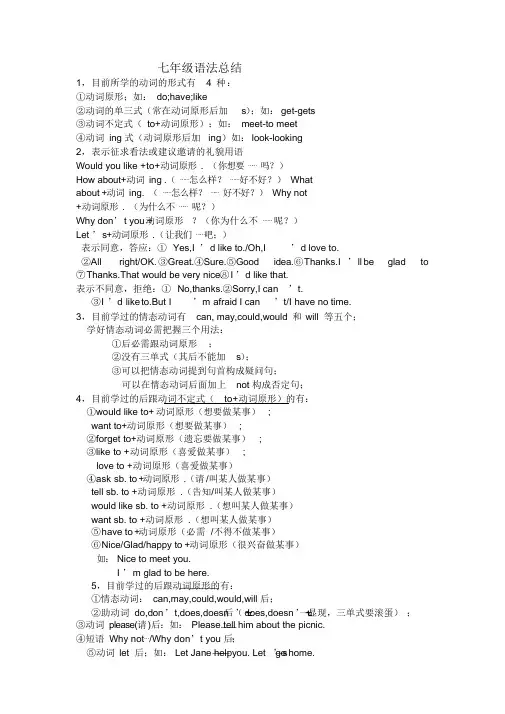
七年级语法总结1,目前所学的动词的形式有 4 种:①动词原形;如:do;have;like②动词的单三式(常在动词原形后加s);如:get-gets③动词不定式(to+动词原形);如:meet-to meet④动词ing 式(动词原形后加ing)如:look-looking2,表示征求看法或建议邀请的礼貌用语Would you like +to+动词原形. (你想要⋯⋯吗?)How about+动词ing .(⋯⋯怎么样?⋯⋯好不好?)Whatabout +动词ing. (⋯⋯怎么样?⋯⋯好不好?)Why not+动词原形. (为什么不⋯⋯呢?)Why don’t you 动+ 词原形?(你为什么不⋯⋯呢?)Let ’s+动词原形.(让我们⋯⋯吧;)表示同意,答应:①Yes,I ’d like to./Oh,I ’d love to.②All right/OK. ③Great.④Sure.⑤Good idea.⑥Thanks.I ’ll be glad to ⑦Thanks.That would be very nice⑧.I ’d like that.表示不同意,拒绝:①No,thanks.②Sorry,I can ’t.③I ’d like to.But I ’m afraid I can ’t/I have no time.3,目前学过的情态动词有can, may,could,would 和will 等五个;学好情态动词必需把握三个用法:①后必需跟动词原形;②没有三单式(其后不能加s);③可以把情态动词提到句首构成疑问句;可以在情态动词后面加上not 构成否定句;4,目前学过的后跟动词不定式(to+动词原形)的有:①would like to+ 动词原形(想要做某事);want to+动词原形(想要做某事);②forget to+动词原形(遗忘要做某事);③like to +动词原形(喜爱做某事);love to +动词原形(喜爱做某事)④ask sb. to +动词原形.(请/叫某人做某事)tell sb. to +动词原形.(告知/叫某人做某事)would like sb. to +动词原形.(想叫某人做某事)want sb. to +动词原形.(想叫某人做某事)⑤have to +动词原形(必需/不得不做某事)⑥Nice/Glad/happy to +动词原形(很兴奋做某事)如:Nice to meet you.I ’m glad to be here.5,目前学过的后跟动词原形的有:①情态动词:can,may,could,would,will 后;d oes,doesn ’一t显现,三单式要滚蛋);②助动词do,don ’t,does,doesn后(’t③动词please(请)后:如:Please tell him about the picnic.④短语Why not⋯/Why don’t you 后⋯;⑤动词let 后;如:Let Jane helpyou. Let ’go s home.⑥动词help 后,也可带to;如:Let ’s help Maria (to) carry water.⑦祈使句以动词原形开头,如:Have a seat , please请.坐下;6,目前学过的后跟动词ing 的有:①Be 动词后的动词;如:Are you k..id.d.i.n.g.. I’m just .lo.o.k..in.g..This is Michael speak.i.n.g.②全部的介词后;已学过的介词有:at,for,about,in,on,from,of,to,with,after 等;如:What about +动词ing. —Whatabout .f.ly..in.g.a kite with me .How about +动词ing. —How about .g.o.i.n.g fishing this Sunday.It ’im s e t for g.o..in.g.home=It ’s time to go home.Thank you for h..e.l.p.in.g.me=Thank you for your help..③go +动词ing——go fishing 去钓鱼; go shopping去购物④do some shopping购物⑤like/love +动词ing (喜爱做某事)7,有单复数变化的词①名词(1) 名词单数变复数的方法1) 大部分在词尾加s. 如:dog---dogs2)以-s, -x, -ch, -sh 结尾的加es. 如:class---classes bus---buses glass---glassesbox---boxes watch---watches( 手表)fish---fishes3)以“辅音字母+ y”结尾的,变y 为i,加es.baby---babies( 婴儿) family---families( 家庭)study---studies( 书房) fly---flies( 蝇子)留意:boy ---boys play---plays toy---toysway---ways monkey---monkeys4)以f, fe 结尾的,变f, fe 为v,加es.half---halves( 一半) knife---knives( 小刀)yourself( 你自己)---yourselves( 你们自己)(2) 特别变化的词1) a 变e: man—men(男子) woman —women( 女子)snowman---snowmen( 雪人)Englishman--- Englishmen( 英国人)Englishwoman---Englishwomen( 英国妇女)2) o 变e:foot---feet( 脚) tooth---teeth( 牙齿)3) 单复数同形:Chinese---Chinese(中国人) fish---fish( 鱼)yuan---yuan( 人民币元)4) mouse—mice ( 老鼠) child —children( 儿童)5) 合成词中一般变后面的词:apple tree---apple trees(苹果树)但以下需前后都变:man teacher---men teachers(男老师)woman doctor---women doctors( 女医生)6) 集体名词,以单数形式显现,但实为复数;例如:people(人们)police (警察们)本身就是复数,family 指“全家人”时,本身也是复数,它们都不能加s. 如:The Chinesepeople are very kind. 中国人民都 很友好;Kangkang ’s family are all tall and thin. 康康全家人都又高又瘦; ② be 动词:单数 am, is ; 复数 are ③行为动词:复数:动词原形单数:在行为动词后加s 或 es (即动词的三单式) ; 如:M .a .r .i .a .likes milk. (likes 是三单式,为单数) M .a .r .i .a .a .n .d .J .a .n .e .like milk. ( like 是动词原形,为复数) ④指示代词单数: this 这个 that 那个 复数: these 这些those 那些8.名词+’ s 全部格 单数名词后直接加“ ’ s ”:Jim ’ s coat 吉姆的外套 Jeff ’ s mother 杰夫的妈妈以 s 结尾的复数名词,只加“’ ”Teachers ’ Day 教 师节 the twins ’ books 双胞胎的书不以 s 结尾的不规章的名词复数,加“ ’s ” Children ’ s Day 儿童节 men ’ s shoes 男式鞋 表示两者共同拥有时,只在最终一个名词后加’ sLucy and Lily ’ s mother 露茜和莉莉的妈妈 (共同的妈妈,一个妈妈 ) 表示两者各自拥有时,要在每个名词后加’sLucy ’s and Kate ’ s rooms 露茜和凯特的房间(各自的房间,两间房子)9,人称代词和物主代词表人 主格 称 宾格代词 中文形容物 词性 主 名词 代 性 词中文 用法:①人称代词主格:作主语,常放在句首; ②人称代词宾格:作宾语,放在动词和介词后; ③形容词性物主代词:后出名词时,用形容词性; (出名就形) ④名词性物主代词:后无名词时,用名词性;(无名就名)10. 句子的成分①主语:是句子要说明的人和物,是动作的发出者,是句子的主体,一般放在句首;主语由名词 ,代词担任;②谓语:说明主语的动作;只有动词才作谓语,一般放在主语之后; ③宾语:是动作的接受者;放在动词或介词后;由名词,代词担任;如:I we you he she it they me us you him her it them 我我们你,你们他她它他们myour your his her its theirmineours yours his hers its theirs 我的 我们的 你的 ;你们的 他的 她的 它的 他们的Michael often looks after his sister at home on Sunday.主语谓语宾语11. 三单问题①总就:主语是第三人称单数时,动词(谓语)要用三单式;如:He gets up at six ;由于主语He是第三人称单数,动词get 后要s, 即gets 是三单式;②可以作第三人称单数主语(三单主语)的有:(1)he, she,it;(2) 单个的人;单个的物;③动词三单式的构成(1) 特别的:be—is have —has(2) 有规律的:1) 大部分在词尾加s; 如:get —gets take--takes need -needs know —knows2) 以s, x,ch, sh,o 结尾的加es; 如:guess —guesses( 猜) watch--watches( 看) teach ―teaches( 教) fish -fishes( 钓鱼) go-goes( 去) do -does3) 以“辅音字母+y”结尾的, 变y 为i ,加es. 如:study →studies( 学习) fly →flies( 飞,放)carry →carries( 提) worry —worries( 担忧)留意:buy-buys say -says play -plays12. 特别疑问句特别疑问词的用法意思用法例句who 谁问人的身份,姓名等whom 谁问人的身份,姓名等(问宾语)He is LiLie Who is he . He is my brother. Who is he . I can ask him the question.Whom can you ask the question.what which 什么哪一个问人的职业或事物是什么问一定范围内He is a worker. What is he.He has a book . What does he have .The big box is mine. Which box is yours.特指的人或物The girl at the door is Ann. Which girl is Ann.whose 谁的问所属关系This is her book. Whose book is this .This book is hers .what color 什么颜色问颜色(表语)My skirt is red. What color is your skirt. What time 几点问点时间We play games at five in the afternoon .What time do you play games.when 什么时候问时间We play games in the afternoon .When do you play games.where 什么地方问地点(状语)We play games at home on Sunday ;Where do you play games on Sunday. why 为什么问缘由He isn't at school today because he is ill .Why isn't he at school today .how 怎样问健康状况,做事的方式等He is fine/strong. How is he .I go home by bike . How do you go home.how old 多大几岁问年龄He is ten. How old is he .how many 多少跟复数名词,问数量how much 多少跟不行数名词问数量或价钱There are thirty boys in my class.How many boys are there in your class. There is some milk in the bottle.How much milk is there in the bottle.how far 多远问路程It's five kilometers away from hereHow far is it from here.how soon 多久问in+ 一段时间He can finish it in half an hour.How soon can he finish it .how long 多久问一段时间,问物体的长短He has lived here for a year. How long has he lived here. The desk is one meters long. How long is the desk .how often 多久(一次)问频率I go to see my parents once a month .How often do you go to see your parents.对画线部分提问,除了要留意挑选正确的疑问词外,仍要留意语序的运用;1,对句子的主语提问,其语序是:疑问词+谓语+其他成分?(整个句子是陈述句语序)She is their teacher. Who is their teacher.主语谓语主语谓语2,对句子主语的定语部分提问,其语序是:疑问词+主语(即定语所修饰的名词)+ 谓语+其他成分?(整个句子是陈述句语序)My book is over there. Whose book is over there .主语的定语主语谓语疑问词主语谓语以上两点方法都是:用正确的疑问词代替画线部分,再把句号改为问号,其余部分一般不做转变3.对表语或宾语的定语部分提问,其语序是:疑问词+表语或宾语(画线部分所修饰的名词)+一般疑问句(省略画线部分和它所修饰的名词)I'm looking for my watch.. Whose watch are you looking for .宾语的定语宾语疑问词宾语一般疑问句(省略掉my watch)4,对表语,宾语或状语提问,其语序是:疑问词+ 一般疑问句(省略掉画线部分)?He lives in Beijing . Where does he live .状语疑问词一般疑问句(省略掉画线部分in Beijing )5,对谓语和宾语提问,其语序是:疑问词(What)+ 一般疑问句(其中谓语动词要用do 的相对应形式代替, 省略掉宾语)He watches TV in the evening What does he do in the evening.He watched TV yesterday evening. What did he do in the evening.He is watching TV now. What is he doing now.否定句:;含有否定词not 或no 的句子;改否定句的方法:先加后借①在句中找到Be 动词(am, is, are)或情态动词(can,may,could,would,will ),在它后面加not;②找不到以上词时,借don’t 或doesn’t,放在动词前;留意:句子是三单主语时,借doesn’t;不是三单主语时,借do. 并且:doesn’t 一显现,三单式要滚蛋;13,冠词的用法<1>a /an 不定冠词,表示“一个⋯”,放在单数名词前,指不确定的某一个;<2> a 用在元音前(不是元音字母);an 用在辅音前(不是辅音字母);如:(1) an English boy,anapple,an orange, an egg , an eraser, an old monkey,(2) an hour 一个小时half an hour 半小时(hour 中h 不发音)(3) a “d”( 一个d), an “i”, an “f ”, an “x ”, a “u”.<3>the 定冠词,表示“这,那,这些,那些”,放在名词前,表示特指;14.数词(一),基数词注意eleven, twelve , thirteen, fourteen, eighteen, twenty, thirty, forty, fifty, one hundred/thousand 等词的拼写;详细用法如:Lesson Twelve, Class Two, Grade Eight, The No. 45 bus, Channel Five, Room 302, the No.2 middle School, a five-year-old daughter留意1,“前有,后无;前无,后有”即two hundred books ,hundreds of books2,如eight-year-old 的词后面要加名词3,“在某人几十岁时”用in one ’整s 十+ 的复数如:in her fifties, in their thirties4,表示“多高,多宽,多长,多深,年龄少大,距离多远”时,用“数量+单位+形容词”如:two months old, twenty meters deep(二),序数词注意first, second, third, fifth, eighth, ninth, twelfth, twentieth, twenty-first, ninety-ninth, one hundredth 等词的拼写;详细用法如:the Twelfth lesson, June 5 th, the Second World War, on his twentieth birthday.(三),分数,小数和百分比:分数的表达:分子用基数词,分母用序数词;分子大于一,分母加s,分子和分母之间一般用连字号;如3/5 读作three-fifths, 1/3 读作one-third0.78 读作zero point seven eight 7.45 读作seven point four five45%读作Forty-five percent 67%读作sixty-seven percent留意:分数表示1/2,可以用a/one half 表示;分数1/4,3/4 也可以用quarter 表示;如:1/4 读作one-fourth or a quarter, 3/4 读作three-fourths or three quartersHalf of the students live in the school on weekdays. ( 习惯上省略a)One- third of the students are on the playground.Three-fourths of the earth is covered with water.(四),时间和钟点7:15 读作seven fifteen/ a quarter past seven7:30 读作seven thirty/half past seven7:35 读作seven thirty-five/ twenty-five(minutes)to eight8:03 读作three minutes past eight留意:假如分钟不是 5 的倍数,minute 不能省略;(五),日期和年份on March 8 读作on march the eighth on 8th of March 读作on the eighth of Marchin 1998 读作nineteen ninety-five, in 2021 读作in two thousand and eight15.介词一,介词一般位于名词或代词之前,在句中不单独做任何成分;介词本身有独立的含义,但意义不够完整,在句中使用时,后面必需接有宾语构成介词短语后,才能表达完整的意义;介词短语在句中常作状语,定语,表语或宾语补足语;二,介词的用法:(一)表示时间的介词的用法:1;at, on, in(1)at 在句中用在钟点之前;意为“在,, 点钟”如:at six 在 6 点(2)at 用在固定短语中;如:at noon 在中午;at this time of year 一年这个时候(3)on 常用于表示详细的哪一天或某天的上午,下午及晚上或用于固定短语中;如:on the morning of June 在6 月5 日的早上;on a cold winter night 在一个冰冷的冬天的夜里;on May 20th 在 5 月20 日(4)on 用在星期前;如:on Sunday 在星期日(5)in 用于年,月前面,季节,世纪前以及固定短语中;如:in 2021 在2021 年;in October 在10 月;in spring 在春天;in the twentieth century 在二十世纪;in his twenties 在他二十多岁时;in the morning / afternoon / evening 在早上/下午/晚上2.before ,after,in①in 是以现在为起点,表示将来一段时间以后,常用于一般将来时态中;eg: I will comeback in three days.我三天以后回来;②after 是以过去为起点,表示过去一段时间以后,常用于过去时态中;eg:She went after three days. 她三天以后走的;③before 表示“某时刻或某时间之前”时态依据句子而定; E.g: Check your papers carefully before you hand them in,(二)表示地点方位介词的用法:1. a t, in at 后跟小地方,in 后跟大地点2. i n, on, toin 表示在某一范畴内的某方位;on 表示与某地相邻关系;to 表示在某一地区之外的某方位,不属于该范畴;Shanghai lies in the east of China.Shandong lies on the east of Hebei.China lies to the west of Japan.(三)表示手段方式的介词的用法:in, by, with, on 表示“用”(1)by 主要指利用交通工具;即:“by +名词原形”或“行为手段by +v-ing 形式”;如:I go to school by bike every day. He learns English by listening to cassettes.(2)in 主要指" 用某种语言"或"用工具,材料"以及方式( way) 等;如:People say it in English. I often write in ink / pencil. He can say it in a different way.(3)on 主要表示行走或站立时所用的身体部位,或利用交通工具;There be 句型的句式 即:“ on +冠词 / 形容词性物主代词 + 交通工具名词”或接表示媒体的名词;此时相当于 over ;如: People walk on foot. But some people can walk on hand.He oftengoes to school on a bus.留意:“ on / in + 冠词 / 形容词性物主代词 + 交通工具名词”这种交通方式的表达可以转换成“ by + 交通工具名称” ;例:on a bike = by bike 假如交通工具名词为 car ,习惯上用 in ,其他多用 on ;如: He learns English on TV .(4) with 主要指某一详细的劳动工具,材料或用身体部位;如: They like writing with a brush. 他们情愿用毛笔写字 . We see with our eyes and hearwith our ears. 我们用眼睛看 ,用耳朵听 .16. 祈使句一, 用于表达命令,恳求,劝说,警告,禁止等的句子叫做祈使句,祈使句最常用于表达命令,因此在学校文法中也常称为命令句;祈使句因对象(即主语)是其次人称,所以通常都省略;祈使句的动词都为一般现在时,句末就使用句号来表示终止;.用客气的语气表示祈使句时,可在句首或句尾加上 please ,但假如在句尾加 please ,那在 please 之前肯定要加一个逗号 “,”; 二,表现形式 ●确定结构 :1. Do 型(即:动词原形 (+宾语)+其它成分 );如:Please have a seat here 请. 这边 坐; 有的祈使句在意思明确的情形下 ,动词可省略;如:This way, please. = Go this way, please. 请这边走;2. Be 型(即:Be + 表语(名词或形容词 )+其它成分 );如:Be a good boy. 要做一 个好孩子 . Be quite.寂静 Be careful !当心!3. Let 型(即:Let + 宾语 + 动词原形 + 其它成分 );如:Let me help you. 让我来帮你;●否定结构 :1. Do 型和 Be 型的否定式都是在句首加 don't 构成;如 :Don't forget me. 不要遗忘我 . Don't be late for school. 上学不要迟到 .2. Let 型的否定式有两种 : “ Don'+t let + 宾语 + 动词原形 + 其它成分 ”和 “ Let +宾语 + not + 动词原形 + 其它成分 ”;如:Don't let him go. / Let him not go. 别让他走;3. 有些可用 no 开头 ,用来表示禁止性的祈使句;如 :No smoking. 禁止吸 烟.No fishing. 禁止钓鱼 . 17,There be 句型There be 句型表示 “某地存在某人 /物”; 它的构成形式一般为 There are / is +某物/人+地点; 它即可以表示某地方有什么东西,也可以表达某地方有什么人; There are 20 students in a class 班. 里有 20 名同学; There is an apple on the desk.桌子上有个苹果;There are many students in the classroom. 教室里有很多同学;一,否定句: be 后加 not ;留意确定句中的 some 变为 any ;There isn’t any water in the bottle. 瓶子里没有水;疑问句:be 提到主语前;同样,some变为any;一般疑问句的简略确定回答:Yes, there is/ are.否定回答:No, there isn’t/ aren’t.Is there any water in the bottle. 瓶子里有水吗?Yes, there is./ No, there isn’t. 有;/没有;二,there be句型有数的变化be 的单复数取决于其后的主语,单数主语用is,复数主语全用are;如有并列主语时,be 随第一主语变,即就近原就;There is a pen and two erasers on the desk.课桌上有一支钢笔和两块橡皮;There are two erasers and a pen on the desk.课桌上有两块橡皮和一支钢笔;三,there be句型与have 的区分当表示“人”(有生命的)有的时候,用have 或has,强调所属关系;当表示“物”(无生命的)有的时候,用there is 或there are,强调空间上的存在;I have a brother. 我有一个弟弟;There are many apples on the table.桌子上有很多苹果;18. 一般现在时一般现在时表示常常性或习惯性的动作,或表示现在的特点或状态;其动词形式是:动词原形(只有第三人称单数作主语时除外,要加-s)其疑问句和否定句需要用助动词do 或does1) 确定句用行为动词原形表示They get up very early every morning. 他们每天早晨起来很早;I visit my grandparents four times a month. 我一个月去探望祖父母四次;2) 否定句用don’t + 动词原形来表示We do not go shopping on Sundays. 我们周日不去购物;I don ’t think you like this colour. 我想你不喜爱这个颜色;3) 一般疑问句就是把助动词do 提前至句首,后面动词用原形;回答时,确定用“Yes, 主语+do”;否定句用“No, 主语+don’t”;–Do they go to school at seven o’clock. 他们七点去上学吗.--Yes, they do.--Do you like this skirt. 你喜爱这条裙子吗.--No, I don ’t. 不,我不喜爱;一般现在时用来表示常常的或习惯性的动作,常与以下的时间状语连用:often 常常,always 总是,sometimes 有时,usually 通常,every day/ week 每天/ 周等;He usually goes to school by bike. 通常他骑车上学;I visit my grandparents every week. 我每个星期都去看祖父母;She is always late for class. 她总是上课迟到;My parents and I sometimes go out to eat. 我和父母有时出去吃饭;It often rains here. 这儿常常下雨;主语为第三人称单数时的一般现在时一般现在时态,当主语为第三人称单数时,谓语动词也要是第三人称单数,后要加-s 或-es;He likes reading at night. 他喜爱夜里读书;She usually goes to school by bike. 她平常骑车上学;The little cat drinks milk every day. 小猫每天都喝牛奶;转换成否定句要加doesn’t,其后的动词用原形;Kelly doesn ’t get up early on Saturdays and Sundays. 凯丽星期六星期天起床不早;He doesn’t feel well today. 他今日感觉不舒适;转换成一般疑问句,句首用Does,其后的动词用原形;Does he have lunch at school. 他在学校吃午饭吗.Does it take long by train. 乘火车要很长时间吗.19. 现在进行时态:概念:表示现在(说话瞬时)正在进行或发生的动作,也可以表示目前一段时间内或现阶段正在进行的活动;结构:由be 动词(am, is, are) + 动词ing 构成,其中be 动词要与主语保持性数一样;Mary is flying a kite in the park. 玛丽正在公园里放风筝;--What are you doing now. 你现在在干什么.--I’m reading English. 我正在读英语;Are they drawing the pictures now. 他们正在画画吗.动词现在分词是动词原形变化而来的,规章变化如下:动词ing 形式叫动词现在分词,其构成如下:1) 直接在动词后加ingplay—playing, do—doing, talk—talking, sing--singing2) 以不发音的字母 e 结尾的动词,先去e,再加ingmake—making, write —writing, have—having, take—taking3) 以重读闭音节结尾的动词且词尾只有一个辅音字母,应双写这个辅音字母,再加ingrun—running, stop—stopping, put—putting, swim—swimming留意对现在进行时态的判定;判定一个英语句子用什么时态,主要看句子的时间状语,一般说来,每种时态都有与之相对应的时间状语;现在进行时表示现在(说话瞬时)正在进行或发生的动作;因此,这个时态最常用的时间状语是now;但有不少句子并没有now,只能通过提示语如look ,listen 等或者通过上下文来确定用现在进行时;She is cleaning her room now.她正在打扫房间;Look. The girl is dancing over there. 看.那个女孩在那里跳舞;--Can you go and play games with me.你能和我们一起做嬉戏吗.--Can’t you see I am doing my homework. 你没观察我正在做作业吗.20 一般过去时1. 一般过去时表示过去某个时间发生的动作或存在的状态,常和表示过去的时间状语连用;一般过去时也表示过去常常或反复发生的动作;2. Be 动词在一般过去时中的变化:⑴am 和is 在一般过去时中变为was;(was not=wasn’)t⑵are 在一般过去时中变为were;(were not=weren ’)t⑶带有was 或were 的句子,其否定,疑问的变化和is, am, are 一样,即否定句在was 或w ere 后加not,一般疑问句把was 或were 放到句首;3. 句中没有be 动词的一般过去时的句子否定句:didn ’t+动词原形,如:Jim didn ’tgo home yesterday.一般疑问句:在句首加did ,句子中的动词过去式变回原形;如:Did Jim go home yesterday.特别疑问句:⑴疑问词+did+ 主语+动词原形?如:What did Jim do yesterday.⑵疑问词当主语时:疑问词+动词过去式?如:Who went to home yesterday.动词过去式变化规章:1.一般在动词末尾加-ed,如:pull-pulled, cook-cooked2.结尾是 e 加d,如:taste-tasted3. 末尾只有一个元音字母和一个辅音字母的重读闭音节,应双写末尾的辅音字母,再加-e d,如:stop-stopped4. 以“辅音字母+y ”结尾的,变y 为i,再加-ed,如:study-studied5.不规章动词过去式:am,is-was are-were, do-did, see-saw, say-saidgive-gave, get- got, go-went, come-came, have-had,eat-ate, take-took, run-ran, sing-sang, put-put,make-made, read-read, write-wrote, draw-drew, drink-drank,fly-flew, ride-rode, speak-spoke, sweep-swept, buy-bought swim-swam, sit-sat bring--brought can-could cut-cut become-became begin-began draw-drew feel-felt find-found forget-forgot hear-heard keep-kept know-knewlearn-learnt (learned)leave-left let-let lose-lostmeet-met read-read sleep-slept speak-spoke take-took teach-taught tell-told write-wrote wake-woke think-though。
最新人教版七年级英语语法知识点汇总

新人教版七年级英语语法知识点汇总一.字母和音标1.26个英文字母:5个元音字母a, e, i, o, u (联系汉语拼音中的韵母排列顺序快速记忆)2.48个国际音标:20个元音组合,28个辅音组合.重点辨别相似发音的元音组合.如:[ə] a China breakfast [e] ea head bread [ei] a name cake二.十大词类名词a. 专有名词和普通名词.专有名词指个别的人,事物,地点等专有的名称,如China, Gina. 普通名词如table, chair.b. 可数名词和不可数名词:可数名词有复数形式,如an apple,two apples. 不可数名词一般没有复数形式,如milk, bread, rice.[重点]可数名词的复数变形:有规则变化和不规则变化两种规则变化:○1一般情况直接在词尾加“-s”, 如: bag-bags, day-days, boy-boys, key-keys等.○2以s, x, sh, ch结尾的单词,要在词尾加“-es”, 如: bus-buses, watch-watches, box-boxes等.○3以辅音字母加y结尾的单词,要变y为i再加“-es”, 如:baby-babies, country-countries, family-families等.○4部分以f (e)结尾的单词,要变f (e)为“ves”, 如:knife-knives, half-halves等.顺口溜:小偷(thief)的妻子(wife),为了自己(self)保命(life),站到架子上(shelf),用树叶(leaf)做的小刀(knife),将狼(wolf)劈成了两半(half)○5以字母“o”结尾的单词,没有生命的加“-s”,有生命的加“-es”,如:zoo-zoos, photo-photos, tomato-tomatoes.口诀:黑人(Negro)英雄(hero)爱在火山(volcano)吃土豆(potato)西红柿(tomato)不规则变化:○1改变单数名词中的元音字母:man-men, woman-women, foot-feet, tooth-teeth等. ○2单、复同形:sheep-sheep, Chinese-Chinese, Japanese-Japanese等.○3其他形式如: mouse-mice, child-children等.c. 名词所有格:表示所属关系1. 单数名词词尾直接加’s, 复数名词词尾没有s的也要加’s, 如the boy’s bag 男孩的书包 men’s room 男厕所Children’s Day 儿童节2. 若是复数名词词尾有s ,只加“’”, 如:Teachers’ Day 教师节3. 如果两个名词并列,并且分别有’s,则表示“分别有”;只有一个’s,则表示“共有”,如:John’s and Mary’s room(两间) John and Mary’s room(一间)冠词1.定冠词the:特指某(些)人或某(些)物,如The blue shirt is mine. 蓝衬衫是我的.2.不定冠词a/an: 用来表示“一”这个数量, 其中an放在元音字母开头的名词前面,如an apple, an orange.3.零冠词: 不用冠词的情况.在专有名词,不可数名词,学科名称,三餐和球类运动名称前不用冠词,如:Tian’an Men Square天安门广场I have lunch at school every day.代词(人称、物主、反身代词)物主代词:包括名词性物主代词和形容词性物主代词.前者用法相当于名词,在句中可单独使用,如:--Who’s book is this? --It is mine. 后者用法相当于形容词,在句中不可单独使用,如It is my book.反身代词:表示“自己”,“本身”.指示代词数词1.基数词:表示数目的多少2.序数词:表示事物的先后顺序,往往与冠词the连用基数词变序数词口诀:一、二、三,单独记;八去t,九除e, ve要用f替,整十基数变序数,先把ty变成tie;要是遇到两位数,十位基数个位序,th最后加上去.口诀解析:one→first, two→second, three→third这三个词变化特殊,要单独记;eight →eighth, nine→ninth, 八去t,九去e后再加-th; five→fifth, twelve→twelfth,五和十二把ve换成f再加-th;twenty→twentieth, thirty→thirtieth... 整十先把词尾y改为ie再加-th.两位数时则十位数用基数词,个位数用序数词,如:twenty-first.注:four→fourteen→forty(基数词)fourth→fourteenth→fortieth(序数词)三.时态:一般现在时:a.表示习惯性、经常性、反复性的动作或存在的状态b. 表示事实或客观真理.结构:1. be动词(am, is, are)的用法记忆口诀:“我”用am, “你”用are, is用于“他、她、它”;单数全都用is,复数全部都用are.句子转换:当句子中有be动词或情态动词时,则把be动词或情态动词(can, could 等等)提到主语的前面变成一般疑问句;在be动词或情态动词后面加not变成否定句陈述句:She is a student. 一般疑问: Is she a student? 否定句:She is not a student.2. 实义动词do(除第三人称单数外,谓语动词用原形)句子转换:当句子中既没有be动词,也没有情态动词时,则在主语前加助动词do (I, you, we, they), does(单数she, he, it)变成一般疑问句;在主语后谓语动词前加助动词don’t(I, you, we, they), doesn’t(单数she, he, it)变成否定句,助动词后的动词要变成动词原形.陈述句:We get up at 7:00 every morning.一般疑问句:Do you get up at 7:00 every morning?否定句:We don’t get up at 7:00 every morning.【重点】动词第三人称单数(三单)的规则变化1. 一般在词尾加-s,如: looks, puts, reads, sees等.2. 以-o, -s, -x, -sh, -ch结尾的加-es,如: goes, does, watches, teaches3. 以辅音字母加y结尾的,变y为i再加-es. 注:若是元音字母加y,则直接加-s. 如:fly → flies, try → tries, fry → fries, copy → copiesbuy → buys, enjoy → enjoys, play → plays, say → says, pay → pays总结:三单的变化规律与可数名词复数的(前三种)变化规律相似.现在进行时:1.表示现在(说话的瞬间)正在进行或发生的动作,强调“此时此刻”.如:He is reading . They are talking now.2.表示当前一段时间内的活动或现阶段正在进行的动作.如:They are working on a farm these days.3. 结构:动词be(am/is/are)+V-ingV-ing形式构成:1. 一般在动词词尾加上-ing,如go→going look→looking watch→watching2. 以不发音字母e结尾的动词,先去e,再加-ing. 如write→writing take→taking3. 以重读闭音节结尾,且末尾只有一个辅音字母时,要先将词尾的辅音字母双写再加ing,如run→running shop→shopping get→getting sit→sitting一般过去时:表示过去某个时间里发生的动作或状态;或过去习惯性、经常性的动作、行为(used to);1.句子转换口诀:一般过去并不难,表示过去(动作、状态)记心间. 动词要用过去式,时间状语句末站.否定句很简单,didn't动词(原形)前,其它部分不要变.疑问句也好变,did放在句子前,其它部分依次站.陈述句He(she, it) worked 疑问句Did he(she, it) work?否定句He (she, it)did not work2. 表过去的时间状语如:ago, yesterday, the day before yesterday, last week, last (year, night, month, 具体时间), just now, at the age of , one day, long ago, once upon a time(很久以前)3. 动词变化规则:规则变化:a.一般情况直接加ed,如:work→worked look→lookedb. 以不发音的e结尾的,加-d,如:live →lived hope →hopedc. 以辅音字母+y结尾的,变y为i加ed, 如:study→ studiedd. 以重读闭音节结尾的,末尾只有一个辅音字母,要双写最后的辅音字母加-ed,如: stop→ stopped plan→planned不规则变化:过去时和原形相同, 如:cut→cut read→read四.There be句型结构1. 结构的主谓一致.There is/are+某物/某人+某地/某时表示某地或某时存在某事或某人.句子的结尾往往带有地点状语或时间状语.其中there是引导词,本身没有词意,be是谓语动词,be后面的名词是主语.be的数与后面的名词一致,若be后是两个或多个并列的名词,be则与靠得最近的那个名词的数一致.如There was a meeting yesterday. 昨天有个会议比较:There is a pen, two books and many pencils on the desk. 桌上有一支钢笔、两本书和好些铅笔.There are two books, a pen and many pencils on the desk2.there be的否定、疑问及其回答式(1) 否定式:be后面加not(any)或no.如:There are not any boats on the river. 河上没有船.(2) 疑问句:把be移到there之前.如:Were there many boats on this river? 过去这条河上有许多船吗?回答:Yes, there were. / No, there weren’t.五.句子种类祈使句:表命令、警告、提醒、建议、请求、叮嘱、号召等,谓语动词用原形.主语you通常省略,句末用叹号或句号.肯定式以动词原形开头,否定式在动词原形前加don’t. 如:Don’t arrive late for class. Practice the guitar every day.为了表示礼貌,常在句首或者句末加please,在句末以“,”隔开.如:n,please. Please call me!Let’s祈使句: 包括听话者本人在内,表示建议.如:Let’s go home. 我们回家吧!一般疑问句及特殊疑问句1、一般疑问句:能用Yes或No来回答的问句.一般疑问句句尾读升调.Is he a teacher? Yes, he is./ No, he isn’t.2、特殊疑问句:不能用Yes或No来回答的问句,句尾读降调.(由五个W一个H来引导特殊疑问句)–How was your trip? –It was great.–Where’s Gina? –She is in the teacher’s office.六.情态动词:是一种本身有一定的词义,表示说话人的情绪,态度或语气的动词,但不能单独作谓语,只能和其他动词原形构成谓语.can的基本用法:1.表示能力.I can speak English. 我会讲英语.2.表示许可.You can play football on weekends. 你可以在周末踢足球.3.表示请求.Can you help me? 你能帮助我吗?must表示“必须”. You must read a book before you watch TV.have to表示“不得不”,“必须”,如We have to be quiet in the library.二者区别:1. must表示说话人主观的看法,have to往往强调客观需要.如:I must go.It is a little late and I have to go now.2.否定意义不同:mustn’t 表示“禁止”,而don’t have to 表示“不必”.You mustn’t talk to your mother like that.You don’’t want to.3.must 没有人称和数的变化,但have to有I/You/They must do it now.She has to finish her homework today.八.介词介词是一种虚词,它不能单独担任句子成分,必须与名词或代词或相当于名词的其他词类、短语或从句构成介词短语,才能担任句子成分.1. 表示时间的介词at,in,onA. at:用于表示时刻、时间的某一点at 6 o’clock 在6点at lunch在午饭时at breakfast早餐时at noon正午时at that time那时B. on用于表示某天,某一天的上、下午(指具体的某一天,一律用on)on Monday在周一on Tuesday morning在周二早上 on June 6 在6月6日C. in用于表示周、月、季节、年和泛指的上午、下午、晚上(指在一段时间内)in the afternoon在下午in the week在这周in the holiday在假期中D. for 后面跟一段时间:for two days/hours2. 表示场所、方向的介词at,in,onA.at在某地(表示比较狭窄的场所, 小地方) at school上学at home在家B. on在...上面,有接触面on the desk 在桌子上面on the map在地图上C.in表示一个范围(大地方)in Beijing/China in the water3.固定搭配By+交通工具by bus/ train/plane/bike/subway重点:动词和介词的连用,如:arrive at/in 到达ask for 请求get off 下车listen to 听help sb with sth 帮助某人做某事talk about 谈论look at 看;注视。
人教版七年级英语语法点
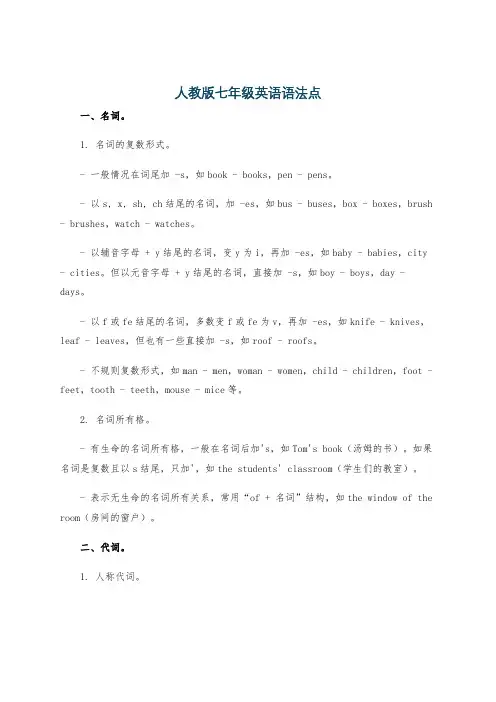
人教版七年级英语语法点一、名词。
1. 名词的复数形式。
- 一般情况在词尾加 -s,如book - books,pen - pens。
- 以s, x, sh, ch结尾的名词,加 -es,如bus - buses,box - boxes,brush - brushes,watch - watches。
- 以辅音字母 + y结尾的名词,变y为i,再加 -es,如baby - babies,city - cities。
但以元音字母 + y结尾的名词,直接加 -s,如boy - boys,day - days。
- 以f或fe结尾的名词,多数变f或fe为v,再加 -es,如knife - knives,leaf - leaves,但也有一些直接加 -s,如roof - roofs。
- 不规则复数形式,如man - men,woman - women,child - children,foot - feet,tooth - teeth,mouse - mice等。
2. 名词所有格。
- 有生命的名词所有格,一般在名词后加's,如Tom's book(汤姆的书)。
如果名词是复数且以s结尾,只加',如the students' classroom(学生们的教室)。
- 表示无生命的名词所有关系,常用“of + 名词”结构,如the window of the room(房间的窗户)。
二、代词。
1. 人称代词。
- 主格:I(我),you(你/你们),he(他),she(她),it(它),we(我们),they(他们/她们/它们)。
主格在句中作主语,如I like English.(我喜欢英语。
)- 宾格:me(我),you(你/你们),him(他),her(她),it(它),us (我们),them(他们/她们/它们)。
宾格在句中作宾语,如He helps me.(他帮助我。
)2. 物主代词。
人教版七年级英语上册重点短语总汇,语法总结

人教版七年级英语上册重点短语总汇,语法总结句型(1)-What+be+主语+doing? ….正在做什么?-主语+be+doing。
…正在做某事。
例:-what are you doing?-I’m doing my homework.(2)-Thanks for … 为。
而感谢例:Thanks for your letter.(3)-Here are/is…例:Here are some of my photos.Here is a photo of my family.(4)-That sounds good.(5)-This TV show is boring.三、日常交际用语(1)-Do you want to go to the movices? –Sure.(2)-When do you want to go? –Let’s go at seven.(3)-Where do people play basketball? –At school.(4)-What’s he waiting for?-He’s waiting for a bus.(5)-What’s he reading? He’s reading a newspaper.1)现在在进行时的形式是:助动词be(am,is,are)+动词-ing形式(也叫现在分词),表示现在(说话的瞬间)正在进行或发生的动作。
2)现在进行时的肯定句形式主语+be(am,is,are)+动词现在分词+其他I’m watching TV.3)现在进行时的否定句形式主语+be(am,is,are)+not+动词现在分词+其他They are not playing soccer.4)现在进行时的一般疑问句形式及回答:Is(am,are)+主语+动词现在分词+其他?Yes,主语+is/am/are. No,主语+isn’t/aren’t/am not.Are you reading? Yes,I am. No,I am not.5) 现在进行时的特殊疑问句形式:特殊疑问词+is/am/are+主语+现在分词+其他?例:What is your brother doing?6) 动词+ing形式(现在分词)的构成.1一般情况下在动词词结尾加-ing.如: eat--eating, do—doing,clean—cleaning,play—playing,2以不发音的元音字母e结尾的动词,先去掉e再加-ing.如:take--taking,write—writing,have-havingcome—coming.dance--dancing3词尾如果是以一个辅音字母结尾的重读闭音节词.应该先双写这个辅音字母,再加-ing.如:run—runing,sit—sitting ,swim—swimming.Shop—shopping.put—putting,sit—sittingUnit 6 It’s raning!一、词组Around The World 世界各地On vacation 度假Take photos 拍照On the beach 在海边a group of people 一群人play beach volleyball 打沙滩排球be surprised 惊讶的be surprised at sth./sb.对某人或某人感到惊讶be relaxed 放松have a good time 玩得很痛快in different kind of weather 在不同的天气里Thank sb for(doing)sth由于(做)某事而感谢某人How’s it going? 近况如何Some…others…一些…另一些…Look like..看起来像。
人教版初中英语七年级上册语法知识点总结
人教版初中英语七年级上册语法知识点总结
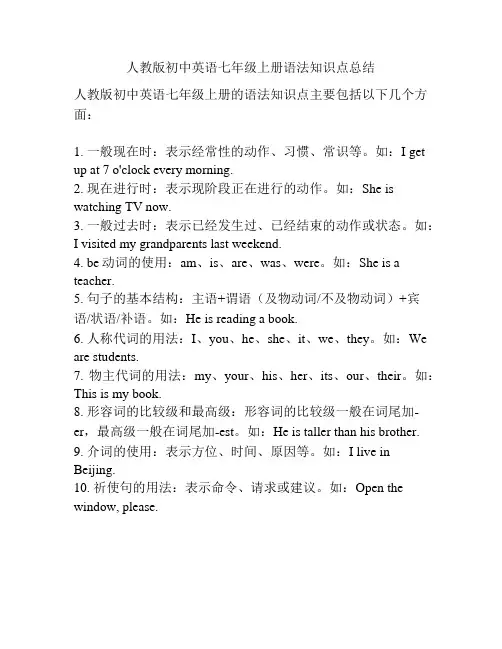
人教版初中英语七年级上册的语法知识点主要包括以下几个方面:
1. 一般现在时:表示经常性的动作、习惯、常识等。
如:I get up at 7 o'clock every morning.
2. 现在进行时:表示现阶段正在进行的动作。
如:She is watching TV now.
3. 一般过去时:表示已经发生过、已经结束的动作或状态。
如:
I visited my grandparents last weekend.
4. be动词的使用:am、is、are、was、were。
如:She is a teacher.
5. 句子的基本结构:主语+谓语(及物动词/不及物动词)+宾
语/状语/补语。
如:He is reading a book.
6. 人称代词的用法:I、you、he、she、it、we、they。
如:We are students.
7. 物主代词的用法:my、your、his、her、its、our、their。
如:This is my book.
8. 形容词的比较级和最高级:形容词的比较级一般在词尾加-er,最高级一般在词尾加-est。
如:He is taller than his brother. 9. 介词的使用:表示方位、时间、原因等。
如:I live in Beijing.
10. 祈使句的用法:表示命令、请求或建议。
如:Open the window, please.。
(完整版)新人教版七年级英语语法知识点汇总
七年级英语语法知识点汇总一.字母和音标1.26个英文字母:5个元音字母a, e, i, o, u (联系汉语拼音中的韵母排列顺序快速记忆)2.48个国际音标:20个元音组合,28个辅音组合。
重点辨别相似发音的元音组合。
如:[ə] a China breakfast [e] ea head bread [ei] a name cake 二.十大词类名词a. 专有名词和普通名词。
专有名词指个别的人,事物,地点等专有的名称,如China, Gina. 普通名词如table, chair.b. 可数名词和不可数名词:可数名词有复数形式,如an apple,two apples. 不可数名词一般没有复数形式,如milk, bread, rice.[重点]可数名词的复数变形:有规则变化和不规则变化两种规则变化:○1一般情况直接在词尾加“-s”, 如: bag-bags, day-days, boy-boys, key-keys等。
○2以s, x, sh, ch结尾的单词,要在词尾加“-es”, 如: bus-buses, watch-watches, box-boxes等。
○3以辅音字母加y结尾的单词,要变y为i再加“-es”, 如:baby-babies, country-countries, family-families等。
○4部分以f (e)结尾的单词,要变f (e)为“ves”, 如:knife-knives, half-halves等。
顺口溜:小偷(thief)的妻子(wife),为了自己(self)保命(life),站到架子上(shelf),用树叶(leaf)做的小刀(knife),将狼(wolf)劈成了两半(half)○5以字母“o”结尾的单词,没有生命的加“-s”,有生命的加“-es”,如:zoo-zoos, photo-photos, tomato-tomatoes.口诀:黑人(Negro)英雄(hero)爱在火山(volcano)吃土豆(potato)西红柿(tomato)不规则变化:○1改变单数名词中的元音字母:man-men, woman-women, foot-feet, tooth-teeth等。
2024年初一(七年级)人教版英语语法知识点
2024年初一(七年级)人教版英语语法知识点1.词性(1)名词(Nouns):表示人、地点、事物或概念。
分为可数名词与不可数名词单数与复数(例如:cat-cats,water-不可数)(2)动词(Verbs):表示动作或状态。
分为实义动词与助动词动词的时态(一般现在时、一般过去时、将来时)(3)形容词(Adjectives):描述名词的性质或状态。
比较级与最高级(例如:big-bigger-biggest)(4)副词(Adverbs):描述动词、形容词或其他副词的方式、程度等。
(5)频率副词(如always,usually,sometimes,never)2.句子结构(1)简单句(Simple Sentences):只有一个主语和一个谓语的句子。
例如:I like ice cream.(2)并列句(Compound Sentences):由两个或多个简单句通过连词连接而成。
例如:I like ice cream,and she likes cake.(3)从句(Complex Sentences):包含一个主句和一个或多个从句。
例如:I will go to the park if it is sunny.3.时态(1)一般现在时(Simple Present Tense):表示习惯或经常发生的动作。
结构:主语+动词原形(第三人称单数加-s)例如:He plays football.(2)一般过去时(Simple Past Tense):表示过去发生的动作。
结构:主语+动词的过去式例如:They visited the museum.(3)将来时(Future Tense):表示将要发生的动作。
结构:主语+will+动词原形例如:She will go to school tomorrow.4.疑问句和否定句疑问句(Questions):一般疑问句:助动词+主语+动词原形例如:Do you like pizza?特殊疑问句:疑问词+助动词+主语+动词原形例如:What do you want to eat?否定句(Negative Sentences):结构:主语+助动词+not+动词原形例如:I do not like spinach.5.代词人称代词(Personal Pronouns):I,you,he,she,it,we,they物主代词(Possessive Pronouns):mine,yours,his,hers,its,ours, theirs反身代词(Reflexive Pronouns):myself,yourself,himself,herself, itself,ourselves,yourselves,themselves6.介词表示时间的介词:in,on,at例如:I was born in2005.表示地点的介词:in,on,under,between,behind 例如:The cat is under the table.7.连词并列连词:and,but,or从属连词:because,although,if,when8.常用短语表示喜欢或不喜欢的表达:I like/I don’t like...My favorite...is...表示能力的表达:I can/I can’t...9.常见错误注意主谓一致:如第三人称单数加-s。
人教版最全的七年级上册英语语法
人教版最全的七年级上册英语语法1.一般现在时:主语+do/does(现在分词) We clean the room every day.一般现在时:do(n't)/does(n't)2.一般过去时:主语+did We cleaned the room just now.一般过去式:did(n't)+V.原3.现在进行时:主语+am/is/are doing We are cleaning the room now.现在进行时:am(not)/is(n't)/are(n't)+V.ing4.过去进行时:was/were doing .We were cheaning the room at 5:00 yesterday afternoon.过去进行时:was(n't)/were(n't)+V.ing5.现在完成时: have/has done We have cleaned the room already.现在完成时:have(n't)/has(n't)+过去分词(p.p.)6.过去完成时: had done We had cleaned the room before he arrived.过去完成时:had+p.p.7.一般将来时: will do/ We will clean the room tomorrow.一般将来时:will(not)+V.ing / is(n't)/are(n't)+going to +V.原8.过去将来时: was/were to /would do He said he would clean the room next过去将来时:would(n't) / was(n't)/were(n't)+V.原动词不定式:to+V.ing一、一般现在时:概念:经常、反复发生的动作或行为及现在的某种状况。
人教版七年级上册英语Unit3语法总结
人教版七年级上册英语Unit3语法总结1. 一般现在时:表示现在经常性或惯性的动作、状态或客观事实。
- 结构:主语 + 动词原形(+ 其他)- 例句:I usually get up at 7 o'clock in the morning.2. 现在进行时:表示现在正在进行的动作或情况。
- 结构:主语 + am/is/are + 现在分词(+ 其他)- 例句:She is studying English at the moment.3. 一般过去时:表示过去发生的动作或情况。
- 结构:主语 + 动词过去式(+ 其他)- 例句:They visited their grandparents last weekend.4. 过去进行时:表示过去某一时间点正在进行的动作或情况。
- 结构:主语 + was/were + 现在分词(+ 其他)- 例句:He was sleeping when the phone rang.5. 一般将来时:表示将来发生的动作或情况。
- 结构:主语 + will + 动词原形(+ 其他)- 例句:I will go to the park tomorrow.6. 能力和意愿:can,could,may,might,must,shall,should,would等。
- 例句:You should finish your homework before going out.7. 祈使句:表示命令、请求、建议、劝告或禁止等。
- 结构:动词原形(+ 其他)- 例句:Please pass me the book.8. 直接引语和间接引语:表示他人的陈述、断言或问句等。
- 结构:直接引语:引号内的内容;间接引语:引号外的内容。
- 例句:- 直接引语:He said, "I am studying English."- 间接引语:He said that he was studying English.以上是人教版七年级上册英语Unit3语法总结,供参考。