
新人教版七年级上册英语 Unit 6 Period 3 Section B(1a-2c) 重点习题练习复习课件
9. 我不想发胖。 I don't ___w_a_n_t__ ____t_o___ ____b_e___ ____fa_t___.
10. 迈克在学校吃得好。 Mike ___e_a_ts___ ___w_e_l_l __ at school.
1. ____A____ books are like wise friends.
你保持健康”。task任务; exercise练习; habit
习惯。故选C。
3. She ____C____ oranges, but she ________ apples.
A. like; don't like
B. likes; doesn't likes
C. likes; doesn't like
________.
A. nice; good
B. well; well
C. nice; well
D. good; nice
【解析】词语辨析法和语法判定法。连系动词
look表示“看起来”,后跟形容词作表语; 修 饰实义动词sell用副词well,表示“卖得好”。 故选C。
4. My parents often ask me ____A____ my teachers
C. healthy; health
D. health; healthy
【解析】句意为“吃健康的食物有利于我们的 健康”。第一空后的food(食物)是名词,需用 形容词修饰; 形容词性物主代词our后需用名 词,healthy(健康的)是形容词,health(健康) 是名词。根据句意和语境,可知选C。
more foreign students study in our country. 【中考•昆明】
A. unluckily B. never C. really D. hardly
【解析】句意为“一带一路倡议确实是一个让 越来越多的外国学生在我国学习的好机会”。 really意为“确实”。故选C。
A. go
B. goes
C. to go
D. to going
【解析】want to do sth.想要做某事。
二、根据句意及首字母提示完成单词 6. I have milk and bread for breakfast .
7. I'm a reporter(记者). Can I ask you some q uestions ?
D. like; don't likes
4. —____A____ does your father have ________ lunch?
—Chicken and tomatoes.
A. What; for
B. What; /
C. How; for
D. How; /
5. After school, he wants ____C____ to the movies (电影).
14. Tom plays soer very ____w__e_ll_ (good). 15. Let's ___e_a_t___ (eat) some apples for dinner.
四、根据汉语意思完成句子 16. 胡萝卜是健康食品。 Carrots are __h_e_a_lt_h_y_ __f_o_o_d___.
三、用括号内所给单词的适当形式填空 11. My son has good __e_a_ti_n_g__(eat) habits. 12. —Are carrots _h_e_a_l_t_h_y_(health) food? —Yes, they are.
13. —Do you __r_e_a_ll_y__ (real) like to eat fruit? —No, I don't.
A. Good
B. Well
C. well
D. good
2. —Hi, Tim! How is your grandfather?
—Very ____B____. Thanks.
A. tall
B. well
C. nice
D. fat
【解析】表示“身体好,健康”用形容词well。 故选B。
3. This kind of T-shirt looks ____C____ and sells(卖)
7. ——你喜欢什么水果? ——我喜欢橙子和苹果。 —__W__h_a_t__ fruit do you like? —I like _o_r_a_n_g_e_s_ and apples.
8. 早饭我喜欢面包, 但不喜欢牛奶。 __F__o_r_ ___b_r_e_a_k_f_a_st__, I like bread, but I don't like __m_i_lk__.
2. —I go running every day.
—Wow! That's a good ____C____. It keeps you
healthy.
【2019•齐齐哈尔】
A. task
B. exercise
C. habit
【解析】词语辨析法。句意为“——我每天都
跑步。——哇!那是一个好习惯。它可以使
20. 我可以询问一下你的家庭情况吗? Can I ___a_s_k___ you__a_b_o_u_t__ your family?
五、语法填空 阅读下面短文, 按照句子结构的语法性和上下文连贯 的要求, 在空白处填入适当的词或用括号中所给词的 适当形式填空
Hi, I'm Gina. I'm an English girl, but now I'm in China ___w_i_th___21 my parents. My parents are teachers and they work ____i_n___22 the same middle school.
12. Lucy is __r_e_a_ll_y__(real) a good girl. We all like her very much.
13. The Belt and Road Initiative (一带一路倡议) is ____C____ a good chance (机会) to let more and
I only __w_a_t_c_h__27(watch) my father play it. My mother ___lo_v_e_s__28(love) tennis. She thinks it's easy ___a_n_d___29 fun. But my father doesn't like tennis. So my mother often ___a_s_k_s__30 (ask) me to play with her. Now I can play tennis well.
14. He __w_a_n__ts__ (想要) a basketball for his birthday.
15. I don't want __t_o__b_e__ (be)fat. 【2019•常德】
16. Our English teacher wants us ____C____ English
Unit 6 Do you like bananas?
Period 3 Section B(1a-2c)
一、根据汉语提示完成句子, 并背记相应英语词汇 1. Zhu Ting is a volleyball ___s_t_a_r__(明星). 2. I have a light __b_r_e_a_k_f_a_s_t _(早饭). 3. Can I ask a _q_u_e_s_ti_o_n_(问题)? 4. Yao Ming plays basketball very ___w_e_ll___(好). 5. I'm __r_e_a_l_ly__(真正地) sorry.
and classmates.
A. about
B. in
C. with
D. to
【解析】ask sb. about …意为“关于……询问 某人”。句意为“我父母经常询问我关于老 师和同学的情况”。故选A。
5. I don't know Henry well. I think he is ____C____
I'm their only daughter. I'm 12 years old. They love me very much and I love ___th_e_m___23(they), too. My parents like __s_p_o_r_t_s_24(sport). My father likes basketball. He often __p__la_y_s__25(play) basketball in the afternoon. Basketball is fun but difficult ____fo_r___26 me. I can't play it.
7. 每天阅读是一个好习惯。 Reading every day is ____a____ ___g_o_o_d__ ___h_a_b_it__.
8. I often eat fruit ____A____ dinner.
A. for B. of
C. by
D. in
9. After four lessons in the morning, we have an
stories out of class.
【中考•成都】
A. read
B. to reading
C. to read
一、单项选择 1. —Does your sister eat ____C____? —Yes, she does. A. fine B. nice C. well D. good
2024年新人教版七年级英语上册课件 Unit 3 第3课时SectionB(1a—2b)
Unit 3 My School Section B(1a—2b)
Flora’s school
Do you like your school? List your favourite places in your school. Let’s share.
/ˈmɒdn/
I really like my school. There are many modern
CClalassrsrooom Who is next to Peter this week?
Every week, they change seats.
Peter’s best friend, Han lin.
Read Para.4 and choose T(true) or F(Flase).
morning.
/ˈeksəsaɪz/
Q4:What is the special way to start the week? Every Monday students raise the flag on the sports field. /reɪz/ /flæɡ/
Read Para.3 and finish the mind map.
七年级-人教版-英语-上册-[基础诊断]Unit-3-Section-B-(1a-1e)
![七年级-人教版-英语-上册-[基础诊断]Unit-3-Section-B-(1a-1e)](https://360docs-1393072327.cos.ap-beijing.myqcloud.com/f13f740b7f21af45b307e87101f69e314332fa8a.webp)
Unit 3 Is this your pencil? (Period 3)Section B (1a-1e)Ⅰ.单项选择。
1.There is ________ ID card in my box. ________ ID card is white.A.an; The B.an; An C.a; The D.a; A 2.—Excuse me, is this ________ car?—No, it isn’t. Mine is over there.A.my B.your C.his D.her 3.—Jenny, is that bag ________ on the desk?—No, it isn’t ________ bag. It is Lily’s.A.yours; mine B.your; mine C.your; my D.yours; my 4.—________?—R-I-N-G.A.What’s this B.What color is itC.How do you spell it D.Is this your ring5.—Your watch is very nice.—________.A.No, it isn’t B.Yes C.No D.Thank you Ⅱ.阅读理解。
Look at these things. This is Mr. Green’s watch. It’s yellow. That is Jim’s English book. It’s blue. Jim likes English. He is my cousin. He reads English every day. Oh, what’s that over there? It is a white key. It’s Miss Green’s. Look at the card. What card is it? It is a school ID card. The number is 20133082. Is the card Mary’s? No, it isn’t. I think it is Bob’s. Bob is my brother. He is looking for (寻找)his school ID card. What about this dictionary? It’s Helen’s. And the green pen is hers, too. 6.What color is the English book?A.Green.B.Yellow.C.White.D.Blue. 7.Miss Green’s key is ________.A.white B.yellow C.blue D.green 8.What’s the number of the school ID card?A.20130328.B.20133028.C.20138002.D.20133082. 9.________ is yellow.A.Jim’s English book B.Miss Green’s keyC.Mr.Green’s watch D.Helen’s dictionary10.The dictionary is ________.A.Jim’s B.Helen’s C.Bob’s D.Mary’s Ⅲ.用方框中所给词的适当形式填空。
英语人教版(2024版)七年级初一上册Starter Unit 3 Welcome SectionB

Starter Unit 3 Welcome!Period III Section B(1a~1e)话题What is fun on a farm?主题范畴人与自然主题群自然生态子主题内容常见的动物,动物的特征与生活环境主题意义通过对农场里各种元素的讨论,让学生接触到与日常生活中不同的环境和事物,旨在激发学生对自然和生命的好奇与探索欲,让学生感受到乡村生活的宁静与质朴,体会到乡村生活与城市生活不同的氛围。
语篇分析What该部分的阅读文本是一段口头介绍,Han Lin向Peter介绍自己叔叔家的农场。
为了让学生更直观地了解农场的风貌,教材还提供了与语篇内容相匹配的图片。
Han Lin对农场的介绍遵循了从整体到局部的叙事逻辑,他首先开门见山地指出图片展示的是叔叔家的农场。
Han Lin先谈到农场的面积以及占地面积最大的绿地。
接着,他由远到近地介绍散落在草场四周的动物们,最后介绍农场的核心建筑物:叔叔的家。
由于该介绍是口头文本,为了拉近与读者的距离,增加亲切感。
活动1a-1e是完整的读写任务链,体现该板块以读促写的设计理念,其中1a是读前活动,1b-1d是阅读理解活动,le则是写作任务。
活动1a提供了一张农场的图片,画面内容与下面的阅读文本密切相关。
该活动让学生观察图片,识别图中的动植物并勾选相应的词汇,这是为了铺垫话题词汇,复现有关颜色、动植物名称的词汇以及名词的单复数形式,为接下来的阅读作准备。
活动1b主要让学生阅读课文并圈出Han Lin谈到的农场里的各种动植物。
活动1c同样是训练学生获取细节信息的能力,同时也为了巩固话题词汇。
活动1d则通过若干问题引导学生更深入地观察图片,挖掘图片中的信息,并运用所学语言进行表达。
从活动1b到活动1d,分别让学生勾选和圈出名词、完成半开放式句子、提供完整答句,体现了教材在训练学生表达性技能方面由易到难、循序渐进的设计思路。
活动le提供了一个半开放式的短文写作任务,让学生转换视角,模仿阅读文本的叙事手法,添加更多农场的细节描述,以此培养学生的读图能力和写作能力。
新人教版七年级上册英语 Unit 9 Period 3 Section B(1a-2c) 重点习题练习复习课件
5. 在学校我们用电脑上课。 In school, we ___u_s_e___ puters _______t_o ___h_a_v_e__ classes.
6. We go to school ____D____ Monday to Friday every
week.
A. at
B. for
C. on
shoes for her daughters.
finish, Mrs., Sunday, useful, for
12. His classes __f_i_n_is_h__ at 4: 30 p. m. Then he goes to play basketball.
finish, Mrs., Sunday, useful, for 13. These books are very __u_s_e_f_u_l _ to you.
18. 我弟弟认为数学难但很有趣。 My brother thinks math is _d__if_fi_c_u_l_t ___b_u_t___ __i_n_te_r_e_s_ti_n_g__.
19. 辛迪, 谢谢你的照片。 Cindy, __t_h_a_n_k__ ___y_o_u___ ____fo_r___ your photos.
二、根据句意及首字母提示完成单词 6. My brother's favorite day is Wednesday . 7. Our school lunch is f rom 11: 40 to 1: 20. 8. —Hi, Bill. You look cool with the pair of glasses. —Thank you.
school is very big and he likes his classroom.
【初中英语】人教版七年级上册Unit 3 Section B (练习题)
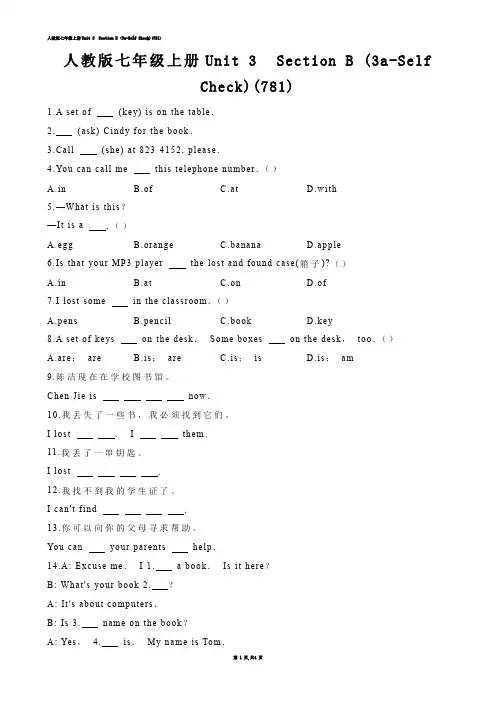
人教版七年级上册Unit 3 Section B (3a-SelfCheck)(781)1.A s e t o f(k e y)is o n th e ta b le.2.(a sk) C in d y f o r th e b o ok.3.Ca ll (sh e) a t 823-4152,p le a s e.4.Yo u c an ca ll me th is te le ph o ne n u mb e r.()A.inB.ofC.a tD.with5.—W ha t is th is?—It is a.()A.e g gB.or a ng eC.ba na n aD.a p p le6.Is th a t yo u r MP3p laye r th e lo s t an d fo u nd ca s e(箱子)?()A.inB.a tC.onD.o f7.I lo s t s o me in th e c la s s r oo m.()A.p e nsB.pe nc ilC.bo okD.k e y8.A s e t o f k e ys on th e d e sk.S o me box e s o n th e d e sk,to o.()A.a r e;a r eB.is;a r eC.is;isD.is;a m9.陈洁现在在学校图书馆。
C he n J ie is no w.10.我丢失了一些书,我必须找到它们。
I lo s t .I th e m.11.我丢了一串钥匙。
I lo s t .12.我找不到我的学生证了。
I c a n't f in d.13.你可以向你的父母寻求帮助。
You c an yo u r p a re n ts h e lp.14.A: E xc u se me.I 1.a b oo k.Is it h e r e?B: Wh a t's yo u r b o ok2.A: It's a b o u t c o mp u te rs.B: Is3.n a me o n th e bo okA: Yes, 4.is.M y n a me is To m.B: O h,yo u r b oo k is 5..A: Th an k yo u!B: You'r e6..M ik e f ou nd yo u r b oo k.A: I mu s t th a nk M ik e.B ye!B: B ye!(1)(2)(3)(4)(5)(6)15.G ina an d M a r y (be)s is te r s.16.H o w (b e)th e b o y?17.Is th is pe nc il (yo u)?18.H is (wa tch)ar e o n th e d e sk.19.P le a se(c a ll) J en n y a t 693-7512.20.We mu s t (h e lp) P a u l an d A la n.21.H o w do yo u(s p e ll)yo u r n a me参考答案1.【答案】:keys2.【答案】:Ask3.【答案】:her4.【答案】:C5.【答案】:C6.【答案】:A7.【答案】:A8.【答案】:B9.【答案】:in;the;school;library10.【答案】:some;books;must;find11.【答案】:a;set;of;keys12.【答案】:my;school;ID;card13.【答案】:ask;for14(1)【答案】lost(2)【答案】about(3)【答案】your(4)【答案】it(5)【答案】here(6)【答案】welcome15.【答案】:are16.【答案】:is17.【答案】:yours18.【答案】:watches19.【答案】:call20.【答案】:help21.【答案】:spell。
Unit 6 Section B Project 课件 人教版(2024)英语七年级上册
6:00/8:40p.m.
7:00p.m. after dinner after walking
When do you go to bed?
10:00p.m.
Let’s give a report now.
time order
注意谓语动 词用三单
Try to think: What do you think oWfNhMoaswt dLiitou’s’ysoduatihlyink roofyutohtuienrejtou?br?n.
新人教版七上
Section B project
教学目标
1.能够通过采访了解并记录被采访者的日常作息; 2.能够运用本单元所学的时间表达法介绍被采访者的日常生活; 3.能够从他人的生活日常中发现有利于时间管理和身心健康的想法和做法, 并从中受到启发和教育; 4.能够理解不同职业从业者的工作特点和不同作息,并尊重他们的生活方式.
I have lunch with my students at 12:30.
Interview:
What time do you get off work?
I usually get off work at 6:00. But when I have evening classes, I get off work at 8:40.
Now it’s your turn. 3a
Choose a profession that you want to know morepaoblioceut. teacher
officer
farmer reporter
bin worker nurse doctor DJ
Now it’s your turn. 3b
人教版七年级英语上册 Unit 3 Section B (3a-Self Check) 教案
完成 Self Check 的练
教学过程
学生活动
去写。这样既可以检查学生的单词掌握情况,也可以调动学生学习英语的积极 习。
性。
2.写新单词:让学生在练习本上写出本单元所学的其他单词。
Step 8:Self Check
让学生完成 Self Check 的第二部分,用代词填表。
I
me
my
mine
you
的写作做好
“Lost” below and find out the important information about it.
铺垫。
Lost:
Lost:
写一篇寻物
I lost my baseball. I lost my ID card.
启事。
练习运用词
Yellow and red.
My name is Mike.
课件呈现信
...
小组内进行 息,练习单
2.让学生根据家庭作业所做的卡片信息,进行物品主人的确认。
对话练习, 词和句型。
这样既可以检查学生的家庭作业情况,又可以训练学生的语言表达能力。 确认物主。
Step 3:Present “Lost and Found”
1.教师利用多媒体课件展示寻物启事和失物招领启事,让学生判断 Lost 和
写一篇寻物 启事。
提高写作能 力。
For example:
T:OK,let's try to write your own lost or found notice with your
name and phone number.
(The students write their bulletin board messages and the teacher
人教版七年级英语上册Unit3SectionB(2a3b)优秀教学案例
一、案例背景
本案例背景基于人教版七年级英语上册Unit 3 Section B(2a-3b)的教学内容。单元主题围绕“How old are you? How old is he/she?”展开,通过介绍不同年龄的人及其兴趣爱好,让学生掌握一般现在时态的提问和回答方式,以及运用基数词进行年龄的询问。此阶段的学生已初步掌握了英语学习的基本语法和词汇,但对于一般现在时态的运用尚处于初级阶段,需要通过实例和活动进一步巩固。
2.创设一个真实的语境,如“生日聚会”,让学生在为角色准备台词的过程中,运用一般现在时态描述年龄和兴趣爱好。
3.利用多媒体手段,如图片、视频等,展示不同年龄阶段的人的兴趣爱好,激发学生的学习兴趣,增强课堂趣味性。
(二)问题导向
1.教师可设计一系列问题,引导学生思考和讨论,如:“How old are you?”, “What do you like to do?”等,让学生在回答问题的过程中,运用一般现在时态。
(二)讲授新知
1.教师可通过讲解、示范等方式,向学生介绍一般现在时态的疑问句和回答方式,以及年龄的表达方法。例如:“How old are you? I am twelve years old.”
2.教师可设计一些实例,让学生区分一般现在时态和其他时态,如:“I like playing soccer.”(一般现在时态),“I played soccer yesterday.”(一般过去时态),帮助学生掌握一般现在时态的特点。
2.教师要求学生在课后反思自己的学习过程,发现自己的不足,制定改进措施。
3.教师鼓励学生在下一堂课前,展示自己的作业成果,进行同伴评价和自我评价。
新人教版七年级上册英语教案Unit
教学内容
1New words:like, banana, hamburger, tomato, broccoli, French fries, orange, ice, cream, salad, strawberry, pear, have,
小结与作业
课堂小结
本课作业
VIII. Homework
Make a survey.( The birthday presents for your parents )
What should you give your parents for their birthdays? What’s the best gift you have ever received? Pleasemake up a shopping list you could use to buy birthday presents for your parents.
( Help to say. )
Ss: Do you like pears/peaches/ grapes/bananas/…?
T: Yes, I do. / No, I don’t.
T: Can you write down my favorite fruit?
The Ss write them down.And see who write the faster and the best.
2 Ask some of them to read3aon page 29 from memory.
3.T: What’s this? ( It’s a soccer ball.)
人教版新目标英语七年级上册 Unit 6 教案(共计17页)
Unit 6 Do you like bananas?一、单元教材分析本单元的核心项目是“喜欢和不喜欢(like and dislike)”。
围绕着这一中心项目,课文中设计了各种食物及水果的插图和不同形式的表格,让学生进行听、说、读、写等各种学习活动。
通过本单元的教学,使学生学会询问对方与了解别人喜欢与不喜欢的食物,学会谈论自己与他人早、中、晚餐喜爱吃的食物,为其今后能在交际中恰当地表达自己的情感、灵活运用已经学过的常用功能项目、进一步学习并掌握新的语言功能奠定坚实的基础。
本单元的重点内容仍然是行为动词在一般现在时句子中的使用,应该是上一个单元内容的延伸,通过本单元的教学,学生应初步掌握行为动词一般现在时的肯定句、否定句、特殊疑问句、一般疑问句的构成以及简单的回答。
二、单元学情分析本单元的主题是使用动词like询问对方对食物的喜好;谈论自己与他人喜欢吃的食物,学习并掌握行为动词的一般现在时的使用。
通过前一单元的学习,学生已经初步了解了行为动词一般现在时的构成及其使用,再通过本单元学生比较感兴趣的话题的操练,一定会使学生有更深刻的印象;同时教师要善于总结、比较以帮助学生了解构成规律,正确把握所学内容。
三、单元教学建议采用自主学习、小组合作探究、Different opinions和Classifying的学习策略,利用实物、教学图片等来展开课堂pairwork问答式或groupwork讨论式的口语交际活动,使用like询问对方对食物的喜好和谈论自己、他人喜欢吃的食物。
本单元的教学法建议:语音教学——让学生进行模仿操练;词汇教学——采取演示讲解的方式进行教学,让学生进行情景操练、反复使用;口语教学——采取pairwork问答式和groupwork讨论式的口语交际活动互相操练练习;阅读教学——让学生学会抓住主要词汇和句型;听力教学——采取图文配对和对话选择的方式;写作教学——以填空、造句为主;语法教学——比较不同、总结规律、模仿操练。