
译林版英语 五上Unit 6 My e-friend 知识点
译林版英语 五上Unit 6 My e-friend 知识点
一. 词汇:
e-friend 网友 send 发出(信件、邮件等) email 电子邮件 to 给
live 住;居住 UK英国 study 学习 Australia 澳大利亚 Canada 加拿大
China 中国 US 美国 tomorrow 明天 fishing 钓鱼,捕鱼 sit 坐;坐在
by… 在…旁边 wait 等,等待 Wait a minute. 等一会儿。
…years old …岁 go fishing 去钓鱼 Don’t worry. 别担心。
二.句型及语法
1. Let’s go and play football in the playground. 让我们去操场踢足球吧。
○1let sb. do sth. 让某人做某事。sb.用宾格人称代替;do(动词)为动词原形。
Let me have a look.
○2and 意为“和”,在英语中是一个普通的连词,此句连接两个并列的句型。
“动词and动词”的结构,其前后时态及用法保持一致。
【拓展】:and作为并列连词,意为“和、并且”等,当连接三个以上的并列成分时,它放在最后一个成分之前,其余用逗号分开。
He buys a book, an eraser and a pen.
○3 play football 踢足球
【注】:play + 球类; play + the +乐器
2. Let me send this email first. 让我先把这封邮件发出去。
○1 send sb. sth. = send sth. to sb. 发送某物给某人(双宾语结构)
She sends me a Christmas card. = She sends a Christmas card to me.
【拓展】:双宾语结构:give sb. sth. = give sth. to sb. 给某人某物
show sb. sth. = show sth. to sb. 展示某物给某人
buy sb. sth. = buy sth. for sb. 买某物给某人
make sb. sth. = make sth. for sb. 制作某物给某人
○2 first意为“先…”,暗示接下去还有其他的动作和事件要发生。可用于形容词或副词,有时还可用作代词;at first意为“开始,起初”,作为介词短语,只起副词作用。它主要强调前后对照,暗示接下去的动作与前面的动作不同甚至相反。
【注】:当first作为序数词来用时,需要用定冠词the ;
on the first floor 在第一层楼上
3.He lives in the UK. 他住在英国。
○1“live”意为“居住、生活”;live with sb. 与某人一起住
He wants to live with his parents.
○2in the UK / US 在英国/ 在美国
在国家、城市、年、月、季节、早中晚等前面用介词“in”。
【注】:the UK / US是专有名词,故需要介词the。
4.How old is he? 他多大了?
“How old…?”是用来询问年龄的常用语,其答语为“I’m / He’s / She’s … years old”。
---How old is the baby?
---He is one year old.
5. Can he speak Chinese? 他会讲汉语吗?
speak Chinese 意为“讲汉语”,speak后接某种语言时为及物动词。
Wang Bing can speak Japanese.
6. Does he have Chinese lessons at school? 他在学校上汉语课吗?
Chinese lesson 意为“汉语课”;
【拓展】:Maths lesson“数学课”;English lesson“英语课”;Art lesson“艺术课”;PE lesson “体育课”;dancing lesson “舞蹈课”;swimming lesson “游泳课”;
Music lesson “音乐课”;Science lesson“科学课”
7. What subjects does he like? 他喜欢什么学科?
“What subjects do / does…like?”是询问某人喜欢什么学科时的常用语。其答语为“I
like…”或“He / She likes…”。
“What lessons do / does …have?”是询问某人有什么课程时的常用语。其答语为“I
have…”或“He / She has…”。
8. 特殊疑问词及用法
疑问词 意思 用法 疑问词 意思 用法
when 什么时间 问时间 what colour 什么颜色 问颜色
who 谁 问人 what/how about …怎么样 问意见
whose 谁的 问所有者 what day 星期几 问星期
where 在哪里 问地点 how …怎么样 问情况
which 哪一个 问选择 how old 多大 问年龄
what 什么 问东西 how many 多少 问数量(可数)
what time 什么时间 问时间 how much 多少 问数量/ 数量
9. Let’s go fishing tomorrow. 让我们明天去钓鱼。
go fishing 意为“去钓鱼”;go doing的结构一般用于户外活动,如做运动之类:
go swimming(去游泳);go shopping(去购物);go running (去跑步)等。
10. But I’m not good at fishing. 但是我不擅长游泳。
be good at= do well in + 动词ing / 名词,意为“擅长于做某事” 。
(同义句):But I don’t do well in fishing.
11.Bobby and Sam sit by the river. 波比和萨姆坐在河边。
sit by the river 意为“坐在河边”;介词by意为“在…旁边”。
Come and sit by me. 来坐在我旁边。
12. I don’t have any fish. 我没有任何鱼。
any 用在否定句和疑问句中,在肯定句中要用some。
以下特例疑问句用some
Would you like some apples?
What / How about some apples?
Can I have some apples?
Do you want some apples?
三. 短语:
play football 踢足球
my e-friend 我的网友
in the playground 在操场上
wait a minute 等一会
send this email 发这封电子邮件
live in the UK 住在英国
eleven years old 11岁
speak Chinese 讲中文
have Chinese lessons 有语文课
at school 在学校
study Chinese 学习汉语
after school 放学后
what subjects 什么学科
like Maths and PE 喜欢数学和体育
like swimming 喜欢游泳
don’t worry 别担心 swim well 游得好
eat fish 吃鱼
at a snack bar 在一家小吃店
go fishing 去钓鱼
be good at fishing 擅长钓鱼
teach you 教你
sit by the river 坐在河旁
many fish 许多鱼
live in Canada 住在加拿大
be good at English 擅长英语
wait and wait 等了又等
in Australia 在澳大利亚
in China 在中国
tomorrow morning 明天早上
know about these countries 了解这些国家
in winter 在冬天
turn to ice 变成冰
the winter weather 冬天的天气
wear warm clothes 穿暖和的衣服 Chinese addresses 中文地址
write English addresses 写英文地址
know about your e-friends 了解你的网友们
牛津译林英语五上《Unit 6 My e-friendD》[教案]【市级】优质课
![牛津译林英语五上《Unit 6 My e-friendD》[教案]【市级】优质课](https://360docs-1393072327.cos.ap-beijing.myqcloud.com/43bf0a84bb4cf7ec4afed0c8.webp)
教学目标
1、学生能够熟练掌握句型Does he/she …? What...does he/she...?
2、通过自主学习和小组合作,能运用所学词汇和句型对自己的朋友或者网友进行综合全面的介绍,并能正确书写。
3、能够在阅读过程中体验到交朋友的乐趣,尝试通过英特网交朋友。
2学情分析
本节课围绕的主要话题是“网友”。通过之前的学习,学生已经学过了年龄、学科和兴趣爱好等话题,结合本单元的主题,教师可以鼓励学生综合运用以前学过的知识对自己的朋友或是网友进行全面的介绍。文本中的一般现在时的一般疑问句及其回答是学生表达的难点,如:Do they like...?Yes,they do/No,they
don’t.Does he/she like...?Yes,he/she does/No,he/she does’t。教师可以设置多种情景,让学生学会在实际运用中掌握所学的知识。【明德教学资源库 独家整理
添加微信:mdjxzyk 永久免费更新最新资源】
3重点难点
1、学生能够熟练掌握句型Does he/she …? What...does he/she...?
2、通过自主学习和小组合作,能运用所学词汇和句型对自己的朋友或者网友进行综合全面的介绍,并能正确书写。
4教学过程
4.1 第一学时
4.1.1教学活动
活动1【导入】Step1 Warming up
Free talk
T: Good morning, boys and girls. Today, I’m your new English teacher. You can
call me Miss Cheng. Last week, we learned Unit6 My e-friend. Now, we’ll go on. At
this lesson, we have 3 aims. The first one is “I can talk about my e-friends.” The
新译林版英语五年级上册第6单元全部教案6课时
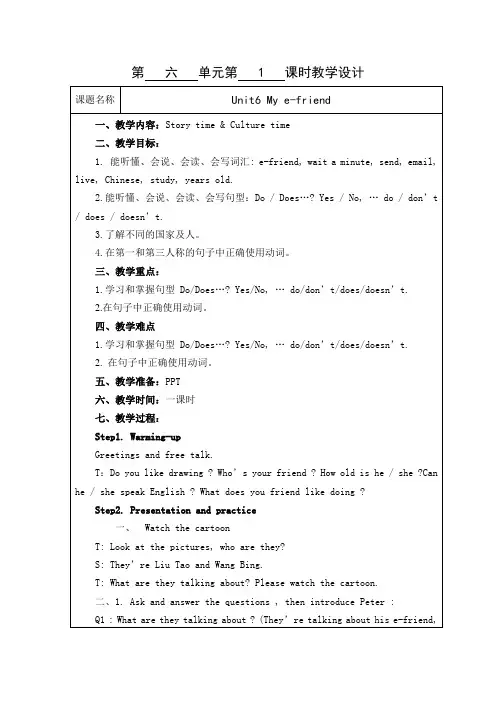
第 六 单元第 1 课时教学设计
课题名称 Unit6 My e-friend
一、教学内容:Story time & Culture time
二、教学目标:
1. 能听懂、会说、会读、会写词汇: e-friend, wait a minute, send, email,
live, Chinese, study, years old.
2.能听懂、会说、会读、会写句型:Do / Does…? Yes / No, … do / don’t
/ does / doesn’t.
3.了解不同的国家及人。
4.在第一和第三人称的句子中正确使用动词。
三、教学重点:
1.学习和掌握句型 Do/Does…? Yes/No, … do/don’t/does/doesn’t.
2.在句子中正确使用动词。
四、教学难点
1.学习和掌握句型 Do/Does…? Yes/No, … do/don’t/does/doesn’t.
2. 在句子中正确使用动词。
五、教学准备:PPT
六、教学时间:一课时
七、教学过程:
Step1. Warming-up
Greetings and free talk.
T:Do you like drawing ? Who’s your friend ? How old is he / she ?Can
he / she speak English ? What does you friend like doing ?
Step2. Presentation and practice
一、 Watch the cartoon
T: Look at the pictures, who are they?
S: They’re Liu Tao and Wang Bing.
T: What are they talking about? Please watch the cartoon.
五年级上英语知识整理56单元|译林版
五年级上英语知识整理56单元|译林版
5、6单位
Unit5 What do they do
【单词】
a cook 一个厨师 a doctor 一个医生 a driver 一个驾驶员 a
farmer 一个农民
a nurse 一个护士 a policeman 一个警员 a teacher 一个老师 a
worker 一个工人
1. teacher 老师 2. teach 教 3. writer 作家 4.write
写 5.work 劳动
6.at home 在家 7.doctor 医生 8.help 帮助 9.sick 生病 10.people 人,人们 11.factory 工厂 12.worker 工人 13.cook 厨师 14.driver 驾驶员,司机
15.farmer 农民 16.nurse 护士 17.policeman 警员
【词组】
1. teach English 教英语 2. a lot of students =lots of
students 许多学生
3. What about...?= How about....? ....怎么样 4. an English teacher 一位英语西席
5. write stories 写故事 6. work at home 在家劳动
7. help sick people 帮助生病的人 8. a factory worker 一个工厂工人
9. make sweets 做糖果 10. a lot of sweets 许多糖果
五上Unit_6_My_e-friend教案
1 Unit 6 My e-friend备课教案
主备人:教 者: 第 3-4 周
教学内容 Unit 6 My e-friend
教学目标:
1. 能听懂、会读、会说单词: e-friend, send, to,email, live, study, China,UK,…years old, wait.
2. 能听懂、会读、会说日常用语:Does he/she…?Yes, he/she does. No, he/she doesn’t. Wait a
minute.
3. 能正确的理解并朗读课文,在教师的引导和帮助下尝试复述课文内容。
4. 能初步运用本课所学的词汇和句型对自己的朋友或者网友进行综合全面的介绍。
教学重点:
1. 能正确理解并朗读课文,在教师的帮助下尝试复述课文。
2. 能初步运用本课所学的词汇和句型对自己的朋友或者网友进行综合全面的介绍。
教(学)具准备:
教学挂图,单词卡片,多媒体 课时划分 共 5 课时
教学设计 第1课时
A. Warming up
1. Greetings
2. Say a rhyme
Subjects (4B Unit 1)
师生一起诵读、改编歌谣Subjects, 复习科目类单词
3. Free talk
What subjects do you like?
What subjects does your friend like?
What do you like doing after school?
What does your friend like doing after school?
B. Presentation and practice
1. 呈现有关澳大利亚、加拿大、中国、美国和英国的标志性建筑、代表性动物、传统服装或特色美食的照片,师生谈话,学习这些国家名称及主要城市Sydney, London, toronto, New
五年级上册英语教案-Unit6Mye-friendSoundtime|译林版(三起)
五年级上册英语教案-Unit6 My efriend Sound time |译林版(三起)
一、教学目标
1. 知识与技能目标:学生能够理解并正确运用一般现在时描述人物的外貌、性格、爱好等特征。
2. 过程与方法目标:学生能够通过图片、情景创设等方式,提高英语听说能力和语言运用能力。
3. 情感态度与价值观目标:培养学生关爱他人、积极向上的情感态度,增强合作意识。
二、教学内容
1. 词汇:eye, ear, hair, nose, mouth, face, arm, leg,
foot等身体部位词汇。
2. 句型:What do/does he/she look like? He/She has
3. 功能:描述人物的外貌、性格、爱好等特征。
三、教学重点与难点
1. 教学重点:掌握身体部位词汇,学会描述人物的外貌、性格、爱好等特征。
2. 教学难点:正确运用一般现在时描述人物特征,区分不同人物的外貌和性格特点。
四、教具与学具准备
1. 教具:PPT、图片、卡片、录音机等。
2. 学具:课本、练习册、文具等。
五、教学过程 1. 导入:通过歌曲、游戏等形式,激发学生学习兴趣,引导学生复习已学过的身体部位词汇。
2. 新课呈现:利用PPT、图片等展示本课主要词汇和句型,引导学生跟读、模仿,并进行角色扮演。
3. 操练:分组进行练习,让学生运用所学词汇和句型描述身边的同学,提高语言运用能力。
4. 巩固:通过游戏、竞赛等形式,巩固所学知识,检查学生的学习效果。
5. 作业布置:布置课后作业,要求学生运用所学描述人物特征,提高写作能力。
六、板书设计
1. Unit6 My efriend Sound time
2. 主要内容:身体部位词汇、句型、功能
3. 板书设计:简洁明了,突出重点,便于学生记录和复习
七、作业设计
1. 编写一篇关于自己朋友的英语短文,要求描述外貌、性格、爱好等特征。
2. 收集身边同学的照片,用英语描述他们的外貌和性格特点。
牛津版五年级上册英语重点知识整理
译林版英语五年级上册知识点整理
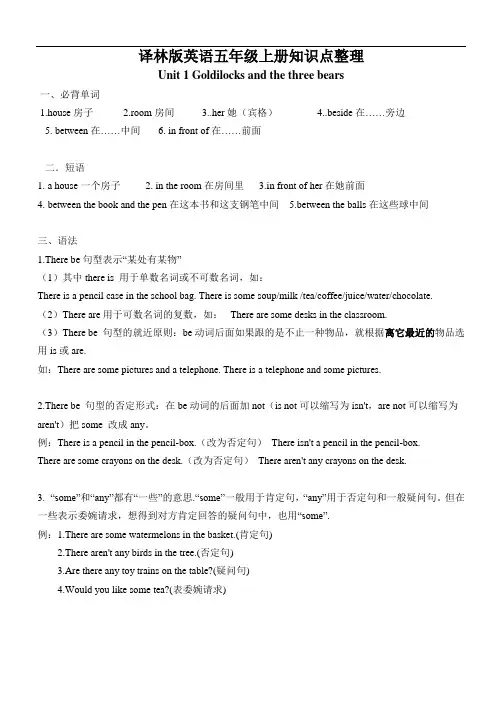
Unit 1 Goldilocks and the three bears
一、必背单词
1.house房子 2.room房间 3..her她(宾格) 4..beside在……旁边
5. between在……中间 6. in front of在……前面
二.短语
1. a house一个房子 2. in the room在房间里 3.in front of her在她前面
4. between the book and the pen在这本书和这支钢笔中间 5.between the balls在这些球中间
三、语法
1.There be句型表示“某处有某物”
(1)其中there is 用于单数名词或不可数名词,如:
There is a pencil case in the school bag. There is some soup/milk /tea/coffee/juice/water/chocolate.
(2)There are用于可数名词的复数,如: There are some desks in the classroom.
(3)There be 句型的就近原则:be动词后面如果跟的是不止一种物品,就根据离它最近的物品选用is或are.
如:There are some pictures and a telephone. There is a telephone and some pictures.
2.There be 句型的否定形式:在be动词的后面加not(is not可以缩写为isn't,are not可以缩写为
aren't)把some 改成any。
例:There is a pencil in the pencil-box.(改为否定句) There isn't a pencil in the pencil-box.
苏教版译林版五年级英语上册单元知识及短语默写检测
Unit 1 单元知识
单词
熊 森林 (与be连用)有 房子
汤 right正合适 房间 硬的
柔软的 害怕的 front of在……前面 她(宾格)
救命 在……旁边 在……中间 真正地
然后 找到,发现 他们的
词组
1. in the forest在森林里 2. a beautiful house一座漂亮的房子
3. in the house 在房子里 4. hungry and thirsty又饿又渴
soup一些汤 6. on the table在餐桌上
7. too cold太冷了 8. too hot太热
9. in the room在房间里 10. too hard太硬
soft太软了 12. just right正合适
13. be afraid害怕 14. three bears三只熊
15. in front of her在她前面 16. a glass of milk一杯牛奶
a cold得了感冒 on your coats穿上你们的外套
China在中国 some cakes吃些蛋糕
the kitchen在厨房里 the fridge在冰箱里
译林牛津5AUnit6 My e-friend教学设计
Unit 6 My e- friend
单元教材分析:
本单元围绕的主要话题是“网友”。通过之前的学习,学生已经学过了年龄、学科和兴趣爱好等话题,结合本单元的主题,教师可以鼓励学生综合运用以前学过的知识对自己的朋友或是网友进行全面的介绍。文本中的一般现在时的一般疑问句及其回答是学生表达的难点,如:Do they
like...?Yes,they do/No,they don’t.Does he/she like...?Yes,he/she does/No,he/she does’t。教师可以设置多种情景,让学生学会在实际运用中掌握所学的知识。
教学目标:
1.能听得懂、会说、会读和会拼写国家类单词。
2.能正确使用特殊疑问句来询问他人信息,如年龄、爱好、居住地等。
3.了解字母w在单词中的读音。
4.了解中英信封的不同写法。
教学重点:
1能正确理解、掌握对话内容,并能朗读,初步表演对话。
2能从国籍、年龄、爱好、所学科目等方面来描述他人的信息。
教学难点:
1能正确理解、掌握对话内容,并能朗读,初步表演对话。
2能从国籍、年龄、爱好、所学科目等方面来描述他人的信息。
3.语音:字母w在单词中的读音。
课时安排:5课时
第1课时:Story time(text, think and write)
第2课时:Story time (words, Think and say)
第3课时:Fun time ,Grammar time
第4课时:Cartoon time ,Sound time
第5课时:Culture time,Checkout time
第6课时:Ticking time(review , exercise)
第1课时Story time(text, Think and write)
教学目标:
1. 理解,掌握对话内容,用正确的语音语调朗读对话,初步表演对话。
2. 正确运用日常交际用语How old is he/she?Do/Does…? Yes/No, … do/don’t/does/doesn’t.What
译林版五年级上册个单元知识点整理
5A Unit1 Goldilocks and three bears
一、单词:
1. forest 森林
2. house 房子
3. soup 汤
4. hard 硬的 5. soft 软的
6. afraid 害怕
7. help 救命
8. bear 熊 9. really 真的
10. beside 在„旁边
11. find 找到 12. between 在„之间
13. their 他们的
14. then 然后
二、词组:
1. in the forest 在森林里 2. a beautiful house 一个漂亮的房子
3. in the house 在房子里 4. hungry and thirsty 又饿又渴
5. some soup 一些汤 6. on the table 在桌子上
7. too cold 太冷 8. too hot 太热
9. just right 正好 10. three beds 三张床
11. too hard 太硬 12. too soft 太软
13. three bears 三只熊 14. in front of her 在她前面
15. in the room 在房间里 16. on the chair 在椅子上
17. a glass of milk 一杯牛奶 18. have a cold 感冒
19.put on 穿上 20.have some cakes 吃些蛋糕/有一些蛋糕
21.in the fridge 在冰箱里 22.in the kitchen 在厨房里
23.find their cousin 找到他们的表弟 24. in the living room 在客厅
五年级上册英语教案Unit 6 My efriend 译林版
第1页/共5页 五上Unit 6 My
e-friend
一、 教学设计理念
本课以新技术、新媒体为载体,由已知向新知进行合理化的知识迁移,通
过任务驱动以及丰富趣味的课堂活动,引导学生主动学习新知识,达到Involve
me, I’ll understand.的自主学习效果。科学、合理、恰当地利用计算机、可控式一体机以及云资源,能丰富教学内容和形式,给学生创造更好的自主性语言学习环境,不断激发学生学习英语的兴趣,促进学生对知识的掌握。
二、教学背景分析
(一).教材分析
本课是继前面四五单元一般现在时的延续,以介绍网友来学习一般现在时的一般疑问句及其回答。并且在学习介绍他人的爱好后,继续学习介绍他人的其他方面信息。
(二).学情分析
五年级孩子对新奇事物有较强好奇心,对信息化学习有很强的探究愿望,可采取多种信息化手段,如预习时可利用 “一起作业”APP,达到预习效果,并调查预习结果数据。在课堂教学时,可利用可触式一体机,平板电脑, 自由播放音频和视频素材,创设声音图像的形象化情境。孩子们在全新的教学环境下对英语学习的兴趣,方法能力上都有所提高。
三、教学目标
课前预习目标: 第2页/共5页 利用“一起作业” APP布置文本内容的预习,利用网络将学习内容进行前置,初步了解本文并进行相关拓展性学习。
课堂教学目标:
1、借助信息化手段整体学习理解语篇My e-friend, 并在此基础上进行课文表演及尝试复述课文内容。
2、通过学习,学生能理解并运用Does he/she …? Yes, he/she does. No,
he/she doesn’t. Wait a minute. 等句型
3、让生掌握“Friends”这一话题的相关语言知识,并能对自己的朋友或网友进行综合全面的介绍。
教学重难点:
能正确理解并朗读课文,学会问答关于朋友的一些问题。并能初步运用本课所学的词汇和句型对自己的朋友或者网友进行综合全面的介绍。