
大学英语 第一课
Remember more! 5. Review timely Exercise more! 6. Practice over and over Review more! Have the ways of your own! again
Hi, My College!
Hi, My College!
Some Rules to Follow
You must bring…
1. Two books Intensive reading book & listening and reading book
2. A notebook 3. A pen
Hi, My College!
Hi, My College!
Thank you !
Let’s work hard together, I believe we can achieve the goals we set.
关于大学英语四、六级考试题型调整的说明
自2013年12月考次起,全国大学英语四、六级考试委员会将对四、六级考试 的试卷结构和测试题型作局部调整。调整后,四级和六级的试卷结构和测试 题型相同。 二、新题型说明 1. 单词及词组听写 原复合式听写调整为单词及词组听写,短文长度及难度不变。要求考生在听 懂短文的基础上,用所听到的原文填写空缺的单词或词组,共10题。短文播 放三遍。 2. 长篇阅读 原快速阅读理解调整为长篇阅读理解,篇章长度和难度不变。篇章后附有10 个句子,每句一题。每句所含的信息出自篇章的某一段落,要求考生找出与 每句所含信息相匹配的段落。有的段落可能对应两题,有的段落可能不对应 任何一题。 3. 翻译 原单句汉译英调整为段落汉译英。翻译内容涉及中国的历史、文化、经济、 社会发展等。四级长度为140-160个汉字;六级长度为180-200个汉字。
Some Rules to Follow
You must obey…in my class 1. Do not be absent---unexcused absent 2. Do not be late 3. Do not talk loudly in class 4. Do not answer the phone in my class & Turn your phone off or to silent 5. Do not go to the toilet in my class
Hi, My College!
Welcome to My Class !
Hi, My College! NEW TERM
NEW BEGINNINGS
Hi, My College!
Hi, My College!
About Me
Chinese Name:
English Name:
QQ Number Weixin number: Public Mailbox:
Hi, My College!
Old Saying
“ Tell me and I forget,
Teach me and I remember,
Involve me and I learn.”
---By Benjamin Franklin
Hi, My College!
You must …
Involve the class 1. preview the text 2. answer the questions 3. listen carefully 4. take some notes 5. finish the assignment
…
Hi, My College!
Cultivate Good learning Habits 1. Draw up a study plan
I see, I forget. 2. Preview before a class I read, I remember. I do it, I understand! 3. Listen carefully
L+E+A+D+E+R+S+H+I+P
12+5+1+4+5+18+19+9+16 = 89%
ATTITUDE
A+T+T+I+T+U+D+E 1+20+20+9+20+21+4+5 = 100%
It is OUR ATTITUDE towards Life and Work that makes OUR Life 100% ! ! !
( do most of us think this is the most important ??? )
Then what makes 100% ?
Is it Money ? ... NO ! ! !
M+O+N+E+Y
13+15+14+5+25 = 72% Leadership ? ... NO ! ! !
Hi, My College! Final scores
Exam scores(70%) Usual scores(30%)
attendence (10%) performance in class(10%)
assignments (10%)
A SMALL TRUTH TO MAKE LIFE 100%
Attitude is Everything!!!
Change Your Attitude … And You Change Your Life ! ! !
Hi, My College!
Let’s work hard together, I
believe we can achieve the
goals we set.
Course Arrangement in this term
Intensive Reading
Unit 1---Unit 5
(10 weeks)
Focus Listening and Speaking Unit 1---Unit 8 (16 weeks) CET 4 Past exams
(5-6 weeks)
Hard Work H+A+R+D+W+O+R+K 8+1+4+23+15+18+11 = 98% Knowledge
K+N+O+W+L+E+D+G+E
11+14+15+23+12+5+4+7+5 = 96%
Love
L+O+V+E
12+15+22+5 = 54% Luck
L+U+C+K
12+21+3+11 = 47%
新视野大学英语第一课教案
教案2016 ~2017 学年度第一学期课程名称大学英语学时学分 70学时4.5学分专业班级授课教师系部外语系本课程教学总体安排课程名称:大学英语课程性质与类型:公共必修课总学时、学分:70学时,4.5学分教学目的与要求:1.通过本学期的学习,使学生进一步加强基础知识。
2.扩大词汇量,熟悉并掌握大学英语教学大纲中规定的单词、词组和结构的用法,达到大学英语一级的水平及要求。
3.进一步提高学生的听力、阅读及写作技巧。
4.进一步加强学生的语言实际应用能力,尤其是听说能力和篇章理解分析能力。
教材及参考书目:1. 《新视野大学英语》(第三版)读写教程(第1册第1单元—第8单元)2.《新视野大学英语》(第三版)听说教程(第1册第1单元—第8单元)3. 《新视野大学英语》(第三版)教师用书4.《新视野大学英语》(第三版)配套光盘5. 牛津英汉双解词典考核方式及成绩计算方法:综合成绩=期末成绩*60%+听力成绩*15%+读写成绩*10%+平时成绩*15%课程教学日历课程名称:大学英语授课学期:2016-2017学年第一学期第一章教学安排的说明章节题目:Book 1 Unit 1 Fresh startText A Toward a brighter future for all学时分配:8本章教学目的与要求(分了解、熟悉、掌握三个层次):一、了解课文有关的背景知识二、熟悉文章的中心思想和篇章结构三、熟悉文中所体现的记叙技巧四、掌握大学英语教学大纲中规定的单词和词组及其搭配五、掌握文中所包含的主要语法结构:其它:课堂教学方案课题名称、授课时数:大学英语、8课时授课类型:理论课、技法课、习题课教学方法与手段:讲授、讨论、指导、多媒体等教学目的要求:Students should be able to1. grasp he main idea and structure of the text;2. give reasons when they do the ranking activities and make predictions;3. master the key language points and grammatical structures in the text;4. conduct a series of reading, listening, speaking and writing activities related to the theme of the unit.教学重点、难点:1重点:核心词汇及短语、句型结构等语言点(Master the key language points and grammatical structures in the text)2难点:语言特点的分析第1、2学时:授课类型:多媒体加讲解教学方法与手段:领读、自读、多媒体、讲解、举例讲解教学目的要求:一、了解课文有关的背景知识二、熟悉文章的中心思想和篇章结构三、熟悉文中所体现的记叙技巧四、掌握大学英语教学大纲中规定的单词和词组及其搭配五、掌握文中所包含的主要语法结构教学重点、难点:1重点:核心词汇及短语、句型结构等语言点2难点:语言特点的分析教学内容及组织安排:一、朗读Text A出现的生词和短语(朗读10分钟)二、引导讲解和Text A有关的背景知识(多媒体讲解 10分钟)1. What is the ideal university like in your eyes?2. What are your expectations of your college life?三、讲解Text A 课文内容,并结合Text A课文内容,讲解核心词汇及短语、句型结构等语言点(多媒体举例讲解 80分钟)1. 生词表中的词汇及短语2. 用于表达“某人在特定身份下做某事的感受”。
大学英语第一册第一课
Critical Thinking
To develop students' analytical and critical thinking skills through discussions and debates on topics related to English language and culture.
Communication Skills
To improve students' ability to communicate effectively in English, both in formal and informal settings.
Course Outline
01
Unit 1: Language and Culture
The article also highlights important grammar points,
such as parallelism, subordination, and
modality.
These sentence structures and grammar points are used to enhance readability and to ensure that the message is clear and well-
Movie and TV dialogues
选取经典的电影和电视剧片段,让学生熟悉不同场景下的对话,提高 听力反应速度。
half a day大学英语第一课

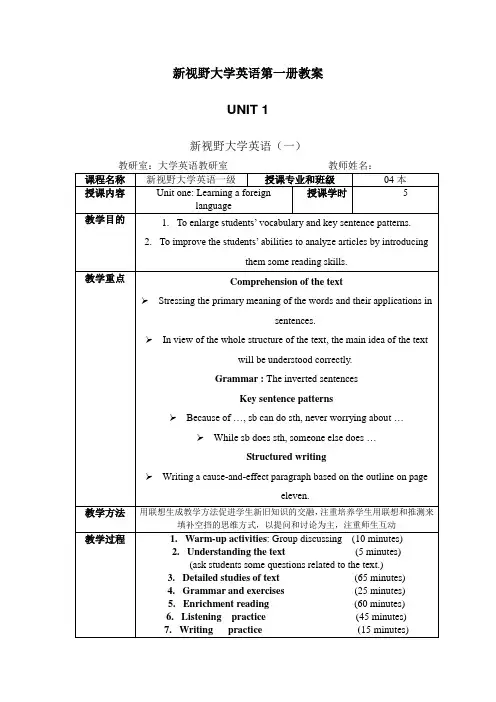
Lesson one half a dayi.Teaching Aim:1.The theme of the article: time flies. How to achieve by using thewriting technique; and the structure2.Grammar: to review some basic usage of past participle andpresent participle by paying attention to some sentence structures in the article, the usage of with3.Sentence patterns and key wordsii.Procedure(6 hours)1.Vocabulary2.Warming up:What’s your deepest impression of your first day to theUniversity?Before you go to college, did your parents give you somesuggestions about your college life?Are you afraid of leaving home and your parents to leave in anew place with your roommate? Or you are excited about that?What’s your dream you want to realize during the four academic years? Or what are your expectations of university?Use one sentence to connect the warming up with the article: this article is also about a boy’s first day of school life. Let’s see if he has some similar feelings with us.3.The author and the writing techniques used by the author.4.Text structureThree parts5. Detailed analysis of each partMain ideas of each partSentence pattern, phrases, words and grammar6.Final discussion:The theme or purpose of the article: time flies?Education can never keep up with changes in societyLife is short and time is preciousiii.The first part:1.Read the first two paragraph and answer the question:How did the boy feel about going to school?Does he feel happy?2.Alongside, clutching;to be thrown into/out of a place3.We walked along a street lined with gardens and fieldsplanted with crops, pears, and date palms4.Why school? I asked my father. “What have I done?”Elliptical question /rhetorical questionEg: go and fetch the book5.Father’s suggestion to the boy. Which one do you agree?6.I didn’t believe there was really any good to be had in tearingme away from my home and throwing me into the huge, hign-walled building.There is no good to be had in doing sth.It is no good/use doing sthI didn’t think it was useful to take me away from home and putme into that building with high walls.7.Put a smile on your face and be a good example to others8.Be a man. Today you truly begin life.9.You will find me waiting for you when it’s time to leave.Find sb doing sth。
《现代大学英语精读1》第1课Half-a-Day-课文讲解
Half a DayNaguibMahfousAbout the AuthorName: NaguibMahfous纳吉布·马哈福兹Nationality:EgyptianDates: From Dec.1911 to Aug. 2006 Birthplace:an old quarter of CairoEducation: studied philosophyat auniversity ofCairo, graduating in 1934.Job: in university administrationas a civil servantas a journalist(记者)Influence: 1st Arab to win the Nobel Prize for literature in 1988described as "a Dickens of the Cairo cafés" and "the Balzac of Egypt".Half of his novels have been made into filmsAbout the AuthorWorks: no fewer than 30 novels, more than 100 short stories, and more than 200 articles●the Cairo Trilogy in 1957●Children of Gebelawi in 1959 (Prize novel for the reasonthat "who, through works rich in nuance - nowclear-sightedly realistic, now evocatively ambiguous -has formed an Arabian narrative art that applies to allmankind"(他通过大量刻画入微的作品—洞察一切的现实主义,唤起人们树立雄心—形成了全人类所欣赏的阿拉伯语言艺术)●the Thief and the Dogs in 1961《小偷与狗》●Small Talk on the Nile in 1966《尼罗河上的絮语》About the Half a Day●First published in Arabic in 1989as part of a short story collectionentitled The False Dawn.●Included in an English-language collection entitled The Time andthe Place in 1991.●Belongs to his later phase and characterized by a shift from socialrealism to a more modern, experimental mode of writing.●An allegorical taleimplicates a commentary on the humancondition; an entire life span is experienced as only ''half a day'' in the school of life and also alludes to the cycle of life, whereby the narrator passes through childhood, middle age and old age in the course of one day.●Uses a strategy commonly used in fiction writing –theprotagonist returns after being absent for a short time to find everything changed beyond recognition. The best example is Rip Van Winkle, a short story by American writer, Washington Irving.●This technique is often used to emphasize rapid changes insociety.Structure●Plot故事情节: a little boy’s first time to go to school●Setting背景: on the way to schoolat schoolon the way home●Protagonist/Narrator主人公/讲述人: “I”–the boy in thestory●Theme of the story主题: rapid changes in societyThree Parts●Para. 1-7: t he boy’s reluctance to go to schoolHis misgivings about school●Para. 8-16: t he Boy’s life at school:Rich and colorful, Requiringdiscipline and hard workPara. 17-20: at the end of school day:Everything has changed!●Detailed Analysis—para1S1---I walked alongside my father, clutching his right hand.1. What’s the function of the –ing form clutchinghis right hand?2. Who clutched his right hand?3. Can you find some other –ing form in this passage whose function is the same as clutching his right hand?S2---All my clothes were new:the black shoes, the green school uniform, and the red cap.S3---They did not make me happy, however, as this was the day I was to be thrown into school for the first time.1. What does They refer to?2. What is the function of the clause I was to bethrown into school for the first time?3. Can you identify the sentence type?Simple sentence, Compound sentenceComplex sentence orCompound-complex sentence4. What’s the p art of speech of however?the minute/moment (that)... as soon as... 一...就...: I want to see him the minute (that) he arrives. 他一来到我就要见他.Detailed Analysis—para2S1---My mother stood at the window watching our progress, and I turned towards her from time to time, hoping she would help.1. Can you identify the sentence type?2. Can you find the logical subject of the present participle phrases watching our progress and hoping she would help?3. What do you get from the phrase hoping she would help?4. What does watching our progress mean?Detailed Analysis—para2S2---We walked along a street lined with gardens and fields planted with crops, pears, and date palms.1. What’s the function of lined with gardens and planted with crops?2. Can you put in the omitted parts of lined with gardens and planted with crops?3. Can you find some more in this passage?Descriptive PhrasesCompare:1.People who are unhappy with the amount of spam they receiveshould write to their lawmakers.2.People unhappy with the amount of spam they receive should writeto their lawmakers.3.Pierre Omidyar, who is the founder of eBay, is one of the richest menin the world.4.Pierre Omidyar, the founder of eBay, is one of the richest men in theworld.5.One-half of all of the e-mail that is sent today is spam.6.One-half of all of the e-mail sent today is spam.7.There are about 11 million items that are listed on eBay.8.There are about 11 million items listed on eBay.9.A man who is living in Florida retired at the age of 37 after makingmillions in the spam business.10.A man living in Florida retired at the age of 37 after making millions inthe spam business.Detailed Analysis—para2S2---We walked along a street lined with gardens, and fields planted with crops: pears, and date palms.Descriptive PhrasesCompare:11.Shoppers who are using eBay can locate a hard-to-find item.12.Shoppers using eBay can locate a hard-to-find item.13.Spam, which is unwanted commercial e-mail, is an annoyingproblem.14.Spam, unwanted commercial e-mail, is an annoying problem.15.eBay, which is an auction Web site, is very popular.16.eBay, an auction Web site, is very popular.17.A man who is in Florida retired at the age of 37.18.A man in Florida retired at the age of 37.19.Pierre, who is from France, created eBay.20.Pierre, from France, created eBay.Detailed Analysis—para2S2---We walked along a street lined with gardens, and fields planted with crops: pears, and date palms.3. From above, can you summarize the similarities of all these sentences?Descriptive PhrasesLanguage Note:1. A descriptive phrase can be essential or nonessential. A nonessentialphrase is set off by commas.People unhappy with the amount of spam they receive should writeto their lawmakers.Pierre Omidyar, the founder of eBay, is one of the richest men in theworld.2.An appositive is always nonessential., an online store, is a very popular Web site.Detailed Analysis—para3S1---"Why school?" I asked my father. "What have I done?”1. What’s the feeling of the boy?2. What’s the elliptical sentence?3. What is the rhetorical question?Summary—para1-3What do you get from these paragraphs?The boy’s feelingHelpless—new clothes did not make me happy Thrown into schoolFrom time to timeHoping she would helpWhy school? What have I done?Detailed Analysis—para4S3---It's a place that makes useful men out of boys.1. make…(out) of sb/sth: cause sb/sth to be orbecome sth使某人[某事物]处於某状况或变成某事物:使其成为争论之点.Eg.W e'll make a footballer of him yet.我们还是要把他造就成优秀的足球运动员Don't make a habit of it/Don't make it a habit.不要养成那样的习惯.2. What is the function of that makes useful menout of boys? Can you find some more in this passage?3. Can you identify the sentence type?Detailed Analysis—para5S2---I did not believe there was really any good to be had in tearing me away from my home and throwing me into the huge, high-walled building.1. It is no good/use doing sth. Or There is no good to be had in doing sth.: It is not useful to do 做…没有什么用处eg. It’s no good crying over spilt milk. 覆水难收It’s no use talking to him2. tearoneself/sb. away from ...:leave sb/sthreluctantly 勉强使离开,忍痛舍去Eg.Do tear yourself away from the television and come out for a walk. 你别舍不得离开电视了, 出去散散步吧.The young artist couldn't tear himself awayfrom da Vinci's Mona Lisa.He couldn’t tear himself away from the book.3. Can you identify the sentence type?Detailed Analysis—para6S1---When we arrived at the gate we could see the courtyard, vast and full of boys and girls.1. What’s the function of the adjective phrase vastand full of boys and girls?2. Can you put in the omitted parts of this phrase?3. Can you identify the sentence type?Detailed Analysis—para7S1---I hesitated and clung to his hand, but he gently pushed me from him.1. Can you identify the sentence type?2. What’s the base/original form of clung?Fling: 扔, 抛, 掷Sting: 蜇(伤), 刺(伤)(某人)String: 装弦, 用线或细绳将…穿起来Swing: 摆动, 摇摆S2---“Be a man,” he said.1. What does man mean here?S3---Y ou will find me waiting for you when it's time to leave. "1. What’s the function of waiting for you?2. Can you tell the difference between object complement andpresent participle as adverbial?Can you tell the difference between object complement and direct object?3. Can you identify the sentence type?4. Complete the Ex6 on page 14.Detailed Analysis—para8I took a few steps. Then the faces of the boys and girls came into view. I did not know a single one of them, and none of them knew me. I felt I was a stranger who had lost his way. But then some boys began to glance at me in curiosity,and one of them came over and asked, "Who brought you?"Detailed Analysis—para11S1---I did not know what to say.1. question word + to do sthS2---The gate was now closed.1. What’s the function of closed? Is it a past participle as adjective or a past participle to form a passive voice?Detailed Analysis—para11S3---Some of the children burst into tears.burst into: send out or produce sth suddenly and violently 突然而猛烈地发出或产生出某事物eg. The aircraft crashed and burst into flames. 飞机坠毁起火.burst into tears, song, angry speech突然哭﹑唱﹑吵起来trees bursting into leaf/ bloom/ blossom/flower 长出新叶[开花]的树木burst out●speak suddenly and with feeling; exclaim突然激动地说; 叫嚷:Eg.`I hate you!' she burst out.‘我讨厌你!’ 她叫嚷道.●(with the -ing form 与-ing连用) suddenly begin (doing sth) 突然开始(做某事):Eg.burst out crying/laughing/singing突然哭起来[笑起来/唱起来].Detailed Analysis—para11S5---A lady came along, followed by a group of men.1. What’s the function of followed by a group of men?S6---The men began sorting us into ranks.1. sort: ~ sth (out) (into sth); ~ sth (out) from stharrange things in groups; separate things of one type, class, etc from things ofother types, etc 将事物分类; 整理:Eg. He was sorting his foreign stamps into piles. 他正在整理外国邮票, 都分成一摞一摞的.We must sort out the good apples from the bad. 咱们得把好苹果拣出来, 同坏的分开.2. Can you list some verbs which should be followed by doing sth or by to do sth or both?The following verbs take a gerund.admit advise* allow* appreciate avoid consider delaydeny discuss dislike enjoy escape excuse finish forbid*imagine include keep (on) mind miss permit*postpone practice quitrecommendresentresist risk stand stop suggest*Allow doing sth allow sb to do sthDetailed Analysis—para11S7---We were formed into an intricate pattern in the great courtyard surrounded by high buildings;from each floor we wereoverlooked by a long balcony roofed in wood.1. Can you identify the sentence type? Why?2. What’s the function of the past participle phrases surrounded by high buildings and roofed in wood?Detailed Analysis—para13S1---Well, it seemed that my misgivings had had no basis.1. What’s the function of the clause that my misgivings had had no basis?2. Why the author use the two different tenses?3. What does the author convey to the reader?S2---From the first moments I made many friends and fell in love with many girls.1. What does the author convey to the reader?S3---I had never imagined school would have this rich variety of experiences.1.How can you explain the two different tenses?2.What are the experiences?Detailed Analysis—para14S2---In the music room we sang our first songs. 1. What’s the base/original form of sang?Bgin, drink, ring, swim, spring*shrink收缩; 萎缩shrank, shrunk/shrunken (定语) *sink下沉sank, sunk/sunken(定语)*spin旋转spun/span(古语), spunS4---We saw a globe of the Earth, which revolved and showed the various continents andcountries.1. What’s the function of the clause which revolvedand showed the various continents andcountries?S5---We started learning numbers, and we were told the story of the Creator of the universe.1. What does the Creator means?2. Can you identify the sentence type? Why?Detailed Analysis—para14S6---We ate delicious food, took a little nap, and woke up to go on with friendship and love, playing and learning.1. Can you identify the sentence type? Why?2. What’s the function of the phrase playing and learning?3. What’s the function of the infinitive phrase to go on with friendship and love?4. What’s the difference between the result infinitive and purpose infinitive?Detailed Analysis—para15S1---Our path, however, was not totally sweet and unclouded.1. What’s part of speech of however?S2---We had to be observant and patient.1.observant●quick at noticing things 善於观察的; 机警的; 注意的:eg. An observant shop assistant had remembered exactly what the man was wearing. 有个机警的店员准确记得那个男子的穿着.Journalists are trained to be observant. 新闻记者都要训练成有敏锐观察力的人.●(fml文) careful to obey laws, customs, traditions, etc(对法律﹑习俗﹑传统等)谨慎遵守的: Eg. observant of the rules 遵守规则.Detailed Analysis—para15S3---It was not all a matter of playing and fooling around.1. a matter of: situation, question or issue that depends on sth else 取决於某事的情况﹑问题或事情:Eg. Dealing with these problems is all a matter of experience.处理这些问题全凭经验.Success in business is simply a matter of knowing when totake a chance. 商业上的成功就在於把握时机.2. fool around/about:●behave stupidly or foolishly 干蠢事:eg. Stop fooling about with that knife or someone will get hurt.不要摆弄那把刀, 会伤人的.●waste time; be idle 虚度光阴; 胡混:eg. I was meant to be working on Sunday, but I just fooled around all day. 星期日我本应工作的, 但却闲混了一整天.3. What’s the part of speech of the word all?Detailed Analysis—para15S4---Rivalries could bring about pain and hatred or give rise to fighting.1. bring about: cause sth to happen 使(某事物)发生; 导致:Eg.bring about reforms, a war, sb's ruin导致改革﹑战争﹑某人的毁灭The Liberals wish to bring about changesin the electoral system.自由党人想要改变选举制度.2. give rise to sth: (fml文) cause sth引起﹑导致某事物:Eg. Her disappearance gave rise to the wildest rumours.她失踪一事引起了各种流言蜚语.3. What does Rivalries means?S5----And while the lady would sometimes smile, she would often yell and scold.1. What’s the part of speech of while?2. What does would mean?Detailed Analysis—para15S6---Even more frequently she would resort to physical punishment.1.resort to sth: make use of sth for help; adopt sthas an expedient 求助於或诉诸某事物; 采取某手段或方法应急或作为对策:eg. If negotiations fail we shall have to resort to strike action.假若谈判失败, 我们就采取罢工行动.resort to violence, deception, trickery, etc靠暴力﹑欺骗﹑欺诈等.2. What does physical punishment means?Detailed Analysis—para16S1---In addition, the time for changing one’s mind was over and gone and there was no question of ever returning to the paradise of home.1.there is some/no question of sth happening/sb doing sth there is a/no possibility of 有[没有]...的可能性:eg. There was some question of selling thebusiness. 有可能将公司转让.There will be no question of anyone beingmade redundant(多余的, 被解雇的, 失业的). 决不可能裁掉任何人2. the paradise of home: metaphor3. What’s metaphor and what’s difference betweenmetaphor and simile?Detailed Analysis—para16S2---Nothing lay ahead of us but exertion, struggle, and perseverance.1. What’s the part of speech of but?2. but(used after the negatives nobody, none, nowhere, etc, thequestion words who, where, etc, and also all, everyone, anyone, etc 用於否定词nobody﹑none﹑nowhere等和疑问词who﹑where等之後, 以及all﹑everyone﹑anyone等之後) except (sb/sth); apart from; other than 除(某人[某事物])以外; 此外;不同於:Eg. Everyone was there but him. 除了他之外, 所有的人都在.Nobody but you could be so selfish.除了你之外, 谁也不会这样自私.Nothing but trouble will come of this plan.这个计划只能带来麻烦.Right now he thinks about nothing but his research.She ate nothing but an apple for lunch.Detailed Analysis—para16S3---Those who were able took advantage of the opportunities for success and happiness that presented themselves.1. Can you analyze the sentence structure?2. take advantage of●make use of sth well, properly, etc充分利用:eg. They took full advantage of the hotel's facilities.他们充分利用旅馆设备.●make use of sb/sth unfairly or deceitfully to get what one wants利用sb或sth:eg. He's using his charm to try to take advantage of her.他用魅力企图占她的便宜.3. present●present onself for sth (of a person) appear or attend (指人)出现, 出席:eg. You will be asked to present yourself for interview. 要求你到场面试.I have to present myself in court on 20 May. 我须於5月20日出庭.●present itself to sb(of an opportunity, a solution, etc) show itself (to sb);occur(指机会﹑解决办法等)(对某人)显露, 产生:eg. A wonderful opportunity suddenly presented itself.突然有了个绝妙的机会.The answer presented itself to him when he looked at the problem again.Detailed Analysis—para17S1---The bell rang, announcing the passing of the day and the end of work.1. What’s the function of announcing the passing of the day?S2---The children rushed toward the gate, which was opened again.1. What’s the function of the clause which was opened again?S4---I looked around but found no trace of my father, who had promised to be there.1. What’s the function of the clause who had promised to be there?2. How do you understand the different tenses?Detailed Analysis—para17S6---When I had waited for a long time in vain, I decided to return home on my own.1. Can you identify the sentence type?2. What’s part of speech of home and return?3. in vain:●with no result; uselessly 无结果地; 徒然:eg. try in vain to sleep 怎麽也睡不着.●fruitless or useless 无效果的; 无用的:eg. All our work was in vain. 我们的工作全都白干了.4. on my own: alone, by oneself; without helpS7---I walked a few steps, then came to a startled halt.1. come/draw to a halt: to stopEg. Production has come to a halt owing to the lackof raw materials.由于缺少原料,生产已陷入停顿。
大学英语第一课教案
1.Vocabulary
2.Structure
3.Translation
Enrichment reading:
Elicit questions from the students, practice fast reading skills, focus on difficult sentences and cultural notes and improves students’ self-learning abilities.
Step 2:Ask the representatives of 2 or 3 groups to report the result of their discussion to the class.
2).Class discussion:
Summarize the answers to these questions.
6.Virtual:almost what is stated; made up
e.g The king was so much under the control of his wife that she was the
virtual leader of the country.
mitment:a promise to follow certain beliefs or certain course of actions
e.g Far from angry, he’s very happy.
e.g Her husband is far from handsome, he’s very ugly.
大学英语第一节课(课堂PPT)

Hi, My College!
Some Rules to Follow
You must bring…
1. Two books Intensive reading book
& listening and reading book
2. A notebook
3. A pen
5
Hi, My College!
19
Hi, My College!
Thank you ! Let’s work hard together, I believe we
can achieve the goals we set.
20
关于大学英语四、六级考试题型调整的说明
自2013年12月考次起,全国大学英语四、六级考试委员会将对四、六级考试 的试卷结构和测试题型作局部调整。调整后,四级和六级的试卷结构和测试 题型相同。 二、新题型说明 1. 单词及词组听写 原复合式听写调整为单词及词组听写,短文长度及难度不变。要求考生在听 懂短文的基础上,用所听到的原文填写空缺的单词或词组,共10题。短文播 放三遍。 2. 长篇阅读 原快速阅读理解调整为长篇阅读理解,篇章长度和难度不变。篇章后附有10 个句子,每句一题。每句所含的信息出自篇章的某一段落,要求考生找出与 每句所含信息相匹配的段落。有的段落可能对应两题,有的段落可能不对应 任何一题。 3. 翻译 原单句汉译英调整为段落汉译英。翻译内容涉及中国的历史、文化、经济、 社会发展等。四级长度为140-160个汉字;六级长度为180-200个汉字。
Hi, My College!
Welcome to My Class !
1
Hi, My College!
NEW TERM NEW BEGINNINGS
大学英语新生第一课ppt课件
.
.
哈佛大学曾进行过这样一项跟踪调查,对象是一群在智力、学 历和环境等方面条件差不多的年轻人。调查结果发现:27%的 人没有目标;60%的人目标模糊;10%的人有着清晰但比较短 期的目标;其余3%的人有着清晰而长远的目标.
以后的岁月,他们行进在各自的人生旅途中。25年后,哈 佛再次对这群学生进行了跟踪调查。结果是这样的:
Reading 1.Morning-reading class; 2. Student Times; 3.Other kinds of materials, magazines
Writing Write Weekly Diary using the words, phrases and Sentences that have been learned; Translation
III. Arrangement : 1 unit/2 weeks
.
V. Evaluation
Final Exam (100*60%) Everyday performance (100*40%)
45% attendance 35% quiz & homework (words dictation, composition) 20% classroom performance (notes, question answering, classroom speaking, group work report, etc.)
大学英语第一课
What to learn?
• • • • • • Language knowledge Language skills Culture Way to arrange time and make plans Way to improve Way to evaluate
Four Skills
Listening Speaking 1.textbook; 2.other kinds of tapes; 3.simple English songs; TV-9; 5.Internet 1.Be active in and after class; 2.Don’t be afraid of making mistakes
•
• • • • •
“二”习‘五’ 多 Prepare your lessons well before every
class.(预习) Review what you’ve learned in time.(复习) Read more and read different materials. (多读) Write as often as possible.(多写) Talk more either in class or out of class. (多说) Turn to your teachers for advice and help. (多问) Cooperate more(多合作)
Some of you might find the content of the course a piece of cake, while some others feel it’s kind of challenging, with the majority enjoying it as their cup of tea. Whichever group you fall into, if only you follow this schedule, you’re sure to acquire A lot of knowledge as well as useful English learning skill and make progress accordingly.
大学英语第一课教案
课程目标:1. 让学生熟悉大学英语课程的基本要求和教学环境。
2. 培养学生基本的英语听说读写能力。
3. 增强学生的英语学习兴趣和自信心。
课程内容:1. 课程介绍2. 自我介绍3. 基本问候语4. 简单日常对话5. 课堂互动教学时间:1课时教学材料:1. 教科书2. PPT课件3. 黑板和粉笔4. 录音机教学步骤:一、导入1. 教师简要介绍课程内容和教学目标,让学生对大学英语课程有一个初步的了解。
2. 通过提问的方式,了解学生对英语学习的态度和期望。
二、课程介绍1. 讲解大学英语课程的设置、教学方法和考核方式。
2. 强调课堂纪律和作业要求。
三、自我介绍1. 教师示范如何进行自我介绍,包括姓名、年龄、专业等基本信息。
2. 学生轮流进行自我介绍,教师给予适当点评和鼓励。
四、基本问候语1. 教师展示基本问候语的PPT,包括Hello, Good morning/afternoon/evening, How are you? 等。
2. 学生跟读并尝试运用这些问候语。
五、简单日常对话1. 教师展示几个简单的日常对话场景,如询问时间、天气等。
2. 学生分组练习对话,教师巡回指导。
六、课堂互动1. 教师设计几个简单的游戏,如“猜谜语”、“你画我猜”等,让学生在游戏中练习英语。
2. 鼓励学生积极参与,提高课堂氛围。
七、总结1. 教师总结本节课的重点内容,强调英语学习的重要性。
2. 鼓励学生课后复习,为下一节课做好准备。
教学评价:1. 课堂参与度:观察学生在课堂上的发言和互动情况。
2. 自我介绍:评估学生的口语表达能力。
3. 基本问候语:检查学生对基本问候语的掌握程度。
4. 简单日常对话:评估学生在实际场景中的英语运用能力。
课后作业:1. 复习本节课所学的基本问候语和简单日常对话。
2. 尝试用英语写一篇关于自己家乡的短文。
教学反思:1. 教师需根据学生的实际情况调整教学内容和进度。
2. 注重培养学生的英语学习兴趣和自信心。
大学英语口语第一课let's get to know each other
Edwin: Can you help me, please?
Officer: Yes? Edwin: I found this, uh, cat in...in my kitchen. Officer: You want to report a lost cat?
圣 甲 虫
Edwin: No, I found a cat. I think somebody probably wants this cat back.
“International tourism A class”
LET ‘S TALK
wedding
CAN HEAR
bell
பைடு நூலகம்
amstanding
In Let’s
The
of my dream see the
Get to
+
each other
kown
+
She can speak English
A: How do you say the e-mail address?
B: It's Y underscore C-H-E-N two at C-U-P dot O-R-G
Activity2 B
A: What's your home phone number? B: It's three one two, dash five five five, dash six three zero one. How about you? C: I don't have a home phone. I only have a cell phone. It's zero four nine five, dash seven zero one five six. What about you? A: What's your e-mail address? B: It's Y underscore C-H-E-N two at C-U-P dot O-R-G. What's yours? C: I dortt have an e-mail acidress at the moment. What about you? A: When's your hirthday? B: My birthday is October eleventh, nineteen eighty-six. How about you? C: It's the twelfth ofjune, nineteen eighty-eight. When's yours? A: What's your address? B: My address is one dash one, Maihama, Urayasu shi, Chiba, Japan. What's yours? C: It's thirteen thirteen South Harbor Boulevard, Anaheim, California, U.S.A. What about you?