
2019-2020年人教版英语七年级下册Unit2第四课时导学案(无答案)
2 The cake ___delicious. I can`t wait to eat it.
Afeels B sounds C becomes D smells
3 he is very healthy. He ___goes to hospital.
What time do you usually get up ?
I get up at ...
二自主学习,用心思考
1请同学们打开课本第11页,诵读2A部分的短语。
2自学检测
早睡吃冰激淋吃得快
吃蔬菜做运动散步
三合作探究,发表见解
1 Read 2b in a group. Circle the healthy activities. Underline the content that you don`t understand
Aeither B never C usually D often
六总结反思拓展延伸
Homework:write about your பைடு நூலகம்wn daily routine.
学习目标:学会用所学语言来组织表达他人或自己的日常作息
学习重、难点:时间的表达及频度副词的准确运用。
一导入新课,明确目标
情景导入:what time is it ? It`s ...
2小组讨论完成2c
3 Number these sentences in order to make a story about a daily routine.
教后反思
七年级英语科新知探究导学案主备:时间:审核:
学习内容:Unit 2 What time do you go to school?
个性化设计
四交流展示,精讲点拨
1 either ...or
A either...or主要用于表示选择,它的意思是要么...要么...;或者...或者...,用于连接两个性质相同的词或短语
You can have either this one or that one.
B either...or...连接两个成分做主语时,谓语动词通常与其靠近的主语保持一致.
Either you or I am going to the library
五当堂训练,检测目标:
1 I have only two tickets for TF boy`s. __you__he can go with me.
人教版七年级英语下册unit2(4)导学案
本文由一线教师精心整理/word可编辑unit2(4)导学案
1 / 2
课题课型新授课执笔人
本文由一线教师精心整理/word可编辑
教研组长
级部审核时间第二周第 4 导学稿审核签字
教师寄语Time works wonders. 时间能创造奇迹。
学习目标
教学重点学会写一段话谈论自己的日常生活,及日常作息时间。
教学难点在训练阅读能力和写作能力的基础上继续谈论人们的日常生活。
教学方法自主预习、任务型教学、合作学习
教学过程
________ 5. have breakfast__________ 6. eat dinner
很快地或者,也……
大量;许多11. 有时品尝
13. go to bed early 14. eat ice-cream
15. eat quickly 16. eat vegetables
17. play sports 18. take a walk
【检测反馈】一、根据句意,用所给词的适当形式填空。
) 3. Thanks very much your help. A. to B. with
) 4. He at 6:00 in the afternoon. A. get home
)5. He h is homework Sunday. A. doesn’t, on
)6. My mother usually gets up。
2019-2020年人教版英语七年级下册Unit 2 What time do you go to
2019-2020学年人教版英语七年级下册Unit 2 What time do you go to school ?全单元导学案第一课时(Section A 1a-1c )班级小组小组评价教师评价学习目标1掌握P7单词和短语。
2询问和表达时间。
3谈论作息安排。
4时间表达法。
学法指导1听录音机自学P7单词。
2通过跟读录音机用红笔勾出重要的短语、句型和疑难点。
3独立自学完成Section A 1a。
4听听力完成Section A 1b。
背诵1b,学科组长检查并做好记录。
5小组合作完成SectionA 1c编对话,并写在本子上,准备课堂展示。
6询问和表达时间。
7谈论作息安排。
8时间表达法。
9读P7,独立完成预习案。
学科组长检查并做好记录。
目标疑难点解析1.get up 起床go to bed 上床睡觉eg. 他们通常早晨6点起床。
They usually get up at six in the morning.我每天早上6点起床,晚上10点上床睡觉。
I get up at six in the morning and go to bed at ten in the evening every day.(1) up adv. 向上反义词:down 向下stand up 站起来sit down 坐下(2)up 的短语:wake up醒来bring up抚养grow up长大turn up 调大pick up捡起end up 告终2.go to school 去上学go to the school 去学校短语:be in hospital 住院be in the hospital 在医院be at table在进餐be at the table 在桌子边eg 我们从周一到周五去上学。
We go to school from Monday to Friday.他喜欢去上学。
He likes to go to school.我妈妈为了见我去学校。
人教版七年级英语下册导学案Unit4Period2SectionA2d3c人教七下
Unit 4 Don't eat in class.Period2 SectionA2d-3c【教学目标】知识与技能(1)熟练掌握下列词汇:复习上一课词汇(rules, arrive, late, hall, dinning hall, listen, , fight, sorry outside,wear, important, bring, uniform, quiet)(2)熟练掌握下列短语:复习上一课短语(dining hall, arrive late for school, (be) on time, listen to music break the rules, in class, be/ keep quiet, a lot of, bring …to…,wear a hat, have to, music players)(3)掌握下列句型:继续练习运用如何做自我介绍及问候他人。
学会从对话中获取对方的基本信息(询问他人姓名)。
① Don't eat in class.② You must be on time.③ Eat in the dining hall.过程与方法对话练习谈论和写下学校制度语法练习情感、态度与价值观了解校规,规范在校行为,养成良好的习惯和教养。
【教学重难点】重点:1) 继续学习使用目标语言谈论对某些规章制度(校规、家规等)的看法2) 通过不同方式的练习方式来学会用英语表达一些标志的含义。
3) 运用祈使句来表达一些规章和制度。
难点:1) 总结用祈使句、情态动词can、must及have to来表达各种规章制度;2) 能用所学的知识来制定一些简单的规章制度。
3) 语法学习,句型转换练习【导学过程】一.新课预习学生阅读Grammar Focus中的句子,然后做填空练习。
① 不要在楼道里跑。
_______________________② 不要打架。
人教版英语七年级下册Unit2知识点总结+练习(无答案)预习版
⼈教版英语七年级下册Unit2知识点总结+练习(⽆答案)预习版U2: What time do you go to school?学习⽬标:词汇:time, shower, night, hotel, work, job , brush, usually , love, listen, 短语:what time, go to school, get up, get to, take a shower, all night,eat breakfast,重难点:--What time do you / does she usually get up ? --At 7 o’clock.--What time is it ? -- It’s 11 o’clock.1. 你能译出下列短语吗?去上学_____________起床_________吃早饭____________洗淋_______________在5点钟_____________ 刷⽛______________work very long hours_______________all night ________ get home___________ watch morning TV_____________ 2. 导⼊:--What time do you usually get up , Tom? --I usually get up at six o’clock .3. 调查你的同学或朋友⼀天作息时间,作好记录。
所⽤句型:What time do4. 难点解析:1)?询问某⼈做某事的时间询问某⼈何时做某事时,常⽤what time 或when 提问?请看例句:Mike usually gets up at six o’clock.(对划线部分提问) What time/When does Mike usually get up?注意: when 和what time 都可⽤来询问时间,但询问具体时间点时,通常⽤what time 提问?例如:①—What time do you usually get up in the morning? 你通常早晨什么时候起床? —I usually get up at 6:30. 我通常在6:30起床? (具体时间点)②—When were you born? 你是什么时候出⽣的?—I was born in 1988. 我⽣于1988年?(时间不具体)2)?时刻表达法本课我们要学习“⼩时+分钟”的时刻表达法?这种表达法中的⼩时和分钟之间可以加上连词符号“-”,也可以不加?例如:10∶50ten fifty/ten-fifty?逢整点的时刻可⽤“... o’clock”表⽰?例如:8∶00eight o’clock?询问时刻要⽤“What time is it, please?”或“What’s the time, please?”?3)?感叹句感叹句是⽤来表⽰喜?怒?哀?乐等强烈情感的句⼦,多⽤what 或how 开头,使⽤陈述句语序,句末⽤感叹号?在本册教材中,我们只学习以what 引起的感叹句?what 在感叹句中修饰名词,若被修饰的名词是可数名词单数, what 之后还要加上a 或an?在感叹句中,由what 所修饰的名词词组后⾯的陈述部分往往可以省略?例如:What bad weather it is!(=What bad weather!) 多么糟糕的天⽓啊!(What 修饰不可数名词weather)What good children they are!(=What good children!) 多好的孩⼦啊!(What 修饰可数名词复数children)What a nice present it is!(=What a nice present!) 多么漂亮的礼物啊!(What 修饰可数名词单数present)中考链接1. —What time do you usually get up, Rick? —I usually get up______five o’clock.A. inB. atC. onD. for2._________ exciting game it is!A. WhatB. What anC. HowD. How much3. If you see a sign with “Business Hours: 9∶00-17∶00” near the door of a shop, you can buy nothing from the shop at_________.A. 2∶00 p.m.B. 10∶00 a.m.C. 7∶00 a.m.D. 4∶00 p.m.4. —Excuse me, could you tell me_________?—Certainl y. It’s over there along the street on the left.A. where the People’s Park isB. where is the People’s ParkC. the People’s Park is whereD. the People’s Park where is5. Thank you for_________my grandpa when I was away.A. looking afterB. look overC. looking atD. look for跟踪练习1)、完成句⼦1.Does he b________ his teeth every day ?2.I often t________ a shower in the morning .3.School s________ at 8 o’clock.4.I usually have l_________ at school.2)、⽤适当形式填空1.Can you see many ___________ ( bus)?2.My father often __________(watch ) morning TV.3.People love to listen to __________( he ).4.What a ___________ (fun) time to have breakfast.收获:_____________________________________________疑问:_____________________________________________5. 要掌握的词汇what time 什么时候,⼏点go to school 去上学go to work去上班at five o’clock在5:00 eight fifteen / a quarter past eight 8:15ten thirty / half past ten 10:30 eleven forty-five / a quarter to twelve 11:45 one and a half hours ⼀个半⼩时brush one’s teeth刷⽛have / take a shower洗澡after breakfast吃过早餐之后take a bus to school 乘公共汽车去上学Thanks for sth / doing sth. 感谢你⼲某事love to do sth / love doing sth喜欢⼲某事listen to sb / sth听某⼈说/ 听某物listen to music 听⾳乐all night / day 整晚/整天get to swh 到达某地want to do sth 想要⼲某事know about了解get up 起床at around/about six fifteen在⼤约6:15 go to bed 去睡觉watch morning TV看早间新闻go home 回家in the evening 在晚上in the morning 在早上in the afternoon 在下午eat/have dinner 吃晚餐tell sb about sth 告诉某⼈关于某事start to do sth 开始⼲某事write to sb / write a letter to sb 给某⼈写信work very long hours ⼯作很长时间an hour ⼀个⼩时half an hour 半个⼩时巩固练习⼀、⽤助动词填空1. When _____ her father go to work?2. We _____ (not) eat lunch at home?3. _____ he play the guitar every day?4. What time _____ you have dinner?5. Jeff _____ (not) know about my morning.6. _____ her grandparents walk in the morning.⼆、⽤适当的介词填空1.We have vegetables and fruit ______ lunch2.What time does he get _____ school?3.Do you get up early _____ weekdays?4.Her mother usually gets up at _____ six thirty.5.What do you like doing ____the evening?6.Thanks ____ your letter.7.Look ____ the blackboard and listen ______me.8.We begin classes ____ about 8:00.三、英汉互译1. 去上班_____2. get to _____3. 上床睡觉_____4. get up _____5. brush teeth _____6. 洗澡_____7. 吃早饭_____8. take number 25 bus_____9. get home _____ 10. listen to him _____四、⽤所给词的正确形式填空1. I usually _____ (get) up at five o’clock.2. What a _____ (fun) time to have breakfast.3. She has a shower and _____ (eat) her breakfast.4. What time _____ Scot _____ (practice) his guitar?5. School _____ (start) at eight o’clock.6. Tony and Ben _____(go) to school by bus.7. They _____ (not like) thrillers because thrillers _____(be) scary.8. Susan _____ (get) up early every morning.9. Liu Mei _____ (want) _____(join) the art club.10. She _____ (be) born in 1989, so she _____ (be) 16.11. Let’s _____(take) a walk after dinner.12. My mother often works very long _____ (hour)13. What time _____ she _____ (go) to school?14. John doesn’t _____(have)brothers or sisters.15. My mother _____ (watch) morning TV at 7:0016. He usually _____ (do) his homework in the evening.17. They often take he number 10 bus _____ (go) to school.18. His friend _____ (go) to work in the morning.19. _____ (thank) for your help.20. What time does he usually _____ (get) up?21. Tom and Bon can’t _____ (watch) TV in the evening.22. Does he want _____ (write) to his parents?23. Her father _____ (not like) Beijing Opera.24. May is the _____ (五) month of the year.25. There are seven _____ (day) in a week. 26. Do you like _____ (tomato)?五、⽤介词填空1. Does Li Lei get up _____ weekends?2. Thank you _____ your help.3. What time does she get _____ school?4. Do you have lunch _____ 12:00?5. Please tell me _____ your morning.6.Please listen _____ me and answer my question.7. We watch the volleyball game _____ TV.8. Where’s Lucy? She is _____ school.9. They often talk _____ the interesting book.10. Can you help me _____ math?11. Anna usually goes _____ school at 6:45.12. They like to play games _____ weekends.13. The teachers usually go to work early _____ the morning.14. Thanks _____ your help.15. I often have breakfast _____ six-forty.六、单项选择1. I play the piano _____ Friday afternoon.A. onB. inC. forD. at2. It’s time _____ classA. toB. forC. inD. on3. What do people do _____new Year’s Day?A. onB. inC. toD. at4. I usually _____ home at seven.A. get toB. go toC. getD. goes5. What time does he_____ up?A. getB. getsC. getting d. geting6. I like to sleep _____ longer in the morning.A. moreB. veryC. a littleD. many7. He usually _____ school clothes to go to school.A. wearB. to wearC. puts onD. wears8. What do you_____ for breakfast? I _____ two eggs and _____ some milk.A. have, eat, haveB. have, have, eatC. eat, have, eatD. eat, eat, eat9. _____ don’t you go to school today? Because I’m ill.A. WhatB. WhenC. WhyD. How10. Tom is the first boy in the class _____ a shower every morning.A. to takeB. takingC. takeD. takes11. What time does she _____?A.go to schoolB. go schoolC. goes to schoolD. goes school12. My father usually _____ at 7:00 in the evening.A. gets homeB. gets to homeC. gets homesD. get home13. What time is it? I t’s _____ o’clock.A. half past tenB. ten past sixC. a quarter past twoD. about eight14. Who _____breakfast for you? My mother.A. makeB. makingC. makesD. to make15. Rick likes to sleep____ longer in the morning.A. littleB. a littleC. someD. more16. He works _____ night a. a B. the C. all d. for17. Rick has _____ brothers and _____ sisters but his family has _____ shower.A. one, two, twoB. two, two, oneC. two, one, twoD. one, one, two18. What time _____ your sister _____ to bed?A. do, goB. does, goC. does, goesD. do, goes19. I eat supper _____ 7:00 _____ the evening.A. at, onB. on, inC. in, inD. at, in20. What’s _____? It’s five fifteen.A. thatB. thisC. timeD. the time21. Hi, Jim. _____? Let me see. It’s about four thirty.A. How old are youB. Where is itC. What time is itD. How much is it七阅读理解AMy favorite animal is rabbit. I have a lovely rabbit. Her name is Sally. She has very short hair and she is quite small. She has a white and short tail(尾巴). She has two long and big ears, two red eyes. She is one year old. She is usually very friendly and quiet. We never frighten(吓唬) her or pull her tail or ears. She likes walking around me and playing with me. Her favorite food is grass. She likes apples, too. Sally often plays with balls and pieces of string(绳). She does not like dogs and she doesn’t like the rain. She likes sitting on the sofa and watching TV with me.I give Sally food and clean water every day. Sometimes I brush (刷) her fur(⽑) and she enjoys it very much.Sally is a very good friend. She is always a happy rabbit.1.The rabbit’s tail is short, red and white.2.The rabbit doesn’t like the rain or dogs.3.The rabbit is quiet and her favorite food are banana.4.The rabbit is lovely and it is happy in the writer’s home.5.From the passage we know the writer likes her rabbit very much.BMy name is Tony. I like sports very much and I often play sports with my friends after school . We play many kinds (种类) of ball games . We all like playing soccer. We all have soccer balls. My friend Jack likes volleyball very much. He has four volleyballs. My friend Tim likes ping-pong and he can play it very well. He has six ping-pong balls. I like all the ball games but I can't play them all. Ping-pong is not easy for me. I have a great sports collection(收集) . I have four baseballs, seven tennis rackets , and two basketballs . There are some sports clubs in our school . We like them very much .1.After school, Tony with friends.A.watches TVB. runsC. plays gamesD. play ball games2.likes volleyballs very much.A.Tony B.Jack C.Tom D.Tony’s father3.Tom has .A.four volleyballsB.four baseballsC.two basketballsD. six ping-pong balls4.Tom thinks ping-pang is .A.boring D.bike5.A.interesting B.easy C.difficult D.not fun⼋任务型阅读Dear Johnson,Do you want to know something about my weekends? Now I tell you about them.I usually get up at five, but on weekends I get up at seven because I watch TV in the evening. After I get up, I eat breakfast.(1)At around seven thirty I go to the music club. I get there at eight. The class begins a t eight ten. There the teacher shows us how to play the guitar. At noon we have lunch in the club. At four in the afternoon I get home. (2)I take a shower at around four thirty. Then my father gets home from work. I usually play with my father.Do you think I am happy on weekends? What about your weekends? Tell me, will you?Yours,Lisa 1. What time does Lisa get up on weekend s?________________________________________________________________2. Why does Lisa go to bed late on weekends?________________________________________________________________3. Where does Lisa have lunch on weekends?________________________________________________________________4. 将短⽂中(1)画线句⼦译成汉语。
人教版英语七年级下册unit2导学案(单词,词汇变形,短语,用法,语法,作文)(无答案)
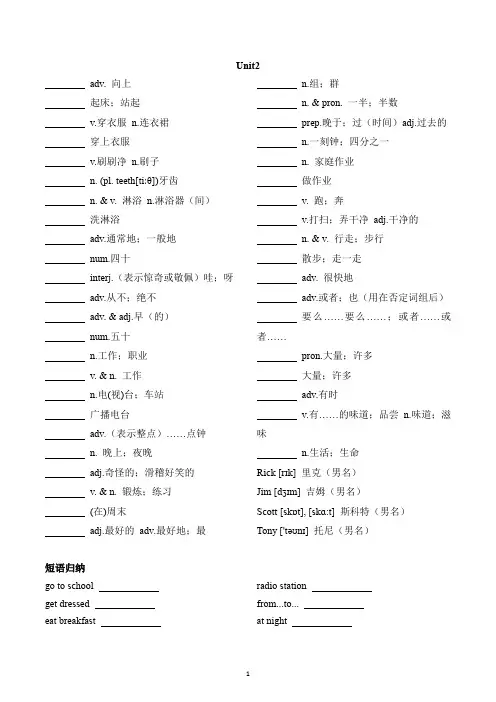
Unit2adv. 向上起床;站起v.穿衣服n.连衣裙穿上衣服v.刷刷净n.刷子n. (pl. teeth[tiːθ])牙齿n. & v. 淋浴n.淋浴器(间)洗淋浴adv.通常地;一般地num.四十interj.(表示惊奇或敬佩)哇;呀adv.从不;绝不adv. & adj.早(的)num.五十n.工作;职业v. & n. 工作n.电(视)台;车站广播电台adv.(表示整点)……点钟n. 晚上;夜晚adj.奇怪的;滑稽好笑的v. & n. 锻炼;练习(在)周末adj.最好的adv.最好地;最n.组;群n. & pron. 一半;半数prep.晚于;过(时间)adj.过去的n.一刻钟;四分之一n. 家庭作业做作业v. 跑;奔v.打扫;弄干净adj.干净的n. & v. 行走;步行散步;走一走adv. 很快地adv.或者;也(用在否定词组后)要么……要么……;或者……或者……pron.大量;许多大量;许多adv.有时v.有……的味道;品尝n.味道;滋味n.生活;生命Rick [rɪk] 里克(男名)Jim [dʒɪm] 吉姆(男名)Scott [skɒt], [skɑ:t] 斯科特(男名)Tony ['təʊnɪ] 托尼(男名)短语归纳go to school get dressed eat breakfast radio station from...to... at nighton weekendsfrom Monday to Friday in the afternoonhave a good jobgo homeplay sportshave much timebe good forafter schoolhave a healthy life either ... or ....get upbrush one’s teeth take a showerradio showgo to workbe late forin the morningdo one’s homework go to bedclean my roomtake a walkplay computer games lots ofhalf an hour用法总结1.询问在几点做某事What time do/does sb do sth...? 某人几点做某事?When do/does sb do sth..? 某人什么时候做某事?2.表达某人从不做某事Sb never do / does sth 某人从不做某事3.关于时刻的表达At + 具体时间点在几点Half past+基数词....点半A quarter past + 基数词...点一刻 A quarter to + 基数词差一刻到...点4.系动词taste用法:sth taste(s) + adj. 某物尝起来....5.always, often, usually, sometimes, never词汇梳理Tooth n. 牙齿→teeth(复数)Early adv. 早的→(反义词)Late adv.adj晚的Funny adj. 奇怪的,滑稽好笑的→Fun n. 娱乐,快乐Half n.pron 一半,半数→(复数)halvesClean v. 打扫,弄干净adj. 干净的→cleaner n.清洁工Life n. 生活,生命→(复数)livesWe want to go to Hainan ______(在某一时候).I play basketball with my friends ______(有时).My father goes to Beijing ______ ______(好几次)a year.写作:根据下面日程表的内容,以“My school day”为题,写一篇不少于60词的短文。
人教版英语七年级下册Unit2复习学案(无答案)

第二讲Unit 2 What time do you go to school? 【学习目标】1. 能够熟练地谈论关于日常安排的话题。
2.能掌握并运用关于时间表达和日常活动的短语。
3.能够灵活运用本单元的重点句型和语法点。
【知识梳理】1.请写出你知道的频率副词:(至少3个)2.请写出表达时间的短语:(至少5个)3.请写出关于起居的短语:(至少5个)4.请写出关于饮食就餐的短语:(至少3个)5.请写出关于运动的短语:(至少3个)6.请写出其他日常活动的短语:(至少3个)7.请写出谈论日常活动的问句和答句:(至少2组,用不同的人称)一.新课内容(一)知识点知识点2:重点语法1. get dressed►He can’t dress himself.►I usually dress my daughter before I go to work.【拓展】辨析wear, put on和dress2. From twelve o’clock at night to six o’clock in th e morning.►How far is it from your office to the bank?►We work from morning to night.3.At eleven o’clock, so I’m never late for work.►I’ll ____________(be) late for the meeting.我将开会迟到了。
►Please __________(not) be late for school.请上学不要迟到。
4. In our group, Li Fei usually gets up late on weekends.►My group has some good players.►A group of girls are cleaning the room.5. …so I usually eat very quickly.►The dog runs quickly.►Don’t eat quickly. It’s not a good habit.【拓展】quick adj.快的;迅速的。
人教版七年级英语下册导学案 Unit 4-2
Unit 4 第 2 课 时 英语
课型 班级
新授
编号
4-2Βιβλιοθήκη 七年级 领导签字执笔人
使用人 1、学习掌握本节课的生词和短语; 2、巩固祈使句的用法;
使用时间
学习目标 3、学习情态动词 can 表示许可的肯定句、否定句、一般疑问句及 肯定、否定回答。
4、提高学生的听说能力。 学习重 学习情态动词 can 表示许可的肯定句、否定句、一般疑问句及肯 点、难点 定、否定回答。
课时安排
1 课时
自主预习 翻译 1. eat outside ________________ 2. wear a hat ___________________ 3. a lot of ___________________ 4. be late for class_______________ 5. 不得不 __________________6. 穿校服_____________________ 7. 保持安静 ________________
知识探究
动词 ca n 的用法 (1)表示能力,"会""能" I can dance and sing. 我能唱歌又能跳舞。 (2)表示允许、许可,"可以"、"能" Can the students run in the hallways? 学生们可以在走廊上跑吗? We can eat outside. 我们可以在外面吃东西。Can I come in? 我能进 来吗?问句中,把 can 放到主语前面,并且没有人称和数的变 化。
C. be late for
( ) 3. There are ________ rules in our school.
人教版七年级下册Unit2精学精练(无答案)
U2元复默写复要点短1. 几点2.去上学3.早起床4. 洗淋浴5.刷牙6.抵达7.做家庭作8. 去上班9. 回家10. 吃早11.穿上衣服12. 到家13.要么⋯要么⋯;不是⋯就是⋯14.上床睡15.在上午 / 下午 / 夜晚16.漫步 ,走一走17.多,大批18.广播台19.在夜晚20.到21. 在周末22.上学期23.半小24. 需要做某事25.吃 ...作早午晚饭26.造作 / 家27.风趣 n28 风趣的 adj29.从哪里到哪里30.v&n31.我最好的朋友32.没有太多33.有足的精力34 一刻, 15分35. 很快地, adv36.有37.上学日38. 午饭此后要点句型1.你往常什么时间起床?我往常在六点三十分起床。
2.斯科特什么时候上班? .他老是七点去上班。
他从没晚过。
3.那个时间吃早餐真存心思哟。
4.你的朋友何时锻炼身体 ?他们往常在周末锻炼。
5.他们往常在夜晚差一刻七点吃晚饭。
6.安娜素来不吃早餐。
7.到家后,我老是先造作业。
8.下学后,我有时打半个小时篮球。
9.夜晚,我要么看电视要么玩电脑。
10.在十二点,她午饭吃很多水果和蔬菜。
11.她知道它(冰淇淋)对她不好,但它尝起来好吃。
短语复习翻译题1.电视节目从夜晚7 点到 8 点。
The TV show is at night.2.汤姆老是上班迟到。
Tom work.3.我每日吃大批的水果和蔬菜。
I have fruit and vegetables every day.4.当我弟弟和妹妹到家,他们先做家庭作业。
When my brother and sister,they first.5.在礼拜天 ,她要么看书 ,要么看电视。
On Sunday, she reads books watches TV.6.蒂娜从不在周末锻炼。
Tina on weekends.7.我弟弟在6:45 穿衣服。
My brother at 6:45.8.此刻是三点四十五分。
人教版七年级英语下册2导学案(第4课时)
精品"正版〞资料系列,由本公司独创 .旨在将"人教版〞、〞苏教版"、〞北师大版"、〞华师大版"等涵盖几乎所有版本的教材教案、课件、导学案及同步练习和检测题分享给需要的朋友 .本资源创作于2021年8月,是当前最||新版本的教材资源 .包含本课对应内容,是您备课、上课、课后练习以及寒暑假预习的最||正确选择 .七年级|| (下) 英语导学案主备人:授课时间:月日至|| 月日1. 根据汉语写单词、短语一半、半数晚于;过(时间) 一刻钟家庭作业做作业奔、跑清扫、弄干净行走、步行散步;走走2.翻译以下句子.1. Tom一般几点起床?他一般4点15起床.What time _____ Tom ______ _____ up?He usually ____ ______ _____ 4:15 .2. 人们一般都什么时候吃晚饭?一般在晚上吃.What time ____ people usually _______ ________ ?People usually ____ ______ in ____ ______.3. 你经常几点吃早饭?What time _____ _____ ______ ______ _______?4. 你的哥哥几点淋浴?他经常在七点淋浴.___________________________________________________4.我姑姑喜欢在中午一点吃午餐.My _______ likes ________ dinner _______ 1:00.【合作学习】1.小组代表向全班同学展示调查结果,其他同学评价.[来源:]2. 独立完成1a 将行为与时间匹配.3. 1b, 两人一组,利用1a中的短语,练习对话,并小组竞争,展示成果.4. 听录音,完成活动1c,1d,组内检查.[来源学&科&网]5.熟读并掌握这些表示日常活动的动词和动词词组 .6. 两人一组,对Tom一天的活动情况进行问答练习. 【拓展提高】时间表达法1.整点法: 时间为整点时,可用"整点数+o ,clock〞表示. o ,clock只能用在表示整点的时间后面,也可省略.It ,s five o ,clock. /It ,s five.现在五点整. ( )1. He is one of my friends. A. good B. better C. best D. well( )2. He up at six o ,clock.A. get usuallyB. usually goesC. usually getD. usually gets( )3. My father always goes to bed 10 o ,clock ______ night.A. at, atB. in, atC. on, /D. at, /[来源学#科#网]三.用所给动词的适当形式填空.1. Alice often ( go ) to school at seven -fifteen.2. What time her father (get)home ?3. she wants (brush)her teeth.4. When your uncle often (start)his work?5. Some students (play)sports every day.完形填空Tom is a student of No.2 Middle School .He has classes 1Monday to Friday .He has 2 things to do after school. First he 3his homework at home at 6:30. He watches TV 4 the evening .On Friday afternoon he plays 5 football 6 his friends. OnSunday he 7 a good rest .Now it ,s 8:30 in the morning . Tom 8 in the classroom and 9 tothe teacher carefully(认真地). He is a good student. He 10 veryhard.反思:本课教学反思英语教案注重培养学生听、说、读、写四方面技能以及这四种技能综合运用的能力.写作是综合性较强的语言运用形式, 它与其它技能在语言学习中相辅相成、相互促进.因此, 写作教案具有重要地位.然而, 当前的写作教案存在" 重结果轻过程〞的问题, 教师和学生都把写作的重点放在习作的评价和语法错误的订正上,无视了语言的输入.这个话题很容易引起学生的共鸣,比较贴近生活,能激发学生的兴趣, 在教授知识的同时,应注意将本单元情感目标融入其中,即保持乐观积极的生活态度,同时要珍惜生活的点点滴滴.在教授语法时,应注重通过例句的讲解让语法概念深入人心,因直接引语和间接引语的概念相当于一个简单的定语从句,一个清晰的脉络能为后续学习打下根底.此教案设计为一个课时,主要将安妮的处境以及她的精神做一个简要概括,下一个课时那么对语法知识进行讲解.在此教案过程中,应注重培养学生的自学能力,通过辅导学生掌握一套科学的学习方法,才能使学生的学习积极性进一步提高.再者,培养学生的学习兴趣,增强教案效果,才能防止在以后的学习中产生两极分化.在教案中任然存在的问题是,学生在"说〞英语这个环节还有待提高,大局部学生都不愿意开口朗读课文,所以复述课文便尚有难度,对于这一局部学生的学习成绩的提高还有待研究.本资源的初衷,是希望通过网络分享,能够为广阔读者提供更好的效劳,为您水平的提高提供坚强的动力和保证 .内容由一线名师原创,立意新,图片精,是非常强的一手资料 .本课教学反思本节课主要采用过程教案法训练学生的听说读写.过程教案法的理论根底是交际理论,认为写作的过程实质上是一种群体间的交际活动,而不是写作者的个人行为.它包括写前阶段,写作阶段和写后修改编辑阶段.在此过程中,教师是教练,及时给予学生指导,更正其错误,帮助学生完成写作各阶段任务.课堂是写作车间, 学生与教师, 学生与学生彼此交流, 提出反响或修改意见, 学生不断进行写作, 修改和再写作.在应用过程教案法对学生进行写作训练时, 学生从没有想法到有想法, 从不会构思到会构思, 从不会修改到会修改, 这一过程有利于培养学生的写作能力和自主学习能力.学生由于能得到教师的及时帮助和指导,所以,即使是英语根底薄弱的同学,也能在这样的环境下,写出较好的作文来,从而提高了学生写作兴趣,增强了写作的自信心.这个话题很容易引起学生的共鸣,比较贴近生活,能激发学生的兴趣, 在教授知识的同时,应注意将本单元情感目标融入其中,即保持乐观积极的生活态度,同时要珍惜生活的点点滴滴.在教授语法时,应注重通过例句的讲解让语法概念深入人心,因直接引语和间接引语的概念相当于一个简单的定语从句,一个清晰的脉络能为后续学习打下根底.此教案设计为一个课时,主要将安妮的处境以及她的精神做一个简要概括,下一个课时那么对语法知识进行讲解.在此教案过程中,应注重培养学生的自学能力,通过辅导学生掌握一套科学的学习方法,才能使学生的学习积极性进一步提高.再者,培养学生的学习兴趣,增强教案效果,才能防止在以后的学习中产生两极分化.在教案中任然存在的问题是,学生在"说〞英语这个环节还有待提高,大局部学生都不愿意开口朗读课文,所以复述课文便尚有难度,对于这一局部学生的学习成绩的提高还有待研究.。
2019-2020学年七年级英语下册 Unit 2 What time do you go to school知识点总结+导学案(新版)人教新目标版
2019-2020学年七年级英语下册 Unit 2 What time do you go to school知识点总结+导学案(新版)人教新目标版学习目标:1.熟练读出书写本节课的表示活动的单词。
2.学会询问时间的句型,熟练的谈论表示时间的话题。
重难点:what time/when 引导的特殊疑问句;频率副词的用法。
情感目标:通过询问和谈论彼此的作息习惯,培养良好的学习习惯。
学习过程:Ⅰ.【课前热身】预习效果检测: 默写下列短语。
去上学起床跑步吃早餐洗澡通常几点,什么时候穿上衣服刷牙Ⅱ.【自主学习】1.给图片找到对应的短语 1a2.听录音完成下列部分1b,2a,2bⅢ.【合作学习】与同伴练习1b中的对话Ⅳ.【拓展提升】根据1b,2b部分创编新对话, 完成1c,2c对话表演。
Ⅴ.【答疑解惑】针对本课提出困惑的知识点或问题。
Ⅵ.【课堂小结】总结本课所学知识点。
Ⅶ.【达标检测】一、翻译句子。
1.你通常几点钟起床?What _______ do you ________get ________?2.我通常在12:00吃午餐。
I ________ eat _______ ________12:00.3.你通常什么时候起床?______do you usually _____ ______?4.我通常6点钟起床。
I usually _____ _____at six______.5. 我从来不起这么早。
I _____get up so______.6. 他有一份有趣的工作。
He _____ an ______ job.备课人:7. 那是一个有趣的早餐时刻。
That’s a ____time ______ _______.8、It’s 7 o’clock.(对划线部分提问)______ ______ is it?9、Alicia takes a shower at 9:00 (对划线部分提问)______ _____ does Alicia ______ ___ ________?10、Jim gets up at 6:00 in the morning.(变成否定句)Jim _______ ____ ____ at 6:00 in the morning.11、他们总是在7:20穿衣服。