
人教版七年级英语上册教材思维导图及典型试题每课一练unit3
Unit 3 Is this your pencil?
一、思维导图
重点单词:pencil,book,eraser,box,schoolbag,dictionary,notebook,
baseball,watch,computer,game,card,ring,bag,
his,mine,hers,yours,
excuse,me,thank,for,help,welcome,
teacher,about,in,library,ask,find,some,classroom,e-mail,
at,call,lost,must,set
重点短语:pencil box, excuse me, what about, thank you for…,
ID card, ask…for…, a set of…, computer game,
call…at…
核心句型:1、--Is this your pencil?
--Yes,it is.It’s mine./No,it isn’t.It’s hers.
2、--Is that your schoolbag?
--No,it isn’t.It’s his.
3、--Are these your books?
--Yes,they are./No,they aren’t.They are hers.
4、--How do you spell it?
--W-A-T-C-H.
5、Call me at 685-6034.
重点语法:1、名词性物主代词mine,yours,his,hers的用法。
2、含有be动词的一般疑问句的用法。
交际话题:谈论教室里的物品,确认物主关系
文化知识:1、了解英语致谢及回答小常识
2、了解电子邮件基本知识
3、了解失物招领小常识
二、重点难点:
一般疑问句:
1、一般疑问句的一种形式是将be动词提到句首,其结构是:Be+主语+其他成分?肯定回答用:Yes,主语(代词主格)+be.否定回答用:No,主语(代词主格)+be+not.其中be和not常用其缩略形式。
例如:
--Is he a student?
--No,he isn’t.
2、一般疑问句的另一种形式是:情态动词(或助动词do/does/did)+主语+动词原形+其他成分?肯定回答用:Yes,主语(代词主格)+情态动词(或助动词)。
否定回答用:No,主语(代词主格)+情态动词(或助动词)+not.其中情态动词(或助动词)和not常用其缩略形式。
例如:
--Can you swim?
--Yes,I can.
三、典型试题
1.---Is this his dictionary?
---No,_______.
A. it is
B.it isn’t
C. he isn’t
D. this isn’t
2.I like TFBOYS.How about you?(改为同义句)
I like TFBOYS._______ _______ you?
3.---Thank you for your help.
---_________.
A. OK
B.You are welcome
C. No
D. All right
4.---______ do you spell “eraser”?
---E-R-A-S-E-R.
A. What
B.How
C.Are
D.Who
5.---I’m not happy.I can’t_____my iPad.
---I can help you.
A. look
B. be
C. find
D. Lost
6.I found a schoolbag in the library.Please e-mail me _____ mary@.
A.for
B.of
C.at
D.in
四、教学思路
Section A 1a-1c
本课的内容比较贴近学生生活的实际,教学中可充分利用学生活泼好动的特点,设计以下思路:
思路一:通过展示学生的学习用品来学习重点词汇,完成活动1a,并学习本课的目标语言。
思路二:听力训练运用任务型教学,帮助学生为对话编号,从中学习句型“Is this/that…? Yes, it is./No, it isn’t. Are these your…? Yes, they are./No, they aren’t.”来确认物品的主人。
Section A 2a-3c
本节课主要是对上一节课的复习与巩固;通过上一节课的小组表演等活动,
学生对知识点已有所把握,但是仍然需要练习;为此,可以设计以下思路:思路一:训练听力:询问学生自己的学习用品以进一步巩固所学句型。
思路二:通过归纳本单元的目标语言,让学生学会整合知识的学习方法。
Section B 1a-2c
这一部分实用性比较强,学起来比较枯燥,可用调查或游戏的方法加深学生
对内容的理解。
思路就是学生相互调查他们曾经丢失过或捡到过的物品,分组讨论他们是如何处理的,如何写寻物启事或招领启示。
人教版七年级英语上册教材思维导图及典型试题每课一练unit 4

Unit 4 Where’s my schoolbag?一、思维导图重点单词:room,table,bed,sofa,chair,desk,hat,radio,clock,tape,headplayer,model,planetheir,ourwhere,everywhere,under,come,think,know,tiny,but,always 重点短语:on the sofa, under the table, in your schoolbag,come on,in the bookcase, modle plane, tape player, on the floor 核心句型:1.---Where’s the schoolbag?---It’s under the table.2.---Where are my books?---They’re on the sofa.3.I’m tidy,but Gina is not.4.Gina’s books are everywhere—on her bed,on the sofa andunder the chair.重点语法:1.where引导的特殊疑问句2.介词on,in,under的用法3.连词and的用法交际话题:谈论房间里的物品,能够询问并描述物品的位置文化知识:了解物品摆放规则,养成良好的生活习惯二、重点难点and的用法1.and意为“和;又”,用来连接两个语法作用相同的句子成分。
这两个成分可以是单词、短语或分句。
例如:John and Tom are our good friends.2.用and连接两个以上的词语,通常把and放在最后一个词语前面;把词语连接起来时,通常把较短的词语放在前面。
例如:I like rice,apples,oranges and milk.The apples are big and delicious.三、典型试题1.---_____is my computer games?---It’s in your drawer.A. WhatB. WhereC. HowD. How much2.---Is the cat_____the bed?---No, it isn’t. It’s_______the door.A. under;underB. on;inC. under;behindD. in;in3.---Is your name Fan Fan?---_______.A. Yes, it isB. No, I’m notC. Yes, I amD. No, it is4.---Whose cap is that?---It’s________.A. Daniels’B. Daniel’sC. DanielsD. Daniel5.Bill’s room is not tidy. His things are________.A. everywhereB. whereC. thereD. here四、教学思路Section A 1a-1c本课的内容是询问物品的位置,内容较简单,教学中可充分利用学生活泼好问的特点,设计以下思路:思路一:让学生以合作交流的学习方式,完成活动1a,来学习本课的重点词汇。
2013七年级上英语starterunit3Whatcolorisit增加了思维导图

色,左上方为英国国旗,右边有四颗镶白边的红色
五角星,四颗星排列均不对称。新西兰是英联邦成
员国,“米”字图案表明同英国的传统关系;四颗
星表示南十字星座,表明该国位于南半球,同时还
8象/5/2征020 独立和希望。
72
加拿大国旗,为长方形,长宽之比为2:1。旗面自左至右由 红白两色组成,两边的红竖长方形代表太平洋和大西洋,白 色正方形代表的是加拿大广阔无垠的国土。中央绘有一片11个 角的红色枫树叶。枫树是加拿大的国树,红色枫叶象征生活 在加拿大富饶国土上辛勤努力的人民 。
8/5/2020
73
牙买加 (Jamaica)国旗,为长方形,长宽之比为2:1。旗面
上有两道交叉的黄色对角宽带,把旗面分成四个三角形,
上下为绿色,左右为黑色。黄色代表该国的自然资源和
阳光,黑色象征已经克服和即将面临的困难,绿色象征
希望和国家丰富的农业资源。
8/5/2020
74
中华人民共和国国旗,旗面为红色,象征革命.
CCTV= China Central Television
8/5/2020
61
网络聊天常用英语缩略词
BTW——By the way——随便说一下 CU——See you——再见 CUL——See you later——下次再会 FTF——Face to face——面对面 FYI——For your information——供参考 ILY——I love you——我爱你 TIA——Thanks in advance——十分感谢 TTUL——Talk to you later——以后再讲 TY——Thank you——谢谢 VG——Very good——很好
What color is it? It’s…
人教英语七上Unit 3 be动词现在时、一般疑问句专练
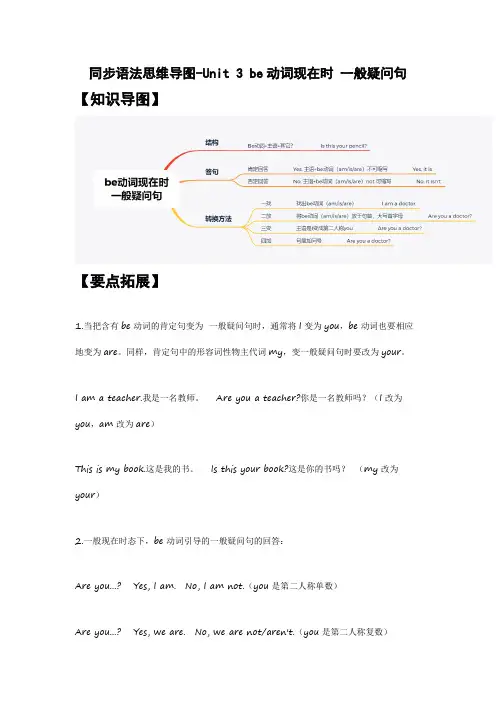
同步语法思维导图-Unit 3 be动词现在时一般疑问句【知识导图】【要点拓展】1.当把含有be动词的肯定句变为一般疑问句时,通常将I变为you,be动词也要相应地变为are。
同样,肯定句中的形容词性物主代词my,变一般疑问句时要改为your。
I am a teacher.我是一名教师。
Are you a teacher?你是一名教师吗?(I改为you,am改为are)This is my book.这是我的书。
Is this your book?这是你的书吗?(my改为your)2.一般现在时态下,be动词引导的一般疑问句的回答:Are you...?Yes, I am.No, I am not.(you是第二人称单数)Are you...?Yes, we are.No, we are not/aren't.(you是第二人称复数)Are they...?Yes, they are.No, they are not/aren't.Is she/he/it...?Yes, she/he/it is.No, she/he/it is not/isn't.Is this/that...?Yes, it is.No, it is not/isn't.Are these/those...?Yes, they are.No, they are not/aren't.【奇思巧计】含be句子变问句,把be提前没问题;yes和no要搞清,回答要用代词替;主语的数决定be,结尾定把问号记。
【同步检测】1.—________ you Li Fen?—No, I ________ not.【答案】Are am【解析】【分析】【详解】句意:——你是李芬吗?——不,我不是。
结合句意,表示是,用be动词,主语是you,be动词用are;主语是I,be动词用am,故填Are;am。
2.— ________ Mr. Green very busy?—Yes. He ________.【答案】Is is【解析】【详解】句意:——Green先生很忙吗?——是的,他很忙。
人教版(五四制)七年级上英语主题思维导图

语法篇-现在进行时
现在进行时
含义
用来描述现在正在发生的动作或存在的状态。
构成
be+现在分词
现在分词 的变化规律
直接在动词原形末尾加-ing 以不发音的字母e结尾的动词,去e加-ing 以重读闭音节结尾的从此,且词尾只有一个辅 音字母,双写再加-ing
looking making running stopping
A: What are you doing? B: I’m watching TV.
A: What’s she doing?
B: She’s washing her clothes.
A: Is he reading a newspaper?
B:Yes he is. / No, he isn’t. He’s playing basketball.
人教版(五四制)七年级上英语 各单元主题思维导图
人教版(五四制)七年级上英语
Unit1 Why do you like pandas?
单元主题思维导图
Talk about animals
Jenny: dog/cute Peter: pet Dingding smart Jenny: What can he do? Peter: walk on two legs dance Jenny: Wow! Peter: Does your family have a pet? Jenny: boring sleep all day Lazy Peter: a good name
A: Are they using the computer?
B: Yes, they are. / No, they aren’t. They’re exercising.
人教版七年级英语上册Unit3单元知识点总结及同步练习题附答案
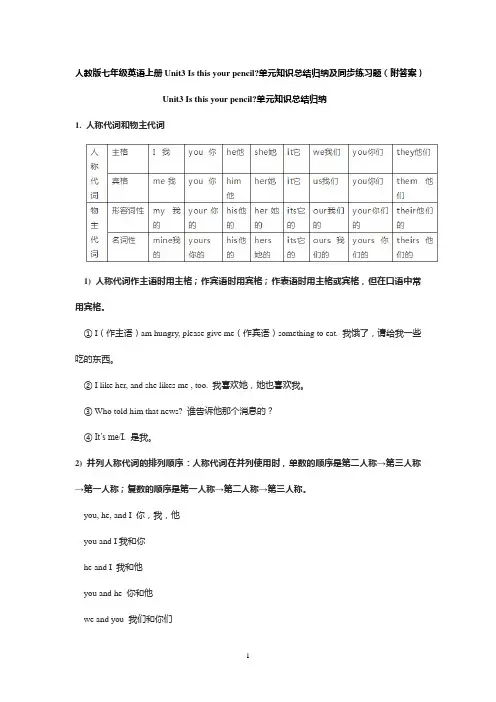
人教版七年级英语上册Unit3 Is this your pencil?单元知识总结归纳及同步练习题(附答案)Unit3 Is this your pencil?单元知识总结归纳1. 人称代词和物主代词1) 人称代词作主语时用主格;作宾语时用宾格;作表语时用主格或宾格,但在口语中常用宾格。
① I(作主语)am hungry, please give me(作宾语)something to eat. 我饿了,请给我一些吃的东西。
② I like her, and she likes me , too. 我喜欢她,她也喜欢我。
③ Who told him that news? 谁告诉他那个消息的?④It’s me/I. 是我。
2) 并列人称代词的排列顺序:人称代词在并列使用时,单数的顺序是第二人称→第三人称→第一人称;复数的顺序是第一人称→第二人称→第三人称。
you, he, and I 你,我,他you and I我和你he and I 我和他you and he 你和他we and you 我们和你们you and they 你们和他们we, you and they我们,你们和他们3) 形容词性物主代词修饰名词,必须放在名词前面,相当于形容词,在句中作定语。
名词性物主代词相当于名词(即指代名词,后面不能再加名词),在句中作主语、表语或宾语。
This is your ruler, it is not mine.这是你的尺子,不是我的。
2. Is this/that...? 这/那是......吗?Yes, it is. / No, it isn’t. 是的,这/那(它)是。
/ 不,这/那(它)不是。
回答时,要用it来代替this和that。
不可回答Yes, this/that is. / No, this/that isn’t.1)Is this your pencil ?这是你的铅笔吗?Yes, it is. It’s mine是的,它是我的(铅笔)。
初中英语《七年级上册Module 3 My School》单元教学设计以及思维导图
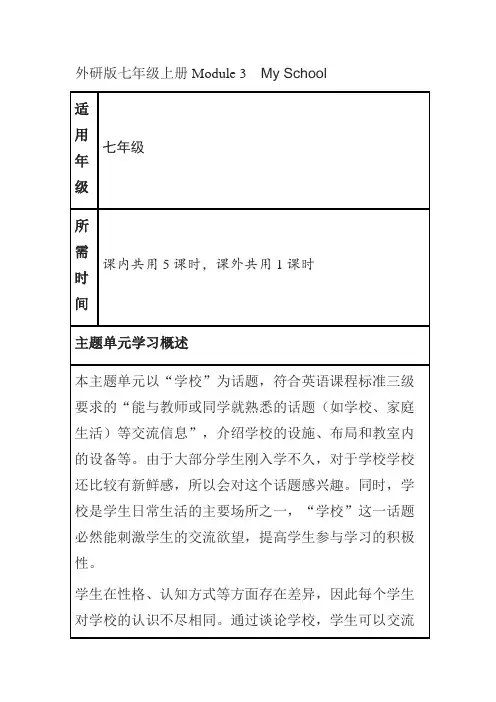
专题一: My Classroom ( 课内2 课时)
专题二: My School ( 课内2 课时)
专题三: Foreign Schools ( 课外2 课时)
其中,专题 三中的活动 around the world 作为研究性学习
专题一
首先通过图片练习了教室有关的词汇。对话情景是大明向琳达询问英国学校教室的样子,并对自己的教室做了一些介绍。最后谈论自己的教室和理想中的教室,并做绘画或ppt展示。
What are there in our classroom?
How many … are there in our classroom?
Is there a … in our classroom?
活动3:听对话录音回答问题:
How many students are there in Daming’s class?
What is my ideal classroom like?
评价要点
学生学习成果评价
1显示图片,学生能快速说出对应的单词。
2 学生能两人小组依据表格内容流畅问答。
3 学生能流畅的陈述教室内存在的物品和数量。
4 学生能绘制自己理想中的教室并讲述。
评价方法:教师口头评价学生互评学生组间评价教师评价小组
语言技能目标:
听:能听懂介绍学校的简短对话;
说:能利用“there be”句型介绍自己的班级和学校;
读:能通过描述判断出途中物体之间的位置关系;
写:能正确使用表示方位的介词来描述图中物体的位置关系;
运用:描述自己的学校内设施;
学习策略:
自学策略:能借助图片掌握单词;
合作学习策略:学会倾听,并在小组活动中充分发挥自己的作用。
人教版七年级英语上册教材思维导图及典型试题每课一练
Starter Unit 1 Good morning!一、思维导图重点单词:hi,hellogood,morning,afternoon,eveninghow,are,you,I,am,fine,OK核心句型:1.Good morning/afternoon/evening!2.--How are you?--I’m fine,thanks.How are you?--I’m OK.重点语法:1.感知am,are的用法2.感知人称代词I,you的用法交际话题:会见朋友,问候他人文化知识:了解缩略词HB,CD,BBC的含义二、重点难点--How are you?--I’m fine,thanks.(1)how可以用来询问身体健康状况,意思是“……(身体)好吗”。
例如:How are you? 你(身体)好吗?How is Hellen? 海伦(身体)好吗?常用答语为Fine,thank you./Very well./I’m fine./I’m OK./She’s fine./She’s OK.等。
(2)有时出于礼貌还要反问对方:How are you?或And you?(3)thanks相当于thank you,意为“谢谢”。
Thank you的语气较强。
当对方问候我们或为我们做某事时,或当对方称赞、夸奖我们时,我们要用Thanks./Thank you.作答。
例如:--Alice,you look beautiful today.--Thank you.三、典型试题1.---Good morning!---_________.A. HelloB. Good morningC. Thank youD. Good2.--Hello!-- .A.Good morning!B.How are you?C.Nice to meet you.D.Hello!3.---How are you?---_________.A. Fine, thanks.B. How are you?C. How do you do?D.Hello!。
人教版七年级英语上册教材思维导图及典型试题每课一练starterunit3
Starter Unit 3 What color is it?一、思维导图重点单词:color,red,yellow,green,blue,black,white,purple,brownthe,now,see,can,say,my重点短语:what color,black and white核心句型:1、--What color is it?--It’s black.2、The key is yellow.重点语法:1、what引导的询问颜色的特殊疑问句2、定冠词the的用法交际话题:谈论物品的颜色文化知识:了解缩略词S/M/L,UFO,CCTV的含义二、重点难点The key is yellow.这把钥匙是黄色的。
the是定冠词,表示“这(个),那(个),这些,那些”。
在辅音前读/e?/,元音前读/ei:/,它可以用在名词前,表示特指说话双方都知道的或复述上文中提到的人或事物。
例如:The TV in his room is new.(特指)Where is the teacher?(双方都知道)【拓展延伸】定义定冠词the有“这个;那个;这些;那些”之意。
用在名词前,表示特指某人或某物,以区别于同类中的其他人或物。
用法1.特指某些人(物)或者对话双方都知道的人或物。
例如:The bag is mine.2.上文已提到过的人或物。
例如:I can see a bike.The bike is black.3.世界上独一无二的事物前。
例如:We live on the earth.4.某些由普通名词构成的专有名词前。
例如:The People’s Republic of China is great.5.一些习惯短语和乐器前。
例如:The boy can play the piano.三、典型试题1.--What___is the apple?--It’s red.A. colorB. timeC. numberD. game2.--What color is your ruler?--___white.A. IsB. ItC. It’sD. It’s a。
2013七年级上英语starter_unit3 What_color_is_it增加了思维导图
Thing 物品
Color颜色
a jacket a quilt a pen
brown purple green
9/16/2013
70
Pair work
A: What’s this in English? B: It’s a key. A: Spell it, please. B: K-E-Y. A: What color is it? B: It’s yellow.
9/16/2013 74
中华人民共和国国旗,旗面为红色,象征革命. 长宽之比为3:2。国旗中的大五角星代表中 国共产党,四颗小五角星分别代表工人、农 民、小资产阶级和民族资产阶级四个阶级。 四颗小星各有一尖正对着大星的中心点,其 间的位置关系象征着中国共产党领导下的革 命人民大团结。五星采用黄色是为了在红地 9/16/2013 上显出光明,也表示中华民族为黄色人种。
72
加拿大国旗,为长方形,长宽之比为2:1。旗面自左至右由 红白两色组成,两边的红竖长方形代表太平洋和大西洋,白 色正方形代表的是加拿大广阔无垠的国土。中央绘有一片11个 角的红色枫树叶。枫树是加拿大的国树,红色枫叶象征生活 在加拿大富饶国土上辛勤努力的人民 。
9/16/2013 73
牙买加 (Jamaica)国旗,为长方形,长宽之比为2:1。旗面 上有两道交叉的黄色对角宽带,把旗面分成四个三角形, 上下为绿色,左右为黑色。黄色代表该国的自然资源和 阳光,黑色象征已经克服和即将面临的困难,绿色象征 希望和国家丰富的农业资源。
What color is it? It’s It’s an apple. It’s a green apple.
9/16/2013
It’s green.
41
七年级上册英语第三单元思维导。
七年级上册英语第三单元思维导。
全文共3篇示例,供读者参考篇1Unit 3 Thinking GuideHey everyone! It's me again, your friendly neighborhood 7th grader, here to give you all the insider info on Unit 3 of our English textbook. Get ready, because this one is a doozy!The big concepts we're covering this unit are natural disasters, emergency preparedness, and environmental protection. I know, I know, it sounds super heavy and serious. But trust me, the readings and activities are actually pretty interesting once you get into them.We started off by learning all about different types of natural disasters like earthquakes, tsunamis, hurricanes, tornadoes, and volcanic eruptions. I have to admit, some of the details and statistics were kind of scary. Did you know that the 2004 Indian Ocean tsunami killed over 230,000 people across 14 countries? Insane!But we also learned about how communities can prepare for and respond to these disasters through early warning systems,evacuation plans, emergency shelters, and international relief efforts. It was really inspiring reading about how people come together to help each other in times of crisis.From there, we pivoted to discussing the environmental impacts of natural disasters and human activities. This was definitely the part that made me feel most guilty. Between deforestation, pollution, overfishing, and fossil fuel consumption, it's kind of amazing there are any healthy ecosystems left on the planet. The Amazon rainforest is getting demolished at an alarming rate, and if we don't get our act together soon, tons of plant and animal species could go extinct.The good news is we talked about potential solutions too, like renewable energy, sustainable agriculture, recycling initiatives, and protecting habitats. Our teacher had us do a really cool project where we had to research an environmental organization and present on their mission and key programs. I picked the World Wildlife Fund because I'm lowkey obsessed with pandas.Throughout the whole unit, we practiced key language skills around describing events, expressing opinions, making predictions, and proposing solutions. There were tons of great discussion questions that really made us think critically. Like,"What do you think is the biggest threat facing the environment today and why?" Or, "If you were the leader of your country, what policies would you implement to improve disaster preparedness?"In terms of vocabulary, we learned words related to natural phenomena (avalanche, drought, tidal wave), environmental protection (biodegradable, compost, deforestation), and emergency response (evacuate, relief supplies, search and rescue). My favorite new word was "anthropogenic" which means caused by human activity. It's fun to throw that one out to sound super smart.As for grammar, the main focus was on conditionals (if this happens, then that will occur), passives (the forest was destroyed by the wildfire), and giving advice with modals like should, ought to, had better (We should reduce our carbon footprint. You had better listen to the evacuation orders).Overall, I'd say Unit 3 really opened my eyes to the high stakes and urgency around the climate crisis and natural disasters. It was definitely a little scary at times, but also motivating. If we all do our part and make sustainable choices, we can absolutely turn things around and create a safer, greener world. Reduce, reuse, recycle, am I right?Now I just have to stop procrastinating and actually do something about it...one step at a time, I guess! Let me know if you need any tips for nailing the Unit 3 test. I'm always happy to help a friend out. For now, I'm outta here - time to go pick up all those wrappers I left on the floor. Baby steps!篇2Unit 3 – A Diligent LifeI have to admit, when I first looked at the title of Unit 3 in our 7th grade English textbook – "A Diligent Life" – I wasn't exactly thrilled. It sounded kind of boring, to be honest. But as I started reading through the unit, I realized there was actually a lot of interesting stuff in there about hard work, perseverance, and following your dreams.The unit kicks off with a reading passage about Terry Fox, a young Canadian who lost his leg to cancer as a teenager. Even after having his leg amputated, Terry was determined to run across Canada to raise money for cancer research. The passage describes how he ran over 3,000 miles across Canada on his prosthetic leg before his cancer spread and he had to abandon the run. I have to say, Terry's story really inspired me. It made merealize that no matter what obstacles you face in life, you can overcome them if you have enough grit and tenacity.After the Terry Fox passage, there are some dialogues and exercises that focus on using modal verbs like "can," "could," "should," and "have to" correctly. I struggled a bit with these at first, but my English teacher went through lots of examples and I finally got the hang of it. Using modals properly is key for expressing ability, permission, obligation and so on.The next reading was about an American kid named Joshua Williams who started his own business at age 9, making creative bowties. Joshua overcame a tough family situation through his hard work and entrepreneurial spirit. His story teaches the importance of being diligent and seizing opportunities. After this reading, we practiced using phrases like "no matter what/how" and "even if/though" which are really useful for conceding a point but then stating the main idea.My favorite part of the unit, though, was the section on Dr. Govindappa Venkataswamy, a retired Indian eye doctor who made it his mission to help cure preventable blindness in India. Dr. V (as he was known) performed endless numbers of eye surgeries and set up hospitals specifically for poorer populations who couldn't afford treatment. What an amazing guy! Thepassage about his work in India and the U.S. was really fascinating. We had some hard vocabulary to learn, like "intraocular" and "corneal transplant," but it was worth it to understand his pioneering work.Along with Dr. V's story, this part of the unit had us focusing on using parallel structure in sentences. Parallel structure just means using the same grammatical structure to express similar ideas. Like "He worked diligently, treated patients fairly, and never gave up his mission." See how all those verbs follow the same structure? Parallelism makes your writing sound much more organized and polished.After learning about these inspiring individuals, the unit moved on to discussing more philosophical questions about the value of hard work and a diligent mindset. We read an essay arguing that too much emphasis is placed on natural talent rather than diligence. The author made the point that innate talent will only get you so far - it's the people who outwork others and persevere who end up being the most successful. I tended to agree with this viewpoint, but we had a great class debate about it!To practice argumentative writing, our assignment was to write a five-paragraph persuasive essay on whether we valuednatural talent or a diligent work ethic more in achieving goals. I decided to argue the diligence side, using examples from the unit like Terry Fox and Dr. V to support my points about how far diligence and perseverance can take you. Let me tell you, writing a whole essay arguing a position was not easy! But it really helped solidify my understanding of the unit's themes.The last few sections focused on developing our listening and speaking skills related to diligence and hard work. We watched interviews with successful entrepreneurs and students where we had to distinguish factual claims from opinions. We also practiced discussing and debating strategies for overcoming obstacles through diligence.For the unit test, we had to write a biographical narrative about someone we considered diligent, making sure to use parallel structure and modals accurately. We also had to explain an inspiring quote about hard work that we chose. I picked a quote from Dr. V that went something like "The more diligent you are today, the luckier you get tomorrow." Powerful stuff!Overall, I have to say that this unit really shifted my perspective. At first I thought it would be super dry, but learning about people like Terry Fox, Joshua Williams, and Dr. V showed me the incredible power of perseverance, hard work, and anunwavering spirit. Their stories motivated me to be more diligent in pursuing my own goals and dreams.The readings and activities also taught me some crucial language skills - how to use modals, parallel structure, concession phrases, and argumentative techniques effectively. While some of the exercises were challenging, sticking with them diligently (see what I did there?) really paid off. I feel like my English fundamentals, as well as my ability to express and defend my ideas, improved a ton.So thanks, Unit 3, for opening my eyes to what diligence and perseverance can achieve. You turned out to be not just inspiring, but full of valuable language practice. I have a feeling the lessons from this unit will stick with me well beyond 7th grade. Now if you'll excuse me, I've got some diligent study sessions calling my name!篇3Unit 3: A Brighter FutureEnglish has always been a subject that has challenged me. All those grammar rules, vocabulary words, and strange pronunciations can make it seem like an uphill battle at times. However, Unit 3 in our 7th grade English textbook was different.The theme of "A Brighter Future" resonated with me in a way previous units hadn't. Perhaps it was the hopefulness and optimism of looking ahead, or maybe it was a recognition that the skills I'm developing now will shape the possibilities awaiting me down the road. Whatever the reason, I found myself unusually engaged with the readings, discussions, and activities we explored.The unit began with a short story called "The Inventor's Dream." It told the tale of a young girl named Maya who longed to create something that could improve people's lives. Despite facing skepticism and setbacks, Maya persevered until her invention – a low-cost water purification system – became a reality. Her unwavering determination and belief in herself were inspiring. The story made me think about the role innovation plays in creating a brighter future and how one person's ideas really can change the world.We had some fascinating classroom conversations stemming from Maya's story. Our teacher asked us to explore where great ideas come from and what qualities allow some people to turn their visions into realities when others may give up. Students offered examples of famous inventors like Thomas Edison and hypothetical scenarios where creativity andpersistence paid off. I'll admit my hand didn't go up too often, but I found myself pondering those questions long after class ended.The readings that followed exemplified how human ingenuity has consistently reshaped our world, from the industrial revolution and assembly lines to modern advances in renewable energy, artificial intelligence, and workspace automation. We discussed potential careers that don't even exist yet and how today's technologies may be laughably obsolete in 20 years. Those discussions awakened me to the mind-boggling pace of change and made me wonder what my own future might look like in an era of riddling unknowns.My favorite activity was when we formed small groups and envisioned future innovations that could help solve a global issue like hunger, disease, or climate change. My group tackled the environmental crisis and ended up proposing solar-powered drones that could re-seed deforested regions by firing seed missiles into areas decimated by wildfires or illegal logging. Was it a bit far-fetched? Sure. But the process of brainstorming, defending our concept, and considering real-world implications like that got me thinking more analytically and creatively.Looking back now, I realize what made this unit resonate with me wasn't just the futuristic subject matter. It was how the lessons, readings, and projects motivated me to envision possibilities rather than limits. They challenged me to be curious, to question assumptions, and to consider how the skills I'm developing today in English class could lead to unimagined future opportunities if I combine them with passion, hard work, and bold thinking. In that sense, this unit has prepared me for more than just academic success – it's given me a mental framework for approaching an uncertain future with a mindset of potential instead of doubts.Of course, not every day was an "aha" moment ofself-actualization. We still had to learn grammatical concepts like the future continuous tense and sentence structures for speculating about the future. We still struggled through vocabulary lists filled with words like "unprecedented" and "prospective." And we still spent time practicing writing skills like thesis statements and supporting evidence. In other words, it wasn't all philosophizing about human potential – sometimes it was just hard work.But even those nitty-gritty lessons on the building blocks of language started taking on new significance for me. I no longersaw them as isolated drills, but as tools that will allow me to communicate my ideas, ambitions and value more articulately and effectively. Mastering these skills became more than an academic obligation; it was an investment in my ability to engage with the world, process information critically, and share my perspective and proposals in a compelling way. After all, what good are brilliant innovations if you can't explain them or persuade people of their merits?So while I may not have all the answers about what the future holds, this unit has successfully prepared me to approach it with an empowered mindset, creative thinking abilities, and stronger communication skills. Perhaps most importantly, it has heightened my appreciation for how the habits, knowledge, and experiences I accumulate today – even those that seem mundane – will shape the brightest futures I can imagine for myself. As Maya demonstrated through her struggles and achievements, our dreams for a better world start with developing ourselves first. Unit 3 has motivated me to do just that.。